Disclosure: airfryerkitchensupply.com is reader-supported. When you buy through links on our site, we may earn an affiliate commission at no extra cost to you.
Where to buy
For readers comparing the best office chairs home office chairs, every chair below was cross-checked against the Amazon catalog data available to us, and each pick links straight to its Amazon listing so you can check the current price on Amazon and read the full specification sheet before you commit. If a chair is listed here, it is a complete chair sold as a complete chair — no parts, no add-ons dressed up as picks. Start with these links:
- Steelcase Gesture Office Chair (Graphite Gray) — Check the current price on Amazon
- HON Ignition 2.0 Ergonomic Office Chair — Check the current price on Amazon
- SIHOO M57 Ergonomic Office Chair (3D Armrests) — Check the current price on Amazon
- Marsail Ergonomic Office Chair (3D Armrests, Headrest) — Check the current price on Amazon
- SIHOO M18 Ergonomic Office Chair (Headrest) — Check the current price on Amazon
- Amazon Basics Low Back Office Chair (Mesh) — Check the current price on Amazon
The best office chairs home office chairs — the chairs that serve both the workplace office and the home office equally well — are the ones that survive both environments’ demands. An office chair must endure shared use, facilities managers and eight-hour days; a home office chair must do the same work in a room that also hosts guests, laundry and a life, bought with your own money and assembled on your own floor. The overlap is larger than the marketing suggests: support you can adjust, mesh or upholstery that suits the room’s temperature, a capacity with honest headroom, and a design that does not make a bedroom look like a call center. This guide’s six picks were chosen for that overlap, across the full range from a premium flagship to a compact budget chair.
Our method was the program’s standard one: every candidate was cross-checked through the site’s Amazon listing data access, and every feature quoted in these reviews — armrest types, lumbar systems, capacities, recline angles — is stated in the chair’s verified listing title. Where a title omits a specification, the review says so instead of filling the gap. Prices are never printed; check the current price on Amazon from each pick’s link, where the full specification table lives for your final verification.
The six span the realistic home-office market. Steelcase’s Gesture represents the premium, adjust-everything school. HON’s Ignition 2.0 is the institutional workhorse that home workers keep rediscovering. Two SIHOO models bring deep adjustability to mid and budget tiers, Marsail covers the contoured mesh middle, and Amazon Basics closes the list with the compact, inexpensive chair that has furnished more spare rooms than any flagship ever will. Somewhere in that spread is the chair your home office actually needs — the buying guide will help you find which.
Key Takeaways
- Match the tier to your hours: full-time use justifies the HON or the Gesture; mid-tiers (Marsail, SIHOO M18) cover mixed weeks; the Amazon Basics honestly serves occasional desks.
- Capacities stated in titles: 330 LBS / 330lbs on the SIHOO pair. Other picks require a check of the full listing — flagged in each review.
- Check the casters against your floor: one premium pick states carpet wheels, which on hard floors means a mat.
- Every chair here rewards a ten-minute setup and a week of tuning. An unadjusted ergonomic chair is just an expensive chair.
In this guide
Quick Picks
Steelcase Gesture Office Chair (Graphite Gray) — Best Premium: Steelcase’s flagship with arms designed to move like yours — the adjust-everything chair for home workers who sit all day and buy once. Check on Amazon
HON Ignition 2.0 Ergonomic Office Chair — Best Overall Value: The institutional workhorse: lumbar support and adjustable arms from the brand that furnishes actual offices, at a home-office price. Check on Amazon
SIHOO M57 Ergonomic Office Chair (3D Armrests) — Best Adjustability: A mesh chair with 3D armrests, an adjustable headrest and a stated 330 LBS capacity — flagship-style adjustment at a mid-market tier. Check on Amazon
Marsail Ergonomic Office Chair (3D Armrests, Headrest) — Best Mesh Comfort: A high-back mesh chair with adjustable lumbar, 3D armrests and a headrest — the contoured middle of the market, done completely. Check on Amazon
SIHOO M18 Ergonomic Office Chair (Headrest) — Best Budget Ergonomic: The value ergonomic formula: mesh back, headrest, adjustable lumbar, a wide cushion, tilt lock and a stated 330lbs — the most chair per dollar here. Check on Amazon
Amazon Basics Low Back Office Chair (Mesh) — Best Compact Budget: The spare-room staple: a low-back mesh chair with a padded seat, height adjustment and stated dimensions — simple, compact and honest about it. Check on Amazon
How These Picks Were Chosen
Selection began from the site’s verified catalog data with a generalist brief: complete desk chairs with lumbar support stated in the title, adjustable height, and a design brief compatible with home offices. We then deliberately spread the six across price tiers and philosophies — one premium, one institutional, two adjustable-value, one mid-range mesh, one budget compact — because a general guide that only recommends flagships serves nobody. Near-duplicate listings of the same chair in different colors were deduped to a single entry.
Capacities and mechanisms are quoted only as titles state them: you will find 330 LBS and 330lbs figures on the SIHOO picks, a 360-degree-arm design claim on the Gesture, and honest ‘not stated’ flags where titles are silent, including on the premium pick. Every chair here is a complete chair — no cushions, mats or accessories — and every one is a model a home worker can order, assemble and use without a facilities department. The reviews are written for the dual brief in the search: if a chair would embarrass itself in a corporate office or exhaust itself in a home one, that is said.
The 6 Best Office Chairs Home Office Chairs

Steelcase Gesture Office Chair (Graphite Gray) — Best Premium
The Gesture was designed around a study of how people actually sit now — not at attention before a single screen, but shifting between laptop, tablet, phone and paper, leaning, perching, turning to a second monitor. Its title highlights the signature feature: 360-degree arms, armrests designed to move in an arc like a human arm, supporting your elbows through postures a fixed arm cannot reach. For the home worker whose desk is also a reading chair, a call seat and a thinking perch, that arm freedom is the difference between a chair fitted to one posture and a chair fitted to a day.
The rest of the proposition is Steelcase’s usual one: a contoured back that supports through recline, adjustments intended to be found by hand without a manual, and build quality aimed at a decade of daily use. This listing is the Graphite Gray fabric version. In a home office, the Gesture’s real luxury is disappearance — after the first week’s tuning, it stops being an object you manage and becomes the place work happens, which is what premium money is supposed to buy.
The flags are price and one specification: this listing states wheels for carpet, so hard-floor homes should budget for a chair mat or check our laminate-floor guide before assuming compatibility. The title also does not state a numeric capacity, so confirm it on the full listing if that is a concern. Neither flag dents the recommendation for the buyer it suits: a full-time home worker amortizing one excellent chair across years of daily use.
Strengths
- 360-degree arms support the many postures of a real workday
- Premium build and adjustment design aimed at a decade of use
- Contoured support through recline suits mixed desk tasks
Trade-offs
- Premium price tier
- This listing states carpet wheels — hard floors need a mat
- Numeric capacity is not stated in the title
| Spec (as stated in the listing title) | Detail |
|---|---|
| Arms (title-stated) | 360-degree arms |
| Design (title-stated) | Ergonomic work chair, intuitive-to-adjust |
| Wheels (title-stated) | Wheels for carpet |
Best for: Full-time home workers buying a decade-long chair / Not suited for: Budget buyers; this listing states carpet-floor wheels
Check the current price on Amazon

HON Ignition 2.0 Ergonomic Office Chair — Best Overall Value
HON furnishes offices for a living, and the Ignition 2.0 is the chair that facilities managers buy by the hundred — which is precisely the recommendation for a home worker. A chair specified for workplaces must survive different bodies daily, adjust quickly between them, and not generate complaints; brought home, those same virtues serve one body extremely well for years. The title states the essentials without decoration: an ergonomic office desk chair with lumbar support and adjustable arms.
For the dual brief of this search, the Ignition is the most literal answer on the list — it is an office chair, currently sitting in real offices, that happens to be sold for home offices too. The adjustable arms and lumbar support cover the two fit points home workers most often get wrong with budget chairs, and the design is neutral enough to sit in a spare bedroom without announcing a cubicle. If your home office hosts clients or video calls, that professional neutrality is worth money by itself.
The trade-offs are the absence of flourish: the title states no headrest, no recline angle and no capacity figure, so those specifics live on the full listing, and buyers who want the deep feature lists of the SIHOO picks below should look there. The Ignition’s comfort is the tuned, supportive kind rather than the plush kind. As the value anchor of this guide — office-proven, home-appropriate, honestly specified — it is the chair we would hand to the undecided.
Strengths
- A genuine office line chair — proven under workplace duty
- Lumbar support and adjustable arms stated in the title
- Neutral professional design suits client-facing home offices
Trade-offs
- No headrest or recline angle stated in the title
- Capacity is not stated in the title — verify on the listing
- Supportive rather than plush feel
| Spec (as stated in the listing title) | Detail |
|---|---|
| Support (title-stated) | Lumbar support |
| Arms (title-stated) | Adjustable arms |
| Brief (title-stated) | Ergonomic office desk chair |
Best for: Home workers who want office-grade durability without flagship pricing / Not suited for: Buyers wanting a headrest or gaming-style features
Check the current price on Amazon

SIHOO M57 Ergonomic Office Chair (3D Armrests) — Best Adjustability
The SIHOO M57’s title reads like a flagship’s: an ergonomic mesh office chair with 3D armrests, lumbar support, an adjustable headrest, and a stated capacity of 330 LBS. The 3D armrests are the working feature — height, width and angle adjustment that lets a home worker place support under their elbows at a desk, then re-place it for a reclined call, the exact adaptability the Gesture sells at several times the tier. Paired with the adjustable headrest, the M57 covers both of editing’s and writing’s postures: forward and anchored, back and resting.
Mesh construction keeps the chair cool in the un-air-conditioned spare rooms where home offices actually live, and the stated capacity gives the purchase a checkable foundation that many mid-market listings omit. SIHOO has built its name on exactly this formula — specification density per dollar — and the M57 is the formula’s mature expression: nothing exotic, everything adjustable, all of it stated.
Mid-market honesty applies: the plastics and mechanisms will not match Steelcase’s decade-grade feel, and the title does not state a recline angle, so check the listing if that number matters to you. Assembly is also a real session with a chair this adjustable — budget the time and a second pair of hands for the backrest. For home workers who want maximum stated adjustability without premium pricing, the M57 is this guide’s sweet spot.
Strengths
- 3D armrests and adjustable headrest at a mid-market tier
- Capacity stated in the title (330 LBS)
- Mesh back suits warm home offices
Trade-offs
- Respect the 330 LBS ceiling
- Recline angle is not stated in the title
- Assembly is a longer job than simpler chairs
| Spec (as stated in the listing title) | Detail |
|---|---|
| Armrests (title-stated) | 3D armrests |
| Capacity (title-stated) | 330 LBS |
| Headrest (title-stated) | Adjustable headrest |
| Back (title-stated) | Mesh back |
Best for: Home workers who adjust everything and want it in writing / Not suited for: Users above the stated 330 LBS
Check the current price on Amazon

Marsail Ergonomic Office Chair (3D Armrests, Headrest) — Best Mesh Comfort
The Marsail occupies the center of this guide’s market and fills the position completely: its title states a high-back mesh design with adjustable lumbar support, 3D armrests and a headrest, in a rolling swivel task format. That is the full modern checklist — the features home workers most often discover they need in month two, present from day one. Adjustable lumbar, rather than a fixed pad, is the item to weight most heavily: it is the adjustment that decides whether a chair’s back support meets your back or merely occupies the same chair.
In home-office terms, the Marsail is the no-drama pick. Mesh for warm rooms, a high back for lean-back calls, arms that move three ways for desks of different heights, and a design neutral enough for a living-room corner. It asks nothing exotic of its buyer — no decade budget, no gaming aesthetic, no assembly heroics beyond the class norm — and that restraint is a genuine virtue in a generalist guide.
The flag is capacity: the title does not state one, and for a chair bought for years of daily use that number matters, so verify it on the full listing before ordering — if it is not published there, the SIHOO M57 states its 330 LBS outright and is the safer documented choice. Recline range is likewise unstated in the title. Within those checks, the Marsail is the balanced mesh recommendation of this guide.
Strengths
- Complete stated checklist: adjustable lumbar, 3D arms, headrest, high-back mesh
- Neutral design suits living-space home offices
- Rolling swivel task format fits standard desks
Trade-offs
- Weight capacity is not stated in the title
- Recline range is not stated in the title
- Mid-market materials will not match premium longevity
| Spec (as stated in the listing title) | Detail |
|---|---|
| Armrests (title-stated) | 3D armrests |
| Lumbar (title-stated) | Adjustable lumbar support |
| Back (title-stated) | High back mesh |
| Headrest (title-stated) | Headrest included |
Best for: Home workers who want a full mesh spec from one listing / Not suited for: Buyers who need a stated capacity in the title — there is none
Check the current price on Amazon

SIHOO M18 Ergonomic Office Chair (Headrest) — Best Budget Ergonomic
The M18 is the chair that made SIHOO’s reputation, and its title shows why: a mesh-back ergonomic chair with a headrest, adjustable lumbar support, a wide cushion, tilt lock, 2D armrests and a stated capacity of 330lbs. Read that list against the budget tier’s usual offering — a fixed pad, a prayer and no stated capacity — and the M18’s popularity explains itself. For a home worker furnishing a first real setup, this is the point where ergonomic features stop being premium extras.
The wide cushion deserves its mention: budget chairs skimp the seat first, and a wider, fuller cushion is what separates an eight-hour chair from a two-hour chair at this tier. Tilt lock adds the other budget rarity — the ability to fix a slight recline for reading rather than fighting a free rocker — and the mesh back keeps the whole proposition cool in small rooms. The headrest completes a specification that embarrasses chairs a tier above it.
The compromises are in the armrests and the ceiling. 2D arms adjust less completely than the M57’s 3D set — if your desk setup is fussy, that difference is worth the step up. The stated 330lbs capacity is a hard boundary, not a guideline. And at this tier, check your unit on arrival and use the returns window if anything feels off; consistency is the thing value manufacturing trades away. As the budget ergonomic benchmark, the M18 earns its place in any honest general guide.
Strengths
- Stated 330lbs capacity with adjustable lumbar and a headrest at a budget tier
- Wide cushion and tilt lock — rare at this level
- Mesh back suits small, warm rooms
Trade-offs
- 2D armrests adjust less than the M57’s 3D set
- Respect the stated capacity ceiling
- Value-tier consistency varies — inspect on arrival
| Spec (as stated in the listing title) | Detail |
|---|---|
| Capacity (title-stated) | 330lbs |
| Lumbar (title-stated) | Adjustable lumbar support |
| Seat (title-stated) | Wide cushion |
| Arms (title-stated) | 2D armrests |
Best for: Home workers equipping a real setup on a budget / Not suited for: Users who need more than 2D arm adjustment
Check the current price on Amazon
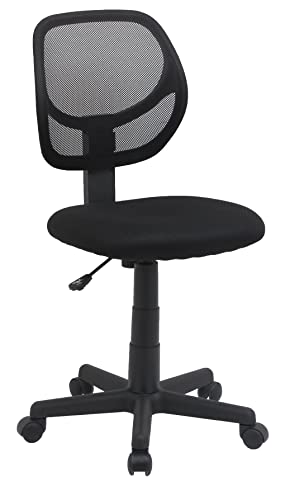
Amazon Basics Low Back Office Chair (Mesh) — Best Compact Budget
Not every home office is a full-time workplace. For the spare room used two days a week, the homework desk, the household’s second workstation, the Amazon Basics low-back chair is the rational purchase — and its title is a model of honesty, stating its dimensions outright: 21.25 inches deep, 22.5 wide, 38 high. A compact mesh chair with a padded seat, height adjustment, rolling wheels and swivel, from the most familiar value line in the catalog. It does not pretend to be an ergonomic system, and this guide will not pretend on its behalf.
Within its brief, the virtues are real. The low back and compact footprint tuck under desks and into corners where high-back chairs loom; the mesh back breathes; the padded seat is adequate for sessions of a few hours; and the whole chair can be assembled and in service faster than the premium picks can be unboxed. For households equipping two desks, a pair of these plus one proper ergonomic chair for the full-timer is a smarter allocation than two mediocre mid-tiers.
The limits must be respected, because they are the product: a low back offers no upper-back or head support, height is the only stated adjustment, and the title states no capacity and no lumbar mechanism. Used for full-time eight-hour days, this chair will make its economy felt in your shoulders by month two — the M18 exists precisely one tier up for that user. Judged as the compact, occasional-use, honest-budget pick, it completes this guide the way it has furnished a million spare rooms: adequately, cheaply and without lying about it.
Strengths
- Dimensions stated in the title — a compact footprint you can plan around
- Mesh back and padded seat suit occasional-use desks
- The value benchmark for second workstations and spare rooms
Trade-offs
- Low back — no upper-back, head or stated lumbar support
- Height is the only stated adjustment; capacity is not stated
- Not a full-time eight-hour chair
| Spec (as stated in the listing title) | Detail |
|---|---|
| Dimensions (title-stated) | 21.25″ D x 22.5″ W x 38″ H |
| Back (title-stated) | Breathable mesh, low back |
| Seat (title-stated) | Padded seat |
| Adjustment (title-stated) | Height adjustable |
Best for: Occasional home-office use, small desks, guest-room setups / Not suited for: Full-time eight-hour days — step up to the ergonomic picks
Check the current price on Amazon
Comparison Table
| Pick | Badge | Key spec | Best for |
|---|---|---|---|
| Steelcase Gesture Office Chair (Graphite Gray) | Best Premium | 360-degree arms (title-stated); contoured back support class design | Full-time home workers buying a decade-long chair |
| HON Ignition 2.0 Ergonomic Office Chair | Best Overall Value | Adjustable arms (title-stated); lumbar support; HON office line | Home workers who want office-grade durability without flagship pricing |
| SIHOO M57 Ergonomic Office Chair (3D Armrests) | Best Adjustability | 3D armrests (title-stated); 330 LBS capacity; adjustable headrest | Home workers who adjust everything and want it in writing |
| Marsail Ergonomic Office Chair (3D Armrests, Headrest) | Best Mesh Comfort | 3D armrests (title-stated); adjustable lumbar; headrest | Home workers who want a full mesh spec from one listing |
| SIHOO M18 Ergonomic Office Chair (Headrest) | Best Budget Ergonomic | 330lbs capacity (title-stated); adjustable lumbar; tilt lock; wide cushion | Home workers equipping a real setup on a budget |
| Amazon Basics Low Back Office Chair (Mesh) | Best Compact Budget | Low back mesh; padded seat; dimensions stated in title | Occasional home-office use, small desks, guest-room setups |
Office Chair vs Home Office Chair: Is There Actually a Difference?
Mostly, no — and understanding why helps you shop both markets. A chair does not know which building it is in. The differences that matter are contextual. In an office, chairs are shared, adjusted by strangers, cleaned by professionals and bought by people who will never sit in them; durability and quick adjustability dominate. At home, one person sits in the chair, in a room with a temperature and a style of its own, bought with personal money and expected to look acceptable next to a sofa. The best home office chairs are office chairs whose durability and adjustability survived the move, in finishes and footprints that respect a home.
Two home-specific factors deserve weight that office buyers ignore. The first is floor: offices have commercial carpet; homes have laminate, hardwood and rugs, and a chair’s casters matter — one pick in this guide states carpet wheels, which on a home’s hard floor means a mat or a different choice, a point our laminate guide covers fully. The second is thermal: offices are air-conditioned by professionals; home offices are spare bedrooms that run warm, which is why mesh dominates this guide’s middle. A leather executive chair in a July spare room is a decision you will re-make hourly.
The third factor is time horizon. A home worker buying their own chair should think in years per dollar, not price per purchase: a premium chair used daily for a decade is cheaper per year than a budget chair replaced three times, and considerably more comfortable in every one of those years. That arithmetic favors the Gesture and the HON for full-timers, the SIHOO pair for the value-conscious, and reserves the Amazon Basics for the genuinely occasional desk — each pick in this guide is the right answer to a different honest version of the question.
How to Choose: A Tier-by-Tier Walkthrough
Start with your hours, because hours choose the tier. Full-time, five days a week, long days: begin at the HON Ignition 2.0 and look upward — its office-proven durability is the floor of sensible full-time buying, the SIHOO M57 adds adjustment depth, and the Gesture is the buy-once answer. Three to four days a week or mixed desk-and-away work: the Marsail and the SIHOO M18 cover you completely, with the M18’s stated capacity and wide cushion making it the value standout. Occasional use — a day a week, homework, household admin: the Amazon Basics is not a compromise, it is the correct tool, and the money saved belongs in your monitor or your desk.
Then verify the fit facts on the full listing of your chosen tier: capacity with headroom above your weight (the SIHOO pair state 330; others here require checking), seat height range against your desk height and your legs, and arm adjustability if your desk is high or your shoulders are particular. Check the caster note if your floor is hard. Confirm the recline and headrest situation if you take calls leaning back. None of this takes long, and all of it is cheaper than a return.
Finally, assemble and tune like you mean it. Every chair in this guide rewards a first week of adjustment — seat height, lumbar position, arm placement, tilt tension — and punishes the set-it-where-it-landed approach with a mediocre decade. The setup section below walks the order. A home office chair is the most-touched object in your working life; the hour spent fitting it is the best-paid hour of your year.
Buying for a Decade: Cost Per Year and What Actually Wears Out
Home workers buy chairs with their own money, so let us do the arithmetic the showrooms avoid. A chair’s real price is its cost divided by its years of comfortable service. By that measure the market inverts: a premium chair at flagship money that serves a decade of full-time days can cost less per year than a budget chair replaced every two years — and it is more comfortable in every one of those years, which is rather the point of buying it. The mid-tier exists because the arithmetic has a middle: chairs like the SIHOO pair and the Marsail deliver most of the flagship’s daily experience at a fraction of the decade cost, accepting shorter service and simpler materials as the trade.
What actually wears out, in order, is worth knowing before you choose your tier. Cushions go first — foam compresses permanently, fastest under heavier users and longest hours, which is why capacity headroom is a longevity feature and not just a fit one. Upholstery goes second: bonded leather surfaces crack at flex points, fabrics fade and pill, mesh — the exception — largely does not wear out at all, which is one reason mesh dominates this guide’s middle. Mechanisms go third: gas lifts sink, tilt locks loosen. A chair whose maker states capacities and sells into offices (the HON’s whole business) is implicitly warranting those components against workplace duty cycles, and that institutional heritage is a real, if unglamorous, predictor of home longevity.
The practical conclusion is a two-question test. How many hours a week will this chair truly work? And if it died in half the expected time, would replacing it sting or merely annoy? Full-time users for whom replacement would sting should buy up a tier — the decade arithmetic is on their side. Everyone else should buy their honest tier without guilt: a correctly tiered chair, fitted properly and used for the hours it was bought for, is not a compromise. It is the market working as it should.
Assembly Day and the First Week: A Realistic Diary
Day zero is assembly, and it deserves more respect than the hour you were planning to give it. Clear the room’s center, lay the parts on a rug or the flattened box — chair bases are heavy and floors are unforgiving, a lesson our laminate guide teaches in another context — and read the instructions fully before the first bolt. The two classic assembly errors are universal: tightening every bolt fully as you go (leave them finger-tight until the frame is complete and square, then torque in sequence), and fitting casters before the base is upright, which guarantees a wrestling match. Photograph the parts layout before you start if the model is new to you; the photo is your undo button. When the chair stands complete, sit in it for exactly one minute and then walk away — the first sit is for spotting defects and missing parts, not for judging comfort, which no chair reveals in a minute.
Days one and two are for the gross adjustments: seat height, lumbar position, arm height, tilt tension, following the setup sequence in this guide. Expect to get them approximately right and noticeably wrong in one particular you cannot yet name. Days three to five are when the chair starts filing its reports — a shoulder that aches by three o’clock (arms or screen), a thigh that tingles (seat edge or height), a lower back that is tired rather than sore (lumbar a notch off, or tilt locked when it should float). Adjust one variable per day in response, and resist the urge to overhaul everything at once, which teaches you nothing and usually strands you further from the fit than you started.
By day seven, a good chair in a good setup should be approaching invisibility during work — not euphoric, not noticeable, simply absent from your attention, which is the highest state office furniture reaches. If it is not approaching that state, day seven is decision day, not month two: use the returns window while it is open, because the difference between a chair that needs one more adjustment and a chair that does not fit is usually clear by the end of an honest first week. The buyers who end up loving their chairs for a decade are rarely the ones who chose perfectly from a listing. They are the ones who assembled carefully, tuned patiently, and returned decisively when the evidence said so.
How to Set Up a Home Office Chair (Once, Properly)
Work from the floor up, in a quiet ten minutes before a workday rather than during one. Seat height first: feet flat on the floor, knees at a comfortable open angle, no pressure from the seat’s front edge under your thighs. If your desk forces the chair higher than your legs like, the fix is a footrest, not dangling. Sit back fully — actually touch the backrest — and set the lumbar support at your belt line, firm enough to feel contact without a push. If your chair’s support is adjustable in height, expect to lower it from its shipping position; supports are packed for a taller average than most users.
Arms next: raise them to meet your forearms with your shoulders completely dropped, and slide the chair in to confirm the arms clear the desktop — if they collide, your chair and desk are setting your posture jointly, and lower or narrower arm settings (or a slightly higher desk) settle the negotiation. Set tilt tension so a lean back takes gentle effort and returns you without a desk-push, then leave the tilt unlocked for the day: small movements are a feature. Headrest last, if fitted: centered where your head lands when you lean back to think, not pushing it forward when you sit up.
Close the setup with the room. Screen top near eye level from your actual seated position — raise the monitor rather than your chin. If your floor is hard and your chair’s casters are hard or carpet-rated, put the mat decision on this week’s list rather than next year’s floor refinishing. Then give the arrangement a full working week before changing anything, adjusting one variable at a time in response to specific end-of-day reports from your own body: shoulder tension points at arms or screen, thigh pressure at height or depth, back fatigue at lumbar position. Fitted this way, the chair disappears — and a disappeared chair is the entire product.
Common Buying Mistakes
Buying a gaming chair for a client-facing office by default. Racing aesthetics are a choice, not a default. If clients see your chair on calls, the neutral professional picks here exist for you.
Ignoring the caster note on hard floors. A premium chair with carpet casters will mark laminate and hardwood. Check the wheel type; budget for a mat where needed.
Spending flagship money for a two-day-a-week desk. Match the tier to the hours. Occasional desks are served honestly by the compact budget pick; full-timers feel every tier they skipped.
Never adjusting the chair after assembly. An unadjusted ergonomic chair is just an expensive chair. Ten minutes of setup and a week of tuning is where the value is.
Forgetting the room. Warm spare rooms punish leather and reward mesh. Buy for the room the chair will live in, not the showroom in your head.
Final Recommendation
If you buy one chair from this guide for full-time home work, make it the HON Ignition 2.0 — office-proven, honestly specified, priced for humans — unless your budget reaches the Steelcase Gesture, in which case buy the decade instead of the years. Adjustability seekers should take the SIHOO M57, mesh comfort seekers the Marsail, budget equippers the SIHOO M18 with its stated capacity and wide cushion, and occasional desks the Amazon Basics without a flicker of guilt. Every one of those is the right answer to a different real home office.
Verify capacity and casters on the full listing, set the chair up properly in its first ten minutes, and tune it across its first week. The best office chair for your home office is the one fitted to your body, your floor and your hours — this guide’s job was to make sure it was also honestly described.
Best Home Office Chairs For Comfort Best Office Chairs For Long Sitting And Comfort Best Inexpensive Ergonomic Office Chairs Best Office Chairs For Laminate Flooring Best Office Chairs For Video Editors
Frequently Asked Questions
What is the difference between an office chair and a home office chair?
Functionally, very little — the same support, adjustability and durability serve both. The practical differences are context: home chairs must suit residential floors (check casters), home temperatures (mesh earns its keep) and home aesthetics, and they are bought with personal money, which makes tier-to-hours matching matter more.
How much should I spend on a home office chair?
Match the spend to your hours rather than to a number. Full-time daily use justifies the institutional and premium tiers on a cost-per-year basis; a few days a week is served completely by the mid-tier mesh picks; occasional use is honestly served by the compact budget chair. Every tier is represented in this guide with its reasoning stated.
Do I need a chair with a headrest?
Only if you lean back during the day — for calls, reading or thinking. Upright, forward workers gain nothing from a headrest. Several picks here include adjustable ones (SIHOO M57, Marsail, SIHOO M18) for readers whose days mix both postures.
Are mesh chairs better than padded chairs for home offices?
Mesh breathes, which matters in warm spare rooms, and tends to feel firmer and cooler. Padded chairs feel softer initially and suit cooler rooms. Both appear in this guide deliberately; choose by your room’s temperature and your own preference, not by fashion.
What capacity should I choose?
A stated rating comfortably above your weight, so the cushion and mechanism work in the middle of their range for years. Where a title states the figure — 330 LBS on the SIHOO picks — we print it; where it does not, we flag it, and the full listing’s specification table is the place to confirm before ordering.
My chair will sit on hardwood — what should I check?
The casters. Hard or carpet-rated wheels can mark hard floors; look for soft rubber or PU wheels, or plan a hard-floor chair mat. One pick in this guide states carpet wheels outright, and our laminate flooring guide covers the floor-safe options in full.
Should my home office chair match my desk style?
Comfort first, but do not dismiss the question — you will look at this chair daily for years, and a chair you dislike seeing is a chair you will replace early for the wrong reason. The neutral picks here (HON, Marsail, the grey NEO-style designs in our other guides) exist because most home offices share space with the rest of life. Choose the most comfortable chair whose look you can live with, in that order.
How do I know if a chair will fit under my desk?
Measure two numbers on your desk — the height of its underside and the width between its legs or drawers — and compare them with the chair’s stated dimensions on the full listing: the chair’s overall width at the arms, and its arm height at your preferred setting. A chair fits under a desk when its arms, at the height your elbows need, pass beneath the desktop with clearance to roll. Flip-up and adjustable arms forgive many mismatches, which is one reason they recur across this guide’s picks. If the numbers are borderline, remember that you do not need the chair to park fully under the desk — you need it to roll close enough for your elbows to reach your work with your back supported. Fit is about your working position, not about storage geometry.
Should I buy the chair or upgrade my desk first?
The chair, in almost every case. A poor chair punishes you every hour you sit; a poor desk mostly punishes you at the margins of reach and screen height, and several of those margins can be corrected cheaply — a monitor stand, a footrest, a keyboard tray — while a chair’s failings cannot be accessorized away. The exception is a desk so low or so shallow that no chair can be set correctly at it; if your knees cannot fit beneath it or your screen cannot be raised to eye level by any means, the desk becomes the first purchase. Otherwise, sit well first and furnish around the chair.


