Disclosure: airfryerkitchensupply.com is reader-supported. When you buy through links on our site, we may earn an affiliate commission at no extra cost to you.
Where to Buy
Read this first, because this search attracts more overclaiming than almost any other in bedding: no pillow can promise to stop snoring, and none of the six below is presented as a treatment for snoring or sleep apnea. What these pillows genuinely offer is positioning — a stable incline for back sleepers, or well-fitted support that makes side sleeping comfortable — and many people like to experiment with position as a matter of sleep comfort. Every pick was verified in Amazon listing data, and every specification quoted is as listed. Prices in bedding move with promotions, so check the current price on Amazon through the links rather than relying on any fixed figure.
If your snoring is loud and nightly, if a partner has noticed pauses or gasping in your breathing during sleep, or if you wake unrefreshed and fight sleepiness through the day, please treat those as reasons to talk to a doctor — they can be signs of sleep apnea, which is a medical condition with medical treatments. A pillow is a comfort purchase. With that line drawn clearly, here are the six positioning pillows most worth your money.
- Bedluxe Wedge Pillow, 10 Inch — check price on Amazon
- Nordjager Wedge Pillow for Sleeping, 24 x 24 x 10 Inch — check price on Amazon
- Bambulex 4-Piece Wedge Pillow Set — check price on Amazon
- Coop Home Goods Original Adjustable Pillow, Queen — check price on Amazon
- EPABO Contour Memory Foam Pillow — check price on Amazon
- UTTU Cervical Pillow, Adjustable Heights — check price on Amazon
Key Takeaways
- Pillows offer positioning, not treatment: a stable incline, or support that makes side sleeping comfortable. No pillow can promise to stop snoring.
- Wedges (Bedluxe, Nordjager, Bambulex) suit back sleepers who want their head and shoulders raised; contour and adjustable pillows (Coop, EPABO, UTTU) suit side sleepers.
- Adjustability is insurance: the Bambulex set, the Coop’s removable fill and the UTTU’s two heights all let you learn your own geometry instead of guessing.
- Loud nightly snoring, witnessed breathing pauses or gasping, and heavy daytime sleepiness are reasons to see a doctor — they can indicate sleep apnea.
- Give any new pillow position at least a few nights before judging it; sleep posture adapts slowly.
Best Anti Snore Pillows: What Actually Matters
The search for the best anti snore pillows usually begins at 2 a.m., in a bed where one person is asleep and the other is not. The honest starting point is that snoring has many causes — anatomy, congestion, alcohol, weight, sleep position and more — and a pillow can only touch one of them: position. That is not a reason to dismiss this category. Position is a real variable, changing it is a reasonable comfort experiment, and the right pillow is what makes a new position sleepable through the whole night instead of for the first twenty minutes.
This roundup divides into the two positional strategies people actually use. The first is elevation: sleeping with the head and shoulders raised on a wedge, which is why three of our six picks are wedges of different characters — a simple fixed incline, a memory-foam-topped comfort version, and an adjustable multi-piece set. The second is side-sleeping support: pillows shaped or filled to keep a side sleeper’s head and neck level and comfortable, represented by an adjustable shredded-foam pillow and two contour designs.
Every product below was verified against its Amazon listing before earning a link, and the specifications we quote — dimensions, heights, certifications — are reported exactly as listed.
In this guide
Quick Picks

Bedluxe Wedge Pillow, 10 Inch — Best Overall Wedge
A 10-inch bed wedge in white/grey that gives back sleepers a simple, stable incline — the most common positioning experiment in this category, in its most straightforward form.
Check the current price on Amazon

Nordjager Wedge Pillow for Sleeping, 24 x 24 x 10 Inch — Best Wedge Comfort
A 24 x 24 x 10 inch wedge with a memory-foam top layer over a supportive foam base — the comfort pick for people who found plain foam wedges too hard.
Check the current price on Amazon

Bambulex 4-Piece Wedge Pillow Set — Best Adjustable Wedge System
A four-piece adjustable wedge set in white/grey — multiple pieces that combine into different inclines and support arrangements, for experimenters who do not know their angle yet.
Check the current price on Amazon

Coop Home Goods Original Adjustable Pillow, Queen — Best Adjustable Loft
A queen-size adjustable pillow with cross-cut memory foam fill you can add or remove — the pick for side and combination sleepers, with CertiPUR-US and GREENGUARD Gold certifications as listed.
Check the current price on Amazon
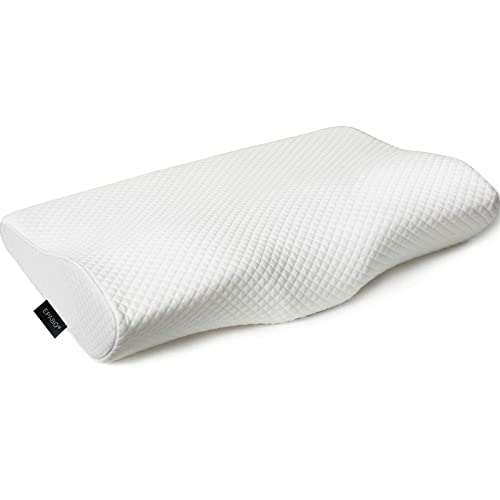
EPABO Contour Memory Foam Pillow — Best Contour for Side Sleepers
A contoured ergonomic memory-foam pillow shaped to cradle the neck — the structured alternative for side and back sleepers who dislike shredded fill.
Check the current price on Amazon

UTTU Cervical Pillow, Adjustable Heights — Best Dual-Height Contour
A contoured memory-foam pillow with two usable heights — listed at 5.2 and 4.5 inches across its two sides — so you can choose your support level by rotating the pillow.
Check the current price on Amazon
How These Picks Were Chosen
We chose these six by first splitting the category by sleeping position, because a pillow that ignores your position is useless to you however it is marketed. Wedges were assessed on incline height, footprint and surface comfort; side-sleeping pillows on loft — fixed, dual or adjustable — and on how honestly their listings describe their construction. Dimensions and heights quoted in the reviews come from the listings themselves.
Certifications were recorded exactly as listed and not upgraded in the telling: the Coop’s CertiPUR-US and GREENGUARD Gold credentials, for example, are foam-content and emissions standards respectively, and we describe them as such rather than letting them blur into a health endorsement. The same discipline applied to vocabulary: words like ‘orthopedic’ appear in several listings, and in this article they are treated as the marketing terms they are.
Finally, we excluded products that were not complete pillows — cases, inserts marketed as accessories, and travel-size novelties — and any listing whose identity could not be confirmed confidently. What remains is six complete, verifiable pillows that cover the realistic positional experiments a shopper in this category wants to run.
The 6 Best Anti Snore Pillows
Bedluxe Wedge Pillow, 10 Inch — Best Overall Wedge
Most people who go looking for an ‘anti-snore pillow’ are really looking for a different sleeping position: a modest incline for back sleeping, or support that makes side sleeping stick. The Bedluxe wedge is the purest version of the first idea — a 10-inch incline wedge, listed for headboard use and for sleeping with the head and shoulders raised. There is nothing to adjust, inflate or programme; you put it on the bed and your upper body rests at a gentle, consistent angle all night.
That simplicity is the wedge’s real virtue. Loft experiments with stacked ordinary pillows fail because pillows migrate, compress unevenly and leave your neck bent at an angle your shoulders resent by morning. A single foam wedge holds its geometry. Ten inches of rise spread over the wedge’s length is a moderate incline — enough to feel meaningfully different from flat, not so steep that you slide down it by 3 a.m., which is the failure mode of very tall wedges.
Be honest with yourself about what you are buying: a positioning aid for comfort, not a treatment. Whether an incline changes how quietly any individual sleeps depends on why they snore, and pillows cannot answer that question — only experimentation and, where symptoms warrant, a doctor can. What the Bedluxe reliably delivers is a stable, comfortable elevated sleeping position at a sensible tier, which is exactly the experiment most people type this query want to run.
It is also a useful bed accessory beyond this brief — for reading in bed and for anyone who simply prefers sleeping with their head and shoulders raised. Wedges do take up bed real estate, though, and partners who sleep flat may find the incline’s edge encroaches; measure your side of the bed before ordering.
Strengths
- Stable one-piece incline — no stacking, shifting or re-fluffing at 3 a.m.
- 10-inch rise is a moderate, sleepable angle for most back sleepers
- Doubles as a reading and head-raised sleeping wedge
Trade-offs
- Takes up significant bed space; can encroach on a partner’s side
- One fixed angle — no adjustment if you want more or less incline
- A positioning aid for comfort, not a treatment for snoring or sleep apnea
| Specification | Detail (as listed) |
|---|---|
| Height | 10 inch (as listed) |
| Type | Bed wedge pillow |
| Colour | White/Grey (as listed) |
| Use | Head and shoulder elevation, reading |
Best for: Back sleepers who want to try a stable raised-head position for comfort / Not suited for: Anyone seeking a treatment for sleep apnea — that requires medical care
Check the current price on Amazon
Nordjager Wedge Pillow for Sleeping, 24 x 24 x 10 Inch — Best Wedge Comfort
The most common complaint about wedge pillows is not the angle — it is the feel. A wedge is a big slab of firm foam, and side-of-face and shoulder contact on plain foam can feel like sleeping on a ramp in a car park. The Nordjager’s listing answers that directly: a memory-foam top layer over a supportive foam base, in a 24 x 24 x 10 inch format. The base holds the incline honestly; the top layer gives your head, shoulders and arms somewhere forgiving to land.
The dimensions matter. At 24 inches wide, this wedge serves one sleeper without annexing the whole bed, and the 10-inch height matches the moderate incline most back sleepers can actually sleep on through the night. The listing describes the shape as an ergonomic incline supporting the back, legs and comfortable sleep — wedges moonlight as leg-elevation and reading supports, and a two-layer build is noticeably better in those roles too, because the memory foam cushions contact points the way plain foam does not.
Who is it for? The back sleeper who already knows they like an incline — perhaps from a recliner nap or a hotel bed with the head raised — and wants the home version to feel like bedding rather than equipment. Who should skip it? Determined side sleepers: a wedge this size is a back-sleeping tool first, and side sleepers are better served by the contour and adjustable picks below that are designed around the shoulder.
As with every pick here, the framing is comfort and positioning. A softer wedge makes an elevated position pleasant to sleep in; it does not convert that position into a medical intervention, and this article does not claim otherwise anywhere.
Strengths
- Memory-foam top layer over supportive base — the comfort fix for firm wedges
- 24 x 24 x 10 inch size serves one sleeper without taking the whole bed
- Two-layer build also works well for reading and leg elevation
Trade-offs
- Primarily a back-sleeping tool; side sleepers should look below
- Fixed incline like all one-piece wedges
- Memory foam sleeps warmer than plain foam for some people
| Specification | Detail (as listed) |
|---|---|
| Dimensions | 24 x 24 x 10 inch (as listed) |
| Construction | Memory foam top layer, foam base (as listed) |
| Type | Bed wedge |
| Use | Sleeping incline, back and leg support |
Best for: Back sleepers who want an incline that feels like bedding, not equipment / Not suited for: Dedicated side sleepers — see the contour picks
Check the current price on Amazon
Bambulex 4-Piece Wedge Pillow Set — Best Adjustable Wedge System
If the fixed wedges above ask you to commit to one angle, the Bambulex set asks the opposite question: what if you could try several? Its listing describes a four-piece wedge pillow set — adjustable pieces that can be arranged for different sleeping and sitting positions. For the buyer whose honest answer to ‘how much incline do you want?’ is ‘no idea’, a set is the rational purchase: you can start shallow, build up, and rearrange pieces for reading or for leg support without buying three separate products.
Adjustability has a second, underappreciated benefit in this category: tolerance. Many people abandon an incline after one uncomfortable night on a fixed wedge that was slightly too steep, when a slightly shallower arrangement would have suited them. A set lets you grade the experiment instead of passing or failing it in a single night. Give each arrangement at least a few nights — sleep positions take time to feel normal — before rearranging again.
The trade-offs are the mirror image of the one-piece wedges’ virtues. Pieces can shift against each other during the night in a way a single slab never does, the full set occupies serious storage space when not in use, and there are more covers and components to keep track of. Households that value simplicity over experimentation should take the Bedluxe or Nordjager instead.
One framing note that applies to this pick’s listing in particular: multi-piece wedge sets are marketed with long lists of conditions they are supposedly for. This article credits the Bambulex with exactly what is verifiable — adjustable foam pieces that let you build a comfortable inclined or supported position — and nothing more. Comfort and positioning are honest reasons to buy it; anything beyond that belongs in a clinician’s office.
Strengths
- Four adjustable pieces — build the incline that suits you instead of committing to one
- Pieces rearrange for reading, sitting up and leg support
- Lets you grade the elevation experiment over several nights
Trade-offs
- Pieces can shift relative to each other during the night
- Bulky to store when not in use
- More components and covers to manage than a one-piece wedge
| Specification | Detail (as listed) |
|---|---|
| Pieces | 4-piece set (as listed) |
| Type | Adjustable bed wedge set |
| Colour | White/Grey (as listed) |
| Use | Configurable incline and support positions |
Best for: Experimenters who want to find their incline gradually / Not suited for: Minimalists who want one slab, zero decisions
Check the current price on Amazon
Coop Home Goods Original Adjustable Pillow, Queen — Best Adjustable Loft
Not everyone pursuing a quieter, more comfortable night should sleep on an incline. For side sleepers — and for people whose partners report the noise is worst when they roll onto their backs — the relevant pillow is one that makes side sleeping comfortable enough to stay in. The Coop Home Goods Original is the classic tool for that job: a queen-size pillow filled with cross-cut memory foam that you add or remove to set the loft precisely, listed with CertiPUR-US and GREENGUARD Gold certifications.
Adjustable fill solves the side sleeper’s central geometry problem. Side sleeping needs enough loft to fill the space between the ear and the shoulder so the neck stays level; too little and the head drops, too much and it cranes. Because shoulder widths differ, no fixed pillow is right for everyone — a pillow you tune by handfuls of fill can be right for you specifically, and can be re-tuned if you change mattresses (a softer mattress lets your shoulder sink deeper and needs less loft).
The certifications deserve a precise word, because pillow marketing blurs them. As listed, this pillow’s foam is CertiPUR-US certified — a foam-content and emissions standard for the foam itself — and the pillow carries GREENGUARD Gold certification, which concerns chemical emissions into indoor air. Neither is a medical endorsement, and we do not present them as one; they are materials and emissions credentials, stated here exactly as listed so you can weigh them accurately.
Choose the Coop if you are a side or combination sleeper who wants to tune loft at home. Choose a wedge instead if your goal is specifically to sleep with your head and shoulders raised. And note the honest limit shared by every pick in this article: a pillow can make a position comfortable; whether that position changes your snoring is individual, and persistent loud snoring with gasping or daytime sleepiness is a reason to see a doctor, not to keep buying pillows.
Strengths
- Fill adjusts by hand — set the exact loft your shoulder width needs
- Queen size suits side and combination sleepers
- CertiPUR-US foam and GREENGUARD Gold certification, as listed
Trade-offs
- Needs a break-in and tuning period to dial in
- Shredded fill feels different from a solid foam pillow — a preference point
- Not an incline tool; back sleepers wanting elevation should choose a wedge
| Specification | Detail (as listed) |
|---|---|
| Size | Queen (as listed) |
| Fill | Cross-cut memory foam, adjustable (as listed) |
| Certifications | CertiPUR-US, GREENGUARD Gold (as listed) |
| Firmness | Medium firm (as listed) |
Best for: Side and combination sleepers who want to tune their loft precisely / Not suited for: Back sleepers specifically seeking head-and-shoulder elevation
Check the current price on Amazon
EPABO Contour Memory Foam Pillow — Best Contour for Side Sleepers
The EPABO takes the opposite approach to the Coop: instead of fill you tune, it offers a fixed contoured shape — a sculpted memory-foam pillow with a neck cradle and higher edges for side sleeping, listed for side, back and stomach sleepers. The contour does the positioning work for you: the head rests in the central hollow while the neck roll supports the curve of the neck, and the raised sides give side sleepers their loft without a separate adjustment process.
Contour pillows divide opinion, and it is worth understanding why before buying. Sleepers who match the shape often find the support transformative for morning neck comfort; sleepers whose proportions differ from the mould can find a fixed contour feels like being assigned a position. If you have never slept on a contour pillow, expect an adjustment period of several nights, and buy from a listing whose return terms you have checked — that advice applies to every shaped pillow in this category.
For this article’s brief, the contour’s value is positional stability. A side sleeper whose head is cradled at the right height is a side sleeper who stays on their side — and many people explore exactly that as their preferred comfortable position. The EPABO’s memory foam also simply feels different from shredded fill: slower, denser, more uniform. Neither is better; they are different textures of support, and the choice is personal.
The listing uses the word ‘orthopedic’, as many contour listings do. Recorded here for accuracy, that word is marketing vocabulary in this category, not a medical credential — the pillow is a comfort product, assessed in this article on its shape, materials and fit, like everything else on the page.
Strengths
- Fixed contour cradles the head and supports the neck curve
- Raised sides give side sleepers loft without adjustment
- Dense, uniform memory-foam feel
Trade-offs
- Fixed shape fits some proportions better than others — expect an adjustment period
- Cannot be re-tuned the way adjustable fill can
- Memory foam contour is a distinct feel that divides opinion
| Specification | Detail (as listed) |
|---|---|
| Type | Contour memory foam pillow (as listed) |
| Sleep positions | Side, back and stomach (as listed) |
| Design | Ergonomic cervical contour (as listed) |
| Fill | Solid memory foam |
Best for: Side sleepers who want structured support without tuning fill / Not suited for: Anyone who dislikes being assigned a fixed head position
Check the current price on Amazon
UTTU Cervical Pillow, Adjustable Heights — Best Dual-Height Contour
The UTTU splits the difference between the fixed EPABO and the fully adjustable Coop: it is a contoured memory-foam pillow whose two sides offer different heights — the listing gives its queen dimensions as 23.6 x 13.8 inches with heights of 5.2 and 4.5 inches. Rotate the pillow and you change the loft, which gives you a genuine A/B test of the two most common support levels in a single purchase.
That dual-height design is more useful than it sounds. Neck support preference is not knowable in advance — it emerges over nights. A sleeper can spend a week on the higher side, rotate, spend a week on the lower, and actually learn something about their own geometry instead of guessing again with a second purchase. The contour itself follows the category pattern: a cradle for the head, support under the neck, and a shape intended to serve side and back sleepers (the listing also mentions stomach sleepers, though most stomach sleepers prefer much flatter pillows than any contour).
The listing describes the foam as adjustable in the sense of its sandwich-style construction, and the pillow as a cooling contour design. We report those as listed features of construction and design; what we can stand behind editorially is the measurable part — the two heights and the contour — and the general character of memory foam support.
Buy the UTTU if you like the contour idea but fear committing to the wrong height. It is the hedging pick of this roundup, in the best sense: one purchase, two geometries, and a fair chance of learning which one your neck actually prefers — knowledge that will inform every pillow you buy afterwards.
Strengths
- Two heights in one pillow (5.2 and 4.5 inches as listed) — rotate to choose
- Contour cradle with neck support for side and back sleeping
- Queen footprint at 23.6 x 13.8 inches as listed
Trade-offs
- Still a fixed contour family — two options, not infinite adjustment
- Stomach sleepers will likely find both heights too much
- Adjustment period applies, as with all contour pillows
| Specification | Detail (as listed) |
|---|---|
| Dimensions | 23.6 x 13.8 inches (as listed) |
| Heights | 5.2 / 4.5 inches, dual-sided (as listed) |
| Type | Contour memory foam pillow |
| Size | Queen (as listed) |
Best for: Contour-curious sleepers who want two heights in one purchase / Not suited for: Anyone wanting a flat, traditional pillow feel
Check the current price on Amazon
Comparison Table
| Pick | Badge | Key spec | Best for |
|---|---|---|---|
| Bedluxe Wedge Pillow, 10 Inch | Best Overall Wedge | 10-inch fixed incline wedge | Back sleepers who want to try a stable raised-head position for comfort |
| Nordjager Wedge Pillow for Sleeping, 24 x 24 x 10 Inch | Best Wedge Comfort | Memory-foam-top wedge, 24x24x10 | Back sleepers who want an incline that feels like bedding, not equipment |
| Bambulex 4-Piece Wedge Pillow Set | Best Adjustable Wedge System | 4-piece adjustable wedge set | Experimenters who want to find their incline gradually |
| Coop Home Goods Original Adjustable Pillow, Queen | Best Adjustable Loft | Adjustable shredded-foam loft, Queen | Side and combination sleepers who want to tune their loft precisely |
| EPABO Contour Memory Foam Pillow | Best Contour for Side Sleepers | Sculpted contour, neck cradle | Side sleepers who want structured support without tuning fill |
| UTTU Cervical Pillow, Adjustable Heights | Best Dual-Height Contour | Dual-height contour, 5.2/4.5 in | Contour-curious sleepers who want two heights in one purchase |
How to Choose a Pillow for Sleep Positioning
Start with the position you are trying to achieve, not with a product. If you sleep on your back and want to try sleeping with your head and shoulders raised, you are shopping for a wedge, and your variables are incline height (10 inches is the moderate, widely sleepable choice), width, and surface feel. If you want to sleep on your side more comfortably, you are shopping for loft and neck support, and your variables are shoulder width, mattress softness and whether you want to tune the fill yourself.
Then be realistic about adaptation. Any new sleeping position feels strange for the first few nights, and pillows are routinely returned on night two by people who would have loved them by night six. Commit to a fair trial — the better part of a week per configuration — and change one variable at a time: if you buy an adjustable pillow or wedge set, resist re-tuning it nightly, or you will learn nothing except that change itself is disruptive.
Finally, keep the health frame straight. Positional experimentation is a comfort project. It is not a screening tool and not a treatment, and it should never delay a medical conversation when the warning signs in the next section are present.
Wedge height: how much incline is enough?
Wedge listings range widely in height, and taller is not better: a very steep wedge slides you down the bed and bends you at the waist rather than inclining your whole upper body. The 10-inch wedges in this roundup represent the moderate mainstream — a clear, felt incline that most back sleepers can sleep on all night. If you are unsure, the adjustable Bambulex set lets you start shallower and build, which is the empirical way to answer a question your body has to answer for you.
Loft for side sleepers: the shoulder equation
A side sleeper’s pillow must fill the gap between the side of the head and the surface of the mattress, a distance set by shoulder width minus how deeply the shoulder sinks into the mattress. Broad shoulders on a firm mattress need the most loft; narrow shoulders on a soft mattress need the least. This is why adjustable fill (Coop) and dual heights (UTTU) are such rational designs: they convert an unknowable specification into a home experiment with a definite answer.
Materials: shredded fill, solid foam and wedge foam
Shredded or cross-cut fill feels mouldable and breathable and can be re-tuned; solid contour foam feels uniform and supportive and holds a sculpted shape; wedge foam is firmer by necessity, since it must hold an incline under your torso’s weight — which is why a memory-foam comfort layer, as on the Nordjager, makes such a difference to how a wedge feels at the shoulder and cheek. None is superior in the abstract; match the material to the job and to the textures you already know you sleep well on.
Sharing the Bed: Footprint, Partners and Pillow Logistics
Positional pillows are bigger than the pillows they replace, and a shared bed makes that a household decision rather than a private one. A wedge occupies a full sleeper’s width and part of the bed’s length; on a queen bed that is manageable, on a double it is a negotiation. Measure before ordering, and consider that your partner may end up half on the incline’s shoulder — some couples solve this by putting a wedge on both sides or by choosing a narrower 24-inch model like the Nordjager, which leaves more of the bed flat.
Contour and adjustable pillows are easier neighbours: they occupy a normal pillow footprint, so the side-sleeping strategy disturbs nobody’s territory. If you are experimenting on a partner’s behalf as much as your own — a common and perfectly kind motivation — the low-footprint options are the gentlest first step, and the wedge conversation can happen once you know whether position changes anything in your household at all.
Whatever you choose, keep the displaced pillow. Trials fail, guests arrive, and a wedge stored in a wardrobe is easier to live with than a wedge that has permanently exiled the household’s spare pillow to a charity bag in week one.
Snoring, Sleep Apnea and When to See a Doctor
This section exists because the most important sentence in any article about snoring is not about pillows. Sleep apnea — repeated pauses in breathing during sleep — is a common and serious condition, and its typical signs include loud nightly snoring, witnessed pauses or gasping, morning headaches, waking unrefreshed and significant daytime sleepiness. If that description sounds familiar, the right next step is a conversation with a doctor, who can arrange proper assessment and discuss real treatments.
Nothing in this roundup diagnoses, screens for or treats apnea or any other condition, and no purchase here should postpone that conversation. Think of these pillows as what they are: well-made tools for sleeping in a position you find comfortable. Many people enjoy experimenting with elevation or side sleeping purely for comfort and sleep quality, and that is a perfectly good reason to buy one — it is simply a different reason from treating a medical condition, and this article keeps the two separate on purpose.
How to Set Up Your New Pillow Position (and Give It a Fair Trial)
Technique for the trial matters as much as the pillow. Set up properly and judge over nights, not minutes.
- Start from a normal bedtime. Introduce the new pillow on an ordinary night, not before a big day, and keep the rest of your routine unchanged so the pillow is the only new variable.
- Wedge users: align the incline. Place the wedge with its thin edge toward the foot of the bed and lie so the incline supports your whole upper body — head, shoulders and upper back — rather than bending you sharply at the waist. Your regular pillow can go on top if you prefer its feel against your face; many wedge sleepers use a thin one.
- Side sleepers: check the line. Lie on your side and have a partner check (or use a mirror) that your head and neck run level with your spine. Adjust fill (Coop), rotate to the other height (UTTU), or settle into the contour (EPABO) until the line is straight and your shoulder is not being pushed up into your ear.
- Change one thing at a time. If you bought something adjustable, set it once and sleep on that configuration for at least three nights before changing it. Nightly re-tuning teaches you nothing and disrupts everything.
- Note the mornings. Keep a simple note for a week: how your neck and shoulders feel, how rested you feel, and — if a partner is involved — what they report. Decisions about pillows should always be made on a full week of honest evidence, not on one single restless night.
- Keep the health check separate. However the trial goes, remember the signs listed above. If they are present, book the doctor conversation in parallel — comfort experiments and medical assessment are not alternatives.
A fair trial usually ends in one of two good outcomes: a position you now sleep in comfortably every night, or definite knowledge about your own geometry that makes your next pillow purchase a certain one. Both are worth the week, and both beat another month of guessing in the dark.
Common Buying Mistakes
Expecting a pillow to cure snoring
The category’s founding disappointment. A pillow changes your position; whether that changes your snoring depends on your individual causes, and no honest seller can promise the outcome. Buy for comfort and positioning, judge on sleep quality, and involve a doctor when the warning signs are present.
Buying the steepest wedge on the page
Extreme inclines slide you down the bed and fold you at the waist. The moderate 10-inch class exists because it is what people can actually sleep on. If you are unsure of your angle, buy adjustability, not altitude.
Judging on one night
New positions feel wrong before they feel right. One restless night condemns pillows that a week would have vindicated — and one good night can flatter a pillow your neck hates by Friday. Trial for the better part of a week, changing nothing mid-trial.
Ignoring your actual sleep position
Back sleepers buying contour pillows and side sleepers buying wedges are the two most common mismatches in this category. Shop for the position you sleep in or deliberately want to adopt, not for the product with the longest feature list.
Letting certification language blur
CertiPUR-US and GREENGUARD Gold are materials and emissions standards — worth having, and described exactly that way in this article. They are not medical endorsements, and treating them as such inflates what a pillow purchase can mean.
Final Recommendation
For back sleepers who want to try an incline, start with the Bedluxe 10-inch wedge for simple stability, the Nordjager if surface comfort is your worry, or the Bambulex set if you want to discover your angle gradually. For side sleepers, the Coop Original is the most tunable route to the right loft, the EPABO the most structured, and the UTTU the sensible hedge between heights. Every one of them is a comfort and positioning tool — choose the one whose experiment you will actually run for a week.
And the closing word belongs to the article’s recurring line: loud, nightly snoring with pauses, gasping or heavy daytime sleepiness deserves a doctor’s attention, promptly and regardless of which pillow you buy. Comfort is a fine goal. It is not a diagnosis.
Readers working on the whole sleep setup may also find our guides to the best contour side sleeping pillows, the best cold pillows for side sleepers and the best bamboo memory foam pillows useful — and anyone whose partner’s snoring is the household issue should read the office-chair lesson in reverse: sometimes the purchase is for the other person’s comfort, and that is fine too.
Best Contour Side Sleeping Pillows
Best Cold Pillows For Side Sleepers
Best Bamboo Memory Foam Pillows
Best Contour Neck Pillows For Sleeping
Related guides
Frequently Asked Questions
Do anti-snore pillows actually work?
They work at what a pillow can do: holding you in a chosen position — head and shoulders raised on a wedge, or head and neck level on your side — comfortably enough to sleep there all night. Whether a position change alters any individual’s snoring depends on that person’s causes, which a pillow cannot know or promise. Judge a purchase on sleep comfort and quality, and see a doctor if the warning signs of sleep apnea are present.
Wedge or contour pillow — which should I try first?
Match it to position. Back sleepers curious about elevation should start with a wedge (the 10-inch Bedluxe or Nordjager, or the adjustable Bambulex set). Side sleepers should start with loft: the adjustable Coop, the contoured EPABO, or the dual-height UTTU. Buying against your position is the most common mistake in this category.
How high should a wedge pillow be?
For most back sleepers, around 10 inches of rise is the moderate, sleepable mainstream — clearly inclined without sliding you down the bed. Steeper wedges exist but are harder to sleep on all night. If you are unsure, an adjustable set lets you start shallower and build over several nights.
What loft do side sleepers need?
Enough to keep the head and neck level with the spine, which depends on your shoulder width and how much your shoulder sinks into your mattress. That is why adjustable designs are so practical: the Coop’s removable fill and the UTTU’s two heights (5.2 and 4.5 inches as listed) let you find your number at home instead of guessing in a shop.
Can a pillow help with sleep apnea?
No pillow treats sleep apnea, and this article does not present any product here as doing so. Apnea is a medical condition with effective medical treatments; if you have loud nightly snoring, witnessed breathing pauses or gasping, or significant daytime sleepiness, see a doctor for proper assessment.
Can I use my normal pillow on top of a wedge?
Yes, and many people prefer it: a thin regular pillow on the wedge’s upper section keeps a familiar surface against your face while the wedge provides the incline underneath. Keep it thin — a thick pillow on top re-bends the neck and defeats the geometry you bought the wedge for. Some wedge sleepers use no pillow on top at all; both arrangements are normal, and your week-long trial will tell you which your neck prefers.
How long should I trial a new pillow before deciding?
The better part of a week in a single configuration. Sleep positions adapt slowly, and first-night impressions are unreliable in both directions. Adjustable owners: set it once, sleep several nights, then change one variable if needed.

