Disclosure: airfryerkitchensupply.com is reader-supported. When you buy through links on our site, we may earn an affiliate commission at no extra cost to you.
Where to buy
Every chair below was verified, and each one earned its place on evidence from its own listing: it is a drafting-height chair, a standing-desk chair, or a perching stool — the three families that actually work with a sit-stand desk. A standard office chair fails this brief geometrically: it cannot rise high enough to meet a raised desk, so “sit and stand” shopping is really shopping for height range, a foot ring to rest your feet on at that height, and, for the standing hours, a perch that lets you lean rather than fully sit. Use the links to check the current price on Amazon.
AtHope Drafting Chair — check price on Amazon
BOLISS Drafting Chair — check price on Amazon
Primy Drafting Chair — check price on Amazon
HYLONE Drafting Chair — check price on Amazon
Desktronic Wobble Stool — check price on Amazon
Pearington SitFree Wobble Stool — check price on Amazon
Best Office Chairs for Sit and Stand: Height Range Is the Whole Brief
The best office chairs for sit and stand work solve a problem that is easy to state and routinely bought wrong. A sit-stand desk spends its day at two heights — seated height in the morning, standing height after lunch — and a chair that serves both halves must either rise far beyond a normal chair’s range and give your feet somewhere to rest when it does, or abandon the chair format entirely and become a perch: a tall stool you lean against at standing height, taking some weight off your legs without sitting down. Standalone standing is harder on the body over a full day than its fans admit, and full sitting is what the desk was bought to escape; the honest middle is alternation, and alternation is a seating product category of its own. That category is what this list contains: four drafting or standing-desk chairs with foot rings, and two active perching stools.
It is worth pausing on why the ordinary answer — “just buy a better office chair” — fails, because it is the purchase most standing-desk owners make first. A standard chair’s seat tops out around the height of a fixed desk; raise the desk to standing and the chair is a foot too short, with no foot support at the height it can reach. Owners improvise: sitting on the chair’s raised-to-maximum seat with feet on the base, or standing unsupported all day and quietly reverting to sitting by the month’s end. Both improvisations end with the desk parked at sitting height, which converts an adjustable workstation into an expensive fixed one. The six products below exist to break that sequence at its first step, by making both desk heights genuinely sittable — fully, in the drafting chairs, and partially, by design, in the perches.
A note on claims, because this corner of furniture marketing is exuberant: this guide talks about comfort, support and working position, in the terms the listings themselves use. No chair here is presented as a medical device or a treatment for anything, and the right reason to buy one is the mundane, sufficient one — you will work at both desk heights, comfortably, for years, without the chair dictating which height you are allowed to use.
In this guide
Quick Picks
Best Overall — AtHope Drafting Chair. Its listing specifies a standing-desk chair with a footrest ring, 3D lumbar and head support, flip-up arms and an extended high frame in breathable mesh. The complete drafting package for a desk that moves twice a day. Check the current price on Amazon
Best Heavy-Duty — BOLISS Drafting Chair. A 400 lb-rated mesh drafting chair per its listing, built for standing desks, with an extra wide seat, an adjustable foot ring and adjustable armrests. Big and tall sit-stand users start here. Check the current price on Amazon
Best Value Drafting Chair — Primy Drafting Chair. A tall standing-desk chair with flip-up armrests, lumbar support and an adjustable footrest ring per its listing, at the value end of the drafting family. The straightforward way to buy the format. Check the current price on Amazon
Best Armless and Compact — HYLONE Drafting Chair. An armless tall drafting chair with a high back, footrest and wheels per its listing. Armless matters at a raised desk: nothing collides with the desktop when you pull in close. Check the current price on Amazon
Best Perching Stool — Desktronic Wobble Stool. Listed explicitly as a wobble stool for standing desks: height-adjustable perching, 360-degree swivel and a non-slip base. For the standing hours, this is the lean-and-work option. Check the current price on Amazon
Best Compact Active Seat — Pearington SitFree Wobble Stool. A height-adjustable wobble stool for active, flexible seating in office or school settings per its listing. The small-footprint way to add perching to a desk you already own a chair for. Check the current price on Amazon
How These Picks Were Chosen
Every pick was cross-checked against Amazon listing data: searched by brand and model, the listed title matched against the chair we intended to recommend, and the ASIN taken from the listing response. No ASIN is invented, and every feature named in this article — foot rings, height adjustment, weight capacity, swivel — appears in the product’s own listing title.
The filter was the brief itself, applied strictly. A chair qualified only if its listing placed it at standing-desk or drafting height, or in the perching/active family designed for standing desks. That excluded the hundreds of ordinary ergonomic office chairs in the same listing result — many excellent, all geometrically wrong for a raised desk — and it excluded dining-height stools and bar stools that are tall for a kitchen counter rather than for working. Within the qualifying set we spread the list across the real sub-choices a sit-stand user faces: full drafting chairs with backs and arms for the seated hours, an armless option for tight desks, a heavy-duty capacity for larger users, and two perches for the standing hours. Prices are never printed; tiers are described in words.
Key Takeaways
- “Sit and stand” seating is a height problem: the chair must reach a raised desk and support your feet there — hence drafting chairs with foot rings, or perches.
- A standard office chair plus a standing desk is a mismatch, however good the chair: it cannot rise to the desk’s standing height.
- Drafting chairs serve the seated hours at any desk height; perching stools serve the standing hours by letting you lean with partial support.
- Many users need both formats across a day — a drafting chair for sitting, a wobble stool for standing — rather than one chair asked to be two things.
- Comfort framing only: buy for working position and all-day comfort, not for medical promises no chair listing can keep.
- Measure before you buy: desk working heights, underside clearance and your own hip height decide which of these six fits, and every one of those numbers is knowable in ten minutes with a tape measure.
- Fit is a process, not a delivery: expect a fortnight of small adjustments to ring height, seat height and desk presets before the workstation disappears beneath your attention, which is the true sign that the geometry is right.
The 6 Best Office Chairs for Sit and Stand

1. AtHope Drafting Chair — Best Overall
The AtHope is the most complete drafting answer in this list, and its listing is correspondingly specific: a tall office chair with 3D lumbar and head support, an ergonomic mesh standing-desk design, a footrest ring, an extended high frame, flip-up arms and even a hanger detail. Read as a sit-stand tool, each element has a job. The height range meets the raised desk; the footrest ring gives your feet a home at that height, which is what makes high sitting comfortable rather than dangling; the mesh back suits long sessions; and the flip-up arms solve the drafting chair’s classic annoyance — arms that clash with a high desktop when you pull in to work.
Strengths
- Footrest ring and standing-desk design stated in the listing — the two defining features of the category, both present.
- 3D lumbar and head support per the listing, in breathable mesh for long sessions.
- Flip-up arms clear the raised desktop instead of colliding with it.
Trade-offs
- A drafting chair is tall even at its lowest; petite users should check that its minimum height suits their seated desk position.
- Mesh and 3D supports are comfort features with adjustment ranges — expect a fitting session, not instant perfection.
- It serves the sitting half of sit-stand; the standing half still wants a perch or plain standing.
Key specs (from the Amazon listing)
- Type: drafting / standing-desk chair, mesh
- Footrest: ring, per listing
- Support: 3D lumbar and head support, per listing
- Arms: flip-up, per listing
Who it suits: the committed sit-stand worker who spends the majority of the day seated but at varying desk heights — the drafting chair follows the desk up for perching-height calls and down for focused work, and the foot ring makes both positions sustainable. If your day is mostly standing with sitting breaks, invert the logic and start with the perches below.
Best for: seated-dominant sit-stand users wanting the full drafting feature set. / Not suited for: standing-dominant users, or petite users who cannot reach a drafting chair’s low end comfortably.
Check the current price on Amazon

2. BOLISS Drafting Chair — Best Heavy-Duty
BOLISS builds the same brief for larger users, and its listing leads with the number that matters: a 400 lb capacity, in a mid-back mesh ergonomic drafting chair for standing desks, with an extra wide seat, two locking positions, lower back support, an adjustable foot ring and height-adjustable armrests. Weight capacities on tall chairs matter doubly — a drafting chair’s longer gas lift and higher centre of effort ask more of the frame than a standard chair’s — so a listing that states a serious capacity, a wide seat and an adjustable ring in one breath is making the right promises in the right order.
Strengths
- 400 lbs capacity per the listing, with an extra wide seat to match.
- Adjustable foot ring: the ring meets your legs, not the other way round.
- Mesh back and two locking positions for reclined pauses between tasks.
Trade-offs
- Mid-back rather than high-back: head support is not part of this package.
- A heavy-duty frame is a heavier chair to move around a home office.
- Value-engineered fittings at this tier; the capacity and geometry are the purchase, not the finish.
Key specs (from the Amazon listing)
- Capacity: 400 lbs, per listing
- Type: mesh drafting chair for standing desk
- Seat: extra wide, per listing
- Foot ring: adjustable; armrests height-adjustable, per listing
Choose the BOLISS if you are big, tall, or simply tired of chairs whose stated capacities read like apologies. In the sit-stand category, where the chair is asked to work at unusual heights all day, structural headroom is comfort: nothing creaks, nothing flexes, and the foot ring adjusts to the leg length that actually arrives.
Best for: big and tall sit-stand users needing a stated 400 lb capacity. / Not suited for: users wanting high-back head support or the lightest possible chair.
Check the current price on Amazon

3. Primy Drafting Chair — Best Value Drafting Chair
The Primy states the drafting formula without ornament: a tall office chair with flip-up armrests, an executive ergonomic computer standing-desk design, lumbar support and an adjustable footrest ring, in black. That is the complete checklist for the category — height, ring, support, arms that clear the desk — at the value end of this list’s drafting family, which makes it the recommendation for buyers who want the format proven in their own office before spending premium money on it.
Strengths
- Adjustable footrest ring and standing-desk design per the listing.
- Flip-up armrests: full arm support when wanted, full clearance when not.
- The value route into drafting height for a first sit-stand setup.
Trade-offs
- Fewer refinement features than the AtHope — no head support story, simpler adjustment set.
- Executive styling means a more padded, less breathable seat than the mesh picks.
- Like all drafting chairs, tall at rest; confirm your desk and storage space accept the silhouette.
Key specs (from the Amazon listing)
- Type: tall drafting / standing-desk chair
- Footrest: adjustable ring, per listing
- Arms: flip-up, per listing
- Support: lumbar support, per listing
Buy the Primy to learn your own sit-stand habits: whether you actually raise the desk daily, where your feet want the ring, how high your seated-working position really is. Those lessons, learned at value tier, make any later upgrade precise — and many users will find the Primy simply stays, because the format was the point all along.
Best for: first drafting chair for a new sit-stand desk, at value tier. / Not suited for: buyers wanting mesh breathability or head support.
Check the current price on Amazon

4. HYLONE Drafting Chair — Best Armless and Compact
The HYLONE’s listing describes an armless drafting chair: a tall office chair with adjustable height, a high-back ergonomic design, a drafting-stool format with footrest and wheels. The armless decision is the story. At a raised desk, armrests are the part of the chair most likely to collide with the desktop edge, the keyboard tray or the desk frame, and for users who pull in close, play an instrument at the desk, or simply prefer freedom of movement, removing them removes a daily friction. The high back keeps the support that armless stools usually surrender, which is why this pick is a chair and not merely a stool with ambition.
Strengths
- Armless: zero collision with raised desktops, trays and frames.
- High back retained — support without the armrest compromise.
- Footrest included per the listing, completing the drafting formula.
Trade-offs
- No arm support at all: users who lean on arms to rise or rest will miss them.
- The listing is specification-light beyond the format; buy it for the armless drafting geometry.
- Stool-adjacent ergonomics reward users who sit actively rather than slump.
Key specs (from the Amazon listing)
- Type: armless drafting chair / tall desk chair
- Back: high back, per listing
- Footrest: yes, per listing
- Brand: HYLONE
Choose the HYLONE for tight desks, music and maker workstations, and any setup where the chair must slide close and disappear under a raised top. It is also the natural second chair for a household where the main drafting chair’s arms have been annoying someone for months.
Best for: close-in workers, compact desks and armrest sceptics. / Not suited for: users who rely on armrests for support or for standing up.
Check the current price on Amazon

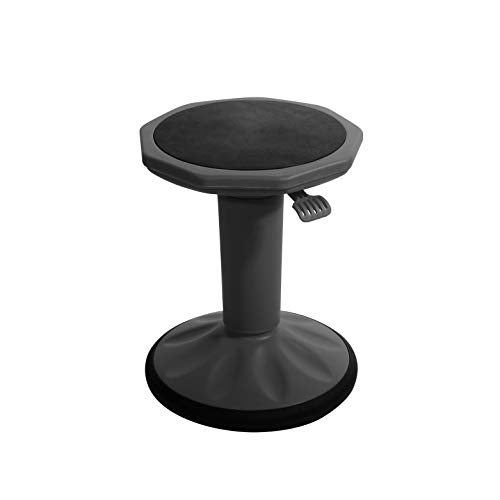
5. Desktronic Wobble Stool — Best Perching Stool
Crossing to the standing half of the day: the Desktronic is listed, in terms, as a wobble stool for standing desks — an ergonomic active-sitting chair, height-adjustable, a perching stool with 360-degree swivel and a non-slip base. Perching is the posture standing desks actually need by hour three: hips high, weight shared between feet and seat, spine in its working curve, and the freedom to shift, swivel and step away without a chair-extraction ceremony. The wobble base is the mechanism — it keeps the body making the small adjustments that a fixed stool or a locked chair suppresses.
Strengths
- Designed for standing desks by name: perching height and posture are the brief.
- 360-degree swivel suits multi-monitor and L-shaped desk work at standing height.
- Non-slip base per the listing — the wobble is in the seat, not in the footing.
Trade-offs
- No back, no arms: this is a lean, not a lounge, and it complements rather than replaces a chair.
- Active sitting is a habit; the first days feel like a new exercise, because in a small way they are.
- Perching height ranges suit standing desks; at a low fixed desk it is simply a stool.
Key specs (from the Amazon listing)
- Type: wobble / perching stool for standing desk
- Height: adjustable, per listing
- Movement: 360-degree swivel, per listing
- Base: non-slip, per listing
Buy the Desktronic if your desk already has a chair you like for sitting and what is missing is the standing half of the day, the half that currently ends early because unsupported standing quietly taxes the whole afternoon. It converts “standing desk” from a posture you endure in shifts into a workstation with seating support at full height — the purchase that makes the desk’s motor earn its keep, day after day, long after the novelty of standing has worn off and only the habit, properly supported, remains.
Best for: standing-dominant users adding perching support to an existing setup. / Not suited for: anyone wanting one seat to do everything, including reclined sitting.
Check the current price on Amazon
6. Pearington SitFree Wobble Stool — Best Compact Active Seat
The Pearington SitFree closes the list at the compact end of the perch family: a height-adjustable wobble stool for active, flexible seating, listed for kids and adults in school and office settings. Its virtues are footprint and price of admission — it tucks under the raised desk or into a corner when not in use, travels between rooms without a thought, and introduces active perching to a household or a classroom at the gentlest tier here. Flexible seating is the listing’s own phrase, and it is accurate: this is the stool that gets borrowed, perched on for a call, and returned.
Strengths
- Height adjustable per the listing, across adult and younger users.
- Smallest footprint here: stores under the desk or in a corner.
- The lowest-commitment route into active sitting on this list.
Trade-offs
- A shared school-and-office design: less specialised for all-day desk work than the Desktronic.
- No back or arms, as with any perch.
- Light build means committed all-day sitters should choose a drafting chair instead.
Key specs (from the Amazon listing)
- Type: wobble stool, active flexible seating
- Height: adjustable, per listing
- Settings: school and office, per listing
Choose the SitFree for shared spaces, family desks, homework stations and standing calls, and as the household’s floating perch. In a sit-stand home it plays the utility role: the seat that is always where the standing is happening, because moving it costs nothing and storing it costs almost as little, which is more than can be said for any full chair in a small home with a desk that refuses to stay at one height.
Best for: shared desks, small spaces and a first active seat. / Not suited for: all-day solo desk work as the only seat.
Check the current price on Amazon
Comparison Table
| Pick | Badge | Key spec (from listing) | Best for |
|---|---|---|---|
| AtHope Drafting Chair | Best Overall | Standing-desk chair; footrest ring; 3D lumbar and head support; flip-up arms | Seated-dominant sit-stand users |
| BOLISS Drafting Chair | Best Heavy-Duty | 400 lbs capacity; extra wide seat; adjustable foot ring | Big and tall users |
| Primy Drafting Chair | Best Value Drafting Chair | Standing-desk chair; adjustable footrest ring; flip-up arms | First drafting chair |
| HYLONE Drafting Chair | Best Armless and Compact | Armless; high back; footrest | Close-in and compact desks |
| Desktronic Wobble Stool | Best Perching Stool | For standing desk; height adjustable; 360 swivel; non-slip base | Standing-dominant users |
| Pearington SitFree Wobble Stool | Best Compact Active Seat | Height adjustable wobble stool; flexible seating | Shared and small spaces |
How to Choose a Chair for a Sit-Stand Desk
Start by timing your own day, because the right product follows the ratio. If you sit for most of the day but raise the desk for calls, reading and variety, you need a drafting chair: full back, foot ring, height range that covers both desk positions. If you stand for most of the day and sit for breaks, you need a perch plus whatever ordinary chair already serves your breaks. If you genuinely split the day, the honest answer is both formats — a drafting chair and a wobble stool cost less together than the premium “does-everything” chair that does neither job well.
Within drafting chairs, check three things in the listing. Height range first: the chair’s maximum seat height must meet your desk’s standing working height minus the distance your forearms need — measure your desk at its working heights before shopping, because “drafting” spans several inches of variation. The foot ring second: it must be adjustable (the BOLISS and Primy state this) or positioned for your leg length, because a fixed ring at the wrong height is worse than none. Arms third: flip-up arms (AtHope, Primy) are the safe default at a raised desk; fixed arms are a collision schedule, and armless (HYLONE) is a legitimate preference for close-in work.
Within perches, judge height range against your desk’s top position and your own hip height: a perch supports you at roughly standing hip level, tilted, with feet on the floor. Swivel matters at wide desks; base stability matters everywhere — the Desktronic’s non-slip base is the kind of listing detail to look for. And manage expectations honestly: active sitting is a skill with a learning curve of days, and a perch used for twenty-minute standing intervals is a success, not a compromise.
Finally, weight capacity and build. Tall chairs work their lifts and frames harder than standard chairs; a stated capacity with headroom (the BOLISS’s 400 lbs) is the conservative buy for any user near a limit, and mesh versus padding is a climate and preference call — mesh for warm rooms and long sessions, padding for a more executive feel.
Setting Up: Desk Heights, Foot Rings and Monitor Geometry
1. Set the desk first. Seated working height puts your elbows at roughly a right angle with feet supported; standing working height repeats the same elbow geometry on your feet. Save both as presets if the desk allows.
2. Set the chair to the desk, not the other way round. In drafting mode, raise the seat until your forearms meet the raised desktop level, then set the foot ring so your feet rest flat with knees soft — the ring is a footrest, not a decoration.
3. Check the monitor at both heights. The screen’s top should sit near eye level in each position; a monitor arm earns its money in a sit-stand setup because the ideal screen height moves with you.
4. Alternate on a rhythm you will keep. Twenty to thirty minutes standing or perching in each hour is a sustainable pattern for most people; heroic all-day standing is how sit-stand desks end up as expensive fixed desks.
5. Keep the floor in the system. An anti-fatigue mat under the standing position and sensible footwear change the standing hours as much as any stool; the perch, the mat and the desk are one workstation, not three purchases.
6. Revisit in a fortnight. Adjust ring height, seat height and desk presets once your body has opinions; the first setup is a draft, and the fortnight setup is the one you will live with.
Common Buying Mistakes
Buying a standard chair for a standing desk. The most common and most expensive error in this category: an excellent chair that cannot rise to the desk is an excellent chair for a different desk. Height range is the first specification, not an afterthought.
Ignoring the foot ring. High sitting without foot support leaves legs dangling and pressure in the wrong places within the hour. If the listing does not mention a ring or footrest, the chair is tall, not drafting.
Expecting one seat to be both chair and perch. The formats solve different halves of the day. Households that buy both a drafting chair and a modest perch report better use of the desk than households that bought one premium compromise.
Standing heroically, then quitting. All-day standing is its own strain. The desk’s value is alternation; build the rhythm with the perch’s help rather than testing your endurance against furniture.
Skipping the tape measure. Sit-stand geometry is unforgiving of guesses: desk heights, underside clearance, seat ranges and ring positions are all numbers, and the listings print most of them. Ten minutes with a tape before ordering prevents the category’s commonest return — a good chair that is simply the wrong height for the desk it met.
Setting it once and never again. Your first configuration is a hypothesis. Bodies adapt, shoes change, desk contents shift the working height by small amounts that matter at hour six. The fortnight review in the setup section is not fussiness; it is the step that converts a purchased chair into a fitted workstation.
Believing medical marketing. Chairs support comfortable working positions; they do not treat conditions. Buy the geometry, the capacity and the build — and let any health questions go to a clinician, not a listing.
The Sit-Stand Day, Hour by Hour
It helps to see what these products are for in the shape of an actual day. The morning’s deep-focus work is usually seated work — and in a sit-stand home that may mean seated at the raised position on the drafting chair, feet on the ring, because the worker prefers the higher sightline, or at standard height with the desk lowered. The first standing block often arrives with the first calls: desk up, perch under you, swivel between screens. After lunch is where standing desks earn or lose their reputations — the post-lunch slump tempts people back to a chair for three unbroken hours, and the alternation rhythm (thirty seated, thirty perched or standing) is specifically the tool against it. Late-day tasks — inbox, admin, tomorrow’s list — suit the perch and the mat, with the chair in reserve.
Two lessons hide in that sketch. First, transitions are the point: a setup that makes changing position effortless — chair that rises, stool that rolls out from under the desk, desk presets that remember both heights — gets alternated; a setup with friction gets parked at one height by February. Second, no single product carries the day. The drafting chair owns the seated blocks, the perch owns the standing blocks, and the desk’s motor owns the transitions. Budget and buy accordingly, and distrust any single product — however premium — that claims to be the whole system.
Drafting Chairs Beyond the Standing Desk
The same geometry serves other high work surfaces, and a drafting chair often justifies itself across several. Kitchen counters and island benches sit between desk and bar height, and a drafting chair with its ring set mid-way is a better perch for laptop-at-the-island work than any backless counter stool. Home studios — art tables, craft benches, music production desks with raised racks — are drafting-height environments by tradition, and the armless HYLONE in particular belongs there, where arms collide with instruments and workpieces. Workshops and lab-style benches in garages and maker spaces take drafting chairs gratefully, with the heavy-duty BOLISS as the natural citizen. When you assess value, count the surfaces: a chair that serves the desk, the island and the studio is three chairs wearing one price tag, which is why this older furniture category keeps outliving the trends that rename it.
Practicalities: Castors, Floors, Assembly and Care
Tall chairs move differently. A drafting chair’s higher centre of mass makes castor quality and base diameter real safety features rather than specifications to skim: look for a wide, stable base, keep castors clean of the hair and grit that make them skid instead of roll, and be deliberate when sitting down at full height — the chair will travel if you drop into it carelessly. On hard floors, castors designed for hard surfaces protect the finish and roll more quietly; on carpet, the taller chair needs a firmer push, and a chair mat under a sit-stand workstation serves both the chair and the standing position’s mat arrangement if laid out thoughtfully.
Assembly is the other practical hour. Drafting chairs add a foot ring to the standard build — fit it loosely, set its height after the chair is in use at your desk, then tighten — and gas lifts on tall chairs are longer, so check the lift’s smooth travel through its whole range on day one, while returns are painless. Mesh backs want dusting; padded seats want the occasional vacuum; wobble stools want their base contact surface kept clean so the non-slip promise holds. None of this is burdensome, but tall seating rewards the owners who set it up deliberately, which is the recurring theme of this entire category: the geometry is the product, and geometry must be fitted, not merely purchased.
Three Desks, Three Answers: Worked Examples
The solo home office, seated-dominant. One person, one desk, six seated hours against two standing. The AtHope drafting chair is the whole seating budget, correctly spent: it follows the desk through both heights, the ring supports the raised hours, and the flip-up arms keep the raised desk usable up close. Add the anti-fatigue mat now and the perch later, if the standing hours grow.
The standing-dominant studio. A designer or developer who stands by default and sits to think. The Desktronic perch is the primary seat; the existing ordinary chair stays for the seated blocks at the lowered desk; no drafting chair is needed at all, because the seated hours never happen at height. This is the build that surprises people — the “chair for sit and stand” they needed was mostly a stool.
The shared family desk. Two adults of different heights and a teenager, one desk, constant adjustment. The Pearington SitFree floats between users because it adjusts in seconds and stores in a corner; the Primy drafting chair anchors the desk for long sessions; and the household rule — leave the ring and seat where the next person can start from neutral — does more for harmony than any feature. Shared setups reward fast-adjusting, mid-priced gear over one person’s perfect chair.
A Word on the Alternatives We Left Out
Honesty about the edges of this list: kneeling chairs and saddle stools are real active-seating categories with devoted users, and ball chairs have their advocates. They are not here because the brief was chairs for sit-and-stand desks, and the listings that qualified — drafting height, standing-desk design, perching for standing desks — formed a complete, verifiable set without them. If your interest is specifically kneeling or saddle seating, shop those categories on their own terms rather than treating them as substitutes for a drafting chair: they change your posture far more radically, suit shorter sessions for most people, and do not raise you to a standing desk’s working height in the way this brief requires. The perch is as far toward alternative seating as a sit-stand workstation usually needs to go.
Tiers and Total Cost: Furnishing the Whole Workstation
Prices are not printed in this guide because they move, but the tier structure of this category is stable enough to plan around. Wobble stools occupy the lowest tier — the Pearington SitFree at the entry, the Desktronic a step up for standing-desk specialisation. Drafting chairs form the middle: the Primy at the value end, the BOLISS priced by its heavy-duty brief, the HYLONE by its armless niche, and the AtHope at the top of this list’s range for its full support package. Ordinary ergonomic chairs at the same prices are not competitors here; they are a different product that happens to share a showroom.
The total-cost view matters more than any single tier. A sit-stand workstation is a desk, a chair solution, a perch perhaps, a mat, and a monitor arm — and the seating share of that budget is best spent in the order this guide implies: first the format that matches your dominant posture, then the complement for the other half of the day, then refinement. Households that invert the order — premium chair first, perch never — own beautiful seating for a desk that spends its life at one height, which is the category’s most elegant failure mode. Buy the system in the order the day uses it, and the mid-tier picks here will outperform a flagship bought alone.
Final Recommendation
Seated-dominant sit-stand users should buy the AtHope Drafting Chair for its complete feature set; big and tall users, the 400 lb-rated BOLISS; first-time drafting buyers, the value-tier Primy; close-in and compact desks, the armless HYLONE. Standing-dominant users should add the Desktronic Wobble Stool for perching, and shared or small spaces the Pearington SitFree. The households that get the most from a sit-stand desk are the ones that seat both halves of its day — which is why this list contains both chairs and perches, and recommends them in combination without embarrassment.
Related guides in this series: Best Ergonomic Office Chairs Home, Best Home Office Chairs For Comfort, Best Customizable Office Chairs, Best Inexpensive Ergonomic Office Chairs, Best High Use Office Chairs.
Related guides
Frequently Asked Questions
Can I use my regular office chair with a standing desk?
For the seated hours, yes — that is what it is for. For the raised hours, no: a standard chair’s lift does not reach standing working height, and perching on its top setting with feet dangling is the worst of both worlds. Add a drafting chair or a perch for the desk’s upper range.
What is a drafting chair, exactly?
A chair built taller than standard — longer lift, higher seat range — with a foot ring to support your feet at height. The category comes from draughtsmen’s high drawing boards; the modern version serves standing desks, high counters and lab benches.
Is perching really better than just standing?
For most people, for long stretches, yes: a perch takes part of your weight, lets you shift and swivel, and keeps your feet on the floor for balance — comfort framing, not a medical claim. It turns standing from an endurance posture into a working position, which is why standing-desk veterans so often end up owning one.
How high should the seat be at a raised desk?
High enough that your forearms rest at the desktop with shoulders relaxed and elbows near a right angle, with your feet fully supported — on the foot ring in a drafting chair, on the floor when perching. If your shoulders creep toward your ears, the seat is low; if your feet dangle, the ring is wrong.
Do I need arms on a drafting chair?
Only if they flip up or clear the desk. Fixed arms at drafting height meet the desktop edge constantly. Flip-up arms (AtHope, Primy) give you both worlds; armless (HYLONE) suits close-in work. Decide by your desk’s underside and your habits, not by showroom comfort.
How do I know if a drafting chair will fit under my desk?
Check two measurements: the chair’s maximum arm height (or seat height, if armless) against your desk’s underside clearance at its lowest position, and the chair’s overall height against the room if it will live beside a standard desk. Flip-up arms exist precisely because this collision is common — when in doubt, choose them, or go armless, and the question answers itself.
Is a foot ring really necessary?
At drafting height, yes — it is the difference between supported sitting and dangling. Your feet need a resting surface when the seat is high; without one, most people hook their feet on the chair base or the desk frame within minutes, which tells you the body was asking for the ring all along. Adjustable rings suit more leg lengths; fixed rings suit the leg length they were placed for.
Can a wobble stool replace my chair entirely?
For standing-dominant workers who sit in short breaks, some do use a perch as their only seat. For anyone sitting in long blocks, a perch is a complement, not a replacement — buy the drafting chair for those hours and let each format do the job it was shaped for.


