Disclosure: airfryerkitchensupply.com is reader-supported. When you buy through links on our site, we may earn an affiliate commission at no extra cost to you.
Where to buy
Every vacuum below was verified, and each one earned its place the same way: its own listing positions it for low-pile carpet, bare floors and area rugs, or it gives you a way to stop the brush roll from chewing at delicate fibres. Fine rugs — flatweaves, low-pile wool, vintage and hand-knotted pieces — are damaged by aggressive beater bars far more often than they are damaged by weak suction, so this list favours suction control and gentle floorheads over headline power. Use the links to check the current price on Amazon.
Miele Classic C1 Pure Suction — check price on Amazon
SEBO AIRBELT K2 Kombi Canister Vacuum — check price on Amazon
Miele Classic C1 Turbo Team — check price on Amazon
Shark Navigator Lift-Away NV360 — check price on Amazon
Bissell Zing 2156A Canister Vacuum — check price on Amazon
Kenmore 81214 200 Series Bagged Canister — check price on Amazon
Best Vacuum for Fine Rugs: Suction Without the Beater Bar
The best vacuum for fine rugs is rarely the most powerful machine in the store. Fine rugs — flatwoven kilims and dhurries, low-pile wool rugs, silk-blend pieces, vintage Persian and Turkish rugs, and modern low-pile designs with delicate fringe — fail in a specific way: a stiff, fast-spinning brush roll grabs loose fibres, worries the edges of the weave, fuzzes the surface pile and can pull fringe into the head until threads snap. Suction alone almost never does that damage. That is why this guide is built around machines whose listings put them on hard floors and low-pile carpet, canisters with straight-suction or combination floorheads, and one upright that lets you switch the brush roll off entirely.
There is a second, quieter truth worth saying up front: no vacuum is safe on every fine rug. A fragile antique with a worn foundation, a silk rug with dry rot, or a rug whose dyes bleed should be hand-dusted, shaken outdoors, or cleaned by a rug specialist, not machine-vacuumed at all. The picks below are for the large middle ground — well-made fine rugs in sound condition that need regular dust removal without a beater bar beating them up. Used on the gentlest settings described in the how-to section below, they remove the grit that acts like sandpaper inside the pile, which is the main thing that wears a fine rug out from within over the years.
In this guide
Quick Picks
Best Overall — Miele Classic C1 Pure Suction. A straight-suction canister whose listing names hard floors and low-pile carpet as its home turf. No rotating brush to fuzz delicate pile, and Miele’s suction control lets you dial down for the most fragile pieces. Check the current price on Amazon
Best for Area Rugs Only — SEBO AIRBELT K2 Kombi. The listing is unusually honest: the Kombi nozzle is made for bare floors and area rugs only. If your fine rugs sit on hard floors and you never ask the machine to deep-clean thick carpet, that focus is a feature, not a limitation. Check the current price on Amazon
Best for Low-to-Medium Pile — Miele Classic C1 Turbo Team. Positioned by its listing for hard floors and low-to-medium pile carpet, the Turbo Team adds an air-driven turbo brush for rugs that need a little more agitation than pure suction gives — step up one level of pile without jumping to a full electric beater bar. Check the current price on Amazon
Best Upright with Brushroll Shutoff — Shark Navigator Lift-Away NV360. Its listing states brushroll shutoff outright, which is the single feature that makes an upright safe to roll onto a fine rug: brush spinning for ordinary carpet, brush stopped for delicate pieces. Check the current price on Amazon
Best Budget — Bissell Zing 2156A. A lightweight bagless canister that keeps the format fine-rug owners want — a canister body and a floorhead you can work slowly by hand — at the budget end of the range. Check the current price on Amazon
Best Bagged with HEPA Filtration — Kenmore 81214 200 Series. The listing specifies HEPA filtration, a two-motor system and three cleaning tools, in a lightweight bagged canister — a good fit if the fine rug sheds fibres you would rather trap in a bag than in a washable filter. Check the current price on Amazon
How These Picks Were Chosen
Every pick was cross-checked against Amazon listing data: the product was searched by brand and model, the listed title was matched against the product we intended to recommend, and the ASIN in each link comes from that API response. Nothing here carries an invented ASIN, and where a listing’s title was short, we have said only what the title supports rather than filling gaps with brochure language.
Beyond verification, four filters shaped the list. First, floorhead behaviour: straight-suction heads, combination heads and turbo brushes rank above full electric beater bars, and any upright had to offer brushroll shutoff. Second, the listing’s own positioning: machines whose titles name low-pile carpet, area rugs or bare floors outrank general-purpose machines that merely tolerate rugs. Third, suction control: fine-rug cleaning is a dial-down exercise, so variable suction counted heavily. Fourth, format: canisters dominate because the floorhead is light, manoeuvrable and easy to lift over fringe, but we kept one upright and one budget option so the list serves different homes and wallets. Prices are never printed in this guide because they move; each pick is positioned by tier in words instead.
Key Takeaways
- For fine rugs, the brush roll is the risk, not the suction. Choose straight-suction, combination or turbo floorheads, or an upright with brushroll shutoff.
- Canisters suit fine rugs best: the floorhead is light, you control every pass by hand, and you can lift it cleanly over fringe.
- Turn suction down for flatweaves and fragile pieces; full power can distort a light weave and lift a rug off the floor.
- Vacuum the back of a fine rug occasionally with the gentlest setting, then the front with suction only — grit inside the pile is what wears it out.
- Never run any powered head over fringe. Stop short, lift the head, and comb fringe straight by hand.
The 6 Best Vacuums for Fine Rugs

1. Miele Classic C1 Pure Suction — Best Overall
The Classic C1 Pure Suction is the reference point for this category, and its listing says exactly why: it is a vacuum for hard floors and low-pile carpet. Pure suction means the floorhead has no rotating brush roll at all — air flow does the work, gliding over the surface of a fine rug and pulling dust and grit out of a low pile without scrubbing the fibres. For flatweaves, low-pile wool and most vintage rugs in sound condition, that is precisely the mechanism you want, and Miele’s suction adjustment lets you soften it further for the lightest pieces.
Strengths
- Straight-suction floorhead: no brush roll to fuzz, tear or distort delicate pile and weave.
- Listing positions it for hard floors and low-pile carpet — the exact surfaces fine rugs live on.
- Variable suction lets you back the power off for flatweaves and fragile edges.
Trade-offs
- Pure suction cannot deep-clean medium or thick pile; it is the wrong tool for plush carpet elsewhere in the house.
- Bagged running costs continue for as long as you own it.
- The floorhead rewards slow, deliberate passes; rushing reduces how much grit it lifts from the pile base.
Key specs (from the Amazon listing)
- Type: bagged canister, pure suction (no powered brush roll)
- Listing positioning: hard floors and low-pile carpet
Who it suits: the owner of one or more good fine rugs on mostly hard floors, who wants one machine that treats those rugs as the priority rather than as an afterthought. The canister format means the heavy motor stays behind you while the light floorhead does the delicate work, and the wand gives you reach under furniture where dust settles into rug edges. If your home mixes fine rugs with ordinary low-pile rooms, this is the machine that handles both without a setting you can forget to change — there is no brush to accidentally leave spinning.
Best for: owners of flatweaves, low-pile wool and vintage rugs who want the gentlest mainstream machine. / Not suited for: homes that also need deep cleaning of thick, plush carpet.
Check the current price on Amazon

2. SEBO AIRBELT K2 Kombi — Best for Area Rugs Only
SEBO’s listing for the AIRBELT K2 Kombi contains a sentence most manufacturers avoid: the Kombi nozzle is made for bare floors and area rugs only. Read that as a promise about intent. This German-made canister is built around a combination floorhead for hard floors and rugs, with S-class filtration and a 37-foot operating radius, and it makes no claim to be a deep carpet cleaner. For a fine-rug household, that narrow brief is exactly right — the machine was designed for the floors your rugs sit on.
Strengths
- Kombi combination nozzle is specified by the listing for bare floors and area rugs.
- S-class filtration, per the listing, suits homes where rug dust and fibres need trapping well.
- 37-foot operating radius means fewer outlet changes across a rug-covered room.
Trade-offs
- No powered carpet head: thick pile anywhere in the home is outside its brief, as the listing itself states.
- Sits in the premium tier of this list.
- Bagged, so bags are an ongoing purchase.
Key specs (from the Amazon listing)
- Type: bagged canister with Kombi combination nozzle
- Filtration: S-class, per listing
- Operating radius: 37 ft, per listing
- Motor warranty: 7 years, per listing
The AIRBELT bumper design also matters around fine rugs more than it sounds: the soft bumper protects furniture legs and skirting as you work around a rug’s edges, and the canister follows without the tugging an upright’s body can transmit through a stiff hose. Choose this SEBO if your fine rugs are the centrepiece of hard-floor rooms and you would rather own a specialist than a generalist.
Best for: fine rugs on bare floors, in homes with no thick carpet to apologise for. / Not suited for: mixed homes needing one machine to deep-clean plush bedrooms too.
Check the current price on Amazon

3. Miele Classic C1 Turbo Team — Best for Low-to-Medium Pile
Some fine rugs sit one step up the pile scale: a low-to-medium wool rug with a denser weave can hold grit that pure suction leaves behind. The Classic C1 Turbo Team is Miele’s answer in this range — its listing positions it for hard floors and low-to-medium pile carpet — pairing the canister body with an air-driven turbo brush. Because the brush is spun by air flow rather than a separate electric motor, its agitation is milder than a full powerhead’s, which is the right side of the line for sturdier fine rugs.
Strengths
- Listing covers low-to-medium pile, a step beyond pure-suction machines.
- Air-driven turbo agitation is gentler than an electric beater bar.
- Same canister control and suction adjustment as the Pure Suction model.
Trade-offs
- Any rotating brush, even air-driven, is still too much for silk, fragile antiques and loose flatweaves — keep those on pure suction.
- Turbo heads lose brush speed when the bag fills or filters clog, so maintenance matters.
- Bagged running costs apply, as with the other Miele here.
Key specs (from the Amazon listing)
- Type: bagged canister with turbo brush floorhead
- Listing positioning: hard floors and low-to-medium pile carpet
Think of the Turbo Team as the pick for the rug that is fine but not fragile: a well-made wool rug with a real, if modest, pile that gets walked on daily and needs its grit actually removed. If your collection spans both that rug and a delicate flatweave, the honest answer is to run the turbo head on the sturdy piece and swap to a suction-only approach — or the Pure Suction model above — for the delicate one.
Best for: sturdier low-to-medium pile wool rugs that need light agitation. / Not suited for: silk, antique or loosely woven pieces, which should stay brush-free.
Check the current price on Amazon

4. Shark Navigator Lift-Away NV360 — Best Upright with Brushroll Shutoff
Plenty of households will not give up the upright format, and for them the NV360’s listing contains the one phrase that matters: brushroll shutoff. With the brush stopped, this Shark works as a suction cleaner you can roll across a fine rug; with it spinning, it goes back to being a conventional upright for ordinary carpet. Its listing also specifies HEPA filtration, a lift-away pod for above-floor work, swivel steering and a 0.9-quart dust cup, so it covers the rest of the house without asking you to own two machines.
Strengths
- Brushroll shutoff stated in the listing — the essential fine-rug feature in an upright.
- Lift-away pod turns it into a portable canister-style cleaner for stairs and edges.
- HEPA filtration per the listing, in a bagless design with no bags to buy.
Trade-offs
- An upright’s head is heavier on the rug than a canister floorhead, even with the brush off — work slowly.
- The shutoff only protects the rug if you remember to use it every single time.
- Bagless bins and filters need regular washing and emptying to keep suction honest.
Key specs (from the Amazon listing)
- Type: upright with lift-away pod, bagless
- Brushroll shutoff: yes, per listing
- Dust cup: 0.9 qt, per listing
- Filtration: HEPA, per listing
The discipline point deserves repeating: with this machine, your fine-rug routine is a habit, not a hardware guarantee. Brush off before the head touches the rug, every time, and lift the head — do not roll it — over fringe. Owners who build that habit get a genuinely versatile single vacuum; owners who know they will forget should buy the Pure Suction canister instead, where the safe behaviour is the only behaviour available.
Best for: upright loyalists who will reliably use brushroll shutoff on delicate rugs. / Not suited for: anyone likely to forget the shutoff — a pure-suction canister removes the risk entirely.
Check the current price on Amazon
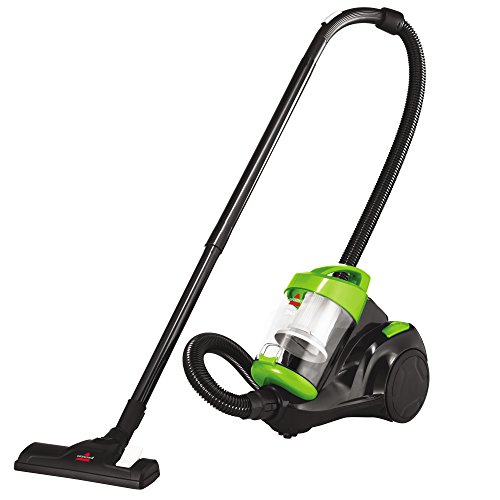
5. Bissell Zing 2156A — Best Budget
The Zing keeps the fine-rug formula — a canister body and a floorhead you guide by hand — at the budget tier of this list. Its Amazon listing title is short, simply naming it a bagless canister vacuum, so we will not dress it up with specifications the listing does not state. What the format itself gives you is what matters here: a light floorhead with no heavy motorised body pressing on the rug, a hose-and-wand setup that lets you slow down at edges and fringe, and bagless running costs of effectively zero beyond filter care.
Strengths
- Budget-tier way into the canister format that suits fine rugs.
- Bagless: no ongoing bag purchases.
- Light, simple machine that is easy to carry between rug rooms.
Trade-offs
- The listing states few specifications, so buy it for the format and price tier, not for a feature list.
- Budget canisters generally trade refinement — expect more noise and simpler fittings than the Miele and SEBO picks.
- Not the tool for deep-cleaning thick carpet elsewhere in the home.
Choose the Zing when the fine rug is one good piece in a small home, when a second dedicated rug vacuum is the plan, or when budget simply rules the decision. It will not match the filtration or finish of the premium canisters, but the core safety property — a hand-guided floorhead instead of a self-propelled beater bar — is present, and that property is most of what protects the rug.
Best for: small homes, second-vacuum duty and tight budgets. / Not suited for: buyers who want verified premium filtration and a long feature list.
Check the current price on Amazon

6. Kenmore 81214 200 Series — Best Bagged with HEPA Filtration
Kenmore’s 200 Series canister brings a specification set its listing states plainly: pet-friendly positioning aside, it is a lightweight bagged canister with HEPA filtration, a two-motor system and three cleaning tools. For fine-rug owners, the relevant reading is the bagged-plus-HEPA combination: fibres and dust pulled from a delicate rug are sealed into a bag and filtered air leaves the machine, which matters in homes where the rug itself sheds and the room doubles as a bedroom or nursery.
Strengths
- HEPA filtration and a sealed bag, per the listing, keep rug dust out of the room air.
- Lightweight bagged canister format with three included cleaning tools for edges and upholstery.
- Two-motor system per the listing, separating suction from the floorhead drive.
Trade-offs
- A two-motor system means the floorhead side needs the same caution as any driven head on fragile pieces — use the gentlest configuration for delicates.
- Bags are a continuing cost, as with all bagged picks here.
- Sits in the mid tier: neither the cheapest route nor the premium specialist.
Key specs (from the Amazon listing)
- Type: bagged canister, two-motor system
- Filtration: HEPA, per listing
- Included tools: 3 cleaning tools, per listing
This is the pick for the allergy-conscious fine-rug household: the rug gets a canister’s gentle handling, and the room gets bagged, filtered exhaust. If your rugs include both sturdy and fragile pieces, treat the driven head as a tool for the sturdy ones and use suction-focused technique — slow passes, no lingering on one spot — everywhere.
Best for: households that want bagged HEPA containment with their gentle rug care. / Not suited for: buyers avoiding ongoing bag costs.
Check the current price on Amazon
Comparison Table
| Pick | Badge | Key spec (from listing) | Best for |
|---|---|---|---|
| Miele Classic C1 Pure Suction | Best Overall | Pure suction, no brush roll; hard floors and low-pile carpet | Delicate flatweaves and low-pile wool |
| SEBO AIRBELT K2 Kombi | Best for Area Rugs Only | Kombi nozzle for bare floors and area rugs; S-class filtration; 37 ft radius | Fine rugs on hard floors |
| Miele Classic C1 Turbo Team | Best for Low-to-Medium Pile | Turbo brush; hard floors and low-med pile carpet | Sturdier fine rugs needing light agitation |
| Shark Navigator Lift-Away NV360 | Best Upright with Brushroll Shutoff | Brushroll shutoff; HEPA; 0.9 qt cup | Upright households with mixed floors |
| Bissell Zing 2156A | Best Budget | Bagless canister | Small homes and second-vacuum duty |
| Kenmore 81214 200 Series | Best Bagged with HEPA | Bagged, HEPA, two-motor, 3 tools | Dust-sensitive households |
How to Choose a Vacuum for Fine Rugs
Start with the floorhead, because that is where rugs are damaged. Straight-suction heads have no rotating brush and are the safest choice for flatweaves, silk blends and antiques. Combination heads, like the SEBO’s Kombi nozzle, add a retractable brush strip for hard floors and still keep rotating parts away from the pile. Turbo heads spin a brush with air flow and suit sturdier low-to-medium pile. Electric powerheads sit at the far end: reserve them for rugs the maker explicitly rates for beater-bar cleaning, which most fine rugs are not.
Next, suction control. A light flatweave under full suction can be pulled against the floorhead, distorting the weave and making the head drag. A dial or slider that genuinely reduces suction is a fine-rug feature, not a luxury. Related to that, weight on the head matters: canister floorheads rest lightly and are guided by your arm, while an upright puts its body weight through the head. If you choose an upright, brushroll shutoff is non-negotiable, and a lift-away pod helps for edges and stairs.
Filtration and containment come third. Fine rugs release fine dust; bagged machines with strong filtration — the SEBO’s S-class system and the Kenmore’s HEPA setup are the examples here — keep that dust out of the room. Bagless machines avoid bag costs but ask you to empty and wash filters on schedule, and their suction falls off as filters load. Finally, be honest about the rest of your home: a pure-suction specialist is a joy on rugs and hard floors and a disappointment on a plush bedroom carpet. Buy for the floors you actually have, not the ones in the showroom.
What Counts as a Fine Rug, and Why It Changes the Rules
“Fine” in rug terms usually refers to construction: a high knot count in hand-knotted wool or silk, a tight flat weave, or fibres that are lustrous but not hard-wearing. These rugs share three vulnerabilities. Their pile is short, so a brush roll reaches the foundation threads quickly. Their fibres — silk especially, and older wool — tolerate abrasion poorly. And their value is often in the surface pattern, which fuzzing destroys visually long before the rug wears through. That is why rug-care guidance for fine pieces converges on suction-only cleaning, gentle handling of fringe, and periodic back-side vacuuming to shake grit loose without touching the face with machinery. The picks in this guide were chosen to make that guidance easy to follow with mainstream machines.
How to Vacuum a Fine Rug Without Damaging It
1. Inspect first. Check for loose edges, worn spots and fragile fringe. If the foundation is cracking or the rug is a delicate antique, stop — that piece gets hand care or a specialist, not a vacuum.
2. Set the machine gentle. Choose the suction-only head or switch the brush roll off, and reduce suction for flatweaves and light rugs.
3. Work in the direction of the pile. Slow passes, with the grain of the pile rather than against it, lift dust without roughing the surface.
4. Stop at the fringe. Never roll a floorhead — powered or not — over fringe. Lift the head clear, vacuum up to the fringe line, and straighten fringe by hand afterwards.
5. Vacuum the back monthly. Turn the rug over, use the gentlest suction setting on the back to vibrate grit out of the pile, then roll the rug up, sweep the floor beneath, and vacuum the front as usual.
6. Rotate the rug seasonally. Even wear and even light exposure keep one traffic lane from ageing faster than the rest.
Common Buying Mistakes
Buying maximum suction and a powerhead “just in case”. On fine rugs, the aggressive head is the damage, and “just in case” features get used by guests, cleaners and teenagers who do not know the rule.
Assuming “carpet mode” is rug-safe. Carpet settings are tuned for cut-pile synthetic carpet. A fine rug needs the opposite end of every adjustment the machine offers.
Ignoring fringe until it tangles. Fringe damage is the most common fine-rug vacuum injury and the easiest to prevent: lift the head, every time.
Skipping the back-of-rug clean. Grit migrates to the pile base and saws at fibres from inside. Front-only vacuuming leaves the most destructive dirt in place.
Judging by the first-week result. A gentle machine’s benefit compounds quietly: less fuzzing, less edge wear, grit removed before it saws at the pile base. An aggressive machine also compounds — in the other direction. Owners who switch to suction-only cleaning often find the rug looking calmer and more even after a few months, because the surface is no longer being roughened faster than it can settle. Give the gentle method a season before deciding it is not cleaning, and judge it by the grit collected in the bag or bin, which is the honest measure of what came out of the pile.
Using a robot vacuum as the only cleaner. Robots are convenient on hard floors, but their brushes and edge behaviour are hard to control around fringe and delicate edges; treat them as a supplement at most on fine rugs, and keep them off antiques entirely.
Fine Rugs by Type: Matching the Machine to the Weave
Flatweaves — kilims, dhurries and soumaks. There is no pile to protect, but the weave itself is the surface, and it is often cotton- or wool-warp threads that a brush can fray. Suction only, at reduced power, is the whole answer: full suction can make a light flatweave ripple and drag under the head. The Pure Suction Miele and the SEBO Kombi are the natural picks, worked slowly in overlapping passes.
Low-pile wool — most modern “fine” rugs and many Persian-style pieces. A short, dense wool pile tolerates suction well and benefits from it, because grit falls to the base and abrades the fibres from inside. Pure suction handles weekly cleaning; the Turbo Team earns its place when the rug is sturdy, well-bound and walked on daily, adding mild air-driven agitation without an electric beater bar.
Silk and silk-blend rugs. Silk is strong in tension and weak against abrasion, and its sheen is the first casualty of rough handling. Treat silk pieces as suction-only at the gentlest setting, never use any rotating brush, and consider whether a valuable silk rug should be cleaned by hand-dusting and professional care instead. No pick in this guide overrides that judgement for a genuinely valuable piece.
Vintage and antique rugs. Age changes the calculation: foundation threads may be brittle even when the face looks sound. Vacuum the back at the lowest setting to loosen grit, keep the face to the lightest suction passes, and stop entirely if you see fibres or foundation dust coming away in unusual amounts. A rug specialist’s cleaning costs less than the value lost to one season of enthusiastic machine cleaning.
Hand-tufted and loop-pile lookalikes. Many affordable “fine-look” rugs are hand-tufted with a glued backing or looped rather than knotted. Loops snag: a brush roll can pull a loop into a run. These rugs belong in the suction-only group too, and aggressive suction on a failing glued backing can pull latex dust through the pile — another reason the dial-down habit matters.
Suction Control, Dust Containment and the Details That Actually Matter
It is worth understanding why suction control outranks suction power here. A vacuum’s job on a fine rug is to move air through a shallow pile and carry grit out. Beyond a moderate level, extra suction mostly presses the floorhead harder against the rug and makes the head harder to push — it does not extract proportionally more dirt from a two-millimetre pile. The useful adjustment range is therefore the low half of the dial, and a machine whose control works smoothly down there, like the Miele canisters, is better matched to fine rugs than a stronger machine with an on/off personality.
Containment is the second detail. Fine rugs release two things: the grit you want out, and fibres from the rug itself. Bagged machines seal both away; the SEBO’s S-class filtration and the Kenmore’s HEPA listing are the relevant claims in this list, and both keep the exhaust cleaner than a basic bagless bin that puffs dust back when you empty it over a bin. If you choose the bagless Shark or Bissell, empty the bin outdoors and wash filters on the maker’s schedule — a clogged filter quietly converts a gentle machine into a weak one, and owners compensate by pressing harder and moving faster, which is exactly the handling fine rugs dislike.
Third, edges and bindings. More fine rugs fail at the edges than in the field: the binding takes the floorhead’s knocks, and corners get lifted and dropped. Slow down at the perimeter, approach edges from inside the rug outward rather than driving off the edge, and never let a canister body or upright base roll onto the rug itself. These habits cost seconds and save the parts of the rug that are most expensive to repair.
What to Budget: Tier Positioning Without the Price Tag
Prices move too often to print honestly, so here is the shape of the market instead. The Bissell Zing sits at the budget tier and buys the right format with minimal frills. The Shark NV360 and Kenmore 200 Series occupy the mid tier, adding filtration and versatility. The Miele C1 models and the SEBO K2 Kombi sit in the premium tier, where the money goes on build, filtration and floorhead refinement rather than extra attachments. For a rug worth more than the vacuum — the usual situation with genuinely fine rugs — the premium canisters are not extravagance; they are insurance priced below a single professional rug repair.
A Fine-Rug Care Rhythm: Weekly, Monthly, Seasonally
Weekly. One unhurried suction pass over the face of the rug, pile direction respected, fringe left to hand care. In entryways and hallways, a second midweek pass is worthwhile because tracked-in grit is the most abrasive. Empty or check the bag or bin afterwards — a machine working against a full container loses the gentle, even suction this whole method depends on.
Monthly. The back-side clean described in the how-to section: rug over, gentlest suction on the back, floor swept beneath, face vacuumed as usual. This is also the moment to inspect the pad underneath. A rug pad protects the rug from floor abrasion and keeps it from creeping, but a crumbling pad sheds granules that migrate into the pile; replace a pad that is breaking down rather than vacuuming its remains out of your rug forever.
Seasonally. Rotate the rug a half-turn so traffic and sunlight move to different areas. Check the whole surface in good light for moth activity in wool rugs — look for small bare patches and webbing along the edges, especially under furniture — and address any finding promptly, since moth damage, not vacuuming, is the other great destroyer of stored and undisturbed wool. Deep washing belongs to professionals for genuinely fine pieces; home washing of a hand-knotted or silk rug risks dye bleed, shrinkage and foundation damage that no vacuum guide can undo.
When something spills. Blot, never scrub, and keep the vacuum away until the area is fully dry — damp pile plus suction pulls fibres and can set a stain’s edges. Once dry, a gentle suction pass lifts loosened residue. The instinct to “vacuum it out” while wet is understandable and wrong for fine fibres.
Canisters vs Uprights for Fine Rugs, Settled Honestly
The canister case rests on control: the part touching the rug weighs little, your arm sets the pressure, and lifting over fringe or a threshold is a flick of the wrist. The upright case rests on consolidation: one machine, stored in one closet, that also handles the carpeted bedrooms. Both cases are legitimate. What is not legitimate is the middle path many owners drift into — an upright with a powerful fixed brush used on the fine rug “just quickly”. Every pick in this guide was chosen to close off that drift: the canisters have no aggressive head to drift to, and the one upright included has its shutoff stated in its own listing, so the safe mode is a designed mode rather than a workaround.
Storage and handling deserve a sentence too. Canister wands and floorheads should be stored off the rug, not resting on it, and hoses should not be dragged across fringe. Small disciplines, but fine rugs are long-lived objects that meet your habits thousands of times; the habits are the maintenance programme.
Reading a Vacuum Listing Like a Rug Owner
Listings are written to sell cleaning power, so a fine-rug buyer has to translate. “Deep cleans carpet” usually means an aggressive powered brush — a warning, not a promise, for your purposes. “For hard floors and low-pile carpet”, the phrasing on the Miele Pure Suction listing, is the dialect you are listening for: it tells you the floorhead was designed for exactly your surfaces. “Brushroll shutoff”, stated on the Shark NV360 listing, is the upright equivalent. “Made for bare floors and area rugs only”, on the SEBO Kombi listing, is the most honest sentence of all, because it tells you what the machine refuses to do.
Two more translation rules. First, treat wattage and suction statistics as near-irrelevant for this job; you will run the machine turned down, so the useful range is the bottom of the dial, and smoothness there beats a bigger number at the top. Second, weigh the floorhead list more than the attachment count: a crevice tool and an upholstery nozzle, like those named on the Shark and Kenmore listings, genuinely help at rug edges and on the stairs beside them, while a dozen novelty attachments add closet clutter and nothing to rug safety. Read every listing this way — floorhead first, control second, filtration third, everything else as decoration — and the right machine usually identifies itself, which is precisely how the six picks above were sorted.
Final Recommendation
For most fine-rug owners, the Miele Classic C1 Pure Suction is the answer: no brush roll, listing-verified positioning for hard floors and low-pile carpet, and suction you can soften for the most delicate pieces. If your rugs live on bare floors and you value a specialist, the SEBO AIRBELT K2 Kombi is the connoisseur’s choice, and the Turbo Team covers sturdier low-to-medium pile. Upright households should take the Shark NV360 and build the brushroll-shutoff habit; tight budgets point to the Bissell Zing; dust-sensitive homes to the Kenmore 200 Series.
Related guides in this series: Best Vacuum For Fluffy Rugs, Best Vacuum For Loose Woven Rugs, Best Inexpensive Vacuum For Low Pile Rugs, Best Canister Vacuum For Rugs, Best Vacuum To Use On Area Rugs, Best Miele Vacuum For Rugs.
Frequently Asked Questions
Can I use a regular upright vacuum on a fine rug?
Only with the brush roll switched off, and only on a rug in sound condition. A spinning beater bar fuzzes delicate pile and can tear fringe. If your upright has no shutoff, keep it off fine rugs entirely and use a suction-only canister instead.
Is suction alone enough to clean a low-pile rug?
For low-pile and flatwoven rugs, yes — the pile is short, so airflow reaches the base where grit sits. Slow passes matter more than raw power. Denser low-to-medium pile may benefit from a gentle air-driven turbo head.
How often should a fine rug be vacuumed?
Once a week for the face with gentle suction is a sensible rhythm for walked-on rugs, with a back-side clean about once a month. Hallway runners and entry rugs may need a second light pass midweek.
What should I do about fringe?
Never run a floorhead over it. Vacuum up to the fringe line, lift the head, and comb the fringe straight with your fingers or a wide brush afterwards. Tangled fringe is a hand task, not a machine task.
Are bagged vacuums better for fine rugs?
Not inherently — the floorhead decides rug safety. Bags do help containment: fibres and fine dust are sealed away, and suction stays consistent as the bag fills, whereas bagless filters need regular washing to hold performance.
Should I use a rug pad under a fine rug?
Yes — a good pad protects the rug’s back from floor abrasion, stops creeping that wrinkles the weave, and adds a layer that keeps grit from grinding between rug and floor. Choose a pad that is not sticky with adhesives that can transfer to the rug or floor, trim it slightly smaller than the rug so it stays hidden, and replace it when it starts to crumble.
Why does my fine rug shed fibres when I vacuum?
Some shedding is normal for new wool rugs as loose surface fibres work free, and gentle suction removes them without harm. Shedding that increases over time, or that comes with visible thinning, usually means the cleaning is too aggressive — check that no brush roll is running, reduce suction, and slow your passes down. Persistent heavy shedding on an older rug can signal fibre degradation, which is a specialist conversation.
Can a robot vacuum clean my fine rugs?
We would not make a robot the primary cleaner for valuable fine rugs. Brush behaviour and fringe encounters are hard to supervise, and a snagged fringe can be pulled before you notice. Use the canister picks here for the rugs and save robots for hard-floor upkeep.


