Disclosure: airfryerkitchensupply.com is reader-supported. When you buy through links on our site, we may earn an affiliate commission at no extra cost to you.
Where to buy
All six canister vacuums in this guide are sold on Amazon, where you can compare the current configuration, included floorheads, and bag or filter packs before ordering. Canister models are frequently sold in several variants that differ only in the included floorhead, so use the Check on Amazon link under each review and confirm the floorhead named in the review is the one in the listing you choose. If you are replacing an older canister, order a pack of bags or a spare filter at the same time — the first bag fills faster than you expect in a home that has gone a while between deep cleans.
Introduction
Shoppers looking for the best new canister vacuums usually mean one of two things: the newest models the major brands have released, or simply a new machine to replace the tired one in the closet. This guide serves both readings honestly. It leads with Miele’s current Guard L1 generation — the newest canister line in this roundup — and rounds out the list with the strongest current-production canisters from Kenmore, SEBO, Dyson, Eureka, and Bissell, each confirmed against Amazon’s catalog data before inclusion. Canisters keep winning a loyal following for good reasons: the motor weight sits on the floor instead of in your hand, the long hose and wand reach under furniture and up stairs without gymnastics, and a good canister is quieter and longer-lived than most uprights. What separates the six machines below is floorhead design, filtration, and how much vacuum you actually need for your floors — not raw suction numbers, which every brand inflates in its own way.
It is also worth saying what this guide is not: it is not a ranking of every canister sold, and it does not pretend that a budget apartment machine and a premium German canister are rivals. They answer different questions. Read the badges as job descriptions — pet hair, lightweight, bagless, premium — and the right machine for your home will usually identify itself before you reach the comparison table.
A quick orientation before the picks. Bagged canisters (Miele, Kenmore, SEBO, Eureka, Bissell Zing in its bagged form) trap dust in a sealed bag you replace every month or two; they are the better choice for allergy-sensitive households and for people who hate emptying dusty bins. Bagless canisters (the Dyson here) save the ongoing bag cost but ask you to empty a bin and wash filters on schedule. Floorheads matter more than motor watts: a powered brushroll head is what cleans medium and high carpet, a parquet or hard-floor brush is what protects wood and tile, and a turbo brush is the middle path for low pile and rugs. Every pick below states plainly which floors it is built for, so match the machine to your floors first and your budget second.
In this guide
Quick Picks
- Best Overall / Newest Line: Miele Guard L1 Allergy Bagged Canister Vacuum with HEPA Filter — Miele’s current-generation canister with sealed HEPA filtration. Check the current price on Amazon
- Best for Pet Hair: Kenmore 600 Series 81615 Pet Friendly Bagged Canister Vacuum — powered Pet PowerMate head, two-motor suction, HEPA filtration. Check the current price on Amazon
- Best Premium: SEBO Airbelt K3 Premium Canister Vacuum — German-built, powered ET-1 head, and a long motor warranty stated in the listing. Check the current price on Amazon
- Best Bagless: Dyson Big Ball Multi Floor Canister Vacuum — self-righting ball design and no bags to buy. Check the current price on Amazon
- Best Budget: Eureka Bagged Canister Vacuum 3670H — the simple, light, inexpensive canister that has cleaned apartments for years. Check the current price on Amazon
- Best Lightweight: Bissell Zing Lightweight Bagged Canister Vacuum 2154A — a carry-it-anywhere canister for small spaces and quick jobs. Check the current price on Amazon
How These Picks Were Chosen
Every candidate was cross-checked against Amazon’s product catalog data to confirm the model, configuration, and floorhead described in the listing title, and only current listings with a confirmed identity made the cut. We then applied the filters that matter for canister ownership. First, floor coverage: a pick must state what it cleans — hard floors, low pile, or real carpet with a powered head — and vague “all floors” claims were read skeptically. Second, filtration: sealed systems and HEPA-rated filtration were favored because a canister’s exhaust blows at floor level where you breathe the room’s lowest air. Third, ownership cost and effort: bag capacity, cord length and retraction, weight, and whether the machine’s consumables are standard and easy to source. Fourth, serviceability: brands with established parts networks (Miele, SEBO, Kenmore) scored ahead of anonymous imports whose titles pile up wattage claims but name no model. The result is a list with no anonymous machines at all — six named models from six established brands, spread across bagged and bagless, premium and budget, so the right choice is a matter of matching floors and habits rather than gambling on an unknown.
One deliberate exclusion: the many 12-volt automotive canister vacuums that appear in catalog searches are car accessories, not home canisters, and none appears here. Likewise, wet/dry shop-style canisters were left out — they are useful garage tools but the wrong machines for finished floors and carpet. This guide is about the home canister category as buyers mean it.
The 6 Best New Canister Vacuums

Miele Guard L1 Allergy Bagged Canister Vacuum with HEPA Filter — Best Overall / Newest Line
The Guard L1 is Miele’s current-generation canister line, and the Allergy configuration is the one most households should look at first: a bagged canister with HEPA filtration, built on Miele’s long-standing formula of a sealed body, a large-capacity bag, and floorheads engineered for both hard floors and low-to-medium carpet. It suits buyers who want one machine for a mixed-floor home and who value clean exhaust air — the “Allergy” in the name reflects the filtration focus, and the sealed bag system means the dust you collected leaves the house in a closed bag rather than a cloud over the trash can. It is less suited to deep high-pile carpet households unless you choose a configuration with a powered electrobrush floorhead, and it sits in the premium tier, so budget-first buyers should look further down this list.
Strengths
- Current-generation Miele line with HEPA filtration and a sealed bagged system for clean emptying.
- Miele’s build quality and parts support are the benchmark in the canister category.
- Quiet, composed running character compared with most uprights and budget canisters.
Trade-offs
- Premium-tier pricing, and Miele bags and filters are a real ongoing cost.
- Hard-floor-focused configurations will not satisfy deep-carpet homes; check the floorhead in the listing.
- Heavier than the lightweight picks when carried up stairs, despite the smooth casters.
Key specs: Bagged canister; HEPA filter; Allergy configuration; Miele Guard L1 line.
What you are buying with a Miele is a decade-scale appliance. The canister body rolls on casters that track straight, the hose and wand connections click together with a precision the budget brands do not match, and suction stays strong as the bag fills because the bag material is engineered as part of the airflow path. In a home with wood or tile plus area rugs — the most common flooring mix — the Guard L1 Allergy is the complete answer: gentle on hard floors, capable on rugs, and kind to the air. Choose the Cat & Dog or deep-carpet sibling configurations only if your floors demand them; for the typical mixed home, this is the pick to beat.
Best for: mixed-floor homes wanting sealed HEPA filtration and long service life / Not suited for: tight budgets or deep high-pile carpet without the powered-head configuration
Check the current price on Amazon
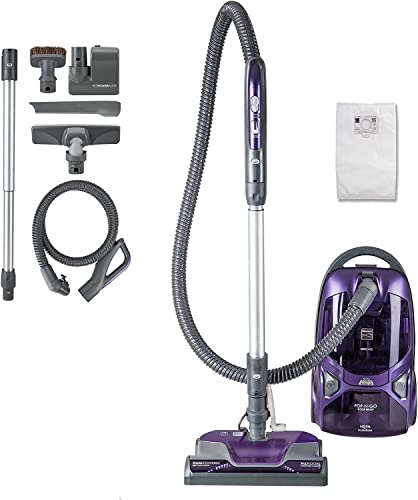
Kenmore 600 Series 81615 Pet Friendly Bagged Canister Vacuum — Best for Pet Hair
Kenmore’s 600 Series is the workhorse answer for pet households: a bagged canister with a two-motor system, a powered Pet PowerMate floorhead for carpet, HEPA filtration, and a retractable cord. The powered head is the story — pet hair woven into carpet pile needs a rotating brushroll to release it, and the 600 Series brings that plus a smaller powered tool tradition for upholstery and stairs. It suits dog and cat owners with real carpet, and anyone whose floors mix carpeted rooms with hard surfaces. It is more machine than a hard-floor-only apartment needs, and its size and weight reflect the two-motor design.
Strengths
- Pet PowerMate powered floorhead pulls embedded hair from carpet that suction alone leaves behind.
- Two-motor design keeps brushroll performance independent of suction settings.
- HEPA filtration and bagged emptying suit pet-dander-sensitive households.
Trade-offs
- Bigger and heavier than the lightweight picks; stairs take planning.
- Bagged system means ongoing bag purchases.
- More floorhead than hard-floor-only homes will ever use.
Key specs: Bagged canister; 2-motor system; Pet PowerMate powered head; HEPA filter; retractable cord.
In practice, the 600 Series earns its place during shedding season, when a suction-only vacuum leaves a visible shadow of hair on the carpet no matter how many passes you make. The powered head changes that in one pass. The retractable cord and onboard tool storage keep it tidy between sessions, and Kenmore’s long presence in the category means bags and belts are easy to find. If your home is mostly hard floors with a shedding pet, the Miele above is gentler; if carpet and pets define your cleaning problem, this is the machine built for it.
Best for: pet owners with carpeted rooms / Not suited for: small hard-floor apartments or buyers avoiding bag costs
Check the current price on Amazon

SEBO Airbelt K3 Premium Canister Vacuum — Best Premium
SEBO is the connoisseur’s canister brand: German-made, sold through specialty dealers for decades, and built like commercial equipment. The Airbelt K3 Premium pairs the canister with the ET-1 powerhead for pet hair and carpets, a parquet floor brush for hard floors, a 37-foot operating reach, and a 7-year motor warranty stated in the listing — a warranty figure that tells you how SEBO expects the machine to age. The soft airbelt bumper around the body protects furniture and walls from the bumps every canister eventually delivers. It suits buyers who keep appliances for a very long time and want dealer-grade engineering. It is priced accordingly, in the premium tier, and its bags and parts follow specialty-channel pricing too.
Strengths
- ET-1 powered head plus a dedicated parquet brush — the full floor range in one kit.
- 7-year motor warranty stated in the listing signals commercial-grade build intent.
- Airbelt bumper protects furniture; 37-foot reach means fewer outlet changes.
Trade-offs
- Premium-tier price and premium consumable costs.
- Utilitarian styling; this is equipment, not décor.
- Heavier, more deliberate handling than the lightweight picks.
Key specs: Bagged canister; ET-1 powerhead; parquet brush included; 37-foot operating radius; made in Germany.
The K3 is the pick for the buyer who has replaced a cheap vacuum every few years and is done with that cycle. Everything about it — the belt-protected brushroll, the sealed filtration path, the hospital-quiet motor tuning — is engineered for service life and serviceability. If your home mixes delicate hardwoods with real carpet, the two-floorhead kit means you never compromise on either surface. It is overkill for a first apartment; it is exactly right for a long-term home.
Best for: long-term owners with mixed delicate floors and carpet / Not suited for: budget buyers or anyone who moves frequently
Check the current price on Amazon

Dyson Big Ball Multi Floor Canister Vacuum — Best Bagless
Dyson’s Big Ball is the bagless entry: a canister built around a ball body that self-rights when it topples — a small thing that anyone who has dragged a canister around a corner will appreciate — with Dyson’s cyclone separation keeping suction consistent as the bin fills, and no bags to buy, ever. The Multi Floor configuration targets the common mix of hard floors and carpet. It suits buyers who dislike consumable costs and prefer to see exactly what the machine picked up. It asks more of you in maintenance: the bin needs regular emptying (ideally outside), and filters need washing on schedule to keep performance where it should be.
Strengths
- No bags — zero consumable cost for the dust-collection side of ownership.
- Self-righting ball design recovers from the topples that happen on every cleaning run.
- Cyclone separation maintains suction as the bin fills better than old bagless designs.
Trade-offs
- Bin emptying releases more dust than a sealed bag — a real consideration for allergy-sensitive users.
- Filter washing is mandatory maintenance, not optional.
- Bagless bins are smaller than bagged capacity; big homes empty mid-clean.
Key specs: Bagless canister; ball body, self-righting; Multi Floor configuration; corded.
The Big Ball is the right answer for a specific owner: hard-floor-heavy home, no allergy issues, hates buying bags, and actually enjoys a machine that feels engineered. On carpet it performs respectably for a suction-led design, though the powered-head bagged picks above dig deeper in pile. Keep the filter washed and the bin emptied below the max line and it will run consistently for years.
Best for: bag-free ownership in hard-floor-heavy homes / Not suited for: allergy-sensitive households or deep-carpet cleaning
Check the current price on Amazon

Eureka Bagged Canister Vacuum 3670H — Best Budget
The Eureka 3670H is the budget classic of the category: a lightweight bagged canister with honest suction, a blower function, and a design that has served apartments, dorms, and second homes for years. It comes with bags in the box and asks very little of its owner. It suits hard floors, low rugs, cars and garages as a second machine, and any space where a full-size premium canister would be wasted. It will not deep-clean medium carpet — there is no powered brushroll — and its plastics and fittings feel budget-grade because they are. Within its brief, nothing at its tier does the job more simply.
Strengths
- Budget-tier price for a real, named-brand bagged canister.
- Light and simple — easy to carry, easy to store, easy to lend to a teenager.
- Blower function clears leaves from a porch or dust from a workshop bench.
Trade-offs
- Suction-only cleaning; not a medium- or high-pile carpet machine.
- Basic filtration compared with the HEPA picks above.
- Shorter cord and reach than the premium models.
Key specs: Bagged canister; model 3670H; suction plus blower; lightweight body.
Every category needs its honest cheap option, and this is the canister category’s. Buy it for what it is — a light, bagged floor-and-rug vacuum for hard-surface homes — and it will satisfy. Ask it to groom deep carpet and it will disappoint, but that is a mismatch of brief, not a failure of the machine. For a first apartment or a vacation home, it is frequently the smartest money in this entire guide.
Best for: apartments, dorms, second homes, hard floors and low rugs / Not suited for: deep carpet or allergy-grade filtration needs
Check the current price on Amazon
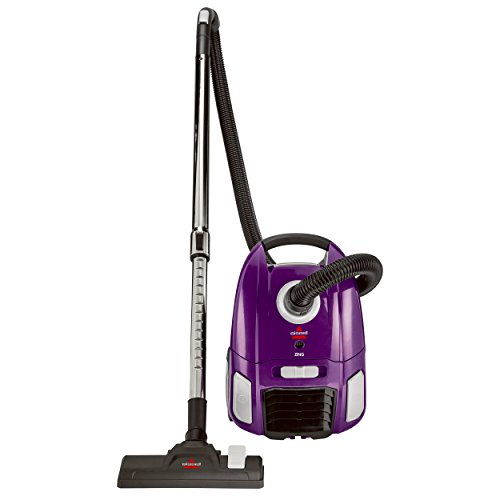
Bissell Zing Lightweight Bagged Canister Vacuum 2154A — Best Lightweight
The Bissell Zing (2154A, in its purple bagged configuration) is the canister you carry like a tote: a compact bagged body made for quick cleanups, small apartments, stairs, and above-floor jobs where a full-size machine is pure friction. It suits small-space living, older users who cannot wrestle a heavy vacuum, and anyone who wants a second machine that lives in a closet near the mess. The trade-offs are the expected ones: a compact bag, a compact reach, and suction-only floor cleaning. For hard floors and low rugs in small spaces, that brief is not a compromise at all.
Strengths
- Genuinely light and compact — the easiest carry in this guide.
- Bagged emptying keeps quick cleanups dust-contained.
- Simple controls and handling suit shared and multi-user homes.
Trade-offs
- Small bag capacity fills quickly in larger homes.
- No powered head; low-pile and hard floors only.
- Shorter hose and cord than full-size canisters.
Key specs: Bagged canister; model 2154A; lightweight compact body; hard floor and low-rug brief.
The Zing’s virtue is frequency: because it is effortless to grab, floors get vacuumed more often, and a home vacuumed twice a week with a light machine is cleaner than a home vacuumed twice a month with a perfect one. Pair it with a deeper machine for seasonal carpet work, or let it be the whole solution in a small hard-floor flat. Either way, it earns its closet space.
Best for: small apartments, stairs, quick daily cleanups, lighter-strength users / Not suited for: large homes or real carpet cleaning
Check the current price on Amazon
Comparison Table
| Pick | Badge | Key spec | Best for |
|---|---|---|---|
| Miele Guard L1 Allergy | Best Overall / Newest Line | Bagged, HEPA filter | Mixed floors, clean exhaust air |
| Kenmore 600 Series 81615 | Best for Pet Hair | Bagged, 2-motor, Pet PowerMate head | Pets plus carpet |
| SEBO Airbelt K3 Premium | Best Premium | ET-1 powerhead, parquet brush, 37-ft reach | Long-term mixed-floor homes |
| Dyson Big Ball Multi Floor | Best Bagless | Bagless, self-righting ball body | No-consumable ownership |
| Eureka 3670H | Best Budget | Bagged, lightweight, blower function | Apartments and second homes |
| Bissell Zing 2154A | Best Lightweight | Bagged, compact tote-style body | Small spaces and quick jobs |
Key Takeaways
- Match the floorhead to your floors first: powered brushroll for real carpet, parquet brush for delicate hard floors, suction-only for low rugs and hard surfaces.
- Bagged canisters with sealed HEPA systems are the cleaner-air choice; bagless saves consumable cost but demands filter discipline.
- “New” in this category means the current generation of a proven line — maturity and parts support beat novelty every time.
- Miele’s Guard L1 is the newest line here; SEBO and Kenmore remain the long-service benchmarks; Eureka and Bissell own the honest budget end.
- Suction wattage claims are the least useful number in the category — floorhead, filtration, and build decide real performance.
- Judge daily livability by noise, wand weight, and parking size — the specs you will feel every single week.
- A light maintenance rhythm (bag, brushroll, filter, hose) prevents nearly every case of “lost suction” owners report.
How to Choose a Canister Vacuum
Begin with an honest floor inventory. Count your surfaces: wall-to-wall carpet (and its pile height), area rugs, wood, tile, laminate. A home that is 80% hard floor should buy a hard-floor specialist with a soft brush and stop worrying about carpet specs; a home with carpeted bedrooms needs a powered head in those rooms or the carpet never truly gets clean. Mixed homes — the majority — are exactly what the Miele and SEBO kits are built for, with a floorhead per surface.
Next decide bagged versus bagless as a lifestyle choice, not a spec. Bagged costs a modest amount per year and gives you sealed, hygienic emptying and consistently strong suction as the bag fills. Bagless costs nothing per change but asks you to empty a dusty bin and wash filters on schedule; skip the washing and performance fades in a way owners often misdiagnose as the machine “dying.” Neither is wrong; be honest about which maintenance you will actually do.
Then weigh the ownership details that spec sheets bury: cord length and retraction (a retractable cord is a daily pleasure), operating radius (SEBO’s 37 feet means one outlet per floor in many homes), weight split between body and wand (canisters put the motor on the floor, which is why they suit users who cannot push a heavy upright), and consumable availability. A vacuum whose bags are stocked everywhere is a vacuum you will still be using in ten years. Finally, set the budget by tier: budget tier for secondary spaces, mid tier for the main family machine, premium tier when you are buying the decade-long answer — and spend premium money on build and filtration, not on novelty features.
One last consideration is who else will use the machine. A canister is shared equipment in most homes, and the best choice accounts for the weakest pair of hands that will run it. If a teenager does the weekend clean, the Zing’s simplicity or the Kenmore’s onboard tools will get the job finished; if a grandparent helps out, wand weight and a composed noise profile matter more than any performance figure. Conversely, the enthusiast who deep-cleans monthly will extract full value from the SEBO’s two-head kit and long reach. There is no household-neutral vacuum — there is only the vacuum that fits the people and floors in yours, which is why this guide spreads its six picks across such different briefs instead of crowning one machine for everyone.
Bagged vs. Bagless, and What HEPA Actually Buys You
Filtration language is where vacuum marketing gets slippery, so here is the plain version. A HEPA filter captures very fine particles, but it only delivers clean exhaust if the system around it is sealed — otherwise dust leaks out through seams before it ever reaches the filter. That is why this guide favors machines that pair HEPA filtration with a sealed, bagged path: the bag itself is the first and largest filter, and it leaves the house closed. In a bagless machine, filtration depends on cyclones plus a washable filter, and every bin emptying is a small dust event. For a household managing asthma or pet dander seriously, sealed bagged is the defensible choice; for everyone else, it is a preference about maintenance style. What you should not do is pay a premium for the letters “HEPA” on an unsealed budget machine — the filter cannot fix the leaks.
How to Use a Canister Vacuum for a Whole-Home Clean
- Step 1: Walk the route first — pick up small objects, cables, and pet toys so the floorhead never has to stop.
- Step 2: Start at the far end of the home and work toward the exit, vacuuming yourself out of rooms rather than into corners.
- Step 3: Use the crevice tool and dusting brush above the floor first — shelves, baseboards, vents — so dislodged dust falls to the floor you are about to vacuum, not onto a clean one.
- Step 4: Vacuum carpet in slow, overlapping rows; the powered head needs dwell time to lift embedded grit. Hard floors take a faster pass with the parquet or hard-floor head.
- Step 5: Do stairs from the bottom up with the body parked safely at the base or on a wide step, using the upholstery tool on treads.
- Step 6: Finish by checking the bag or bin and the brushroll for wrapped hair — two minutes now prevents the slow performance fade owners blame on the motor.
Floorheads Decoded: The Part That Actually Cleans
If you remember one thing from this guide, make it this: the floorhead, not the motor, decides how clean your floors get. A powered electrobrush or powerhead spins a brushroll that agitates carpet fibers, loosening the grit and hair that suction alone skates over. That is the Kenmore’s Pet PowerMate and SEBO’s ET-1, and it is non-negotiable equipment for carpeted homes. A parquet or hard-floor brush does the opposite job: soft bristles and a wide, gentle path that sweeps hard floors without scattering debris or scratching finishes — the correct tool for wood, tile, and laminate, and the head most buyers should have on the wand most of the time in a hard-floor home. Turbo brushes sit between the two: an air-driven brushroll that helps on low pile and rugs without a second motor, common in Miele’s rug-and-low-carpet configurations. Combination rug/floor tools — the pedal-switched heads on budget machines like the Eureka — are the honest economy answer: adequate on both surfaces, master of neither.
Two practical consequences follow. First, when a canister is sold in several configurations, you are really choosing floorheads, and the cheapest configuration with the wrong head is worse value than the right head at a higher tier. Second, floorheads are wear items and upgrades: a budget canister can gain a better hard-floor brush later, but a suction-only machine can never gain a powered head it was not wired for. Buy the electrical capability your carpets need on day one; accessorize the rest over time.
The Real Cost of Owning a Canister
Sticker price is the smallest part of canister economics. A bagged premium machine will consume bags and filters across its life — a modest, predictable sum each year — and in exchange it will likely still be running, with parts available, a decade from now. A budget machine costs little today and may be replaced two or three times in that same decade, each replacement cheap and each landfill-bound. Bagless shifts the cost from money to time: no bags to buy, but filters to wash, bins to empty carefully, and seals that need the occasional wipe to keep the system honest. None of these profiles is wrong; they suit different owners. The mistake is buying the premium machine and then starving it of genuine bags (ill-fitting generics leak at the collar and quietly defeat the sealed system), or buying the budget machine for a 3,000-square-foot carpeted house and blaming the category when it struggles. Match the machine’s economics to your home’s size and your own maintenance temperament, and any of the six picks here will feel like money well spent.
Service networks deserve a sentence of their own. Miele and SEBO sell through dealer networks that stock parts and employ technicians who know the machines; Kenmore’s long retail history means bags and belts are everywhere; Dyson supports its machines directly; Eureka and Bissell consumables are commodity items. When a vacuum is a ten-year appliance, that support map matters as much as any suction figure — and it is a large part of why this guide contains no anonymous imports, however dramatic their wattage claims.
Common Buying Mistakes
- Buying suction-only for real carpet. Without a powered brushroll, medium pile keeps its embedded dirt and hair no matter the wattage.
- Chasing wattage and “Kpa” claims. Anonymous high-number listings rarely name a serviceable model; floorhead and build decide cleaning.
- Ignoring consumables. Bags, belts, and filters are the lifetime cost and the lifetime availability question — check both before buying.
- Choosing bagless with allergies in the house. Bin emptying is a dust event; sealed bags exist precisely for this household.
- Forgetting the stairs test. A canister you cannot carry or park safely on your staircase is the wrong canister, whatever its specs.
- Skipping filter maintenance on bagless models. An unwashed filter is the number one cause of “my vacuum lost suction.”
- Buying for the home you wish you had. A powered-head carpet machine for a hard-floor flat — or a suction-only toy for a carpeted house — is money spent against your actual floors.
A Short Word on “New”: Model Years in the Vacuum Aisle
Vacuum model cycles do not work like phone releases, and buyers hunting the “newest” canister should know what new actually means here. The established brands revise lines slowly: Miele’s Guard series is the current generation succeeding its long-running Complete and Compact families, which is why the Guard L1 leads this guide as the genuinely new design. SEBO and Kenmore refine proven platforms rather than replacing them — a K3 or a 600 Series bought today is a mature design with the bugs long engineered out, and in appliances that maturity is a feature, not staleness. Dyson iterates its bagless formats on its own cadence, with the Big Ball remaining its canister expression. The practical advice: buy the current generation of a proven line, be suspicious of “new” anonymous models whose novelty is a bigger wattage number, and remember that a canister is a ten-year purchase — the support network behind the model will matter long after its launch date is forgotten. That is the standard this guide applied, and it is why every pick here carries a brand and model you can buy bags for in five years.
Final Recommendation
Most buyers should start with the Miele Guard L1 Allergy: it is the newest line in this guide, its sealed HEPA bagged system suits the widest range of homes, and Miele’s service life justifies the premium tier. Pet owners with carpet should step sideways to the Kenmore 600 Series and its powered Pet PowerMate head. Buyers purchasing for the long term across delicate floors should look at the SEBO K3. If bags offend you, the Dyson Big Ball is the credible bagless route; if the budget rules, the Eureka 3670H and Bissell Zing cover apartments and quick-clean duty honestly. For narrower briefs, see Best Canister Vacuums For Pet Hair, Best Canister Vacuums For Medium Pile Carpet, and Best Bagged Vacuums For Allergies. Brand-focused shoppers can compare Best Bissell Canister Vacuums and Best And Lightest Miele Vacuums.
Noise, Weight, and Storage: The Daily-Living Specs
Three qualities decide whether you will like living with a canister, and none of them headline a spec sheet. Noise first: canisters are generally the quietest full-size format because the motor sits in an insulated body on the floor, away from your ears, and the premium machines here — Miele and SEBO in particular — are tuned to a composed hum rather than a shriek. If you clean around sleeping children, calls, or a nervous pet, that tuning is worth real money. Weight second: judge a canister by what you lift, not what it weighs in total. The body rolls; you lift it only for stairs and storage. The wand-and-head assembly is what your arm actually carries, and the light picks — Zing and Eureka — keep even the body trivial. A heavy upright punishes every pass; a canister punishes only the staircase, so be honest about your stairs.
Storage third: a canister wants a closet corner where body, hose, and wand park together. Machines with onboard tool storage and a retractable cord — the Kenmore here, and the premium pair — park neatly and deploy in seconds; budget models with loose tools and manual cord wraps take a little more Tetris. Measure your intended closet before falling for the largest machine: the best vacuum is the one that fits your storage, your stairs, and your floors, in that order of daily annoyance. Buyers in small apartments should weight the Zing and Eureka far above their spec sheets, because a compact machine that lives happily in a small home gets used constantly — and used constantly beats perfect occasionally, every week of the year.
Keeping a Canister at Full Strength: A Simple Maintenance Rhythm
Canisters rarely die suddenly; they fade. The fade is almost always maintenance debt, and a light rhythm prevents it. Monthly: check the bag or bin and change or empty before it is packed — airflow, not the motor, is what a full bag strangles. Check the brushroll for wrapped hair and thread, and snip it free; a strangled brushroll is the top cause of “it stopped picking up.” Quarterly: inspect or wash filters as your system requires — bagged machines typically want a pre-motor filter check and an exhaust filter on a longer cycle, bagless machines want their washable filter rinsed and fully dried before it goes back. Twice a year: wipe the bag compartment and bin seals, check the hose for a partial clog by dropping a coin through it, and look at the floorhead’s wheels and bristles for wear. That is the whole program — perhaps twenty minutes a quarter — and it is the difference between a machine that feels new in year five and one that gets replaced in year three. When suction drops suddenly, troubleshoot in order: bag or bin, filter, hose clog, brushroll. It is nearly always one of the four, and almost never the motor.
Where a Canister Fits Among Uprights and Robots
Buyers cross-shopping formats should think in terms of jobs, not winners. A robot vacuum — covered in our companion guide to automated floor vacuums — is a maintenance tool: it keeps hard floors presentable between real cleans and cannot do stairs, upholstery, or deep carpet. An upright is a carpet sprinter: fast across open carpeted rooms, clumsy on stairs and under furniture, and heavy in the hand by design. A canister is the generalist and the detailer: stairs, upholstery, curtains, car interiors, hard floors, and carpet all in one machine, with the motor’s weight on the floor. Homes that can own one vacuum should usually own the canister; homes that own two often pair a canister with a robot for daily upkeep. What a canister will not do is clean while you are out — that is the robot’s whole appeal — so the honest question is whether you want automation for light daily work or capability for thorough weekly work. This guide assumes the latter; if your heart is set on automation, read the robot guide and keep a canister like the Eureka or Zing as the detail partner.
Frequently Asked Questions
Are canister vacuums better than uprights?
For mixed floors, stairs, and above-floor cleaning, generally yes: the motor weight rides on the floor, the wand reaches under furniture, and canisters are typically quieter. Uprights can be quicker for large open carpet. Most households that switch to a good canister do not switch back.
How often do canister bags need changing?
With the large bags on machines like the Miele and SEBO, typically every one to two months in an average home — sooner with shedding pets or renovation dust. Change on fullness and suction feel, not the calendar, and never try to empty and reuse a bag; the pores clog and airflow suffers.
Do I need a powered floorhead?
If you have wall-to-wall carpet of low-medium pile or deeper, yes — a rotating brushroll is what releases embedded dirt and hair. For hard floors and flat rugs, a suction head or parquet brush is not a compromise; it is the correct tool and gentler on the surface.
Is the Dyson Big Ball good for allergies?
Its filtration is respectable while running, but emptying the bin exposes you to the collected dust. Allergy-managed households are usually better served by a sealed bagged machine like the Miele Guard L1 Allergy, where the full bag leaves the house closed.
Are expensive canisters worth it over budget ones?
If the machine is your home’s only vacuum and your floors include carpet or delicate wood, the premium tier repays itself in filtration, floorhead quality, quietness, and a service life measured in decades rather than years. If the job is a small hard-floor flat, the honest answer flips: the Eureka or the Zing will clean it completely, and the premium money is better spent elsewhere. Worth is a function of the brief, which is why this guide refuses to name a single winner for every home.
How long should a good canister last?
Premium canisters from Miele and SEBO are built for a decade or more of service with bags, filters, and the occasional belt — SEBO states a 7-year motor warranty on the K3. Budget models trade that longevity for price, which is a fair trade in a dorm or second home.
What about above-floor cleaning — upholstery, curtains, cars?
This is where canisters quietly outclass every other format. The hose and wand that do your floors also do sofas, mattresses, car interiors, ceiling corners, and the tops of wardrobes, with small tools that store on or near the body. The Kenmore’s powered pet tool tradition makes short work of upholstery hair; the light Eureka and Zing are natural car and garage machines. If your cleaning includes anything above ankle height, a canister is not one option among many — it is the format the job assumes.
Can a canister vacuum clean stairs well?
Yes — it is one of the format’s strengths. The body stays parked while the hose and a small tool do the treads. Light models like the Bissell Zing can sit on a wide step; larger bodies work best from the base with a long hose.

