Disclosure: airfryerkitchensupply.com is reader-supported. When you buy through links on our site, we may earn an affiliate commission at no extra cost to you.
Where to buy
Every pick below was confirmed against Amazon’s own catalogue data before it earned a link, so the pack counts, sizes and cotton claims in this guide are the ones attached to the actual listings. Flour sack towels are a commodity product sold by dozens of near-identical labels, which makes the listing details — hemmed edges, exact dimensions, ring-spun versus ordinary cotton — the only honest way to separate them. Use the links in this box to check the current price on Amazon for each set; prices are never printed in this guide because they move too often to stay accurate.
- Utopia Kitchen White Flour Sack Towels, 12 Pack, 28 x 28 Inch — check price on Amazon
- Avalon Kitchen Flour Sack Towels, 15 Pack, 28 x 28 Inch — check price on Amazon
- Simpli-Magic Flour Sack Kitchen Towels, 12 Pack, 24 x 24 Inch — check price on Amazon
- Aunti Em’s Kitchen Flour Sack Dish Towels, 13 Pack — check price on Amazon
- Honest Weave Organic Cotton Flour Sack Towels, 12 Pack, 27 x 27 Inch — check price on Amazon
- HIC Kitchen Jumbo Flour Sack Set, Heavyweight Cotton, 4 Pack, 32 x 38 Inches — check price on Amazon
The best flour sack towels for drying dishes share a simple formula: a thin, flat weave of cotton that drinks water off glass and ceramic without pushing it around, leaves no lint behind, and survives hundreds of hot washes without going stiff. Flour sack cloth earned its name from the cotton sacks flour was once shipped in, and the modern kitchen version keeps the same virtues — a plain, open weave that absorbs fast, dries fast between uses, and folds flat in a drawer instead of bulking up like terry.
If you have ever dried a wine glass with a plush microfiber towel and watched it smear water into streaks, you already understand why cooks keep coming back to this fabric. Terry loops hold more water in total, but they release it slowly and shed fibres onto wet glass. A flour sack towel’s smooth surface wipes a plate dry in one or two passes and lets go of the moisture quickly when you hang it up, which is exactly the behaviour you want during a long session of washing up.
This guide compares six verified sets, from a 28 x 28 inch everyday workhorse to a jumbo heavyweight set for people who dry roasting pans and stockpots. Every set here is 100% cotton according to its listing, and the differences that actually matter — size, pack count, hem quality, ring-spun yarn, organic cotton, and whether the cloth is pre-washed — are called out pick by pick so you can match a set to the way your kitchen really runs.
In this guide
Quick Picks
Best Overall — Utopia Kitchen White Flour Sack Towels, 12 Pack, 28 x 28 Inch. The default recommendation: a dozen full-size 28 x 28 inch cotton towels, big enough to drape over a shoulder or line a draining rack, in the pack size a working kitchen actually consumes. Check price on Amazon
Best Value Pack — Avalon Kitchen Flour Sack Towels, 15 Pack, 28 x 28 Inch. Fifteen full-size towels — the largest count in this guide — for households that cook daily, bake often, and want a clean towel within reach at all times. Check price on Amazon
Best for Glassware — Simpli-Magic Flour Sack Kitchen Towels, 12 Pack, 24 x 24 Inch. A slightly smaller 24 x 24 inch towel whose listing leads with lint-free performance — the pick for stemware, mirrors of the kitchen world, and anyone who hates fibres on glass. Check price on Amazon
Best Ring-Spun Cotton — Aunti Em’s Kitchen Flour Sack Dish Towels, 13 Pack. Ring-spun cotton with hemmed edges in a 13-pack — the smoothest, most even cloth in this guide, sold for embroidery but superb at drying dishes. Check price on Amazon
Best Organic Cotton — Honest Weave Organic Cotton Flour Sack Towels, 12 Pack, 27 x 27 Inch. Organic cotton with mitered corners, hemmed edges and hidden hanging loops — the detail-finished pick for buyers who want their kitchen textiles grown without conventional cotton chemistry. Check price on Amazon
Best Oversize Heavyweight — HIC Kitchen Jumbo Flour Sack Set, Heavyweight Cotton, 4 Pack, 32 x 38 Inches. A 32 x 38 inch heavyweight cloth — closer to a small sheet than a hand towel — for stockpots, roasting pans, and lining or covering big jobs. Check price on Amazon
How These Picks Were Chosen
Picks were chosen from listings verified on this site’s own Amazon connection. A set only earned a link if the listed a matching title confirming it is a genuine flour sack towel — not a terry towel, not a waffle weave, and not a decorative printed hand towel wearing a flour sack label. Pack count, dimensions and material claims in each spec box are copied from the verified listing title, and anything the listing does not state is described as not stated rather than guessed.
The six sets were then spread across the jobs flour sack towels actually do. One pick is the all-round drying towel most kitchens should start with. One is the high-count value pack for households that burn through towels daily. One is the smaller lint-free option aimed at glassware. One covers the organic cotton buyer, one covers the oversize heavyweight niche, and one covers the ring-spun embroidery-grade cloth that also happens to dry dishes beautifully. Sets that were near-identical re-badges of the same cloth were deduplicated so the six slots show six genuinely different choices.
No prices and no star ratings appear anywhere in this guide. Prices on commodity cotton goods swing with promotions, and a printed number would be wrong within weeks; each pick instead links to Amazon so you can check the current price at the moment you buy. Ratings counts were excluded for the same reason — they change constantly and say little about whether a flat-weave towel will dry your dishes well.
The 6 Best Flour Sack Towels for Drying Dishes

1. Utopia Kitchen White Flour Sack Towels, 12 Pack, 28 x 28 Inch — Best Overall
This is the set to buy if you want one dependable answer and no further research. Twelve towels at 28 x 28 inches is the classic flour sack format — large enough to dry a dinner plate in a couple of swipes, to cradle a hot casserole, or to fold into a trivet — and a dozen in rotation means a fresh towel every day of the week with spares in the wash. It suits family kitchens, keen home cooks, and anyone replacing a drawer of tired terry towels in one purchase.
Strengths
- Full 28 x 28 inch size covers large plates, trays and sheet pans without doubling up
- 12-pack rotation keeps a dry towel available through a full week of washing up
- 100% cotton flat weave dries glass without the smearing plush towels cause
Trade-offs
- White only in this listing, so turmeric and tomato stains show until bleached out
- Thin flour sack weave holds less total water than terry before it needs wringing
- Listing does not state pre-washing, so expect some shrinkage on the first hot wash
| Spec | Detail (as listed) |
|---|---|
| Pack count | 12 towels |
| Size | 28 x 28 inches |
| Material | 100% cotton (as listed) |
| Colour | White |
The reason this set leads the guide is balance. The 28-inch square is the size flour sack towels were standardised around because it matches the work: it wraps a mixing bowl, lines a bread basket, and still folds down to a sensible hand towel. Smaller 24-inch towels feel skimpy on a roasting tin; larger ones bunch awkwardly in a drawer. Utopia’s dozen hits the standard exactly, and the listing positions them for cleaning and drying rather than decoration, which is the honest use case.
In daily use, the flat weave is the whole point. Water spreads through the cloth instead of beading on loops, so a just-washed plate comes away dry rather than polished damp. Hang the towel over a handle afterwards and the same openness that absorbed the water lets it evaporate; a flour sack towel rarely develops the sour smell that thick towels grow in a warm kitchen because it simply does not stay wet for long.
Best for: most households wanting one proven, full-size set for everyday dish drying / Not suited for: buyers who want coloured or patterned towels to match a kitchen scheme

2. Avalon Kitchen Flour Sack Towels, 15 Pack, 28 x 28 Inch — Best Value Pack
If your kitchen goes through towels the way a café does, this is your pick. Fifteen 28 x 28 inch towels means five on hooks, five in the drawer and five in the laundry without ever running dry mid-recipe. The listing explicitly covers drying dishes alongside baking and bread proofing, which suits keen bakers who use the same cloth to cover rising dough and to dry the bowls it rose in.
Strengths
- Largest pack in this guide at 15 full-size towels
- 28 x 28 inch format matches standard dish-drying and proofing jobs
- One cloth covers dish drying, dough proofing and general wiping
Trade-offs
- White cloth shows baking and sauce stains quickly
- A 15-pack is more laundry volume than a small household needs
- Listing does not state ring-spun cotton or pre-washing
| Spec | Detail (as listed) |
|---|---|
| Pack count | 15 towels |
| Size | 28 x 28 inches |
| Material | 100% cotton (as listed) |
| Colour | White |
Value in flour sack towels is mostly arithmetic: cost per towel at a size you will actually use. Fifteen towels at the full 28-inch size is the strongest arithmetic in this guide, and unlike budget packs that quietly shrink the cloth, Avalon keeps the standard dimensions. That matters when a towel doubles as a proofing cover — a 24-inch cloth barely covers a large banneton, while 28 inches drapes with room to spare.
Because the same set is pitched at crafting and embroidery as well as drying, the cloth is a plain, even weave without decorative borders. For dish duty that plainness is a feature: there are no raised patterns to catch on fork tines or to leave un-dried stripes across a plate. Keep a few towels reserved for glassware only, and they will stay lint-free for years while the rest take the heavier work.
Best for: busy family kitchens and bakers who rotate towels constantly / Not suited for: small households that wash up once a day and need only a handful of towels

3. Simpli-Magic Flour Sack Kitchen Towels, 12 Pack, 24 x 24 Inch — Best for Glassware
Choose this set if your drying is dominated by glasses, jars and polished stainless rather than pots. The 24 x 24 inch size is handier in the hand — less cloth to bunch around a wine glass stem — and the listing’s lint-free claim is the one that matters most for glassware, because a single fibre left on a tumbler is more annoying than a slightly damp plate. It also suits smaller kitchens where drawer space is tight and a 28-inch towel folds down bulky.
Strengths
- Listing specifies lint-free cloth, the key trait for streak-free glass
- 24 x 24 inch size handles neatly around stemware and jars
- 12-pack still gives a full weekly rotation
Trade-offs
- Smaller cloth covers big trays and sheet pans less comfortably
- Thinner coverage means wringing out more often on large loads
- Listing does not state hem style or pre-washing
| Spec | Detail (as listed) |
|---|---|
| Pack count | 12 towels |
| Size | 24 x 24 inches |
| Material | 100% cotton (as listed) |
| Noted trait | Lint-free, high absorbency (as listed) |
Lint is the quiet failure mode of dish towels. Terry and microfiber both shed, and the fibres show up exactly where you least want them: on the inside of a drinking glass, on a serving platter, on the proofing surface of dough. A flat flour sack weave has no loops to break and shed, and Simpli-Magic builds its whole listing around that advantage, which is why it earns the glassware slot over larger rivals.
The trade is coverage. At 24 inches square you lose the easy drape over a full-size dinner plate, and for a family roast’s worth of washing up you will reach for a second towel sooner. The sensible setup is mixed: this set by the sink for glass and cutlery, a 28-inch set for pans. Many experienced cooks run exactly that two-size system, and this is the smaller half done properly.
Best for: glassware-heavy kitchens and anyone who prioritises a lint-free finish / Not suited for: households whose main load is large pans and trays
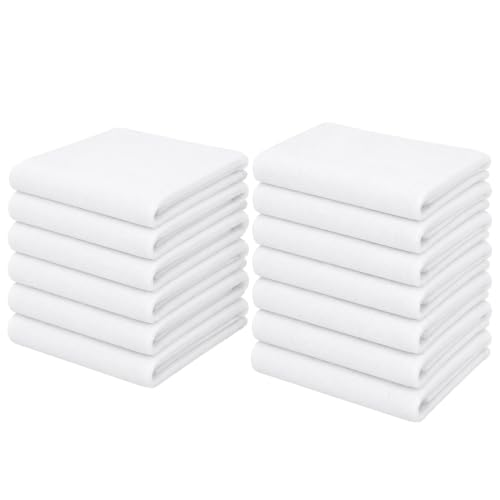
4. Aunti Em’s Kitchen Flour Sack Dish Towels, 13 Pack — Best Ring-Spun Cotton
Ring-spun cotton is yarn that has been twisted and thinned to remove short fibres, producing a smoother, stronger cloth — and smoothness is precisely what dish drying rewards. This set suits buyers who notice fabric quality: the towels feel softer from new, present an even surface that wipes glass cleanly, and the hemmed edges resist the fraying that kills cheap towels at the corners. Crafters get a bonus: the same even weave that dries well also takes embroidery and monograms cleanly.
Strengths
- Ring-spun cotton gives a smoother surface and fewer stray fibres
- Hemmed edges, stated in the listing, hold up through repeated washing
- 13-pack is a generous rotation for a two-person or family kitchen
Trade-offs
- Listing does not state the towel dimensions, so check the size on the product page before ordering
- Premium yarn usually means a premium tier price — check price on Amazon
- White only, with the usual stain visibility
| Spec | Detail (as listed) |
|---|---|
| Pack count | 13 towels |
| Material | 100% ring-spun cotton (as listed) |
| Edges | Hemmed (as listed) |
| Size | Not stated in listing title |
Most flour sack towels are woven from ordinary carded cotton, which leaves tiny fibre ends standing proud of the surface. Those ends are what eventually pill, shed and turn a towel scratchy. Ring spinning aligns and twists the fibres into a tighter yarn, so the finished cloth starts smoother and stays smoother — a difference you can feel the first time you polish a glass and see it come away completely clean.
The hemmed edges deserve their own mention. Flour sack cloth is thin, and an unhemmed or poorly hemmed edge frays within months of weekly washing, after which the towel twists and stops lying flat. A proper hem is the single best predictor of whether a set is still in your drawer in three years, and this listing states it outright where many rivals stay silent.
Best for: buyers who want the smoothest cloth and longest service life / Not suited for: shoppers who need a confirmed oversize towel and cannot verify dimensions first

5. Honest Weave Organic Cotton Flour Sack Towels, 12 Pack, 27 x 27 Inch — Best Organic Cotton
This set is for the buyer who reads fibre labels. The listing specifies organic cotton, and the finishing details are the best documented in this guide: mitered corners that lie flat and look tidy folded, hemmed edges for wash durability, and hidden loops so each towel hangs from a hook without a garish tab. At 27 x 27 inches it sits a whisker under the classic 28-inch square — a difference you will not feel in use. It suits eco-conscious households, bread bakers (the listing names proofing), and anyone kitting out a kitchen properly once.
Strengths
- Organic cotton, as listed, for buyers avoiding conventional cotton
- Mitered corners and hemmed edges give the neatest finish in this guide
- Hidden hanging loops keep towels aired and off the counter
Trade-offs
- Organic cotton sits in a premium tier — check the current price on Amazon
- 27-inch size is marginally smaller than the 28-inch standard
- White only in this listing
| Spec | Detail (as listed) |
|---|---|
| Pack count | 12 towels |
| Size | 27 x 27 inches |
| Material | Organic cotton (as listed) |
| Finishing | Mitered corners, hemmed edges, hidden loops (as listed) |
A note on labels, because this category abuses them: this listing says organic cotton, and that is the claim we repeat — no more, no less. It does not name a certification in the title, so we do not invent one. What can be said is that the cloth itself is specified as organic cotton flour sack weave, and the construction details around it are unusually complete for this product class.
Those details change daily life more than you would expect. Mitered corners stop the dog-eared curl that makes cheap towels look tired on the oven handle. Hidden loops mean the towel actually gets hung up after use — and a hung flour sack towel dries between jobs, stays fresher, and lasts longer than one left in a damp ball by the sink. If you bake, the smooth organic cloth is also a kind proofing cover that will not stick to a wet dough the way terry does.
Best for: eco-conscious buyers and bakers who value finishing details / Not suited for: budget-first shoppers, since organic cotton commands a premium tier

6. HIC Kitchen Jumbo Flour Sack Set, Heavyweight Cotton, 4 Pack, 32 x 38 Inches — Best Oversize Heavyweight
Some kitchens outgrow the standard towel. If you regularly dry a 30cm stockpot, a full-size sheet pan, or a turkey roaster, a 28-inch towel means two towels and four hands; this 32 x 38 inch jumbo covers the job in one cloth. The heavyweight weave also holds more water per towel, so it suits the final dry of a huge holiday wash-up. It is equally at home under a draining rack, over a proving tray of rolls, or folded as an improvised mat for hot dishes.
Strengths
- 32 x 38 inch jumbo format covers the largest pans in one pass
- Heavyweight cotton absorbs more water before needing a wring
- Listing specifies lint-free and machine washable
Trade-offs
- Only 4 towels per pack — a supplement, not a full rotation
- Oversize cloth is cumbersome for glasses and small items
- Heavier wet weight makes wringing harder for smaller hands
| Spec | Detail (as listed) |
|---|---|
| Pack count | 4 towels |
| Size | 32 x 38 inches |
| Material | Heavyweight cotton (as listed) |
| Noted traits | Super absorbent, lint-free (as listed) |
Think of this set as the specialist that completes a towel drawer rather than the whole drawer. Paired with a standard 12-pack, the jumbos handle the top end of the size range: the roaster at Christmas, the canning pot in summer, the sheet pan every weekend. Their extra area also makes them the best rack liners here — spread one under the dish drainer and it catches drips across the whole counter run instead of a puddle at one end.
The heavyweight weave is the second half of the appeal. Standard flour sack cloth is deliberately thin; this set trades some of that quick-drying lightness for capacity, which is the right trade when the job is a sink full of pots rather than a rack of glasses. It still dries far faster than terry of similar capacity, so the freshness advantage of flour sack cloth survives the upgrade.
Best for: cooks with big pans, canners, and holiday-scale washing up / Not suited for: anyone buying their only set — four towels cannot run a kitchen alone
Comparison Table
| Pick | Badge | Key spec | Best for |
|---|---|---|---|
| Utopia Kitchen White Flour Sack Towels, 12 Pack, 28 x 28 Inch | Best Overall | 12 pack, 28 x 28 in, 100% cotton | most households wanting one proven, full-size set for everyday dish drying |
| Avalon Kitchen Flour Sack Towels, 15 Pack, 28 x 28 Inch | Best Value Pack | 15 pack, 28 x 28 in, 100% cotton | busy family kitchens and bakers who rotate towels constantly |
| Simpli-Magic Flour Sack Kitchen Towels, 12 Pack, 24 x 24 Inch | Best for Glassware | 12 pack, 24 x 24 in, lint-free (as listed) | glassware-heavy kitchens and anyone who prioritises a lint-free finish |
| Aunti Em’s Kitchen Flour Sack Dish Towels, 13 Pack | Best Ring-Spun Cotton | 13 pack, ring-spun cotton, hemmed edges | buyers who want the smoothest cloth and longest service life |
| Honest Weave Organic Cotton Flour Sack Towels, 12 Pack, 27 x 27 Inch | Best Organic Cotton | 12 pack, 27 x 27 in, organic cotton | eco-conscious buyers and bakers who value finishing details |
| HIC Kitchen Jumbo Flour Sack Set, Heavyweight Cotton, 4 Pack, 32 x 38 Inches | Best Oversize Heavyweight | 4 pack, 32 x 38 in, heavyweight cotton | cooks with big pans, canners, and holiday-scale washing up |
Key Takeaways
- Flour sack cloth dries dishes better than terry because its flat weave spreads water thin and releases it fast — look for 100% cotton and hemmed edges.
- 28 x 28 inches is the standard working size; go 24-inch for glassware focus or 32 x 38 inch jumbo for stockpots and sheet pans.
- Ring-spun cotton (Aunti Em’s) gives the smoothest, longest-lasting cloth; organic cotton (Honest Weave) adds the best finishing details in this guide.
- Buy in rotation-sized packs — 12 to 15 towels — so a fully dry towel is always available; a damp towel cannot dry dishes.
How to Choose Flour Sack Towels for Drying Dishes
Start with the weave, because everything else follows from it. A true flour sack towel is a plain, flat weave with no loops, no pile and no raised pattern. That flatness is why it dries glass without streaks and why it sheds almost no lint. If a listing shows terry loops, waffle pockets or a plush face, it may be a fine towel, but it is not the tool this guide is about, and it will behave differently at the sink.
Size is the second decision. The 28 x 28 inch square is the settled standard because it matches dinner plates, medium pans and proofing bowls. Drop to 24 inches if your load is mostly glasses and you value a cloth that stays in the hand. Step up to a 32 x 38 inch jumbo only as a supplement for the largest cookware — as an only towel it is clumsy, but as the big-job specialist it is unmatched.
Yarn quality separates sets that last a season from sets that last years. Ring-spun cotton, called out in the Aunti Em’s listing, produces a smoother and stronger cloth. Ordinary cotton works well too, but check the edges: hemmed edges are the clearest durability signal a listing can give, and mitered corners — as on the Honest Weave set — keep the towel lying flat and looking neat after hundreds of washes.
Finally, buy enough. A flour sack towel dries dishes properly only when it starts dry; once saturated it just moves water around. A rotation of at least a dozen means one fresh towel per day plus laundry slack. Packs of 12 to 15 are the practical sizes, and the per-towel cost of cotton cloth is low enough that undersizing the pack is a false economy that shows up as damp plates.
One last check before you order: count your drying load honestly for a week. Households consistently underestimate how many towels a real week consumes — the pasta night, the baking afternoon, the glass-polishing before guests. Watch the drawer for seven days, note the day you first reach for a towel that is still damp, and size your pack so that day never arrives. That single observation is worth more than any specification in this guide, because absorbency, size and yarn only matter once a dry towel is actually in your hand.
Colour deserves one honest paragraph. Every pick in this guide is white, because that is how serious flour sack towels are sold — white cotton can be washed hot, bleached when stained, and matched across brands and years without dye lots drifting apart. A coloured or printed towel can be charming, but it surrenders the bleach option that keeps a working towel hygienic and bright through years of tomato sauce and turmeric. If your kitchen’s look demands colour, hang one decorative towel for show and keep the working rotation white; cooks have run that two-tier system for generations, and it survives because it works.
Flour Sack vs Terry vs Microfiber: Which Dries Dishes Best?
Each fabric wins a different contest. Terry cloth holds the most water in absolute terms because its loops create enormous surface area, which makes it the best choice for mopping a spill. But at the drying rack its strengths turn: the loops hold water against the dish, release it slowly, and shed fibres onto wet glass. A terry towel also stays damp for hours, which is why kitchen terry so often smells sour by Wednesday.
Microfiber absorbs quickly and can polish glass well when new and clean, but it is a synthetic that degrades with hot washes, picks up grease films that reduce its absorbency, and many cooks dislike its clinging feel on the hands. It also cannot go near a hot pan handle safely the way cotton can. For pure dish-drying duty it is a reasonable second choice, rarely the favourite.
Flour sack cotton sits in the sweet spot for the drying rack specifically: absorbent enough for a full load when rotated, fast to release water when hung, lint-free on glass, heat-tolerant, cheap to replace, and fully machine washable at high temperatures that would damage microfiber. That combination — not any single superlative — is why professional kitchens and generations of home cooks keep a stack of them by the sink.
Setting Up a Towel Rotation That Actually Works
The difference between a kitchen where dish drying feels effortless and one where it feels like a chore is rarely the towel itself — it is the system around the towel. A simple rotation turns a pack of flour sack towels into a small machine. Keep the full set folded in one drawer. Each morning, take two: one becomes the drying towel, hung over the oven handle or a hook between jobs, and one becomes the hand and counter towel. Keeping those two roles separate is the single most effective habit in this guide, because the drying towel never touches a greasy hob or a floury counter, and the utility towel never touches a clean glass.
At the end of the day both towels go to the laundry basket, whether they look dirty or not. Flour sack cloth hides soil well, and a towel that looks clean can still carry a day of kitchen bacteria. With a 12 or 15-pack, the daily two-towel rhythm gives you six or seven days before laundry day, which matches how most households already wash. If you cook three meals a day, move to a three-towel rhythm and let the larger packs in this guide earn their keep.
Hang drying towels properly between uses and they will reward you. A flour sack towel draped fully open over a handle dries in an hour or two; the same towel scrunched on a hook stays damp all day and starts the evening shift already compromised. This is where little construction details matter — the hidden hanging loops on the Honest Weave set, for example, exist precisely to make the fully-open hang effortless.
Finally, mark your glass-only towels so the system survives other people’s good intentions. A small coloured stitch in one corner, or simply storing the glass towels in a different drawer, protects them from pan grease. Grease contamination, not wear, is what ends most towels’ streak-free careers, and it is entirely preventable with thirty seconds of organisation on day one.
How to Wash and Care for Flour Sack Towels
Wash new towels before first use, on a warm or hot cycle with your usual detergent. New cotton carries finishing agents from the mill that block absorption; one or two washes strip them and the towels will drink noticeably better afterwards. Expect a small amount of shrinkage on this first wash if the set was not pre-washed.
Skip fabric softener and dryer sheets entirely. Softener coats cotton fibres with a water-repelling film — the exact opposite of what a drying towel needs. If towels ever start pushing water around instead of absorbing it, a hot wash with a cup of white vinegar in the rinse will strip the build-up and restore them.
Wash kitchen towels hot and often — at least weekly, and immediately after any contact with raw meat juices. Cotton tolerates hot water indefinitely, which is a core advantage of flour sack cloth over synthetics. Tumble dry or line dry; the thin weave dries quickly either way.
Keep a glass-only subset. Dedicate two or three towels exclusively to glassware and never use them on greasy pans. Grease is what eventually makes any towel streak, and a protected subset stays streak-free for years while the workhorse towels take the abuse.
Retire towels by demotion, not disposal. When a towel thins or stains beyond kitchen dignity, it becomes a cleaning rag, then a garage rag. Flour sack cotton is useful at every stage of its life, which is part of its economy.
Beyond the Drying Rack: What Else Flour Sack Cloth Does Well
A good flour sack towel earns its drawer space several times a day, because the same properties that dry dishes — flat weave, fast absorption, no lint, heat tolerance — transfer to half the jobs in a kitchen. As a proofing cloth it covers dough without sticking. As a produce towel it dries washed salad leaves and herbs more gently than a spinner’s second pass. Spread under a cutting board it stops the board skating on a smooth counter. Folded twice, it is a serviceable hot pad for a casserole dish, though it should never be your only protection against a heavy roasting pan straight from a hot oven — use proper oven mitts for serious heat and treat the towel as a trivet layer, not a glove.
Bakers lean on flour sack cloth hardest. It lines baskets, covers cooling racks of biscuits so they stay warm without steaming soggy, and strains stocks and nut milks when a finer filter than a sieve is wanted. Because the weave is plain and the cloth is cheap, none of these uses feels precious; you can commit a towel to straining yoghurt without mourning it. That disposability-in-spirit is part of the fabric’s centuries-old appeal: it is a working cloth, not a decorative one.
The cloth also travels well outside the kitchen. A folded flour sack towel in a picnic basket dries hands, wraps sandwiches and protects jars in transit. In a bathroom it makes a fast-drying travel towel for short trips. Gardeners use worn ones to line harvest baskets and shade seedlings. None of this is marketing stretch — it is simply what a metre of absorbent cotton cloth does, and it is why buying a proper rotation of 12 to 15 towels rarely feels like overbuying six months later.
One caution travels with all these uses: keep food-contact towels and cleaning towels separate, and wash any towel that has strained, wiped raw meat, or cleaned a spill before it returns to dish duty. The rotation system described earlier makes this easy — towels flow one way, from glass to dishes to utility to laundry, and never backwards without a hot wash in between.
Common Buying Mistakes
Buying terry or microfiber towels for a flour sack job. Loops and plush faces smear water on glass and shed lint. If the listing does not describe a flat cotton weave, it will not dry dishes the way this guide promises.
Buying too few towels. A single towel saturates halfway through a family wash-up and then only redistributes water. Rotation packs of 12 or more exist precisely because drying requires a dry towel.
Using fabric softener. Softener films block absorption permanently until stripped. The towels feel softer and work worse — the classic flour sack own goal.
Ignoring the hem. Unhemmed thin cotton frays at the edges within months. Hemmed edges, stated plainly in a listing, are the cheapest longevity you can buy.
Judging by thickness. For dish drying, thin and flat beats thick and plush. Save your thickness preferences for bath towels; at the sink they work against you.
Final Recommendation
For most kitchens the answer is simple: start with the Utopia Kitchen 12-pack as your everyday rotation, and add the HIC jumbo set if big pans are a regular event. If fabric quality matters most to you, the Aunti Em’s ring-spun set is the upgrade pick; if organic cotton and finishing details lead your list, choose Honest Weave. Glassware specialists should run the Simpli-Magic 24-inch set by the sink, and high-volume households will get the most raw value from Avalon’s 15-pack.
Whichever set you choose, wash before first use, ban fabric softener from the towel load, and keep a couple of towels reserved for glass only. Do that, and a modest stack of cotton cloth will quietly outperform every novelty towel in the drawer. Readers comparing neighbouring topics may also find our guides to related kitchen textiles useful below.
- Utopia Kitchen White Flour Sack Towels, 12 Pack, 28 x 28 Inch (Best Overall) — check price on Amazon
- Avalon Kitchen Flour Sack Towels, 15 Pack, 28 x 28 Inch (Best Value Pack) — check price on Amazon
- Simpli-Magic Flour Sack Kitchen Towels, 12 Pack, 24 x 24 Inch (Best for Glassware) — check price on Amazon
- Aunti Em’s Kitchen Flour Sack Dish Towels, 13 Pack (Best Ring-Spun Cotton) — check price on Amazon
- Honest Weave Organic Cotton Flour Sack Towels, 12 Pack, 27 x 27 Inch (Best Organic Cotton) — check price on Amazon
- HIC Kitchen Jumbo Flour Sack Set, Heavyweight Cotton, 4 Pack, 32 x 38 Inches (Best Oversize Heavyweight) — check price on Amazon
Best Flour Sack Dish Towels For Embroidery Best Drying Kitchen Towels Best Dish Towels Ever Best Bar Towels For Drying Glassware Best Bang For Buck Dish Towels
Frequently Asked Questions
Why do flour sack towels dry dishes better than regular kitchen towels?
Because of the weave. Flour sack cloth is a flat, plain weave with no loops, so water spreads through it evenly and the surface wipes a dish fully dry instead of skating over it. Loops on terry towels hold water against the surface and shed fibres; the flat cloth also dries quickly when hung, so it starts the next job fresh rather than damp.
How many flour sack towels does a kitchen need?
A rotation of 12 to 15 is the practical answer for a household that cooks daily. One towel saturates during a large wash-up, so you want a fresh towel each day plus enough slack for laundry days. Smaller households that wash up once a day can manage with a single 12-pack comfortably.
Do flour sack towels leave lint on glasses?
A flat cotton weave sheds far less than terry or microfiber, which is why sets like the Simpli-Magic in this guide are listed as lint-free. The first wash removes loose mill fibres; after that, a flour sack towel is one of the safest choices for stemware and serving glass.
Can flour sack towels be used for bread proofing as well?
Yes — the smooth cloth is a traditional proofing cover because it does not stick to wet dough the way terry does, and several listings in this guide, including Avalon and Honest Weave, name proofing explicitly. Use a dedicated towel for dough so flour dust and dish duty never mix.
How should I wash flour sack towels to keep them absorbent?
Wash hot with regular detergent, never use fabric softener or dryer sheets, and wash new towels before first use to remove mill finishes. If absorbency ever fades, a hot wash with white vinegar in the rinse strips softener build-up and restores the cloth.
What size flour sack towel is best for drying dishes?
28 x 28 inches is the standard for good reason — it covers plates and medium pans in one cloth. Choose 24-inch towels if your load is mostly glassware, and keep a 32 x 38 inch jumbo set for stockpots and sheet pans rather than as your only towels.


