Disclosure: airfryerkitchensupply.com is reader-supported. When you buy through links on our site, we may earn an affiliate commission at no extra cost to you.
Where to buy
Every pillow below was matched to a live Amazon listing before it earned a link, and the heights, sizes and certifications quoted come from those verified listing titles. This guide uses comfort and sleep-position language only; where a listing’s own title makes stronger claims, those claims are recorded in the article’s sources and deliberately not repeated as promises here.
- Sidney Sleep Adjustable Curved Pillow, Queen 19″ x 29″, CertiPUR-US Certified — Check the current price on Amazon
- Coop Home Goods Original Crescent Adjustable Pillow, Queen — Check the current price on Amazon
- Bluewave Bedding Ultra Slim Gel Memory Foam Pillow, 2.75-Inch, Standard — Check the current price on Amazon
- LOFE Buckwheat Pillow 20×26 with Organic Cotton Pillowcase, Adjustable — Check the current price on Amazon
- Low Loft Latex Bed Pillow with Organic Cotton Cover, Standard, Soft — Check the current price on Amazon
- SofGlowly Thin Flat Pillow, 2.25-Inch Ultra Slim Memory Foam — Check the current price on Amazon
The best pillows to stay on your back solve a problem that willpower cannot. People who want to sleep on their backs — because their snoring partner begs them to, because their skin or shoulders prefer it, because they simply wake up better that way — usually fail the same way: they fall asleep on their back happily and wake at 3 a.m. on their side, betrayed by geometry. A pillow that keeps you on your back works on that geometry. It either cradles the head so rolling means climbing, or it corrects the loft error that made rolling attractive in the first place. This guide is organized around those two honest mechanisms.
That organization produces two families of picks. The contour family — an adjustable curved pillow and an adjustable crescent — builds a place for the head to stay. The loft family — two ultra-slim pillows and a low-loft latex — removes the excess height that tips the chin and starts the roll. Between them stands buckwheat, the moldable traditionalist that locks a custom cradle in place. Every pick is adjustable or precisely specified, because back sleeping succeeds or fails on a half-inch of height, and a guide that ignores that fact is selling pillows, not outcomes.
One boundary, stated before the picks: this is a comfort and sleep-position guide. What these pillows can honestly offer is a better mechanical arrangement for staying where you fell asleep — and for the right sleeper, that is the whole difference between a resolution and a habit.
In this guide
Quick Picks
Best Overall for Staying on Your Back — Sidney Sleep Adjustable Curved Pillow, Queen 19″ x 29″, CertiPUR-US Certified
An adjustable curved cervical contour pillow with extra shredded fill included, in a queen 19×29 size, with CertiPUR-US certified foam per the verified title. The curve cradles the head in the center — the geometry that discourages rolling — and the fill lets you tune the height until back sleeping sticks.
Check the current price on Amazon
Best Crescent Design — Coop Home Goods Original Crescent Adjustable Pillow, Queen
A crescent-shaped adjustable pillow in queen size, medium firm, with CertiPUR-US and GREENGUARD Gold certifications per the verified title. The crescent cut removes the pillow from under the shoulders so the head stays low and centered — a different, elegant answer to the same rolling problem.
Check the current price on Amazon
Best Low-Profile Pillow — Bluewave Bedding Ultra Slim Gel Memory Foam Pillow, 2.75-Inch, Standard
An ultra-slim gel memory foam pillow at just 2.75 inches of height, in standard size, designed for stomach and back sleepers per the verified title. For back sleepers whose problem is a pillow that is simply too tall, the answer is subtraction.
Check the current price on Amazon
Best Firm, Moldable Pillow — LOFE Buckwheat Pillow 20×26 with Organic Cotton Pillowcase, Adjustable
A buckwheat hull pillow at 20×26 inches with an organic cotton pillowcase, adjustable by adding or removing hulls per the verified title. Buckwheat does what foam cannot: it molds to your head and then stays exactly there, all night, like a beanbag that has memorized you.
Check the current price on Amazon
Best Natural Low-Loft Pillow — Low Loft Latex Bed Pillow with Organic Cotton Cover, Standard, Soft
A low-loft latex pillow in standard size and soft feel, with an organic cotton cover and GOLS/GOTS certifications per the verified title. Its listing states its purpose in its own words: a low elevation for back and stomach sleepers. Natural materials, low profile, certified paperwork.
Check the current price on Amazon
Best Ultra-Thin Pillow — SofGlowly Thin Flat Pillow, 2.25-Inch Ultra Slim Memory Foam
The thinnest pick in the guide at 2.25 inches per the verified title: an ultra-slim cooling memory foam pillow with a soft washable cover, aimed at stomach and back sleepers. For the sleeper who has considered using no pillow at all, this is the civilized version of that idea.
Check the current price on Amazon
Key Takeaways
- Staying on your back is geometry: cradle the head, or correct the loft that makes rolling attractive
- Adjustable fill is the highest-value feature here — back sleeping succeeds or fails on half an inch
- Slim pillows (2.75 in and 2.25 in, verified) fix chin-tipping; contours fix wandering
- This guide uses comfort language only and repeats no medical claims from any listing
- Judge a positional pillow by where you wake for a week, not by how it feels at lights-out
How These Picks Were Chosen
Candidates came from a cache-first scan of Amazon listing data-verified pillow listings, filtered to products whose verified titles address back sleeping directly: contours and crescents that center the head, slim and low-loft designs whose stated purpose includes back sleepers, and moldable fills that hold a shape. Travel pillows, children’s pillows, body pillows and generic hotel pillows with no back-sleeping design intent were excluded, however comfortable they may be — this search is a positional brief, not a pillow roundup.
Each surviving pick had to offer a mechanism this guide can explain without medical language: a cradle, a crescent, a corrected loft, or a locking fill. Heights and sizes are quoted only where the verified title states them — 2.75 inches, 2.25 inches, 19×29, 20×26 — and certifications are recorded in the titles’ own terms: CertiPUR-US for foam content standards, GREENGUARD Gold for low emissions, GOLS for organic latex and GOTS for the organic cotton cover. None of those certifications is a sleep claim, and none is presented as one.
The final six balance the two mechanisms and the material spectrum — shredded adjustable foam, solid gel foam, buckwheat hulls, natural latex — so that the reader’s real decision, which mechanism fits their failure mode, comes with a genuine choice inside each family. The buying guide’s two-minute loft test exists to make that decision before money moves.
The 6 Best Pillows to Stay on Your Back

Sidney Sleep Adjustable Curved Pillow, Queen 19″ x 29″, CertiPUR-US Certified — Best Overall for Staying on Your Back
Start here if you are training yourself to sleep on your back and keep waking on your side. The curved contour gives your head a defined place to rest, and the border of the curve gives your turning head gentle feedback before you fully roll. The included extra fill matters more than it sounds: back sleeping fails most often because the pillow height is wrong, and this is the pick you can correct without buying another pillow. It is a queen width, so single sleepers in twin beds should check the footprint.
Strengths
- Curved contour centers the head — positional feedback that helps back sleepers stay put
- Adjustable shredded fill with extra fill included per the verified title: tune the loft instead of replacing the pillow
- CertiPUR-US certified foam per the title, in a generous queen 19 x 29 size
Trade-offs
- A contour pillow feels strange for the first nights; back-sleep training is an adjustment, not an instant fix
- Queen width is a lot of pillow on a twin bed or in a crowded double
- Shredded fill can feel less uniform than a solid foam contour until it settles and is fluffed into place
| Size (per Amazon title) | Queen, 19″ x 29″ |
| Fill | Adjustable shredded fill, extra included (per Amazon title) |
| Certification | CertiPUR-US Certified (per Amazon title) |
| Shape | Curved cervical contour |
Staying on your back is a geometry problem before it is a willpower problem. On a flat, high pillow, a back sleeper’s head sits on a slope, and the easiest direction for a sleeping body to resolve that slope is sideways — so it rolls. A curved contour reverses the geometry: the head rests in a shallow cradle, the curve’s edges register against the sides of the head, and rolling requires climbing out of the cradle rather than sliding down a hill. That small mechanical discouragement, repeated across the night, is what positional pillows actually sell, and this one sells it in its most adjustable form.
The adjustable fill is the second half of the system, because the cradle only works at the right depth. Too much fill and your chin tips toward your chest; too little and your head falls back and the curve’s edges miss their cue. Sidney Sleep includes extra shredded fill with the pillow per the verified title, which turns the first week into a tuning exercise — add or remove a handful, sleep, adjust — instead of a pass/fail purchase. Keep notes; the right loft announces itself within three or four nights.
CertiPUR-US certification, stated in the title, concerns the foam’s content and emissions standards — it is the foam claim this guide can verify, and it is recorded here in exactly those terms. Combined with the queen footprint, this is the most complete back-sleeping tool in the guide, and the one to buy if you buy one.
Best for: Back-sleep trainees who keep rolling to their side and need an adjustable cradle / Not suited for: Committed side sleepers, or twin beds where a queen pillow crowds

Coop Home Goods Original Crescent Adjustable Pillow, Queen — Best Crescent Design
Choose the crescent if contour pillows feel like too much apparatus: the shape works by absence, carving away the shoulder zone so your upper back lies flatter and your head rests lower, which keeps the whole arrangement stable through the night. It is adjustable, so loft tuning is available here too. Side sleepers who split the night between back and side will find the crescent less committed than a deep contour — a feature or a flaw depending on how strict your back-sleeping project is.
Strengths
- Crescent shape keeps shoulders off the pillow, so the head rests low, level and centered
- Adjustable fill in a medium-firm brief — tune the loft to your frame
- CertiPUR-US and GREENGUARD Gold certifications per the verified title: the strongest foam-paperwork in this guide
Trade-offs
- The gentler geometry discourages rolling less firmly than a deep contour cradle
- Crescent shape is back-focused; dedicated side positions feel like a compromise on it
- Premium positioning in the adjustable-pillow market — bought for design and certifications, not as the value pick
| Shape | Crescent, adjustable |
| Size | Queen (per Amazon title) |
| Firmness | Medium firm (per Amazon title) |
| Certifications | CertiPUR-US / GREENGUARD Gold (per Amazon title) |
The crescent is the minimalist’s positional pillow. Where a contour adds structure around the head, the crescent subtracts structure under the shoulders — and the effect is surprisingly powerful. When the shoulders lie on the mattress rather than on the pillow, the head naturally sits lower and the neck stays nearer neutral, and a low, level head has far less tendency to wander. Back sleepers who dislike the feeling of being held in place often succeed on a crescent where a contour felt like a restraint.
Coop’s adjustability completes the design: the fill can be tuned until the low-and-level geometry is right for your shoulders and mattress, and a too-soft or too-firm mattress changes that equation enough that adjustability is not a luxury here. Work in small handfuls of fill across several nights, and judge by where you wake, not by how the pillow feels at lights-out — position retention is a whole-night metric.
The certifications deserve their sentence, stated precisely: CertiPUR-US addresses the foam’s content standards, and GREENGUARD Gold addresses low chemical emissions, per the verified title. Neither says anything about sleep outcomes, and this guide claims nothing more for them than what they are — the most complete foam documentation available on any pick in this roundup.
Best for: Back sleepers who want positional help without a deep contour’s embrace / Not suited for: Anyone needing firm discouragement from rolling, or strict side sleepers
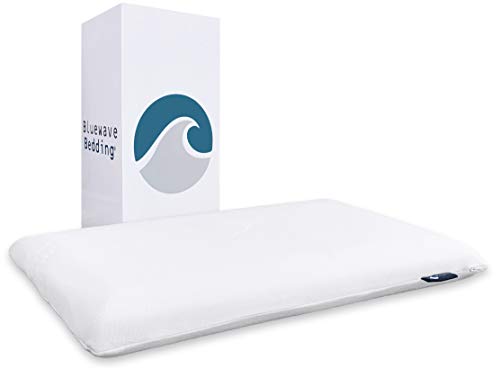
Bluewave Bedding Ultra Slim Gel Memory Foam Pillow, 2.75-Inch, Standard — Best Low-Profile Pillow
Pick the Bluewave if every normal pillow pushes your chin toward your chest when you lie on your back — the classic sign that your frame, mattress and pillow loft are mismatched. Slim pillows suit smaller frames, softer mattresses that let the shoulders sink, and anyone who has been folding an arm under a flat pillow for years. It is not a contour and offers no rolling discouragement beyond its lowness; committed rollers should start with the Sidney Sleep.
Strengths
- 2.75-inch profile per the verified title — genuinely low, where most ‘slim’ pillows are merely less tall
- Gel memory foam in a flat design aimed at back and stomach sleepers per the title
- Standard size fits ordinary pillowcases and beds without the queen footprint
Trade-offs
- No contour or cradle: if you roll because you wander rather than because of loft, this will not stop you
- Very low loft is wrong for broad shoulders or firm mattresses that keep the body riding high
- Memory foam’s feel is temperature-sensitive; expect firmer first minutes in a cold room
| Height (per Amazon title) | 2.75 inches |
| Fill | Gel memory foam (per Amazon title) |
| Size | Standard |
| Design | Ultra slim, flat |
A remarkable share of failed back sleeping is a loft error wearing a discipline costume. Lie on your back on a tall pillow and your head is tipped forward all night; the body, seeking a neutral airway and a level head, eventually rolls to the side where the tall pillow makes sense. Remove the excess height and the incentive to roll goes with it. The Bluewave’s 2.75 inches — a number stated in its verified title, and genuinely low rather than marketing-low — is the direct correction for that specific failure mode.
The flat design is the honest complement: no contour, no cradle, no claims beyond a thin, even surface of gel memory foam. Gel foam’s role here is feel — a cooler-touch, evenly supportive slab that does not develop the lumps shredded fills can — in a profile that lets the mattress do the positioning work. On a mattress with any give, a slim pillow plus a sinking shoulder zone produces the low, level head position that back sleeping needs.
Know its boundary: if your loft is already right and you still roll, your problem is habit or geometry of a different kind, and the contour picks above are your tools. The buying guide below gives you a two-minute test to tell the two problems apart before you spend anything — run it, because this pillow is a precision answer to one of them.
Best for: Back sleepers whose current pillow is simply too tall, and smaller frames / Not suited for: Rollers whose loft is already correct, or broad shoulders on firm mattresses

LOFE Buckwheat Pillow 20×26 with Organic Cotton Pillowcase, Adjustable — Best Firm, Moldable Pillow
Choose buckwheat if you are a restless back sleeper who reshapes foam pillows into submission by 3 a.m. Hulls shift when you move and lock when you stop, so the pillow holds a custom cradle without springs or resilience pushing back. The trade is feel: buckwheat is firm, heavy and rustles faintly when you move. Foam devotees and light sleepers bothered by sound should read the trade-offs twice — this is the most polarizing pick in the guide, and its devotees would have it no other way.
Strengths
- Hulls mold and hold a custom shape — a self-built cradle that does not rebound or drift
- Fully adjustable loft: add or remove hulls to set the height precisely, per the verified title
- Organic cotton pillowcase per the title, and a fill that lets air circulate rather than trapping heat
Trade-offs
- Firm and heavy compared with every foam pick here; the adjustment period is real
- Hulls make a soft rustling sound when you move — a dealbreaker for some light sleepers
- The pillowcase is organic cotton per the title; the guide makes no organic claim for the hull fill itself, which the title does not state
| Size (per Amazon title) | 20 x 26 in |
| Fill | Tartary buckwheat hulls (per Amazon title) |
| Pillowcase | Organic cotton (per Amazon title) |
| Adjustability | Add or remove hulls |
Every foam pillow, however clever, pushes back. That resilience is comfortable, but across a night it is also a slow argument with a sleeping body, and restless sleepers lose the argument by ending up wherever the foam’s shape and their rolling agree to put them. Buckwheat declines the argument entirely. The hulls flow around the head when you settle, then friction locks them into a rigid, personalized mold — the original adjustable pillow, centuries older than the category’s marketing.
For staying on your back, that locking behavior is the mechanism: shape the hulls into a shallow bowl with slightly raised sides before sleep, and the pillow holds the architecture all night. Loft is set by fill volume, and the verified title confirms the pillow is adjustable by adding or removing hulls, with the organic cotton pillowcase as the contact surface. Give the tuning a week of small changes; hull pillows reward patience more than any pick here.
The honest costs are texture and sound. Buckwheat is firm — supportive-firm, not soft — and it weighs noticeably more than foam, and movement produces a soft rustle that most owners stop hearing within a fortnight and a minority never do. This guide’s verdict: if you have ever loved a beanbag’s honesty, this is your pillow; if you want to sink into plushness, it is not, and no adjustment will make it so.
Best for: Restless back sleepers who want a molded, locked-in cradle and firm support / Not suited for: Plush seekers, light sleepers sensitive to rustling, or anyone who hates heavy pillows

Low Loft Latex Bed Pillow with Organic Cotton Cover, Standard, Soft — Best Natural Low-Loft Pillow
Pick this latex pillow if you want the slim pillow’s low geometry in a natural, resilient material rather than memory foam — latex springs back instantly, sleeps without the foam warm-up, and holds its loft for years. The soft, low build suits back sleepers with smaller frames and softer mattresses. It has no contour, so it corrects loft-driven rolling rather than habit-driven rolling; and latex has a distinctive springy feel that foam loyalists should sample mentally before committing.
Strengths
- Low elevation designed for back and stomach sleepers, stated in the verified title itself
- Natural latex resilience: instant response, no warm-up softening, durable loft
- GOLS/GOTS certified per the title, with an organic cotton cover — the strongest materials paperwork here
Trade-offs
- No contour or cradle — positional help comes from correct loft alone
- Latex feel is springy and immediate; memory foam sleepers may find it lively at first
- Soft firmness in a low loft is wrong for broad shoulders or very firm mattresses
| Loft | Low loft (per Amazon title) |
| Fill | Latex (per Amazon title) |
| Cover | Organic cotton (per Amazon title) |
| Certifications | GOLS/GOTS Certified (per Amazon title) |
Certification precision matters with latex, so let this guide be precise: the verified title claims GOLS and GOTS certifications. GOLS is the organic standard for latex; GOTS covers the organic cotton cover. Between them, this small pillow carries the most specific materials documentation in the roundup — stated here in exactly the terms the listing uses, and a model of how the category should label itself.
As a sleeping tool, latex’s character is responsiveness. Where memory foam molds slowly and holds, latex answers instantly and evenly, which many back sleepers experience as the head being floated rather than gripped. In a low loft aimed at back and stomach sleepers — the listing’s own stated purpose — that float keeps the head level without the tipped-chin problem of tall pillows, addressing the same loft-error rolling the Bluewave targets, in a completely different material language.
Durability is latex’s quiet argument: a quality latex pillow holds its loft for years beyond the service life of most foam, which matters in a low-loft pillow where losing half an inch is losing the entire design. If the slim-foam picks interest you but you buy for the long term and prefer natural materials, this is the pick that reconciles the brief.
Best for: Back sleepers wanting low loft in a certified natural latex with an organic cotton cover / Not suited for: Contour seekers, broad shoulders, or anyone who dislikes a springy pillow feel

SofGlowly Thin Flat Pillow, 2.25-Inch Ultra Slim Memory Foam — Best Ultra-Thin Pillow
Choose the SofGlowly if the Bluewave’s 2.75 inches still sounds tall — some back sleepers, particularly on soft mattresses where the shoulders sink deeply, need the head almost level with the bed. The washable cover is a practical grace note. This is the extreme end of the loft correction and wrong for most average frames; if you are unsure whether you need slim or ultra-slim, the two-minute test in the buying guide will tell you, and erring toward the Bluewave is the safer default.
Strengths
- 2.25-inch height per the verified title — the lowest loft in this guide
- Cooling memory foam brief with a soft, washable cover per the title
- Flat, even surface for sleepers who want the minimum between head and mattress
Trade-offs
- Ultra-thin is a specialist tool: too low for most frames, and unforgiving if your mattress is firm
- No contour, no cradle — purely a loft correction, like the Bluewave but more so
- Thin foam compresses to very little under the head’s weight; expect a minimal, grounded feel
| Height (per Amazon title) | 2.25 inches |
| Fill | Memory foam (per Amazon title) |
| Cover | Soft, washable (per Amazon title) |
| Design | Ultra slim, flat |
There is a sleeper this pillow exists for, and you may already suspect you are one: the person who sleeps best on hotel pillows that have given up, who pushes plump pillows off the bed, who wakes on their back comfortably only when the head is nearly flat. For that sleeper, standard advice fails because standard loft is the problem, and the market’s answer stops at slim. At a verified 2.25 inches, the SofGlowly goes the final step — a pillow that is present, soft and washable, but barely there.
The use case is precise. On a soft mattress, the shoulders sink several inches; a head that must stay near the sunken shoulders’ level needs very little pillow, and the excess in an ordinary pillow is exactly what tips the chin and starts the nightly roll to the side. Ultra-slim removes the excess. On a firm mattress the arithmetic reverses, and this pillow becomes a mistake — which is why the guide insists on the loft test below rather than letting thinness sound universally virtuous.
Judge it as the specialist it is. It will not cradle, it will not discourage a determined roller, and it will not flatter a broad-shouldered frame. For its intended sleeper it is the only pick in the guide that goes far enough, and that is a complete justification for its slot.
Best for: Back sleepers on soft mattresses who need the head nearly level with the bed / Not suited for: Firm mattresses, broad shoulders, or anyone unsure they need ultra-slim
Comparison Table
| Pick | Badge | Key spec | Best for |
|---|---|---|---|
| Sidney Sleep Adjustable Curved Pillow, Queen 19″ x 29″, CertiPUR-US Certified — check price on Amazon | Best Overall for Staying on Your Back | Adjustable curved contour, queen, CertiPUR-US | Back-sleep trainees who keep rolling to their side and need an adjustable cradle |
| Coop Home Goods Original Crescent Adjustable Pillow, Queen — check price on Amazon | Best Crescent Design | Crescent adjustable, CertiPUR-US + GREENGUARD Gold | Back sleepers who want positional help without a deep contour’s embrace |
| Bluewave Bedding Ultra Slim Gel Memory Foam Pillow, 2.75-Inch, Standard — check price on Amazon | Best Low-Profile Pillow | Ultra slim 2.75 in gel memory foam | Back sleepers whose current pillow is simply too tall, and smaller frames |
| LOFE Buckwheat Pillow 20×26 with Organic Cotton Pillowcase, Adjustable — check price on Amazon | Best Firm, Moldable Pillow | Buckwheat hulls, adjustable, 20×26 | Restless back sleepers who want a molded, locked-in cradle and firm support |
| Low Loft Latex Bed Pillow with Organic Cotton Cover, Standard, Soft — check price on Amazon | Best Natural Low-Loft Pillow | Low-loft latex, GOLS/GOTS, organic cotton cover | Back sleepers wanting low loft in a certified natural latex with an organic cotton cover |
| SofGlowly Thin Flat Pillow, 2.25-Inch Ultra Slim Memory Foam — check price on Amazon | Best Ultra-Thin Pillow | Ultra slim 2.25 in memory foam, washable cover | Back sleepers on soft mattresses who need the head nearly level with the bed |
How to Choose a Pillow That Keeps You on Your Back
Diagnose your failure mode first, because the two mechanisms in this guide treat different problems. If you fall asleep on your back and wake on your side with your pillow undisturbed, your head is wandering — you need a cradle: the contour or the crescent, or buckwheat molded into a bowl. If you wake on your side with your chin having spent the night tipped toward your chest, or you wake with the pillow half off the bed, your loft is wrong — you need subtraction: the slim or low-loft picks. Many sleepers have a little of both, and for them the adjustable contour is the safest single purchase, because its cradle can be tuned shallow.
The two-minute loft test
Lie on your back on your own bed with your current pillow. Have someone look from the side, or prop a phone and record: is your forehead roughly level with your chin, in a straight line from your chest? If your chin tips noticeably toward your chest, your pillow is too tall — measure by how much, and shop the slim family. If your head falls back with your chin pointing at the ceiling, you need more loft than the slim picks offer, and the adjustable picks are your route because they can be built up. If the line is already level and you still roll, loft is innocent — buy geometry, meaning the cradle family.
Adjustability is the insurance policy
Half an inch decides whether a back-sleeping pillow works, and no product page can know your mattress, your shoulders and your habits. Adjustable picks — the two shredded-fill pillows and the buckwheat — convert that uncertainty into a week of tuning. Fixed picks — the slim foams and the latex — are bets on a stated height, which is why this guide quotes their verified heights so prominently: a fixed pillow is only a good purchase when its number matches your test result.
Finally, budget a genuine adjustment period. A positional pillow changes the mechanics of your night, and the first three nights are data, not verdict. Judge any pick here across a week of wake-up positions — keep a note by the bed — and tune fill before you judge shape. Most back-sleeping projects that fail, fail in the first seventy-two hours for reasons that patience would have fixed.
Back Sleeping, Honestly Framed
People adopt back sleeping for many reasons — a partner’s sleep, shoulder comfort, skincare routines, simple preference — and this guide’s job is the mechanics, not the motivation. What a pillow can do is arrange your head so that staying is easier than rolling, and what it cannot do is guarantee a position or an outcome; bodies move in sleep for their own reasons, and a pillow that improves your odds most nights is a success honestly measured. Anyone whose interest in sleep position comes from a diagnosed condition should take their clinician’s guidance on position itself, and use this guide only for the pillow mechanics that follow from it.
How to Set Up Your Pillow for the First Week of Back Sleeping
A positional pillow is a small system, and the first week is its calibration. Run it deliberately and the pillow you bought has its best chance to become the pillow you keep.
- Night one: set the pillow to its middle configuration — as shipped for fixed pillows, half the extra fill held back for adjustable ones — and note where you wake
- If you wake on your side with your head still near the pillow, add a little containment: more fill at the contour’s edges, or shape buckwheat’s sides a touch higher
- If you wake with a tipped-chin feeling or a stiff jaw-side ache of effort, remove fill or step down in loft — the pillow is pushing, not cradling
- Keep the rest of the bed constant while you tune: same mattress side, same room temperature, so the pillow is the only variable changing
- After seven nights, judge by the tally of wake-up positions, not by any single night — one bad night is weather, a week is climate
Support the project with the room: a slightly cool room and a blanket you do not fight reduce the restlessness that no pillow can govern. And place a thin pillow under your knees if your lower back prefers it — many new back sleepers find that small addition settles the whole position, and it asks nothing of the pillow budget at all.
Common Buying Mistakes
Buying a contour when your problem is loft
A cradle at the wrong height fails exactly like a flat pillow at the wrong height. Run the two-minute loft test in this guide before choosing a family — the diagnosis takes less time than a return.
Judging the pillow on the first night
Positional pillows feel foreign before they feel right. A week of wake-up positions is the verdict; night one is just the introduction. Buyers who return on day two often return the pillow that would have worked on day six.
Skipping the fill tuning on adjustable pillows
An adjustable pillow at its shipping fill is a starting point, not a recommendation. The tuning is the product. Add and remove in small handfuls across nights, and write down where you woke.
Expecting the pillow to do the whole job
Room temperature, bedding weight, a partner’s schedule and simple habit all move a sleeping body. The pillow governs geometry; give the rest of the system a fair chance to cooperate before blaming the tool.
Buying slim on a firm mattress
Slim pillows presume your shoulders sink into something. On a firm mattress they leave the head hanging low, which is its own reason to roll. Match the loft family to the mattress you actually own.
Treating certification labels as sleep claims
CertiPUR-US, GREENGUARD, GOLS and GOTS describe materials and emissions. They are worth having and worth reading precisely — and they promise nothing about where you will wake up. This guide keeps the two ledgers separate, and so should your shopping.
Final Recommendation
Start with the diagnosis, then the pick. Head wandering on a level pillow: the Sidney Sleep adjustable contour, tuned over a week. Apparatus-averse but still wandering: the Coop crescent. Chin tipping from excess loft: the Bluewave at 2.75 inches, or the SofGlowly at 2.25 if your mattress is soft and your frame is slight. Prefer natural materials at low loft: the GOLS/GOTS latex. Restless reshaper who defeats foam by 3 a.m.: the buckwheat, molded into your own cradle. Every one of those recommendations is a mechanism matched to a failure mode — which is the only honest way to recommend a pillow for staying on your back.
Run the loft test tonight, keep the week’s tally, and let evidence pick your pillow. The neighboring guides cover the adjacent sleep decisions in the same spirit: Best Back Side Pillows Best Affordable Pillows Best Affordable Firm Pillows Best Alternative To Down Pillows Best 100 Down Pillows
- Sidney Sleep Adjustable Curved Pillow, Queen 19″ x 29″, CertiPUR-US Certified — check price on Amazon
- Coop Home Goods Original Crescent Adjustable Pillow, Queen — check price on Amazon
- Bluewave Bedding Ultra Slim Gel Memory Foam Pillow, 2.75-Inch, Standard — check price on Amazon
Best Back Side Pillows Best Affordable Pillows Best Affordable Firm Pillows Best Alternative To Down Pillows Best 100 Down Pillows
Frequently Asked Questions
How does a pillow actually keep you on your back?
By geometry, two ways. Contour and crescent pillows give the head a defined resting place — a shallow cradle or a low, level platform — so rolling requires effort your sleeping body usually declines to make. Slim and low-loft pillows remove the excess height that tips the chin forward, which is the discomfort that makes many back sleepers roll in search of a level head. Buckwheat does the first job by molding a cradle that locks in place. No pillow can guarantee a position; the good ones change the odds most nights.
How long does it take to get used to a positional pillow?
Plan on a week. The first nights feel foreign because the mechanics of your sleep are genuinely changing, and adjustable pillows need several rounds of fill tuning across those nights. Judge by a tally of where you wake across the week — the method in this guide’s how-to section — rather than by any single night’s impression. Most sleepers who persist through the tuning week know clearly by its end whether the mechanism fits them.
What pillow height is right for back sleeping?
The height at which your forehead and chin sit level when you lie on your back — which is lower than most people expect, and lower on a soft mattress than a firm one, because sunken shoulders raise the pillow’s effective height. That is why this guide quotes verified heights so precisely (2.75 inches, 2.25 inches, low-loft latex) and why adjustable pillows are the safest purchase when you are unsure: they let you find your number instead of guessing it.
Contour or slim — which should I try first?
Run the two-minute loft test in the buying guide. Chin tipping toward your chest on your current pillow means loft is your problem: start slim. A level head that still wanders to the side means geometry is your problem: start with a contour or crescent. If you cannot tell, or both sound familiar, the adjustable contour is the most forgiving first purchase because its cradle can be tuned shallow while its fill corrects the loft.
Is buckwheat really comfortable for back sleeping?
For its devotees, it is the most comfortable option here: the hulls mold into a personal cradle and hold it without pushing back, and the fill breathes well. The honest costs are firmness, weight and a soft rustle when you move, which most owners stop noticing and a minority never accept. It is the most polarizing pick in this guide, recommended strongly to the right sleeper and not at all to the wrong one.
Do the certifications on these pillows affect how they sleep?
No — and this guide keeps that ledger clean. CertiPUR-US concerns foam content standards, GREENGUARD Gold concerns low chemical emissions, GOLS certifies organic latex and GOTS the organic cotton cover. They describe what the pillow is made of and how it was verified, which are legitimate reasons to prefer one pick over another. Whether you stay on your back is decided by shape, loft and tuning — the subjects the reviews grade each pillow on.

