Disclosure: airfryerkitchensupply.com is reader-supported. When you buy through links on our site, we may earn an affiliate commission at no extra cost to you.
Where to buy
Every chair in this guide is sold through Amazon, and every model below was confirmed against the Amazon catalog data we checked for this article before a link was added. Start with the SIHOO M18 if you want the strongest support-per-dollar in the group, the Furmax mesh chair if your budget is the tightest, or the GABRYLLY high-back chair if you are taller or heavier and need a wider seat. Prices in this category move often, so check the current price on Amazon for the exact configuration you want rather than relying on any number printed elsewhere.
Shopping for the best inexpensive office chairs for bad backs is frustrating because the two halves of that phrase pull against each other. Genuine back comfort at a desk usually comes from adjustability — a lumbar support you can move, a seat you can set to your leg length, armrests that meet your elbows — and adjustability is exactly what budget chairs cut first. The good news is that the budget end of the market has changed. A few years ago, a cheap office chair meant a fixed foam pad, a decorative curve in the backrest, and a cushion that went flat by spring. Today, several inexpensive mesh chairs include genuinely adjustable lumbar supports, headrests, and tilt locks, because the same factories that build mid-range chairs now sell entry models under their own names. This guide sorts the worthwhile ones from the decorative ones. Six chairs made the cut, all of them inexpensive by office-chair standards, all of them with some form of real lumbar support rather than a shaped piece of foam and a prayer. One honest caveat up front: no chair in this price band, and frankly no chair at any price, treats a back condition. What a well-chosen inexpensive chair can do is stop making things worse — support a neutral sitting posture, spread your weight sensibly, and let you change position through the day. If you have persistent or worsening back pain, that is a conversation for a medical professional, not a product page. What follows is about comfort, posture support, and value, judged on the features each manufacturer actually lists and confirms.
In this guide
Quick Picks
- Best Overall: SIHOO M18 Ergonomic Office Chair — adjustable lumbar support, headrest, 2D armrests and a wide cushion on a mesh back. Check the current price on Amazon
- Best for Bigger Bodies: GABRYLLY Ergonomic Office Chair — high-back mesh design with a wide cushion, flip-up arms and a 90–120° tilt lock. Check the current price on Amazon
- Best Budget: Furmax Office Chair — a simple mid-back mesh chair with lumbar support and adjustable height that covers the basics honestly. Check the current price on Amazon
- Best Simple Starter Chair: BestOffice Ergonomic Office Chair — mid-back swivel chair with lumbar support and a sponge seat for a first home office. Check the current price on Amazon
- Best for Small Spaces: Sweetcrispy Ergonomic Computer Desk Chair — mid-back mesh chair with flip-up arms that tuck under a desk. Check the current price on Amazon
- Best for Movement Breaks: DUMOS Home Office Chair — mesh chair with a rocking mode, so you can shift position instead of sitting frozen. Check the current price on Amazon
Key Takeaways
- At budget prices, an adjustable lumbar support matters more than thick padding — padding compresses, a movable support keeps working.
- Mesh backs breathe and hold their shape better than thin foam backs in this price band.
- Match the chair to your body first: seat width, weight capacity and back height decide comfort more than any feature list.
- Flip-up armrests are the single most useful feature in small home offices because the chair can slide fully under the desk.
- No inexpensive chair fixes a back problem; the realistic goal is neutral posture support and the freedom to move during the day.
How These Picks Were Chosen
We started with the inexpensive end of the office chair market and applied a support-first filter. Every chair on this list had to offer lumbar support as a named, structural feature — an adjustable pad, a sprung support, or at minimum a contoured support built into the frame — because a chair for a sore back that offers nothing to the lower back is just a chair. Chairs that were only a seat cushion or an accessory were excluded; this list is complete chairs only. We then checked each candidate against Amazon catalog data, confirming the exact model, its listed features and its capacity figures before any link was added, and we only claim features that listing data confirms. Where a listing states a weight capacity or a measurement, we print it exactly as stated. Where it does not state something, we say so rather than guessing.
Within that filter we deliberately spread the six picks across the situations budget buyers actually face: a first work-from-home setup, a larger body that most cheap chairs exclude, a small apartment desk, a shared family computer, and a long-hours desk where the ability to rock and shift matters. We also weighted adjustability over upholstery. In this price band, faux-leather executive styling usually hides thin foam over plywood, while plain mesh chairs tend to put the money into the mechanism and the back support — which is where a back that aches at 4 p.m. actually needs it spent. Finally, we favored chairs sold in single packs with clear assembly expectations, because a budget chair that needs two people and an afternoon to build has spent your savings in time instead.
The 6 Best Inexpensive Office Chairs for Bad Backs

SIHOO M18 Ergonomic Office Chair — Best Overall
The SIHOO M18 is the chair that makes the rest of this list necessary to explain, because it raises the question of why you would buy anything else at the price. It is a mesh-back desk chair with a headrest, an adjustable lumbar support, 2D armrests and a wide cushion, and the listing confirms a 330 lb hold capacity. For a back that complains by mid-afternoon, the adjustable lumbar is the headline: instead of a fixed bulge that either lands in the right spot or does not, you can position the support where your lower back actually curves. That single feature is what separates chairs that help you sit neutrally from chairs that merely feel soft for the first week. SIHOO sells chairs at several price levels, and the M18 is its entry ergonomic model, which means the design language — mesh tension, lumbar placement, tilt lock — comes from further up the range rather than being invented for the bargain bin.
Strengths
- Adjustable lumbar support you can position against your own lower-back curve
- Mesh back with a headrest, so the whole spine has somewhere to rest during pauses
- 2D armrests and a wide cushion, with a tilt lock and a confirmed 330 lb capacity
Trade-offs
- Mesh feel is firmer than padded executive chairs, which some people dislike at first
- 2D armrests adjust height and angle but not width or depth
- Assembly has more steps than the simplest chairs here because there is more to adjust
Spec box
- Back: breathable mesh with headrest
- Lumbar: adjustable support
- Armrests: 2D adjustable
- Capacity: holds 330 lbs (as listed)
- Tilt: tilt lock fitted
Through a long workday, the M18’s advantage compounds quietly. The mesh does not hold heat the way a vinyl back does, so the 3 p.m. shift-and-squirm cycle that makes people slouch is reduced. The tilt lock lets you set a slight recline for reading and calls, which changes the load on your lower back instead of holding one posture for eight hours — and posture variety is half of what “good for backs” actually means in practice. The cushion is wide rather than deeply sculpted, which suits people who change leg positions often. If you are coming from a dining chair or a foam chair that has gone flat, this is the most complete inexpensive answer we found.
Best for: most home-office workers who want real lumbar adjustability on a budget / Not suited for: anyone who strongly prefers a soft, padded, lounge-style seat
Check the current price on Amazon

GABRYLLY Ergonomic Office Chair — Best for Bigger Bodies
Most inexpensive chairs quietly assume a smaller sitter, and the mismatch — a narrow seat, a low back, arms that crowd the hips — is itself a cause of end-of-day backache. The GABRYLLY addresses the fit problem directly: it is a high-back mesh chair with a wide cushion, a headrest, flip-up arms, and a tilt lock that works between 90 and 120 degrees. The high back matters for taller users because support that stops at the shoulder blades leaves the upper back to fend for itself, and the wide cushion spreads weight across more area instead of concentrating it. The flip-up arms are a thoughtful inclusion at this size: arms that lift away let you sit close to the desk and let the chair fit bodies that fixed arms would squeeze.
Strengths
- High-back design with headrest suits taller sitters who outgrow mid-back chairs
- Wide cushion and big-and-tall positioning instead of a standard narrow seat
- Flip-up arms and a 90–120° tilt lock add flexibility most budget chairs skip
Trade-offs
- The larger frame needs more floor space than the compact picks here
- Mesh-and-cushion build is functional rather than plush
- Flip-up arms do not offer the fine height adjustment of the SIHOO’s 2D arms
Spec box
- Back: high-back mesh with headrest
- Seat: wide cushion
- Armrests: flip-up
- Tilt: 90–120° with tilt lock
What we like about the GABRYLLY’s approach is that it treats size as an ergonomic feature, not a luxury upgrade. A chair that fits lets your feet rest flat, your knees bend near ninety degrees, and your lower back reach the backrest without perching — the basic geometry that keeps sitting tolerable. The listing does not state a specific weight capacity figure in the data we verified, so if you are near the top of the big-and-tall range, check the current listing details before ordering. For tall or broad sitters shopping on a budget, though, this is the pick that starts from your dimensions instead of apologizing for them.
Best for: tall or broad sitters who find standard budget chairs cramped / Not suited for: small desks or petite sitters who would swim in the seat
Check the current price on Amazon
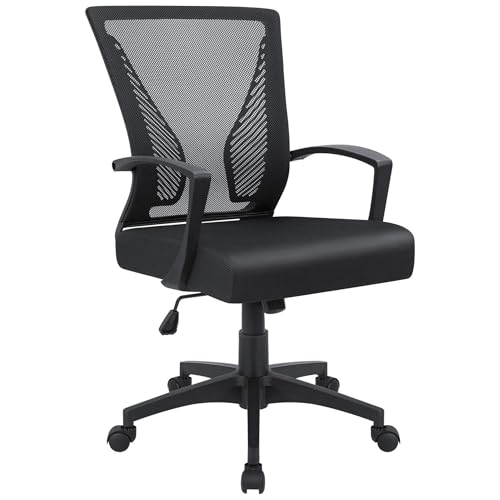
Furmax Office Chair — Best Budget
The Furmax is the honest floor of this category: a mid-back mesh desk chair with lumbar support, adjustable height, a breathable backrest and 360-degree swivel with armrests, sold in black as a single pack. There is no headrest, no multi-way armrest system, no recline theater. What there is, is the core geometry a back needs — a shaped mesh back with lumbar support, a seat you can set to your height, and casters that let you roll instead of twisting to reach things, which is a genuinely underrated back-saver in a home office. Furmax has sold this basic pattern for years, and its virtue is that nothing about it is experimental.
Strengths
- Covers the ergonomic basics — lumbar support, height adjustment, swivel — at the lowest cost here
- Breathable mesh back avoids the heat build-up of cheap vinyl chairs
- Simple build means simple assembly and fewer parts to fail
Trade-offs
- Mid-back height offers no head or upper-back rest for taller users
- Lumbar support is built-in rather than adjustable to your curve
- Armrests are fixed in position
Spec box
- Back: mid-back breathable mesh
- Lumbar: built-in support
- Height: adjustable
- Base: 360° swivel with rolling casters
Choose the Furmax with clear eyes and it will not disappoint you: it is a chair for someone upgrading from a kitchen chair, furnishing a first apartment desk, or equipping a spare room, who needs their back supported today rather than perfectly. The mid-back format actually suits shorter sitters well, because the backrest’s curve lands where it should instead of pushing at the shoulders. For marathon sitting, the picks above it add adjustability that matters; for a few hours of work a day at the lowest sensible price, this is the one.
Best for: first home offices, students, and anyone upgrading from a dining chair on the tightest budget / Not suited for: very tall users or all-day sitters who need adjustable lumbar placement
Check the current price on Amazon
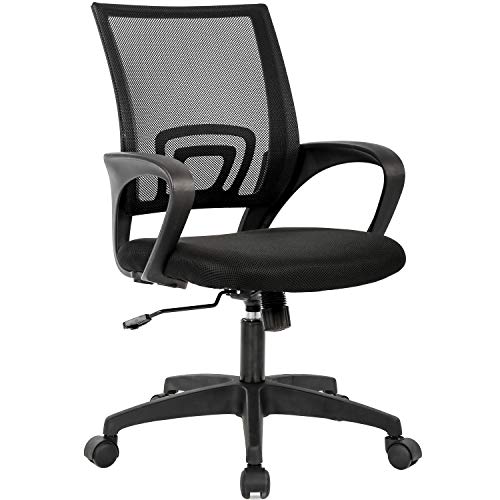
BestOffice Ergonomic Office Chair — Best Simple Starter Chair
The BestOffice chair overlaps the Furmax in spirit — mid-back, mesh, lumbar support, adjustable height, rolling wheels — but swaps the seat approach: where the Furmax keeps things minimal, the BestOffice uses a sponge seat cushion, which gives a slightly softer first impression for people who find mesh seats too firm. It is a swivel desk chair with a breathable backrest and lumbar support, sold as a pack of one in black. For a back that is more “stiff after long days” than seriously troublesome, that combination — a supportive back and a forgiving seat — is a sensible starter formula, and the chair’s long presence in the budget market means its assembly and behavior are well understood.
Strengths
- Sponge seat cushion softens the sit for people who dislike mesh seats
- Lumbar support and breathable backrest cover the back-comfort essentials
- Adjustable height and rolling wheels make it easy to set up a correct desk position
Trade-offs
- Foam seats compress over time faster than quality mesh or spring seats
- Mid-back design, again with no headrest
- Adjustment range is basic: height and swivel, not a full ergonomic suite
Spec box
- Back: mid-back breathable mesh
- Seat: sponge cushion
- Lumbar: support built in
- Base: swivel with rolling wheels
The honest way to think about the BestOffice is as a two-to-three-year chair: it will make a real difference to your working comfort today, and its cushion will eventually tell you when it is done. That is a fair trade at this price, and it is a better trade than a prettier faux-leather chair whose foam is thinner still. Pair it with a desk at the right height and a screen raised to eye level, and you have the complete inexpensive ergonomic triangle.
Best for: new work-from-home setups that want a softer seat feel at a starter price / Not suited for: buyers who want a decade-long chair or advanced adjustability
Check the current price on Amazon

Sweetcrispy Ergonomic Computer Desk Chair — Best for Small Spaces
Small rooms punish office chairs twice: the chair eats floor space, and fixed armrests stop it sliding under the desk, so it lives in the middle of the room forever. The Sweetcrispy answers with flip-up arms on a mid-back mesh chair with lumbar support, rolling swivel and a gray finish that suits bedrooms and study corners. Flip the arms up and the chair tucks fully under most desks, returning your floor. The back support does not suffer for the compact format — the listing confirms comfortable lumbar support as a headline feature — and the mid-back height keeps the visual bulk low in a small room.
Strengths
- Flip-up arms let the chair slide completely under the desk
- Mid-back mesh format keeps a small footprint and a light look
- Lumbar support included despite the compact, apartment-friendly design
Trade-offs
- Compact dimensions will feel snug for larger sitters
- No headrest for leaning back
- Gray is the confirmed colorway in the listing data we checked
Spec box
- Back: mid-back mesh
- Lumbar: support built in
- Armrests: flip-up
- Base: rolling swivel
There is a back-comfort angle to the small-space design that is easy to miss: in a cramped room, a chair that cannot tuck away gets parked at an angle, and people end up sitting twisted toward the desk because straight-on does not fit. A chair that stores properly gets used properly. If your desk is in a bedroom corner, a dorm, or a shared living room, the Sweetcrispy is the pick that respects both your back and your floor plan.
Best for: apartments, dorms, and bedroom desks where the chair must disappear after work / Not suited for: large sitters or anyone who wants a high-back executive feel
Check the current price on Amazon

DUMOS Home Office Chair — Best for Movement Breaks
The DUMOS entry in this category adds one feature the others mostly lack: a rocking mode. It is an ergonomic mid-back mesh chair with lumbar support, height adjustment, fixed armrests and a 360-degree swivel, and the ability to rock sounds like a gimmick until you think about what actually makes backs miserable — not sitting, but sitting still. A gentle rock changes pressure points, lets the lower back move through a small range, and makes the micro-breaks that every piece of sitting advice recommends feel natural instead of forced. The mesh back keeps the same breathability logic as the rest of the list, and the fixed armrests keep the price and the mechanism simple.
Strengths
- Rocking mode encourages the position changes that keep long sitting tolerable
- Ergonomic mid-back mesh with lumbar support for the core support job
- Height adjustable with a full swivel, so desk geometry can be set correctly
Trade-offs
- Fixed armrests will not suit every elbow height
- Rocking is a gentle tilt, not a deep recline with a lock range like the GABRYLLY
- Mid-back format again means no headrest
Spec box
- Back: mid-back mesh
- Lumbar: support built in
- Motion: rocking mode plus 360° swivel
- Height: adjustable
Think of the DUMOS as the fidgeter’s chair. If you know you will not take formal stretch breaks but you do shift, lean and perch, a chair that moves with you is more honest than a chair that demands perfect still posture. It is also a kind pick for shared family desks, because the forgiving mid-back format suits a wide range of heights without adjustment fuss. For focused, motionless, all-day task work, the SIHOO’s adjustability wins; for a living, shifting workday, the DUMOS earns its place.
Best for: restless sitters and shared desks who benefit from gentle movement / Not suited for: users who want armrest adjustability or a lockable recline for calls
Check the current price on Amazon
Comparison Table
| Pick | Badge | Key spec | Best for |
|---|---|---|---|
| SIHOO M18 | Best Overall | Adjustable lumbar, headrest, 330 lb capacity | All-day home-office work |
| GABRYLLY Ergonomic Chair | Best for Bigger Bodies | High back, wide cushion, 90–120° tilt lock | Tall and broad sitters |
| Furmax Office Chair | Best Budget | Mid-back mesh, built-in lumbar support | First desks on the tightest budget |
| BestOffice Ergonomic Chair | Best Simple Starter | Sponge seat, lumbar support, swivel base | Softer seat feel at a starter price |
| Sweetcrispy Ergonomic Chair | Best for Small Spaces | Flip-up arms, mid-back mesh | Apartments and bedroom desks |
| DUMOS Home Office Chair | Best for Movement Breaks | Rocking mode, mesh back, lumbar support | Restless sitters, shared desks |
How to Choose an Inexpensive Office Chair When Your Back Is the Priority
Start with lumbar support, not cushion thickness
The single most misleading number in budget chair shopping is seat thickness. Thick foam feels wonderful in a showroom minute and compresses into a hard pancake within months, while the lower back — the part that actually aches — depends on the backrest, not the seat. Look for lumbar support you can verify: an adjustable pad or mechanism you can move, like the SIHOO M18’s, is the gold standard at this price; a sprung or firmly contoured built-in support is the acceptable second tier; a vague “ergonomic shape” with no support structure named is marketing. If a listing cannot tell you how the lower back is supported, assume it is not.
Fit the chair to your measurements
Three numbers decide whether a chair can work for you. Seat height range must let your feet rest flat with knees near ninety degrees — too high and the seat edge presses the thighs, too low and the lower back rounds. Seat width must clear your hips with room to shift; a seat that pins you in one position guarantees stiffness. Back height must reach at least your shoulder blades if you lean back to think, which is why taller sitters should start with the GABRYLLY’s high-back format. Weight capacity, where the listing states it, is a durability figure as much as a safety one: a chair used near its limit wears its mechanism and foam far faster.
Mesh versus padded at budget prices
In the inexpensive band, mesh is usually the smarter buy for backs. It distributes support through tension, holds its shape for years, and breathes through summer afternoons. Padded chairs at this price use thin foam that feels plush initially and ages quickly; the BestOffice’s sponge seat is the reasonable compromise if you simply dislike mesh seats, with the understanding that the seat is the wear item. Faux-leather executive styling is the trap of this category: it photographs like a corner office and sits like a kitchen stool by month six.
Armrests: the quiet posture feature
Armrests set your shoulder posture. Too high, and your shoulders shrug all day; too low, and you lean sideways onto one elbow, curving the spine for hours. Adjustable arms, like the SIHOO’s 2D set, solve this properly. Flip-up arms, on the GABRYLLY and Sweetcrispy, solve a different problem — desk access and storage — and are the right choice in small rooms. Fixed arms are the budget compromise; if you choose them, check that the fixed height roughly matches your desk height so your forearms can rest level.
Budget tiers, honestly framed
Without printing prices that will change, the inexpensive market falls into three rough tiers. The entry tier buys you mesh, basic lumbar shaping and height adjustment — the Furmax and BestOffice live here, and they are legitimate chairs. The middle budget tier adds the features that matter most for backs: adjustable lumbar, headrests, better armrests — the SIHOO M18’s territory, and the best value-per-dollar in this guide. The upper budget tier buys size and mechanism: wider seats, higher backs, tilt locks, the GABRYLLY’s ground. Spending within the inexpensive band is rational; spending below its floor, on chairs with no named lumbar support at all, is how people buy two chairs in a year.
How to Set Up Your Chair and Desk for a Happier Back
A good chair set up badly still produces a bad afternoon. Work through this sequence once, in order, because each step depends on the one before it. First, sit in the chair and set the seat height so your feet rest flat on the floor with your knees at roughly ninety degrees; if your feet dangle, the seat is too high or you need a footrest, and dangling feet drag the lower back forward all day. Second, adjust the lumbar support — movable pads like the SIHOO’s — until it fills the natural curve of your lower back without pushing you forward; built-in supports need you to sit fully back in the seat to meet them, which is the most common setup mistake: perching on the front half of the seat makes every backrest useless. Third, set armrests so your forearms rest level with shoulders relaxed, elbows near ninety degrees. Fourth, raise or lower your screen until the top third is at eye level; a laptop on the desk guarantees a curved neck no chair can compensate for. Fifth, bring your keyboard and mouse close enough that you are not reaching forward — reaching is leaning, and leaning is load. Finally, set a rhythm: change position or stand briefly every half hour or so. The DUMOS’s rocking mode and the GABRYLLY’s tilt lock exist precisely to make that rhythm easy inside the chair itself.
What “Ergonomic” Actually Means at This Price — and What It Does Not
The word ergonomic appears on nearly every chair in this category, including chairs that are a flat seat screwed to a flat back. There is no certification a budget chair must pass before using the word, so the buyer’s job is to translate it into checkable parts. A genuinely ergonomic inexpensive chair gives you at least four adjustments or supports: seat height that matches your legs, a lumbar support with some structure to it, a backrest tall enough for your torso, and a way to change your recline or rock. The six chairs in this guide each clear that bar in different proportions — the SIHOO M18 with the most adjustment, the Furmax with the honest minimum — and that spread is exactly what the word should mean at this price: not a medical device, not a posture cure, but a set of levers that let the chair meet your body instead of the reverse.
What ergonomic does not mean is equally important. It does not mean the chair will correct years of slouching on its own; a support only works on a sitter who sits back into it. It does not mean one perfect posture exists — current thinking on sitting favors variety, which is why tilt locks and rocking modes appear in this guide as real features rather than garnish. And it does not mean the chair substitutes for the rest of the workstation. A supportive chair under a laptop at kitchen-table height still produces a rounded neck and shoulders. Treat the chair as the foundation of the setup, then finish the job with screen height, foot position and movement, as laid out in the setup section above.
Sitting Habits That Matter More Than Any Single Feature
Ask people who sit comfortably all day what their secret is and almost none of them name a chair part. They name habits, and the chairs in this guide are best understood as tools that make those habits easier. The first habit is sitting all the way back. It sounds trivial; it is the difference between a lumbar support working and not working, because every support in this guide is positioned for a sitter whose hips are at the back of the seat. The second habit is the micro-shift: crossing and uncrossing legs, moving between upright and a slight recline, standing for a call. Tilt locks on the GABRYLLY and SIHOO and the rocking mode on the DUMOS exist to serve exactly this, letting the chair hold several postures instead of one. The third habit is the foot check — feet flat, not tucked under the chair or wrapped around its base, both of which rotate the pelvis and undo the backrest’s work.
The fourth habit is the hourly reset: stand, walk to get water, look at something far away. No feature in any price band replaces it, and a budget chair plus the reset will beat an expensive chair sat in motionlessly for nine hours. This is also why we are comfortable recommending genuinely inexpensive chairs for back comfort. The expensive end of the market sells finer materials, longer warranties and smoother mechanisms — real things, worth money to some buyers — but the posture fundamentals that decide how your back feels at 5 p.m. are available at the prices in this guide, provided the chair fits you and you use its adjustments. Spend the savings on a monitor riser or a footrest if your setup needs them; your back will notice those more than it would notice a logo upgrade on the chair.
Keeping a Budget Chair Comfortable for Years
Inexpensive chairs fail in predictable, mostly preventable ways, and a little maintenance protects the comfort you bought. In the first week, re-tighten every assembly bolt once the chair has been sat in; budget hardware settles, and a loose backrest bolt is the usual source of the mysterious lean or squeak that people blame on the design. Every few months, check the casters for wrapped hair and grit, which drag and make you twist to move — the exact motion a sore back hates. Mesh backs clean with a vacuum brush and a damp cloth; foam seats last longer if you rotate your sitting position rather than compressing the same front edge daily. The gas lift is the component most likely to age out first on any chair in this band; a chair that slowly sinks is telling you the lift is done, and lifts are standard, replaceable parts — replacing one is far cheaper than replacing a chair whose back support still suits you. Finally, keep the lumbar support set where you calibrated it during setup. Family members and cleaning routines move adjustments; a monthly ten-second check keeps the chair fitted to the body it was bought for.
Who Should Skip the Budget Band Entirely
Honesty about limits is part of this guide’s job, so here is the case against everything above. If you sit for ten or more hours daily as a professional whose chair is a primary work tool — a developer, editor, dispatcher, or trader — the budget band’s compromises in mechanism smoothness, foam quality and warranty length will cost you more in replacements and discomfort than a mid-range chair bought once. If you are well outside standard sizing in either direction, the inexpensive market’s one-size patterns may simply never fit, and a chair built to your measurements is not a luxury but the only version of the product that works. And if a clinician has specified particular support characteristics for a diagnosed condition, follow that specification rather than a shopping guide; none of these chairs was designed to a medical brief, and this article deliberately makes no treatment claims for any of them.
For everyone else — the work-from-home majority, students, shared family desks, first apartments, spare rooms that became offices — the budget band is not a compromise so much as the rational price of the thing. The support fundamentals are present in the picks above, the money saved is real, and the difference between a good inexpensive chair used well and an expensive chair used badly runs in favor of the inexpensive one. Buy the fit, set it up carefully, move often, and let the chair do the modest, honest job it was designed for.
A note on casters and floors
One practical detail decides daily comfort more than buyers expect: the casters. Every chair here rolls on standard casters suited to low-pile carpet and hard floors, but deep plush carpet makes any budget chair feel sluggish, and hard floors let a chair drift when you lean — both encourage the bracing and twisting that tire a back. If your chair will live on thick carpet, budget for a chair mat; if it lives on hardwood and wanders, a mat solves that too and protects the floor. It is the least glamorous accessory in the home office and one of the most effective.
Common Buying Mistakes
Buying the executive look. High-back faux leather with pillow-top padding photographs like luxury and is the most returned shape in this category, because the foam is thin and the “lumbar pillow” is a loose cushion that slides to wherever it is least useful. Ignoring your own size. A petite sitter in a big-and-tall chair and a tall sitter in a mid-back chair are both unsupported, in opposite directions; match the format to your body before comparing features. Judging by the first sit. Almost any new chair feels better than a worn-out one for a week; judge by the support structure and adjustability, which predict month six. Forgetting the desk half of the system. A supportive chair under a too-high desk still produces shrugged shoulders and a rounded back; measure your desk height before blaming a chair. Expecting a chair to treat pain. Chairs support posture; they do not diagnose or treat. Persistent, radiating, or worsening pain deserves professional assessment, and no purchase in this guide should delay it. Skipping assembly care. Budget chairs reward careful assembly: bolts tightened in sequence and re-checked after a week keep the mechanism quiet and the support where you set it.
Final Recommendation
For most people, the answer is the SIHOO M18: it is the one inexpensive chair here whose lumbar support adjusts to you rather than asking you to adjust to it, and that is the feature a sore back actually cashes in. If you are tall or broad, go straight to the GABRYLLY, because fit beats features. If the budget is truly tight, the Furmax covers the honest basics, and if your desk lives in a small room, the Sweetcrispy with its flip-up arms will serve both your back and your floor plan. Whichever you choose, spend the ten minutes on the setup sequence above; it is worth as much as the chair.
One last word on expectations: give any new chair two weeks before judging it. A back accustomed to a bad chair often reads correct support as stiffness at first, because the muscles that were compensating have to relearn their job. Adjust in small steps — a little lumbar, a centimeter of height — rather than changing everything daily, and keep the setup sequence nearby. Most people who follow that process with the chairs above report the change not as a dramatic fix but as the absence of the familiar 4 p.m. ache, which is exactly the honest promise an inexpensive chair can keep.
Related guides in this series: Best Ergonomic Office Chairs Back Pain, Best Inexpensive Comfortable Office Chairs, Best Home Office Chairs For Comfort, Best Heavy Duty Office Chairs Flip Up Arms 500 Pounds, Best Ergo Office Chairs Available, Best Customizable Office Chairs.
Frequently Asked Questions
Can an inexpensive office chair really help my back?
It can help your posture, which is the part of back comfort a chair controls. A chair with real lumbar support, correct height and a backrest you actually sit against keeps your spine closer to neutral through the day. It cannot treat an injury or a medical condition, and any chair claiming to do so is overpromising.
Is mesh or a padded seat better for long sitting?
At budget prices, mesh usually wins over time because it holds its tension and breathes, while inexpensive foam compresses. If you dislike mesh seats, a sponge-seat chair like the BestOffice is a fair compromise, with the expectation that the cushion is the part that will age first.
How do I know if a chair fits my body?
Check that the seat height range lets your feet rest flat, the seat width clears your hips with room to shift, and the backrest reaches at least your shoulder blades. Where a listing states a weight capacity, stay comfortably under it for durability as well as safety.
Are flip-up armrests worth it?
In small rooms, yes: they let the chair tuck fully under the desk and let you sit closer to your work. At a large desk where the chair lives in place, adjustable armrests like the SIHOO’s 2D set do more for shoulder posture.
How long should an inexpensive office chair last?
With daily use, expect a budget mesh chair to give several years of service, with casters and gas lifts as the typical wear items. Foam-seat models usually feel tired sooner. Re-tightening bolts after the first weeks extends the life of any of them.
Would a standing desk be better than a better chair?
They solve different problems. Standing all day loads the legs and lower back in its own way, and most people who thrive with a standing desk alternate — sit for focused work, stand for calls and email. If your budget forces a choice, fix the chair and the screen height first, because you already own a desk; add standing later if you still want it. A supportive chair plus regular standing breaks captures most of the benefit at a fraction of the cost.
What else should I fix besides the chair?
Screen height and desk height matter as much. Raise the screen so its top third sits at eye level, keep your feet flat, and change position regularly. The chair is one leg of the stool; setup and movement are the other two.


