Disclosure: airfryerkitchensupply.com is reader-supported. When you buy through links on our site, we may earn an affiliate commission at no extra cost to you.
Where to buy
The fastest way to buy any pick in this guide to the best vacuums for wool rugs is through Amazon, where sizing, colour and stock are shown on the listing itself. Use the links below to go straight to each verified product page and check price on Amazon before you order — we do not print static prices here because they change too often to stay honest.
- Miele Classic C1 Pure Suction — Best Overall for Wool: Check the current price on Amazon
- Miele Classic C1 Turbo Team — Best for Low-Medium Pile Wool: Check the current price on Amazon
- Kenmore 600 Series 81615 Bagged Canister (Pet Friendly) — Best Powered Canister: Check the current price on Amazon
- Shark Navigator Lift-Away NV360 — Best Upright (Brushroll Shutoff): Check the current price on Amazon
- Eureka Bagged Canister 3670H — Best Budget Canister: Check the current price on Amazon
- Sebo Airbelt K3 Premium Canister — Best Premium Pick: Check the current price on Amazon
The best vacuums for wool rugs solve a specific problem: wool is a protein fibre with a scaly surface and a springy pile, and the rotating brushroll that makes a cheap upright brilliant on synthetic carpet will fuzz, pill and eventually tear that pile apart. Wool rugs — especially hand-knotted, looped or antique pieces — need suction they can survive, week after week, for decades. This guide therefore ranks vacuums by how gently they lift dirt out of wool, not by headline suction numbers.
That is why canisters dominate this list. A suction-only canister like the Miele Classic C1 Pure Suction cleans with airflow alone. Turbo and powered heads appear here too, but with conditions attached: an air-driven turbobrush is gentler than a motor-driven beater, and a powered head with height adjustment and a shutoff earns its place only if you actually use those controls. One upright makes the cut — the Shark Navigator NV360 — precisely because its brushroll can be switched off for delicate floors.
Every product below was cross-checked by brand and model, and only listing-confirmed listings carry buying links. Specs quoted are the ones the verified listing titles confirm; where a detail is not stated in the verified data, we say so rather than guess. Wool rugs are often the most expensive soft furnishing in a room — the vacuum advice here is deliberately conservative, and where a pick needs care in use, the review says so plainly.
One more framing note before the picks: ‘best’ in this guide means best at protecting wool while cleaning it, which is not the same as the most powerful vacuum, the most expensive vacuum or the best vacuum for a house full of synthetic carpet. Several famous uprights and robot models are absent on purpose. If your wool rug shares the home with wall-to-wall carpet, read the Sebo and Kenmore reviews closely — they are the picks designed to serve both masters — and if your rug is genuinely precious, let the Miele Pure Suction settle the question and stop shopping.
Budget expectations help before the reviews: wool-safe cleaning exists at every tier in this guide, from the budget Eureka canister to the premium Sebo, because gentleness is a design choice rather than an expensive component. What more money buys is refinement — better filtration, finer suction control, longer reach, quieter running and build quality that survives a decade of weekly use. Decide which of those refinements your household will actually feel, and let the rug’s value, not the motor’s wattage, set the tier.
Key Takeaways
- Wool pile is damaged by aggressive rotating brushrolls, not by suction — the safest vacuums here are suction-led canisters or machines with a brushroll shutoff.
- The Miele Classic C1 Pure Suction is the benchmark wool-safe design: no rotating brush at all, just controlled suction and a combination floorhead.
- If you use a powered head on wool, keep it on its lowest height setting, move slowly, and never leave it running in one spot.
- Every pick was verified against Amazon listing data before earning a link; prices are checked live on the listing, never printed here.
In this guide
Quick Picks
Best Overall for Wool — Miele Classic C1 Pure Suction. A suction-only canister built for hard floors and low-pile carpet — exactly the cleaning action delicate wool pile tolerates best. — check price on Amazon
Best for Low-Medium Pile Wool — Miele Classic C1 Turbo Team. The C1 canister with an air-driven turbobrush floorhead for low-to-medium pile — gentle agitation for wool rugs that need a little help releasing grit. — check price on Amazon
Best Powered Canister — Kenmore 600 Series 81615 Bagged Canister (Pet Friendly). A two-motor bagged canister with a Pet PowerMate powered head, HEPA filtration and a retractable cord — powerful, so use its control with wool. — check price on Amazon
Best Upright (Brushroll Shutoff) — Shark Navigator Lift-Away NV360. A lift-away upright with HEPA filtration and — the feature that earns its place here — a brushroll shutoff for delicate floors and rugs. — check price on Amazon
Best Budget Canister — Eureka Bagged Canister 3670H. A lightweight bagged canister with straightforward suction and a blower function, sold with two bags — the low-cost route to wool-safe cleaning. — check price on Amazon
Best Premium Pick — Sebo Airbelt K3 Premium Canister. A German-made premium canister with an ET-1 powerhead, parquet brush, 37-foot reach and a 7-year motor warranty stated in the listing. — check price on Amazon
How These Picks Were Chosen
Candidates were screened in a fixed order. First, the API check: brand and model were searched connection and the returned title had to match the intended machine exactly. Second, the wool test: could this vacuum clean a wool rug without a spinning brushroll touching the pile — either because it has no brushroll, because the brushroll switches off, or because the head is air-driven and comparatively gentle? Machines that failed that test were cut regardless of power or price. Third, the household test: weight, cord or runtime practicality, filtration and whether the machine also handles the hard floors most wool rugs sit on.
Within that frame we deliberately mixed formats — pure-suction canister, turbo canister, full powered canister, a shutoff upright and a premium German canister — because wool-rug owners differ. A flat-weave wool rug in a hallway and a deep hand-knotted rug in a sitting room do not need the same machine. Prices are not printed: they move too often to stay honest, so use the links to check price on Amazon on the day you buy.
The 6 Best Vacuums for Wool Rugs, Reviewed

Miele Classic C1 Pure Suction — Best Overall for Wool
The Pure Suction is the reference point for wool-safe cleaning. As its name states, it cleans by suction alone: there is no rotating brushroll to fuzz or tear wool fibres, so the combination floorhead glides over the pile and lifts grit out with airflow. For hand-knotted, looped and antique wool rugs, this is the mechanism conservators would choose, in a mainstream machine at a mid-range tier.
Strengths
- Suction-only cleaning — zero brushroll contact with wool pile
- Canister format follows easily around and under furniture
- Equally at home on the hard floors around the rug
Trade-offs
- Suction alone is slower on deep-pile synthetic carpet elsewhere in the house
- Bagged design means ongoing bag costs
- Low-pile focus: not the tool for thick shag
| Format | Bagged canister |
| Cleaning action | Pure suction, no brushroll |
| Stated for | Hard floors & low-pile carpet |
The reason this machine tops the list is mechanical honesty. Wool pile damage is cumulative and mostly invisible until the surface looks tired: each pass of an aggressive brushroll breaks fibres that then vacuum away as fluff. Pure suction removes the loose grit — the grit is what actually grinds fibres down when walked on — without adding mechanical wear of its own. On a low-pile wool rug the result is a genuinely deep clean, achieved at walking pace with overlapping strokes.
In daily use the C1 format is easy to live with: the canister trails behind on casters, the wand reaches under sofas where wool rugs collect dust at the edges, and the same head handles the surrounding wood or tile without a swap. If your home is mostly wool rugs and hard floors with one synthetic carpet upstairs, this is still the right primary machine — just expect that carpet to take a few extra passes.
Best for: owners of hand-knotted, looped or antique wool rugs who want the gentlest effective clean / Not suited for: homes dominated by deep-pile synthetic carpet

Miele Classic C1 Turbo Team — Best for Low-Medium Pile Wool
The Turbo Team keeps the C1’s canister practicality and adds a turbobrush: a brushroll spun by the vacuum’s own airflow rather than by a motor. Air-driven brushes stall against resistance instead of forcing their way through, which makes them markedly gentler on wool than electric beater bars — a sensible middle path for low-to-medium pile wool rugs that hold onto grit.
Strengths
- Air-driven turbobrush agitates without motor-driven force
- Same manageable C1 canister body as the Pure Suction
- Listed for hard floors and low-med pile carpet alike
Trade-offs
- Still a rotating brush — test on a hidden corner of delicate or looped wool first
- Turbobrush needs occasional hair removal to spin freely
- Bagged running costs apply
| Format | Bagged canister |
| Floorhead | Air-driven turbobrush |
| Stated for | Hard floors & low-med pile carpet |
Think of the Turbo Team as the pick for wool rugs that live real lives — hall runners, family-room rugs, wool blends that trap grit deeper than surface suction reaches. The turbobrush’s gentle agitation shakes that grit loose so suction can take it away. The discipline is in the test: run it first on an inconspicuous corner, check the dust bag for wool fluff afterwards, and if the rug is shedding fibres into the machine, step back to pure suction.
Owners of both hard floors and wool rugs will appreciate not having to think in two machines. The turbo head handles the rug, the suction setting handles the boards, and the canister body keeps the whole routine light. It is also a kind choice for wool rugs in homes with pets, where hair works itself into the pile and pure suction sometimes skates over it — the brush lifts what suction alone leaves behind, without the violence of a powered beater.
Best for: low-to-medium pile wool rugs and wool blends that need gentle agitation / Not suited for: delicate looped or antique wool — stay with pure suction
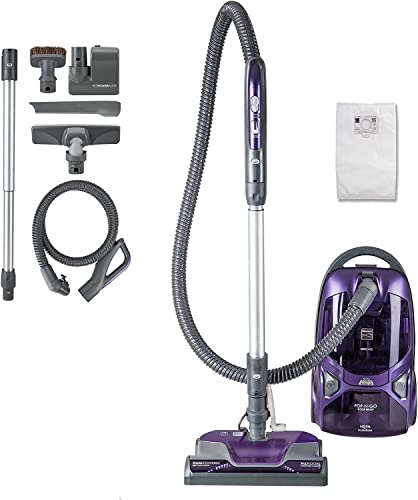
Kenmore 600 Series 81615 Bagged Canister (Pet Friendly) — Best Powered Canister
The Kenmore 600 Series is the muscle in this list: a bagged canister whose separate powered head (the Pet PowerMate) is driven by its own motor, with HEPA filtration and a retractable cord. It earns its place for large wool rugs in busy, pet-owning homes where pure suction is slow going — provided you treat the powered head as an adjustable tool, not a default.
Strengths
- Powered Pet PowerMate head for large rugs and heavy soil
- HEPA filter and bagged dirt containment
- Retractable cord and lightweight canister body
Trade-offs
- Powered brushroll is the riskiest action here for delicate wool — use the lowest setting and keep moving
- Two-motor power is overkill for small flat-weave rugs
- Bags and filters are ongoing consumables
| Format | Bagged canister, 2-motor |
| Floorhead | Pet PowerMate powered head |
| Filtration | HEPA filter |
| Cord | Retractable |
Used with discipline, the Kenmore is excellent: set the head height so the brush just kisses the pile, work in slow overlapping passes, and let the strong suction do the lifting. Used carelessly — lowest height, brush grinding in one place — it is exactly the machine that fuzzes wool. The HEPA filtration and bagged system are real quality-of-life features in pet homes, keeping the dust you remove from re-entering the room air.
The honest framing: this is the pick for big, hard-wearing wool rugs — dense machine-made pieces that tolerate a powered head — in homes that also have carpeted rooms where the PowerMate earns its keep daily. If your wool rug is the valuable antique kind, buy this for the rest of the house and clean the rug with the Pure Suction approach instead. Versatility is this machine’s virtue; restraint is the owner’s job.
Best for: large, hard-wearing wool rugs in pet homes that also have fitted carpets / Not suited for: fragile antique or looped wool rugs

Shark Navigator Lift-Away NV360 — Best Upright (Brushroll Shutoff)
Most uprights were excluded from this guide on sight. The NV360 survives because its brushroll can be switched off, turning it into a suction-led cleaner for wool, and because its lift-away pod handles stairs and edges where rugs collect grit. For households that will only own an upright, this is the wool-tolerant way to do it.
Strengths
- Brushroll shutoff makes suction-only cleaning possible in an upright
- Lift-away pod for stairs, edges and above-floor cleaning
- HEPA filtration with swivel steering
Trade-offs
- You must remember to switch the brushroll off for wool — every time
- Heavier in hand than a canister wand on large rugs
- 0.9-qt dust cup needs frequent emptying in pet homes
| Format | Lift-away upright, bagless |
| Key feature | Brushroll shutoff |
| Filtration | HEPA |
| Dust cup | 0.9 qt |
The NV360’s wool case rests entirely on that shutoff, so build the habit: brushroll off before the machine touches the rug, in the same motion as plugging in. With the brush off, suction and the swivel head give a controlled clean, and the lift-away pod is genuinely handy for the gritty borders where rug meets hard floor. The swivel steering that makes it nimble on carpet needs a slower hand on wool — wide, straight passes beat scrubbing motions.
As an all-house machine it is easy to recommend: carpets get the brush, wool and hard floors get suction-only, and the pod mode covers stairs and upholstery. The trade-off against the canisters is finesse — an upright’s head is heavier on the pile even with the brush off. For a household with one good wool rug among otherwise synthetic flooring, that compromise is reasonable; for a house full of wool, a canister stays the better tool.
Best for: upright loyalists with one or two wool rugs among mixed flooring / Not suited for: anyone who will not reliably use the brushroll shutoff

Eureka Bagged Canister 3670H — Best Budget Canister
The Eureka 3670H proves wool-safe cleaning does not require a premium machine. It is a lightweight bagged canister with simple suction cleaning — no aggressive powered head — that the verified listing positions for hardwood, carpet and pet households alike. For a single wool rug or a small flat, it covers the need at a budget tier.
Strengths
- Gentle suction-led cleaning at a budget tier
- Lightweight canister is easy to carry between floors
- Bagged containment; two bags included in the listing
Trade-offs
- Basic filtration compared with the HEPA picks
- Less refined controls and floorhead than Miele or Sebo
- Suction-only pace on larger rugs
| Format | Bagged canister |
| Cleaning action | Suction (with blower function) |
| Included | 2 bags |
| Stated for | Hardwood floor, carpet, pet & car use |
The 3670H’s simplicity is its wool credential: with no beater bar forcing the issue, the risk profile drops to that of any suction cleaner, and the light body encourages the slow, overlapping technique wool prefers. It will not match the Miele’s refinement or the Kenmore’s power, and its filtration is basic, but for the price tier it is the honest way to protect a wool rug instead of attacking it with a cheap upright.
It doubles happily as a second machine — the one kept upstairs, or dedicated to the rug room — even in homes that own a bigger vacuum. Owners report the format’s usual virtues: it stores in a small cupboard, the bags keep dust contained on disposal, and the blower function clears leaves from a porch where outdoor wool-look rugs live. Judge it as a specialist budget tool and it over-delivers.
Best for: budget buyers, small homes and single-rug households wanting gentle suction / Not suited for: allergy-focused buyers needing sealed HEPA filtration

Sebo Airbelt K3 Premium Canister — Best Premium Pick
The Sebo K3 is the connoisseur’s option: a premium canister, made in Germany per the verified listing, supplied with both the ET-1 powerhead for carpets and a parquet brush for hard floors, with a 37-foot operating reach and a stated 7-year motor warranty. For wool, the parquet brush and suction are your everyday tools; the powerhead is for the home’s other carpets.
Strengths
- Two floor tools: suction parquet brush for delicate surfaces, ET-1 powerhead for carpets
- 37-foot reach reduces socket changes on large rugs
- Stated 7-year motor warranty and German manufacture
Trade-offs
- Premium tier pricing
- Powerhead must stay off delicate wool — this is a two-tool discipline
- Bagged consumables at premium prices
| Format | Premium bagged canister |
| Floorheads | ET-1 powerhead + parquet brush |
| Reach | 37 ft |
| Warranty | 7-year motor (per listing) |
| Origin | Made in Germany (per listing) |
What the premium buys is control and longevity. Suction is finely adjustable, the parquet brush glides over hard floors and flat wool without any rotating contact, and the build quality is the kind owners keep for a decade or more. On wool rugs, treat the K3 as a suction machine with a superb wand; keep the ET-1 for fitted synthetic carpets where its height adjustment can be set precisely.
The Airbelt bumper that gives the range its name protects furniture legs — a small mercy around the antique furniture that often shares a room with a good wool rug. If you are buying one vacuum for a serious house and expect it to outlast trends, this is the considered choice; if your wool is delicate, its suction tools are as gentle as anything here, and its powerhead simply stays in the cupboard on rug day.
Best for: buyers wanting one premium, long-life machine for wool rugs plus fitted carpets / Not suited for: budget buyers, or anyone who wants a single do-everything head
Comparison Table
| Pick | Badge | Key spec | Best for |
|---|---|---|---|
| Miele Classic C1 Pure Suction | Best Overall for Wool | Suction-only canister, no brushroll | owners of hand-knotted, looped or antique wool rugs who want the gentlest effective clean |
| Miele Classic C1 Turbo Team | Best for Low-Medium Pile Wool | Air-driven turbobrush canister | low-to-medium pile wool rugs and wool blends that need gentle agitation |
| Kenmore 600 Series 81615 Bagged Canister (Pet Friendly) | Best Powered Canister | 2-motor canister, powered head, HEPA | large, hard-wearing wool rugs in pet homes that also have fitted carpets |
| Shark Navigator Lift-Away NV360 | Best Upright (Brushroll Shutoff) | Upright with brushroll shutoff, HEPA | upright loyalists with one or two wool rugs among mixed flooring |
| Eureka Bagged Canister 3670H | Best Budget Canister | Lightweight bagged suction canister | budget buyers, small homes and single-rug households wanting gentle suction |
| Sebo Airbelt K3 Premium Canister | Best Premium Pick | Premium canister, dual floorheads, 37-ft reach | buyers wanting one premium, long-life machine for wool rugs plus fitted carpets |
Why Wool Pile Hates Brushrolls
A wool fibre is not smooth like a synthetic filament; under magnification it has overlapping scales, and the pile of a wool rug stands in a particular direction — its ‘nap’ — set during making. A fast rotating brushroll drags against those scales thousands of times per minute. The visible results arrive slowly: a fuzzy halo on the surface, pills in traffic lanes, and eventually thin patches where fibres have snapped and been vacuumed away. Hand-knotted and looped constructions suffer worst, because a brush can catch a loop and pull.
Suction works differently. Airflow lifts loose material — grit, dust, hair — out of the pile without bending fibres against their scales. That is why the safest machines in this guide either lack a brushroll entirely, drive it gently with air, or let you switch it off. Power is not the enemy: strong suction with no brush is safer for wool than weak suction with a beater bar.
The Wool-Safe Vacuuming Technique
Technique matters as much as machinery. Vacuum in the direction of the pile where you can identify it — stroke a hand across the rug; the smooth direction is with the nap. Use slow, overlapping passes and let suction work; three unhurried passes clean better and safer than six scrubbing ones. Keep a powered or turbo head moving at all times and never park it running on the rug. Work the edges with a crevice tool rather than forcing the main head against skirting, and vacuum fringes only with suction, combing them straight by hand afterwards — never run any brush over fringe.
Frequency beats intensity. Wool rugs in use shed loose fibre naturally in their first months — that fluff is not damage. A gentle weekly vacuum that removes grit before feet grind it in will protect the pile far better than a monthly deep assault. Empty or change the bag before it is packed full; a choked machine loses the airflow that makes suction-only cleaning work.
Matching the Machine to the Rug Type
Flat-weave and kilim-style wool rugs are the most forgiving: pure suction or a turbo head on a low setting both serve, and their thin profile means grit sits near the surface. Low-to-medium pile machine-made wool rugs tolerate the Turbo Team approach or a carefully set powered head. Deep-pile and shaggy wool wants suction and patience — a turbo head can tangle in long pile, so pure suction with more passes is the play. Hand-knotted, antique and looped rugs get the strictest rule in this guide: suction only, no exceptions, and consider a professional clean rather than any home machine for a full refresh.
Blends sit between their parents. A wool-synthetic blend tolerates slightly more agitation than pure wool, but the wool fraction still fuzzes first, so treat blends as wool until a hidden-corner test proves otherwise. When in doubt, test any new machine or head on the rug’s least visible corner and inspect the collected dust for dyed wool fluff — the machine will tell you the truth within one session.
Filtration, Bags and the Dust Question
Wool rugs hold fine dust deep in the pile, and vacuuming releases some of it into the room air — which is why the filtration differences in this list matter. Sealed systems with HEPA filtration, like the Kenmore and the Shark here, return cleaner air, a genuine consideration for allergy-prone households. Bagged machines contain dust better at disposal time than bagless cups, which puff on emptying; if you choose the bagless NV360, empty it outdoors and away from the rug room.
Bags are also a performance feature, not just a cost: a fresh bag restores the airflow that suction cleaning depends on, while a bagless machine with a clogged filter quietly loses it. Whichever format you choose, put filter and bag checks on the same monthly rhythm as your sole-and-tread checks on footwear — small maintenance is what keeps a wool-safe vacuum wool-safe.
When to Call a Professional Instead
Some jobs are not vacuum jobs. Ground-in staining, pet accidents that have reached the backing, moth activity in stored rugs, and any antique or high-value piece with existing damage all belong to a specialist rug cleaner, who can wash wool with controlled chemistry and drying that a home cannot replicate. Vacuuming is maintenance between those events: it removes dry soil brilliantly and does nothing for set stains except sometimes set them further.
A useful rule: if you would be upset to lose the rug, its deep cleans are professional and its home care is suction-only. If it is a hard-wearing everyday rug, the powered options in this guide, used with the discipline described, are entirely reasonable. Either way, rotate the rug a half-turn every few months so traffic and sunlight even out — the cheapest pile-preservation trick there is.
How to Vacuum a Wool Rug Safely, Step by Step
This routine works with any pick in the guide and takes about ten minutes for a medium rug.
- Clear the rug: lift furniture where practical, and pick up large debris by hand so the vacuum only handles dust and grit.
- Set the machine for wool: pure suction head fitted, or brushroll switched off, or turbo/power head set to its highest pile setting.
- Test on a hidden corner for thirty seconds, then check the dust container or bag for dyed wool fluff. Fluff beyond the rug’s normal early shedding means stop and switch to pure suction.
- Vacuum with the nap in slow, overlapping straight passes, keeping any rotating head constantly moving.
- Slow down further on traffic lanes — that is where grit concentrates — rather than pressing down or scrubbing.
- Use the crevice tool along skirting edges and under furniture lips where the main head cannot seal.
- Do fringes with suction only, then straighten them by hand. Never brush or beat fringe.
- Finish by checking the rug at raking light: remaining grit sparkles. A second light suction pass beats one heavy one.
Fortnightly for quiet rooms, weekly for halls and pet homes, and always before and after moving furniture — grit under a furniture leg does more damage in a day than feet do in a month.
Suction Numbers and Other Specs That Mislead on Wool
Shoppers comparing vacuums meet a wall of numbers — watts, amps, air watts, pascals — and almost none of them predict wool safety or even wool cleaning quality. Wattage measures electricity consumed, not dirt removed. What cleans a wool rug is airflow at the head combined with a good seal against the pile, and both depend more on head design and on the machine’s maintenance state than on the motor’s headline figure. A mid-power canister with a fresh bag and a well-sealed suction head will out-clean a high-power upright whose brush is busy damaging the pile it is meant to clean.
The specs that do matter for this job are the unglamorous ones: whether the brushroll can be disabled or removed, the head’s height range, the filtration standard, the cord length or runtime that lets you finish the rug without rushing, and the weight of the part you actually push. Read listings for those five things and ignore the horsepower theatre. Every pick in this guide was chosen on those criteria, which is why a modest Eureka sits comfortably beside a premium Sebo — on wool, their cleaning actions are cousins.
Seasonal and Storage Care for Wool Rugs
Wool rugs that rotate seasonally — heavy pieces put down for winter, stored for summer — need a vacuum routine at both ends. Before storage, vacuum both sides thoroughly with suction: the underside sheds grit that would otherwise sit against the pile for months, and a clean rug is far less interesting to moths. Roll the rug with the pile facing inward around a wide tube if possible, never fold it sharply, and store it dry, off the floor, in a breathable wrap rather than sealed plastic, which traps moisture against the wool.
When the rug comes back out, unroll it and let it rest a day before vacuuming — fibres need time to relax — then give it a gentle suction pass and check the edges and underside for any sign of insect activity before furniture goes back on top. Rugs staying down year-round benefit from the same both-sides treatment once or twice a year: flip, vacuum the back, vacuum the floor beneath, then the top again. It takes twenty minutes and removes the grit reservoir that regular top-only vacuuming never reaches.
Attachments Worth Using on Wool
Three attachments earn their storage space in a wool-rug household. The crevice tool handles edges, under-hearth gaps and the gritty line where rug meets skirting better than any main head. An upholstery tool with no brush — or with its brush retracted — is the right way to vacuum rug-covered stairs, where control matters and a full head is clumsy. And a soft dusting brush lifts surface dust from fringed ends and from the rug’s border patterns without touching the pile structure. What you do not need: powered mini-turbos and scrubbing attachments marketed for stairs and pet hair. On wool they concentrate exactly the aggressive action this guide exists to avoid, in a smaller, harder-to-control package.
A Realistic Buying Checklist for Wool-Rug Owners
Start by naming your rug honestly. Construction first: hand-knotted, hand-tufted, looped, flat-woven or machine-made — if you do not know, the underside tells you, since hand-knotted rugs show the pattern clearly on the back while machine-made pieces show a uniform backing. Pile depth second: press a fingertip in and note how far it sinks. Value third — not the price tag, but your honest answer to ‘would I be upset to lose this piece?’ Those three answers, written down, decide which third of this guide applies to you before any brand name enters the conversation.
Next, audit the rest of your floors, because few households vacuum one rug in isolation. A home that is wool rugs over hard floors wants a suction canister and nothing else. A home mixing wool rugs with fitted synthetic carpets wants either two tools — the Sebo pattern — or one machine with a genuine brushroll shutoff, used with discipline. A home with pets adds filtration and capacity to the list. Writing the floor audit down stops the commonest buying error in this category: purchasing a brilliant carpet machine and then discovering it is the wrong tool for the most valuable floor covering in the house.
Then set the maintenance budget alongside the purchase budget. Bagged canisters need bags; HEPA systems need filters; every machine needs both on schedule or its wool-safe airflow quietly degrades. None of these costs is large, but they are real, and a machine you cannot afford to maintain becomes a machine that tempts you into scrubbing harder to compensate. The Eureka’s low running costs are part of its case; the Sebo’s premium consumables are part of its price of admission. Buy the whole ownership picture, not the box.
Finally, plan the test before the machine arrives. Choose the rug’s least visible corner, decide what ‘too much fluff’ looks like by first vacuuming that corner with your current gentlest method, and keep the packaging until the new machine has passed. Retail returns windows exist for exactly this. A vacuum is a ten-year relationship in the good cases in this guide; a thirty-minute test on day one is the cheapest insurance in the whole purchase.
Common Buying Mistakes
Using the carpet setting everywhere. The beater-bar setting that flatters synthetic carpet is the one that fuzzes wool. If your machine has a shutoff or a suction head, the wool rug is where it earns its existence.
Vacuuming fringe with the main head. Fringe tangles, tears and wraps around brushrolls. Suction by hand-held tool only, then comb straight — thirty seconds that saves a repair bill.
Waiting until the rug looks dirty. Wool hides grit deep in the pile long before the surface looks soiled. By the time it looks dirty, feet have been grinding that grit into the fibres for weeks.
Scrubbing motions and parked heads. Back-and-forth scrubbing bends fibres against their scales, and a powered head left running in one spot can wear a visible patch. Slow, straight, moving passes only.
Ignoring a full bag or clogged filter. Suction-only cleaning depends entirely on airflow. A choked machine tempts you to press harder and scrub more — the two things wool hates — to compensate.
Final Recommendation
For most wool-rug owners the answer is the Miele Classic C1 Pure Suction: it removes the damaging mechanism entirely and cleans low-pile wool beautifully. If your wool is low-to-medium pile and lived-in, the Turbo Team adds gentle help. Pet homes with big hard-wearing rugs should look at the Kenmore, upright households at the NV360 with its shutoff used religiously, budget buyers at the Eureka 3670H, and anyone buying a decade-long machine at the Sebo K3 — using its suction tools on the wool and saving its powerhead for fitted carpet.
Whichever you choose, the technique section above is half the purchase. The best vacuums for wool rugs are the ones whose owners vacuum gently, often, and with the brush under control.
Shortlist again: Miele Classic C1 Pure Suction, Miele Classic C1 Turbo Team, Kenmore 600 Series 81615 Bagged Canister (Pet Friendly), Shark Navigator Lift-Away NV360, Eureka Bagged Canister 3670H, Sebo Airbelt K3 Premium Canister.
Related guides on this site: Best Bagged Vacuums For Carpet And Hardwood · Best Area Rug That Vacuums Easily · Best 8 X 10 Wool Area Rugs · Best Braided Wool Rugs · Best Carpet Cleaner Machine For Wool Rugs
Frequently Asked Questions
Can I use a robot vacuum on a wool rug?
Cautiously, on robust flat-weave or low-pile wool only, and only a model whose brush can be removed or disabled — most robot brushes are always-on beater bars. For hand-knotted, looped or valuable wool, we would not risk it; the picks in this guide give you control a robot does not.
Why does my wool rug fill the vacuum with fluff?
New wool rugs shed loose surface fibre for months — that is normal and slows over time. If an older rug suddenly sheds heavily under a new machine, the machine is too aggressive: switch to pure suction and re-test on a corner.
Is a bagged or bagless vacuum better for wool?
The bag does not touch the rug, so either can be wool-safe; what matters is the head. Bagged models hold airflow longer between changes and contain dust better at disposal, which is why most picks here are bagged.
How often should wool rugs be vacuumed?
Weekly in living areas, twice weekly in halls and pet homes, always gently. Frequent light suction removes grit before it grinds the pile — the main long-term threat to wool.
Can steam cleaning replace vacuuming on wool?
No — they do different jobs, and heat plus moisture needs care on wool. Vacuum for dry soil; leave wet deep-cleaning of valuable wool to specialists, and never use a powered scrubbing carpet washer on a delicate rug.
What suction setting should I use?
Full suction is fine — airflow does not harm wool. It is brush action, head height and scrubbing that cause damage. Keep powered heads on their highest pile setting and keep them moving.
Should I vacuum the back of a wool rug too?
Yes, once or twice a year. Grit migrates through the pile and sits against the backing, where feet grind it upward into the fibres. Flip the rug, vacuum the back with suction, vacuum the floor beneath, then replace and vacuum the top. It is the single most effective deep-maintenance step short of professional washing.
Does vacuuming wear out a wool rug over time?
Gentle suction vacuuming extends a wool rug’s life by removing the grit that abrades fibres underfoot. It is aggressive brush action, scrubbing and excessive heat that wear wool out. The owners who vacuum weekly with suction are the ones whose rugs reach their third decade looking right.
What about under-rug pads — do they change vacuuming?
A good pad holds the rug still so the vacuum head is not dragging the rug across the floor, which reduces both pile stress and your effort. It also lifts the rug slightly, letting airflow work at the edges. If your rug creeps when you vacuum, a pad is a better fix than pressing down harder with the machine.
Is it safe to vacuum an antique rug myself at all?
Gentle suction through a mesh screen laid over fragile areas is the conservator’s home method, and the Pure Suction approach in this guide is compatible with it. If the rug has existing tears, powdering dye or a disintegrating foundation, stop: that rug needs a specialist’s assessment before any machine, however gentle.

