Disclosure: airfryerkitchensupply.com is reader-supported. When you buy through links on our site, we may earn an affiliate commission at no extra cost to you.
Where to Buy
The best homework chairs are height-adjustable kids’ study chairs, and every chair below is exactly that, confirmed in Amazon’s catalog — age ranges, adjustments and features are quoted from the listings themselves rather than from roundups. Kids outgrow everything, but they outgrow badly sized chairs fastest of all, so check the current price on Amazon and confirm the chair’s stated age range covers your child with room to spare before ordering:
- Costzon Kids Desk Chair with Arms & Wheels, Blue — check price on Amazon
- HONEY JOY Kids Desk Chair with Footrest, Purple — check price on Amazon
- GIANTEX Kids Desk Chair, Armless Mesh, Purple — check price on Amazon
- Primy Kids Desk Chair, Mesh, Pink — check price on Amazon
- VIVO Children’s Height Adjustable Desk Chair, Gray — check price on Amazon
- OYOWINGO Ergonomic Kids Desk Chair with Footrest — check price on Amazon
Introduction
The best homework chairs are not small office chairs and they are not dining chairs dragged to a desk. They are height-adjustable study chairs sized for a child’s body, built around one unglamorous fact: homework happens at a desk whose height was chosen for the room, while the child sitting at it changes size every year. A chair that fits — feet flat on the floor or a footrest, knees at a comfortable angle, elbows level with the desktop, back supported — is the difference between a homework session that lasts until the work is done and one that dissolves into perching, kneeling on the chair, sitting on one foot, and wandering off every four minutes. Posture at homework age is a comfort and habit matter, and the chair is the one variable a parent fully controls.
Every pick in this guide is a verified kids’ desk chair from Amazon’s catalog, checked: the stated age ranges (several cover ages 4–12), the height adjustment, the arm and footrest configurations and the caster types all come from the listings themselves. The six split along the decisions families actually face — arms or armless, wheels or stability, mesh or cushion, footrest or floor — and each review says plainly which child and which room the chair suits. Adult desk chairs are deliberately not here; a small adult chair is still an adult chair, and the final section explains when an older student graduates to one.
One more framing note: a homework chair cannot make a child love homework, and this guide promises nothing of the sort. What it can do is remove the physical friction — the dangling feet, the too-high desk edge, the wobble — that gives a reluctant student a legitimate reason to leave the chair. Remove the friction, and whatever remains is the homework itself, which is a fairer fight for everyone at the table, on every school night of the year, in every subject from spelling to long division.
Key Takeaways
- Fit is the feature: feet supported (floor or footrest), elbows level with the desk, back in contact with the backrest — height adjustment is how one chair delivers that across years of growth, school terms and growth spurts alike.
- Most picks here state an age range around 4–12; a chair bought at the top of its range is a chair bought for one school year, so buy into the middle of the range whenever you can.
- A footrest matters most for younger children whose feet cannot reach the floor at desk height — two picks in this guide build one in, and they are the two to buy first for early elementary ages.
- Sit-brake and locking casters, where fitted, are the compromise between a child’s love of wheels and a parent’s need for a chair that stays at the desk through an entire assignment.
- Mesh backs breathe through long sessions and warm rooms; cushioned seats are kinder for short, wiggly homework bursts in the early grades, when no session lasts long anyway.
- Armless chairs tuck fully under the desk and suit small rooms; arms help younger children climb in and settle.
- Revisit the height every school term — an adjustable chair that is never adjusted is just a fixed chair with a lever.
- Let the child pick the color among chairs that already fit; ownership is a homework feature no spec sheet lists.
In this guide
Quick Picks
Best Overall — Costzon Kids Desk Chair with Arms & Wheels, Blue. Height-adjustable with arms and rolling casters, stated for ages 4–12: the complete, grow-with-them homework chair for the elementary years. Check the current price on Amazon
Best with Footrest — HONEY JOY Kids Desk Chair, Purple. Adjustable height, armrests and a footrest in one swivel mesh chair — the full support kit for younger students whose feet cannot yet reach the floor. Check the current price on Amazon
Best Armless Space-Saver — GIANTEX Kids Desk Chair, Purple. An armless, height-adjustable mesh task chair with lumbar support that tucks completely under the desk when the school day ends. Check the current price on Amazon
Best Mesh for Warm Rooms — Primy Kids Desk Chair, Pink. A height-adjustable swivel mesh chair stated for ages 4–12, in the color half the target audience will demand on sight. Check the current price on Amazon
Best Compact — VIVO Children’s Height Adjustable Desk Chair, Gray. A chair-only workstation seat in a neutral gray, built for school writing and study in tight, shared spaces. Check the current price on Amazon
Best with Flip-Up Arms — OYOWINGO Ergonomic Kids Desk Chair. Footrest, flip-up armrests and 360° wheels in a mesh chair stated for ages 4–12 — support when wanted, clearance when not, in one chair. Check the current price on Amazon
How These Picks Were Chosen
The intent was read plainly: a homework chair is a chair a child sits in to do schoolwork at a desk, so candidates had to be children’s desk or study chairs — height-adjustable, sized and stated for school-age users. That filter excluded the adult office chairs that dominate the wider catalog (however excellent, they are answered in this site’s desk-chair guides), toddler armchairs and reading chairs (no desk posture to support), high chairs, and desk-chair accessories like cushions and mats, which are not chairs. What remained was a tight field of genuine kids’ study chairs, and every one was verified from this program’s cache: brand, exact title, stated age range and feature list all read from the catalog record.
Feature honesty mattered in this category, because kids’ chair listings love adjectives. We credited only what the listing states: height adjustment (all six), arms (stated on four), a footrest (stated on two), mesh construction (stated on four), sit-brake casters (stated on the second Costzon listing we reviewed but did not pick — see the sources note).
The slots were balanced by household reality — the all-rounder, the footrest chair, the armless tuck-away, the mesh in the demanded color, the compact neutral, and the flip-arm hybrid. Prices were never a filter and are never printed; check the current price on Amazon, and weigh it against the years the stated age range promises.
A word on the chairs that did not make the six, because their absence is information too. The wider cache holds excellent adult ergonomic chairs — mesh task chairs with headrests and multi-axis arms — and they were excluded on intent, not quality: a nine-year-old in an adult chair is a small person in a big frame, and no adjustment range fully closes that gap. It also holds toddler armchairs and reading chairs, excluded for the opposite reason: they support lounging, not desk work. The homework chair is a specific tool — child-sized, desk-fitted, adjustable across growth — and this guide’s discipline was to recommend nothing that is merely adjacent to it.
The 6 Best Homework Chairs
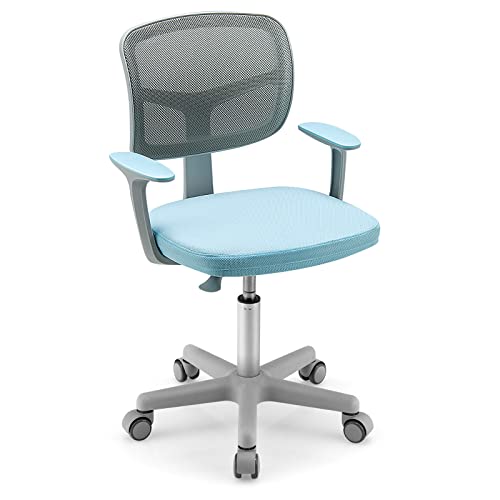
Costzon Kids Desk Chair with Arms & Wheels, Blue — Best Overall
The Costzon is the complete homework brief in one chair: height-adjustable, with armrests and rolling wheels, swiveling, and stated by its listing for boys and girls aged 4–12, for home, bedroom and school use alike. That age span is the value proposition — one chair that starts under a kindergartner whose feet dangle and finishes under a sixth-grader doing long division, with the pneumatic height range bridging all the growth in between. The arms give younger children something solid to push against when climbing in and a place to rest during reading; the wheels give the chair the mobility kids insist on and parents learn to tolerate when the casters behave on the room’s floor.
Strengths
- The full feature set — height adjustment, arms, swivel, wheels — in the guide’s widest stated age range, 4–12.
- Ergonomic kids’ shaping rather than a shrunken adult shell, per the listing’s own positioning.
- Blue colorway and student styling suit the bedroom-desk reality most homework happens in.
Trade-offs
- Rolling casters on hard floors travel — a rug or mat under the desk (and a house rule) keeps the chair at its post.
- No footrest: the youngest users at full desk height will dangle until they grow into the chair’s lower range or a separate footrest joins the setup.
- Arms fix the chair’s width; tight desk kneeholes should be measured before ordering.
| Spec | Verified detail |
|---|---|
| Age range | 4–12 (per listing) |
| Adjustment | Height adjustable |
| Features | Armrests, swivel, rolling wheels |
| Color | Blue |
Set it up by the fit routine in the how-to section — seat height first, desk relationship second — and revisit the height every school term, because the adjustment only pays if somebody turns it. Parents of siblings should note the arithmetic: a chair honestly spanning 4–12 can hand down, and a hand-me-down homework chair with a working gas lift is worth more than two cheap fixed chairs bought in panic each September. This is the default recommendation for a family buying once and buying properly.
Best for: most families — one chair from kindergarten to the edge of middle school. / Not suited for: the youngest children who need a footrest today, or desks with narrow kneeholes.
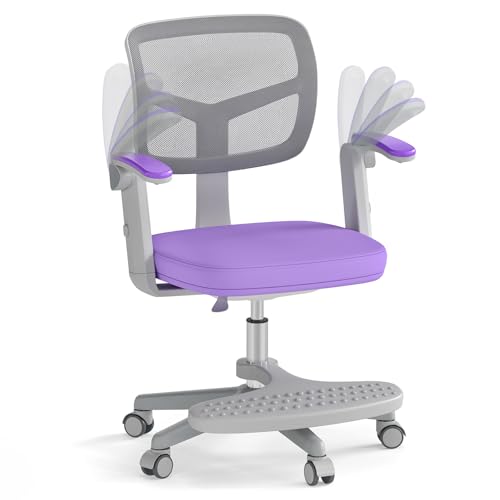
HONEY JOY Kids Desk Chair with Footrest, Purple — Best with Footrest
The HONEY JOY is the chair that understood the assignment’s hardest detail: a six-year-old at a standard desk cannot reach the floor at all, and unsupported feet are the first cause of the nightly squirm. Its listing states the full support kit — adjustable height, armrests and an adjustable footrest, in a swivel rolling mesh task chair for teens and kids alike, for home, school and office use. The footrest converts the chair’s whole geometry: with feet planted on the ring, a small child gets the stable base that the floor will not provide for years, and the mesh back keeps long sessions ventilated. Purple is the launch color here, and in this market that is a feature, not a footnote.
Strengths
- A real footrest — the single most valuable feature for younger homeworkers, and rare in this category.
- Height, armrest and footrest adjustability stack into the widest fit range here.
- Mesh back breathes through warm rooms and long sessions.
Trade-offs
- More moving parts means more setup and more to re-tighten each term.
- Rolling casters plus a footrest can tempt footrest-standing; the house rule needs stating on day one.
- Purple will not be every child’s (or every room’s) choice — check the product page for other colorways in the same listing family.
| Spec | Verified detail |
|---|---|
| Adjustment | Height, armrest and footrest adjustable |
| Construction | Mesh task chair, swivel, rolling |
| Audience | Kids and teens (per listing) |
| Color | Purple |
Buy this chair when the child is young for the desk — the early elementary years, when the gap between chair height and floor is at its worst and homework habits are being formed. The footrest also future-proofs in an unexpected direction: raised to its higher settings it serves the older child as a perch option during long reading, and the chair’s teen-inclusive listing means it need not be replaced at the middle-school border. Of the six picks, this is the one a pediatric-minded parent would design, and the one most likely to be sat in correctly without being asked.
Best for: younger elementary children and any child whose feet dangle at the desk. / Not suited for: minimalists who want the fewest possible adjustments, or color-neutral rooms.

GIANTEX Kids Desk Chair, Armless Mesh, Purple — Best Armless Space-Saver
The GIANTEX makes the opposite bet from the HONEY JOY and wins its own category: no arms at all. Its listing describes an adjustable children study chair — swivel, armless, mesh, a computer desk chair with adjustable height and lumbar support. Armless is a room decision before it is a comfort one: the chair slides completely under the desk when homework ends, which in a small bedroom is the difference between a chair that lives at the desk and a chair that lives in the doorway. The mesh keeps it light and breathable, and the stated lumbar support gives the backrest a job beyond existing.
Strengths
- Tucks fully under the desk — the small-room and shared-room solution.
- Mesh construction is light to move and cool to sit in.
- Height adjustment plus lumbar support covers the fit essentials without arm hardware.
Trade-offs
- No arms means no arm support during long reading, and younger children lose their climbing-in handholds.
- No footrest — pair with a step or box for the youngest users, as the buying guide suggests.
- Armless swivel chairs invite sideways sitting in determined fidgeters; the backrest’s support only works facing forward.
| Spec | Verified detail |
|---|---|
| Adjustment | Height adjustable |
| Construction | Mesh, swivel, armless |
| Support | Lumbar support (per listing) |
| Color | Purple |
This is the chair for the desk built into a closet nook, the shared sibling room, the kitchen-table homework station that must disappear by dinner. It is also a sensible second chair — the one that lives at the craft table or the second desk — where the full arm-and-footrest apparatus would be overkill. Older elementary children, who climb in without thinking and sit for shorter, task-shaped bursts, are its natural constituency; buy the HONEY JOY for the six-year-old, the GIANTEX for the ten-year-old, and the room will tell you you were right.
Best for: small rooms, tuck-away desks and older elementary students. / Not suited for: very young children needing arms and a footrest.

Primy Kids Desk Chair, Mesh, Pink — Best Mesh for Warm Rooms
The Primy is the mesh specialist with the audience’s favorite color: a height-adjustable swivel mesh task chair for students aged 4–12, listed for boys and girls at home, school and office, in pink. Mesh is a climate feature before it is a style one — a child doing homework in a warm room, a sun-facing bedroom or a long summer-school session stays measurably more comfortable against a breathable back than against foam and vinyl — and the Primy’s whole construction leans into that. The stated 4–12 range matches the Costzon’s span, making this the like-for-like alternative for families choosing between cushion-and-arms solidity and mesh lightness.
Strengths
- Full mesh breathability for warm rooms and long sessions.
- Stated 4–12 range equals the guide’s best — a genuine grow-with-them span.
- Pink colorway answers the most common request in this market without a separate search.
Trade-offs
- Mesh seats offer less plush than cushioned rivals for children who prefer a soft perch.
- No footrest is stated; young users may need the box-or-step interim solution.
- Primy also lists a drafting-chair line for adults — confirm you are on the kids’ listing (this link is) before checkout.
| Spec | Verified detail |
|---|---|
| Age range | 4–12 (per listing) |
| Adjustment | Height adjustable, swivel |
| Construction | Mesh task chair |
| Color | Pink |
Primy appears twice in this program’s verified cache — here as a children’s chair maker, and elsewhere with an adult drafting chair — which is why the verification step mattered: the linked listing is unambiguously the kids’ study chair, sized and stated for 4–12. In the hand, expect a light, airy chair that a child can move themselves, which is an underrated independence feature: a chair a seven-year-old can position is a chair that gets positioned, and homework starts on time more often in rooms where the furniture cooperates with its user.
Best for: warm rooms, mesh fans and the pink-chair constituency aged 4–12. / Not suited for: children who want a plush cushioned seat or a footrest.

VIVO Children’s Height Adjustable Desk Chair, Gray — Best Compact
VIVO is a workstation brand, and its children’s chair reads like one: a height-adjustable desk chair described as a kid’s multifunctional interactive workstation seat, for school writing, study or play, in gray — chair only, model DESK-V201G-CH. The gray neutrality is the point: this is the chair for the living-room homework corner, the parent’s home-office shared desk, and any room where a purple or pink chair would start an interior argument. The workstation framing also implies the right priorities — this is furniture for a task, sized for the years when the task is daily.
Strengths
- Neutral gray suits shared and grown-up rooms where kids’ colors clash.
- A workstation brand’s design discipline: height adjustment and study-first geometry.
- Compact footprint suits corners, shared offices and apartment desks.
Trade-offs
- The listing is spare on extras — no arms or footrest are stated, so judge it as a clean, adjustable seat and nothing more.
- Gray will lose the bedroom popularity contest against every colored rival here.
- Chair only, as the listing itself notes — the desk pairing is on you, and the fit routine below becomes essential.
| Spec | Verified detail |
|---|---|
| Adjustment | Height adjustable |
| Use | School writing, study, play (per listing) |
| Model | DESK-V201G-CH |
| Color | Gray |
The VIVO is the pick for the family whose homework happens in adult space — the kitchen-adjacent desk, the office corner — and whose aesthetic vote counts the chair as furniture, not equipment. It is also the natural choice for a second, homework-only station in a different room from the child’s bedroom desk, where color coordination with a sibling’s setup is irrelevant. What it asks in return is honest setup: with no footrest or arms to compensate, the seat height and desk height must be gotten right, and the how-to section’s five-minute routine is the whole secret.
Best for: shared offices, living-room homework corners and neutral rooms. / Not suited for: children who need arms, a footrest, or a chair with personality.

OYOWINGO Ergonomic Kids Desk Chair with Footrest — Best with Flip-Up Arms
The OYOWINGO is the hybrid: a mesh student task chair stated for ages 4–12 with a footrest, flip-up armrests and 360° wheels. Flip-up arms resolve the category’s oldest argument — arms for support versus armless for tucking — by offering both, on demand: down for the long essay, up for the quick worksheet and for sliding the chair fully under the desk at night. Combined with the footrest, it matches the HONEY JOY’s support kit and adds the clearance trick, making it the most configurable chair in this guide.
Strengths
- Flip-up arms: support when wanted, full tuck-away clearance when not.
- Footrest included — the young-child essential, again.
- Mesh construction and a stated 4–12 ergonomic brief round out the most complete spec here.
Trade-offs
- The brand is the least established name in this guide; the listing’s stated features are verified, but long-term parts support is a fair question.
- Flip mechanisms are moving parts — a termly check of pivots belongs in the setup routine.
- Wheels plus footrest plus flip arms is the most temptation-rich configuration here for a committed fidgeter.
| Spec | Verified detail |
|---|---|
| Age range | 4–12 (per listing) |
| Features | Footrest, flip-up armrests, 360° wheels |
| Construction | Mesh student task chair |
| Brand | OYOWINGO |
Choose the OYOWINGO when the desk is shared between homework and everything else — the craft hour, the laptop call with grandparents, the Lego administration — because its configurations change as fast as the desk’s purpose does. It is also the peacemaker purchase: the parent who wants the chair gone at night and the child who wants arms at work both get their way, in the same chair, on the same day. In a category of compromises, it is the one that refuses the most of them.
Best for: multi-use desks, peacemaker parents and children who want every feature at once. / Not suited for: buyers who prioritize an established brand name over configuration.
Comparison Table
| Pick | Badge | Key spec | Best for |
|---|---|---|---|
| Costzon Kids Desk Chair, Blue | Best Overall | Ages 4–12, arms, wheels, height adjustable | Buying once, growing through |
| HONEY JOY Kids Desk Chair | Best with Footrest | Footrest + armrests + height adjustable, mesh | Younger children, dangling feet |
| GIANTEX Kids Desk Chair | Best Armless Space-Saver | Armless mesh, lumbar support | Small rooms, tuck-away desks |
| Primy Kids Desk Chair, Pink | Best Mesh for Warm Rooms | Ages 4–12, mesh, swivel | Warm rooms, long sessions |
| VIVO Children’s Desk Chair, Gray | Best Compact | Height adjustable, workstation design | Shared offices, neutral rooms |
| OYOWINGO Ergonomic Kids Desk Chair | Best with Flip-Up Arms | Footrest, flip-up arms, ages 4–12 | Multi-use desks |
How to Choose a Homework Chair
Fit before features, in this order. First, the seat height must let the child’s feet rest supported — flat on the floor, or on a footrest — with knees bent comfortably; dangling feet are the root of most homework squirming, which is why the footrest picks punch above their price. Second, the seat depth should support the thighs without the edge pressing behind the knees; a child perched on the front half of a too-deep seat is a child whose backrest might as well not exist. Third, with the chair at the desk, elbows should rest at desktop height with shoulders relaxed — if the shoulders hike, the chair is low or the desk is high, and the chair’s adjustment is the variable you own.
Then match the configuration to the room. Wheels for hard floors and older children; a chair that stays put (or a mat beneath) for the young and the restless. Arms for readers and younger climbers; armless or flip-up for desks that must swallow the chair nightly. Mesh for warm rooms and long sessions; cushions for short bursts and children who find mesh scratchy. And always read the stated age range as the honest spec it is: a chair ranged 4–12 bought for an eleven-year-old is a one-year purchase, and the teen section below is the better destination for that money.
Last, and not least in practice: let the child choose between the finalists. The fit rules narrow the field to chairs that will work; within that field, the purple one versus the pink one versus the serious gray one is a decision whose only real consequence is whether the chair’s owner feels ownership. A child who chose the chair defends it, sits in it and starts homework in it with measurably less negotiation — every parent who has bought the “wrong color” version of a perfect product knows this tax. The picks here span blue, purple, pink and gray precisely so the choice can be offered honestly, inside a field where every option already fits.
How to Set Up a Homework Chair: The Five-Minute Fit
- Step 1: Set the seat height so the child’s feet are fully supported — flat on the floor, or flat on the footrest with the rest lowered until they are. Adjust the footrest-equipped picks (HONEY JOY, OYOWINGO) to meet the feet; for the others, a sturdy box or step is a legitimate interim.
- Step 2: Check the knees and seat edge: thighs supported, a fist’s width of clearance behind the knees, back resting against the backrest without slumping to reach it.
- Step 3: Roll the chair to the desk and check the elbows: forearms should rest on the desktop with shoulders down and relaxed. Raise the chair if shoulders hike; if the feet then leave the floor, the footrest (or the box) closes the gap — this two-step is the entire ergonomics of childhood homework.
- Step 4: Set the house rules while the Allen keys are out: feet on floor or rest, never on the footrest standing up; wheels are for repositioning, not recreation; the chair lives at the desk.
- Step 5: Revisit every school term. Children grow in the night, apparently; a two-minute height check each September and January keeps the fit the chair was bought for.
The Homework Station: Chair, Desk and Light as One System
A chair is fitted to a desk, and both are fitted to a room, so the chair decision lands better when the whole station is considered at once. The desk’s height is the fixed point: standard desks sit at a height chosen for adults, which is precisely why the child’s chair must adjust upward and why the footrest question exists at all. If you are buying the desk too, a height-adjustable desk paired with any chair in this guide dissolves most fit problems before they form — the two adjustments meet in the middle, and the station can be tuned yearly in minutes. If the desk is a family heirloom at a fixed height, the chair and the footrest do all the adapting, and the footrest picks rise in value accordingly.
Light is the station’s silent third member. A chair positioned so the child faces a window will be abandoned by glare at the same hour every sunny day; a chair under a single overhead light leaves the page in the child’s own shadow. The homework station that works has the light coming over the shoulder opposite the writing hand, the chair’s back to the room’s distractions where the layout allows, and — the detail children vote on with their attendance — a small sense of territory: a hook for the bag, a tray for the pencils, a chair that is theirs. None of that is sold in this guide, but all of it decides whether the chair you buy gets used as intended, and it costs less than the chair.
When They Graduate: The Teen Transition
Every pick here has a stated ceiling, and honoring it is part of buying well. The signs of graduation are physical: knees rising above the seat’s comfortable angle even at full height, the backrest ending mid-back, the child choosing the kitchen chair voluntarily. At that point the answer is not a bigger kids’ chair — the category tops out where it tops out — but a compact adult desk chair, fitted with the same five-minute routine, with the footrest question usually retiring itself as legs reach the floor. The internal links in the final recommendation point to this site’s college and extended-use chair guides, which are the honest next step.
The outgrown homework chair, meanwhile, has a second life that belongs in the family budget: hand it down to the next sibling (the 4–12 span makes this the rule rather than the exception), demote it to the craft table or the guest desk, or pass it to the cousin whose kindergartner is exactly where yours was. A chair bought once and used by two children across a decade is the cheapest seating a family will ever own, and it is the quiet argument for buying the verified, adjustable chair over the disposable one that this entire guide is built on.
Safety and Durability Checks Worth Five Minutes a Term
Kids’ chairs live hard lives — they are vehicles, step stools and fort components in their off hours — so a termly five-minute inspection is part of owning one responsibly. Check the base first: all casters present and rolling freely, no cracks in the five-star feet, and the chair stable when rocked deliberately. Check the lift: the chair should hold its set height under the child’s weight across a full day; a chair that sinks slowly has a failing cylinder and should be retired from homework duty, because a fit that drifts is a fit that is gone. Check the fasteners: armrest screws, backrest bolts and footrest pivots all loosen with swivel-and-fidget mileage, and a quarter-turn each is the difference between a chair that feels solid for years and one that develops the wobble children interpret as an invitation.
Two household rules do more for safety than any hardware: feet belong on the floor or the footrest, never standing on either; and the chair is sat in facing the desk, not ridden, climbed or used as a scooter. State them when the chair arrives, enforce them while the novelty is fresh, and the chair will outlast the child’s elementary career with its dignity — and its casters — intact.
Common Buying Mistakes
- Buying an adult chair in a small size. Adult geometry — seat depth, back height, arm spacing — does not shrink proportionally. A stated kids’ chair with a stated age range is the honest product.
- Ignoring the feet. The most common fit failure is invisible in product photos: feet dangling six inches off the floor. If the chair lacks a footrest and the child is young, budget the box, step or rest from day one.
- Buying at the top of the age range. A chair ranged to 12 bought at 11 is a single school year of value. Buy into the middle of a range, or graduate the child to the teen setup.
- Wheels without a plan. Casters on hardwood in a small room become a vehicle. A low-pile rug or chair mat under the desk is part of the purchase, not an accessory.
- Skipping the termly readjustment. An adjustable chair that is never adjusted is a fixed chair with a lever. Put the fit check on the school calendar.
Final Recommendation
For most families, the Costzon is the buy-once answer across the elementary years; for a younger child whose feet dangle, go straight to the HONEY JOY with its footrest, and for a small room the armless GIANTEX disappears under the desk like it was designed by the room itself. Whichever chair arrives, spend the five minutes of the fit routine before the first worksheet, mark the height setting with tape, and put the termly check on the family calendar — the chair will repay that small ceremony every school night for years, in the only currency homework respects: a child who sits down and stays sat. When your student outgrows this category, our guide to Best Desk Chairs For Kids covers the wider field, Best Chairs For College Students handles the next graduation, and mesh shoppers can compare Best Desk Chairs Mesh. Long-session families should also read Best Chairs For Sitting At Desk and Best Desk Chairs For Extended Use for the adult end of the same fit logic.
Frequently Asked Questions
What age are homework chairs for?
The picks here center on elementary school: several state ages 4–12 outright, and the footrest models serve the youngest best. A child at the top of the range — tall eleven- and twelve-year-olds — may be better served by a compact adult desk chair fitted with the same routine: feet supported, elbows at desk height. Buy the range your child is in the middle of, not the edge of.
Does my child really need a footrest?
If their feet do not reach the floor at the seat height that puts their elbows at the desk, yes — something must meet those feet, whether it is a built-in footrest like the HONEY JOY’s and OYOWINGO’s, or a sturdy box or step. Unsupported feet pull the body forward, tire the legs and start the squirm cycle that ends homework early. It is the cheapest posture fix in this entire guide.
Are wheels on a homework chair a good idea?
For older children on hard floors, wheels are convenient and harmless; for young children they are a toy with a seat attached. The mitigations are simple: a low-pile rug or chair mat under the desk to slow the travel, a chair placed against the desk rather than roaming the room, and a house rule with a short life expectancy of being tested. If your child is a committed chair-surfer, choose the configuration that tempts least and keep the desk against a wall.
Mesh or cushioned seat for homework?
Mesh breathes, which wins in warm rooms and for sessions that stretch past half an hour; it also tends to be lighter for the child to move. Cushioned seats feel kinder for short, intense homework bursts and for children who find mesh textures distracting. There is no wrong answer — there is a wrong climate and a wrong session length, and the Primy and HONEY JOY cover the mesh case while the Costzon covers the classic cushioned one.
How long should a homework chair last?
A height-adjustable chair honestly ranged 4–12 should serve the whole span if the lift and casters are treated decently — which is the economic argument for buying the adjustable chair over a fixed one that fits for eighteen months. Check the pivots and lift each term when you readjust the height, hand the chair down when it is outgrown, and judge any chair that cannot hold its height setting as finished, whatever its age.
Can siblings of different ages share one homework chair?
Yes, if it is height-adjustable — and that is one of the strongest arguments for every pick in this guide. The routine is thirty seconds: the taller child’s setting marked with a piece of tape on the lift column, the younger child’s below it, and each child (or parent) dials to the mark when their homework hour starts. Shared chairs fail when they are fixed-height, because a fixed chair fits exactly one sibling and merely hosts the other. With a footrest model, the sharing range widens further, since the rest can meet the smaller child’s feet at the taller one’s seat height in a pinch — though per-child settings remain the honest solution.
What if my child does homework at the kitchen table?
Then the chair has to travel or the table has to host a dedicated seat. A lightweight mesh pick like the GIANTEX or Primy moves between rooms without a parental hernia, and the armless GIANTEX in particular suits a table that must return to dining duty — it tucks fully away. If the kitchen is the permanent homework room, treat it as a station: leave the chair there, apply the same fit routine against the table’s height (tables often sit higher than desks, making the footrest question sharper), and let the bedroom desk go.
How do I know the chair fits my child’s desk?
Run the three checks from the setup routine at the actual desk: feet supported with knees comfortably bent, seat edge clear of the back of the knees with the child’s back touching the backrest, and elbows resting on the desktop with shoulders relaxed. If all three pass at some setting of the chair’s height range, the chair fits the desk — whatever either product’s marketing says. If the elbows pass only with the feet dangling, the missing piece is a footrest, not a different chair.
Can a homework chair help my child focus?
It can remove the physical excuses: a child who is perched, dangling or sliding has a legitimate bodily complaint competing with the worksheet, and a fitted chair takes that complaint off the table. What remains — interest, difficulty, tiredness — is parenting and teaching territory, and no chair in this guide or any other can sit in it for you. Buy the fit; the focus is a fairer fight afterward.


