Disclosure: airfryerkitchensupply.com is reader-supported. When you buy through links on our site, we may earn an affiliate commission at no extra cost to you.
Where to buy
The six vacuums below cover the four formats a house actually uses — cordless stick, full-size upright, robot and lightweight stick — and every one is a complete vacuum confirmed through Amazon listing held for this site. No replacement filters, floorheads or accessories are presented as picks. Suction figures and runtimes quoted in the reviews are the figures stated in each verified listing title, including the manufacturers’ own footnote markers where they appear.
- Dyson V8 Plus Cordless Vacuum (Best Premium Cordless): Check the current price on Amazon
- Shark Pet Cordless Stick Vacuum IX141 (Best for Pet Hair): Check the current price on Amazon
- Levoit Cordless Vacuum Cleaner LVAC-200 (Best Anti-Tangle Mid-Range): Check the current price on Amazon
- Eureka PowerSpeed Upright Vacuum NEU181A (Best Corded Upright): Check the current price on Amazon
- iRobot Roomba 105 Vac Robot Vacuum (Best Robot for Maintenance): Check the current price on Amazon
- Bissell Featherweight Stick Vacuum 3061 (Best Lightweight and Second Vacuum): Check the current price on Amazon
The best vacuums for house cleaning are not a single product, because a house is not a single cleaning problem. There is the weekly whole-house clean, the daily crumb-and-pet-hair patrol, the stairs, the car-adjacent hallway, and the room you only notice when guests are coming. The households that are happiest with their vacuums usually own an answer to the first job and an answer to the second — and this roundup is organised to help you choose both, or to choose the one format that covers your house best if you only want one machine.
Six verified machines made the cut: a Dyson and a Shark and a Levoit in the cordless stick format that now dominates house cleaning, a corded Eureka upright for readers who distrust batteries on principle, an iRobot Roomba robot for hands-off maintenance, and a featherweight Bissell stick for small houses, stairs and second-vacuum duty. Each format’s honest weakness is stated in its review — cordless runtime ceilings, upright weight, robot limitations on deep cleaning, featherweight capacity — because a house vacuum is a five-year relationship, not a first impression.
Specs quoted — air watts, pascals, runtimes, dust cup sizes — come from the verified listing titles and are labelled as listed. Runtime figures in this category are always measured in the gentlest mode, and the reviews say so where it matters, because the difference between a headline runtime and a high-power runtime is the difference between a vacuum that finishes your house and one that finishes most of it.
In this guide
Quick Picks
Six verified house vacuums across four formats. Decide the format first — the model second — and the table is organised to make that order easy.
| Pick | Badge | Key spec | Best for |
|---|---|---|---|
| Dyson V8 Plus Cordless Vacuum — Check price on Amazon | Best Premium Cordless | 115AW as listed; up to 40 min as listed; 2 power modes; converts to handheld | hard-floor-heavy houses that want one premium cordless for everything |
| Shark Pet Cordless Stick Vacuum IX141 — Check price on Amazon | Best for Pet Hair | 40-min runtime as listed; XL dust cup; LED headlights; pet tool included as listed | pet households that vacuum often and empty rarely |
| Levoit Cordless Vacuum Cleaner LVAC-200 — Check price on Amazon | Best Anti-Tangle Mid-Range | Up to 50 min as listed; anti-tangle; 180° lay-flat design; model LVAC-200 | mixed-floor houses that want the longest listed runtime and easy under-furniture reach |
| Eureka PowerSpeed Upright Vacuum NEU181A — Check price on Amazon | Best Corded Upright | Corded upright; 2.6L dust cup; pet turbo brush and tools as listed; bagless | carpeted houses and battery sceptics who want full power for the whole clean, every time |
| iRobot Roomba 105 Vac Robot Vacuum — Check price on Amazon | Best Robot for Maintenance | 7,000 Pa suction as listed; LiDAR navigation; cleans in neat rows; charging base version | busy households that want floors maintained daily with no human holding a vacuum |
| Bissell Featherweight Stick Vacuum 3061 — Check price on Amazon | Best Lightweight and Second Vacuum | Cordless featherweight stick; self-standing; model 3061 | small houses, flats, stairs duty and as the second vacuum beside a big machine |
Three of the six are cordless sticks, which reflects where the market and most households have landed: the stick is the machine that gets used daily, and daily use beats weekly perfection in real houses. But note the deliberate counterweights — a corded upright with no battery to age, and a robot that cleans when nobody is cleaning. A house with all three patterns covered is a house that stays clean with suspiciously little effort.
How These Picks Were Chosen
Candidates had to be complete vacuum cleaners — the screening excluded replacement filters, standalone floorheads, batteries and other parts that flood vacuum search results, because a part is not a pick. Each surviving machine then had to be confirmed, with its format, runtime and suction figures taken from the verified listing title.
Slots were then allocated by format and by household job, not by brand: three cordless sticks at different positions (premium detangling, pet-focused value, anti-tangle mid-range), one corded upright as the no-battery benchmark, one robot as the maintenance layer, and one featherweight as the small-house and second-vacuum option. One deliberate dedup: the Roomba 105 also appears in the cache with an auto-empty dock configuration under a different ASIN; only the standard charging-base version is used here, and the dock version is noted in the sources rather than counted as a second, supposedly different robot.
The 6 Best Vacuums for a House

1. Dyson V8 Plus Cordless Vacuum — Best Premium Cordless
The V8 Plus is the mature end of the cordless idea: the verified listing states 115AW of suction, two power modes, up to 40 minutes of runtime, a detangling cleaner head, and conversion to a handheld for stairs, upholstery and the car. The V8 platform has been refined for years, and it shows in the details that matter in a house — the head that does not wind itself in hair, the handheld conversion that takes seconds, the balance that makes a ceiling cobweb a one-handed job.
The runtime needs its honest footnote, which the listing itself marks with a footnote symbol: up to 40 minutes is the gentle-mode figure, and the high mode that deep-cleans carpet is a fraction of it. For flats and average houses cleaned room by room, that is plenty; for a large carpeted house cleaned in one pass, it is the format’s ceiling, and the Eureka upright below exists for exactly that reader.
Strengths
- Detangling head suits houses with long hair and pets
- Handheld conversion covers stairs, sofas and cars with one machine
- 115AW as listed is strong, honest suction for a cordless
Trade-offs
- High-power mode runtime is far below the headline figure
- Premium positioning in the cordless segment
- Battery ages over years, as all cordless batteries do
| Format | Cordless stick, converts to handheld |
| Suction as listed | 115AW |
| Runtime as listed | Up to 40 minutes (maker’s figure, gentlest mode convention) |
| Modes as listed | 2 power modes |
| Feature as listed | Detangling cleaner head |
Buy the Dyson if your house is mostly hard floors with rugs, your cleaning style is frequent and short, and you want the one machine that always gets grabbed. That pattern — little and often — is where cordless vacuums quietly outperform bigger machines that need a special occasion to come out of the cupboard.
Skip it if your house is large, carpeted wall to wall, and cleaned in one weekly marathon. No battery stick is the right tool for that job yet, and pretending otherwise is how premium vacuums end up resented.
Best for: hard-floor-heavy houses that want one premium cordless for everything / Not suited for: very large carpeted houses, where corded power still finishes more per session
Check on Amazon — check price on Amazon for the current listing, size and colour options before you decide.

2. Shark Pet Cordless Stick Vacuum IX141 — Best for Pet Hair
The Shark IX141 is specified the way pet owners actually ask: the verified listing states a 40-minute runtime, an XL dust cup, LED headlights, a removable handheld, and crevice and pet tools, for carpet and hard floors. The XL cup is the unglamorous hero — pet hair fills cups at comic speed, and a vacuum you empty mid-room is a vacuum you stop using. The headlights sound like a gimmick until you vacuum under a sofa and see the archaeology they reveal.
Shark’s pet positioning is about the whole debris type: hair, litter, kibble, the tracked-in grit by the door. A stick format suits the pet rhythm, which is not a weekly deep clean but a daily two-minute patrol of the same five hotspots. The IX141 is built for the patrol, with enough runtime in reserve for the weekly whole-house pass in most homes.
Strengths
- XL cup matches pet hair volume without constant emptying
- Pet tool and handheld conversion cover sofas and stairs
- LED headlights genuinely help under furniture
Trade-offs
- Runtime is a gentle-mode figure, like all cordless claims
- No sealed-HEPA claim in the verified listing
- Stick format still trails corded uprights on deep carpet pile
| Format | Cordless stick with removable handheld |
| Runtime as listed | 40 minutes |
| Cup as listed | XL dust cup |
| Tools as listed | Crevice and pet tools |
| Feature as listed | LED headlights |
Choose the Shark if a pet runs your cleaning schedule. Pair it with the habit it is designed for — short, frequent passes — and it will keep a pet house visibly cleaner than a bigger machine used reluctantly once a week.
If nobody in the house sheds, the Levoit below offers a similar format with an anti-tangle emphasis, and the Dyson offers the premium version of the same idea. The Shark’s case rests on hair volume and cup size, and for the right house that case is decisive.
Best for: pet households that vacuum often and empty rarely / Not suited for: allergy-sensitive homes wanting sealed HEPA systems — not claimed in this listing
Check on Amazon — check price on Amazon for the current listing, size and colour options before you decide.
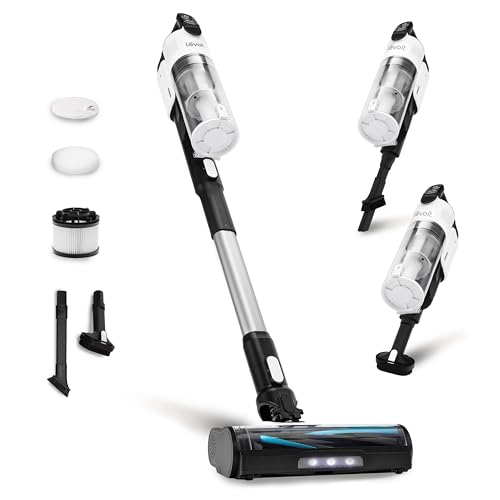
3. Levoit Cordless Vacuum Cleaner LVAC-200 — Best Anti-Tangle Mid-Range
The Levoit LVAC-200 competes on the two numbers-and-design points that matter in daily use: the verified listing states up to 50 minutes of runtime — the longest headline figure in this roundup — an anti-tangle design for pet hair, and a 180-degree lay-flat body that slides under sofas and beds without the crouching and furniture-moving that make people skip those areas. Under-furniture dust is where houses quietly fail, and a vacuum that reaches it flat changes what “clean” includes.
The anti-tangle emphasis suits houses with hair but without the Shark’s sheer debris volume — a cat, a shedding breed in moderation, long-haired humans. As ever, the 50 minutes is a gentlest-mode figure; read it as “the biggest battery budget here” rather than a promise of 50 high-power minutes, and it is still a meaningful advantage.
Strengths
- Longest listed runtime in the roundup
- Lay-flat design cleans under furniture others skip
- Anti-tangle brush suits hair without heavy-duty pet volume
Trade-offs
- Headline runtime is gentle-mode, as with all rivals
- Mid-range positioning means fewer premium touches than the Dyson
- Stick format shares the category’s deep-carpet limits
| Format | Cordless stick |
| Runtime as listed | Up to 50 minutes (gentlest mode convention) |
| Feature as listed | Anti-tangle brush design |
| Design as listed | 180° lay-flat |
| Model as listed | LVAC-200 |
Buy the Levoit if your house mixes floors and furniture you currently vacuum around rather than under. The lay-flat design is the kind of feature that sounds minor in a listing and major in a month of use.
It is also the natural pick for a reader choosing their first cordless stick and unsure which premium features they need: runtime, anti-tangle and reach are the three that survive contact with real houses, and this model leads with all three.
Best for: mixed-floor houses that want the longest listed runtime and easy under-furniture reach / Not suited for: readers who want a handheld conversion with dedicated tools — check the listing configuration
Check on Amazon — check price on Amazon for the current listing, size and colour options before you decide.
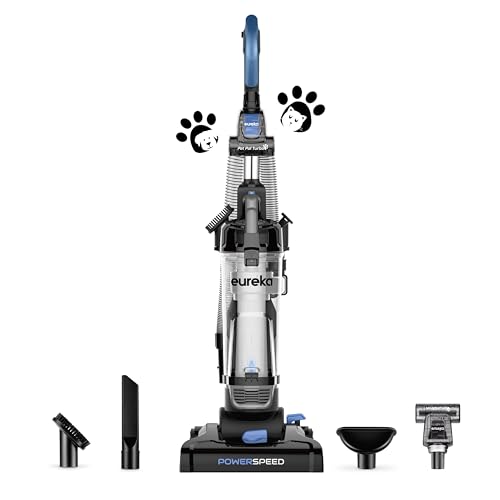
4. Eureka PowerSpeed Upright Vacuum NEU181A — Best Corded Upright
The Eureka PowerSpeed is the argument for the cord, stated in one listing: an upright with a 2.6-litre dust cup, a pet turbo brush, crevice and upholstery tools, for carpet and hard floors — and no battery anywhere in the story. It cleans at full power in minute one and minute ninety, it will do so in ten years, and its cup swallows a whole house’s worth of debris without the mid-clean emptying that cordless cups demand.
Uprights also remain the deep-clean format for carpet pile. A powered brushroll in a heavy, plugged-in machine agitates carpet in a way a light stick cannot match, and for wall-to-wall carpet households that difference is the clean itself. The trade is written into the format: you manage a cord, you haul a heavier machine up stairs, and you will not grab it for two minutes of crumbs — which is why upright households so often pair it with a stick or a robot from this same roundup.
Strengths
- Unlimited runtime at full power — no battery ceiling or ageing
- 2.6L cup is the largest capacity in this roundup
- Deep carpet agitation that light sticks cannot match
Trade-offs
- Cord management and weight make it a planned clean, not a patrol
- Stairs are work with any full-size upright
- Bagless cup emptying is dustier than bagged rivals
| Format | Corded upright, bagless |
| Cup as listed | 2.6L dust cup |
| Tools as listed | Pet turbo brush, crevice and upholstery tools |
| Floors as listed | Carpet and hard floor |
| Model as listed | NEU181A |
Choose the Eureka if your house is carpet-led, your cleans are weekly and thorough, or you simply refuse to build a five-year appliance around a battery. It is the benchmark the cordless picks are measured against, and on deep carpet it still wins.
Pairing advice: this plus the Bissell Featherweight below is the classic two-machine house — the upright for Saturday, the featherweight for every other day — and together they cover the whole pattern of house dirt for less complexity than any single premium machine.
Best for: carpeted houses and battery sceptics who want full power for the whole clean, every time / Not suited for: anyone whose cleaning style is a quick daily patrol — a corded upright is a weekly machine
Check on Amazon — check price on Amazon for the current listing, size and colour options before you decide.

5. iRobot Roomba 105 Vac Robot Vacuum — Best Robot for Maintenance
The Roomba 105 Vac represents the third philosophy in this roundup: cleaning as a background process. The verified listing states 7,000 Pa of suction, LiDAR navigation, multi-surface cleaning and neat-row coverage, on a standard charging base. LiDAR matters — it maps and rows methodically instead of bouncing randomly, which is the difference between a robot that maintains a floor and a robot that performs cleaning theatre.
A robot’s job in a real house is maintenance, and judged on that job the spec is right: daily scheduled passes keep crumbs, hair and grit from ever becoming a visible problem, on hard floors and low carpet, while the humans keep a stick or upright for the weekly edges, stairs and deep work. Judged as a house’s only vacuum, every robot fails somewhere — thresholds, thick pile, the corner behind the door — and this review will not pretend otherwise.
Strengths
- LiDAR row cleaning maintains floors systematically
- 7,000 Pa as listed is strong suction for the format
- Scheduled daily passes prevent dirt rather than removing it heroically
Trade-offs
- Maintenance tool, not a deep-clean replacement
- Cannot do stairs, upholstery or cars
- Base version here has no auto-empty dock — the dock configuration is a separate listing
| Format | Robot vacuum |
| Suction as listed | 7,000 Pa |
| Navigation as listed | LiDAR, neat rows |
| Floors as listed | Multi-surface |
| Configuration | Charging base (a separate auto-empty dock configuration exists under a different ASIN — see sources) |
Buy the Roomba if your house’s problem is frequency, not intensity — floors that are fine after a clean and grubby by Wednesday. Set the schedule, keep cords and small obstacles off its routes, and let it hold the line between your real cleans.
Note the configuration carefully: this pick is the charging-base version verified here. An auto-empty dock configuration of the same model exists under a different ASIN in the cache; it is one model in two configurations, and this roundup counts it once, honestly.
Best for: busy households that want floors maintained daily with no human holding a vacuum / Not suited for: homes wanting deep cleans, stairs coverage, or thick-pile carpet performance from their only machine
Check on Amazon — check price on Amazon for the current listing, size and colour options before you decide.
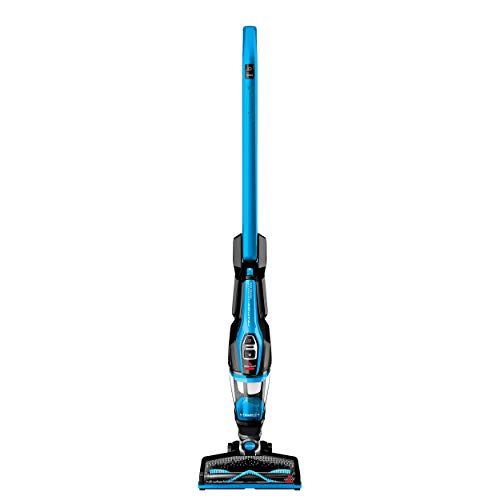
6. Bissell Featherweight Stick Vacuum 3061 — Best Lightweight and Second Vacuum
The Bissell Featherweight 3061 closes the roundup at the opposite end from the Eureka: a cordless stick in the featherweight class that, per its verified listing, stands by itself — a small feature with outsized daily value, because a vacuum that stands in a corner gets used, and one that must be fetched from a cupboard and assembled gets used on Saturdays. The listing is spare on figures, and this review matches it: no runtime or suction numbers are claimed here beyond the format itself.
Featherweights are the stairs and spill answer. Light enough to carry one-handed, quick enough for the hallway grit that tracks through a house daily, and cheap in complexity — no modes to think about, no dock etiquette. In a small house or flat, that can honestly be the whole vacuum story; in a big house, it is the second machine that makes the first machine’s weekly job smaller.
Strengths
- Self-standing as listed — lives in a corner, always ready
- Lightest format here; stairs and quick patrols are its home ground
- Simple, low-complexity machine with nothing to configure
Trade-offs
- Light-duty format: not a deep-clean or large-house only machine
- Listing states few figures, so expectations should stay format-level
- Small cup class means frequent emptying on big jobs
| Format | Cordless stick, featherweight class |
| Feature as listed | Self-standing |
| Model as listed | 3061 |
| Colour as listed | Electric Blue / Black |
Buy the Featherweight as a small home’s main vacuum or a big home’s second one, and it will likely become the most-used vacuum you own by count of outings. That is the featherweight paradox: the least powerful machine does the most cleaning, because it is the one that is there.
Do not buy it as a cheap way to cover a large carpeted house alone. That job belongs to the Eureka or a premium cordless, and stretching a featherweight across it disappoints everyone involved.
Best for: small houses, flats, stairs duty and as the second vacuum beside a big machine / Not suited for: large carpeted houses as the only vacuum — it is a light-duty format by design
Check on Amazon — check price on Amazon for the current listing, size and colour options before you decide.
Comparison Table
Format is destiny in this table: the cordless sticks trade runtime ceilings for daily convenience, the upright trades convenience for unlimited deep power, the robot trades depth for automation, and the featherweight trades capacity for presence. Pick your trade first.
| Pick | Badge | Key spec | Best for |
|---|---|---|---|
| Dyson V8 Plus Cordless Vacuum — Check price on Amazon | Best Premium Cordless | 115AW as listed; up to 40 min as listed; 2 power modes; converts to handheld | hard-floor-heavy houses that want one premium cordless for everything |
| Shark Pet Cordless Stick Vacuum IX141 — Check price on Amazon | Best for Pet Hair | 40-min runtime as listed; XL dust cup; LED headlights; pet tool included as listed | pet households that vacuum often and empty rarely |
| Levoit Cordless Vacuum Cleaner LVAC-200 — Check price on Amazon | Best Anti-Tangle Mid-Range | Up to 50 min as listed; anti-tangle; 180° lay-flat design; model LVAC-200 | mixed-floor houses that want the longest listed runtime and easy under-furniture reach |
| Eureka PowerSpeed Upright Vacuum NEU181A — Check price on Amazon | Best Corded Upright | Corded upright; 2.6L dust cup; pet turbo brush and tools as listed; bagless | carpeted houses and battery sceptics who want full power for the whole clean, every time |
| iRobot Roomba 105 Vac Robot Vacuum — Check price on Amazon | Best Robot for Maintenance | 7,000 Pa suction as listed; LiDAR navigation; cleans in neat rows; charging base version | busy households that want floors maintained daily with no human holding a vacuum |
| Bissell Featherweight Stick Vacuum 3061 — Check price on Amazon | Best Lightweight and Second Vacuum | Cordless featherweight stick; self-standing; model 3061 | small houses, flats, stairs duty and as the second vacuum beside a big machine |
Bags, Filters and the Maintenance Economy of a House Vacuum
Every vacuum in this roundup is bagless, which is where the market has settled — but bagless is a maintenance commitment, not a maintenance exemption. A bagless cup must be emptied before it is full, because suction falls as the cup fills and the cyclones that separate the dust depend on airflow the full cup chokes. The honest rhythm is empty at two-thirds, every time, over a bin, with the occasional cup wash the maker allows. Households that empty religiously get years of full performance from mid-range machines; households that empty at the overflow get premium machines performing like budget ones.
Filters are the second economy. Washable filters must actually be washed — monthly under the tap for most stick and upright designs here, dried fully before refitting, because a damp filter is a smell with a motor attached — and replaced on the maker’s schedule even when they look fine, because filtration degrades before it visibly fails. Keep a spare filter and the wash cycle stops costing you a vacuum-less day; it is the cheapest accessory in the category and the one nobody buys until they need it.
The third economy is the brushroll. Anti-tangle and detangling designs have genuinely reduced the hair problem, and they have not abolished it: a monthly check, scissors or a seam ripper for the wound ends, and a look at the belt and bearings on uprights keeps the agitation your carpets are paying for. Add these three small economies together and they explain most of the performance gap between two identical vacuums in two different houses — the machine is the same; the maintenance is the product.
Stairs, Cars, Upholstery and the Other 20 Percent of a House
Whole-house marketing is measured on open floor, but houses are cleaned in their awkward fractions: the stairs, the car in the drive, the sofa the dog owns, the mattress, the tops of wardrobes. The picks in this roundup were chosen with those fractions in view, and the differences matter. The Dyson and the Shark convert to handhelds, which is the stairs and car answer in one gesture; the Eureka answers with its hose and tools — the pet turbo brush is an upholstery tool wearing a pet name — and the longest reach in the roundup; the robot answers none of these fractions at all, which is precisely why it is a layer and not a solution.
Stairs deserve a method, whichever machine serves them: work top-down so debris falls toward the uncleaned steps, one hand on the rail when the other holds a handheld, and never balance a full-size upright on a step to reach two more — the featherweight and the handheld conversions exist so that nobody has to. Cars want the crevice tool and patience; upholstery wants the turbo or upholstery tool run slowly, in overlapping passes, because fabric releases hair to agitation and suction together, not to speed.
The mattress and the high places are the quarterly jobs: a slow pass with the upholstery tool over the mattress surface when the bedding is stripped for washing, and the stick formats at full extension for cobwebs and the tops of units. None of this appears in suction figures, and all of it appears in how clean a house feels. Choose your format with the 20 percent in mind, and the 80 percent will take care of itself.
Noise, Weight and Storage: The Specs Nobody Lists and Everybody Lives With
Three properties decide whether a vacuum is loved or resented, and none of them headline a listing: how loud it is, how heavy it feels at the end of a clean, and where it lives between cleans. Noise governs when cleaning can happen — a vacuum that cannot run during a baby’s nap or a partner’s call will be run less, and run less means dirtier, whatever its suction figure says. The robot in this roundup quietly wins this category by cleaning in empty rooms; the sticks win second place by finishing before the noise outstays its welcome.
Weight is really two numbers: the specification weight, and the felt weight at minute twenty with a filling cup, at arm’s length under a sofa, or halfway up the stairs. This is where the featherweight earns its existence and where the upright’s honest trade lives — its power is paid for in felt weight, every clean, by whoever carries it. Households should assign the machine to the person as honestly as to the floor: the best vacuum for a house is the one its actual cleaner can use without negotiation.
Storage is the third silent spec. A vacuum with a home — a cupboard it fits, a corner where the self-standing Bissell simply stands, a dock the robot returns to — is a vacuum that gets used; a vacuum that must be excavated is a weekly event at best. Measure the storage before the purchase, including the doorway swing and the shelf the tools will colonise. It sounds like housekeeping trivia until the first time a premium machine spends a month behind the coats, cleaning nothing at all.
A Final Calibration: Runtime, Honestly Budgeted
Before the recommendations, one piece of arithmetic worth doing with your own house. Pace out your usual clean and time it — most people are surprised in both directions, overestimating the weekly deep clean and underestimating the accumulated minutes of daily patrols. Set that honest number against the listed runtimes in this roundup, remembering they are gentlest-mode figures: a house whose whole clean takes twenty-five mixed-mode minutes is a cordless house with room to spare, while a house whose carpeted clean takes an hour at high power is the Eureka’s natural territory. Your own stopwatch settles the format argument better than any review, including this one.
How to Choose a Vacuum for a Whole House
Map your house before you map the market. Floor mix decides more than any spec: mostly hard floors reward cordless sticks and robots; wall-to-wall carpet rewards a corded upright or the strongest cordless; stairs punish weight and reward handheld conversions and featherweights. A house that is 80 percent one surface should be vacuumed by the format that loves that surface, with the other 20 percent handled by tools and attachments.
Then decide your cleaning pattern, honestly. Little-and-often cleaners — the daily patrol, the after-dinner sweep — get the most from sticks, featherweights and robots, because those machines minimise the friction of starting. Weekly-marathon cleaners get the most from an upright, because it never runs out of anything mid-clean. Most dissatisfaction in this category is a pattern mismatch: a marathoner with a small-battery stick, or a patroller with a heavy upright that needs an occasion.
Treat runtime and suction figures as listed claims with a convention attached. Runtimes are measured in the gentlest mode; high-power modes that deep-clean carpet use a fraction of the headline. Suction units differ by format — air watts on sticks, pascals on robots — and are not directly comparable across formats. What is comparable is the job evidence: cup size, brush design, navigation type, and whether the machine’s format suits your floors. Buy on those, and let the figures break ties within a format, never across formats.
Finally, plan the household system, not the single purchase. The most reliably clean houses in this category run a division of labour — robot maintaining, stick patrolling, upright deep-cleaning — assembled over time. If you are buying one machine today, buy the one that covers your most frequent job, and know which second machine you will add when the first proves the pattern.
Cordless, Corded or Robot: The Honest Format Guide
Cordless sticks win on behaviour: they are grabbed daily, they convert to handhelds, and modern detangling heads and 40-to-50-minute listed runtimes cover most houses in most modes. Their costs are the battery ceiling on long high-power cleans and battery ageing over years. If your house fits inside a gentle-mode runtime — most do, room by room — those costs may never actually bill you.
Corded uprights win on physics: unlimited full power, the deepest carpet agitation, the biggest cups, and no battery to replace. Their cost is friction — weight, cord, storage — which quietly reduces how often they come out. Robots win on automation: they clean on schedule whether or not anyone feels like it, and LiDAR models do it systematically. Their costs are depth and scope: no stairs, no upholstery, no deep pile heroics.
None of these is the advanced choice and the others primitive; they are three answers to three different definitions of the problem. The reader who defines the problem as “my floors are dusty by Wednesday” needs a robot or a stick. The reader who defines it as “my carpets never feel deep-cleaned” needs the upright. Name your problem in one sentence and the format chooses itself.
How to Set Up a House Vacuum Routine That Sticks
Step one: assign zones to formats. High-traffic hard floors — hall, kitchen, entry — get the frequent light pass; carpeted bedrooms get the weekly deep pass; stairs get the handheld or featherweight. Writing the assignment down sounds excessive until you realise it is what stops every clean becoming a whole-house expedition.
Step two: schedule the maintenance layer. If you own the robot, its schedule is the routine’s heartbeat — run it when the house is out or occupied upstairs, and keep its routes clear of cords and small obstacles. If you do not, anchor the stick patrol to an existing habit: after breakfast, after the dog’s walk, while the kettle boils. Habits attached to habits survive; resolutions do not.
Step three: maintain the machines on a small calendar. Empty cups before they are full — suction falls as cups fill; wash or replace filters on the maker’s rhythm; clear brushrolls of wound hair monthly even on anti-tangle designs, because “anti-tangle” means less often, not never. A vacuum maintained monthly outperforms a neglected premium machine within a year.
Step four: audit quarterly. Walk the house at floor level with a torch once a season — under sofas, along skirting, behind doors — and let what you find adjust the routine. The lay-flat Levoit and the robot exist because those zones are where houses hide their real dirt; a routine that includes them stays honest.
Common Buying Mistakes
Comparing suction numbers across formats. Air watts and pascals measure different things in different test setups, and a robot’s figure cannot be ranked against a stick’s. Compare within a format, and across formats compare jobs: floors covered, depth achieved, frequency sustained.
Believing the headline runtime. Up to 40 or 50 minutes means the gentlest mode. If your house needs high power throughout, plan around a fraction of the headline — or choose the corded upright and delete the variable entirely.
Buying a robot as your only vacuum. Robots maintain; they do not deep-clean, do stairs, or do upholstery. A house with only a robot slowly accumulates the dirt robots cannot reach. Pair it with anything that has a hose or a handheld mode.
Neglecting filters and brushrolls. A clogged filter quietly halves a vacuum’s performance, and a hair-wound brushroll stops agitating carpet. Monthly five-minute maintenance is the cheapest performance upgrade in the category.
Using a featherweight as a whole-house deep cleaner. Light formats are patrol tools. Stretching one across a large carpeted house produces a clean that looks done and is not — and a burned-out motor to follow. Match the format to the job size.
Forgetting the stairs in the plan. Stairs are where vacuum plans go to die: too heavy, no handheld mode, cord too short. Every pick in this roundup was checked against the stairs question — make sure your final choice answers it for your house.
Final Recommendation
For most houses, the cordless stick is the centre of gravity: the Dyson V8 Plus if you want the premium detangling all-rounder, the Shark IX141 if pets set the agenda, the Levoit LVAC-200 if runtime and under-furniture reach matter most. Add the Roomba 105 if your problem is Wednesday dust rather than Saturday dirt, and it will quietly hold the line between real cleans.
Choose the Eureka PowerSpeed if your house is carpet-led and your cleans are weekly and thorough — it remains the benchmark for that job — and the Bissell Featherweight if your house is small, your stairs are many, or your big machine needs a nimble partner. The right answer is the format that matches your floors and your habits; this roundup’s six machines cover every honest version of that match.
- Dyson V8 Plus Cordless Vacuum (Best Premium Cordless): Check on Amazon
- Shark Pet Cordless Stick Vacuum IX141 (Best for Pet Hair): Check on Amazon
- Levoit Cordless Vacuum Cleaner LVAC-200 (Best Anti-Tangle Mid-Range): Check on Amazon
- Eureka PowerSpeed Upright Vacuum NEU181A (Best Corded Upright): Check on Amazon
- iRobot Roomba 105 Vac Robot Vacuum (Best Robot for Maintenance): Check on Amazon
- Bissell Featherweight Stick Vacuum 3061 (Best Lightweight and Second Vacuum): Check on Amazon
Keep exploring the same corner of the catalogue with these related guides: Best Lightweight Vacuums With Bags Best Metal Canister Vacuums Best Mini Pet Vacuums Best Minimalist Vacuums Best Handheld Vacuums For House Best Vacuums For Houses With Infant
Frequently Asked Questions
What type of vacuum is best for a whole house?
For most houses, a cordless stick covers the daily reality best, with a corded upright winning in large carpeted homes and a robot adding maintenance between cleans. The deciding factors are your floor mix and your cleaning pattern, not any single suction figure.
Are robot vacuums enough on their own?
No — they are maintenance machines. A LiDAR robot like the Roomba pick here keeps floors at a good baseline daily, but stairs, upholstery, edges and deep carpet cleans need a stick or an upright alongside it.
How long do cordless vacuums really run?
The listed figures — up to 40 or 50 minutes in this roundup — are gentlest-mode numbers. High-power carpet modes run for a fraction of that. For room-by-room cleaning that rarely matters; for one-pass marathons in big carpeted houses, a corded upright removes the question.
Corded or cordless for pet hair?
Both work; the pattern decides. Pet hair is a frequency problem, so the stick you grab daily usually beats the upright you fetch weekly — look for anti-tangle or detangling heads and a generous cup, as on the Shark and Levoit picks. The Eureka upright answers with unlimited power and the biggest cup here for weekly deep cleans.
How often should I vacuum a house?
High-traffic zones benefit from a light pass two or three times a week — daily if a robot is doing it — with a deeper clean weekly. The best routine is the one your machines make easy; that is why format fit matters more than raw power.
When should I replace a vacuum?
When suction stays poor after filters and brushroll are cleaned, when a cordless battery no longer covers your routine even in gentle mode, or when repairs approach the cost of the format’s current equivalent. Maintained monthly, the machines here should serve for years.


