Disclosure: airfryerkitchensupply.com is reader-supported. When you buy through links on our site, we may earn an affiliate commission at no extra cost to you.
Where to buy
Every pick below was cross-checked against this site’s the Amazon catalogue before it earned a link — the two robots and the Bissell pair in a fresh verification run for this guide, the Eureka and Dirt Devil from this site’s verified cache. Use the links to check the current price on Amazon and confirm the exact model variant, because minimalist machines are often sold alongside feature-stuffed siblings whose names differ by a single letter.
- ILIFE V2 Robot Vacuum Cleaner — Best Overall Minimalist: Check on Amazon
- Bissell Featherweight Stick Vacuum 2033M — Best Corded Simplicity: Check on Amazon
- iRobot Roomba 105 Vac Robot Vacuum — Best Simple Robot with Smart Mapping: Check on Amazon
- Bissell Featherweight Cordless Stick Vacuum 3061 — Best Cordless Simplicity: Check on Amazon
- Eureka Airspeed Ultra-Lightweight Upright NEU10AE5 — Best Simple Upright: Check on Amazon
- Dirt Devil Scorpion Plus Handheld Vacuum — Best Handheld Minimalist: Check on Amazon
Introduction: minimalism in a vacuum means fewer decisions, not weaker cleaning
The best minimalist vacuums are built on a refusal: no app you must create an account for, no dock the size of a nightstand, no seventeen attachments in a bag you will lose, no filter subscription ambush, no touchscreen. A minimalist vacuum is a machine with one job, a handful of parts, a footprint that disappears into a closet or a corner, and a maintenance routine you can hold in your head — empty the cup, rinse the filter, done. For small homes, first apartments, dorms, minimalist households and anyone who has ever looked at a flagship vacuum’s accessory wall and felt tired, that refusal is the feature.
This guide takes the philosophy seriously rather than treating it as a synonym for “cheap.” Each pick was chosen for a deliberately short feature list executed well: a robot that runs from a remote control instead of a phone, stick vacuums that are essentially powered brooms, an upright that weighs under eight pounds, a handheld that is one motor, one cup and one cord. Every pick was verified in this site’the Amazon catalogue, and the specs we cite — runtimes, weights where the catalog states them, navigation types — come from those listings.
The honest trade-offs, up front: minimalist machines give up the flagship party tricks. There is no self-empty dock emptying a month of dust in this list (one pick’s robot sibling offers it; the base machine here does not), no mopping arms race, no laser obstacle theater. Suction figures in this category are also routinely inflated by no-name listings, which is why our picks lean on established makers — ILIFE, Bissell, iRobot, Eureka, Dirt Devil — whose minimalist models have reputations to protect. What you get in exchange is a vacuum you will actually use daily, because using it requires no setup, no charging ritual beyond a plug, and no manual.
In this guide
Quick Picks
- Best Overall Minimalist — ILIFE V2 Robot Vacuum. A slim, self-charging robot with tangle-free suction, a 120-minute runtime per its listing, and a remote control instead of an app — automation without the account creation. Check on Amazon
- Best Corded Simplicity — Bissell Featherweight 2033M. The electric broom perfected: a lightweight stick that converts to a hand vacuum, bagless, with a crevice tool — and a cord, so it is always ready. Check on Amazon
- Best Simple Robot with Smart Mapping — iRobot Roomba 105 Vac. LiDAR navigation and neat-row cleaning from the category’s founding brand, in its entry configuration — smart where it helps, absent where it doesn’t. Check on Amazon
- Best Cordless Simplicity — Bissell Featherweight Cordless 3061. The Featherweight idea without the cord: self-standing, rechargeable, and still just a stick, a cup and a button. Check on Amazon
- Best Simple Upright — Eureka Airspeed NEU10AE5. A 7.7 lb full upright per its catalog history — a real brush roll and real carpet cleaning at featherweight commitment. Check on Amazon
- Best Handheld Minimalist — Dirt Devil Scorpion Plus. Corded, quick-flip crevice tool built in, powerful suction: the crumb-and-car specialist that lives in a drawer. Check on Amazon
How These Picks Were Chosen
We applied a subtraction test. For every candidate we asked: what can be removed before cleaning suffers? Apps with accounts — removable, and the ILIFE V2’s remote control proves it. Self-empty docks — removable; they trade a weekly ten-second cup-emptying for a large appliance, proprietary bags and a second purchase stream. Attachment ecosystems — removable down to one crevice tool. Mop combos — removable for a vacuum guide. What cannot be removed: adequate suction for the floors it claims, a filter you can clean instead of constantly replacing, a form factor that stores in the homes it targets, and a maker whose parts and support will exist in three years.
We also weighted readiness. A minimalist tool should be ready the moment a mess happens: corded machines are always ready; the robots self-charge on their bases; the cordless Featherweight stands on its own rather than demanding a wall mount installation. Weight mattered — every handheld and stick here is in the featherweight class, and the upright is 7.7 lb per its verified catalog entry. Finally, verification: all six picks were matched in the Amazon catalogue for this site, four of them fresh for this guide. We print no prices and no star ratings; check the current price on Amazon, and compare within the minimalist class rather than against flagship spec sheets — that comparison is the marketing trap this category exists to escape.
The 6 Best Minimalist Vacuums
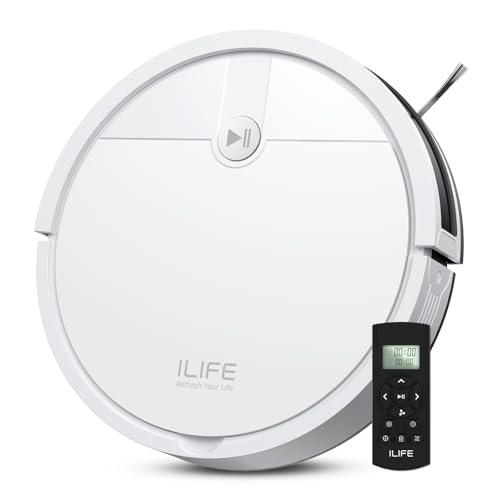
ILIFE V2 Robot Vacuum Cleaner — Best Overall Minimalist
The ILIFE V2 is what a robot vacuum was before the category’s arms race: a slim disc that vacuums your floors on a schedule, returns itself to its charger, and is controlled by a remote control — full stop. Its verified listing describes tangle-free suction, a 120-minute runtime, a slim self-charging body in white, and positioning as ideal for pet hair. Tangle-free suction is a quietly radical minimalist feature: instead of a spinning brush roll that winds hair into a weekly cutting chore, the V2’s suction port takes hair straight in, which deletes the most annoying maintenance task in robot ownership. The remote deletes the other one — there is no app, no WiFi pairing ceremony, no account, no firmware-update nag. You point, you press, it cleans.
Strengths
- Remote control instead of an app — no account, no WiFi setup, no phone required; a schedule can be set from the remote.
- Tangle-free suction port: pet and human hair go into the bin instead of winding around a brush roll.
- 120-minute runtime and self-charging per the listing, in a slim body that fits under furniture.
Trade-offs
- No mapping: it navigates by pattern and sensors rather than a floor plan, so it cleans by coverage and patience, not by room selection.
- Suction-port designs are happiest on hard floors and low pile; deep carpet is not this robot’s brief.
- No self-empty dock — the bin is yours to empty, which is either minimalism or a chore depending on your theology.
Spec box: Robot vacuum · Tangle-free suction · 120 mins runtime · Remote control, schedule · Slim, self-charging · White (per Amazon listing title).
For hard-floor homes — the natural habitat of minimalist living — the V2 is the set-and-forget ideal at an entry price structure: press a button in the morning and live on clean floors without owning a cleaning appliance ecosystem. It is also, not coincidentally, the robot most often recommended for parents and grandparents, because its entire interface can be learned in one minute and never updates itself overnight.
Best for: hard floors and low pile, pet hair, app-averse households, gifts for parents. / Not suited for: deep carpet, buyers wanting room-by-room mapping or self-emptying. Check on Amazon

Bissell Featherweight Stick Vacuum 2033M — Best Corded Simplicity
The Featherweight is the electric broom reduced to its essence, and its verified listing says so in so many words: a lightweight bagless stick vacuum and electric broom with a crevice tool, for hard floors and carpets. It converts between stick, hand vacuum and stair vacuum by removing parts rather than adding them. It has a cord — which in minimalist accounting is a virtue disguised as a limitation. No battery to degrade, no runtime to manage, no charger to lose, no dock to mount; it is ready at full power every single time, forever, for the price of walking a cord around a small home.
Strengths
- Three forms in one tool — stick, handheld, stair vacuum — achieved by subtraction, not accessories.
- Corded readiness: full suction indefinitely, no battery aging, no charging infrastructure.
- Featherweight class and a footprint that stores in a broom closet or behind a door.
Trade-offs
- The cord defines its range; large multi-room homes will feel the plug-hopping.
- A convenience cleaner, not a deep-clean upright: heavy carpet and whole-house Saturday cleans exceed its brief.
- Small cup, emptied often — the recurring tax on all featherweight designs.
Spec box: Stick / hand / stair vacuum · Bagless · Crevice tool included · Corded · For hard floors and carpets (per Amazon listing title).
Every home has a category of mess that happens daily — kitchen crumbs, entry grit, litter scatter, the toddler’s oat constellation — and a category that happens weekly. The Featherweight owns the daily category so completely that many owners find the weekly one shrinking. It is the vacuum most likely to be used ten times a week, and use frequency, not spec-sheet suction, is what keeps floors clean.
Best for: small homes, daily mess duty, hard floors with area rugs, first apartments and dorms. / Not suited for: large homes or deep-carpet deep cleans as the only vacuum. Check on Amazon

iRobot Roomba 105 Vac Robot Vacuum — Best Simple Robot with Smart Mapping
Minimalism does not have to mean unsophisticated — it can mean sophistication that stays invisible. The Roomba 105’s verified listing describes LiDAR navigation, multi-surface cleaning, cleaning in neat rows, and a 7,000 Pa power-lifting suction figure as stated by the maker, with a charging base. This is iRobot’s entry robot: the mapping intelligence that makes a robot genuinely efficient — systematic rows instead of random wandering, multi-surface awareness — without the mop systems, docks and feature tiers stacked on the flagship models. You get the one smart feature that changes outcomes (navigation) and skip the dozen that change only the price and the manual’s page count.
Strengths
- LiDAR navigation with neat-row cleaning: systematic coverage, no missed stripes, no endless random rediscovery of the same room.
- From the category’s founding brand — parts, support and a mature app for those who do want scheduling by phone.
- Multi-surface positioning suits mixed hard floor and carpet homes better than suction-port robots.
Trade-offs
- It does use an app for its full feature set — the ILIFE remains the pick for the strictly app-free.
- Base configuration: no self-empty dock in this listing, so bin-emptying is manual.
- Brush-roll designs need the occasional hair untangling that the ILIFE’s suction port avoids.
Spec box: Robot vacuum with charging base · LiDAR navigation · Neat-row, multi-surface cleaning · Maker-stated 7,000 Pa suction (per Amazon listing title).
Choose the Roomba when your floors are mixed, your rooms are several, and you want the robot to be methodical rather than charming. It is the minimalist pick for people who like technology — provided the technology files no weekly reports and asks for nothing but an emptied bin.
Best for: mixed-floor homes, methodical cleaning, brand-and-support confidence. / Not suited for: app-free purists or buyers wanting a self-empty dock in the base price. Check on Amazon
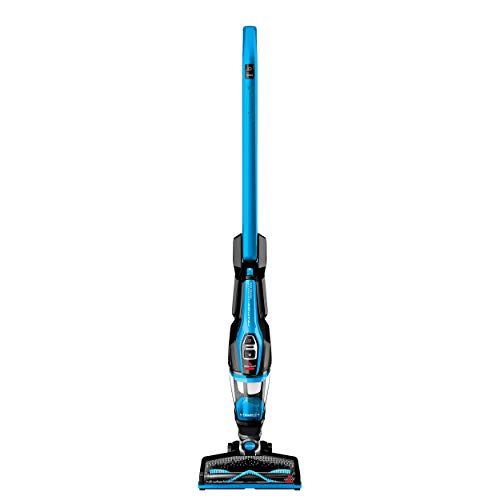
Bissell Featherweight Cordless Stick Vacuum 3061 — Best Cordless Simplicity
The 3061 answers the one legitimate complaint about its corded sibling — the cord — while keeping the design’s soul intact. Its verified listing describes a Featherweight cordless stick vacuum, self-standing, in electric blue and black. Self-standing is the minimalist detail that matters: most cordless sticks demand a wall-mounted dock, which means drilling, a dedicated wall, and a charger station that becomes furniture. This one stands in a corner like a broom, charges from a plug, and is otherwise exactly what the Featherweight has always been — a light stick for daily messes, ready without ritual.
Strengths
- Cordless freedom with self-standing storage — no dock installation, no wall commitment.
- The Featherweight formula: light, simple, grab-and-go for the daily mess category.
- Rechargeable convenience for homes where the cord genuinely was the dealbreaker.
Trade-offs
- Battery physics apply: runtime is finite and the battery ages over years, unlike the immortal corded version.
- Still a convenience-class cleaner — not a deep-carpet or whole-house primary for larger homes.
- Small cup, frequent emptying, as with all featherweights.
Spec box: Cordless stick vacuum · Self-standing · Rechargeable · Electric blue/black (per Amazon listing title).
The choice between this and the 2033M is a genuine fork in minimalist philosophy: corded permanence versus cordless ease. Small homes with outlets everywhere lean corded; homes where the vacuum must travel between floors, or where a cord across the kitchen is a trip hazard for toddlers and elders, lean here. Both answers are right; the guide refuses to pretend otherwise.
Best for: multi-floor small homes, cord-averse users, corner storage. / Not suited for: buyers wanting zero battery maintenance forever, or large-home primary duty. Check on Amazon

Eureka Airspeed Ultra-Lightweight Upright NEU10AE5 — Best Simple Upright
Some minimalist homes still have wall-to-wall carpet, and for them the sticks are snacks where a meal is needed. The Eureka Airspeed’s verified catalog entry describes an ultra-lightweight upright at 7.7 lb, positioned for pet hair, carpet and hard floors, with brush and crevice tools — a full upright format with a proper brush roll and a full-size cleaning path, at a weight below most stick vacuums’ marketing claims. There is no screen, no app, no modes worth the name: you plug it in, it stands up, it cleans carpet the way uprights have for fifty years, and it carries up the stairs like a grocery bag.
Strengths
- 7.7 lb full upright — real brush-roll carpet cleaning at featherweight commitment.
- Corded, bagless and simple: the upright format with every modern complication removed.
- Senior-friendly weight and handling, per its catalog positioning — a vacuum nobody has to wrestle.
Trade-offs
- Compact upright, compact cup: emptying is frequent in shedding season.
- No sealed flagship filtration claims — fine for general homes, less tailored to severe allergy regimens.
- Upright format stores bigger than a stick, though at this weight it hangs or corners easily.
Spec box: Upright vacuum · 7.7 lb · Bagless · Brush and crevice tools · For carpet, hard floor, pet hair (per API catalog entry, Batch083-wave12).
This is the pick that proves minimalist does not mean underpowered-for-carpet. If your small home is carpeted — rentals often are — the Airspeed is the primary vacuum of this guide, and the sticks and handhelds become its supporting cast rather than its replacements.
Best for: carpeted small homes and rentals, seniors, one-vacuum households on a budget of space and money. / Not suited for: buyers wanting cordless operation or flagship filtration. Check on Amazon

Dirt Devil Scorpion Plus Handheld Vacuum — Best Handheld Minimalist
The Scorpion Plus is the drawer vacuum perfected, and its verified listing is a model of the genre: a corded handheld with powerful suction, lightweight build and a QuickFlip crevice tool built into the nose. The QuickFlip detail is minimalist design at its best — the crevice tool is not an attachment to lose but a part that flips down when needed and away when not, which means the tool you need for the couch cushions and the car footwell is always already attached. Corded, again, as a philosophy: a handheld that lives in a drawer for a decade, ready at full power the day the rice spills, with no battery quietly dying between uses.
Strengths
- Built-in QuickFlip crevice tool — the attachment cannot be lost because it is not an attachment.
- Corded full power, indefinitely ready; the drawer-and-forget tool that always works.
- Lightweight handheld format for stairs, cars, upholstery and spill response.
Trade-offs
- A specialist, not a floor vacuum: it complements the other picks rather than replacing them.
- Corded range applies — it works near outlets, which for spills and cars is where the outlets problem is solved with one extension cord.
- Small cup and a filter to keep clean; handheld physics.
Spec box: Handheld vacuum · Corded · QuickFlip crevice tool · Lightweight (per API catalog entry, Batch068-wave12).
Minimalist households sometimes make the mistake of owning one tool and demanding it do everything. The Scorpion argues the opposite: one tiny tool that does the small jobs instantly is what makes the big tool’s life simple. Crumbs, litter, car mats, the stair treads — handled in the moment, by the drawer.
Best for: spill response, cars, stairs, upholstery, as the second vacuum in any home. / Not suited for: floor cleaning as a primary vacuum. Check on Amazon
Comparison Table
| Pick | Badge | Key spec | Best for |
|---|---|---|---|
| ILIFE V2 Robot | Best Overall Minimalist | Remote control, tangle-free suction, 120 min runtime | App-free automation, hard floors |
| Bissell Featherweight 2033M | Best Corded Simplicity | Stick/hand/stair 3-in-1, bagless, corded | Daily messes, small homes |
| iRobot Roomba 105 Vac | Best Simple Robot with Smart Mapping | LiDAR navigation, neat rows, multi-surface | Mixed floors, methodical cleaning |
| Bissell Featherweight Cordless 3061 | Best Cordless Simplicity | Self-standing cordless stick, rechargeable | Cord-free daily cleaning |
| Eureka Airspeed NEU10AE5 | Best Simple Upright | 7.7 lb upright, bagless, carpet + hard floor | Carpeted small homes |
| Dirt Devil Scorpion Plus | Best Handheld Minimalist | Corded handheld, built-in QuickFlip crevice tool | Spills, cars, stairs |
How to Choose a Minimalist Vacuum
Start by naming your floor truthfully. Mostly hard floors with rugs: the robots and Featherweights live here, and the ILIFE V2 is the hands-free answer. Mostly carpet: the Eureka Airspeed is your primary, full stop, and everything else is support. Mixed floors across several rooms: the Roomba 105’s navigation earns its place. Then name your mess rhythm. Daily small messes argue for a grab-and-go stick kept assembled and visible — a vacuum stored disassembled in a closet is a vacuum used weekly at best. Weekly deep cleans argue for the upright. Spill chaos — toddlers, craft tables, a car that eats crackers — argues for adding the Scorpion to whichever primary you chose.
Then apply the subtraction test to your own habits. If you know you will never open the app, do not buy the app. If a dock on the wall will annoy you every day, buy the self-standing or corded machine. If emptying a small cup annoys you more than a large machine would, be honest and size up — minimalism that fights its owner gets donated within a year, which is the least minimalist outcome of all. The philosophy is not deprivation; it is the discipline of owning exactly the tool your floors and habits require, from a maker who will still sell you a filter in five years.
The Real Cost of Features: What Minimalist Vacuums Save You
Feature-heavy vacuums charge rent long after purchase. Self-empty docks consume proprietary bags on a schedule. Mop combos consume pads and solution and demand their own washing routine. Multi-attachment systems consume storage and the will to fetch them. Smart platforms consume attention: accounts, passwords, WiFi migrations when you change routers, apps that sunset. None of these costs is irrational — for large, complex homes they can be worth it — but in a small home they are nearly pure overhead, paid to solve problems the home does not have.
The minimalist machines in this guide invert the ledger. Their consumables are a washable or replaceable filter on a long interval and, for the cordless pick, a battery measured in years. Their storage cost is a corner or a drawer. Their attention cost approaches zero — the ILIFE’s remote has no password, the Featherweight has no firmware, the Scorpion has no settings. And their failure modes are legible: a clog you can see, a filter you can rinse, a belt or brush you can inspect. When a minimalist vacuum stops performing, the cause is findable in minutes; that diagnosability is a feature no spec sheet lists and every owner eventually values.
How to Keep a Minimalist Vacuum Working for Years
- Empty the cup before it is full, not after. Small cups are the category’s tax; paying it early keeps suction honest and filters cleaner. Ten seconds, every few uses.
- Rinse or tap the filter on a monthly rhythm. Follow the maker’s instruction for your model — washable filters want a full day to dry before reinstalling.
- Keep the air path stupidly clear. Most “dead” simple vacuums have a sock, a toy or a hair clog in the hose or port. The subtraction-designed machines make this a two-minute inspection, not a service call.
- For brush-roll models, clear the roll monthly. The Eureka and Roomba benefit from scissors and thirty seconds; the ILIFE’s tangle-free port exists to skip exactly this step.
- Store it assembled and reachable. The minimalist routine fails at the closet. A stick standing by the kitchen and a robot on its base get used; anything in a box does not.
- For the cordless pick, avoid deep-discharge storage. Charge it after use and do not leave it dead for months; battery manners are the one ritual cordless minimalism cannot delete.
Minimalist Setups That Work: Four Homes, Four Configurations
The studio apartment. One room, hard floors, a rug, a life lived in 400 square feet. The ILIFE V2 on its base under a shelf, running each morning, plus the Scorpion in a kitchen drawer for the counter-and-floor crumb economy. Total storage consumed: one shelf footprint and one drawer. Total weekly effort: emptying one bin. This is the minimalist ideal in its purest form, and it costs less — in money, space and attention — than any single flagship machine.
The carpeted rental. Wall-to-wall carpet the landlord chose, a no-renovation lease, a cat. The Eureka Airspeed is the primary — real brush roll, 7.7 pounds up the stairs — and the Featherweight cordless lives in the hall closet for the litter perimeter and the kitchen’s hard floor. The pairing covers every surface in the home with two machines that share one virtue: neither has ever asked for a software update.
The grandparents’ house. The requirements are kindness-shaped: nothing heavy, nothing complicated, nothing that requires a phone. The ILIFE V2’s remote is the interface a person can learn at eighty — one button to start, one to send it home — and the corded Featherweight hangs in the pantry for the rest. No accounts are created, no passwords exist, and the floors stay clean on a schedule set once, by a grandchild, on the remote.
The small family home. Hard floors downstairs, carpet up, messes everywhere, time nowhere. The Roomba 105 maps and maintains the ground floor in neat rows; the Eureka handles the carpeted upstairs on weekends; the Scorpion lives where the toddlers eat. Three simple machines, each legible, each replaceable alone when it eventually wears — a system with no single point of expensive failure.
What Minimalism Asks of You: The Honest Other Half
Minimalist vacuums are a fair trade, and fairness has two sides. In exchange for deleting the dock, the app and the accessory wall, these machines ask three small things forever. First, the cup: you will empty small dust cups often — that frequency is the physical price of small machines, and no design in this guide escapes it. Second, the filter: a monthly rinse or tap, because a simple vacuum has no self-cleaning theater to hide neglect behind. Third, presence: sticks and handhelds only clean when carried, so the household must actually develop the ninety-second daily habit — or buy the robot, which is the honest way to outsource the habit itself.
Households that accept those three asks get the category’s full dividend: machines that last for years, cost almost nothing to keep, never strand them mid-clean with a dead battery ecosystem or a discontinued bag size, and can be understood completely by every person in the home. Households that know they will not empty cups or rinse filters should not romanticize minimalism — they should buy the self-emptying flagship and enjoy it without guilt. This guide’s loyalty is to the match, not to the philosophy: the right vacuum is the one whose maintenance you will actually perform.
The Minimalist Vacuum and the Planet: A Short, Honest Accounting
There is an environmental argument for this category, and it deserves to be made without embroidery. A vacuum’s footprint is mostly its manufacture and its lifespan: a machine used for eight years amortizes its materials twice as well as one replaced in four, and simple machines — fewer motors, no dock, no screen, no battery in the corded cases — carry less embedded complexity to amortize. The consumables ledger matters too: this guide’s machines consume filters slowly and nothing else, while dock-based systems generate a steady stream of bags, pads and solution bottles. Repairability completes the picture: a clog you can reach, a filter you can rinse, a belt you can see — the minimalist machine fails legibly and is fixed at the kitchen table, where complex machines fail opaquely and are replaced at the store.
The honest counterweight: a cheap machine discarded in a year is worse than a flagship kept for ten, whatever its feature count. Minimalism’s environmental case rests entirely on longevity, which is why this guide insists on established makers and legible mechanisms rather than celebrating the lowest possible price. Buy the simple machine built to last, keep it with the tiny maintenance it asks, and the philosophy and the planet get the same outcome: less stuff, working longer.
Troubleshooting the Simple Vacuum: Five Fixes That Cover Almost Everything
It lost suction. Empty the cup, clean the filter, then check the air path end to end for the clog — in that order, because the cause is in that list ninety times in a hundred. The robot stopped mid-room. Check its wheels and sensors for hair and dust film, empty its bin, and confirm the charging contacts are clean; robots are defeated by housekeeping, not electronics, far more often than by failure. The stick smells when it runs. The filter is holding damp dust — wash it if washable, dry it completely (a full day), or replace it; smell lives in filters, not motors. The upright leaves a line of dirt. The brush roll is wound with hair or the belt has stretched; both are five-minute, no-tools-or-one-screwdriver fixes on simple machines — which is rather the point of simple machines. The cordless will not charge. Reseat the battery if removable, clean the contacts, and try the outlet with a lamp before mourning the battery; chargers and outlets fail more often than cells do. A minimalist vacuum’s deepest feature is that this entire troubleshooting section fits in one paragraph — keep it, and you will rarely need a manual again.
Common Buying Mistakes
- Confusing minimalist with underpowered. A simple machine from an established maker cleans properly; a feature-stuffed no-name with an invented suction figure often does not. Judge by maker and mechanism, not by the length of the feature list — in either direction.
- Buying a flagship for a studio. A self-empty dock in a 400-square-foot home is furniture that empties a cup you could empty in ten seconds. Scale the machine to the home.
- Demanding one tool do everything. Minimalist systems pair a primary (robot, stick or upright) with the Scorpion-class handheld for spills. Two simple tools beat one complicated one.
- Ignoring the cord question until unboxing. Corded means immortal readiness and a range limit; cordless means freedom and battery aging. Choose with your eyes open — both Featherweights are in this guide precisely so the choice is yours.
- Letting the cup and filter slide. Every performance complaint about simple vacuums traces to a full cup or a clogged filter. The maintenance is tiny; it is also non-optional.
- Storing it disassembled. If it takes assembly, it will not be used for the daily messes that are its purpose. Keep it standing, charged or plugged, in the room that makes the messes.
A Note on Buying for Someone Else
Minimalist vacuums are disproportionately gift purchases — for parents aging in place, for graduates in first apartments, for the dorm-bound — and the gifting logic deserves thirty seconds. Give the machine whose interface the recipient already understands: the remote-controlled ILIFE for the phone-averse, the corded Featherweight for the person who distrusts batteries on principle, the Scorpion for the car enthusiast whose interior is a crumb museum. Include the first filter replacement and a note with the two maintenance lines that matter (empty the cup, rinse the filter monthly) — a gift with its upkeep explained is a gift that gets kept. And resist upgrading the gift into complexity: the flagship you find exciting is, to its recipient, a dock, an account and a manual. The simple machine, chosen to match its owner, is the generous one.
How the Picks Divide a Week: A Sample Schedule
Abstract advice becomes real when it is scheduled, so here is the week these machines were chosen to run. The robot household: the ILIFE or Roomba runs each morning after breakfast — daily maintenance is what makes robot cleaning compound — with bins emptied on trash night and filters rinsed on the first of the month. The stick household: ninety seconds after dinner, kitchen and entry, every day without exception, because the habit is the machine; the upright household: the Eureka on Saturday for carpet and bedrooms, the Featherweight or Scorpion on weekdays for incidents. In every configuration the deep truth is the same: floors stay clean not because a machine is powerful but because a system is frequent, and minimalist machines win by making frequency effortless. Choose the configuration your household will actually repeat on its worst week, not its best — that is the whole of vacuum wisdom, and the rest is specifications.
Final Recommendation
If your home is hard-floored and you want cleaning to simply happen, buy the ILIFE V2 and let the remote be the last vacuum interface you ever learn. If you prefer to do it yourself in ninety seconds a day, the corded Featherweight 2033M is the immortal choice and the cordless 3061 its liberated sibling — pick by your honest feelings about cords and batteries. Mixed floors and a taste for method point to the Roomba 105; wall-to-wall carpet points to the 7.7 lb Eureka Airspeed as the primary; and every household on this list should consider the Scorpion Plus in a drawer, because spills do not schedule themselves around floor-cleaning day. Minimalism, done right, is not owning less cleaning — it is owning cleaning that asks less of you.
Comparing the wider small-vacuum shelf? See our guides to Best Mini Upright Vacuums, Best Portable Mini Vacuums, Best Lightweight Vacuums With Bags, Best Mini Pet Vacuums and Best Robot Vacuums For Bare Floors for the related picks in this program.
And if, after all of this, you remain torn between two picks, choose the one whose maintenance you can picture yourself doing on a tired Tuesday in February — that picture, not the spec sheet, is the most accurate product review ever written. The clean floor, after all, does not care which badge the machine wore — it cares that the machine was used, daily, without friction, by a household that never had to think about it twice.
Frequently Asked Questions
Is a minimalist vacuum powerful enough for a real home?
For the homes they target — small to medium, with daily light messes and weekly ordinary cleaning — yes, provided you buy an established maker’s simple machine rather than a no-name’s inflated spec sheet. The Eureka Airspeed in this guide is a genuine carpet upright; the robots cover hard floors thoroughly by running often. What minimalist machines do not claim is flagship deep-clean performance in large, high-traffic houses — and they do not charge for it either.
Robot or stick: which is the better minimalist choice?
They solve different halves of the problem. A robot (ILIFE V2 or Roomba 105) maintains floors continuously with no effort, but cannot do stairs, sofas or spills. A stick handles everything a robot cannot, in the moment, but requires you. Many minimalist homes run a robot for maintenance and keep a Featherweight for everything else — two simple tools, no complicated ones.
Why choose a corded vacuum in a cordless era?
Because a cord deletes the battery from your life: no runtime limit, no charging dock, no degradation, no replacement cost in year four, and full power at every use, forever. In a small home where an outlet is always near, that is a rational trade — which is why three of this guide’s six picks are corded, proudly.
How do I maintain a vacuum with almost no features?
Empty the cup early and often, clean the filter monthly, keep the air path clear, and clear brush rolls where fitted. That is the entire liturgy. The machines in this guide were chosen so that maintenance stays at that level — no dock bags, no pad washing, no app-managed consumable subscriptions.
Can a minimalist vacuum handle pet hair?
Yes, with the right mechanism. The ILIFE V2’s tangle-free suction port is positioned for pet hair and avoids the brush-roll winding problem entirely; the Eureka Airspeed’s catalog positioning includes pet hair on carpet; the Featherweights handle daily hair on hard floors easily. Heavy-shedding homes should empty cups more often — the tax is frequency, not capability.
Are minimalist vacuums a good choice for allergy households?
With eyes open. The general cleaning case is strong — frequent cleaning with simple machines removes dust and dander from floors effectively, and frequency is the allergy household’s best friend. What this category does not emphasize is sealed, certified filtration of the flagship kind; households managing diagnosed allergies or asthma under medical guidance should weigh their clinician’s advice and consider filtration specifications as a primary criterion, which may point beyond this guide’s brief. For everyone else, clean floors kept clean daily beat a theoretically superior machine used reluctantly.
How loud are minimalist vacuums?
Small machines are not automatically quiet machines — motor size and noise are only cousins — but the category has one honest advantage: the robots and sticks here do their work in short, frequent sessions or at conversational distance, rather than in one weekly whole-house roar. The ILIFE’s daily hour in an empty morning house bothers nobody; the Featherweight’s ninety seconds is over before it registers. Judge by your household’s rhythm, and let the schedule do what decibels cannot.
Where should a minimalist vacuum live in a small home?
Where the messes are, in plain sight or one door away: the stick in the kitchen’s broom corner, the robot’s base under a sideboard, the handheld in the drawer nearest the dining table. Storage that hides a vacuum completely also hides it from your routine, and in small homes the visible tool is the used tool. Every pick in this guide was chosen partly for a footprint that tolerates being left out — a corner, a drawer, a shelf — without turning the room into a utility closet.
What should a minimalist vacuum setup cost in ongoing consumables?
Very little, by design: a filter on a long replacement interval for most picks, and a battery in years for the one cordless model. There are no dock bags, proprietary pads or solution cartridges anywhere in this guide. If a “simple” vacuum you are considering elsewhere has a consumables page, it has failed the subtraction test.


