Disclosure: airfryerkitchensupply.com is reader-supported. When you buy through links on our site, we may earn an affiliate commission at no extra cost to you.
Where to buy
All six picks below were confirmed through Amazon data before receiving a link — four flour sack towels, plus the two traditional straining tools, cheesecloth and the nut milk bag, whose listings were verified in a follow-up API round because the best towels for cauliflower rice is a job where the traditional tools deserve a place alongside the towels. Prices vary, so verified picks use check-price links instead of printed figures, and the picks are listed in recommendation order.
- Utopia Kitchen Flour Sack Towels (12-Pack, 28″x28″) — Check the current price on Amazon
- Aunt Martha’s Flour Sack Dish Towels (Set of 7) — Check the current price on Amazon
- DG Collections Flour Sack Towels (24-Pack, 27″x27″) — Check the current price on Amazon
- Honest Weave Organic Cotton Flour Sack Towels (12-Pack, 27″x27″) — Check the current price on Amazon
- Unbleached Cheesecloth, Grade 50 (45 Sq Ft) (Best Traditional Strainer) — Check on Amazon
- Reusable Nut Milk Bags, Fine Mesh (2-Pack) (Best Fine-Mesh Alternative) — Check on Amazon
- Unbleached Cheesecloth, Grade 50 (45 Sq Ft) — Check the current price on Amazon
- Reusable Nut Milk Bags, Fine Mesh (2-Pack) — Check the current price on Amazon
Cauliflower rice succeeds or fails on water. A raw head of cauliflower is mostly water, and ricing it multiplies the surface area that releases that water into your pan. Skip the squeeze and you are not making cauliflower rice — you are steaming cauliflower granules in their own liquid, with the texture and the diluted flavour to prove it. The best towels for cauliflower rice exist to solve exactly that: to take a cooked, riced batch and wring it to a fluffy dryness that fries, seasons and holds together like the grain it imitates.
The tool that wins is not the thickest towel in the drawer. It is a thin, tightly woven, lint-free cotton towel — the flour sack towel — that can be twisted hard without tearing, that releases the squeezed cauliflower cleanly, and that gives up almost no lint to food. Terry cloth is too thick to wring dry and too loopy to release grains; paper towels disintegrate mid-squeeze and turn a weekly recipe into a weekly purchase. This roundup is built around four verified flour sack picks, plus honest guidance on the two traditional alternatives.
Two of the six picks — cheesecloth and the nut milk bag — are not towels at all, and they are included deliberately. They are the traditional straining tools for this job, verified through the same Amazon listing data process as the towels, and each earns its place for a different stage of the work: cheesecloth for the fine drain, the mesh bag for the fully contained squeeze.
In this guide
Quick Picks
| Pick | Badge | Best for | Check |
|---|---|---|---|
| Utopia Kitchen Flour Sack Towels (12-Pack, 28″x28″) | Best Overall | Regular cauliflower-rice cooks who want the proven, right-sized workhorse | Check price on Amazon |
| Aunt Martha’s Flour Sack Dish Towels (Set of 7) | Best Traditional Weave | Cooks who value weave quality and squeeze smaller, regular batches | Check price on Amazon |
| DG Collections Flour Sack Towels (24-Pack, 27″x27″) | Best Value for Batch Cooking | Batch cookers, big households and anyone who wants the deepest towel rotation | Check price on Amazon |
| Honest Weave Organic Cotton Flour Sack Towels (12-Pack, 27″x27″) | Best Organic Option | Organic-minded cooks who want finished construction and presentable looks | Check price on Amazon |
| Unbleached Cheesecloth, Grade 50 (45 Sq Ft) | Best Traditional Strainer | Cooks who also strain stocks, milks and curds and want the traditional fine-straining tool | Check price on Amazon |
| Reusable Nut Milk Bags, Fine Mesh (2-Pack) | Best Fine-Mesh Alternative | Frequent cauliflower-rice cooks who want the tidiest, fully contained squeeze | Check price on Amazon |
How These Picks Were Chosen
Selection started from the mechanics of the squeeze. A candidate towel had to be thin enough to wring nearly dry, woven tightly enough to contain riced grains under twisting pressure, lint-free against food, large enough to bundle a batch — 27 to 28 inches square proved the working range — and honest about its material in its listing. Terry towels, microfibre and decorative tea towels were excluded by those criteria before any brand was considered.
Verified listings did the rest. The four linked picks all state their cotton content, size and pack count in listing-confirmed titles, and their construction details — thread count, hemming, pre-washing, organic fibre — are quoted only where the listing states them. Where a listing’s language outruns its evidence, the review trims it back: the organic pick, for example, is described exactly as its listing describes it, with the absence of a named certifier in the title data noted rather than papered over.
The two straining-tool picks were chosen by role: cheesecloth for fine straining and the nut milk bag for contained squeezing are the two tools experienced cauliflower cooks actually reach for alongside towels, and both listings were confirmed in a follow-up verification round before being linked here.
A final selection note on rotation: the working life of a flour sack towel is measured in hundreds of wring-and-wash cycles, and the picks were ordered partly by how gracefully they age — hemmed edges, pre-washing and denser weaves all slow the journey from tool to rag. When a towel does retire from food duty, it retires downward into general kitchen service, which is why even the largest pack in this article is rarely a waste of money in a cooking household.
The 6 Best Towels for Cauliflower Rice

Utopia Kitchen Flour Sack Towels (12-Pack, 28″x28″) — Best Overall
Riced cauliflower holds a remarkable amount of water, and removing it is the difference between fluffy “rice” and a soggy pan of mush. The tool for the job is a thin, lint-free cotton towel you can wring hard, and the Utopia Kitchen flour sack towels are the category standard: the confirmed listing describes a 12-pack of 28-by-28-inch, 100% cotton flour sack towels. That size wraps a whole batch of riced cauliflower with room to twist.
Strengths
- 28″x28″ per the listing — large enough to bundle and wring a full batch at once
- 100% cotton flour sack weave: thin, strong when wet, and lint-free against food
- 12-pack format suits the reality that a working towel leaves rotation while it launders
Trade-offs
- White cotton shows turmeric, berry and tomato stains proudly — dedicate a few towels to food duty
- Flour sack cotton is utilitarian, not plush; these are tools, not display towels
- Like all cotton, they need a wash before first food use to remove sizing and reach full absorbency
| Pack | 12 towels (per Amazon title) |
| Size | 28″ x 28″ (per Amazon title) |
| Material | 100% cotton flour sack (per Amazon title) |
| Colour | White |
Why flour sack weave wins this job comes down to three properties. It is thin, so it wrings out nearly dry instead of holding water in a thick pile. It is tightly woven for its weight, so riced cauliflower stays in the towel instead of escaping through the weave. And it is lint-free, so the towel gives up water without donating fibres to dinner. Terry towels fail the first and third tests; paper towels fail the strength test halfway through the first squeeze and turn a weekly habit into a rubbish habit.
The technique matters as much as the towel: steam or microwave the riced cauliflower first, let it cool enough to handle, then bundle and wring in batches over the sink — and be surprised, the first time, by how much liquid comes out. The 28-inch square gives you the leverage to do this properly, with a twist that keeps pressure even. Twelve towels means a fresh one for each batch and a laundry rhythm that never leaves you towel-less on cauliflower night.
Beyond cauliflower, this is the towel that squeezes grated zucchini, wrings thawed spinach, strains yoghurt in a pinch and dries herbs — the whole water-management portfolio of a vegetable-heavy kitchen. Bought for one job, kept for six.
Best for: Regular cauliflower-rice cooks who want the proven, right-sized workhorse / Not suited for: Anyone wanting decorative kitchen linens — these are tools first
Aunt Martha’s Flour Sack Dish Towels (Set of 7) — Best Traditional Weave
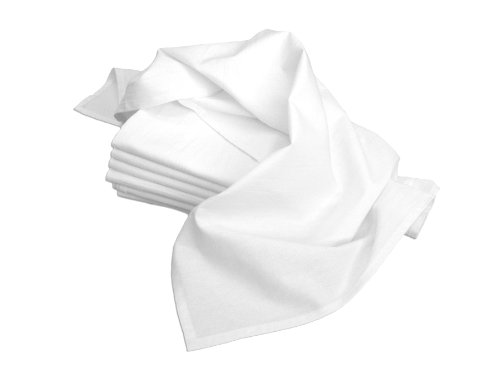
Aunt Martha’s is the heritage name in flour sack towels, and its confirmed listing offers a set of seven 28-by-28-inch towels in a premium 130 thread count, in white. Thread count is a meaningful specification here: a denser flour sack weave squeezes cleaner, sheds less lint and survives more wringing cycles than the loosest bargain weaves.
Strengths
- Premium 130 thread count stated in the listing — a denser, smoother flour sack weave
- Full 28″x28″ working size, the same generous square as the top pick
- A heritage maker whose flour sack towels have been a kitchen staple for generations
Trade-offs
- Seven towels is a smaller rotation than the 12- and 24-packs here — heavy users will launder more often
- White, with the same stain honesty as every white cotton towel in this article
- The listing leads with embroidery-grade presentation; the towels work hard, but you are paying a little for the pedigree
| Pack | Set of 7 (per Amazon title) |
| Size | 28″ x 28″ (per Amazon title) |
| Weave | Flour sack, premium 130 thread count (per Amazon title) |
| Colour | White |
If the Utopia is the sensible default, the Aunt Martha’s is the connoisseur’s version of the same tool. The stated thread count signals a tighter, more even weave, and in the wringing job that translates to two small advantages: less chance of fine cauliflower grains working through under pressure, and a smoother surface that releases the squeezed cauliflower cleanly instead of holding it in a nap. Marginal gains, honestly described — but this is a marginal-gains task once the basics are right.
The smaller set size is the real decision point. A household ricing cauliflower twice a week will cycle seven towels comfortably with a midweek wash; a household batch-cooking on Sundays, squeezing multiple heads at once, will feel the limit and should take the DG Collections 24-pack below instead. Match the pack to the production line.
There is also a second-life argument: flour sack towels of this grade are the traditional embroidery and craft blank, so a set that eventually retires from food duty has somewhere honourable to go. Tools that age into hobbies are rarely wasted money.
Best for: Cooks who value weave quality and squeeze smaller, regular batches / Not suited for: High-volume batch cooks who need a deep towel rotation

DG Collections Flour Sack Towels (24-Pack, 27″x27″) — Best Value for Batch Cooking
When cauliflower rice is a weekly production rather than an occasional side, towel count becomes the bottleneck, and the DG Collections pack answers with numbers: the confirmed listing describes 24 towels of 100% cotton flour sack at 27 by 27 inches, lint-free, pre-washed, with hemmed edges, in white. Pre-washed matters — the towels arrive closer to working absorbency instead of needing three washes to get there.
Strengths
- 24-pack: the deepest rotation in this roundup, built for batch cooking and big households
- Pre-washed per the listing, so absorbency starts nearer its working level from day one
- Hemmed edges and a lint-free claim stated in the listing — the two details that separate tools from rags
Trade-offs
- 27″x27″ is an inch smaller each way than the 28″ picks — a trivial difference, noted for completeness
- Buying 24 towels is a commitment of drawer space; small kitchens should count storage honestly
- Value-tier weave: expect good service, not the Aunt Martha’s density
| Pack | 24 towels (per Amazon title) |
| Size | 27″ x 27″ (per Amazon title) |
| Material | 100% cotton flour sack (per Amazon title) |
| Details | Lint-free, pre-washed, hemmed edges (per Amazon title) |
Batch cooking changes the arithmetic of everything, towels included. Squeezing four heads of cauliflower in a session wants a fresh towel per head — a damp towel wrings the next batch less dry — and then the whole production needs to survive until laundry day. Twenty-four towels is not excess in that kitchen; it is the difference between a system and a bottleneck. The pre-washed detail compounds the value, because flour sack cotton’s absorbency climbs over its first washes and these start the climb before you own them.
The hemmed edges deserve their mention. Unhemmed flour sack frays at exactly the point of maximum stress — the twist — and a fraying towel sheds fibres into food and dies young. Hemming is a small, unglamorous specification that doubles working life, and its presence in the listing is a good sign about the rest of the construction.
For smaller households, split the difference: this pack also makes sense shared between cauliflower duty, general drying and the craft drawer, which is how most 24-packs actually live. The per-towel cost of a deep pack is the lowest route to never improvising with a bath towel again.
Best for: Batch cookers, big households and anyone who wants the deepest towel rotation / Not suited for: Small kitchens with one shallow linen drawer

Honest Weave Organic Cotton Flour Sack Towels (12-Pack, 27″x27″) — Best Organic Option
For cooks who buy organic on principle, the Honest Weave listing states its case in its title: organic cotton flour sack towels, white, 12-pack at 27 by 27 inches, with mitered corners, hemmed edges and hidden hanging loops. A precision point this article keeps carefully: “organic” here describes the cotton as stated in the listing; no third-party certification name appears in the verified title data, so none is claimed in this review.
Strengths
- Organic cotton stated in the listing, for buyers who prioritise fibre sourcing
- Mitered corners and hemmed edges per the listing — finished construction, not cut cloth
- Hidden loops for hanging, a small detail that speeds drying between uses
Trade-offs
- Organic positioning usually carries a tier premium — check the current price against the conventional picks
- No certification body is named in the verified title data; buyers who require a specific certification should confirm it on the product page
- 27″x27″ — the slightly smaller square, as with the DG pack
| Pack | 12 towels (per Amazon title) |
| Size | 27″ x 27″ (per Amazon title) |
| Material | Organic cotton flour sack (per Amazon title; no certifier named in title) |
| Details | Mitered corners, hemmed edges, hidden loops (per Amazon title) |
The honest way to present this pick is exactly as its listing does: the cotton is described as organic, the construction details are stated and checkable, and anything beyond that — a named certification, a supply-chain story — is for the product page to confirm, not for this article to embellish. Buyers whose standard is a specific certification should verify it there before ordering; buyers whose standard is organically grown fibre from a transparent listing will find this the natural choice in the roundup.
As a working towel it stands on its construction. Mitered corners lie flat and resist the corner-fray that kills flour sack towels; hemmed edges take the wringing twist; the hidden loops mean the towel hangs fully open and dries fast, which in a working kitchen is a hygiene feature as much as a convenience. Performance-wise it squeezes cauliflower exactly as a good flour sack should.
It is also the presentable pick — the one that can move between food prep and the table without looking like equipment. Households that host in the kitchen, where the working towels are on display, may find that worth the tier difference on its own.
Best for: Organic-minded cooks who want finished construction and presentable looks / Not suited for: Buyers who require a named third-party certification confirmed before purchase
Unbleached Cheesecloth, Grade 50 (45 Sq Ft) — Best Traditional Strainer
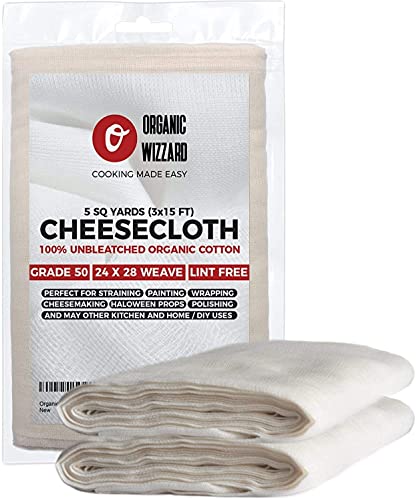
Cheesecloth is the traditional tool for this job — generations of cooks have strained and squeezed through its open weave — and for fine straining it remains excellent. The verified listing for this slot is an unbleached cotton cheesecloth described by its seller as organic cotton fabric, Grade 50 with an ultra fine mesh, supplied as 45 square feet (5 yards) of cloth, and stated to be washable and reusable as a food filter and strainer. Those are the specifications that matter for cauliflower work: a fine grade, enough yardage to layer, and a cloth you can wash and use again.
Strengths
- Open weave strains liquids and fine curds that a flour sack towel cannot match for fineness
- Cheap, light and disposable-or-reusable depending on grade — a flexible tool to keep in a drawer
- Excellent as a liner inside a colander for the first, gravity stage of draining riced cauliflower
Trade-offs
- A 45-square-foot piece is generous for straining but must be portioned for each session; cut what you need rather than unrolling the whole cloth over food
- Single-layer cheesecloth is too open for direct wringing of riced cauliflower; grains escape unless it is layered several deep
- Loose weaves snag and tear under hard twisting sooner than woven flour sack cotton
Used well, cheesecloth and flour sack are partners rather than rivals. Line a colander with layered cheesecloth for the first drain and the liquid runs freely; then transfer the bundle to a flour sack towel for the high-pressure wring that cheesecloth’s open weave cannot survive. Cooks who squeeze with cheesecloth alone usually learn the layering lesson through a sink full of escaped cauliflower grains.
When you buy cheesecloth for this job, the specifications that matter are these: an unbleached, food-grade cloth; a finer grade (the higher grade numbers are finer weaves) if you will strain with it; and enough yardage to work in multiple layers. This listing’s Grade 50 ultra fine mesh and 45 square feet hit all three, which is why it holds the slot over the looser, coarser cloths sold for crafts and table décor.
If you already own cheesecloth, none of this article’s technique changes: cook, cool, drain in layers, finish with the towel wring. The flour sack picks above remain the primary recommendation for the squeezing stage because their listings are verified and their weave is built for the twist. A practical layering rule: fold this cloth to at least four layers before riced cauliflower touches it, and rotate the bundle a quarter turn between squeezes so the weave is stressed evenly rather than torn at one fold.
Best for: Cooks who also strain stocks, milks and curds and want the traditional fine-straining tool / Not suited for: Anyone wanting one tool that survives hard wringing on its own

Reusable Nut Milk Bags, Fine Mesh (2-Pack) — Best Fine-Mesh Alternative
The nut milk bag — a fine mesh bag built for straining nut milks — is the modern alternative for squeezing riced cauliflower, and many low-carb cooks swear by its combination of fine mesh and a bag shape that keeps the batch contained. The verified listing for this slot is a two-pack of reusable nut milk bags, described as a fine mesh strainer for almond milk and juice — exactly the construction this job needs, sold as a pair so one bag can be in the wash while the other works.
Strengths
- Fine mesh contains riced cauliflower completely — no grains escape, even under a hard squeeze
- Bag format with a drawstring makes the bundle-and-wring technique tidier than a flat towel
- Reusable mesh rinses clean quickly and dries fast, suiting frequent low-carb cooking
Trade-offs
- The listing does not state the bag dimensions, so check the size on the product page if you squeeze large batches at once
- Mesh bags are smaller than a 28″ towel, so big batches are squeezed in more, smaller rounds
- Mesh quality varies widely between listings; seams are the failure point under twisting pressure
The bag’s advantage is containment geometry. A towel bundle can leak at the folds when the twist tightens; a sewn bag cannot leak anywhere except through its mesh, and the mesh is finer than the smallest cauliflower grain. For cooks who find towel-wringing messy, that tidiness is a genuine quality-of-life difference, and the drawstring gives the hands a defined grip for the final squeeze.
The specifications to demand in any nut milk bag are a food-grade fine mesh, reinforced seams, and a size that swallows a batch of riced cauliflower without packing it tight — an overfilled bag cannot be wrung effectively. This listing states the fine mesh and the two-bag reusable format; its title does not state the mesh material or the bag dimensions, so confirm those two details on the product page if they matter to you, and treat marketplace superlatives with the usual care.
Honest positioning: for most households the verified flour sack towels above remain the first purchase — cheaper per unit, larger, and useful across the whole kitchen. The nut milk bag is the specialist upgrade for people who rice cauliflower constantly and want the tidiest possible squeeze. Both statements can be true at once, and in this article, they are.
Best for: Frequent cauliflower-rice cooks who want the tidiest, fully contained squeeze / Not suited for: Big-batch cooks, or anyone who wants one tool for every kitchen job
Comparison Table
| Pick | Badge | Key spec | Best for | Check |
|---|---|---|---|---|
| Utopia Kitchen Flour Sack Towels (12-Pack, 28″x28″) | Best Overall | 100% cotton flour sack, 28″x28″, 12-pack | Regular cauliflower-rice cooks who want the proven, right-sized workhorse | Check price on Amazon |
| Aunt Martha’s Flour Sack Dish Towels (Set of 7) | Best Traditional Weave | 130 thread count flour sack, 28″x28″ | Cooks who value weave quality and squeeze smaller, regular batches | Check price on Amazon |
| DG Collections Flour Sack Towels (24-Pack, 27″x27″) | Best Value for Batch Cooking | 24-pack, pre-washed, hemmed edges | Batch cookers, big households and anyone who wants the deepest towel rotation | Check price on Amazon |
| Honest Weave Organic Cotton Flour Sack Towels (12-Pack, 27″x27″) | Best Organic Option | Organic cotton stated, mitered corners | Organic-minded cooks who want finished construction and presentable looks | Check price on Amazon |
| Unbleached Cheesecloth, Grade 50 (45 Sq Ft) | Best Traditional Strainer | Grade 50 ultra fine mesh, 45 sq ft, washable and reusable | Cooks who also strain stocks, milks and curds and want the traditional fine-straining tool | Check price on Amazon |
| Reusable Nut Milk Bags, Fine Mesh (2-Pack) | Best Fine-Mesh Alternative | 2-pack reusable fine mesh strainer bags | Frequent cauliflower-rice cooks who want the tidiest, fully contained squeeze | Check price on Amazon |
How to Choose a Towel for Cauliflower Rice
Weave first: why flour sack wins
Flour sack cotton is a plain, tight weave with no pile. Under a twist, water moves through it and out, the grains stay inside, and the towel itself can be wrung to near-dryness so the last squeeze is as effective as the first. Terry’s loops hold water inside the towel and trap grains in the pile; cheesecloth’s open weave passes water beautifully and grains almost as freely unless layered; mesh bags contain everything but limit batch size. Every tool in this article is a point on that triangle of drainage, containment and capacity.
Thread count and finishing refine the choice within flour sack. A denser weave, like the Aunt Martha’s stated 130 thread count, resists grain escape and lint. Hemmed edges and mitered corners resist the fray that starts exactly where the twist stresses the cloth. None of these details photographs well, and all of them decide whether a towel is still working in year two.
Size and pack count are production decisions
A 27-to-28-inch square wraps roughly a head’s worth of riced cauliflower with enough tail to twist. Smaller towels force smaller batches and more rounds; the difference between 27 and 28 inches is trivial, the difference between 20 and 27 is not. If a listing does not state dimensions, treat that silence as a specification in itself.
Pack count follows your rhythm. A fresh, dry towel wrings better than a damp one, so the number of towels should cover your biggest cooking session plus laundry lag. Twice-a-week cooks live happily in a 7- or 12-pack; Sunday batch producers should be looking at the 24-pack and not apologising for it.
Cotton, organic cotton and the certification question
Conventional and organic cotton perform identically in the squeeze — the difference is in how the fibre was grown, which is a values decision, not a performance one. If you buy on that value, buy precisely: a listing that states organic cotton, like the Honest Weave pick, is making a checkable claim; a named third-party certification is a stronger one, and where the verified title does not name a certifier, this article says so and sends you to the product page to confirm before paying a premium for it.
What to avoid at any fibre tier: synthetic blends for this job. Microfibre and polyester-blend towels can melt-risk near hot pans, hold odours through washes, and — most relevantly — their fibres behave differently under a hard twist. For food squeezing, plain cotton’s predictability is the feature.
What about freezing and storing riced cauliflower?
The squeeze also decides how well riced cauliflower freezes. Wet grains freeze into a solid, icy block that thaws back into soup; properly wrung grains freeze loose enough to scoop by the cup and go straight into a hot pan. If you batch-cook, squeeze first, freeze second — the order is the whole trick — and label bags with the date, because even well-dried cauliflower rice is best used within a few months.
Storage of the fresh, squeezed batch is simpler: a sealed container in the fridge for a few days, with a fresh square of towel or paper on top to catch condensation. That small habit keeps the surface grains dry, which is where staleness starts. The towel, having made the rice, quietly goes on protecting it.
The Full Technique: From Head to Fluffy Rice
Rice the cauliflower to grain size, by processor pulses or a box grater, keeping the grains even so they cook and dry evenly. Cook before you squeeze: a few minutes in a covered pan or microwave softens the grains and releases far more water than squeezing raw, which mostly bruises the cauliflower and tires the cook. Let the batch cool until it can be handled comfortably — the squeeze is a hands task and steam is unforgiving.
Bundle a towel-load at a time into the centre of a flour sack towel, gather the corners, and twist steadily over the sink, re-gripping and twisting again until the stream slows to drips. Work batch by batch with a dry towel for the last pass if you are chasing maximum dryness. Then fry the squeezed rice in a wide pan without crowding, season late, and notice that it browns — the reward that only a properly dry batch can give.
Troubleshooting a Wet Batch
Problem: the fried rice steams instead of browning. → The batch went into the pan too wet or too crowded. Squeeze again with a fresh dry towel, then fry in two uncrowded batches; a wide pan and patience repair most of the damage. Problem: grains escaped during the squeeze. → The bundle was overloaded or the weave too open; halve the batch, fold the towel double, and twist more slowly so pressure builds evenly. Problem: the rice tastes watery even when dry-textured. → Season after frying, not before, and finish with acid and fat — lemon and butter or olive oil — which carry flavour on the surface of dry grains instead of diluting into pan liquid.
Problem: the towel smells after one use. → It sat damp. Cauliflower water is mild but it sours; rinse the working towel straight after the session if the wash must wait, hang it fully open, and never ball a used towel into the hamper wet. These four fixes cover nearly every disappointing batch of cauliflower rice ever made, and all four are about water — which is, for the last time in this article, the entire subject.
Beyond Cauliflower: The Towel’s Wider Job
A pack of flour sack towels bought for cauliflower rarely stays in that lane. The same properties — thin, strong, lint-free, washable — make them the right tool for drying salad greens by the bundle, straining homemade stock through a layered square, covering dough while it proofs, and drying glassware without lint. Kitchens that cook vegetables seriously tend to standardise on them the way workshops standardise on shop cloths.
That wider utility is also the honest answer to the pack-size question. A 12- or 24-pack looks excessive for one recipe and exactly right for a kitchen system, because the towels rotate through every wet job in the room. Buy for the system and the cauliflower squeeze becomes one well-served stop in a longer working life.
How to Squeeze Cauliflower Rice Dry, Step by Step
This is the complete method the picks above are chosen for. It takes about ten minutes and is the entire difference between cauliflower rice as a substitute and cauliflower rice as a dish.
- Rice the cauliflower evenly — food processor in short pulses, or the coarse side of a box grater — and discard any large stalk chunks, which hold water and cook slowly.
- Cook the grains before squeezing: microwave in a covered bowl or steam in a pan until just tender. Raw cauliflower releases a fraction of the water that cooked cauliflower does.
- Cool the batch until you can handle it without discomfort. Hot grains plus a hard twist is a scald risk; five patient minutes is the safety step.
- Spread a clean flour sack towel over a bowl, tip in a manageable batch, gather the corners into a bundle and twist steadily over the sink, tightening your grip as the flow slows.
- Empty the squeezed grains into a dry bowl and repeat with the remaining batches, switching to a fresh towel when the working one becomes saturated.
- Fry the dried rice in a wide, uncrowded pan, or proceed with your recipe. Season toward the end — dry grains take seasoning on their surface instead of diluting it in pan liquid.
Wash the working towels promptly; cauliflower water left in cotton turns sour quickly. A hot wash and a full dry keeps the rotation sweet, and hanging loops or an airy shelf finish the job.
One refinement for committed cooks: weigh the batch before and after squeezing once, just to learn what your hands are doing. The difference — often a startling amount of water — calibrates your sense of “dry enough” better than any description, and after that single experiment your twist will find the right pressure by feel.
Common Buying Mistakes
Squeezing raw cauliflower. Cooking first releases far more water and gives a better texture. Squeezing raw is harder work for a wetter result.
Using a terry towel. The pile traps grains, holds water inside the towel and donates lint. Flour sack’s flat weave exists precisely for this job.
Reaching for paper towels. They tear mid-twist, cost money every batch and still leave the rice damp. A reusable cotton towel pays for itself in weeks.
Overloading one bundle. A bundle you cannot twist fully cannot be wrung dry. Work in batches your hands can actually close around.
Skipping the cooling pause. Steam plus pressure is a scald. Five minutes of cooling is part of the recipe, not a delay.
Storing damp working towels. Cauliflower water sours in cotton fast. Wash promptly and dry fully, or the next batch inherits the smell.
Final Recommendation
For most kitchens the answer is the Utopia Kitchen 12-pack: the right weave, the right 28-inch size, and a rotation deep enough for weekly cooking. Choose the Aunt Martha’s set if weave density is your priority and your batches are modest; choose the DG Collections 24-pack if you batch-cook at scale; choose the Honest Weave if organic fibre is your standard, with the certification caveat noted in its review.
The two straining tools complete the picture rather than competing with it: layered cheesecloth for the draining stage and fine straining generally, and the two-pack of fine-mesh nut milk bags when a fully contained squeeze matters more than batch size. Both were verified in a follow-up round, so the full six-pick set above is linked and checkable.
Whichever towel you start with, keep the technique: cook, cool, bundle, twist, fry. The towel is a simple tool, but in this recipe it is the tool — and a dry batch of cauliflower rice is the most persuasive review any of these picks could earn.
Keep the two traditional tools in perspective: they are included because experienced cooks genuinely use them at the draining stage, and the flour sack towels remain the finishing tool for the hard wring. Add the Grade 50 cheesecloth if you strain stocks and milks as well as cauliflower, and the two-pack of fine-mesh nut milk bags if you rice cauliflower weekly and want the tidiest squeeze. Neither replaces a towel; both make the towel’s job easier.
- Utopia Kitchen Flour Sack Towels (12-Pack, 28″x28″) (Best Overall) — Check on Amazon
- Aunt Martha’s Flour Sack Dish Towels (Set of 7) (Best Traditional Weave) — Check on Amazon
- DG Collections Flour Sack Towels (24-Pack, 27″x27″) (Best Value for Batch Cooking) — Check on Amazon
- Honest Weave Organic Cotton Flour Sack Towels (12-Pack, 27″x27″) (Best Organic Option) — Check on Amazon
Related guides on this site: Best Kitchen Towels For Cleaning; Best Chef Kitchen Towels; Best Flour Sack Towels For Cricut; Best Flour Sack Dish Towels For Embroidery; Best Hand Towels For Proofing Bread.
Frequently Asked Questions
Why does cauliflower rice need to be squeezed at all?
Cauliflower is mostly water, and ricing releases it. Unsqueezed grains steam in their own liquid, turning soft and diluting seasoning. A properly wrung batch fries, browns and holds a rice-like texture — the squeeze is the recipe’s turning point, not an optional refinement.
Can I use a regular kitchen towel instead of flour sack?
A flat-weave cotton tea towel can work in a pinch. Terry towels are the ones to avoid: their pile traps grains, holds water and sheds lint into food. Flour sack towels are recommended because their thin, tight, lint-free weave is purpose-suited to wringing.
Is cheesecloth or a towel better for cauliflower rice?
They do different stages best. Cheesecloth, layered, drains and fine-strains beautifully but tears and leaks grains under a hard solo wring. A flour sack towel survives the twist and finishes the job. Many cooks use cheesecloth to drain, then a towel to squeeze.
How many towels do I need?
Enough dry towels to cover your largest session plus laundry lag. A dry towel wrings a batch drier than a damp one, so twice-a-week cooks do well with 7–12, and batch producers should consider the 24-pack.
How do I stop the towels smelling sour?
Wash working towels promptly after use — cauliflower water sours in cotton quickly — use a hot wash, and dry them fully and airy before storing. A towel put away damp will greet the next batch with the smell.
Can the same towels squeeze other vegetables?
Yes — the same wring works for grated zucchini, thawed spinach, salted cabbage and grated potato. A flour sack towel is the general water-management tool of a vegetable-heavy kitchen, which is why a good pack earns its drawer space.
Can I squeeze cauliflower rice in a salad spinner or press instead?
A salad spinner removes surface water only — it cannot apply the sustained pressure that wringing does, so the grains stay wet inside. A potato ricer or press can work for small amounts but is slow and hard to clean. The towel twist remains the fastest route to a genuinely dry batch.
Should I dedicate specific towels to cauliflower duty?
It helps. Cauliflower is gentle on towels, but the same rotation often meets turmeric, beetroot and tomato. Marking two or three towels as food-squeezing towels — and keeping them out of the staining jobs — keeps the working set bright and the system simple.


