Disclosure: airfryerkitchensupply.com is reader-supported. When you buy through links on our site, we may earn an affiliate commission at no extra cost to you.
Where to buy
The fastest way to shop this shortlist is the retailer link under each pick. Availability, sizes and colour options change often, so use the links below to check the current price on Amazon and confirm the exact configuration before you order:
- Roborock Q7 L5 Robot Vacuum and Mop Combo — Check on Amazon
- Shark AV2501S AI Ultra Robot Vacuum — Check on Amazon
- iRobot Roomba 105 Vac Robot Vacuum — Check on Amazon
- eufy C10 Robot Vacuum Self Emptying — Check on Amazon
- Lefant M210 Robot Vacuum — Check on Amazon
- ILIFE A30 Pro Robot Vacuum and Mop — Check on Amazon
The best robot vacuums for bare floors are not simply the best robot vacuums. Carpet hides a robot’s sins — a missed pass disappears into pile — while hardwood, tile, laminate and vinyl display every crumb, hair and grit line to the room. So this category is judged by different rules: navigation that covers in rows rather than wandering, brushes that sweep edges and grout lines without scattering, heights that reach under furniture where hard-floor dust actually lives, and honesty about mopping, which on bare floors is a maintenance film-remover, not a deep clean.
Every machine below was verified: we searched by brand and model, matched the returned listing title, and took the ASIN from the listing. Where a brand states a figure — suction in pascals, runtime in minutes, self-empty capacity in days — we quote it as the brand’s figure, because those numbers are not measured on one shared standard across makers and pretending otherwise would mislead you. What can be compared fairly is design: LiDAR mapping versus simpler navigation, bagged versus bagless self-emptying, slim bodies versus big bins. That is how the picks are organised.
The short answer: the Roborock Q7 L5 is the most complete bare-floor package, the Shark AV2501S and ILIFE A30 Pro compete on self-emptying in bagless and bagged forms, the eufy C10 wins the under-furniture war, the Roomba 105 Vac is the simple mapped purist’s choice, and the Lefant M210 keeps daily hard floors honest at a budget. None of them replaces a weekly human mop and a shaken entrance mat — they keep bare floors at the just-cleaned line between your own sessions, which is precisely the job worth paying for.
In this guide
Quick Picks
Roborock Q7 L5 Robot Vacuum and Mop Combo — Best Overall
LiDAR navigation, multi-level mapping and a dual anti-tangle system with brand-stated 8,000Pa suction — the most complete bare-floor package here, with mopping for the sealed floors that need it. Check on Amazon
Shark AV2501S AI Ultra Robot Vacuum — Best Self-Emptying for Bare Floors
Matrix Clean navigation, home mapping and a bagless self-empty base with a brand-stated 30-day capacity — the set-and-forget option for hard-surface homes with pets. Check on Amazon
iRobot Roomba 105 Vac Robot Vacuum — Best Simple Mapped Cleaning
LiDAR navigation and neat-row cleaning with brand-stated 7,000 Pa power-lifting suction, from the brand that taught robots to tidy — a focused vacuum-only machine. Check on Amazon
eufy C10 Robot Vacuum Self Emptying — Best Slim Self-Emptying
A 2.85-inch slim body that slides under furniture other robots cannot reach, LiDAR mapping, an edge expansion brush, and self-emptying the brand frames as 8 weeks hands-free. Check on Amazon
Lefant M210 Robot Vacuum — Best Budget for Hard Floors
The budget staple of the category: brand-stated 120 minutes of runtime, slim low-noise running, Wi-Fi, app and Alexa control, positioned by the brand for pet hair and hard floors. Check on Amazon
ILIFE A30 Pro Robot Vacuum and Mop — Best High-Suction Self-Emptying Value
Brand-stated 10,000Pa suction, LiDAR navigation, 150-minute runtime and a self-empty station the brand rates at 280 days with 5 dust bags — the specification maximalist’s pick. Check on Amazon
How These Picks Were Chosen
Picks were chosen for bare-floor competence first: navigation style, brush and edge design, body height, and the debris path from floor to bin. We verified each machine, matching brand and model searches to returned titles before taking any ASIN. Machines that were carpet specialists, that lacked any hard-floor positioning in their verified listings, or that duplicated another pick’s design without a distinct advantage were left out.
Brand-stated figures are reported as brand-stated and used only for within-list context. Prices and ratings from the listing served as internal sanity checks only and are never printed. The six survivors split deliberately across the real decisions in this category: mapping quality, self-empty format, body height, and budget — so that whichever way your household leans, one pick was chosen with your constraint as its headline.
The 6 Best Robot Vacuums for Bare Floors

Roborock Q7 L5 Robot Vacuum and Mop Combo — Best Overall
Bare floors reward a robot that maps properly, because there is nowhere for missed dirt to hide: every crumb shows on hardwood and tile. The Q7 L5’s verified listing leads with LiDAR navigation and multi-level mapping, which means methodical rows instead of random bouncing, remembered floor plans for multi-storey homes, and a dual anti-tangle system aimed at the hair and string that wrap lesser brushes. The brand states 8,000Pa suction — a figure we quote as the brand’s, useful for comparing within this list rather than as a laboratory measurement.
It suits households whose floors are mostly bare with rugs at the edges, and who want the mop function for sealed hard floors between proper cleans. The combo format is the point: vacuum the grit first, then damp-mop the film that bare floors show so clearly. It is less suited to homes wanting a fully hands-off self-empty station included at this tier, and anyone with delicate unsealed wood should treat any robot mop with the caution that floor deserves.
Strengths
- LiDAR navigation cleans in planned rows and remembers multiple floor levels
- Dual anti-tangle design targets the hair wrap that stalls bare-floor robots
- Vacuum-and-mop combo handles both the grit and the film on hard floors
Trade-offs
- No self-empty base in this configuration: the dustbin is yours to empty
- Mopping is maintenance mopping, not a substitute for a periodic deep clean
- Brand suction figures are not comparable across makers; judge by navigation and brush design
Key specs (as stated in the verified listing title): Brand-stated 8,000Pa suction; LiDAR navigation; multi-level mapping; dual anti-tangle system; self-charging; vacuum and mop combo.
On bare floors the brush question matters more than the suction headline. A spinning main brush sweeps grit toward the intake and works beautifully on tile grout lines and board gaps, but it also scatters light debris ahead of itself if the robot approaches too fast, and it collects hair around its axles. The anti-tangle design is Roborock’s answer to the second problem; the first is handled by the mapping, which keeps passes overlapping in rows rather than charging across the room. Set no-go lines for pet bowls and cable nests, schedule the kitchen after dinner rather than before, and the Q7 L5 settles into the role bare floors suit best: a daily maintenance machine that keeps hard surfaces visibly clean between your own weekly sessions.
Best for: mostly-bare-floor homes wanting mapped, methodical cleaning plus mopping / Not suited for: carpet-heavy homes or buyers who refuse to empty a dustbin manually
Check on Amazon — check the current price on Amazon before ordering.

Shark AV2501S AI Ultra Robot Vacuum — Best Self-Emptying for Bare Floors
Shark’s AI Ultra pairs its Matrix Clean pattern — multiple passes from multiple angles over the same ground — with a bagless self-empty base the brand rates at 30 days of debris. On bare floors that pattern matters: a single straight pass can roll a crumb ahead of the brush, while a grid pattern catches what the first angle missed. The verified title also flags it as built for pet hair, and the base being bagless removes the ongoing bag cost that puts some buyers off self-empty systems.
It suits pet homes on hard floors who want the longest possible interval between chores: the robot empties itself, the base holds weeks of hair and grit, and mapping keeps it methodical. It is less suited to small flats where a full-size base has nowhere sensible to live, and the base’s capacity figure, like all such figures, depends on how much debris your floors actually produce — a shedding dog writes its own schedule.
Strengths
- Self-empty bagless base removes both daily emptying and bag purchases
- Matrix Clean multi-angle passes suit bare floors where misses are visible
- Home mapping with pet-hair positioning for hard-surface pet homes
Trade-offs
- The base needs floor space and a permanent spot near a socket
- 30-day capacity is the brand’s figure; heavy shedding shortens it
- Self-empty cycles are brief but not quiet — schedule them for waking hours
Key specs (as stated in the verified listing title): Matrix Clean navigation; home mapping; bagless self-empty base with brand-stated 30-day capacity; HEPA filtration at the base as stated in the title; Wi-Fi control.
The honest way to think about the AV2501S is as two products: a competent mapping robot and a small waste station. The waste station is what you are really paying for, and on bare floors it earns its place because hard surfaces fill dustbins with dense, heavy debris — grit, litter, hair — faster than carpet homes expect. Bagless matters here too: the ongoing cost of bagged rivals is small per bag but endless, while this base asks only for a periodic empty into the household bin and a filter check. Place the base against a wall with clear floor in front of it, keep that approach lane out of the family’s shoe pile, and the system genuinely disappears from your week.
Best for: pet homes on bare floors wanting weeks between chores / Not suited for: small flats with nowhere for a self-empty base
Check on Amazon — check the current price on Amazon before ordering.

iRobot Roomba 105 Vac Robot Vacuum — Best Simple Mapped Cleaning
The Roomba 105 Vac is iRobot’s straightforward answer to bare floors: LiDAR navigation, cleaning in neat rows, and a brand-stated 7,000 Pa of suction in a vacuum-only format. No mop to fill, no self-empty base to house — just a mapped robot that covers hard floors methodically and returns to its charging base. For buyers who distrust combo machines and want one job done predictably, that focus is the appeal.
It suits apartments and single-level homes with mostly hard floors, where neat rows and reliable navigation beat feature lists. Roomba’s long history in the category also means the app and accessory ecosystem are mature. It is not the pick if you want the robot to empty itself or mop, and vacuum-only means the fine film that bare floors develop still needs your own mop on weekends — the robot keeps the surface honest, not finished.
Strengths
- LiDAR navigation and neat rows give predictable, complete coverage
- Vacuum-only focus: nothing to fill, rinse or maintain beyond the bin and filter
- Brand-stated 7,000 Pa suction is strong for a focused machine at this tier
Trade-offs
- No mopping and no self-empty base in this model
- Dustbin emptying is a manual, frequent chore in pet homes
- Bare-floor film still needs a weekly human mop
Key specs (as stated in the verified listing title): Brand-stated 7,000 Pa power-lifting suction; LiDAR navigation; multi-surface cleaning; cleans in neat rows; charging base included.
There is a quiet virtue in a robot that only vacuums. Mop combos carry water near electronics, need pads washed, and tempt owners to leave damp pads sitting; self-empty bases cost floor space. The 105 Vac avoids all of it, and on bare floors its row pattern is the feature that actually shows: parallel tracks, full coverage, no random missed wedge behind the table. Run it daily and bare floors stay at the ‘just cleaned’ line that makes the whole category worthwhile. Pair it with a simple routine — shake the entrance mat outside weekly, since mats feed grit onto hard floors constantly — and this is the lowest-drama robot on the page.
Best for: apartments and hard-floor homes wanting simple, mapped, vacuum-only cleaning / Not suited for: anyone wanting mopping or self-emptying in the same purchase
Check on Amazon — check the current price on Amazon before ordering.

eufy C10 Robot Vacuum Self Emptying — Best Slim Self-Emptying
Most robot comparisons ignore the dirt that lives under the sofa. The eufy C10’s verified title leads with its 2.85-inch height — slim enough for the under-furniture zone where bare floors collect dust bunnies undisturbed — plus LiDAR smart mapping, an edge expansion brush that reaches toward skirting boards, and self-emptying the brand describes as 8 weeks hands-free. Carpet detection is also listed, useful in homes where bare floors meet rugs.
It suits furnished rooms where the dirtiest square metres are the hidden ones, and buyers who want self-empty convenience without a towering robot. The slim body is a genuine trade: less room inside for battery and bin, which the self-empty base compensates for by taking debris off the robot’s hands. It is less suited to very large open floors where a bigger machine’s capacity tells, and ‘8 weeks’ is the brand’s framing — your mileage follows your floors.
Strengths
- 2.85-inch slim body reaches under furniture that stops taller robots
- Edge expansion brush addresses the skirting-board line bare floors reveal
- Self-emptying plus LiDAR mapping in a compact package
Trade-offs
- Slim body means a smaller onboard bin between base visits
- Brand hands-free duration depends on your debris load
- Under-furniture cleaning needs the furniture gap to actually clear 2.85 inches — measure first
Key specs (as stated in the verified listing title): 2.85-inch slim body; LiDAR navigation; self-emptying with brand-stated 8-week hands-free framing; edge expansion brush; carpet detection.
Before ordering any slim robot, do the unglamorous thing: measure your furniture clearances with a tape. The C10’s advantage exists only in the gap between its height and your sofa’s underside, and that gap varies by centimetres across furniture in the same room. Where it fits, the payoff is real — the under-sofa strip on a bare floor is a dust reservoir that re-seeds the visible floor every time someone sits down. The edge brush deserves its mention too: on hard floors the visible dirt line is at the edges, along skirting and cabinet toe-kicks, and a brush that physically extends toward that line cleans the part of the room your eyes actually check.
Best for: furnished bare-floor rooms with low furniture clearance / Not suited for: very large open-plan floors needing maximum onboard capacity
Check on Amazon — check the current price on Amazon before ordering.
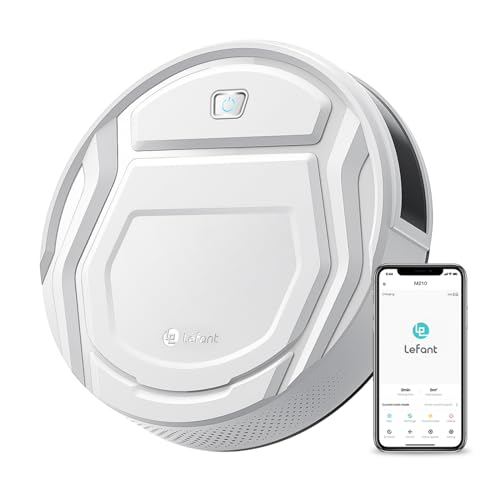
Lefant M210 Robot Vacuum — Best Budget for Hard Floors
The Lefant M210 has been the budget recommendation in this category for years because it gets the hard-floor basics right at the lowest commitment here: a slim body, low-noise running, brand-stated 120-minute runtime, self-charging, and app, Wi-Fi and Alexa control. Its verified title positions it for pet hair, hard floors and daily cleaning — which is exactly the job description of a budget bare-floor robot: daily maintenance, not deep restoration.
It suits smaller homes, first-time robot buyers, and anyone adding a second machine for a bedroom level. Navigation at this tier is simpler than the LiDAR machines above — expect thorough but less architectural coverage, and help it by keeping floors picked up. It is not the pick for large multi-room floors where mapping pays for itself, nor for buyers who want mopping or self-emptying; those features live further up this page, at their prices.
Strengths
- Lowest-commitment route to daily bare-floor maintenance
- Brand-stated 120-minute runtime covers small and medium homes
- Slim, low-noise running suits bedrooms and flats
Trade-offs
- Simpler navigation than the LiDAR picks: coverage is willing, not architectural
- No mopping, no self-empty base, manual bin emptying
- Budget brush and filter parts need their periodic checks to stay effective
Key specs (as stated in the verified listing title): Brand-stated 120-minute runtime; slim body; low-noise operation; automatic self-charging; Wi-Fi, app and Alexa control; positioned for pet hair and hard floors.
Budget robots live or die on expectations. The M210 will not produce the satisfying track-line photos of a mapping robot, and in a cluttered room it will spend some of its intelligence bouncing off chair legs. But on a picked-up hard floor, run daily, it keeps grit and hair at the level where bare floors look kept — and daily is the frequency that matters, because bare floors show a day’s debris in a way carpet never does. Treat it as a broom that works while you are out: clear the floor before it runs, empty the bin when you hang up your coat, and it returns remarkable value for the simplest machine here.
Best for: small homes, first-time robot owners and second-floor second robots / Not suited for: large multi-room homes needing mapped navigation
Check on Amazon — check the current price on Amazon before ordering.

ILIFE A30 Pro Robot Vacuum and Mop — Best High-Suction Self-Emptying Value
The A30 Pro stacks the specification sheet higher than anything else here: the brand states 10,000Pa suction, LiDAR navigation, a 150-minute runtime, and a self-empty system rated by the brand at 280 days using 5 dust bags. It also mops. On paper it is the most complete machine in this roundup, aimed at buyers who compare numbers first and want every modern feature in one purchase.
It suits larger bare-floor homes with pets, where runtime and self-empty capacity both get used, and where the mop function handles sealed-floor maintenance. Read the brand figures the way this guide always reads them: suction numbers are not measured on a shared standard across brands, and a 280-day bag figure assumes an average debris load that a three-dog household will cheerfully exceed. Neither caveat dents the package; they just set the expectations a specification-led buyer deserves to have set honestly.
Strengths
- Highest brand-stated suction and runtime figures in this roundup
- LiDAR navigation with vacuum-and-mop combination
- Self-empty station reduces bin chores to a few bag changes a year on brand figures
Trade-offs
- Bagged self-empty system means an ongoing, if infrequent, bag purchase
- Specification figures are the brand’s, not cross-brand measurements
- Feature-dense machines reward owners who read the manual once, properly
Key specs (as stated in the verified listing title): Brand-stated 10,000Pa suction; LiDAR navigation; brand-stated 150-minute runtime; self-emptying with 5 dust bags and a brand-stated 280-day capacity; vacuum and mop.
ILIFE built its name on tangle-free hard-floor machines, and the A30 Pro is that heritage wearing a flagship suit. The practical question is whether your home uses the headroom: 150 minutes matters in a big single-level house, less in a flat the Lefant could finish twice. The bags deserve a word too — bagged bases seal debris away hygienically, which allergy-conscious households prefer, at the cost of a consumable the bagless Shark avoids. Neither is wrong; they are different answers to the same chore. If your floors are large, bare and busy, this is the machine whose specification stops being marketing and starts being Tuesday.
Best for: large bare-floor homes wanting every feature in one machine / Not suited for: small flats, or buyers avoiding bagged consumables
Check on Amazon — check the current price on Amazon before ordering.
Comparison Table
| Pick | Badge | Key spec | Best for |
|---|---|---|---|
| Roborock Q7 L5 Robot Vacuum and Mop Combo | Best Overall | Brand-stated 8,000Pa suction; LiDAR navigation; multi-level mapping; dual anti-tangle system; self-charging; vacuum and mop combo. | mostly-bare-floor homes wanting mapped, methodical cleaning plus mopping |
| Shark AV2501S AI Ultra Robot Vacuum | Best Self-Emptying for Bare Floors | Matrix Clean navigation; home mapping; bagless self-empty base with brand-stated 30-day capacity; HEPA filtration at the base as stated in the title; Wi-Fi control. | pet homes on bare floors wanting weeks between chores |
| iRobot Roomba 105 Vac Robot Vacuum | Best Simple Mapped Cleaning | Brand-stated 7,000 Pa power-lifting suction; LiDAR navigation; multi-surface cleaning; cleans in neat rows; charging base included. | apartments and hard-floor homes wanting simple, mapped, vacuum-only cleaning |
| eufy C10 Robot Vacuum Self Emptying | Best Slim Self-Emptying | 2.85-inch slim body; LiDAR navigation; self-emptying with brand-stated 8-week hands-free framing; edge expansion brush; carpet detection. | furnished bare-floor rooms with low furniture clearance |
| Lefant M210 Robot Vacuum | Best Budget for Hard Floors | Brand-stated 120-minute runtime; slim body; low-noise operation; automatic self-charging; Wi-Fi, app and Alexa control; positioned for pet hair and hard floors. | small homes, first-time robot owners and second-floor second robots |
| ILIFE A30 Pro Robot Vacuum and Mop | Best High-Suction Self-Emptying Value | Brand-stated 10,000Pa suction; LiDAR navigation; brand-stated 150-minute runtime; self-emptying with 5 dust bags and a brand-stated 280-day capacity; vacuum and mop. | large bare-floor homes wanting every feature in one machine |
How to Choose a Robot Vacuum for Bare Floors
Navigation first. On bare floors, coverage patterns are visible results. LiDAR machines (Roborock, Shark, eufy, ILIFE A30 Pro, Roomba 105) clean in planned rows, remember maps and let you set no-go zones and room schedules. Simpler navigation (the Lefant pattern) costs less and cleans willingly but less architecturally. In a studio or small flat the difference is minor; across a multi-room floor it is the difference between a system and a gadget.
Then the debris path. Ask where the dirt goes and how often you touch it. Manual bins (Roborock Q7 L5, Roomba, Lefant) are simple and free to run but need emptying every few days in pet homes. Self-empty bases stretch that to weeks or months; bagless bases (Shark) avoid consumables, bagged bases (ILIFE) seal debris away at the cost of occasional bags. There is no free lunch — only a choice of which chore you prefer.
Then fit. Measure under your lowest furniture. A slim robot that reaches the under-sofa reservoir cleans the dirtiest part of a bare-floor room; one that cannot is polishing the clean part. Check your thresholds and rug edges too: bare-floor homes are usually mixed homes at the borders, and carpet detection or competent climbing at rug edges decides whether the robot works the whole floor or a fenced subset of it.
Suction numbers last. Pascal figures are brand figures without a shared test standard. A well-sealed 5,000Pa machine with the right brush will out-clean a leaky headline number on hard floors, where the brush and the pickup geometry do most of the work anyway. Buy the navigation, the fit and the debris path; let suction break ties, not make decisions.
Bare Floors Are a System: Mats, Grit and the Weekly Ten Minutes
A robot vacuum maintains; it does not defend. The defence of a bare floor happens at the door: most of the grit that scratches hardwood and dulls tile arrives on shoes, and a good entrance mat — shaken outside weekly — removes more of it than any robot feature. This is the unglamorous truth of hard-floor care: the robot’s daily pass handles what gets past the mat, and your ten weekly minutes with a real mop handle the film that no robot mop fully lifts.
Grit deserves its reputation. A single tracked-in stone under a robot’s wheel or a shoe grinds the same scratch either way, which is why daily robot passes genuinely protect bare floors rather than merely tidying them: they remove the abrasive load before feet distribute it. That is the strongest argument for running a robot on bare floors more often than feels necessary — on carpet, daily is luxury; on hardwood, daily is maintenance of the finish itself.
Mopping Robots and Bare Floors: Calibrated Expectations
Every mop function in this roundup is a maintenance mop: a damp pad that lifts the grey film of foot traffic, paw prints and kitchen drift from sealed hard floors. Used after the vacuum pass, on a floor that gets a real mop weekly, it keeps sealed tile, laminate, vinyl and finished hardwood looking freshly done for days longer. Used as your only mop, it slowly redistributes the film it was meant to remove, and the floor tells on it within a fortnight.
Two disciplines make robot mopping work. Wash or swap pads constantly — a dirty pad is a grey paintbrush — and respect your floor’s finish: unsealed or waxed wood and water are enemies regardless of which robot carries the water, so check your flooring maker’s guidance before enabling any mop mode. With those two rules kept, the combo machines here earn their second function; without them, the vacuum-only Roomba and Lefant are the wiser buys.
Bare-Floor Types, Matched to Robot Behaviour
Hardwood. The robot’s job is grit removal and hair pickup without drama. Every pick here is built for it. Keep wheels and brushes clean — a grit-loaded wheel is the only scratch risk the robot itself poses — and use mop modes only as your floor’s finish allows.
Tile and stone. Grout lines are where robot design shows: brushes that sweep across lines, enough weight and seal to pull debris out of them, and mop functions that genuinely help, because tile shows film fastest. The combo machines (Roborock, ILIFE A30 Pro) earn their premium here.
Laminate and vinyl plank. Kind to robots and vice versa: smooth, sealed, forgiving. The budget Lefant is entirely at home, and mop modes suit the sealed surface with modest water. Watch thresholds between plank and tile, which are the classic robot pause points.
Polished concrete and sealed stone in modern homes. Large, open, unforgiving of missed areas — mapping territory. LiDAR picks with room labelling turn these floors into scheduled zones, and self-empty capacity matters because open plans accumulate debris from every direction at once.
The borders: rugs and mats. Bare-floor homes are archipelagos. Rugs at doors, runners in halls, mats in kitchens. Carpet detection (eufy C10) and competent rug-edge climbing decide whether your robot cleans the whole territory or patrols only the islands. When you map, check the borders in the app after the first run; robots reveal your floor’s true geography faster than you expect.
What Robot Vacuum Ownership Actually Looks Like After Month Three
Month one is delight: tracks in the dust, an app full of maps, floors that feel cleaner underfoot than they have in years. Month three is the truth, and the truth is a rhythm. The owners who still love their robots at month three share three habits. They run the machine on a schedule tied to the house’s debris rhythm rather than on inspiration. They keep a fixed five-minute maintenance moment — bin, brush check, sensor wipe — attached to an existing routine. And they keep the floor in a robot-ready state as a default, not as a pre-run panic: cables managed once, permanently, and a home for the toys and shoes that used to migrate.
The owners who quietly stop using theirs also share a pattern, and it is never the robot’s fault in the way they tell it. The base got moved somewhere unreachable during a furniture shuffle. A damp mop pad was left on once and the smell made the machine unwelcome. The bin filled, the robot complained in a notification nobody read, and three weeks of ‘it seems less good lately’ ended in a cupboard. Every failure mode is a skipped small chore, which is why this guide keeps returning to rhythm over specification: on bare floors, the best robot vacuum is the one whose maintenance fits your week, because a mid-tier machine run daily will out-clean a flagship run monthly, every single month of the year.
Noise, Pets and Neighbours: The Social Side of Robot Cleaning
A robot vacuum is a household member with a sound, and bare floors amplify it: wheels and brushes on hardwood carry through a flat in a way carpeted homes never learn. This shapes scheduling more than specification. Self-empty bases add a brief, startling roar when the robot docks — seconds, not minutes, but seconds that will wake a baby and alarm a dog if they land at the wrong hour. Map your runs to the house’s waking geography: kitchens and halls during the morning rush, bedrooms while their occupants are out of them, the whole floor during the weekly shop.
Pets divide into supervisors, who follow the robot from room to room providing the entertainment the category is famous for, and philosophers, who leave. Both kinds contribute the hair that fills bins ahead of schedule, which is why pet homes should read every capacity figure in this guide — bin days, base days, bag days — as an optimistic draft. Keep the robot’s brushes on a shorter check cycle in a shedding household, because hair wraps axles silently and the first symptom is a clean-looking floor the robot has actually started to miss. Managed this way, a robot in a pet home is not a luxury; it is the difference between hair as a daily condition and hair as a weekly event.
How to Set Up a Robot Vacuum for Bare Floors
Step 1: Place the base on a hard, flat stretch of wall with clear floor in front and to the sides, on the floor the robot will clean most. Bases on carpet or wedged behind furniture cause the docking failures owners blame on the robot.
Step 2: Walk the floor like a robot. Lift cables, tassels, cat toys and lightweight mats; tie up curtain hems that pool on the floor. Bare floors show clutter to a robot as terrain, and five minutes of lifting buys a month of unassisted runs.
Step 3: Run the mapping pass in daylight with doors in their normal positions, then label rooms in the app and set no-go zones for pet bowls, litter areas and cable nests. On multi-level homes, map each level the robot will be carried to.
Step 4: Schedule for the debris rhythm of your house — kitchens after dinner, halls after the morning shoe rush, bedrooms whenever. Daily short runs beat a heroic weekly run on bare floors, because grit removal is finish protection.
Step 5: Keep the maintenance rhythm tiny and fixed. Empty bins or check the base on a set day, wipe sensors and the edge brush path monthly, and rinse mop pads after every use. Robot vacuums rarely die; they fade, one skipped chore at a time, and the fade is always reversible with twenty minutes and the manual.
Robot Vacuums and Rugs: Managing the Mixed-Floor Home
Pure bare-floor homes are rarer than this search implies; most are archipelagos of rugs, runners and mats on a hard-floor sea, and the robot’s border crossings decide whether it serves the whole territory. Three border skills matter. Climbing: the threshold and rug-edge transitions — a robot that balks at a rug’s edge fences itself out of half the home, while one that mounts confidently may also mount things it should not, which is what no-go zones are for. Brush behaviour on pile: the same brush that sweeps grout lines will work a rug, with more resistance and more hair wrap; the anti-tangle designs in this roundup exist for exactly this border. Mop discipline at the border: combo machines must keep damp pads off rugs they cannot lift over — carpet detection, as listed on the eufy C10, is the feature that automates the courtesy.
Walk your borders once with the robot’s eyes: the entrance mat’s curled corner, the runner that slides on polished boards, the bath mat that becomes a barricade. Fix what can be fixed — mat grippers, a centimetre of clearance, a no-go line in the app — and the mixed home becomes the robot’s natural habitat rather than its obstacle course. The bare floor remains the main stage; the borders are simply where the performance is won or lost.
How Long Should a Robot Vacuum Last, and What Kills It Early
A robot vacuum’s honest lifespan is measured in years of daily service, and its early deaths are almost never electronic. The killers are mundane: hair wound tight around brush axles until motors strain against their own neglect; filters run clogged for a year because nobody told the owner they were consumables with a rhythm; batteries kept at the extremes — a robot stored dead in a garage, or one whose base was unplugged for a season and never forgiven. Mop combos add their own executioner: the damp pad left sitting after a run, souring against the machine it served.
Against that list, longevity is a liturgy of small acts, most of them already in this guide: the weekly brush check, the filter rhythm, the pad washed the day it works, the base kept plugged in and reachable, the sensors wiped when the robot starts bumping like a tired shopper. Parts availability is the other half of the equation, and it quietly favours the established names in this roundup — brushes, filters and batteries for a Roborock, a Shark, a Roomba or a eufy remain catalogue items for years, while orphan brands’ machines die of a worn brush nobody sells. Buy the machine whose wear parts you can still order in year four, keep the small liturgy, and a robot vacuum stops being a gadget with a honeymoon and becomes what it was sold as: an appliance.
Common Buying Mistakes
- Buying by suction headline. Pascal figures lack a shared standard across brands. Navigation, brush design and fit decide bare-floor results.
- Skipping the furniture measurement. A robot that cannot go under the sofa leaves the dirtiest strip of the room untouched forever.
- Expecting the robot mop to replace mopping. It maintains sealed floors between real mops. It does not deep-clean, and pads must be washed or it paints with grey water.
- Leaving the floor unpicked-up. Cables and tassels defeat robots at every price. The five-minute tidy is part of the product.
- Running it rarely and heroically. Bare floors reward daily maintenance; grit left for a week is a week of abrasion underfoot.
- Hiding the base. Self-empty and charging bases need clear approach space. A base the robot cannot reach is a very expensive ornament.
Final Recommendation
Start with the Roborock Q7 L5 if you want one machine that maps, vacuums and maintenance-mops a mostly bare home with the least compromise. Choose the Shark AV2501S for bagless self-emptying or the ILIFE A30 Pro for the fullest specification with bagged capacity; choose the eufy C10 when your furniture sits low and your dust lives underneath it. The Roomba 105 Vac is the purist’s mapped vacuum, and the Lefant M210 proves daily hard-floor care does not require a flagship budget.
Related guides in this series: Best Robot Vacuums For Dog Hair, Best Robot Vacuums For Dust, Best Robot Vacuums For Tile Floors, Best Robot Vacuums For Wood Floors, Best Robot Vacuums Mops and Best Lightweight Vacuum For Hardwood Floors And Area Rugs.
Related guides
Frequently Asked Questions
Are robot vacuums safe for hardwood floors?
The machines here are designed for hard floors, with brushes and wheels made for household surfaces. The real risk to hardwood is grit: tracked-in stones scratch under any wheel or shoe. Daily robot passes reduce that abrasive load, which is why regular running protects a finish rather than threatening it. Check your flooring maker’s guidance for mop modes on unsealed or waxed wood.
Do I need LiDAR navigation for bare floors?
For a single room or small flat, simpler navigation cleans adequately. Across multiple rooms, LiDAR’s rows, maps, room schedules and no-go zones are visibly better — bare floors show missed wedges that carpet would hide. Most buyers with a whole floor to cover should treat mapping as the feature worth paying for.
How often should a robot vacuum run on bare floors?
Daily is the honest answer for busy households, and every other day for quiet ones. Bare floors display a day’s debris and accumulate grit continuously; short frequent runs keep both the appearance and the finish protected with less bin load per run.
Is a self-empty base worth it?
If you have pets or a large floor, yes: it converts a chore measured in days into one measured in weeks or months. Bagless bases avoid consumables; bagged bases seal debris hygienically for an occasional bag cost. In a small flat with a manual-bin robot, the base is mostly buying back floor space you may not have.
Can a robot vacuum replace mopping on tile and hardwood?
No. Robot mops maintain sealed floors between real mops by lifting surface film. The weekly human mop — with a shaken entrance mat as its partner — remains part of bare-floor care. Combo machines stretch the interval and keep the floor presentable in between.
Why does my robot leave crumbs along the walls?
Edge cleaning is a design feature, not a default. Machines with edge-focused brushes or grid patterns handle the skirting line better; all robots do better when the approach to walls is not blocked by shoes and clutter. A weekly pass with a crevice tool along skirting remains the finishing touch no robot fully replaces.


