Disclosure: airfryerkitchensupply.com is reader-supported. When you buy through links on our site, we may earn an affiliate commission at no extra cost to you.
Where to buy
All six vacuums below were verified against Amazon catalog data on 2026-11-22 by brand and model on this site. Specifications quoted here come from those verified listings. Prices are not printed because they change — check the current price on Amazon through the links.
- Dyson V15 Detect Cordless Vacuum — Best Overall for Hard Floors. Check the current price on Amazon.
- Dyson V12 Detect Slim Absolute — Best Lightweight. Check the current price on Amazon.
- Dyson Omni-Glide Cordless Vacuum — Best for Small Apartments. Check the current price on Amazon.
- Dyson Gen5detect Cordless Vacuum — Best Premium Power. Check the current price on Amazon.
- Dyson V8 Cordless Vacuum — Best Value Dyson. Check the current price on Amazon.
- Dyson V11 Origin Cordless Vacuum — Best Mid-Range All-Rounder. Check the current price on Amazon.
The best Dyson hard floor vacuums share a design philosophy that suits hard floors better than most rivals: soft-roller and laser-equipped cleaner heads that pick up fine dust and large debris in one pass without scattering it, whole-machine filtration that keeps the dust you collected out of the air, and cordless bodies light enough that a quick daily sweep is easier than fetching a broom. But “Dyson” is a range, not a product, and the six models below differ enormously in weight, runtime, head design and price tier. Buying the flagship when your home is a 700-square-foot apartment with laminate floors wastes money; buying the lightest model for a 3,000-square-foot house of tile and oak guarantees frustration. This guide matches each model to the floors and households it genuinely serves.
Why hard floors change the vacuum brief: on carpet, a brush bar agitates fibres and suction does the rest. On hard floors there is nothing to agitate — the challenge is capturing fine dust that static clings to the surface, grit that a stiff brush simply flicks ahead of the machine, and debris sitting in grout lines and board gaps. Dyson’s answer, across the Detect line, is a soft woven nylon roller that envelops debris instead of scattering it, paired on the Detect models with a precisely angled laser that makes invisible dust visible on the surface so you can see what you have cleaned. That laser sounds like a gimmick until you watch a “clean” kitchen floor light up; it changes behaviour, which is the point.
Every model here is a genuine Dyson verified by model name through the API — no lookalikes, no “compatible-with” accessories dressed as picks. Where a model’s verified listing states runtime, suction or filtration figures, the review quotes them; where the listing is brief, the review sticks to what the model line is documented to do and says nothing more specific. Prices and star ratings are never printed in this guide: both change constantly, and a vacuum chosen on a stale number is a vacuum chosen badly. Check the current price on Amazon for the exact configuration, because Dyson sells several head and accessory bundles under near-identical names.
In this guide
Quick Picks
- Best Overall for Hard Floors: Dyson V15 Detect — laser dust detection, particle counting, and the strongest all-round hard-floor performance in the range.
- Best Lightweight: Dyson V12 Detect Slim Absolute — the Detect experience in a smaller, lighter body with a power button instead of a trigger.
- Best for Small Apartments: Dyson Omni-Glide — an omnidirectional soft-roller head that floats around furniture legs in tight spaces.
- Best Premium Power: Dyson Gen5detect — the most powerful motor in the line, whole-machine HEPA filtration, and the longest runtime.
- Best Value Dyson: Dyson V8 — the entry point to genuine Dyson hard-floor cleaning for smaller homes.
- Best Mid-Range All-Rounder: Dyson V11 Origin — strong suction and long runtime for mixed hard floors with some carpet.
How These Picks Were Chosen
Candidates were verified by brand and model against Amazon listing data on 2026-11-22; only listings whose returned titles confirmed the exact Dyson model were eligible for a linked pick. We then filtered the large Dyson catalogue on hard-floor merit specifically. First, cleaner head: models had to offer, in the box or in the model’s standard configuration, a head suited to hard floors — a soft roller, a laser Slim Fluffy head, or a combination head that does not scatter debris. Second, filtration: whole-machine sealed filtration matters more on hard floors because you are collecting fine dust rather than embedding it in carpet pile. Third, practical runtime in the low-power modes used for hard floors, which is always longer than the headline boost-mode figure. Fourth, weight and handling, because hard-floor homes clean little and often, and a vacuum that feels like a workout gets left in the cupboard.
We excluded Dyson’s corded uprights and its robot and wet-cleaner lines from the linked picks: the keyword is about the cordless stick vacuums people actually buy for hard floors, and mixing categories would muddy the comparison. One honest note on model naming: Dyson refreshes bundles frequently, and the same core machine appears under suffixes like Origin, Absolute and Total Clean with different accessory sets. The reviews identify the core machine and the head that matters; when you check the current listing, confirm the soft-roller or laser head is in the box, because that head — not the badge — is what your floors will meet. We also weighted the second year of ownership as heavily as the first week: bin mechanisms that stay hygienic, filters that survive monthly washing, rollers that rinse clean in a sink. A vacuum is a five-year appliance bought in a five-minute decision, and the picks below were chosen to still feel right when the novelty has worn off and only the routine remains.
The 6 Best Dyson Hard Floor Vacuums

Dyson V15 Detect Cordless Vacuum — Best Overall for Hard Floors
The V15 Detect is the model that defines what a hard-floor vacuum can be. Its laser Slim Fluffy head throws a blade of green light across the floor at a low angle, revealing the dust film you cannot see under normal lighting, while the soft roller picks up everything from flour-fine dust to cereal pieces without flicking them across the room. The machine counts and sizes the particles it collects and displays the tally, which sounds like theatre until you realise it has taught you where your home actually gets dirty — the hallway grit zone, the flour corner by the baking cupboard — and let you clean those areas in a fraction of the passes. For homes that are mostly hard floor, this is the benchmark.
Strengths
- Laser head reveals invisible dust, so “done” is something you can see rather than guess.
- Soft roller captures fine dust and large debris in a single pass, forward and backward.
- Strong suction and up to an hour of fade-free runtime in its standard modes, per the model’s verified listings.
Trade-offs
- Premium tier pricing; the technology is wasted if your floors are mostly carpet.
- The trigger must be held while cleaning, which some users find tiring on long sessions.
- Particle-count display is informative but not essential — you are paying for it either way.
Key specs (verified listings): V15 Detect cordless stick; laser Slim Fluffy hard-floor head in the Detect configuration; whole-machine filtration; converts to handheld.
The V15’s real advantage compounds over months. Because the laser shows you the dust, you clean more completely in fewer passes, and because the machine is cordless and balanced, the psychological cost of a five-minute kitchen sweep drops to nearly zero — so floors get cleaned at the frequency hard floors actually need, which is little and often rather than a weekly deep expedition. Pair it with the wall dock near the kitchen if your layout allows; a V15 stored in a distant cupboard is a V15 used half as much. For households with shedding pets on hard floors, the hair-screw tool in most bundles handles the sofa-and-stairs work, and the main head’s anti-static carbon filaments address the dust-cling problem that plagues dry, heated homes in winter. It is also the model to choose if your hard floors include large-format tile with deep grout: the suction headroom that is surplus on laminate becomes useful when the roller bridges a grout line and only airflow is left to do the work.
Best for: mostly-hard-floor homes that want the best cordless cleaning experience Dyson makes. / Not suited for: carpet-dominant homes or buyers who resent premium tiers.
Check the current price on Amazon

Dyson V12 Detect Slim Absolute — Best Lightweight
The V12 Detect Slim takes the V15’s signature trick — the laser Slim Fluffy head — and shrinks everything around it. The body is smaller, the bin is smaller, the weight drops noticeably, and the trigger is replaced by a single power button, a change that sounds minor and feels enormous during a whole-home clean. For hard floors specifically, the V12 may be the sweet spot of the entire Dyson range: hard-floor cleaning rarely needs maximum suction, it needs a light machine with the right head used frequently, and the V12 is the one you will reach for without thinking.
Strengths
- Lightest Detect model — easy on wrists, shoulders and stairs.
- Power button instead of a hold-down trigger suits longer, relaxed cleaning sessions.
- Laser Slim Fluffy head delivers the same dust-revealing clean as the flagship.
Trade-offs
- Smaller bin needs emptying more often in larger or pet-heavy homes.
- Less raw suction than the V15 and Gen5detect for deep carpet work.
- Compact size means fewer included tools in some bundles — check the box contents.
Key specs (verified listing): V12 Detect Slim Absolute cordless; laser hard-floor head; LCD particle display; converts to handheld.
Choose the V12 if the person doing most of the cleaning values lightness over bin capacity — in practice that describes a large share of households, including anyone cleaning with a wrist, shoulder or back complaint, and anyone whose home is one or two storeys of hard floor rather than a sprawling single level. Its runtime, quoted in the model’s listings at up to an hour in Eco mode, is more than sufficient for apartment and mid-size-home circuits, especially since hard-floor cleaning in Eco and Auto modes is where these machines sip rather than gulp power. The Absolute bundle typically adds the fuller tool set; confirm the soft-roller head is included before ordering, because that head is the entire point for hard floors.
Best for: apartments, mid-size homes, and anyone who wants Detect performance without flagship weight. / Not suited for: very large homes or heavy pet debris volumes.
Check the current price on Amazon

Dyson Omni-Glide Cordless Vacuum — Best for Small Apartments
The Omni-Glide is the specialist: a hard-floor-only machine whose omnidirectional Fluffy head carries soft rollers at both ends and casters that let it glide sideways, backwards and flat under furniture with a flick of the wrist. In a studio or small apartment, where the vacuum must weave between chair legs, under the sofa and around the bed in a space a conventional stick treats like an obstacle course, it is not a compromise — it is the fastest tool for the job. It also lies completely flat, sliding under low furniture that stops every other model on this list.
Strengths
- Omnidirectional head manoeuvres in any direction and lies flat under low furniture.
- Dual soft rollers pick up in both push and pull strokes.
- Very light and compact to store — designed for small living spaces.
Trade-offs
- Hard floors only: no carpet capability worth the name.
- Shorter runtime than the Detect models — sized for small homes, not big ones.
- Small bin, frequently emptied; not a whole-house deep-clean machine.
Key specs (verified listing): Omni-Glide cordless; omnidirectional Fluffy cleaner head; lightweight stick format, Gold/Iron finish in the verified listing.
Judge the Omni-Glide by its brief rather than by the flagship’s spec sheet. It was engineered for the daily reality of small hard-floor homes: crumbs under the table, bathroom hair, hallway grit, all handled in two-minute bursts. Its five-component filtration keeps fine dust captured, and the in-line design makes it feel more like a powered broom than a vacuum — which is a compliment, because brooms are what it replaces, at several times the effectiveness. If your home later grows carpet or a second floor, the Omni-Glide remains a superb second machine; but as an only vacuum for a mixed-floor house, its specialism becomes a limitation, and the V12 or V15 is the safer single purchase.
Best for: studios, small apartments, and hard-floor-only homes where manoeuvrability is everything. / Not suited for: carpets, large homes, or as a household’s only vacuum if floors are mixed.
Check the current price on Amazon

Dyson Gen5detect Cordless Vacuum — Best Premium Power
The Gen5detect is Dyson’s flagship statement: its most powerful cordless motor — the model’s verified listings cite 280AW of suction and up to 70 minutes of runtime — whole-machine HEPA filtration, and the laser dust-detection system refined from the V15. On hard floors that power is mostly headroom, but headroom has uses: grout lines, deep board gaps, heavy grit tracked into entryways, and the occasional carpeted room all benefit, and the HEPA-sealed system is the range’s best answer for households managing dust sensitivity, capturing fine particles and keeping them captured when you empty the bin.
Strengths
- Strongest suction in the Dyson cordless range, per the model’s verified listings.
- Whole-machine HEPA filtration — the best choice here for dust-sensitive households.
- Longest runtime in the line, suiting large single-level hard-floor homes.
Trade-offs
- The heaviest and most expensive route to a clean kitchen floor.
- Power is surplus to requirements on smooth hard floors in lower modes.
- Size and weight make quick two-minute sweeps feel like more of an event than with the V12.
Key specs (verified listing): Gen5detect cordless; 280AW; up to 70 minutes runtime; HEPA filtration; illumination dust detection; all-floor capability.
Buy the Gen5detect when your home justifies it: large floor areas, a mix of hard floors with some demanding carpet, a dust-sensitive family member, or simply a buy-once-for-a-decade philosophy. Its virus-grade filtration claims aside — this guide makes no health claims, and neither should your vacuum purchase — the sealed HEPA system demonstrably exhausts cleaner air than the non-HEPA models, which matters in homes where the vacuum runs daily. Everyone else should read its spec sheet as a description of what they are not missing: the V15 delivers the same laser-guided hard-floor experience at a lower tier, and on smooth oak or tile the Gen5’s extra power sits unused in the motor.
Best for: large homes, mixed floors with demanding areas, and dust-sensitive households. / Not suited for: small apartments or buyers paying for power their floors will never request.
Check the current price on Amazon

Dyson V8 Cordless Vacuum — Best Value Dyson
The V8 is the elder statesman of the range and the most affordable genuine route into Dyson hard-floor cleaning. Its verified listings cite up to 40 minutes of runtime and a direct-drive cleaner head heritage, and in its current bundles it is commonly paired with a soft-roller head for hard floors — confirm that head is in the box, because on hard floors it transforms the machine. What you give up versus the Detect line is the laser, the particle counting and some suction; what you keep is the cyclone separation, the sealed filtration approach, the handheld conversion, and a machine that has been proving itself in real homes for years.
Strengths
- Lowest tier entry to genuine Dyson cordless cleaning.
- Light, simple and proven; ideal for smaller hard-floor homes and flats.
- Converts to a handheld for stairs, cars and upholstery.
Trade-offs
- No laser dust detection; you clean by eye and by feel.
- Shorter runtime and less suction than the Detect and Gen5 models.
- Older bin and filter design needs slightly more hands-on maintenance.
Key specs (verified listing): V8 cordless; up to 40 minutes runtime; 115AW in the model’s Plus listings; detangling head technology in current bundles; handheld conversion.
The V8 suits the buyer who has decided on Dyson for the filtration and the format, whose home is modest in size, and who would rather keep the price tier sane than watch dust light up green. It is also the sensible second vacuum for a large home — one at each end of the house beats one flagship forever charging in the wrong room. Keep expectations calibrated: the V8 predates the laser era, its boost mode is brief, and homes with heavy pet hair on carpet will outgrow it. On hard floors in a flat or small house, though, it delivers the essential Dyson experience — grab, glide, done — at the friendliest tier in this guide, and its long production run means accessories and replacement parts are easy to find, a practical virtue that newer flagships cannot yet match.
Best for: flats, small homes, second-vacuum duty, and value-first Dyson buyers. / Not suited for: large homes or buyers who want dust-detection technology.
Check the current price on Amazon
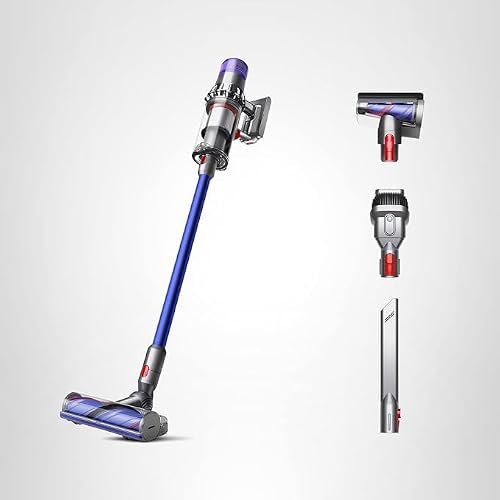
Dyson V11 Origin Cordless Vacuum — Best Mid-Range All-Rounder
The V11 Origin sits between the V8 and the Detect line: its verified listing cites 185AW of suction and up to 60 minutes of runtime across three power modes, with deep-cleaning ability on both hard floors and carpets. It lacks the laser head that defines the V15 and V12, so on hard floors you are cleaning blind in the traditional way — but with strong, consistent suction, a torque-drive head heritage for mixed floors, and a runtime that covers real houses. For households whose floors are genuinely mixed — tile kitchen, oak living areas, carpeted bedrooms — the V11’s balance may serve better than a hard-floor specialist.
Strengths
- Strong suction and long runtime at a mid-range tier.
- Genuinely capable on both hard floors and carpets — a true all-rounder.
- Three power modes let you trade suction for runtime intelligently.
Trade-offs
- No laser dust revelation; hard-floor results rely on technique.
- Heavier in hand than the V12 over long sessions.
- Origin bundles vary in included heads — verify the hard-floor-friendly head before buying.
Key specs (verified listing): V11 Origin cordless; 185AW; 3 power modes; up to 60 minutes runtime; hard floor and carpet capability; detangles hair in current configurations.
Think of the V11 as the range’s pragmatist — the machine for buyers who read spec sheets comparatively rather than aspirationally, and who would rather have strong performance everywhere than a headline feature that shines in one room. There is no shame in that trade; for many homes it is simply the correct one. If your home is half carpet, the laser heads of the Detect line are a luxury you will use in two rooms and ignore in the rest, whereas the V11’s balanced head and suction serve everywhere without swapping your technique. Its LCD-free simplicity in Origin trim also appeals to buyers who find particle dashboards distracting. The buying discipline for the V11 is bundle-checking: Dyson has sold it in many configurations over the years, so read the current listing’s box contents, confirm the cleaner head type, and then buy with confidence — the core machine’s reputation is well earned.
Best for: mixed-floor homes wanting one strong cordless for everything. / Not suited for: hard-floor purists who want laser detection, or the lightest possible machine.
Check the current price on Amazon
Comparison Table
| Pick | Badge | Key spec | Best for |
|---|---|---|---|
| Dyson V15 Detect | Best Overall | Laser Slim Fluffy head, particle counting | Mostly hard-floor homes |
| Dyson V12 Detect Slim Absolute | Best Lightweight | Laser head, button power, compact body | Apartments, wrist-friendly cleaning |
| Dyson Omni-Glide | Best for Small Apartments | Omnidirectional dual soft rollers, lies flat | Studios, hard floors only |
| Dyson Gen5detect | Best Premium Power | 280AW, up to 70 min, HEPA filtration | Large and dust-sensitive homes |
| Dyson V8 | Best Value | Up to 40 min runtime, handheld conversion | Flats, small homes, second vacuum |
| Dyson V11 Origin | Best Mid-Range | 185AW, up to 60 min, 3 power modes | Mixed hard floor and carpet |
How to Choose a Dyson for Hard Floors
The head matters more than the motor. On hard floors, suction figures impress in advertisements and disappoint in kitchens, because the limiting factor is capture at the surface: a soft roller that envelops debris beats a powerful machine whose stiff brush bar flicks grit ahead of itself. That is why this guide is organised around heads — laser Slim Fluffy on the V15 and V12, omnidirectional Fluffy on the Omni-Glide, soft-roller bundles on the V8 — and why the single most important step in buying any Dyson for hard floors is confirming the box contains a soft-roller or laser head. A Detect machine bought with only a torque head is a carpet vacuum visiting your kitchen.
Runtime: read the right number
Manufacturers quote runtime in Eco mode with a non-motorised tool; your real figure sits between that and the boost-mode number, and on hard floors it leans favourable, because soft-roller heads draw less power than carpet torque heads and hard-floor cleaning rarely needs boost. Map your home honestly: a flat needs fifteen working minutes, a family house perhaps thirty-five. Every model here covers its intended home with margin — the Omni-Glide’s shorter runtime is a deliberate trade for size, not a flaw — so buy runtime for the home you have, not the mansion you might retire to.
Weight, trigger and the five-minute clean
Hard floors reward frequency over intensity. The vacuum that wins is the one used for two minutes after dinner, and usability details decide that contest: the V12’s push-button power versus the hold-down triggers elsewhere, the Omni-Glide’s featherweight glide, the Gen5detect’s flagship heft. If the primary cleaner has any wrist or shoulder sensitivity, weight should outrank every other specification in this guide. A slightly less powerful machine used daily leaves floors cleaner than a flagship used reluctantly once a week.
Filtration and emptying, the unglamorous deciders
Fine dust is the hard-floor enemy, and it is also the thing cheap filtration returns to the room through the exhaust. Dyson’s sealed systems are a genuine differentiator here, with the Gen5detect’s whole-machine HEPA at the top of the range. Emptying matters too: point-and-shoot bin emptying over a bin, done outside or into a bag if dust bothers you, keeps the ritual clean. Wash the filter on the schedule the manual sets — a clogged filter is the number-one cause of “my Dyson lost suction” complaints, and it is user-inflicted nearly every time.
Docking and storage: the decision nobody lists
Every model here charges on a wall dock or a cable, and where that dock lives quietly determines how much you will use the machine. The ideal spot is a wall near the kitchen or main entry with a socket, room for the wand to hang, and the two or three tools you actually use mounted rather than boxed. Apartments without a drillable wall can use the cable and a cupboard, but expect usage to drop — friction is real, and the Omni-Glide’s compact footprint is partly a storage argument for exactly those homes. Measure the dock location before buying a flagship: the Gen5detect is a long machine, and a dock planned for a V8-sized stick will not flatter it. Treat storage as part of the specification and the vacuum you buy will be the vacuum you use.
Budget tiers across the range
The range stratifies cleanly. The V8 anchors the value tier and is the right ceiling for small homes. The V11 and V12 occupy the middle, trading blows — the V11 with all-round power, the V12 with laser guidance and lightness. The V15 is the premium hard-floor specialist, and the Gen5detect sits above it as the flagship for large, mixed, dust-sensitive homes. The Omni-Glide prices as a specialist appliance rather than a rung on the ladder. Money spent climbing tiers buys detection, power, runtime and filtration — all real, none magic — so climb only as far as your floors demand.
How to Get the Best Hard-Floor Results From a Dyson
Technique multiplies hardware. First, slow down: soft rollers capture best at a walking pace slower than feels natural, and the laser heads reward patience by showing you the dust line to chase. Second, work the room in overlapping lanes and finish with a pass along skirting boards, where grit migrates. Third, use Eco or Auto mode for maintenance cleans and reserve boost for entryway grit and grout-line detailing with a crevice tool — boost drains batteries and adds little on smooth surfaces. Fourth, empty the bin before it passes the max line, because an overfilled bin strangles airflow and smears fine dust back onto the floor. Fifth, maintain the soft roller: it lifts out for rinsing, and a clean roller picks up dramatically better than a dust-caked one. Finally, schedule the filter wash monthly if you clean daily; set a phone reminder, because nobody remembers filter anniversaries. Follow those six habits and even the value-tier V8 will leave hard floors visibly, laser-test clean.
Hard Floors by Type: What Each Surface Asks of Your Dyson
Tile and stone with grout. The surface cleans easily; the grout lines are the work. Grit settles into the recessed joints where a flat roller bridges over it, so grout-heavy floors reward suction headroom and a weekly crevice-tool pass along the lines. This is the one hard-floor scenario where the Gen5detect’s extra power earns its keep in ordinary homes, and where the laser heads prove their worth by exposing the grey film that camouflages itself against pale grout.
Solid and engineered oak. Wood floors punish two things: grit dragged under hard wheels or stiff brushes, and moisture left sitting. The soft-roller heads on the Detect and Omni-Glide models are the correct interface — they glide on soft material and lift grit rather than skating it across the finish. Keep rollers rinsed and check the head’s underside for trapped stones after entryway cleans. In open-plan homes where oak runs through every room, runtime becomes the deciding spec, which pushes the choice toward the V15 or Gen5detect.
Laminate and luxury vinyl. These are the forgiving floors: smooth, resilient, and cleaned well by every model in this guide, including the V8. Static is their one quirk — fine dust clings in dry weather — and the anti-static carbon filaments in Dyson’s soft rollers address exactly that. Budget confidently here; a mid-tier machine on laminate performs indistinguishably from a flagship, and the savings are better spent on the soft-roller head if your bundle somehow lacks one.
Polished concrete and high-gloss finishes. Gloss shows everything: dust, footprints, and any micro-marring from dirty equipment. The laser heads are almost unfairly good here because the dust they reveal is the dust your guests see under raking window light. Rinse the roller more often than the manual suggests; a clean soft roller is a polishing-safe tool, a gritty one is sandpaper with a motor.
Ownership Over Five Years: Batteries, Filters and Honest Costs
A cordless vacuum is a small appliance with a battery at its heart, so think about ownership in years rather than unboxing day. Dyson’s click-in batteries on the newer models in this guide are replaceable, which converts the most common end-of-life event — a tired battery — into a part swap rather than a new machine; several owners of large homes buy a second battery and rotate, doubling working runtime. Filters are washable and long-lived when washed on schedule and dried fully before refitting — a damp filter refitted in haste is a musty smell you will chase for weeks. Soft rollers wear slowly and are replaceable; brush bars on torque heads wear faster and tangle more, another quiet argument for the soft-roller configuration on hard floors.
Set against that maintenance, weigh what the cordless format saves: no bags, no cord management, no separate broom-and-dustpan routine, and cleaning sessions frequent enough that grit never accumulates into the floor-damaging layer it becomes under weekly-only regimes. The honest total-cost picture is that the mid-tier models — V11, V12 — tend to deliver the lowest cost per clean over five years in average homes, the V8 wins on purchase tier for small homes, and the flagships justify themselves only where their specific advantages (laser guidance at scale, HEPA sealing, maximum runtime) map onto real household needs. That mapping, not the spec sheet, is what this guide’s badges encode.
Common Buying Mistakes
- Buying suction instead of the right head. On hard floors the soft-roller or laser head decides results; confirm it is in the box.
- Paying flagship prices for a studio flat. The Omni-Glide or V12 will serve a small hard-floor home better than a heavy flagship.
- Ignoring the trigger. Hold-down triggers fatigue some users; if that is you, the V12’s button is a feature, not a footnote.
- Expecting carpet performance from the Omni-Glide. It is a hard-floor specialist by design.
- Neglecting the filter. Most “lost suction” stories are unwashed filters. Put the wash in your calendar.
- Confusing bundles. Origin, Absolute and Total Clean suffixes change the tools included, not the core machine. Read the box contents, not just the model name.
A Realistic Hard-Floor Cleaning Rhythm
The households that get the most from these machines settle into a rhythm matched to how hard floors actually soil. Entryways and kitchens collect grit and crumbs daily, so they get two-minute passes several times a week — the Omni-Glide and V12 exist precisely to make that feel effortless. Living areas and hallways need a full pass once or twice a week, working in lanes and finishing at the skirting. Bedrooms, which soil slowly but accumulate fine dust that shows in morning light, reward a weekly laser-guided pass if you own a Detect model, because the dust film there is invisible until the laser finds it. Bathrooms collect hair, which every model here collects easily, but the bin should be emptied after bathroom duty if the same machine serves the kitchen, for simple hygiene. Monthly, the rhythm adds the filter wash and a roller rinse; quarterly, check the head’s wheels and seals for trapped grit. None of this is onerous, and all of it together is less time than one weekly whole-house expedition with a corded machine — which is the actual product Dyson sells: not suction, but a cleaning habit you will keep.
Who Should Not Buy a Dyson for Hard Floors
Honesty about fit matters more than brand enthusiasm. If your home is wall-to-wall carpet with one tiled bathroom, a hard-floor-optimised Dyson is the wrong centre of gravity — buy for the carpet and let the bathroom cope. If your floors are small, smooth and rarely dirty, and the budget is genuinely tight, the V8 is the ceiling of sensible spending and even it is a luxury next to a decent broom used daily; the Dyson case rests on frequency and filtration, and if neither moves you, save the money. If you want a machine that mops as it vacuums, none of these six is that appliance — Dyson sells separate wet-cleaning models, and both hard-floor households with sticky kitchen traffic should consider whether a vacuum-mop category guide serves them better than any pick here. And if you dislike maintaining appliances — washing filters, rinsing rollers, emptying bins over a bin — a corded canister with a bag will forgive neglect that a cordless will not. The six models above are excellent within their brief; outside it, they are expensive ways to be annoyed.
Conversely, the households that report the most satisfaction with these machines share a pattern worth copying: the dock lives where the dirt enters, the soft roller stays rinsed, the filter wash is in the calendar, and the machine is treated as a daily two-minute appliance rather than a Saturday project. Set yours up that way on day one — dock by the kitchen or entry, tools on the dock rather than in a drawer, first filter-wash reminder set before the box is recycled — and whichever model you chose will perform at the top of its class for years.
Final Recommendation
If your home is mostly hard floor and you want the best tool Dyson makes for it, buy the V15 Detect and enjoy watching dust surrender. If weight or budget argues for restraint, the V12 Detect Slim keeps the laser and loses the heft, and it is the pick we would hand to most apartment and mid-size-home buyers. Small hard-floor-only spaces should seriously consider the Omni-Glide before anything else, while large or dust-sensitive homes justify the Gen5detect. Value seekers and second-vacuum buyers are well served by the V8, and mixed-floor households by the V11. Related guides in this programme: Best Cordless Vacuums For Hard Floors · Best Vacuums For Hardwood Floors · Best Robot Vacuums For Hard Floors · Best Vacuum Mops
Related guides
- Best Hepa Bagged Hard Floor Vacuums With Hose For Ceilings
- Best Overall Automated Floor Vacuums
- Best Robotic Floor Vacuums
Frequently Asked Questions
Do I really need a soft-roller head for hard floors?
It is the single biggest upgrade for hard-floor results. Soft rollers envelop debris instead of scattering it, pick up fine dust and large pieces in one pass, and will not scratch delicate finishes the way stiff brush bars can. If a bundle lacks one, factor the head into your budget before comparing prices.
Is the laser on the Detect models a gimmick?
No — it is a genuinely useful feedback tool. The angled light reveals the dust film that room lighting hides, so you stop re-cleaning clean areas and stop missing dirty ones. Owners consistently report cleaning faster because they can see when a lane is done. It does not clean for you, but it aims you.
Which Dyson is best for a home with both hard floors and carpet?
The V11 Origin for balanced mixed duty, or the Gen5detect if the home is large or the carpet demanding. The Detect models also handle carpet well with their torque heads, but their laser heads are hard-floor tools; in a half-carpet home the all-rounder’s simpler kit often makes more sense.
How long do Dyson cordless batteries last in real hard-floor use?
Longer than the scary boost-mode figures suggest. Hard-floor cleaning with a soft roller in Eco or Auto mode is the gentlest workload these machines face, and real sessions typically land close to the quoted standard-mode runtimes. Size the model to your home’s circuit time and you will rarely meet the battery’s limit.
Can these Dysons handle pet hair on hard floors?
Yes — hair on hard floors is actually the easy case, since there is no pile to trap it. The soft rollers collect it without tangling the way brush bars do, and the handheld tools in most bundles handle furniture. Heavy-shedding homes should favour the larger-bin models (V15, Gen5detect, V11) to avoid constant emptying.
Dyson V15 or V12 — which Detect should I choose?
Choose by home size and by who cleans. The V15 brings more suction, a bigger bin and the fuller display, suiting larger homes and pet-heavy floors. The V12 keeps the same laser-guided hard-floor experience in a lighter body with button power, suiting apartments, smaller homes and anyone sensitive to weight. On smooth hard floors in a modest home, results between them are closer than the price gap implies.
Do these vacuums replace mopping?
No. They remove dry debris and fine dust superbly, which is most of hard-floor care, but dried spills, grease films and sticky patches need moisture. Many owners pair a Dyson with a simple spray mop for the kitchen’s weekly wet pass; the vacuum-first sequence makes that pass faster and prevents grit from being dragged through the mop water.
Are Dyson hard-floor vacuums safe on delicate hardwood?
The soft-roller heads are designed for hard floors and are widely used on hardwood, including softer finishes. Keep the roller clean — a grit-loaded roller is the scratch risk, not the machine — and avoid stiff brush-bar heads on delicate or high-gloss floors. When in doubt, test in an inconspicuous area first.


