Disclosure: airfryerkitchensupply.com is reader-supported. When you buy through links on our site, we may earn an affiliate commission at no extra cost to you.
Where to buy
Stock, colours and sizes move around, so use the links below to check the current configuration for your room before you commit:
- ARIEL Cambridge 48-inch Bathroom Vanity Base Cabinet, White — Best Overall. Check the current price on Amazon.
- ARIEL Cambridge 42-inch Bathroom Vanity Base Cabinet, White — Best for Mid-Size Bathrooms. Check the current price on Amazon.
- ARIEL Hepburn 72-inch Bathroom Vanity Base Cabinet, White — Best Double Vanity Base. Check the current price on Amazon.
- Wyndham Collection Beckett 66-inch Single Vanity, Dark Gray, No Countertop — Best Modern Single Vanity. Check the current price on Amazon.
- TONYRENA 48-inch Bathroom Vanity Without Sink, White — Best Value Storage Base. Check the current price on Amazon.
- Design House Wyndham Bath Vanity Without Top, 24-inch, White — Best Small-Space Base. Check the current price on Amazon.
Buying one of the best bathroom vanities without tops is the move of a remodeler who refuses to let a bundle decide their bathroom. A vanity base sold without its countertop lets you pair the cabinet you actually want — its wood, its drawers, its footprint — with the stone, quartz, ceramic or live-edge top of your choosing, sourced separately and cut exactly for your faucets. Every cabinet in this guide was verified in the Amazon catalogue as a base-only or no-countertop model, from solid-wood ARIEL cabinets with dovetail drawers to a Wyndham Collection Beckett sold explicitly with no countertop and no sink.
This format has honest costs, and the guide will not hide them: you must source a top that fits, arrange its cutting and delivery, and coordinate two purchases where a combo needs one. What you get in return is control — over material, over faucet drilling, over the finished height, and over replacing a damaged top someday without replacing the cabinet. The six bases below span 24 to 72 inches and both single and double configurations, compared on construction, storage architecture and the dimensions your top supplier will ask about first.
In this guide
Quick Picks
Best Overall: ARIEL Cambridge 48-inch Bathroom Vanity Base Cabinet, White. Solid wood, two soft-closing doors and nine dovetail drawers in the most useful single-vanity size — the Cambridge at 48 inches is the base-only format done properly.
Best for Mid-Size Bathrooms: ARIEL Cambridge 42-inch Bathroom Vanity Base Cabinet, White. The Cambridge formula at 42 inches — solid wood, soft-closing doors and the same nine dovetail drawers — for bathrooms that cannot spare the 48’s footprint.
Best Double Vanity Base: ARIEL Hepburn 72-inch Bathroom Vanity Base Cabinet, White. Seventy-two inches of solid wood with four soft-closing doors and six dovetail drawers — the double-vanity foundation for a serious primary bathroom and the top you will choose for it.
Best Modern Single Vanity: Wyndham Collection Beckett 66-inch Single Vanity, Dark Gray, No Countertop. A 66-inch single vanity in dark gray with brushed nickel trim, sold explicitly with no countertop and no sink — modern scale for a one-sink bathroom with room to spare.
Best Value Storage Base: TONYRENA 48-inch Bathroom Vanity Without Sink, White. A 48-inch white base with two soft-closing doors and six full-extension drawers — the storage architecture of the premium picks at a friendlier tier.
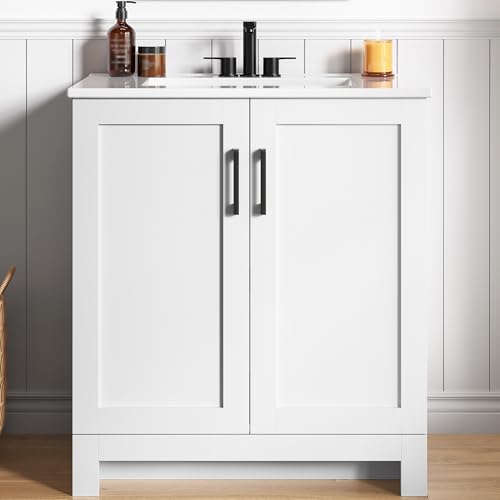
Best Small-Space Base: Design House Wyndham Bath Vanity Without Top, 24-inch, White. A compact 24-inch, two-door base made for a 25 by 19 inch top, flush to the floor — the small bathroom and powder room entry into base-only buying.
How These Picks Were Chosen
The defining gate was literal: the verified listing had to describe a vanity base without a top — base cabinet, without top, without sink, or no countertop in the title itself. That sounds obvious, but vanity search results are dominated by combos, and more than one attractive cabinet in our searches turned out to include a stone top we would have had to warn you about. Each pick below passed a brand-and-model search in the Amazon catalogue with its no-top status visible in the returned title, and only those confirmed bases carry links.
Within the gate we graded cabinet-making, because a base-only buyer is a quality buyer by definition. Solid wood construction and dovetail drawers — the ARIEL Cambridge and Hepburn lines’ signatures — signal a cabinet built to outlast several tops. Soft-close hardware, drawer count and layout, and honest sizing across the 24 to 72 inch working range of real bathrooms all counted. We also spread the picks across budgets and styles deliberately: painted white traditional, a compact white cabinet for a 25-inch top, a dark gray modern Beckett, and a six-drawer TONYRENA at family-bathroom scale.
The 6 Best Bathroom Vanities Without Tops

ARIEL Cambridge 48-inch Bathroom Vanity Base Cabinet, White — Best Overall
Nine dovetail drawers is a statement. Most 48-inch vanities give you two doors, a false drawer front and a cavern; the Cambridge gives you a dresser’s worth of organised storage around the plumbing, built from solid wood with soft-closing doors. It is the pick for the main bathroom where the vanity is the only storage the room has, and where a separately chosen quartz or marble top will crown a cabinet worthy of it.
Strengths
- Solid wood construction with nine dovetail drawers
- Soft-closing doors and serious storage architecture
- 48-inch size suits most main bathrooms
Trade-offs
- Drawer-rich cabinets need careful plumbing planning inside
- Solid wood sits at a premium tier
- Top, sink and faucet are all separate purchases
| Construction | Solid wood |
| Storage | 2 soft-closing doors, 9 dovetail drawers |
| Width | 48 inches |
| Finish | White, base only |
Base-only buying exists for cabinets like this. A combo at this storage level would force a bundled top chosen by a merchandiser; the Cambridge instead asks what your bathroom deserves — thick quartz, veined marble, an integrated ceramic — and provides joinery that will still be tight when that top is eventually replaced. Measure your plumbing rough-in against the drawer layout before ordering the top, and this becomes the easiest strong recommendation in the guide.
One planning detail for this cabinet: its nine drawers include the top row beside the sink, the classic hand-towel and toothbrush territory, so measure your trap’s swing against the centre drawers before the top’s sink position is frozen. ARIEL’s drawer boxes are built to be trimmed by a competent installer if a conflict appears — a flexibility worth confirming with your plumber at rough-in, not at midnight before the top arrives.
Best for: main bathrooms wanting maximum drawer storage / Not suited for: tight budgets or rushed one-box remodels
Check on Amazon — check the current price on Amazon before ordering.

ARIEL Cambridge 42-inch Bathroom Vanity Base Cabinet, White — Best for Mid-Size Bathrooms
Forty-two inches is the forgotten size: too wide for the 36-inch cabinets, too narrow for the 48s, and exactly right for a large share of real bathrooms measured between a tub and a wall. ARIEL keeps the full Cambridge specification at this width rather than stripping features, so the mid-size bathroom gets the same solid wood and nine-drawer storage as its bigger sibling, scaled to fit.
Strengths
- Full Cambridge spec in a 42-inch footprint
- Solid wood with nine dovetail drawers
- Soft-closing doors at a hard-to-find size
Trade-offs
- 42-inch tops are less stocked than 36 or 48 inch
- Premium construction pricing applies here too
- Drawer layout still demands plumbing coordination
| Construction | Solid wood |
| Storage | 2 soft-closing doors, 9 dovetail drawers |
| Width | 42 inches |
| Finish | White, base only |
Size orphans are where base-only buying quietly shines: top fabricators cut to any width, so an unusual cabinet width stops being a constraint and becomes a fit. If your alcove measures in the low forties, this Cambridge plus a custom-cut top gives you a made-to-measure result that combo shopping would have forced into a too-small 36 or a wall-chewing 48. The cabinet quality needs no apology at any size, and the drawers will organise a bathroom that previously stored everything on the counter.
The 42-inch width has a top-sourcing secret in its favour: it sits within the remnant range of most fabricators, so the custom top this cabinet invites is often cheaper than its 48-inch equivalent. Ask fabricators about remnants by name when you call — the savings on a smaller slab are real, and the Cambridge’s quality makes a genuine stone top feel obligatory rather than extravagant.
Best for: bathrooms sized between standard combo widths / Not suited for: shoppers wanting off-the-shelf top availability
Check on Amazon — check the current price on Amazon before ordering.

ARIEL Hepburn 72-inch Bathroom Vanity Base Cabinet, White — Best Double Vanity Base
A 72-inch double vanity is furniture, and the Hepburn base is built like it: solid wood, a bank of dovetail drawers between two door cabinets, soft-close everything. In a primary suite, this is the cabinet you pair with a full-slab quartz or marble top and two undermount sinks, drilled exactly where your faucets want to live — the complete argument for base-only buying, at the scale where the argument is strongest.
Strengths
- Solid wood double-vanity construction
- Four soft-closing doors plus six dovetail drawers
- 72-inch width suits true two-person bathrooms
Trade-offs
- The top for a 72-inch base is a significant second purchase
- Two-person delivery and installation territory
- Overwhelming for anything but a primary bathroom
| Construction | Solid wood |
| Storage | 4 soft-closing doors, 6 dovetail drawers |
| Width | 72 inches, double |
| Finish | White, base only |
At this width, the bundled-top compromise hurts most, because a 72-inch top is the visual field of the whole bathroom. The Hepburn’s restraint — white, shaker-clean, hardware-forward — is designed to sit under a statement stone without competing with it. Storage splits sensibly for two users with a shared drawer bank, and the solid-wood case will hold its lines under a heavy slab for decades. If the primary bath is the remodel’s centrepiece, build it on this.
At this scale, think about the room’s choreography: two users, one drawer bank, doors that must not collide with a linen tower or a swinging entry door. The Hepburn’s soft-close hardware pays for itself in a shared bathroom’s acoustics alone. Order the top with two faucet sets drilled in one visit, and consider a single long mirror rather than two small ones — the cabinet’s calm front rewards the simpler wall.
Best for: primary bathrooms building a two-person centrepiece / Not suited for: small bathrooms or single-purchase projects
Check on Amazon — check the current price on Amazon before ordering.

Wyndham Collection Beckett 66-inch Single Vanity, Dark Gray, No Countertop — Best Modern Single Vanity
Sixty-six inches with one sink is a deliberate luxury: counter space. The Beckett serves the primary bathroom where one person rules, or two share a sink happily but not a countertop battlefield. Wyndham Collection sells it honestly naked — no countertop, no sink — in a dark gray with brushed nickel trim that pairs beautifully with white quartz, concrete-look tops or a bold vessel arrangement of your own design.
Strengths
- Generous single-sink counter potential
- Dark gray finish with brushed nickel trim
- Explicit no-countertop, no-sink specification
Trade-offs
- Single sink at a double-vanity width is a lifestyle choice
- Dark finishes show water spots and dust
- Top and sink sourcing is entirely on you
| Width | 66 inches, single |
| Finish | Dark gray, brushed nickel trim |
| Top | None — no countertop, no sink |
| Brand line | Wyndham Collection Beckett |
The Beckett is the designer’s pick in this guide: a wide, calm, modern base whose whole purpose is to disappear under a top you chose for its own sake. Its single-sink layout also simplifies plumbing and frees the drawer and cabinet volume that a second bowl would eat. Couples who truly share should take the Hepburn; everyone else should at least consider whether counter space beats a second sink they will use to store hair tools. This cabinet makes that case in dark gray.
Best for: modern primary baths prioritising counter space / Not suited for: two-sink households
Check on Amazon — check the current price on Amazon before ordering.

TONYRENA 48-inch Bathroom Vanity Without Sink, White — Best Value Storage Base
TONYRENA’s proposition is access: six drawers that pull fully out, so the back of the drawer is reachable territory rather than a rumour, plus soft-closing doors, in the standard 48-inch width that tops are easiest to source for. It is the pick for the family bathroom that needs the Cambridge’s storage idea at a gentler commitment, and for first-time base-only buyers who want the standard size’s easy top market.
Strengths
- Six full-extension drawers maximise usable storage
- Soft-closing doors at a value tier
- Standard 48-inch width simplifies top sourcing
Trade-offs
- Construction is a step below the solid-wood ARIELs
- White finish is the verified configuration
- Brand ecosystem and parts support are smaller
| Storage | 2 soft-closing doors, 6 full-extension drawers |
| Width | 48 inches |
| Finish | White |
| Top | Without sink/top |
Full-extension drawers are the feature you feel daily and photograph never: no lost bottles in the drawer void, no kneeling to excavate the back. TONYRENA builds its whole case on that usability, priced so the top budget survives. The honest gap to the ARIEL picks is material pedigree — this is a value cabinet, and a twenty-year primary suite should weigh that — but for family bathrooms, rentals of quality and first base-only projects, the arithmetic is persuasive.
Full-extension drawers change the storage arithmetic of a 48-inch vanity more than raw drawer count suggests: six drawers you can fully see into hold more usable goods than nine you cannot. For the family bathroom, assign drawers by person or by category at installation and label nothing — the visibility does the organising. It is the rare value cabinet whose signature feature is one the premium lines should copy more often.
Best for: family bathrooms wanting drawer access on a budget / Not suited for: forever-home suites prioritising solid wood
Check on Amazon — check the current price on Amazon before ordering.

Design House Wyndham Bath Vanity Without Top, 24-inch, White — Best Small-Space Base
Small bathrooms are where combo vanities compromise hardest, squeezing a stone-patterned top you did not choose onto a cabinet you tolerated. Design House’s Wyndham base reverses the deal at powder-room scale: a clean white two-door cabinet, flush to the floor so no dust gathers beneath, sized precisely for a standard 25 by 19 inch top that you select — a real ceramic, a marble offcut, a colour that suits the room.
Strengths
- Made for the standard 25 x 19 inch top size
- Flush-to-floor design eases cleaning
- Two-door storage in a 24-inch footprint
Trade-offs
- Assembly required, unlike the premium bases
- Storage is modest, as 24 inches dictates
- Basic construction tier
| Width | 24 inches (for 25 x 19 in top) |
| Storage | 2 cabinet doors |
| Design | Flush to floor |
| Assembly | Easy assembly (listing) |
Powder rooms are design statements in miniature, and the top is most of the statement — which is exactly why buying this base topless is right. A fabricator’s offcut of real marble in this size is genuinely affordable, and it will sit on this cabinet looking like a bespoke commission. Assembly is the honest price of the tier; take an unhurried hour, glue as well as screw where the design allows, and the result punches far above its footprint.
Because the top size is a true standard, this base also suits renters-grade timelines: order a stock ceramic top alongside it and the pair can be installed in a weekend, while the fabricator route remains open whenever the room deserves it. Its flush-to-floor plinth deserves a final mention in homes with toddlers or pets, where the under-vanity gap of legged cabinets becomes a museum of lost small objects.
Best for: powder rooms and small bathrooms wanting a custom top / Not suited for: storage-hungry family bathrooms
Check on Amazon — check the current price on Amazon before ordering.
Comparison Table
| Pick | Badge | Key spec | Best for |
|---|---|---|---|
| ARIEL Cambridge 48-inch Bathroom Vanity Base Cabinet, White | Best Overall | Solid wood, 9 dovetail drawers, 48 in | main bathrooms wanting maximum drawer storage |
| ARIEL Cambridge 42-inch Bathroom Vanity Base Cabinet, White | Best for Mid-Size Bathrooms | Solid wood, 9 drawers, 42 in | bathrooms sized between standard combo widths |
| ARIEL Hepburn 72-inch Bathroom Vanity Base Cabinet, White | Best Double Vanity Base | Solid wood double base, 72 in, 6 drawers | primary bathrooms building a two-person centrepiece |
| Wyndham Collection Beckett 66-inch Single Vanity, Dark Gray, No Countertop | Best Modern Single Vanity | 66 in single, dark gray, no countertop | modern primary baths prioritising counter space |
| TONYRENA 48-inch Bathroom Vanity Without Sink, White | Best Value Storage Base | 48 in, 6 full-extension drawers, soft-close | family bathrooms wanting drawer access on a budget |
| Design House Wyndham Bath Vanity Without Top, 24-inch, White | Best Small-Space Base | 24 in base for 25×19 top, flush to floor | powder rooms and small bathrooms wanting a custom top |
How to Choose the Best Bathroom Vanities Without Tops for Your Remodel
Begin with the width your room can honestly hold, measured between finished walls and after allowing for door swing and the toilet’s clearance — then buy the cabinet width, because the top will be cut to it, never the other way round. The working sizes in this guide cover the real range: 24 inches for powder rooms, 42 and 48 for main bathrooms, 66 and 72 for primary suites. Between sizes, favour the cabinet with the better storage architecture over the extra two inches of width; drawers you use daily outrank counter you will cover with bottles anyway.
Judge the cabinet as furniture, because that is what remains when tops change. Solid wood cases with dovetail drawers — the ARIEL pattern — tolerate decades, heavy stone and the humidity cycle of a bathroom; value cabinets like the TONYRENA trade some of that pedigree for full-extension hardware and price, a fair trade in family service. Soft-close hinges and slides are worth insisting on at any tier: they protect the cabinet, the top’s sealant line and the household’s mornings. Check the interior against your plumbing before the top is cut — drawer banks and drain positions must be reconciled on paper, because a U-shaped drawer or a relocated trap is a planning decision, not a site improvisation.
Finally, plan the top as its own project with its own lead time. Decide material — quartz for zero maintenance, marble for veining and a sealing habit, ceramic integrated tops for small bases — and faucet drilling before anyone cuts: widespread, single-hole and vessel configurations are permanent choices made in the fabricator’s shop, not at your sink. Order the top when the cabinet is on site and measured, confirm the overhang you want on each exposed side, and arrange templating if the walls are less than perfectly straight, which in real bathrooms they always are.
Vanity Bases and Tops: Materials That Pair Well Together
The base-only format exists to free the top, so choose the top for your life rather than for the showroom. Quartz is the pragmatic champion: non-porous, stain-resistant, consistent in pattern, and heavy enough to make a solid-wood base like the ARIELs feel inevitable. Marble is the romantic: unmatched veining, a cool touch, and a willingness to etch under lemon, vinegar and enthusiastic cleaning that you must accept as patina or avoid as heartbreak. Granite sits between, harder than marble and busier in pattern, while solid-surface and cultured materials offer integrated sinks and seamless cleaning at a more synthetic hand feel.
Small bases open a delightful loophole: fabricators’ remnants. A 25 by 19 inch top for the Design House base, or even a 42-inch top for the smaller Cambridge, can often be cut from the leftover slab of someone else’s kitchen — genuine stone at a fraction of slab pricing, with a story attached. Whatever the material, insist on the underside and edges being finished as your design requires, decide the backsplash as part of the same order, and remember the finished height: cabinet plus top thickness plus any vessel sink should land where your household’s elbows expect it, which for most adults means checking the total against the old vanity before anything is cut.
What Base-Only Buying Really Costs: An Honest Accounting
Advocates of vanity combos will tell you base-only buying costs more, and in line items they are right: cabinet, top, sink or sinks, faucets, plus templating and possibly a fabricator’s delivery, against one combo price. What the line items omit is replacement logic. A combo’s top and cabinet age as a unit — chip the bundled stone in year six and you are shopping for an entire vanity. A base-only installation replaces the damaged layer only, and a solid cabinet like the Cambridge or Hepburn can carry two or three tops across its life, which is where the format quietly wins the twenty-year arithmetic.
The second hidden ledger is fit. Combos are built to nominal widths and standard faucet drillings; real bathrooms have out-of-square walls, off-centre drains and strong opinions about vessel versus undermount. Base-only buying converts those from compromises into specifications. Our advice is to budget the project whole — cabinet, top, sinks, faucets, plumbing trim and a contingency for the wall you have not opened yet — and to spend the contingency last. Judged as a system rather than a SKU, the six bases in this guide are the foundation of bathrooms that look commissioned rather than purchased.
Matching Sinks and Faucets to a Base-Only Vanity
The sink decision is really three decisions: mounting style, material and position. Undermount sinks give the cleanest counter and the easiest wipe-into-bowl cleaning, and they demand a top material with a finished cut edge — quartz and granite oblige, marble obliges at a price. Integrated ceramic tops, the natural partner for the smaller bases here, remove the sink decision entirely and clean like a dream, at the cost of replacing top and sink together if either fails. Vessel sinks are the statement option: they raise the working height, showcase the basin as an object, and suit the Beckett’s modern calm particularly well — provided the finished-height arithmetic in our measuring guide is done honestly.
Faucets follow the sink. A vessel wants a tall or wall-mounted faucet; an undermount accepts the full range. Drilling is decided by the faucet, and the faucet should be physically in your hands — or at least irrevocably ordered — before the top is cut, because hole spacing is the one specification that cannot be negotiated afterwards. Finishes should be chosen as a family across faucet, drain, hardware and lighting: the Beckett’s brushed nickel trim and the ARIELs’ classic lines each suggest their own palette, and a bathroom whose metals agree looks expensive even when its line items were not.
Installing a Base-Only Vanity: Sequence for a Clean Result
Sequence is the difference between a commissioned look and a wrestled one. Set and level the cabinet first, anchored to studs, with the plumbing roughed to the cabinet’s actual interior — not the plan’s memory of it. Dry-fit the top before any adhesive or sealant appears, checking overhangs, wall gaps and the sink’s relationship to the drawers below. Only then set the top, mount the sinks, and leave faucet installation until the top’s sealant has cured, so no one is leaning across fresh joints with a wrench.
The finishing details are where base-only projects prove themselves. A backsplash in the same material, ordered with the top, protects the wall line better than any caulk bead; side splashes belong wherever the vanity meets a wall. Seal the top’s perimeter neatly, connect the plumbing and test with a full basin drained at once while someone watches below — the five-minute test that separates a finished bathroom from a future ceiling stain. Keep the fabricator’s offcuts if any are offered: a matching stone shelf or threshold is the kind of detail that makes visitors ask who your designer was.
Base-Only Vanities for Rentals, Flips and Forever Homes: Three Different Briefs
The same format serves three very different projects, and the right pick changes with the brief. For a quality rental, the priorities are durability under strangers and fast turnaround between tenancies: the TONYRENA’s drawer access and standard size, or the Design House base with a stock ceramic top, keep the bathroom impressive and the parts replaceable, while a damaged top — the most common tenancy injury — becomes a one-item swap instead of a vanity replacement. Landlords who have priced one mid-tenancy vanity swap understand this arithmetic immediately.
For a flip, the brief is photography and perceived value per dollar. Here the base-only format’s gift is the top itself: a genuine stone or quartz surface on a clean white base — the smaller Cambridge is the flipper’s friend — reads as a commissioned bathroom in listing photographs, at a material cost the combo market cannot match at the same visual level. The discipline is to stop at the photograph’s edge: sound cabinet, honest top, standard faucets, and no bespoke dimension that narrows the buyer pool.
The forever home inverts everything again: buy the cabinet as furniture, because you will look at it for decades and the top may change with fashions you cannot yet imagine. That is the ARIEL Hepburn and Cambridge case in its purest form — solid wood, dovetails, hardware that can be serviced — with the top chosen for the decade rather than the year. Three briefs, one format, and the six bases in this guide sorted among them: that is the real structure of the category, and why it rewards buyers who know which project they are actually running.
Caring for a Vanity Cabinet So It Outlives Two Tops
The base-only bargain — a cabinet that outlives its tops — only pays out if the cabinet is kept like the furniture it is, and bathroom furniture lives in the harshest room in the house. The enemies are standing water and steam cycling. Wipe the cabinet front and, above all, the top edge where it meets the counter after splashing sessions; the sealant line at that junction is the cabinet’s sea wall, and it should be inspected yearly and renewed at the first sign of lifting, because water that enters a cabinet’s edge travels invisibly and announces itself as swelling a year later.
Inside, the discipline is containers and ventilation. Cleaning chemicals and cosmetics belong in trays, not on the cabinet floor, where a slow leak becomes a finish problem; the under-sink cabinet benefits from a waterproof liner cut to its floor, which converts any trap weep from cabinet damage into a visible puddle — information you want early. In steamy bathrooms without adequate extraction, leave the cabinet doors ajar after the morning rush on the worst days; solid wood tolerates humidity cycles gracefully, but no finish enjoys being steamed in a sealed box daily for a decade.
Hardware is the cabinet’s moving machinery and its easiest renewal. Soft-close hinges and slides that tire after years can be replaced individually, returning a decade-old ARIEL or its peers to showroom manners for the price of a takeaway — one more dividend of buying cabinets built from standard, serviceable components rather than sealed novelty. Kept this way, the base you buy today is not the vanity of this remodel; it is the foundation of the next two, and the top becomes what it should always have been: the changeable surface on a permanent piece of furniture.
Small Print That Matters: Depth, Toe Kicks and Door Swings
Three dimensions decide whether a beautiful vanity is a daily pleasure or a daily negotiation, and none of them is the width on the box. Depth first: standard vanity depth suits most bathrooms, but a deep cabinet in a narrow room steals the floor space your knees and the door both wanted, so measure the room’s working aisle, not just the wall. Toe kick second: a recessed kick lets you stand at the sink without leaning, a detail your lower back will grade nightly — the flush-to-floor Design House trades that recess for cleanability, a legitimate exchange in a powder room and a questionable one at a main sink.
Door swing third, and drawer clearance with it: open every door and drawer on paper against the room’s obstacles — the entry door’s arc, the toilet’s shoulder room, a linen tower’s face. Drawer-rich bases like the Cambridge reward this sketch most, because a drawer that cannot fully open is a shelf with a handle. Ten minutes with a tape and the floor plan converts these from discoveries into decisions, which is the entire thesis of base-only buying: the bathroom is specified by its owner, on paper, before it is purchased in boxes.
How to Measure for a Vanity Top Once Your Base Is Chosen
The cabinet decides the width; this measuring sequence produces the numbers a fabricator or top supplier needs, and prevents the two classic errors — a top that fights the wall and drillings that miss the faucet.
- Measure the cabinet, not the room. Record the base’s exact width, depth and height from the cabinet itself once it is on site. Nominal widths drift by fractions that matter to stone, and the top order should be built on the object, not the listing.
- Decide overhangs deliberately. Standard practice adds a small overhang on the front and any exposed sides, with the top flush where it meets a side wall. State your overhangs on the order explicitly; fabricators will otherwise apply their defaults, which may not be yours.
- Mark the sink and faucet layout on paper. Fix the sink position — centred on the cabinet or on the door pair, not merely on the room — and the faucet configuration: single-hole, centreset or widespread, or a wall-mounted or vessel arrangement. These become permanent drillings; there is no undo in stone.
- Check the plumbing against the drawers. Note the drain and supply positions relative to the cabinet’s interior and confirm drawers clear them, or specify where a drawer needs a plumbing cut-out. Drawer-rich bases like the Cambridge reward this hour of paper with a decade of function.
- Template if the walls are imperfect. If the vanity sits between walls or against an out-of-square corner, have the top templated from the actual space rather than cut from measurements. A template absorbs the wall’s sins; a rectangle announces them.
- Confirm finished height before cutting. Add cabinet height, top thickness and any vessel sink height, and compare the total with the old vanity and the household’s comfort. A top can be shimmed at install, but discovering a too-tall vanity after drilling is a sorrow best avoided on paper.
Twenty minutes with a tape and a sketch converts the riskiest purchase in the remodel into a specification. Bring those numbers to the fabricator, and the top arrives as a solution instead of a second project.
Common Buying Mistakes
Ordering the top before the cabinet arrives. Nominal sizes lie by fractions, walls lie by more, and stone does not forgive either. Wait for the base, measure the object in the room, then order the top — the schedule pressure to pre-order is how expensive rectangles are born.
Forgetting that sinks and faucets are separate decisions. A base without a top usually also means without sinks and faucets, and each carries compatibility choices — undermount versus vessel, drilling patterns, drain finishes. Price and plan the whole stack before the cabinet ships, not after it lands.
Ignoring drawer-versus-plumbing conflicts. Drawer-rich cabinets are the glory of this category and its one trap: a centre drawer bank and a centre drain must be reconciled. Check the interior layout against your rough-in at purchase time, while exchanging the cabinet is still a click rather than a construction event.
Choosing a top material for the photograph. Marble etches, wood swells, glossy black shows every droplet. The top lives under toothpaste, hard water and hurried mornings. Choose the material whose aging you will enjoy — quartz’s indifference, marble’s patina — with your eyes open, using the pairing guide above.
Skipping the finished-height check. Cabinet heights vary, tops add thickness, vessel sinks add more. A vanity that lands two inches too tall is a daily irritation no stone quality can redeem. Sum the stack on paper and compare it with the vanity you are replacing before anything is cut.
Final Recommendation
For most main bathrooms, the ARIEL Cambridge at 48 inches is the base to build on — solid wood, nine dovetail drawers, and a top market that makes sourcing easy — with its 42-inch sibling for the rooms that measure between standards. Primary suites should look to the Hepburn 72 for two-person scale, or the Beckett 66 if counter space outranks a second sink in your household’s honest politics.
The TONYRENA brings drawer-first storage to a friendlier tier, and the Design House base lets even a powder room have its custom stone moment. Whichever base you choose, measure the cabinet on site before ordering the top, decide your faucet drilling on paper, and check the current price on Amazon while the measuring tape is still out.
Related guides in this series: Best Selling Bathroom Vanities Best Small Bathroom Vanities With Sink Best Bathroom Vanities Reviews Best Stone Bathroom Sinks Best Bathroom Vanities Without Tops
Frequently Asked Questions
Why buy a vanity without a top?
Freedom of pairing. You choose the cabinet for its construction and storage, and the top separately for its material, thickness, sink style and faucet drilling. It also means a damaged top can be replaced someday without replacing the cabinet beneath it.
What size top fits a 48-inch vanity base?
Typically a top around 49 inches wide, allowing a small overhang, at a depth matched to the cabinet — but measure the actual cabinet on site and confirm with your fabricator, since nominal sizes vary and overhang is a choice, not a constant.
Are base-only vanities cheaper than combos?
The cabinet alone is cheaper; the finished installation may cost similar or more once top, sinks, faucets and templating are added. The value case is quality and replaceability over decades, not a lower first invoice.
Can I use a vessel sink on a vanity without a top?
Yes — a vessel is one of the format’s pleasures. Choose a top drilled for the vessel’s drain and your faucet style, and check the finished height carefully, since the vessel adds its full height above the counter.
What should I check before ordering a base-only vanity?
Width against the finished room, interior layout against your drain position, drawer and door hardware quality, and the total finished height once your planned top is added. Every pick in this guide was verified as genuinely sold without a top.
How long does sourcing a separate top take?
Stock tops in standard sizes can arrive in days; fabricated stone with templating usually takes weeks. Order the cabinet first, measure it on site, and start the top process immediately — it is the schedule’s long pole, not the cabinet.
Do vanity bases without tops include sinks and faucets?
Generally, no — and the picks in this guide are no exception. A base-only purchase is the cabinet: case, doors, drawers and hardware. The top, the sink or sinks, the faucets and the drain assemblies are separate purchases, which is precisely the format’s freedom and its budgeting trap. The Design House base is designed around a standard top size that often bundles its own integrated sink, and vessel arrangements fold the sink into a single object, but in every configuration you should list and price the full stack — cabinet, top, sink, faucet, drain, supply lines — before ordering any single part of it.