Disclosure: airfryerkitchensupply.com is reader-supported. When you buy through links on our site, we may earn an affiliate commission at no extra cost to you.
Where to buy
Floating vanities are a measure-twice purchase: the cabinet, the sink, the plumbing rough-in and the wall blocking all have to agree before anything ships. Every pick below is sold on Amazon — use the links to check the current price on Amazon and, more importantly, to confirm the exact width, drain position and drawer configuration of the variant you are ordering.
- Vabches 30 Inch Fluted Floating Bathroom Vanity with Sink — Best Overall: check the current price on Amazon.
- 24 Inch Modern MDF Floating Vanity with Sink — Best for Powder Rooms: check the current price on Amazon.
- 32 Inch Floating Bathroom Vanity with LED Lights, Black — Best with LED Lighting: check the current price on Amazon.
- Virubi 42 Inch Floating Bathroom Vanity, Fluted — Best Wide Single Vanity: check the current price on Amazon.
- OPERTION 36 Inch Floating Bathroom Vanity with Ceramic Sink — Best Drawer Layout for Plumbing: check the current price on Amazon.
- eclife 30 Inch Floating Bathroom Vanity with Black Sink — Best Statement Look: check the current price on Amazon.
The best bathroom vanities floating modern designs share one trick: they move storage off the floor and into the wall plane, so the room reads larger, mops run underneath without a fight, and the floor line stays unbroken. But a floating vanity is also the least forgiving purchase in a bathroom remodel, because it hangs from your wall framing. Studs, blocking, drain height and supply positions stop being abstractions and become the whole project.
This roundup covers the widths most bathrooms actually need — 24 inches for a powder room, 30 and 36 for a standard single bath, 42 for a generous single — and favours the details that separate a good floating vanity from a wobbly one: soft-close hardware, drawer layouts that clear the trap, and sink materials that survive daily use. Every model was confirmed before earning a link. Measure your rough-in before you fall for any of them.
In this guide
Quick Picks
Six wall-mounted vanities from 24 to 42 inches, ranked by the job each does best: the fluted all-rounder, the powder-room space saver, the LED-lit organiser, the wide single, the plumbing-friendly drawer layout, and the black-sink statement piece.
- Best Overall: Vabches 30 Inch Fluted Floating Bathroom Vanity with Sink — a 30-inch fluted-front vanity with four storage drawers that nails the modern brief at the most useful single-bath width. Check the current price on Amazon.
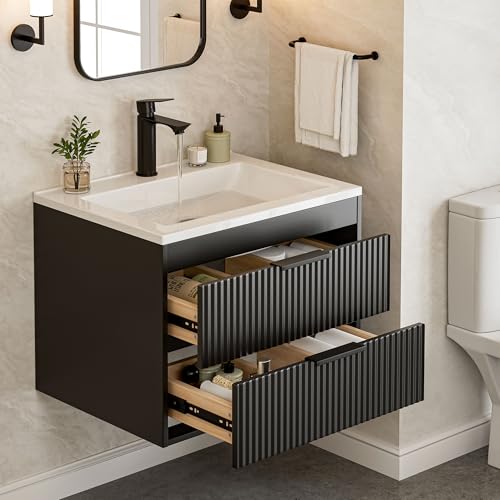
- Best for Powder Rooms: 24 Inch Modern MDF Floating Vanity with Sink — a compact 24-inch wall-mounted vanity with double drawers, black handles and a white resin sink, sized for powder rooms and tiny ensuites. Check the current price on Amazon.
- Best with LED Lighting: 32 Inch Floating Bathroom Vanity with LED Lights, Black — a 32-inch black floating vanity with integrated ceramic sink and built-in LED lighting for bathrooms short on natural light. Check the current price on Amazon.
- Best Wide Single Vanity: Virubi 42 Inch Floating Bathroom Vanity, Fluted — a 42-inch fluted wood vanity with soft-closing doors and drawers, for a single-sink bathroom with room to spread out. Check the current price on Amazon.
- Best Drawer Layout for Plumbing: OPERTION 36 Inch Floating Bathroom Vanity with Ceramic Sink — a 36-inch floating vanity with a ceramic sink combo and a big U-shaped drawer engineered to wrap around the trap. Check the current price on Amazon.
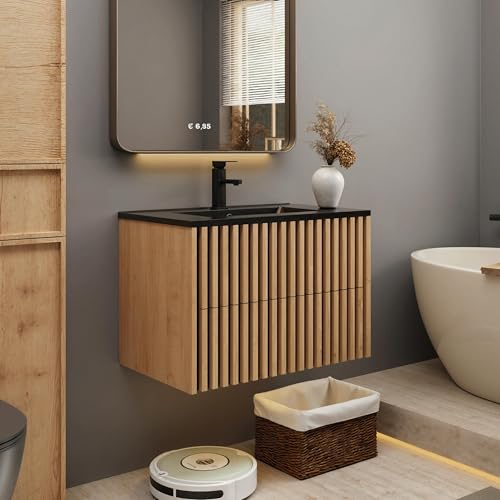
- Best Statement Look: eclife 30 Inch Floating Bathroom Vanity with Black Sink — a 30-inch fluted two-drawer vanity with an undermount black sink, for buyers who want the vanity to be the room’s focal point. Check the current price on Amazon.
How These Picks Were Chosen
We screened for the floating-specific failure points first. A wall-hung cabinet lives or dies on its mounting system and the wall behind it, so picks had to be genuine wall-mount designs with full cabinet backs or proper hanging rails — not floor vanities with the legs left off. Drawer design came next: in a floating vanity the top drawer must wrap or notch around the trap, and models whose drawers are secretly shallow boxes lost out to real U-shaped and double-drawer layouts.
Sink integration was the third filter. Resin and ceramic integrated tops both appear here, and the reviews say plainly which suits whom: resin is seamless and forgiving of drops, ceramic is harder, glossier and heavier. Finally we weighted the modern brief itself — fluted fronts, matte black, handle-less or slim-handle profiles — because nobody shopping this search wants a shaker cabinet that happens to float.
The 6 Best Bathroom Vanities Floating Modern Designs

Vabches 30 Inch Fluted Floating Bathroom Vanity with Sink — Best Overall
Thirty inches is the workhorse width of bathroom remodels — big enough for a real sink and storage, small enough for the average bath — and the Vabches is the most complete answer at that size. The fluted front delivers the current modern look without paint tricks, and four drawers beat the usual door-and-false-front arrangement because drawers bring their contents to you instead of making you kneel. If you are doing one bathroom properly, start here.
Strengths
- Fluted front is the defining modern texture, executed in wood tones that warm up a tiled room
- Four drawers give genuine sorted storage, rare at 30 inches
- Integrated sink keeps the top line clean and removes a separate top purchase
Trade-offs
- Four drawers at 30 inches means each is modest — bulky hair tools need a plan
- Fluted grooves collect dust and toothpaste mist; they need a soft brush, not just a wipe
- Wall-hung weight demands proper blocking or stud anchoring, no exceptions
| Width | 30 in |
| Front | Fluted wood finish |
| Storage | 4 drawers |
| Mount | Wall-hung floating |
Drawer count is where this vanity quietly outclasses rivals. Most 30-inch floaters offer one U-drawer and a door; four drawers let you run a real system — daily items top-left, styling tools top-right, refills below — and soft-close hardware keeps the 6 a.m. routine silent. The fluting is not just decoration either: vertical grooves hide minor scuffs and fingerprints far better than a flat gloss slab, which matters on the piece of furniture you touch with wet hands most often.
The cautions are installation-shaped. A loaded 30-inch vanity is a serious cantilevered weight, so the wall needs studs or added blocking exactly where the hanging rail lands — open the wall during the remodel and add a horizontal 2x board if there is any doubt. Also confirm your drain height against the drawer layout before ordering; the drawers are designed around a standard trap position, and an unusually high or low rough-in can steal the top drawer.
A detail worth planning around: four drawers invite drawer organisers, and the fluted Vabches rewards them more than most, because its drawers are numerous but individually modest. Slim bamboo or plastic dividers in the top two drawers convert them from storage volume into a system — makeup, dental, hair, medication each in a lane. Budget the organisers in the same order; a four-drawer vanity without them devolves into four junk drawers with better PR.
One more Vabches consideration: thirty inches with four drawers is also the configuration most likely to satisfy a future buyer of your home, because it reads as the complete, current answer at the standard size. Remodels are partly consumption and partly stewardship of the house’s value, and a well-chosen mainstream vanity is the rare purchase that serves both ledgers at once.
Best for: a standard single bathroom remodel / Not suited for: walls without solid blocking for a wall-hung load
Check on Amazon — check price on Amazon before you decide; sizes and finishes change between listings.
24 Inch Modern MDF Floating Vanity with Sink — Best for Powder Rooms
A 24-inch vanity is a confession that the room is small, and this one makes the confession gracefully. Double drawers — unusual at this width, where a single door is the norm — plus black handles against a clean cabinet and a white resin sink give a powder room or guest ensuite a finished, deliberate look instead of a squeezed-in compromise. Guests will read it as a design choice, which is exactly what a good small vanity achieves.
Strengths
- Double drawers at 24 inches is genuinely uncommon and far more usable than a door
- Resin sink is seamless, light and forgiving of dropped bottles
- Black handles give the modern contrast the search promises
Trade-offs
- MDF construction demands respect for water — wipe splashes, do not let them sit
- Counter space is essentially the sink rim; no room for a countertop ecosystem
- Storage suits a guest load, not a full daily routine with appliances
| Width | 24 in |
| Sink | White resin, integrated |
| Storage | Double drawers |
| Handles | Black |
The resin top deserves a word in its favour: at this size, a seamless resin sink-and-counter is the practical choice, because there is no seam for water to attack and the whole top wipes down as one surface. It is also light, which reduces the hanging load — a real consideration in a small room where you may be anchoring into a single stud bay. The drawers below swallow the guest-bath brief completely: spare hand towels, soap refills, a small first-aid roll.
Manage expectations on materials. MDF is the honest budget construction at this width, and its enemy is standing water at the cabinet edges. Fit the faucet carefully, seal the wall junction with a neat bead of silicone, and this vanity will serve for years; ignore splash discipline and the edges will tell on you. For a powder room, where water exposure is hand-washing only, that trade is entirely reasonable.
Powder-room specifics flatter this vanity further. Powder rooms see hand-washing and little else, so the resin top’s one theoretical weakness — long hot showers steaming the room daily — barely applies, and the drawers hold exactly the guest load: spare hand towels, soap, a small sewing kit for the household’s buttons. In the room it was designed for, the budget construction stops being a compromise and becomes correct specification.
The 24-inch pick also deserves a word as the ensuite-of-a-guest-room specialist: those rooms are used in bursts, judged by visitors, and starved of space by design. A floating double-drawer vanity makes such a room feel considered rather than leftover, and the floating format’s easy floor cleaning suits a room that is cleaned in bursts too. Small rooms are where design discipline shows most, and this is a disciplined little piece.
Best for: powder rooms and small ensuites / Not suited for: a main bathroom needing full storage
Check on Amazon — check price on Amazon before you decide; sizes and finishes change between listings.

32 Inch Floating Bathroom Vanity with LED Lights, Black — Best with LED Lighting
Windowless bathrooms live or die on their lighting plan, and this 32-inch black vanity builds part of that plan into the furniture: integrated LED lighting, an integrated ceramic sink, and a cabinet body in the matte black that defines the current modern palette. If your remodel budget is choosing between a fancier vanity and a lighting upgrade, this pick argues you can have some of both.
Strengths
- Built-in LED light adds task and ambience lighting without another fixture purchase
- Integrated ceramic sink: hard, glossy, stain-resistant surface
- Black finish anchors a modern scheme and hides water spots better than white gloss
Trade-offs
- The LED needs power — plan the feed with your electrician before the wall closes
- Black shows dust and dried toothpaste more than mid-tone wood finishes
- Integrated electronics are a long-term service question a plain cabinet never asks
| Width | 32 in |
| Sink | Integrated ceramic |
| Lighting | Built-in LED |
| Finish | Black |
Treat the LED as a lighting layer, not a gimmick. Vanity-level light softens the harshness of a single ceiling fixture and makes a small black-cabinet bathroom feel intentional rather than cave-like, especially for evening routines. The ceramic sink is the other grown-up choice here: ceramic shrugs off hair dye, toothpaste and cleaning chemicals that can dull resin over time, and its weight is a fair trade for that durability at 32 inches.
The planning burden is real, though. An illuminated vanity needs a switched or always-on feed at the right position, decided before tiling, not after. And be honest about black: in a hard-water home, black fixtures and cabinets show every dried droplet as a pale ghost. If your household will not wipe down, choose the wood-tone Vabches or Virubi instead and add a separate LED mirror.
Ask one question before ordering the LED model: where does its light fall relative to your mirror? Vanity-integrated light works best as a complement to mirror lighting, filling the under-chin shadow that overhead and mirror lights leave. If this vanity is your only planned light source at the mirror, add a lit mirror in the same project — faces are lit from the front or they are not lit at all, and no under-cabinet glow fully substitutes.
Black vanities have one more environmental friend worth noting: they are the best partners for the warm, low lighting schemes that make evening bathrooms feel like spas rather than clinics. Under warm light a white vanity can glare; the black cabinet absorbs and glows. If your remodel mood board leans candlelit, the LED model is not merely compatible with that direction — it is the piece that completes it.
Best for: windowless bathrooms and evening routines / Not suited for: buyers without a plan for the LED power feed
Check on Amazon — check price on Amazon before you decide; sizes and finishes change between listings.

Virubi 42 Inch Floating Bathroom Vanity, Fluted — Best Wide Single Vanity
Forty-two inches is the connoisseur’s width: one generous sink, real counter landing space on both sides, and storage volume that ends the drawer Tetris of smaller vanities. The Virubi pairs that width with a fluted wood front and soft-closing doors and drawers, making it the pick for a primary bathroom where one person — or two people on different schedules — wants a single, calm, well-organised station.
Strengths
- 42 inches buys counter space on both sides of a single sink — the rarest luxury in vanities
- Soft-closing doors and drawers throughout, not just on the top drawer
- Fluted wood front brings warmth that all-white modern baths often lack
Trade-offs
- One sink at 42 inches is a lifestyle decision — simultaneous-morning couples should look at doubles
- The largest hanging load in this roundup; blocking is non-negotiable
- Wood-tone fluting commits your scheme; it will not disappear into a white-on-white room
| Width | 42 in |
| Sink | Single |
| Hardware | Soft-close doors and drawers |
| Front | Fluted wood |
The single-sink-at-42-inches layout is underrated because showrooms push doubles. In daily life, counter space beats a second bowl for most households: skincare, a hairdryer, a water glass and a phone all land somewhere, and on this vanity they land on stone-flat counter instead of teetering on a sink rim. The storage below matches — doors and drawers in combination suit the mixed load of a primary bath, from tall bottles to folded spare towels.
Installation is the serious conversation. This is the heaviest hang in the list, and it must land on studs or continuous blocking across its full width; a remodel that skips the blocking step is borrowing trouble. Get the mounting right and the payoff is a vanity that feels like furniture, with the floating floor line keeping a larger bathroom feeling larger still.
The Virubi’s counter space suggests a discipline worth adopting: the two landing zones either side of the sink should be assigned, left for daily tools, right for products in current rotation, with everything else banished to drawers. A 42-inch single only delivers its calm if the counter is defended; left undefended, 42 inches simply hosts a wider spread of clutter than 30 did, and the luxury evaporates into surface area.
The Virubi also reframes a common remodel question: whether to keep a single sink and gain counter, or go double and gain a bowl. Doubles at 60 inches give each user a cramped station; this 42-inch single gives one user a palace and a household on staggered schedules everything it needs. Answer the schedule question honestly — simultaneous or staggered — and the Virubi either becomes the obvious buy or the obvious skip, with no middle state.
Best for: a spacious single-sink primary bath / Not suited for: couples who truly need two sinks
Check on Amazon — check price on Amazon before you decide; sizes and finishes change between listings.

OPERTION 36 Inch Floating Bathroom Vanity with Ceramic Sink — Best Drawer Layout for Plumbing
Every floating vanity drawer fights the same enemy: the trap hanging below the sink. The OPERTION’s answer is a big U-shaped drawer that wraps around the plumbing, preserving a genuinely deep, wide drawer where rivals fit a shallow tray or a false front. At 36 inches — the most common primary-bath single width — that makes it the pragmatic optimiser’s pick.
Strengths
- U-shaped drawer converts the plumbing zone from dead space into the main drawer
- Ceramic sink combo: durable, glossy, easy-clean top
- 36-inch width fits the standard single-bath alcove most homes already have
Trade-offs
- The U cut-out is fixed geometry — an off-centre or very low drain can still clash
- One big drawer organises worse than two small ones unless you add dividers
- Ceramic adds hanging weight versus resin at the same width
| Width | 36 in |
| Drawer | Big U-shaped, trap-clearing |
| Sink | Ceramic combo |
| Mount | Wall-hung floating |
Measure your drain before ordering — that sentence decides whether this vanity delights or disappoints. The U-drawer is engineered around a centred drain at standard height. Match that, and you gain the deepest usable drawer in this roundup at 36 inches, a drawer that swallows a hairdryer, straighteners and the whole styling kit in one layer. Miss it, and no drawer design on earth can help you; the trap wins.
The ceramic top is the right pairing for a hard-working primary bath: it tolerates heat, dye and abrasion better than resin and keeps its gloss. Add simple drawer dividers — the one accessory this layout begs for — and the OPERTION becomes the most functionally honest vanity here: nothing decorative, everything earned.
One more OPERTION virtue deserves naming: a single big U-drawer is the easiest vanity storage to clean. Crumbs, hair and product residue collect in any drawer; a wide unobstructed drawer wipes out in one pass, where four small drawers present eight corners of evidence. In a primary bath used twice daily by an adult with long hair, that cleanability is not a footnote — it is a weekly quality-of-life feature.
Installers quietly favour U-drawer vanities for a reason beyond storage: the drawer can be removed in seconds to expose the trap, turning every future leak check and trap clean-out into a no-tools job. Anyone who has paid a plumber to work blind inside a fixed cabinet understands that the OPERTION’s drawer is not just storage — it is the maintenance hatch the whole vanity category should have standardised years ago.
Best for: keeping full-depth drawer storage around standard plumbing / Not suited for: non-standard drain positions that miss the U cut-out
Check on Amazon — check price on Amazon before you decide; sizes and finishes change between listings.
eclife 30 Inch Floating Bathroom Vanity with Black Sink — Best Statement Look
Most vanities try to blend in; the eclife tries to be looked at. A black undermount sink set into a 30-inch fluted two-drawer cabinet is a deliberate focal point — the piece guests comment on. If your remodel has one moment of drama budgeted into it, this is a controlled, single-furniture way to spend it.
Strengths
- Black undermount sink is a genuine statement most rivals will not offer
- Two fluted drawers keep the front clean and the storage drawer-based
- Undermount format wipes counter spills straight into the bowl
Trade-offs
- Black sinks show limescale and dried water spots relentlessly in hard-water areas
- Two drawers is the leanest storage count among the 30-inch picks here
- The look is committed — it anchors the whole room’s palette around it
| Width | 30 in |
| Sink | Undermount, black |
| Storage | 2 fluted drawers |
| Mount | Wall-hung floating |
Undermount is the functional half of this pick’s appeal: with no rim sitting proud of the counter, water and toothpaste sweep straight into the bowl, and the counter reads as one clean plane. The black finish is the emotional half. In a white-tiled room it lands like a piece of punctuation; in a dark scheme it disappears into moody coherence. Either way it is a choice, and the review’s job is to make sure it is an informed one.
The informed part is maintenance. Hard water dries white, and on black ceramic or resin it dries visibly. A squeegee habit or a water softener makes this vanity easy to live with; without either, you will see every splash by morning. Storage is also the leanest here — two drawers suit a guest bath or a minimalist routine better than a product-heavy primary bath, where the Vabches’ four drawers earn their keep.
Styling note for the eclife: a black sink wants restraint around it. Chrome or brushed-nickel faucets keep the contrast crisp, while matte black faucets on a black sink can disappear into a single dark mass that shows every water spot twice. Decide the faucet finish while the vanity is in the cart, not after it is on the wall, because the pairing is the design — the vanity alone is only half of it.
A final eclife note on resale psychology: statement vanities polarise, and polarising is not the same as risky. A well-executed focal piece photographs beautifully in a listing and anchors a buyer’s memory of the house; a timid bathroom is forgotten by the second viewing. If the rest of your remodel is safely mainstream, one committed piece like this is often the highest-leverage design decision in the project.
Best for: design-led remodels and guest baths that should impress / Not suited for: hard-water homes that hate visible limescale
Check on Amazon — check price on Amazon before you decide; sizes and finishes change between listings.
Comparison Table
| Pick | Badge | Key spec | Best for |
|---|---|---|---|
| Vabches 30 Inch Fluted Floating Bathroom Vanity with Sink | Best Overall | 30 in, fluted front, 4 drawers | a standard single bathroom remodel |
| 24 Inch Modern MDF Floating Vanity with Sink | Best for Powder Rooms | 24 in, double drawers, resin sink | powder rooms and small ensuites |
| 32 Inch Floating Bathroom Vanity with LED Lights, Black | Best with LED Lighting | 32 in, LED lighting, ceramic sink | windowless bathrooms and evening routines |
| Virubi 42 Inch Floating Bathroom Vanity, Fluted | Best Wide Single Vanity | 42 in, fluted wood, soft-close | a spacious single-sink primary bath |
| OPERTION 36 Inch Floating Bathroom Vanity with Ceramic Sink | Best Drawer Layout for Plumbing | 36 in, U-shaped drawer, ceramic sink | keeping full-depth drawer storage around standard plumbing |
| eclife 30 Inch Floating Bathroom Vanity with Black Sink | Best Statement Look | 30 in, black undermount sink, 2 fluted drawers | design-led remodels and guest baths that should impress |
Width first, looks second: 24 inches for powder rooms, 30–36 for standard singles, 42 for a spacious single. Then choose your compromise — drawers (Vabches), light (the LED model), plumbing clearance (OPERTION), or drama (eclife). Every one of them needs a wall that can honestly hold it.
How to Choose a Floating Modern Bathroom Vanity
Begin with the wall, not the catalogue. A floating vanity transfers its full loaded weight — cabinet, stone or ceramic top, water, and the contents of every drawer — into your wall framing. Studs at the right spacing or continuous horizontal blocking behind the tile are prerequisites, not upgrades. If your remodel is already opening the wall for plumbing, adding blocking costs almost nothing; retrofitting it after tiling costs a fortune in regret. Any vanity in this roundup assumes that homework is done.
Width follows the room’s honest geometry. Twenty-four inches suits powder rooms where the vanity is a hand-washing station. Thirty and 36 inches are the single-bath standards, balancing bowl size, counter landing and storage. Forty-two inches is a single-sink luxury that buys counter space; beyond that, doubles take over. Measure the alcove, then subtract for tile thickness and any out-of-square walls — older bathrooms routinely steal half an inch you thought you had.
Drawer architecture decides daily happiness. Full drawers beat doors for anything smaller than a towel, and the top drawer must clear the trap — either a U-shaped cut-out like the OPERTION or a shallower top drawer paired with a deep lower one. Count your tall items too: electric toothbrushes, hair tools and tall bottles need one genuinely deep drawer or a tall door section, or they will live on the counter forever, defeating the entire modern brief.
Floating Vanity Installation: What Actually Matters
Height is the first decision: floating vanities typically mount so the counter lands around 32–36 inches from the floor, and taller households should push toward the top of that range — one advantage of floating over floor-standing is that the height is yours to choose. Set it before the plumbing rough-in is finalised, because drain height and drawer clearance are negotiated together.
Level and load path come next. The hanging rail or cabinet back must be dead level and anchored into structure at every available point; a floating vanity that is 3 millimetres off level will announce it in every drawer glide. Finally, seal the wall junction and the counter edges with sanitary silicone. Water’s favourite route into a wall-hung cabinet is the unsealed seam behind the sink, and it travels silently.
Resin vs Ceramic vs Stone Tops: Choosing the Surface You Will Clean for a Decade
The picks in this roundup split between integrated resin and integrated ceramic tops, and the choice deserves more thought than it usually gets, because you will clean this surface roughly seven thousand times. Resin (the 24-inch pick’s material) is seamless, warm to the touch, light on the wall, and forgiving when a glass bottle falls — but it can dull under abrasive cleaners and stain under strong dyes left to sit. Ceramic is the opposite temperament: harder, glossier, essentially stain-proof and heat-proof, at the cost of weight and a colder, louder surface when you set down a bottle.
The practical rule: households that use hair dye, strong cosmetics or abrasive scouring belong in ceramic; households that value a soft, quiet, seamless surface and clean gently belong in resin. Separate stone or solid-surface tops — bought apart from the cabinet — remain the upgrade path for buyers who want neither compromise, but they end the one-purchase convenience that makes these integrated models sell. Whichever surface you choose, the care rule is identical: wipe water up rather than letting it dry, and every material in this paragraph will outlast the bathroom around it.
What a Floating Vanity Does to a Small Bathroom, Honestly
The floating format’s famous benefit — the room looks bigger — is real but specific: it works because the eye reads uninterrupted floor as space, and because light travels under the cabinet instead of dying at a plinth. In a small bathroom that effect is worth genuine money in perceived size. The same gap delivers the practical dividend daily: a mop, a scale, a robot vacuum and a dropped earring all use the under-space, and none of them negotiate with a cabinet base to do it.
The honest costs should be chosen knowingly too. You lose the toe-kick illusion of storage (which was never storage), you gain a wall that must be opened or at least trusted, and you commit to a fixed height that a future household cannot adjust. For the overwhelming majority of remodels the trade is heavily favourable — which is why floating designs dominate the modern category — but it is a trade made in the wall, and this roundup’s repeated blocking advice is the price of making it well.
Faucets, Mirrors and Lighting: Completing the Floating Vanity Wall
A floating vanity is one plane of a three-plane composition, and the other two planes decide whether it looks finished. The faucet first: wall-mounted faucets are the floating format’s natural partner — they free the counter entirely and echo the cabinet’s off-the-floor logic — but they must be roughed in before the wall closes, which makes them a decision for week one, not week six. Deck-mounted faucets on the integrated tops in this roundup are the forgiving alternative, and either is correct provided the finish matches the vanity’s hardware family.
The mirror and its light complete the wall. A mirror sized to the vanity’s width (or a pair of rounds over a wide single) keeps the composition’s proportions honest, and front-facing light at face height — sconces, a lit mirror, or the LED assistance of the black 32-inch pick — is the difference between a bathroom that flatters and one that interrogates. Plan all three planes on one sketch before ordering any of them; the vanity is the anchor, but the wall is the picture.
Budgeting a Floating Vanity Project Beyond the Cabinet Price
The vanity’s price is the project’s headline, never its total, and honest budgeting prevents the mid-remodel stall. Around the cabinet itself, expect the faucet (and a wall-mount rough-in valve if you go that route), the drain assembly where one is not included, a mirror, lighting if the scheme changes, and the unglamorous line items: blocking timber, sealant, shut-off valves worth replacing while the wall is open, and the plumber’s and electrician’s visits, which the LED and wall-faucet choices can each add.
A sensible planning rule is to hold a contingency beside the cabinet price roughly equal to the cost of its installation hardware and one tradesperson visit — then be pleasantly surprised in the projects where the rough-in cooperates. The picks in this roundup were chosen partly to control that tail: integrated sinks remove a separate top purchase, included details like the OPERTION’s plumbing-friendly drawer remove installer friction, and standard widths keep every associated part a stock item rather than a special order. The cheapest vanity is the one whose project finishes on schedule.
How to Plan a Floating Vanity Swap, Step by Step
A floating vanity rewards planners and punishes improvisers. This is the order of operations that keeps the project boring, which is what you want.
- Before ordering: photograph and measure the existing rough-in — drain centre height, supply positions, and the stud locations (a stud finder plus a small test hole behind the old vanity confirms them).
- Choose the vanity whose drawer layout matches that drain position; U-drawer models need a centred drain at standard height.
- If the wall is open, install continuous blocking at mounting height. If it is closed and studs miss the rail, plan a surface mounting board painted to match, rather than trusting drywall anchors.
- Dry-fit the cabinet on the wall, level it, and mark every anchor point before any sealant or plumbing is connected.
- Hang the cabinet, connect the trap and supplies, and test for leaks with the drawers removed — your one easy chance to watch every joint under pressure.
- Fit the top or integrated sink, seal the wall junction, then load drawers gradually over the first week and re-check level once the cabinet has taken its full working weight.
Done this way, the vanity feels inevitable — level, silent, and solid. Every shortcut on the list shows up later as a sagging drawer or a mystery leak, which is why the planning steps outnumber the hanging steps.
Common Buying Mistakes
Hanging a loaded vanity on drywall anchors
This is the catastrophic one. A filled 36-inch vanity with a ceramic top can weigh as much as an adult, cantilevered off the wall. Anchors in plasterboard will creep and fail. Studs or blocking, every time — if the wall cannot provide them, a floor-standing vanity is the honest choice.
Ordering before measuring the drain
Drawer layouts are built around a trap in a specific place. A drain that is off-centre or unusually low turns a premium U-drawer into a drawer that never closes. The rough-in measurements cost five minutes; the wrong vanity costs a restocking fee and a month.
Choosing black everything in a hard-water home
Black sinks, black cabinets and black faucets photograph beautifully and maintain terribly where water is hard — every dried drop leaves a pale mark. If your kettle furs up, choose mid-tone wood or white finishes and get your drama from lighting and mirrors instead.
Forgetting the power and light plan
LED vanities, electric toothbrushes, heated mirrors and shaver sockets all want power at the vanity. Deciding after the tiles are up means surface trunking or doing without. Sketch every electrical want at the same time you choose the vanity, not after it arrives.
Final Recommendation
For most remodels, the Vabches 30-inch is the recommendation: four drawers, a fluted front, an integrated sink, and the width that fits the most bathrooms. Step up to the Virubi 42-inch if your room and your routine want counter space more than a second sink, and choose the OPERTION 36-inch when drawer-versus-plumbing is your binding constraint.
The specialists each win their scenario honestly: the 24-inch for powder rooms, the LED model for windowless baths with an electrician already booked, and the eclife when the vanity is meant to be the room’s exclamation point. Whichever you choose, the wall decides whether it succeeds — block it, level it, seal it.
Keep exploring the same cluster: Best Bathroom Double Vanities Best Bathroom Sink Vanities Best Bathroom Vanities For Seniors Best Bathroom Vanities For Under $400 Best Small Storage Shelves For Bathroom
Frequently Asked Questions
Do floating vanities hold as much as floor-standing ones?
Roughly, yes, at the same width — the cabinet volume is similar; you lose only the toe-kick zone, which was never storage anyway. Drawer-based floaters like the Vabches often organise better than door-based floor vanities because drawers present their contents instead of hiding them at knee level.
Can a floating vanity hold a person sitting on it?
It should never be asked to. A correctly blocked installation carries the cabinet, top, water and contents with a wide safety margin, but it is furniture, not a bench. Keep the habit of perching on the counter out of the house rules, especially with children.
What height should a floating vanity be mounted at?
Most households land the counter between 32 and 36 inches. Taller users should choose the upper end — one real advantage of floating is that the height is a decision, not a factory setting. Decide before the drain rough-in is finalised, because the two interact.
Are integrated sinks better than separate vessel sinks?
For daily practicality, usually yes: no seam to trap grime, no rim to knock, and one less component to buy and align. Vessels win on replaceable style. The integrated ceramic and resin tops in this roundup favour the low-maintenance life.
Do I need to open the wall to install a floating vanity?
Only if the studs do not align with the mounting rail or you want the security of added blocking. During a remodel the wall is open anyway, so blocking is cheap insurance. In a finished room with cooperative stud positions, a surface installation is entirely possible.
How do I clean under a floating vanity?
That is the format’s quiet superpower: a mop or robot vacuum runs straight underneath. A clearance of roughly 8–12 inches under the cabinet keeps the space useful for a scale or a small step stool while preserving the floating look.
Can I install a floating vanity in a bathroom with a tiled, finished wall?
Yes, provided the mounting rail can reach studs through the tile or you add a surface mounting board — the two honest methods. What you cannot do is hang a loaded vanity from tile and plasterboard alone with generic anchors and expect it to stay. If stud positions are unknown, a small inspection hole behind the planned cabinet (which the cabinet itself will cover forever) is the professional way to replace guessing with knowing, and it costs nothing but ten minutes.