Disclosure: airfryerkitchensupply.com is reader-supported. When you buy through links on our site, we may earn an affiliate commission at no extra cost to you.
Where to buy
For a primary bathroom, start with the DKB Beckford 72-inch double-sink vanity or the DELUXE LIVING 60-inch vanity — both arrive with tops and sinks sorted. For a small bathroom or powder room, look at the LIKIMIO 30-inch and Yaheetech 24-inch models. Every linked pick was verified against Amazon’s catalog before publication. Use the Check on Amazon buttons to check the current price on Amazon, and confirm dimensions and drain configuration against your bathroom before ordering — vanities are the least forgiving purchase in this guide to measure wrong.
Introduction
The best selling bathroom vanities earn their sales the hard way: a vanity is the largest, most permanent, most plumbed-in object in the bathroom, so the models that sell in volume are the ones that survive contact with real renovations — real walls that are not plumb, real plumbing that is not where the drawing said, and real families who need storage more than they need sculpture. When a vanity design sells well year after year, it is usually because it solved the unglamorous problems: it arrived assembled or nearly so, its drawers clear the plumbing, its top is pre-drilled sensibly, and its finish tolerates a wet room.
This guide covers the six verified sellers that span the realistic market: a 72-inch double vanity for the primary suite, a solid-wood 60-inch double, a farmhouse barn-door statement piece, a fully assembled 48-inch single, and two compact models — 30 and 24 inches — for the small bathrooms where most vanity shopping actually happens. Each pick is badged by the job it does best, and the buying guide below walks through the measurements and plumbing checks that decide whether any vanity, however popular, will work in your room. Read the reviews for the shortlist; read the measuring section before you spend anything.
In this guide
Quick Picks
- DKB Beckford 72 Inch Bathroom Vanity Double Sink — Best Overall. Quartz-topped double vanity with soft-close doors and dovetail drawers; the full primary-bathroom solution. Check on Amazon
- DELUXE LIVING 60 Inch Bathroom Vanity with Double Sink — Best Solid-Wood Build. Solid wood frame, marble top and backsplash, fully assembled with soft-closing doors and dovetail drawers. Check on Amazon
- LUXOAK 61 Inch Farmhouse Sliding Barn Door Double Vanity — Best Farmhouse Style. Reclaimed-barnwood-look double vanity with sliding barn doors, drawers, and metal handles. Check on Amazon
- DELUXE LIVING 48 Inch Bathroom Vanity with Sink Combo — Best Mid-Size. Solid wood frame, stone top, ceramic sink, fully assembled with seven drawers for a single-sink bathroom. Check on Amazon
- LIKIMIO 30 Inch Bathroom Vanity with Sink — Best for Small Bathrooms. Freestanding white vanity with integrated ceramic sink and soft-close doors; easy assembly. Check on Amazon
- Yaheetech 24 Inch Bathroom Vanity with Sink — Best for Powder Rooms. Compact cabinet with ceramic basin, two doors and a drawer, soft-close hardware, freestanding. Check on Amazon
How These Picks Were Chosen
We chose for the way vanities are actually bought: by width first, then by whether the top and sink are included, then by storage that survives plumbing. The criteria were completeness of the package (vanity + top + sink combos rank above cabinet-only listings because they eliminate the most common compatibility failures), construction signals that correlate with longevity (solid wood frames, dovetail drawers, soft-close hardware), storage design that acknowledges the drain and supply lines rather than pretending they do not exist, and assembly burden — fully assembled models earn a real premium in our ranking because a vanity is the worst furniture category to build flat-packed in a small bathroom.
We also insisted on verified availability: every pick’s identity and ASIN were confirmed against Amazon’s catalog before linking. Models that looked attractive but could not be verified, and listings with unclear top/sink inclusion, were excluded rather than guessed at. The result spans 24 to 72 inches deliberately — “best selling” in this category is not one vanity but a size ladder, and a guide that only lists 60-inch doubles abandons the powder-room and small-bath shoppers who make up much of the market.
The 6 Best Selling Bathroom Vanities

1. DKB Beckford 72 Inch Bathroom Vanity Double Sink — Best Overall
The Beckford is what a primary-bathroom renovation is usually picturing: a 72-inch white double-sink vanity with a pure white quartz countertop and backsplash, four soft-close doors, and six dovetail drawers. Quartz is the pragmatic luxury here — it shrugs off the water, toothpaste, and cosmetics that stain marble, and it needs no sealing. The drawer count matters more than it looks: in a double vanity, six real drawers mean each partner gets genuine storage instead of a shared cavern with a pipe through it. It suits primary suites with the width to spare and two people getting ready at once. It is less suited to bathrooms under about six feet of clear wall, and a 72-inch vanity is a two-person carry through doorways — plan the route before delivery day.
Strengths
- Quartz top and backsplash included — low-maintenance, stain-resistant, no sealing.
- Six dovetail drawers plus four soft-close doors: the best storage layout on this list.
- Double-sink format ends the morning counter negotiation in shared bathrooms.
Trade-offs
- Requires a genuinely large bathroom and a clear delivery path.
- White finish shows every splash in hard-water homes without a wipe-down habit.
- Premium tier positioning within this guide.
The Beckford earns Best Overall because it makes the fewest compromises a primary bathroom can ask for: durable top, real drawer storage, soft-close everything, and a clean white design that pairs with any tile direction the renovation takes later. Bestselling double vanities tend to win on exactly this formula — nothing exotic, everything resolved. If your bathroom has the width, this is the default answer, and the rest of the list is for rooms and tastes it does not fit.
Best for: primary suites, couples, quartz durability. / Not suited for: small bathrooms or tight delivery routes.
Check on Amazon — check the current price on Amazon and verify width and plumbing layout.

2. DELUXE LIVING 60 Inch Bathroom Vanity with Double Sink — Best Solid-Wood Build
At 60 inches, this DELUXE LIVING model delivers the double-sink format in a solid wood frame with a marble top and backsplash, arriving fully assembled with four soft-closing doors and five dovetail drawers. “Fully assembled” deserves emphasis: a vanity of this size arriving as a finished cabinet means the doors hang true, the drawers glide, and your Saturday is spent on plumbing rather than on cam locks. The marble top is the traditional luxury surface — cooler, heavier, more characterful than quartz, and more demanding: it wants sealing and prompt wiping of acids and pigments. It suits buyers who value furniture-grade construction and natural stone. It is less suited to households that will not maintain marble, and to bathrooms where 60 inches crowds the toilet clearance.
Strengths
- Solid wood frame — the construction tier that survives decades in a wet room.
- Fully assembled: no flat-pack marathon, factory-true doors and drawers.
- Marble top and backsplash bring genuine stone character.
Trade-offs
- Marble needs sealing and care that quartz does not.
- Fully assembled also means fully heavy — delivery planning required.
- Five drawers is good, not class-leading, for a double vanity.
This is the pick for buyers who think of a vanity as furniture rather than fixture. Solid wood in a bathroom is not nostalgia; it is the material that tolerates humidity cycles, can be repaired, and does not swell at a chipped edge the way wrapped particleboard does. Paired with marble and a fully assembled delivery, the DELUXE LIVING 60 is the connoisseur’s double vanity in this guide — the one whose compromises (stone care, weight) are the honest price of its virtues.
Best for: furniture-grade build, natural stone fans, no-assembly renovations. / Not suited for: marble-averse households.
Check on Amazon — check the current price on Amazon.

3. LUXOAK 61 Inch Farmhouse Sliding Barn Door Double Vanity — Best Farmhouse Style
The LUXOAK is the personality pick: a 61-inch freestanding double vanity in a reclaimed barnwood finish with sliding barn doors, drawers, and metal handles. The barn doors are more than styling — sliding doors need no swing clearance, which is a genuine advantage in bathrooms where a door arc collides with the toilet or the tub. It suits farmhouse, rustic, and transitional bathrooms and anyone whose renovation brief starts with warmth rather than white. It is less suited to sleek modern interiors, and the barnwood look is a strong design commitment that will steer every other finish choice in the room.
Strengths
- Sliding barn doors eliminate door-swing clearance problems.
- Double-sink capacity with drawers and cabinet storage combined.
- Distinctive warm finish that anchors a farmhouse design scheme.
Trade-offs
- Strong rustic styling will not blend into modern or minimalist rooms.
- Sliding door hardware needs occasional track cleaning in dusty renovations.
- Barn doors do not seal as tightly as hinged doors against humidity.
Farmhouse vanities sell because most bathrooms are cold boxes of tile and porcelain, and wood warmth changes the room’s emotional temperature. The LUXOAK executes the idea at full double-vanity scale rather than as a token small cabinet, which is rarer than it should be. If your design direction is rustic, this is the pick that carries the theme; if it is not, the Beckford and DELUXE LIVING models above are your lane, and forcing this finish into a modern room helps neither the vanity nor the room.
Best for: farmhouse and rustic bathrooms, door-clearance problems. / Not suited for: modern minimalist designs.
Check on Amazon — check the current price on Amazon.

4. DELUXE LIVING 48 Inch Bathroom Vanity with Sink Combo — Best Mid-Size
Forty-eight inches is the sweet spot of the single-sink market: wide enough for real counter space on both sides of the basin, narrow enough for the average bathroom. This DELUXE LIVING combo brings a solid wood frame, stone top with backsplash, ceramic sink, fully assembled delivery, soft-closing doors, and seven drawers — a drawer count that embarrasses many larger vanities. It suits the standard family bathroom and guest suites where one sink serves but storage is at a premium. It is less suited to couples who truly need two basins at once, and its fully assembled weight wants a clear path in.
Strengths
- Seven drawers — the best small-item storage in this guide.
- Solid wood frame and stone top, fully assembled.
- 48-inch width fits the standard bathroom while feeling generous.
Trade-offs
- Single sink: couples sharing a morning routine should look at the doubles.
- Stone top care applies, as with its 60-inch sibling.
- Premium-mid tier for the size class.
Drawer storage is the most underrated vanity spec, because bathroom clutter is small-item clutter: brushes, bottles, chargers, medications. Seven drawers turn the daily countertop archaeology dig into a system, and they do it in the size class most homes actually have. Combined with the solid-wood, fully assembled build, this is the pick we would hand to the largest number of real renovators — the family bathroom upgrade that feels like a primary suite.
Best for: standard family bathrooms, storage-hungry single-sink rooms. / Not suited for: true double-sink needs.
Check on Amazon — check the current price on Amazon.
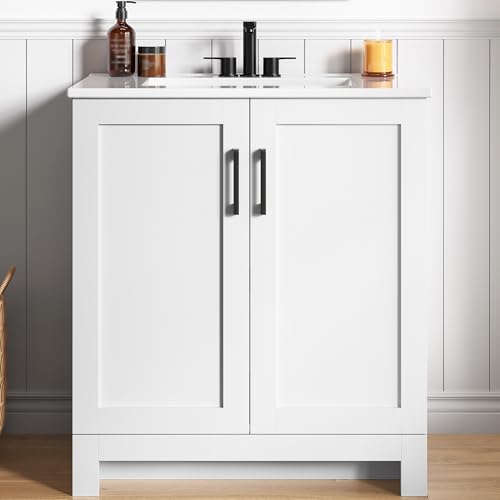
5. LIKIMIO 30 Inch Bathroom Vanity with Sink — Best for Small Bathrooms
At 30 inches, the LIKIMIO threads the needle that defines small-bathroom design: a freestanding white vanity with an integrated ceramic sink, two soft-close doors, and modern styling that makes a small room feel deliberate rather than compromised. The integrated ceramic top is the right call at this size — one seamless surface, no separate top to source, no seam lines to grime. It suits small full bathrooms, ensuites, and basement baths where every inch is budgeted. It is less suited to anyone needing drawer storage — the cabinet format with doors is what fits at 30 inches — and tall users should check the cabinet height against their comfort.
Strengths
- Integrated ceramic sink top simplifies purchase and cleaning.
- Soft-close doors at a compact size and friendly tier.
- Easy assembly compared with larger furniture vanities.
Trade-offs
- Door cabinet only — no drawers for small-item organization.
- Counter space is minimal by definition at 30 inches.
- MDF-class construction rather than solid wood.
Small bathrooms punish both extremes: a too-large vanity makes the room unusable, and a pedestal sink wastes the room’s only storage opportunity. The LIKIMIO’s 30-inch cabinet format is the balanced answer — real concealed storage, a proper sink, soft-close hardware, and a footprint that leaves the room breathing. For the enormous number of homes whose second bathroom is a closet with plumbing, this is the bestselling formula for a reason.
Best for: small full bathrooms, ensuites, basement baths. / Not suited for: drawer-storage seekers.
Check on Amazon — check the current price on Amazon.

6. Yaheetech 24 Inch Bathroom Vanity with Sink — Best for Powder Rooms
The smallest pick is built for the smallest rooms: a 24-inch freestanding cabinet with a ceramic basin, two doors and a drawer, soft-close hardware, and a compact MDF cabinet that assembles easily. In a powder room — where the vanity’s job is a hand-washing basin, a little hidden storage for supplies, and not overwhelming a tiny footprint — 24 inches done well beats 36 inches done awkwardly. It suits powder rooms, half baths, and tight ensuites. It is less suited to a primary bathroom role, where its basin size and storage will frustrate daily use, and its MDF construction asks for prompt wiping of standing water, as all compact budget vanities do.
Strengths
- True powder-room scale with both a drawer and cabinet storage — rare at 24 inches.
- Ceramic basin included; soft-close door and drawer.
- Budget-friendly tier and easy assembly for a weekend project.
Trade-offs
- Basin and counter are sized for hand-washing, not full bathroom routines.
- MDF cabinet needs water discipline to live long.
- Not a primary-bathroom solution despite its good looks.
The Yaheetech succeeds by respecting its brief. Powder rooms are where guests judge a home’s finish quality, and a neat, complete, soft-close vanity at the right scale reads as considered design, while a cramped oversized unit reads as a mistake. The inclusion of both a drawer and doors at this size is the detail that sells it — hand towels and supplies disappear, and the little room stays serene. Buy it for the room it was designed for and it will not disappoint.
Best for: powder rooms, half baths, tight ensuites. / Not suited for: primary bathroom duty.
Check on Amazon — check the current price on Amazon.
Comparison Table
| Pick | Badge | Key spec | Best for |
|---|---|---|---|
| DKB Beckford 72″ | Best Overall | Quartz top, 6 dovetail drawers, double sink | Primary suites |
| DELUXE LIVING 60″ | Best Solid-Wood Build | Solid wood, marble top, fully assembled | Furniture-grade double vanity |
| LUXOAK 61″ Barn Door | Best Farmhouse Style | Sliding barn doors, double sink | Rustic bathrooms |
| DELUXE LIVING 48″ | Best Mid-Size | Solid wood, stone top, 7 drawers | Family bathrooms |
| LIKIMIO 30″ | Best for Small Bathrooms | Integrated ceramic sink, soft-close | Small full baths |
| Yaheetech 24″ | Best for Powder Rooms | Ceramic basin, drawer + doors | Half baths |
How to Choose a Bathroom Vanity: Measure First, Fall in Love Second
Vanity shopping fails in one predictable way: a beautiful unit meets an unmeasured bathroom. Begin with the three numbers that cannot be negotiated. Width: measure the wall space, then subtract respect for door swing, toilet clearance codes, and the simple fact that a vanity wedged wall-to-wall with zero tolerance is miserable to install and clean around. Depth: standard vanities run about 21 inches deep; in a narrow bathroom, a reduced-depth model buys back precious floor. Height: modern comfort height (around 32–36 inches including the top) suits most adults better than the low vanities of older homes; check it against the tallest and shortest users in the house.
Then interrogate your plumbing, because it quietly vetoes designs. Note where the drain and supply lines exit the wall or floor, and their height. Drawers are the first casualty: a full drawer box collides with a drain trap unless the vanity uses U-shaped plumbing drawers or the drawer stack sits clear of the rough-in. Door cabinets forgive almost any plumbing; drawer-heavy designs reward a tape-measure check against the product’s interior diagram before ordering. Floor-exit plumbing rules out some floating and leg designs; wall-exit plumbing is the flexible case. Faucet configuration is the third check: single-hole, centerset, or widespread drilling on the top must match the faucet you intend, and combo units with pre-drilled tops decide this for you — one more reason combos dominate the bestseller lists.
Finally, choose materials for a wet room honestly. Solid wood and quality plywood tolerate humidity cycles; foil-wrapped MDF is fine in a powder room with disciplined wiping and risky under a family’s daily shower steam unless the manufacturer has sealed it seriously. Tops follow the same logic: quartz for zero maintenance, marble for beauty with a sealing habit, ceramic integrated tops for seamless small-bath practicality. The bestselling vanities in this guide are, not coincidentally, the ones whose material choices match the rooms they are sized for.
How to Install a Bathroom Vanity Without the Classic Disasters
Installation is a half-day of care or a week of regret, and the difference is sequencing. First, dry-fit everything: set the vanity in place before any sealant or fastener, check it for level (bathroom floors are rarely level — keep shims in the toolkit), confirm drawers and doors clear the plumbing, and mark the stud locations on the wall. A vanity must anchor to studs or solid blocking; drywall anchors alone under a stone top is a slow-motion accident. Shut off the water and test the shutoffs before disconnecting anything — the middle of a vanity swap is the worst time to learn a valve does not close.
Connect plumbing with the top off if the design allows, because trap and supply work through an open cabinet is twice as fast and half as knuckle-scraping. Set the top with a bead of silicone where the maker directs, mount the faucet before the top goes on whenever possible (faucet nuts are far easier reached on a bench than under a cabinet), and run water to test every joint with dry paper towels beneath them before the backsplash is sealed. Caulk the backsplash-to-wall joint with bathroom silicone, not the gap between top and cabinet, which should stay serviceable. Fully assembled vanities shorten this process enormously — one reason they dominate this list — but even they demand the dry-fit and level steps. Finish by running the drawers through their travel with the plumbing live: the trap-versus-drawer collision is the classic disaster, and it is far better discovered with a flashlight today than by a flooded drawer of cosmetics next month.
Vanity Materials and Finishes: What Survives a Wet Room
A bathroom vanity lives in the most hostile furniture environment in the house: daily steam, standing water at the sink edge, spilled cosmetics and solvents, and cleaning chemicals. Material choice is therefore not an aesthetic footnote — it is the lifespan decision. Solid wood, used in the DELUXE LIVING frames on this list, tolerates humidity cycles by expanding and contracting as a natural material should, and it can be sanded, repaired, and refinished across decades. Its enemies are prolonged standing water at the base and neglected finish damage; treat those and it outlasts everything else in the room. Plywood is the respectable second: dimensionally stable, strong, and far more moisture-tolerant than its reputation suggests when the edges are properly sealed.
MDF and particleboard, used in compact models like the LIKIMIO and Yaheetech, are engineered for exactly the price-and-scale niche they occupy. Their weakness is specific: once water breaches the surface finish and reaches the core — at a swollen toe-kick, a chipped edge, a perpetually wet floor line — the core expands and does not come back. In a powder room with disciplined wiping, that risk is theoretical for years. In a steamy family shower room, it is a countdown. Buy MDF with eyes open and a dry-floor habit, and it serves honestly; buy it for a wet-room war zone and no finish will save it.
Tops divide by maintenance personality. Quartz (the Beckford) is the set-and-forget surface: non-porous, stain-resistant, no sealing, tolerant of the cosmetics counter’s entire chemical arsenal. Marble (the DELUXE LIVING models) is beautiful, cool, and honest about its needs — annual sealing, prompt attention to acids and pigments, and acceptance that a lived-in patina is part of the material’s character. Integrated ceramic (LIKIMIO, Yaheetech) removes the seam between top and basin entirely, which removes the grime line and the leak path with it — the most practical surface at small sizes. Cultured stone and engineered stone combos split the difference. The finish on the cabinet deserves the same scrutiny: catalyzed and multi-coat finishes resist bathroom chemistry; a single decorative coat over MDF in a shower room is a promise with an expiry date. Read the bestselling formula in this guide as a materials lesson — the models that sell pair each size class with the materials that survive it.
Storage That Works Around Plumbing: Drawers, Cabinets, and the Trap Problem
Every vanity interior is a negotiation with a drain trap and two supply lines, and the designs that sell best are the ones that negotiated cleverly. The classic failure is the full-depth drawer that meets the trap: beautiful in the showroom, immovable in your bathroom. The industry’s answers are worth knowing by name so you can shop for them deliberately. U-shaped (plumbing) drawers wrap their box around the trap, surrendering a notch of volume to keep the drawer functional — the design that makes drawer-heavy vanities like the DELUXE LIVING 48 possible in real bathrooms. Tiered stacks place shallow drawers above the trap’s height and deep storage below or beside it. Door cabinets — the LIKIMIO and Yaheetech pattern — sidestep the negotiation entirely, trading drawer convenience for total plumbing forgiveness, which is why they dominate the compact classes where rough-in positions vary wildly between houses.
Organizing what you choose matters as much as choosing it. Drawers win for the small-item chaos of a bathroom — brushes, bottles, chargers, first aid — because everything is visible from above and nothing hides behind anything else. Cabinets win for tall bottles, cleaning supplies, and the spare-towel stack. The hybrid layouts on this list (doors plus drawers, as in the Beckford and Yaheetech) reflect how bathrooms are actually stocked: a drawer for the daily dozen small things, a cabinet for the bulky rest. When comparing two finalists, open the interior photos and mentally load your own countertop clutter into them; the vanity that swallows your real clutter with the trap in place is the one that will still feel organized in month six. And measure your tallest bottle — the under-sink cabinet that cannot stand a shampoo bottle upright is a daily irritation no soft-close hinge can soothe.
Common Buying Mistakes
Ordering by width alone. Depth and height decide whether the room works. A 60-inch vanity at full depth in a narrow bathroom steals the floor the toilet and door need.
Ignoring the plumbing’s position. Drawer stacks and drain traps occupy the same space in many designs. Check the interior diagram against your rough-in before ordering, not during installation.
Buying cabinet-only when you wanted a combo. Sourcing a top and sink separately invites fit, drilling, and color-match failures. If you are not deliberately customizing, the combo units that dominate bestseller lists are the safer purchase.
Choosing marble without accepting marble. It etches and stains in exchange for its beauty. Households that will not seal and wipe should buy quartz and never think about it again.
Forgetting the delivery route. A fully assembled 60- or 72-inch vanity must pass every doorway, hallway turn, and stair between the truck and the bathroom. Measure the route, not just the room.
Undersizing storage to save width. A vanity two inches narrower that forces countertop clutter costs more daily happiness than the two inches buy. In small baths, choose designs like the LIKIMIO and Yaheetech that engineer storage into compact footprints.
Matching the Vanity to the Renovation: Full Gut, Cosmetic Refresh, and Rental
The right vanity depends on which renovation you are actually doing, and confusing the three is a quiet source of overspending. In a full gut renovation, the walls are open and the plumbing can move — which means drawer vanities stop being a gamble, because the rough-in can be placed to suit the cabinet rather than the reverse. This is the moment for the Beckford or the DELUXE LIVING doubles: invest in the furniture-grade piece while the room is already dust, because the marginal cost of the better vanity is smallest when installation labor is already committed. Choose the top for the decade, not the season — quartz’s neutrality outlasts trend cycles that stone patterns and bold cabinet colors do not.
In a cosmetic refresh — paint, mirror, lighting, and a vanity swap against existing plumbing — the constraints invert. The rough-in is fixed, the floor and walls are finished, and the vanity must fit the room as found. Combo units with forgiving door cabinets (LIKIMIO’s pattern) or verified plumbing clearances are the safe buys, fully assembled delivery matters even more because there is no construction zone to build in, and the measurement discipline in the guide above is the whole game. Most bestseller volume lives here, which is why the bestselling designs are disproportionately combos with tolerant interiors.
For rentals and resale preparation, the calculus is durability per dollar and neutrality per viewer. The Yaheetech and LIKIMIO class — complete, clean, soft-close, correctly sized — returns more in perceived quality than a premium piece in a room that does not support it, and MDF’s moisture caveat is manageable in a powder room or a ventilated bath with tenants who wipe. Landlords should still favor integrated ceramic tops: one seamless surface, no grout line at the basin, nothing for a tenant’s standing water to attack. Across all three renovation types, the pattern repeats: the bestselling vanity is never the most exotic object available — it is the one whose size, storage, materials, and plumbing tolerance all match the room it will actually live in.
What a Vanity Replacement Really Involves: Timeline and Hidden Work
First-time renovators consistently underestimate a vanity swap because the vanity is the visible object in a system of invisible ones. The realistic sequence runs: shut off and drain the supply lines; remove the old top, faucet, and cabinet (budget genuine time for this — old vanities are caulked, screwed, and occasionally built into the room’s trim); inspect what the removal reveals, because the wall behind a twenty-year-old vanity frequently carries water damage, mold history, or plumbing that predates current fittings; repair and, if the budget allows one upgrade, add shutoff valves that actually shut off. Only then does the new vanity go in, followed by the top, faucet, trap assembly, and the sealant work that must cure before the sink sees water.
The hidden work is where schedules slip. Flooring rarely runs under the old vanity, so a new cabinet with a different footprint can expose unfinished floor — one more argument for matching or exceeding the old footprint, or for choosing a legged design that reads the exposed patch as intentional. Wall finish tells the same story: a new backsplash lower than the old one’s paint line advertises the renovation’s seam. Mirror and lighting positions were composed for the old vanity’s height; a taller comfort-height cabinet can push the mirror’s sightline and the sconces’ spacing off their marks. None of this is a reason not to replace a vanity — it is the reason the bestselling models cluster at standard widths, standard depths, and combo completeness: standard dimensions maximize the chance that the new piece lands inside the old piece’s shadow, and a combo eliminates the top-and-basin fitting sessions entirely. Plan the swap as a weekend with a contingency day, keep a bucket and towels in the room until the trap has survived a full day of use, and the project stays the satisfying kind of renovation instead of the other kind.
Vanity Heights, Depths, and Floating vs Freestanding: The Remaining Decisions
Three specification choices remain after size and storage, and each has a correct answer per household rather than a universal one. Height: older vanities sat low, around 30–32 inches, a legacy of an era that treated the vanity as a washstand. Modern comfort height — roughly 34–36 inches to the countertop — matches kitchen-counter ergonomics and spares adult backs the daily stoop; it is the right default for primary bathrooms used by adults, while a lower height still serves children’s bathrooms and shorter users better. Mixed-height households should optimize for the person with the back complaint, not the average. Depth: the standard 21-inch depth assumes a standard room; shaving to a reduced-depth model in a narrow bath buys floor space at the cost of counter area and some sink size, a trade that small bathrooms (the LIKIMIO and Yaheetech’s natural habitat) usually win by making.
Floating versus freestanding is the stylistic fork. Wall-mounted floating vanities open the floor visually, make cleaning beneath effortless, and suit modern designs — at the cost of demanding solid wall blocking and offering no toe-kick concealment for floor-exit plumbing. Freestanding models, which are every pick in this guide, forgive floors and plumbing, carry more visual weight, and install without structural wall work. In renovations of older homes — uneven floors, uncertain wall studs, plumbing where it pleases — freestanding is the pragmatic default, and its dominance of the bestseller lists is the market agreeing. Choose floating when the room and the wall are ready for it and the design brief is modern; choose freestanding for everything else, and spend the saved complexity on drawers and tops instead.
Budget framing, finally, in the qualitative terms this guide uses throughout: the compact combos (Yaheetech, LIKIMIO) sit at the budget tier and solve small rooms completely; the mid-size DELUXE LIVING 48 occupies the value-premium middle where most family renovations land; and the doubles — Beckford, DELUXE LIVING 60, LUXOAK — are premium-tier purchases whose cost should be judged across the decades a primary bathroom serves, not against the month’s renovation budget alone. A vanity is the rare purchase where the expensive mistake is usually buying down: the too-small, too-shallow, wrong-material unit is the one that gets replaced, and replacement is the most expensive vanity of all.
A last word on mirrors and hardware, because they finish the vanity’s job: a vanity is read as a unit with its mirror and faucet, and the bestselling cabinets in this guide succeed partly because their finishes — white, greige, barnwood — accept a wide range of metals and mirror frames without fighting them. When you choose the vanity, choose the faucet finish in the same sitting, and hold a hardware sample against the cabinet finish in daylight. Five minutes of coordination at purchase prevents the most common reason a well-chosen vanity looks subtly wrong in photographs for a decade.
Delivery day deserves its own sentence in the plan: inspect the cabinet on the truck, before signing, for the damage that only happens in transit — a crushed corner, a cracked top edge — because a vanity is large enough that returning it is an event. Photograph anything questionable, note it on the delivery paperwork, and keep the packaging until the unit is installed and the drawers have run. Bestselling models move through warehouses at volume; the inspection habit is the buyer’s share of quality control.
Photograph the installed result in daylight before the first toothpaste lands: it is your reference for the finish’s original state, and — years from now, at resale or at the next renovation — the comparison that tells you whether the room aged gracefully. Bestselling vanities photograph well because they were designed to; keep yours looking like the photograph and the room keeps its value.
Final Recommendation
For a primary bathroom with the width, the DKB Beckford 72-inch is the complete answer — quartz, drawers, double sinks, done. If you value furniture-grade construction and natural stone, the DELUXE LIVING 60-inch is the connoisseur’s double. Farmhouse renovations belong to the LUXOAK barn door. The standard family bathroom is best served by the DELUXE LIVING 48-inch and its seven drawers. Small full baths should take the LIKIMIO 30-inch, and powder rooms the Yaheetech 24-inch. Across all of them, the formula that makes these models bestsellers is the same: measure honestly, respect the plumbing, and buy the package complete.
Related guides in this cluster: Best Bathroom Vanities, Best Double Sink Bathroom Vanities, Best Small Bathroom Vanities, and Best Bathroom Vanity Tops.
Frequently Asked Questions
What faucet drilling should I choose with a vanity top?
Match the top’s drilling to the faucet style before ordering either: single-hole for modern single-lever faucets, 4-inch centerset for the classic compact format, and 8-inch widespread for the traditional two-handle look. Combo units decide this for you — check the listing’s drilling before falling for a faucet it cannot accept. When in doubt, single-hole tops accept the widest range of current faucets, including many vessel and tall designs.
How long does a bathroom vanity last?
A solid-wood or quality plywood vanity with a stone or quartz top can serve for decades — it is furniture-grade infrastructure. MDF-based compact vanities in dry, ventilated rooms commonly serve many years; in steamy, poorly ventilated bathrooms their lifespan shortens, which is why matching material to room matters more than any single product choice. Soft-close hardware and finishes can be refreshed long before the cabinet itself needs replacing.
What is the most popular bathroom vanity size?
Single vanities at 48 inches and double vanities at 60–72 inches dominate primary bathrooms, while 24–30 inch models lead in powder rooms and small baths. The right size is the largest your room fits while preserving door swing and comfortable clearance — measure the room, not the trend.
Is it better to buy a vanity with the top and sink included?
For most renovators, yes. Combo units guarantee the top fits the cabinet, the sink fits the top, and the faucet drilling matches — eliminating the three most common compatibility failures. Cabinet-only purchases make sense when you are deliberately pairing a custom stone top.
Quartz or marble vanity top — which should I choose?
Quartz for zero maintenance: it resists stains and needs no sealing. Marble for natural beauty, accepting periodic sealing and prompt cleanup of acids and pigments. In a busy family bathroom, quartz is the pragmatic default; in a primary suite where you will enjoy the stone daily, marble earns its care.
Can I install a bathroom vanity myself?
A confident DIYer can, especially with fully assembled combo units: the work is leveling, anchoring to studs, and standard trap and supply connections. Hire a plumber if your shutoffs are unreliable, the rough-in needs moving, or the drain position conflicts with the vanity’s drawers — those are the jobs where a small professional bill prevents a large water bill.
How do I know if drawers will clear my plumbing?
Compare your drain’s height and horizontal position with the vanity’s interior diagram. Many modern drawer vanities use U-shaped drawers that wrap the trap; if the listing does not show the interior layout, treat that as a question to resolve with the seller before ordering.
What vanity material lasts longest in a humid bathroom?
Solid wood and quality plywood cabinets with properly finished interiors handle humidity cycles best. MDF-based vanities can serve well in powder rooms and ventilated baths but demand prompt wiping of standing water and good exhaust ventilation in shower rooms.
