Disclosure: airfryerkitchensupply.com is reader-supported. When you buy through links on our site, we may earn an affiliate commission at no extra cost to you.
Where to buy
The fastest way to buy any pick in this guide is through Amazon, where stock, color options and delivery timing are shown live on the listing. Prices move often, so this guide never prints a fixed price — use the links below to check the current price on Amazon for the exact configuration you want.
- VINGLI 18-Inch Floating Fluted Bathroom Vanity with Ceramic Sink — check price on Amazon
- Guxeei 18-Inch Freestanding Bathroom Vanity with Sink — check price on Amazon
- Wenore Home 18-Inch Small Bathroom Vanity with Vessel Sink, Black — check price on Amazon
- Vanity Art 20-Inch Bathroom Vanity with Ceramic Top, Walnut — check price on Amazon
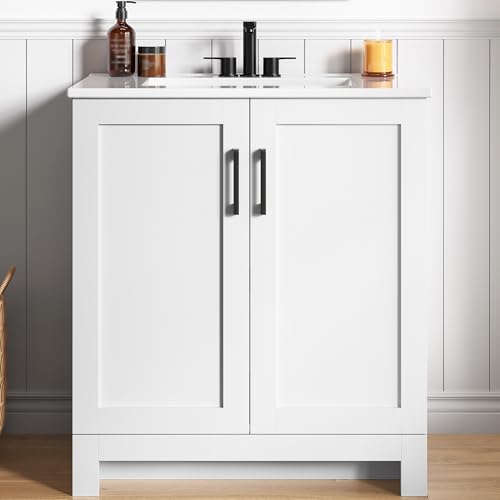
- Yaheetech 24-Inch Bathroom Vanity with Sink, White — check price on Amazon
- T4TREAM 30-Inch Fluted Bathroom Vanity with Ceramic Sink, Natural Oak — check price on Amazon
Every product named in this guide to the best small bathroom vanities with sink was cross-checked against Amazon’s own catalog data before it earned a link. Picks that could not be confirmed that way are discussed in plain unlinked, with no purchase link, so you are never sent to a guessed listing.
The best small bathroom vanities with sink solve three problems at once in the rooms that have the least space to solve them: they put a proper basin at a comfortable height, they hide the plumbing and the clutter, and they do it inside a footprint — 18 to 30 inches wide — that leaves room for the door to swing and a person to stand. Every vanity in this guide includes its sink, was matched against Amazon’s catalog data before earning a link, and was chosen because its dimensions, verified in the listing, genuinely qualify as small.
Small is a discipline, not just a size. A 30-inch vanity in a powder room behaves like furniture; an 18-inch vanity in a narrow rental bathroom is the difference between a functional room and a pedestal sink with nowhere to put a toothbrush. The picks below split across that range deliberately: two true 18-inch space-savers in floating and freestanding forms, a solid-wood 20-inch option, a storage-rich 24-inch cabinet, and a 30-inch fluted design for small-but-primary bathrooms that can spare the width.
Two honest notes before the picks. First, faucets are rarely included at this size and price class — budget for one separately, and check the listing’s faucet-hole configuration against the faucet you choose. Second, no fixed prices are printed here, because they change constantly; each vanity is positioned by tier and linked so you can check the current price on Amazon for the exact finish you want.
One more framing before the picks, because small-vanity regret usually arrives in one of two specific forms. The first is storage regret: the vanity looked complete in the listing and turns out to hold three bottles and a sense of betrayal. The second is scale regret: the vanity fit the wall measurement and still made the room feel smaller, because nobody accounted for door swings, drawer arcs and the human being who has to stand in front of it. Every review below therefore states storage in terms of what the cabinet actually organizes, and the buying guide gives you a tape-measure protocol that catches scale regret before the box is opened. Read those two things and the rest is taste.
In this guide
Quick Picks
Best Overall: VINGLI 18-Inch Floating Fluted Bathroom Vanity with Ceramic Sink — an 18-inch wall-mounted vanity with a fluted door and ceramic sink — maximum visual space in the minimum footprint. — Check on Amazon
Best Freestanding 18-Inch: Guxeei 18-Inch Freestanding Bathroom Vanity with Sink — the same minimal footprint without the wall load — soft-closing door, storage rack and divider inside. — Check on Amazon
Best Modern Look: Wenore Home 18-Inch Small Bathroom Vanity with Vessel Sink, Black — a narrow black cabinet with a vessel sink — the design-forward 18-inch option for contemporary powder rooms. — Check on Amazon
Best Solid Wood: Vanity Art 20-Inch Bathroom Vanity with Ceramic Top, Walnut — a solid wood frame at 20 inches with a ceramic top and soft-closing door — the durability pick for a small primary bathroom. — Check on Amazon
Best Storage at 24 Inches: Yaheetech 24-Inch Bathroom Vanity with Sink, White — two doors plus a drawer and a ceramic basin — the first size where a small vanity stops apologizing for storage. — Check on Amazon
Best for Small Primary Bathrooms: T4TREAM 30-Inch Fluted Bathroom Vanity with Ceramic Sink, Natural Oak — 30 inches of fluted natural oak with two doors, three drawers and a ceramic sink — a real primary-bathroom vanity that still counts as small. — Check on Amazon
How These Picks Were Chosen
Candidates had to pass a dimensional audit first: width at or under roughly 30 inches, depth shallow enough for small-room clearances, and a sink genuinely included in the box — cabinet-only listings and top-only listings were excluded, however good they looked. The survivors were then judged on the things that decide whether a small vanity is a pleasure or a regret: storage that fits real bottles rather than brochure props, soft-close hardware, basin depth, and whether the construction is solid wood, quality MDF, or something in between.
Installation style was the third screen. Floating vanities free floor space visually and make cleaning under the cabinet effortless, but they demand solid wall anchoring. Freestanding units forgive uneven floors and old walls, and suit rentals and quick renovations. This guide includes both, clearly labeled, so the choice is about your walls rather than about which vanity is ‘better’.
Finally, every pick’s title, dimensions and sink inclusion were verified against the catalog listing itself. Small vanities are a category rife with misleading photography — cabinets shot to look generous — so the verified dimensions in each spec box below are the numbers to trust.
A note on materials honesty, since small vanities are sold with more euphemism per inch than any other furniture: where a pick is solid wood, the review says so; where it is MDF or engineered board — a legitimate material at the right tier, used by several picks here — the review says that too, along with the one habit that decides an MDF vanity’s lifespan, which is wiping standing water rather than letting it sit on edges and seams. Construction was never used as a proxy for worth in this shortlist; it was used as a predictor of lifespan, and each pick’s tier was judged against the lifespan its materials can honestly deliver.
The 6 Best Small Bathroom Vanities With Sink

VINGLI 18-Inch Floating Fluted Bathroom Vanity with Ceramic Sink — Best Overall
The VINGLI is the small-bathroom answer that makes the room look bigger while it works: an 18-inch floating cabinet with a fluted single door and a white ceramic sink, wall-mounted so the floor runs visibly underneath. It suits powder rooms, narrow ensuites and rental bathrooms where every visible inch of floor lowers the sense of crowding, and where a pedestal sink currently offers nowhere to put anything.
Strengths
- True 18-inch width with sink included, verified in the listing
- Floating design frees floor visually and makes mopping effortless
- Fluted door front gives a current, designed look at a small scale
Trade-offs
- Wall-mounting demands solid anchoring — not for weak or hollow walls alone
- Single-door cabinet storage is modest, as all 18-inch vanities are
- Ceramic sink is compact; enthusiastic face-washing will splash
| Width | 18 inches |
| Mounting | Wall-mounted floating |
| Sink | White ceramic, included |
| Front | Fluted single door |
Floating vanities earn their keep in small rooms through a perceptual trick that is also practical: the eye reads the uninterrupted floor as space, and the mop reads it as access. In an 18-inch width you are never buying generous storage — you are buying a basin, a door’s worth of concealed space for the daily bottles, and a room that feels less like a closet. The fluted front matters more than decoration usually does, because in a tiny room the vanity is the largest object in your sightline; a textured, furniture-like front makes the whole room feel renovated rather than merely equipped.
Install it with respect for the format: locate studs or use proper heavy-duty anchors, confirm the wall can carry a loaded cabinet plus a leaning adult’s incidental weight on the basin edge, and plan the plumbing to exit through the wall where possible so the floating line stays clean. Households with crumbling plaster or tile-over-drywall uncertainty should choose the freestanding Guxeei below instead — same footprint, no wall loads.
A word on living with the floating format day to day: the space beneath becomes the bathroom’s most useful few inches — a scale slides under it, a step stool parks under it in family bathrooms, and the robot vacuum, if your home has one, treats it as open road rather than an obstacle course. Owners of floating vanities consistently report that the room feels cleaned rather than cleaned-around. Paired with a mirror that carries its own storage — a medicine cabinet — the VINGLI’s modest cabinet stops being a limitation entirely, and the powder room works like a room twice its width.
Best for: powder rooms and narrow bathrooms with sound walls / Not suited for: weak walls or households needing maximum storage
Check on Amazon to check the current price on Amazon for this pick.

Guxeei 18-Inch Freestanding Bathroom Vanity with Sink — Best Freestanding 18-Inch
The Guxeei takes the 18-inch brief and answers it with legs instead of anchors: a freestanding cabinet with sink included, a soft-closing door, and an interior storage rack and divider that squeeze organization out of a tiny volume. It suits renters who cannot drill into tiled walls, older homes with questionable wall construction, and anyone who wants the vanity installed the same afternoon it arrives.
Strengths
- Freestanding — no wall anchoring, renter-friendly installation
- Soft-closing door, unusual at this size and tier
- Interior rack and divider make the small cabinet genuinely usable
Trade-offs
- Legs and a floor footprint read as slightly more visual bulk than a floating unit
- Storage remains 18-inch-class modest
- Floor-standing cabinets collect dust at the base that floating units avoid
| Width | 18 inches |
| Mounting | Freestanding |
| Sink | Included |
| Interior | Storage rack and divider, soft-closing door |
What separates this from other 18-inch freestanding units is the interior thinking. Most tiny vanities are an empty box behind a door, into which bottles fall and disappear. The rack and divider here impose just enough structure that the daily items — toothpaste, a hairbrush, cleaning spray — have places, which is the difference between a cabinet that gets used and a cabinet that becomes a dark cupboard of last resort. The soft-closing door is the other quality-of-life detail: in a small bathroom you open this door constantly, and a door that closes with a thunk ages a room, while one that glides shut makes the vanity feel a class above its tier.
Freestanding also future-proofs the room. When the bathroom is renovated properly in five years, this vanity unbolts from its plumbing and leaves; a floating unit leaves anchor holes and possibly tile damage. For a first fix of a bad small bathroom — the highest-impact, lowest-commitment upgrade available — this is the pragmatic pick.
The Guxeei’s divider-and-rack interior rewards a specific setup: dedicate the rack side to the daily verticals — toothbrushes in a cup, toothpaste, the hair product — and the open side to the horizontal stock of wipes, cotton and cleaning spray. Set up that way on day one, the tiny cabinet develops the one habit that makes small storage work, which is that everything has a visible place and returns to it. It is a small discipline, but it is the difference between an 18-inch vanity that feels organized for years and one that becomes a jumble by the second month.
Best for: renters and quick small-bathroom upgrades / Not suited for: buyers chasing the floating look
Check on Amazon to check the current price on Amazon for this pick.

Wenore Home 18-Inch Small Bathroom Vanity with Vessel Sink, Black — Best Modern Look
The Wenore Home vanity is the style pick at 18 inches: a narrow black freestanding cabinet topped with a vessel sink and a soft-close door, built for small spaces that are being designed rather than merely fixed. Vessel basins sit above the counter, which buys back cabinet room below — the plumbing geometry that makes a vessel more than a fashion choice in a tiny vanity.
Strengths
- Vessel sink configuration preserves cabinet space underneath
- Black finish delivers a deliberate, modern powder-room statement
- Soft-close door at an 18-inch footprint, verified in the listing
Trade-offs
- Vessel basins splash more and sit higher — check total height for shorter users and kids
- Black shows water spots and toothpaste with enthusiasm
- Tall vessel faucets are required and sold separately
| Width | 18 inches |
| Sink | Vessel sink, included |
| Finish | Black |
| Door | Soft-close |
The vessel-versus-integrated question is usually argued as aesthetics, but at 18 inches it is arithmetic. An integrated basin drops into the cabinet and consumes the top third of its volume with bowl and trap geometry; a vessel sits on top, letting the cabinet below stay box-shaped and usable. In a vanity this small, that recovered volume is the difference between storing the cleaning bottles inside or under the bathroom sink’s next-door neighbor. The height cost is real, though — measure the total rim height and be honest about who uses the room. For an adults’ powder room, the drama of the black-and-vessel combination is worth it; for a kids’ bathroom, choose one of the integrated picks instead.
Black cabinetry in a wet room also demands a wipe-down habit: hard-water spots read as grey dusting on black within days. A quick weekly wipe keeps it showroom-sharp, and in a powder room — the bathroom guests actually judge — that small discipline pays design dividends out of all proportion to the vanity’s size.
Styling note for the Wenore, because a black vanity is a commitment to a palette: it looks best with the contrast turned up — white or light walls, a light counter-adjacent surface somewhere in the room, and fixtures in chrome or brushed nickel that give the eye a second note. In an already-dark bathroom it can disappear into gloom, so if your powder room has no window and dark tile, choose the white Yaheetech pattern or the VINGLI instead. In the right room, though, guests will ask where the vanity came from, and they will not believe the width when you tell them.
Best for: design-led powder rooms for adults / Not suited for: kids’ bathrooms or low-maintenance households
Check on Amazon to check the current price on Amazon for this pick.

Vanity Art 20-Inch Bathroom Vanity with Ceramic Top, Walnut — Best Solid Wood
Vanity Art’s 20-inch vanity is the build-quality argument in miniature: a solid wood frame rather than an all-MDF box, a ceramic top with integrated sink, a soft-closing door, and a walnut finish with brushed hardware. Two extra inches over the 18-inch picks buy a noticeably more usable basin and cabinet, making this the pick for a small primary bathroom that must serve daily for a decade, not a powder room that serves weekly.
Strengths
- Solid wood frame — the construction upgrade that matters most in a wet room
- Ceramic top with integrated sink, easy to wipe and keep sealed
- Soft-closing door and quality hardware at a 20-inch footprint
Trade-offs
- Walnut finish narrows the palette of bathrooms it suits
- Heavier than MDF rivals — plan the install accordingly
- Mid-range tier positioning above the 18-inch budget picks
| Width | 20 inches |
| Frame | Solid wood |
| Top | Ceramic with integrated sink |
| Finish | Walnut, brushed hardware |
Bathrooms kill cheap cabinets from the inside out: steam, splashes and the occasional slow leak swell MDF edges until the finish bubbles. A solid wood frame does not make a vanity immortal, but it changes the failure timeline from years to decades, and it holds screws, hinges and door alignment the way particleboard never does after its first swelling. In a 20-inch vanity that will be opened thousands of times, that structural honesty is the feature — the walnut finish and linear detailing are simply how it looks while delivering it.
The ceramic top deserves its own note. Integrated ceramic is the easiest small-vanity surface to live with: no seam between top and basin to trap grime, no stone to seal, and a gloss that wipes clean in seconds. For a small primary bathroom — the room where a couple gets ready in shifts — this combination of honest frame and zero-fuss top is the grown-up choice, and the two extra inches over 18 make morning routines measurably less elbowed.
The walnut finish has a practical virtue beyond its looks: mid-tone wood is the most forgiving surface in a bathroom for the visual noise of daily life — water spots, dust and toothpaste specks all read as texture rather than evidence, where white shows the specks and black shows the spots. Combined with the solid frame’s tolerance for a decade of door swings, the Vanity Art is the pick for the household that wants to install a small vanity once, correctly, and then think about other things for ten years. Some purchases are exciting; this one is satisfying, which lasts longer.
Best for: small primary bathrooms and long-term owners / Not suited for: powder rooms where budget matters more than lifespan
Check on Amazon to check the current price on Amazon for this pick.

Yaheetech 24-Inch Bathroom Vanity with Sink, White — Best Storage at 24 Inches
At 24 inches, a vanity crosses a threshold: there is room for two doors and a drawer, and the drawer is where small-bathroom sanity lives. The Yaheetech pairs that layout with a ceramic basin, soft-close door and drawer, and a white freestanding cabinet that assembles without drama. It suits small family bathrooms and ensuites where the vanity must hold two people’s daily kit, not just hide a trap.
Strengths
- Drawer plus double-door storage — the most usable layout in this guide
- Ceramic basin with soft-close door and drawer, verified in the listing
- Freestanding white cabinet suits most existing bathrooms without a restyle
Trade-offs
- Assembly is required — allow an unhurried hour
- MDF construction asks for prompt wiping of standing water
- 24 inches still will not swallow bulk storage like spare towels
| Width | 24 inches |
| Storage | 2 doors + 1 drawer |
| Sink | Ceramic basin, included |
| Mounting | Freestanding, white |
The drawer is the argument. Doors hide volume; drawers organize it. In a 24-inch vanity, the drawer takes the daily small chaos — toothpaste, floss, hair ties, the razor — in a single visible layer, while the cabinet below handles bottles and cleaning stock. Households upgrading from a pedestal sink consistently report that the drawer, not the basin, is what transforms the morning. Yaheetech’s execution is sensibly mainstream: white finish that matches the installed base of American bathrooms, soft-close hardware so the transformation is quiet, and a ceramic basin that shrugs off daily use.
Assembly is the honest cost. Flat-pack vanities reward patience — lay parts out, keep the cam locks snug, and seal the top edges with a bead of silicone where the basin meets the wall and cabinet. Do that, wipe standing water rather than letting it sit on MDF edges, and this vanity delivers years of service at a budget-friendly tier. If your bathroom is 24 inches of available width and no more, this is the configuration to beat.
Assembly advice from the pattern of owner experience with flat-pack vanities: build the cabinet in the room it will live in if you can, because a finished 24-inch cabinet does not always love a narrow bathroom doorway’s angles; keep every cam lock a quarter-turn past snug rather than forced; and run your silicone bead along the back top edge before the first splash, not after the first swelling scare. None of this is difficult, and all of it is the difference between a flat-pack vanity that feels homemade and one that feels installed. The drawer, once gliding, will be opened ten thousand times — set it up like it matters.
Best for: small family bathrooms and ensuites / Not suited for: buyers who refuse flat-pack assembly
Check on Amazon to check the current price on Amazon for this pick.

T4TREAM 30-Inch Fluted Bathroom Vanity with Ceramic Sink, Natural Oak — Best for Small Primary Bathrooms
The T4TREAM is the top of this guide’s size range and the pick for the small primary bathroom that can spare 30 inches: a fluted natural-oak cabinet with two soft-closing doors, three drawers and a ceramic sink combo. It is for renovators who want the current fluted-oak look and genuine storage, in a room where a 36- or 48-inch vanity would crowd the door swing or the toilet clearance.
Strengths
- Three drawers plus double doors — full primary-bathroom storage
- Fluted natural oak front delivers the current renovation look
- Ceramic sink combo included, with soft-closing doors, per listing
Trade-offs
- 30 inches is the ceiling of ‘small’ — measure door swing and clearances honestly
- Freestanding footprint reads larger in the room than a floating unit
- Design-led finish is a commitment to a warm-wood palette
| Width | 30 inches |
| Storage | 2 soft-closing doors + 3 drawers |
| Sink | Ceramic sink combo, included |
| Finish | Natural oak, fluted front |
Thirty inches is where a vanity stops being an apology. Three drawers mean his, hers and shared, or skincare, hair tools and first aid in a one-person primary; the double-door cabinet below swallows the cleaning bottles and the spare rolls. The fluted oak front is doing real work too — in a small primary bathroom, the vanity is the room’s largest piece of furniture, and a textured wood front lets it carry the room’s design the way a kitchen island carries a kitchen. Against white tile and black or brushed fixtures, it is the difference between a renovated bathroom and a merely updated one.
The cautions are spatial, not qualitative. Tape the footprint on the floor before ordering and live with it for a day: check the door swing, the drawer clearance against the bathroom door’s arc, and the code-comfortable space beside the toilet. If the tape test passes, this vanity delivers a primary-bathroom experience that the 18-inch picks, for all their cleverness, cannot — and it still leaves a small room feeling small in the good way: deliberate, fitted, finished.
For households torn between this and a 36-inch vanity, a deciding thought: the six inches you do not take are six inches the room keeps — for the door’s swing, for a laundry basket’s honest home, for the feeling that the bathroom was designed rather than filled. The T4TREAM’s three drawers recover most of what the larger cabinet would have stored, because drawer organization beats raw volume at bathroom scale. Renovators consistently over-buy width and under-buy drawers; this pick is the correction, in the finish of the moment, and it is why it closes the guide as the small-primary benchmark.
Best for: small primary bathrooms and design-led renovations / Not suited for: powder rooms or widths under 30 available inches
Check on Amazon to check the current price on Amazon for this pick.
Comparison Table
| Pick | Badge | Key spec | Best for |
|---|---|---|---|
| VINGLI 18-Inch Floating Fluted Bathroom Vanity with Ceramic Sink | Best Overall | 18in floating, ceramic sink | powder rooms and narrow bathrooms with sound walls |
| Guxeei 18-Inch Freestanding Bathroom Vanity with Sink | Best Freestanding 18-Inch | 18in freestanding, soft-close | renters and quick small-bathroom upgrades |
| Wenore Home 18-Inch Small Bathroom Vanity with Vessel Sink, Black | Best Modern Look | 18in, vessel sink, black | design-led powder rooms for adults |
| Vanity Art 20-Inch Bathroom Vanity with Ceramic Top, Walnut | Best Solid Wood | 20in solid wood, ceramic top | small primary bathrooms and long-term owners |
| Yaheetech 24-Inch Bathroom Vanity with Sink, White | Best Storage at 24 Inches | 24in, drawer + doors, ceramic | small family bathrooms and ensuites |
| T4TREAM 30-Inch Fluted Bathroom Vanity with Ceramic Sink, Natural Oak | Best for Small Primary Bathrooms | 30in fluted oak, 3 drawers | small primary bathrooms and design-led renovations |
How to Choose a Small Bathroom Vanity: Measure First, Then Storage, Then Style
Measurement is not a preliminary step in small-vanity buying; it is the decision. Measure the available width between walls or fixtures, then the depth your room can spare without the cabinet corner catching hips — small bathrooms often need the shallower depths that true small vanities offer. Check three clearances with a tape measure and a piece of painter’s tape on the floor: the bathroom door’s swing, the vanity’s own door and drawer arcs, and the working space in front of the basin where a person actually stands. A vanity that fits the wall but blocks the door’s last ten degrees will annoy you every single day.
Then interrogate the plumbing. Your supply lines and drain exit at fixed points; a vanity’s interior must accommodate them. Drawers are the usual casualty — many small vanities use a U-shaped top drawer or a false front to clear the trap, and that is fine, but know before ordering whether the drawer you are imagining is real. Floating vanities pair best with wall-exit drains; freestanding units forgive floor-exit plumbing and uneven floors. Photograph your plumbing, measure its height from the floor, and compare against the listing’s interior diagram or reviews before committing.
Storage honesty comes last. List what must live in the vanity — daily bottles, hair tools, cleaning stock, spare rolls — and match it against the cabinet’s real layout, not its volume. An 18-inch vanity holds a disciplined daily kit; it will never hold the household’s towel stock, and planning a separate slim tower or over-toilet shelf from the start beats discovering that in week two. Buy the vanity for the storage pattern it actually offers, and the small room will feel organized rather than compromised.
Floating vs Freestanding Small Vanities: Which Suits Your Walls and Your Life?
Floating vanities make small rooms feel larger, simplify floor cleaning to a single mop pass, and give the most renovated look — but they transfer the vanity’s entire loaded weight, plus the leverage of anyone who leans on the basin, into the wall. That demands studs or serious anchoring, and it makes them a poor gamble in bathrooms with crumbling plaster, unknown tile substrates, or rental agreements. When the wall is sound, the floating VINGLI in this guide is the strongest visual upgrade per inch available.
Freestanding vanities put the load on the floor, install in an afternoon with basic tools, forgive the uneven floors of older houses, and leave with you when you move. Their costs are a slightly heavier visual footprint and dust at the base. For renters, first renovations, and any bathroom whose walls you do not fully trust, freestanding is not the compromise option — it is the correct engineering choice, and the Guxeei and Yaheetech picks show how refined the format has become.
Faucets, Heights and Plumbing: The Small Print That Decides the Install
The faucet is the small vanity’s hidden second purchase, and it has rules. Match the faucet to the top’s drilling — single-hole, centerset or widespread — before falling in love with a design, and match its spout height and reach to the basin: a short faucet over a deep or vessel basin splashes and strands the water stream against the back wall of the bowl. Vessel sinks, like the Wenore pick, need a tall vessel faucet or a wall mount, and their total rim height lands several inches above a standard vanity’s — measure it against the shortest regular user, especially in a household with children, before choosing the look.
Height and plumbing clearances finish the picture. Standard vanity height has crept up toward counter height in modern lines, which taller households love and shorter ones should verify with a tape against their current sink. Inside the cabinet, locate your drain’s height from the floor and your supplies’ positions, and compare them to the vanity’s interior: drawers need U-shaped cutouts or false fronts to clear a trap, and a cabinet back that needs cutting is normal, not a defect — plan the cut before the vanity is against the wall. Ten minutes with a tape and a phone photo of your plumbing prevents every common install-day disaster in this category.
Small Vanity, Big Room: Styling Around a Compact Cabinet
A small vanity succeeds visually when the room’s other choices respect its scale. The mirror is the first ally: a mirror as wide as the vanity — or a round mirror that echoes a vessel sink — makes the cabinet read as a composed station rather than a compromise, and a medicine-cabinet mirror quietly returns the storage the small cabinet cannot offer. Lighting is the second: sconces or a bar at face height, rather than a single ceiling light, flatters both the user and the vanity, and in a small room good light is worth more than another six inches of cabinet.
Color discipline completes the effect. Small bathrooms feel largest when the vanity is either a deliberate contrast — the black Wenore against white tile, the oak T4TREAM against a pale wall — or a seamless match with the room’s dominant tone, as with the white Yaheetech in a white bathroom. The awkward middle, a vanity almost matching its surroundings, reads as an accident. Choose the contrast or the match on purpose, repeat the vanity’s metal finish in the faucet and the mirror frame, and a room built around an 18-inch cabinet can look more designed than a careless room built around a 48-inch one.
Renting? The No-Regret Small Vanity Playbook
Renters face a version of this purchase with the stakes inverted: the vanity must transform the bathroom without transforming the lease. The freestanding picks in this guide — the Guxeei, the Wenore, the Yaheetech and the T4TREAM — are the renter’s arsenal, because each can replace a tired pedestal or a stained cabinet on the existing plumbing points, be secured with minimal wall contact, and leave with you or be left as an improvement a landlord rarely objects to receiving. Keep the old fixture if storage allows, photograph the plumbing before you touch it, and use the existing shut-offs gently — corroded valves in rental bathrooms are the one surprise that turns a Saturday project into a landlord phone call. The floating VINGLI is the exception that proves the rule: install it only with written permission, since its anchors are a genuine alteration. Judged by impact per dollar and per hour, a small vanity remains the highest-value change a renter can make to the room they start and end every day in — it is storage, a better basin and a designed focal point in a single afternoon’s work.
How to Install a Small Bathroom Vanity With Sink
A small vanity is a realistic half-day project for a careful DIYer. This sequence covers the standard freestanding install; floating units add a stud-and-anchor step at the marked point.
- Shut off the water at the angle stops (or the house main), open the old faucet to drain pressure, and disconnect supply lines and the trap. Remove the old vanity or pedestal and clean the wall and floor area completely.
- Dry-fit the new vanity in place. Check it sits level — shim the feet or base as needed — and mark where the plumbing enters so any cabinet cut-outs or back-panel adjustments happen before the unit is fixed.
- For a floating vanity, this is the anchoring step: locate studs, level a mounting rail or the cabinet’s hanging hardware at the planned height, and fix it with lag screws into studs before lifting the cabinet on.
- Set the vanity, level it again in both directions, and secure it to the wall through its back rail with screws into studs — even freestanding units should be anchored against tipping.
- Mount the faucet to the sink or top before setting the top where the design allows; connecting a faucet in open space is twice as easy as underneath. Set the top or basin with a bead of silicone where instructed.
- Reconnect supply lines and the trap, hand-tight plus a quarter turn, then turn the water on slowly and check every joint with a dry paper towel — the towel shows drips your fingers miss.
- Run a bead of paintable silicone along the wall joint, let everything cure, then load the cabinet and adjust door hinges and soft-close dampers as the final step.
Take the level and leak checks seriously and a small vanity install is genuinely satisfying: the room gains storage, a proper basin and a finished look in one project, with no step that requires a professional unless your plumbing itself needs moving.
Common Buying Mistakes
Measuring the wall but not the door swing. A vanity can fit its alcove perfectly and still block the bathroom door or its own drawers. Tape the footprint and swing arcs on the floor first.
Assuming the faucet is included. At this size it usually is not. Confirm the faucet-hole drilling in the top and buy a matching faucet — vessel models need tall faucets — before install day.
Ignoring the trap’s position when choosing drawers. A beautiful three-drawer layout means nothing if the trap occupies the top drawer’s space. Check interior plumbing clearances in the listing details.
Floating a vanity on a weak wall. Wall-hung units need studs or engineered anchors. If the wall cannot be trusted, a freestanding vanity is the right answer, not a risk worth taking.
Skipping the silicone seals. Unsealed wall joints and top edges let water into cabinet material, and water is what kills bathroom furniture. Ten minutes of sealing buys years of life.
Final Recommendation
For most small bathrooms, the VINGLI 18-inch floating vanity is the best small bathroom vanity with sink: it makes the room feel larger, includes its ceramic sink, and looks deliberately designed. If your walls or your lease say no to anchoring, the Guxeei delivers the same footprint freestanding, and the Wenore adds a vessel-sink statement in black.
Where the room allows more, spend the width wisely: the Vanity Art 20-inch for solid-wood longevity, the Yaheetech 24-inch for drawer-led family storage, and the T4TREAM 30-inch when a small primary bathroom deserves a full renovation piece. Measure honestly, check your plumbing, and any of the six will make a small bathroom feel finished.
Best Bathroom Vanities With Sink Best 24 Inch Bathroom Vanities Best Floating Bathroom Vanities
Frequently Asked Questions
What is the smallest bathroom vanity with a sink?
Eighteen inches is the practical floor for a vanity with a usable basin and a cabinet, and three picks in this guide sit exactly there. Below that width you are in wall-hung basin territory with no storage. At 18 inches, expect a compact basin — fine for hand-washing and teeth, snug for washing a full face of water without splashing.
Do small vanities come with faucets?
Usually not. Most listings in this class include the cabinet and sink only, with the top pre-drilled for a standard faucet configuration. Check the hole count and spacing in the listing, and remember vessel sinks need a tall or wall-mounted faucet. Budgeting for the faucet from the start avoids an install-day surprise.
Is a floating vanity strong enough?
Properly anchored into studs, yes — floating vanities are rated for their loaded weight plus normal use, and they are standard in modern renovations. The risk is never the format; it is anchoring into weak substrate. If you cannot confirm what is behind your tile, choose a freestanding model.
Ceramic, resin or vessel sink — which is best for a small vanity?
Integrated ceramic is the easiest to clean and the most forgiving of daily abuse. Resin tops are lighter and common at budget tiers but can stain and scratch sooner. Vessel sinks maximize cabinet space below and make a design statement, at the cost of height and splash. For families, integrated ceramic wins; for adult powder rooms, the vessel is a legitimate style play.
Can I install a small vanity myself?
Yes, if the plumbing stays where it is — swapping a vanity on existing supply and drain points is a half-day DIY with basic tools, as the steps above outline. Moving plumbing, repairing a damaged wall for a floating mount, or dealing with corroded shut-off valves are the points where calling a plumber is money well spent.
How do I stop a small vanity cabinet from water damage?
Seal the wall joint and top edges with silicone at install, wipe standing water off cabinet surfaces rather than leaving it, and check under the sink monthly for slow drips — a ten-cent washer leak left for a season is what actually destroys bathroom cabinets, whatever they are made of.
Best Bathroom Sinks Best Small Bathroom Storage Best Bathroom Faucets