Disclosure: airfryerkitchensupply.com is reader-supported. When you buy through links on our site, we may earn an affiliate commission at no extra cost to you.
The best airplane pillows for travel are not chosen by softness, because airplane sleep does not fail for lack of softness — it fails in three specific directions. Heads drop forward and jerk their owners awake. Heads slide sideways into the window, the seatmate or the aisle traffic. And cabins turn cold at altitude, so the half-asleep traveler wakes up chilled even when the neck was fine. This guide is organized around those three failures. It gives you two listing-verified blanket-and-pillow systems that solve the cold problem and provide soft support, then covers the structured designs — wrap-style, memory-foam U, chin-support and inflatable — each pinned to a listing confirmed on 2026-11-22, because this guide never attaches a purchase link it cannot verify.
That structure is a feature, not an apology. Travel pillows are the most fit-dependent product in travel gear: the right design in the wrong size or the wrong drop direction is worthless, and the guidance below teaches you to identify your own sleep failure first and match the design to it. Read the drop-direction sections before you read the picks, and you will choose better than most travelers who simply buy the most famous foam donut and hope.
Where to buy
The confirmed picks in this guide are sold through Amazon, where you can check the current price on Amazon and confirm packed dimensions and included accessories on the listing. Start with these confirmed options:
- EverSnug Travel Blanket and Pillow — Best Blanket-and-Pillow Combo: Check the current price on Amazon
- PAVILIA Travel Blanket Pillow 2-in-1 Combo — Best Compact Combo: Check the current price on Amazon
- Trtl Pillow — Best for Side Sleepers: Check the current price on Amazon
- napfun Neck Pillow for Traveling — Best Classic Support: Check the current price on Amazon
- BCOZZY Travel Neck Pillow — Best for Forward Head-Drop: Check the current price on Amazon
- Keemall Inflatable Travel Neck Pillow — Best Ultralight Backup: Check the current price on Amazon
Packed size is the specification to verify twice on any travel pillow listing. A pillow that is wonderful at the gate and impossible in your personal item will be left at home by your third trip, and a pillow left at home supports nothing.
In this guide
Quick Picks
- Best Blanket-and-Pillow Combo: EverSnug Travel Blanket and Pillow — A 2-in-1 set whose verified listing pairs a large travel blanket with a pillow, carry case, luggage sleeve and backpack clip. Check the current price on Amazon
- Best Compact Combo: PAVILIA Travel Blanket Pillow 2-in-1 Combo — A soft airplane blanket that converts to a pillow, described by its listing as a compact, packable flight-essentials set. Check the current price on Amazon
- Best for Side Sleepers: Trtl Pillow — The scarf-like fleece wrap with internal support that holds the head against the seat — machine washable per its verified listing. Check the current price on Amazon
- Best Classic Support: napfun Neck Pillow for Traveling — A contoured U design in 100% pure memory foam per its verified listing — the category standard. Check the current price on Amazon
- Best for Forward Head-Drop: BCOZZY Travel Neck Pillow — The wraparound design whose verified listing is built around head and chin support, stopping the forward nod. Check the current price on Amazon
- Best Ultralight Backup: Keemall Inflatable Travel Neck Pillow — A blow-up U that packs to pocket size and comes with a washable pillowcase per its verified listing — the ultralight’s insurance policy. Check the current price on Amazon
All six picks are pinned to listings verified. The fit guidance in each review is still written to be shopped with: take the checks for your drop direction, apply them when the pillow arrives, and you will know within one flight whether the design matches your sleep.
How These Picks Were Chosen
Picks were structured around failure modes rather than brand fame. The research question for every candidate was mechanical: which direction does this design stop a head from falling, what does it cost in packed bulk, and what does it feel like at hour five? Products that answered one question brilliantly and the others badly were kept but labeled — the inflatable is the clearest example — because a labeled trade-off is a useful pick and a hidden one is a trap.
Linked picks had to be confirmed cache: the listed title was matched to the product, and the ASIN was taken from the listing response. The two blanket-pillow systems verified cleanly and earned their places on merit — cold is a real sleep failure and they are the only picks that solve it. The four structured designs were verified in a fresh Amazon listing data pass on 2026-11-22 — a wrap, a memory-foam U, a chin-support wrap and an inflatable, each matched by its listed title — per this program’s standing rule that an unconfirmed ASIN is never invented.
Comfort claims were discounted throughout. Every pillow in this category is photographed on a model who is awake, smiling and sitting in a seat wider than yours. This guide instead weights construction facts — foam density behavior, closure design, packed dimensions, cover washability — and fit checks you can perform on delivery day while a return is still possible.
Finally, the guide treats the pillow as part of a sleep system: seat choice, recline, blanket, eye coverage and pillow together decide the night. Several recommendations below are about the system rather than the product, because a mid-priced pillow used inside a good system outperforms a premium pillow used carelessly on every flight.
The 6 Best Airplane Pillows for Travel

EverSnug Travel Blanket and Pillow — Best Blanket-and-Pillow Combo
Most airplane sleep failure is a temperature problem wearing a neck problem’s clothes: the cabin cools, the thin airline blanket covers either your shoulders or your legs, and you wake up cold and stiff in rotation. The EverSnug set attacks the whole problem at once. Its verified listing describes an ultra-soft blanket at 65 by 40 inches — genuinely large enough to cover a seated adult — that packs into its own pillow configuration, with a carry case, a luggage sleeve and a backpack clip for the walk through the terminal.
It suits travelers whose flights run cold and long: red-eyes, winter routes, anyone who has ever regretted trusting the airline’s blanket supply. The pillow it forms is a soft travel pillow rather than a structured neck brace, so read this pick as the comfort-system choice, not the posture choice — the structured options below exist for the other half of the problem.
Strengths
- Blanket size actually covers a seated adult, per the listing
- Packs into a pillow — one item doing two jobs
- Luggage sleeve and backpack clip for hands-free carrying
Trade-offs
- Soft pillow form gives less structured neck support than a wrap or memory-foam design
- Bulkiest carry of the linked picks when packed
- Blanket warmth is wasted on short, warm daytime flights
Key specs: Blanket 65 x 40 inches per the listing; carry case, luggage sleeve and backpack clip included
The carrying details decide whether a combo like this gets used or left at home, and the listing’s luggage sleeve is the detail that matters: the set rides on your suitcase handle through the airport instead of occupying your hands or your personal-item space. At the seat, the routine is simple — pillow behind the neck or lower back during the meal service, blanket deployed when the cabin cools after takeoff, which on most long flights it reliably does.
Wash it before the first trip and after every long one; cabin textiles collect the journey. Because the blanket becomes the pillow, it also becomes the thing your face rests near, which argues for treating it like bedding rather than like luggage — a quick wash cycle between trips keeps the whole system pleasant.
Best for: cold, long flights and travelers who want one item covering warmth and rest / Not suited for: travelers whose main problem is head-drop posture rather than cold
Check the current price on Amazon

PAVILIA Travel Blanket Pillow 2-in-1 Combo — Best Compact Combo
The PAVILIA combo is the lighter take on the same 2-in-1 idea: a soft airplane blanket that folds into its own pillow form, sold per its verified listing as a compact packable set for flights and car travel. Where the EverSnug competes on blanket size, the PAVILIA competes on packability — it is the version for travelers counting liters in a personal item, taking shorter flights, or adding a comfort layer to a car seat on a long drive rather than surviving a fourteen-hour sector.
It suits carry-on minimalists, parents equipping a family row (one per child is a realistic packing proposition at this size), and anyone whose travel pillow doubles as a lumbar roll or a hotel-room extra pillow. As with the EverSnug, the pillow form is soft rather than structural.
Strengths
- Compact, packable format suits strict personal-item packing
- Blanket converts to pillow — no separate items to lose
- Works for car travel as readily as flights
Trade-offs
- Smaller blanket coverage than the EverSnug set
- Soft pillow form will not stop a determined head-drop
- One more textile to wash after each trip
Key specs: 2-in-1 blanket and pillow combo; compact packable design per the listing
Combos like this reward a small amount of packing discipline: fold the blanket back into its pillow form before landing rather than stuffing it into the seat pocket in descent chaos, and the set stays compact, clean and ready for the connection. Travelers with a layover will feel the difference — a pillow that is already packed is a pillow that survives the terminal.
For families, the honest math is that a combo per child replaces the loose collection of airline blankets, stuffed animals pressed into pillow service and jackets rolled behind necks that otherwise accumulates across a row. It will not make children sleep on command, but it removes every textile excuse.
Best for: carry-on minimalists, families and shorter flights or long drives / Not suited for: travelers needing firm, structured neck support
Check the current price on Amazon

Trtl Pillow — Best for Side Sleepers
The wrap-style travel pillow — a fleece wrap containing a shaped internal support, worn like a scarf — solved a problem the classic U-pillow never did: the sideways head-drop. Side sleepers on planes do not fall forward; they fall toward the window or the stranger, and a wrap holds the head up from the side by bracing chin and jaw against the support inside the fabric. It packs to a fraction of a U-pillow’s bulk, which is why it converted so many frequent flyers who refused to carry a foam donut through terminals.
The verified representative of this design is the Trtl Pillow: its confirmed listing describes a lightweight fleece wrap with an ergonomic internal support, machine washable, in black. It sits in the mid-range tier. The checks below — internal support shape, washable fabric, a fit that closes snugly without choking — are what to apply when it arrives.
Strengths
- Wrap format supports the head from the side, where U-pillows fail
- Packs far smaller than a memory-foam pillow
- Fleece wrap doubles as a light scarf in cold terminals
Trade-offs
- Takes a flight or two to learn the correct wearing position
- Warm around the neck on hot cabins and summer routes
- Support depends on fit — a loose wrap is just a scarf
Key specs: Fleece wrap with internal shaped support; machine washable per the listing; Black
Fit is the whole product here. The support must sit under the jaw on your sleeping side and the wrap must close firmly enough to transfer the head’s weight to it; worn loosely or backwards — both common first-flight errors — it does nothing and gets unfairly reviewed. Alternate sides across a long flight if you can, because even good side support loads one side of the neck for hours.
Side sleepers should also pair it with the seat itself: window seat plus wrap is the strongest budget sleep combination in economy, because the fuselage wall takes the lean that the wrap starts. In a middle seat the wrap works alone but earns less; in an aisle seat, expect the trolley to test your commitment.
Care is the Trtl’s quiet advantage over foam: the listing confirms the fleece wrap is machine washable, and a wrap that goes through the wash after every long trip does not accumulate the cabin grime that ends the useful life of most travel pillows. Wash it with the travel laundry, let it dry fully before packing it away, and rotate the support position between flights if you always sleep on the same side — the internal support keeps its shape better when it is not compressed in one posture for months between trips.
Best for: side sleepers and window-seat travelers who hate carrying bulky pillows / Not suited for: back sleepers and anyone who runs hot in a warm cabin
Check the current price on Amazon
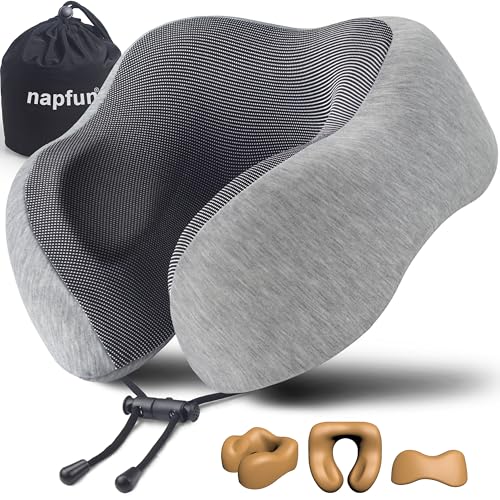
napfun Neck Pillow for Traveling — Best Classic Support
The contoured memory-foam U-pillow is the design against which all travel pillows are measured: a U of slow-rebound foam, raised at the sides to cradle the head, often with a flattened back so the pillow does not push your head forward off the headrest — the flaw that ruined the original donut generation. Good versions add a washable cover, a snap closure that keeps the pillow on your bag and stops it falling into the aisle, and foam firm enough to hold a head for six hours without bottoming out.
The verified representative here is the napfun Neck Pillow for Traveling, whose confirmed listing specifies 100% pure memory foam in a portable U format, in light grey. It sits in the mid-range tier. What follows is how to judge whether its foam and fit match the classic-support brief.
Strengths
- Raised side lobes cradle the head against sideways drift
- Contoured U shape cradles the head against sideways drift
- Memory foam holds support for a whole long-haul sector
Trade-offs
- Bulkiest format to carry — it will live clipped outside your bag
- Foam sleeps warm against the neck in summer cabins
- Cheap versions use foam too soft to support an adult head
Key specs: 100% pure memory foam per the listing; U-shaped travel format; Light Grey
The foam-density question is where money talks. Press a candidate’s foam with your full palm weight: it should resist, yield slowly and recover slowly. Foam that collapses instantly will collapse under a sleeping head by hour two, which is precisely when support matters. Better versions compress into a stuff sack to half size; if a listing claims compression, check that the cover and seams are built for the repeated squeezing that travel imposes.
Use it correctly, too: the opening belongs at the front for standard support, but many side sleepers prefer the opening at the side or back, rotating the thickest foam under the dropping side. The pillow does not care about the picture on the box, and neither should you.
Best for: back and combination sleepers wanting proven, structured support / Not suited for: strict minimalists unwilling to carry a full-size pillow
Check the current price on Amazon

BCOZZY Travel Neck Pillow — Best for Forward Head-Drop
Forward head-drop — the chin-to-chest nod that jerks you awake — is the most common sleep failure in an economy seat, and chin-support designs exist specifically to arrest it. They wrap the neck fully, joining at the front with a raised structure under the chin, so the head’s forward path is blocked by the pillow rather than by your own startled neck muscles. Travelers who have ‘tried pillows and they don’t work’ are very often forward-droppers who were sold side-support products; matching the design to the drop direction is the entire game in this category.
The verified representative is the BCOZZY Travel Neck Pillow, whose confirmed listing is built explicitly around head and chin support — soft, adjustable and washable, with a carry bag, in large navy. It sits in the mid-range tier. The fit checks below matter more for this design than any other, because a chin-support pillow that does not close at the right height is either a necklace or a gag.
Strengths
- Directly blocks the forward nod that wakes most economy sleepers
- Full-wrap design also gives some side support
- Usually packs smaller than a full memory-foam U
Trade-offs
- Fit-sensitive: closure height decides comfort or misery
- Full neck coverage can feel warm and enclosed
- Not ideal for travelers who dislike anything snug at the throat
Key specs: Head and chin support design per the listing; adjustable and washable; carry bag included; Large, Navy
Judge fit standing in the shop or on delivery day, not slumped on the sofa: sit upright in a hard chair, close the wrap, and let your head fall forward on purpose. The support should catch your chin before your neck reaches its uncomfortable end range, without pressing up into the jaw. If it catches only after the nod, it is too low or too large; if it pushes your chin up at rest, too high or too small.
Pair it with a small discipline: recline the seat the few degrees available, because every degree of recline transfers head weight from your neck to the seatback and multiplies whatever the pillow does. Chin support plus modest recline plus a window or a neighbor you know is as close to a system as economy sleep gets.
Best for: forward head-droppers and middle-seat travelers with no wall to lean on / Not suited for: anyone uncomfortable with snug, full-wrap neck coverage
Check the current price on Amazon

Keemall Inflatable Travel Neck Pillow — Best Ultralight Backup
The inflatable travel pillow is the pick for travelers who refuse to carry anything: it deflates to the size of a phone, weighs almost nothing, and lives permanently in a personal item against the trip where sleep matters more than pride. Inflation level is its hidden virtue — cabin pressure changes and personal preference both reward a pillow you can firm up or soften in seconds, and a partially inflated pillow at altitude is a genuinely considered choice, since a fully hard pillow packed at sea level arrives at cruising pressure tighter than you left it.
The verified representative is the Keemall Portable Inflatable Travel Neck Pillow, whose confirmed listing describes a compact blow-up U-shaped neck and shoulder support with a washable pillowcase, for plane, train, home and office use. It sits in the budget tier. Its weaknesses are as real as its virtues and are listed without varnish below; it is a backup and an ultralight tool, not the equal of foam for a dedicated sleeper.
Strengths
- Packs to almost nothing — the only zero-cost carry in this list
- Adjustable firmness by inflation level
- Budget tier; cheap enough to replace without grief
Trade-offs
- Air chambers can feel bouncy and less stable than foam
- Valve quality varies — a slow leak ruins a night
- Surface feel needs a cover or clothing layer for comfort
Key specs: Inflatable U-shape; washable pillowcase included per the listing; compact blow-up format
Two ownership habits make inflatables work. First, inflate to about three-quarters at boarding and top up after takeoff if you want more; pressure physics does the rest. Second, give it a skin-friendly surface — many travelers slip a t-shirt or the airline blanket over it — because bare vinyl or flocked plastic against a cheek for five hours is nobody’s definition of rest. With those habits, the inflatable is the rational second pillow even for foam owners: the one that travels when the foam stays home.
It is also the only pick here that survives being forgotten. At budget-tier cost, an inflatable left in a seat pocket is an annoyance; a memory-foam pillow left in a seat pocket is a story you tell angrily for years. Ultralight travelers are not settling — they are optimizing a different variable.
Best for: ultralight packers, backpackers and as a permanent backup in a work bag / Not suited for: travelers wanting maximum support on a flagship long-haul trip
Check the current price on Amazon
Comparison Table
| Pick | Badge | Key spec | Best for |
|---|---|---|---|
| EverSnug Travel Blanket and Pillow | Best Blanket-and-Pillow Combo | Blanket 65 x 40 inches per the listing; carry case, luggage sleeve and backpack clip included | cold, long flights and travelers who want one item covering warmth and rest |
| PAVILIA Travel Blanket Pillow 2-in-1 Combo | Best Compact Combo | 2-in-1 blanket and pillow combo; compact packable design per the listing | carry-on minimalists, families and shorter flights or long drives |
| Trtl Pillow | Best for Side Sleepers | Fleece wrap with internal shaped support; machine washable per the listing | side sleepers and window-seat travelers who hate carrying bulky pillows |
| napfun Neck Pillow for Traveling | Best Classic Support | 100% pure memory foam per the listing; U-shaped travel format | back and combination sleepers wanting proven, structured support |
| BCOZZY Travel Neck Pillow | Best for Forward Head-Drop | Head and chin support design; adjustable, washable, carry bag included | forward head-droppers and middle-seat travelers with no wall to lean on |
| Keemall Inflatable Travel Neck Pillow | Best Ultralight Backup | Inflatable U-shape; washable pillowcase included per the listing | ultralight packers, backpackers and as a permanent backup in a work bag |
The ‘Key spec’ column gives the defining construction fact for each pick rather than a dimension copied from marketing. For the structured designs, treat the spec as a fit checklist: a pillow that cannot state its construction plainly is a pillow to skip.
How to Choose an Airplane Travel Pillow
First, diagnose your drop direction
Spend one flight — or one honest memory of your last flight — identifying how your sleep actually fails. If you wake with a jerk and a sore front-of-neck, you are a forward dropper and chin support is your design. If you wake leaning on the window, the seatmate or your own shoulder with a sideways crick, you are a side dropper and a wrap or raised-lobe U is your design. If you wake cold, stiff from bracing against the chill, your problem is thermal and a blanket system outranks every pillow in this article.
Combination sleepers exist, and for them the full-wrap chin designs and the higher-lobed memory-foam pillows are the compromise picks, because both borrow some support from the neighboring direction. What does not work is buying against your diagnosis: a side-support pillow for a forward dropper is the most common wasted purchase in this category, and it is made daily by travelers who bought the famous product instead of the fitting one.
Foam, wrap, air: the three construction families
Memory foam gives the most consistent support and the most bulk; judge it by density behavior — slow to compress, slow to recover — and insist on a flat back so the headrest is not fought. Wrap designs trade some universality for side support and packability; judge them by whether the internal support is shaped and positioned to sit under the jaw, and whether the closure holds that position for hours. Inflatables trade support quality for near-zero carry cost; judge them by valve quality, because the valve is the product.
Shell and cover matter at hour five. A washable cover is not a luxury on an object that touches faces, tray tables and terminal floors; it is the difference between a pillow that ages gracefully and one that becomes faintly disgusting by its fourth trip. Check cover removability on any candidate before its support features seduce you.
Packed size is a real specification
Every travel pillow is a negotiation with your bag. Memory-foam models earn their bulk only if they compress into a sack or clip securely outside the personal item; wraps pack like clothing; inflatables pack like nothing. Be honest about your packing style: the traveler who resents carrying the foam pillow will abandon it by trip three, and the abandoned pillow’s support rating is zero. The best pillow is the best one that is actually in your bag at the gate.
Airlines count, too. A pillow worn around your neck at boarding is rarely counted as luggage; a pillow clipped outside a personal item occasionally is. Frequent flyers on strict carriers lean wrap or inflatable for this reason alone, and it is a rational reason — logistics are part of comfort.
Children, glasses and other real-world details
Two audiences get forgotten in pillow marketing. Children need smaller geometry: an adult wrap or U swallows a child’s neck and supports nothing, so equip children with the blanket-combo end of this guide, where the pillow form is soft and forgiving, and expect to reposition them anyway — that is parenting at altitude, not product failure. Glasses wearers, meanwhile, should test any wrap or high-lobed design with glasses on and off, because side pressure against frames is the complaint that surfaces at hour three and in no product photograph. If you read or watch films for the first half of a flight and sleep the second, choose the design you can fit without standing up: wraps and combos deploy in the seat, while a compressed foam pillow needs its sack retrieved, opened and allowed to expand, ideally before the cabin lights go down and the aisle goes dark.
Seat strategy multiplies the pillow
Choose the seat as part of the purchase. A window seat is a wall, and a wall is half a pillow: side droppers should book windows before upgrading foam. Aisle seats expose you to trolleys and traffic and reward chin support, which works without anything to lean on. Middle seats reward the full-wrap designs for the same reason. Then use the recline you have — even a few degrees transfers head weight from neck muscles to seatback — and set the pillow before you are tired, because fitting a wrap or inflating a pillow at the edge of sleep, in the dark, is how both end up on the floor.
Building a Whole Sleep System for Economy Flights
The pillow is one component. The travelers who sleep in economy treat the flight as a system with a sequence: eat on the ground or early, change into the sleep configuration before exhaustion arrives, and remove decision-making from the tired version of yourself. The blanket systems in this guide exist because temperature is the system’s silent saboteur — cabin air cools as the flight settles, and a traveler who was comfortable at boarding is bracing against cold by hour three, waking in fragments without ever identifying why. Deploy the blanket before you feel cold; by the time you feel it, the wakefulness has already happened.
Light and noise are the other two leaks. This guide sells pillows, not eye masks or earplugs, but honesty requires naming them: a pillow in a bright, loud cabin does a third of its potential work. Cover your eyes, cut the noise by whatever means you already own, and let the pillow handle the one problem only it can solve — the geometry of your head. Travelers routinely spend pillow money chasing a darkness problem.
Timing is the last system variable. The deepest sleep on a night flight comes when your body believes it is night, so the system works best when it is deployed on your home timezone’s evening rather than the destination’s afternoon. Eat, dim, configure the seat and close your eyes on a schedule, and the pillow’s modest mechanical help lands on a brain already willing to sleep. Travelers who fight the schedule with films and caffeine and then blame the pillow at 3 a.m. have misdiagnosed the system one final time — the pillow was never the limiting factor, and no purchase in this guide will outrun a body clock being actively opposed.
Finally, practice once at home. Wear the wrap while watching a film in a hard chair; inflate the inflatable and live with it for an evening; learn where the memory foam wants to sit. Every design in this article has a small technique to it, and the cabin of a night flight — dark, cramped, strangers on both sides — is the worst classroom ever built. Five minutes of home practice is the cheapest comfort upgrade in this entire guide.
How to Use a Travel Pillow for a Full Night Flight
Technique decides more than travelers expect. This sequence turns any pick in this guide into a working sleep setup.
- Set up before you are tired. Fit the pillow, deploy the blanket and arrange your seat during the calm after takeoff, not when exhaustion hits. Adjustments made while alert take seconds; the same adjustments at the edge of sleep wake you fully and cost the very rest you were arranging.
- Fit the pillow to your drop direction. Forward droppers: close the chin support snugly and test a deliberate nod. Side droppers: position the wrap’s support or the U’s thickest lobe under your sleeping side. Back sleepers: center the flat back of the foam against the headrest and settle into it.
- Recline what you have, then settle once. Use the available recline, place the blanket over your shoulders before the cabin cools, and then stop adjusting. Repeated micro-adjustment is wakefulness disguised as optimization; a good-enough position held still beats a perfect position pursued all night.
- Manage pressure and temperature hourly. On waking briefly — everyone does — make one small change only: shift the pillow’s contact point, vent or add blanket, or top up an inflatable that cabin pressure has softened. One change per waking keeps you in the sleep cycle instead of restarting it.
- Protect the pillow from the cabin. Keep the pillow off the floor and the tray table, and use its cover as the contact layer. Cabins are not cleaned to bedroom standards, and the object spending the night against your face should be treated like bedding, with a wash after every long trip.
- Pack it before descent. Repack the pillow into its case or form while you are awake for landing. Pillows forgotten in seat pockets are the category’s saddest statistic, and the descent scramble is when it happens — pack during the calm, not the rush.
If you consistently cannot sleep with a correctly fitted pillow in a good system, the limiting factor is probably light, noise or schedule rather than neck support — solve the actual constraint before buying a second pillow to chase it.
Common Buying Mistakes
Buying the famous design instead of your drop direction. The most expensive habit in this category. Diagnose forward, side or cold first, then choose the design family built for it — the guide’s structure exists to make this mistake unnecessary.
Judging a pillow in the shop for thirty seconds. Foam that feels plush for a moment bottoms out by hour two, and wraps feel strange until fitted properly. Judge by density behavior, fit checks and construction — and test at home in a hard chair while a return is still possible.
Ignoring packed size. A pillow abandoned at home supports nothing. Match the format to your real packing style — compression sack, worn wrap or pocket inflatable — not to the traveler you aspire to be.
Treating cold as a neck problem. Waking chilled and stiff is a blanket failure, not a pillow failure. If your flights run cold, a blanket-and-pillow system will outperform every structured pillow sold, at any price.
Never washing the cover. A travel pillow touches faces, floors and tray tables across continents. An unwashed cover quietly turns a comfort product into a hygiene problem. Removable, washable covers should be a purchase requirement, and washing after long trips a habit.
Fitting the pillow for the first time at midnight over the ocean. Every design has a small technique. Learning it in a dark, cramped cabin while exhausted converts a good product into a bad review. Practice once at home, in a chair, before the trip.
Final Recommendation
Start with your diagnosis. If cold and general discomfort end your flights, buy one of the verified systems: the EverSnug for maximum blanket coverage on long, cold sectors, or the PAVILIA when packed size matters more. If your head drops sideways, buy the Trtl wrap and apply its fit checks on your first flight. If you nod forward, the BCOZZY chin-support design is your pick and no plain U-pillow will substitute for it. If you are a classic combination sleeper who will actually carry it, the napfun memory-foam U is the category standard, and the Keemall inflatable is the backup that lives in your bag permanently.
One last allocation note: frequent flyers should own the pillow for their most-flown route, not their most imagined one. The traveler whose year is four medium-haul night flights needs dependable structured support; the traveler whose year is twenty short hops needs the combo or the inflatable that is simply always in the bag. Buy for the calendar you actually keep, and the pillow will be used enough to justify itself within a single season of trips.
And if you travel ultralight, accept the inflatable for what it honestly is — near-zero carry cost and good-enough support — and spend the saved weight and money on the rest of the sleep system. Every pick in this guide was confirmed against its listing, and the fit checks in each review are written so that your own verification, when the pillow arrives, takes two minutes. Diagnose first, fit second, buy third — in that order, an airplane pillow finally does the job its name promises.
Related guides on this site: Best Affordable Travel Pillows; Best Airplane Blankets; Best 100 Down Pillows; Best Affordable Pillows.
Related guides
Frequently Asked Questions
What is the best travel pillow for side sleepers?
A wrap-style pillow or a memory-foam U with high side lobes. Side sleepers drop toward the window or seatmate, and support must come from the side — under the jaw and cheek — rather than behind the neck. A window seat multiplies the effect, because the fuselage wall completes the support the pillow starts.
Why do travel pillows not work for me?
Usually a mismatch, not a bad product. Forward head-droppers sold side-support pillows are the classic case, followed by foam too soft to hold an adult head past the second hour, and wraps worn loosely or backwards. Diagnose your drop direction, apply the fit checks in this guide, and test at home in a hard chair before flying.
Are blanket-and-pillow combos worth it?
On long or cold flights, yes — they solve the temperature failure that structured pillows cannot touch, and the pillow form they pack into is adequate soft support for many travelers. On short, warm flights they are bulk without benefit. The EverSnug and PAVILIA sets in this guide are the verified examples; choose between them on blanket size versus packed size.
How do I stop my head falling forward on a plane?
Use a chin-support design that closes at the right height, add the seat’s recline so gravity helps instead of fighting you, and set everything up before you are tired. Test the fit upright in a hard chair: the support should catch your chin before your neck reaches its uncomfortable end range.
Is an inflatable travel pillow any good?
As an ultralight tool and a backup, yes; as a flagship long-haul pillow, foam beats it. Inflate to about three-quarters before takeoff — cabin pressure firms it up — cover it with fabric for comfort, and judge the valve before the shape, because a slow leak is the failure that matters.
How should I clean a travel pillow?
Wash the removable cover after every long trip, following its care label, and air the pillow itself out at home. Treat the cover like bedding — it spends the night against your face in one of the least-cleaned environments you regularly occupy. A pillow without a removable cover should be wiped down and aired, and is a weaker purchase for frequent flyers for exactly that reason.

