Disclosure: airfryerkitchensupply.com is reader-supported. When you buy through links on our site, we may earn an affiliate commission at no extra cost to you.
Where to buy
Every smoker below was confirmed as a live Amazon listing before inclusion. Check the current price on Amazon for the Pit Boss 4-Series Vertical Pellet Smoker, the Pit Boss 3-Series Vertical Pellet Smoker, the Traeger Woodridge, the recteq Flagship 1600, the Traeger Timberline 1300, and the Z Grills ZPG 550B2. Dedicated smokers are seasonal stock for many sellers, so confirm configuration and included racks on the live listing before ordering.
Introduction: When Smoking Is the Whole Point
The best wood pellet smokers are what happens when the pellet concept stops compromising. A pellet grill smoker splits its talents between grilling and smoking; a pellet smoker — especially the vertical cabinet designs that lead this list — spends its entire engineering budget on one job: holding meat in clean hardwood smoke, at a steady low temperature, for as many hours as the cook demands. The verticals stack rack upon rack inside an insulated cabinet, so a single load can be four briskets, a dozen rib racks, a shelf of jerky, and a tray of sausages, all bathing in the same rising smoke. The barrel-style picks here earn their places differently — flagship capacity and smoke modes in a familiar grill shape — but the brief is identical: maximum smoke, maximum steadiness, maximum capacity for the meats that made barbecue famous.
Choosing a dedicated pellet smoker is really choosing a smoking style. Cabinet owners think in racks and batches — jerky weekends, sausage-making, holiday loads of ribs, fish and cheese in the gentle seasons. Barrel owners think in centerpiece cuts — the brisket, the butt, the turkey — cooked on a machine that also grills when smoking day ends. Both styles share the pellet virtues that built the category: a fire that feeds itself, temperatures held like an oven, and smoke that runs clean for ten hours without a human touching a damper. This guide keeps the two styles separate and honest, so the smoker you buy matches the smoking you actually dream about.
One truth before the picks: pellet smokers produce a cleaner, lighter smoke than stick-burners, and no setting changes that physics. What the best of them do — through low-temperature smoke modes, big pellet reservoirs, and tight temperature control — is maximize what pellet smoke does best: an even, sweet, all-day bath that flavors deeply without ever turning harsh. Judged on that standard rather than on offset nostalgia, the six machines below are superb. They are also, deliberately, a mixed company — two cabinets, four barrels of escalating ambition — because the category’s buyers arrive with different menus, and a guide that forced every smoker into one shape would serve none of them well. Find your menu in the reviews first and your budget second; in this category, in that order, is how the right smoker gets bought.
In this guide
Quick Picks
- Best Overall: Pit Boss 4-Series WiFi Vertical Pellet Smoker — a tall, connected cabinet with rack space for serious batch smoking. Check the current price on Amazon.
- Best Value Vertical: Pit Boss 3-Series WiFi Vertical Pellet Smoker — the same cabinet concept, one size down, with connected control. Check the current price on Amazon.
- Best Barrel-Style Smoker: Traeger Woodridge — 860 square inches with WiFIRE and Traeger’s smoke manners in a versatile barrel. Check the current price on Amazon.
- Best Capacity: recteq Flagship 1600 — 1,667 square inches and a 40-pound hopper for the biggest smoking days. Check the current price on Amazon.
- Best Premium: Traeger Timberline 1300 — insulated flagship construction with Super Smoke and the deepest ecosystem in pellets. Check the current price on Amazon.
- Best Budget: Z Grills ZPG 550B2 — a PID-controlled barrel smoker that makes jerky, ribs, and butts at an entry tier. Check the current price on Amazon.
How These Picks Were Chosen
The filter was smoking specialization. A pick had to excel at the low end: steady temperatures across many hours, generous capacity arranged for smoked foods, and design details — water pan provisions, rack adjustability, grease handling under long fatty cooks — that serve smoking rather than grilling. Vertical cabinets were judged as cabinets and barrels as barrels, on their own terms.
Judging weighted smoke delivery first: how the machine behaves at its lowest settings, whether it offers a dedicated smoke mode, and how its fire cycles — because a controller that swings at smoking temperatures alternately starves and floods the fire, and the smoke quality swings with it. Capacity came second, measured in briskets, rib racks, and jerky trays rather than raw inches. Hopper endurance third: a smoker that cannot outlast an overnight cook on one fill has failed its founding promise. Build and insulation followed, since a cabinet opened to winter air at hour nine of a brisket is a test of everything. Each pick then took the badge it honestly wins, so the six read as a map of the smoking landscape rather than a single ladder.
The 6 Best Wood Pellet Smokers

Pit Boss 4-Series WiFi & Bluetooth Digital Vertical Pellet Smoker — Best Overall
The 4-Series is the dedicated pellet smoker in its most complete current form: a tall vertical cabinet with multiple porcelain-coated racks stacked through a large smoking chamber, an LCD digital controller with Wi-Fi and Bluetooth, and a pellet system sized for the long cooks the cabinet invites. The vertical format is the flavor argument — smoke and heat rise through every rack, basting the load continuously — and the capacity argument: foods that sprawl on a barrel stack efficiently in a cabinet, so rib racks, whole chickens, sausage links, and jerky trays share one fire. For the cook whose smoking dreams are measured in batches, this is the machine those dreams describe.
Strengths
- Cabinet capacity swallows batch smoking — ribs, jerky, sausage, whole birds.
- Connected control suits the long, unattended middle hours of big cooks.
- Vertical smoke path bathes every rack evenly.
Trade-offs
- It is a smoker, full stop — grilling is not in its repertoire.
- Rack-to-rack temperature differences exist; rotation is part of cabinet craft.
- Its tall footprint needs a considered home on the patio.
Owners of big verticals develop a distinctive cooking calendar: jerky in the cool months, sausage after hunting season or a good sale, ribs by the half-dozen for gatherings, a turkey that actually fits. The 4-Series supports that calendar with connected steadiness — set the cabinet, watch it from the phone, and let the smoke do the slow work. If your barbecue ambitions are wide rather than deep, this is the best pellet smoker here.
Best for: batch smokers — jerky, sausage, ribs, and poultry in volume / Not suited for: anyone needing one machine that also grills
Check the current price on Amazon
Pit Boss 3-Series WiFi & Bluetooth Digital Vertical Pellet Smoker — Best Value Vertical
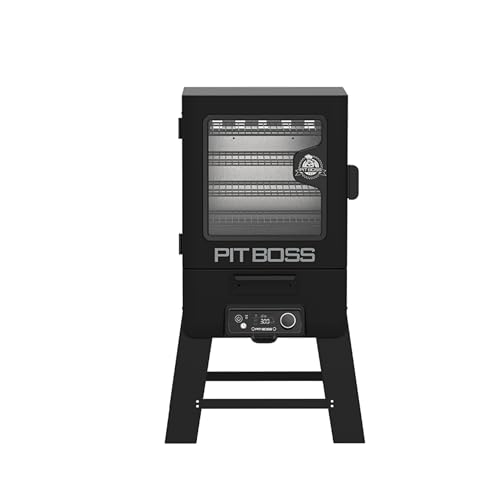
The 3-Series brings the same cabinet idea down a size and a tier: a vertical pellet smoker with Wi-Fi and Bluetooth control, an LCD controller, and rack space that still embarrasses barrel grills for smoking volume — four racks of food stacked through the smoke column in a footprint a small patio can spare. It is the entry point into serious cabinet smoking, and its connected control is the feature that matters most at this price: the long cooks cabinets exist for are exactly the cooks where remote monitoring changes the cook’s day from vigil to errands.
Strengths
- Real cabinet capacity with connected control at a value tier.
- Compact footprint for the volume it smokes.
- Same vertical smoke-bath cooking as its bigger sibling.
Trade-offs
- Smaller chamber than the 4-Series — whole briskets need planning or company.
- Finishes and insulation are a tier below the flagship cabinets.
- Smoker-only, like all true cabinets.
For a first dedicated smoker, the 3-Series is the sweet spot of the vertical world: big enough to learn batch smoking properly, connected enough to make overnight cooks civilized, and priced so the experiment does not require a family meeting. Households that discover cabinet smoking is their thing will eventually eye the 4-Series; households that do not have lost the least possible while learning something true about themselves.
Best for: first dedicated smoker buyers and small patios / Not suited for: maximum-batch cooks
Check the current price on Amazon

Traeger Woodridge Wood Pellet Grill & Smoker — Best Barrel-Style Smoker
Not every smoker wants a cabinet, and the Woodridge is the barrel answer: 860 square inches under Traeger’s WiFIRE control, with the brand’s mature smoke behavior at low temperatures and a full grilling range when smoking day is over. Its smoking credentials rest on steadiness and ecosystem — a controller that holds the low end without drama, an app that watches the cook, and a shape that fits a whole packer brisket the way cabinets sometimes cannot. As the middle path between a grill smoker and a dedicated smoker, it leans smoking-ward with its size and manners while keeping the barrel’s versatility intact.
Strengths
- Full brisket geometry with Traeger steadiness at smoking temperatures.
- WiFIRE monitoring suits overnight cooks.
- Grills properly when the smoker’s work is done.
Trade-offs
- Batch capacity trails the vertical cabinets for ribs and jerky.
- No dedicated vertical smoke column; smoke delivery is barrel-style.
- Premium-mainstream tier pricing.
Choose the Woodridge when your smoking centers on the great cuts rather than the great batches — brisket, butt, turkey, the occasional rib session — and when the same machine must grill the rest of the week. It is the least specialized pick here and, for most households, the most used, which is its own form of best.
Best for: brisket-centered smokers who also grill / Not suited for: jerky and sausage production in volume
Check the current price on Amazon
recteq Flagship 1600 Pellet Grill Smoker — Best Capacity
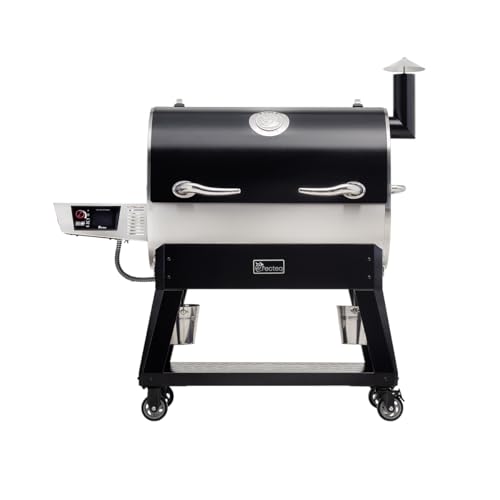
When the smoking day is genuinely large — multiple briskets, a festival of ribs, a whole neighborhood’s worth of pork — the Flagship 1600 is the barrel that answers: 1,667 square inches of cooking space, a 40-pound hopper that removes refueling from the overnight equation entirely, Wi-Fi control, and recteq’s heavy, stainless-forward construction with its famously steady controller. Its smoke manners benefit from that steadiness most at the low end, where the Flagship simply sits at temperature for hour after hour, converting pellets to clean smoke with metronome regularity.
Strengths
- The largest capacity and hopper in this roundup, by wide margins.
- Controller steadiness that long cooks reward directly.
- Heavy construction built for a decade of smoking seasons.
Trade-offs
- Its scale is wasted on small households and intimate cooks.
- A barrel’s batch geometry still trails a cabinet’s for jerky and links.
- Premium investment and a substantial patio footprint.
The Flagship buyer is feeding people at a scale where capacity failures are public — the church picnic, the team dinner, the holiday where two briskets are the minimum viable menu. For that cook, this is the smoker that removes arithmetic from the planning: everything fits, the hopper outlasts the night, and the controller never becomes the story. Everyone else should admire it and buy smaller.
Best for: big-event smokers and large families / Not suited for: couples and small patios
Check the current price on Amazon

Traeger Timberline 1300 Wood Pellet Grill & Smoker — Best Premium
The Timberline is the premium barrel smoker perfected: 1,300 square inches inside a fully insulated body, WiFIRE control with Super Smoke mode for the low-temperature hours where pellet flavor is built, and the deepest bench of accessories, pellets, and community knowledge in the category. Insulation is its smoking superpower — a Timberline in January holds its low end with a composure thin-walled smokers cannot approach, burning fewer pellets and swinging less through the coldest, longest cooks. For the smoker who cooks year-round and wants the flagship experience in barrel form, this is the ceiling of the mainstream market.
Strengths
- Full insulation makes it the best cold-weather smoker here.
- Super Smoke mode maximizes pellet smoke where it matters.
- 1,300 square inches with Traeger’s full ecosystem behind it.
Trade-offs
- Flagship pricing within the mainstream class.
- Barrel geometry, again, trails cabinets for batch work.
- Large and heavy; it chooses its patio spot permanently.
The Timberline’s buyer has usually owned a lesser pellet smoker and knows exactly which frustrations the money is retiring: winter swings, pellet waste, capacity ceilings, accessory envy. Judged as that retirement package, it is complete. Judged as a first smoker, it is more machine than any beginner needs — the Woodridge and the verticals teach the same lessons at friendlier tuition.
Best for: experienced smokers wanting the flagship barrel, year-round / Not suited for: beginners or batch-cabinet devotees
Check the current price on Amazon

Z Grills ZPG 550B2 Wood Pellet Smoker — Best Budget
The 550B2 is the budget door into dedicated pellet smoking: a barrel smoker with the latest PID controller technology in its class, an LCD display, automatic temperature control, and 8-in-1 versatility across a cooking area sized for family smoking — a pork butt, a couple of rib racks, a tray of jerky on the upper rack. PID control is the headline because it is the feature that decides smoking quality: steady temperature means steady smoke, and at this tier steadiness is not a given. Z Grills includes it anyway, which is why this grill keeps appearing in budget conversations it has no business winning on price alone.
Strengths
- PID temperature steadiness at an entry tier.
- Honest family smoking capacity with an upper rack for jerky and sides.
- Simple, automatic operation — a gentle first smoker.
Trade-offs
- No Wi-Fi; overnight cooks are monitored the old way.
- Thinner construction than the premium barrels; shelter and cover it.
- Hopper size asks for a check on the longest cooks.
As a first smoker or a dedicated second machine beside a grill, the 550B2 is the easiest recommendation in this guide: it smokes the full canon — ribs, butts, jerky, salmon — with a steadiness that lets the cook learn smoking rather than firefighting. Its owners’ typical story is the budget category’s best outcome: bought cheap, used constantly, upgraded eventually, and kept.
Best for: first-time smokers and budget-focused households / Not suited for: connected-control seekers or giant cooks
Check the current price on Amazon
Comparison Table
| Pick | Badge | Key spec | Best for |
|---|---|---|---|
| Pit Boss 4-Series Vertical | Best Overall | Wi-Fi cabinet, multi-rack | Batch smoking in volume |
| Pit Boss 3-Series Vertical | Best Value Vertical | Wi-Fi cabinet, compact | First dedicated smoker |
| Traeger Woodridge | Best Barrel Smoker | 860 sq in, WiFIRE | Brisket-centered smoking plus grilling |
| recteq Flagship 1600 | Best Capacity | 1,667 sq in, 40 lb hopper | The biggest smoking days |
| Traeger Timberline 1300 | Best Premium | 1,300 sq in, insulated, Super Smoke | Year-round flagship smoking |
| Z Grills ZPG 550B2 | Best Budget | PID control, LCD controller | Learning to smoke, cheaply and well |
How to Choose a Pellet Smoker: Cabinet or Barrel, and the Specs That Decide
The cabinet-versus-barrel decision is a decision about your menu. Cabinets win wherever food is flat, numerous, or hung: jerky by the tray, sausage by the link, ribs by the half-dozen, whole birds stacked like a rotisserie that read a geometry textbook. Their vertical smoke path and rack density make them production machines, and their weakness is symmetrical — a whole packer brisket, long and awkward, fits a barrel’s open grate more naturally than many cabinet shelves. Barrels win on centerpiece cuts and on versatility, since every barrel here also grills. Read your last year of imaginary menus honestly: if the daydreams are briskets, buy a barrel; if they are production days, buy a cabinet; if they are both, the barrel is the safer first smoker and the cabinet the classic second.
Within either shape, three specs decide smoking quality. Controller behavior at low temperatures is the first and the least visible: ask how the machine holds its lowest settings, and favor PID-class control and smoke modes over raw feature counts, because smoke is made in the fire’s gentle hours and a swinging controller makes dirty, intermittent smoke. Hopper endurance is the second: divide your longest planned cook by the hopper and refuse any smoker that needs a 3 a.m. refill for your signature dish. Insulation is the third, and it is a climate question — mild-climate smokers can treat it as a luxury, while anyone smoking through real winters should treat the Timberline’s insulated body as the category’s correct answer. Rack and grate quality, water-pan provisions, and a grease system that survives a twelve-hour fatty cook without drama complete the checklist; none of them photograph well, and all of them decide whether year two feels like mastery or maintenance.
How to Smoke on a Pellet Smoker: Ribs as the Teaching Cook
Ribs are the pellet smoker’s perfect student dish — long enough to teach smoke management, short enough to forgive, and judged by senses rather than instruments. Start with the smoker’s ritual: burn pot checked clean, hopper filled with fresh pellets, and the machine started on its lowest or smoke setting to establish a gentle, clean fire before any meat appears. The ribs go on cold, membrane removed and rub applied, bone side down, with space between racks for smoke to move — a crowded smoker steams its load, so the discipline of leaving gaps is the first lesson the cabinet’s capacity tempts you to skip. In the opening hours, the cook’s only job is observation: the smoke should run thin and pale, the temperature steady, and the lid should stay shut, because every opening is heat and smoke the ribs will never get back.
Through the middle, judge by the bark and the bones: color deepening to mahogany, rub set so it does not smear under a fingertip, the meat pulling back from the bone ends. Wrap if you wrap — foil for speed and tenderness, paper for bark preservation — with a little liquid and sweetness if that is your school, and return the ribs until they bend like a breaking wave when lifted from one end, the rack’s surface cracking gently. Sauce, if it appears at all, is a final glaze set by a few minutes of heat, not a cooking medium. Rest briefly, slice between the bones, and read the result like a report card: smoke ring and flavor from the fire’s quality, tenderness from the time and temperature, bark from your patience with the wrap. Every other smoked meat in the canon is this same report with different numbers, which is why ribs, cooked attentively three or four times, teach a new smoker more than a year of random cooks.
Jerky, Sausage, and Fish: The Cabinet Smoker’s Second Career
Dedicated smokers earn their keep in the margins of the barbecue canon, and the cabinet owners’ calendar shows it. Jerky is the gateway: lean beef or venison, cured and seasoned, dried in gentle smoke at the smoker’s lowest settings until it bends and cracks without snapping — a transformation no oven performs with a straight face, and one that fills a cabinet beautifully, tray after tray. Sausage follows naturally for anyone with a grinder and a free Saturday: links smoked low until they bloom with color and snap, the cabinet’s racks holding a batch that would crowd any barrel into absurdity. Fish — salmon above all — is the delicate art: a gentle cure, a pellicle formed in the refrigerator’s air, then the coolest smoke the machine can hold, producing the silky, translucent-edged result that makes store-bought smoked salmon taste like a rumor.
Each of these cooks shares the cabinet’s virtues and demands its one discipline: at the lowest temperatures, smoke quality is everything, because there is no high heat to forgive a dirty fire. Keep the burn pot clean, the pellets fresh, and the fire small and honest, and a pellet cabinet becomes a small smokehouse with a product range no grill can imitate. This second career is the real argument for the verticals in this roundup — the brisket gets the glory, but the jerky, sausage, and salmon are why cabinet owners never sell their smokers.
Common Buying Mistakes
The first mistake is buying a cabinet for a brisket life or a barrel for a jerky business — shape follows menu, and no badge overrides geometry. The second is under-buying hopper: a smoker whose fuel cannot outlast its signature cook converts every overnight into a shift schedule, and the disappointment is structural, not fixable with accessories. Third, new smokers chronically ignore the water and grease story: long, fatty cooks produce both in quantity, and a smoker whose pan and drainage you have not pictured handling at hour ten, in the dark, is a smoker whose manual you should read before the first cook rather than during it.
Fourth, do not mistake low price for low stakes in the fire system: the burn pot, auger, and controller are the smoker, and the budget pick here earns its place precisely because its PID control respects that fact while thinner bargains do not. Fifth, resist filling a new cabinet to its walls on the first cook — airflow is an ingredient, and the cook who leaves space learns the machine’s true behavior while the cook who stuffs it learns only that steam is sad. Finally, remember that a dedicated smoker is a commitment to a style: households that grill daily and smoke monthly are usually happier with the grill-smoker combo covered in our companion guide, and honesty about that ratio before purchase is worth more than any feature on any box.
Running a Cabinet Smoker: Rack Rotation and Load Discipline
Cabinet smoking has its own craft, distinct from barrel habits, and the first skill is respecting the column. Heat and smoke rise, so the top racks and the bottom racks live in slightly different climates — the lower racks nearer the fire run warmer and catch more direct energy, the upper racks cruise gentler in pure smoke. Skilled cabinet cooks load with that map in mind: the foods that want heat — chicken bound for crisp skin, the butt that can take a push — ride lower, while the delicate and the patient — fish, cheese-adjacent cooks, the jerky that must dry rather than cook — ride high. Rotation is the second skill: midway through long cooks, swap racks top to bottom so every piece of meat spends time in each climate, the cabinet equivalent of turning a brisket on an offset. It takes ninety seconds and it is the difference between a uniform batch and a gradient of doneness that guests politely navigate.
Load discipline is the third skill, and the one capacity tempts cooks to violate. Smoke must move: racks packed edge to edge with no gaps turn the cabinet’s beautiful column into a steam room, and the food emerges pale and soft-skinned no matter how good the fire was. Leave breathing room around every piece, resist the final “one more rack” that closes the last chimney of space, and accept that two honest loads beat one suffocated one. The cooks who internalize the column — map, rotation, breathing room — find the cabinet the most forgiving smoker ever built; the cooks who treat it as a closet with a fire learn the same lessons slower, one crowded batch at a time.
The Overnight Cook: A Pellet Smoker’s Signature Ritual
Every smoker category has a defining scene, and the pellet smoker’s is 11 p.m.: a brisket going on before bed, a hopper filled to the brim, an app checked once from the pillow, and a cook who sleeps while the fire works. Making that scene routine rather than lucky is a checklist, not a talent. The smoker starts the evening clean — burn pot emptied, grease path scraped, drip bucket honest — because every overnight failure in this category traces to a machine that began the night tired. The pellets start fresh and full, because a hopper that is “probably enough” is the antagonist of every bad brisket story. The meat starts cold and the smoker starts low, because the sleeping hours are the smoke hours, when the fire sips and the flavor builds, and a slightly conservative temperature overnight is cheap insurance that the morning can correct but a runaway cannot.
Morning brings the second act: a check of the hopper and the bark, the wrap decision made by look rather than by clock, and the long, rested finish that turns a good brisket into the story the neighborhood repeats. What the pellet smoker sells, in the end, is not the absence of craft but the relocation of it — from the fire-tending hours to the preparation and judgment hours, where a rested cook makes better decisions than an exhausted one. Owners who master the checklist find the overnight cook becomes their default rather than their stunt, and that is the moment a pellet smoker stops being an appliance and becomes infrastructure: the reason brisket appears at gatherings that used to settle for burgers.
Smoke Quality at Low Temperatures: The Fire Behind the Flavor
Everything a pellet smoker promises is decided in its burn pot during the quiet hours, so the fire’s behavior deserves a plain explanation. A pellet fire makes its cleanest, sweetest smoke when it burns steadily with pellets arriving in a rhythm matched to the heat demand — which at smoking temperatures is a slow rhythm, and exactly where weak controllers stumble: they dump pellets in bursts, the fire flares and smolders in turn, and the smoke alternates between invisible and white. PID-class controllers and the smoke modes on the Traeger picks exist to smooth precisely that cycle, metering fuel so the fire breathes evenly for hours. The visible result, once you know to look, is the thin, steady, pale wisp at the stack that experienced cooks read like a pulse.
The cook’s contribution to that fire is fuel quality and cleanliness, and both are cheaper than any upgrade. Fresh pellets ignite cleanly and burn to fine ash; stale pellets crumble, feed erratically, and smolder. A burn pot cleared of ash lets air reach the fire as designed; a pot mounded with yesterday’s ash starves and dirties today’s fire in ways no controller can correct. This is why the maintenance refrain runs through every guide in this cluster — in a pellet smoker, cleaning is not hygiene, it is flavor engineering. The smoker you keep clean will taste like the flagship in the showroom; the flagship you neglect will taste like the cheapest box on the internet, and the difference was never the badge.
From Smoke to Table: Resting and Holding Like a Pitmaster
The least photographed and most decisive hour of smoking happens after the fire’s work ends. Large cuts — brisket, butt, whole turkey — are not finished when they leave the smoker; they are finished after a rest that lets fierce surface heat equalize, juices redistribute through meat that would spill them if sliced hot, and collagen’s last transformations complete in the residual warmth. The pellet smoker’s gift here is that its cook can be planned backward from the table with confidence: because the machine holds temperature like an oven, the meat can come off early and rest, wrapped, in a dry cooler for one to several hours, emerging hotter in spirit and better in texture than meat rushed straight to the board. Cooks who discover planned resting stop fearing the variable finish times of big cuts, because the rest absorbs the variance that used to ambush dinner.
Holding has its disciplines. Keep the wrapped meat above the food-safety threshold throughout a long hold — a warm oven at its lowest setting or a well-insulated cooler with the temperature monitored — and resist slicing until the table is ready, because sliced meat dries by the minute while whole cuts wait patiently. Ribs rest briefly, briskets rest long, and jerky, sausage, and fish follow their own finishing rules from the cabinet section above. None of this requires equipment beyond a cooler and a thermometer; it requires only the belief, which every experienced smoker eventually shares, that the cook ends at the carving board and not a moment before. Build the rest into your timeline the way you build in the smoke, and the same smoker, the same pellets, and the same meat will suddenly seem a full grade better.
Final Recommendation
For dedicated smoking in volume, buy the Pit Boss 4-Series Vertical; for the same idea at a friendlier tier and footprint, the 3-Series Vertical. Brisket-centered cooks who also grill should take the Traeger Woodridge; event-scale smokers the recteq Flagship 1600; premium year-round smokers the Timberline 1300; and first-time smokers on a budget the Z Grills 550B2. Whichever shape you choose, the first overnight brisket — planned clean, fueled full, and slept through in confidence — is the moment the purchase explains itself.
More from the cluster: Best Wood Pellet Grill Smokers, Best Wood Pellet Grills, Best Wood Pellet Smokers For Beginners, Best Vertical Pellets Smokers, Best Wifi Pellet Smokers, and Best Wood Meat Smokers.
Frequently Asked Questions
How do I store a pellet smoker between seasons?
End the season the way you would want to find the machine: burn pot and interior cleaned, grease system emptied, and — most important — the hopper and auger cleared of pellets, because pellets left in a machine through a humid off-season swell, jam, and can cement an auger solid. A cover goes on last, over a fully cool and dry smoker. In spring, the revival is equally simple: fresh pellets, a short empty burn to clear the winter, and a forgiving first cook to recalibrate. Owners who winterize this way measure their smokers’ lives in decades of seasons rather than in warranties.
Can a pellet smoker be my only outdoor cooker?
The barrel picks here can — they grill respectably alongside their smoking — but the vertical cabinets cannot, and that is by design rather than deficiency. The honest household math is that a cabinet smoker plus any modest grill covers the entire outdoor repertoire better than one premium combo asked to do everything, often for comparable total money. If one machine must do it all, choose from the barrel side of this list or the grill-smoker combo guide; if two machines are acceptable, the cabinet’s specialization becomes pure advantage.
Why is my smoked meat bitter from a pellet smoker?
Bitterness in pellet cooking almost always traces to a dirty fire or a dirty smoker rather than to the pellets’ species: an ash-choked burn pot smoldering its fuel, stale pellets feeding in bursts, or creosote and rancid grease deposits from long-neglected surfaces re-seasoning every cook. The cure is the unglamorous trilogy — clean the burn pot and interior, burn a fresh bag of pellets, and run a hot, empty cycle to clear the chamber — after which the same smoker typically tastes sweet again. If bitterness survives a genuinely clean machine and fresh fuel, shorten the time meat spends in the densest early smoke and check that rubs with sugar are not simply scorching at your chosen temperature.
How many briskets can a vertical pellet smoker hold?
It depends on the cabinet’s shelf dimensions more than its headline capacity: full packer briskets are long, and many cabinets fit them best on a diagonal or one per shelf, which puts a large vertical in the two-to-four brisket class with room for smaller items around them. Rib racks are where verticals truly multiply — a cabinet that holds two briskets may hold a dozen racks of ribs across its shelves. Measure your signature cut against the shelf size on the listing, not against the marketing photograph, which was arranged by professionals with unlimited briskets and no shame.
What is the best temperature strategy for an overnight brisket?
Run the smoker’s low, steady end through the sleeping hours — the zone where smoke production is richest and the cook is most forgiving — with the brisket on cold and the hopper full, then assess in the morning and adjust: wrap when the bark is set, and finish at a moderate temperature until the meat probes tender. The strategy trades a little total speed for a lot of safety and smoke, which is the correct exchange when the cook is asleep. Connected monitoring, where fitted, turns the strategy from faith into supervision.
Is a vertical pellet smoker better than a barrel pellet grill for smoking?
For smoking specifically, usually yes: the cabinet’s stacked racks hold far more food, its rising smoke bathes every level, and its design spends nothing on grilling compromises. The barrel wins when whole briskets and grilling versatility matter. Most households that smoke seriously and often end up preferring the cabinet for production and keeping a grill for everything else — which is why the two shapes coexist rather than one replacing the other.
How much smoke flavor does a pellet smoker produce compared with an offset?
Less, and cleaner — that is the honest trade. A pellet smoker’s fire burns efficiently, making a sweet, even smoke that flavors deeply across long cooks without the assertive edge of a stick-burner. Techniques narrow the gap: run the lowest settings and smoke modes early, put meat on cold, and choose assertive pellets like hickory for beef. Most eaters prefer the pellet result; purists prefer the offset; both are defensible, and this guide’s picks optimize the pellet side of the argument.
Can I cold-smoke cheese and fish in a pellet smoker?
True cold smoking — smoke without meaningful heat — is beyond most pellet smokers’ design, since their fire generates heat by existing. The practical approach is the lowest setting, a cool day, ice pans in the chamber to protect delicate foods, and short sessions, which produces excellent hot-smoked and warm-smoked results. Cheese in particular wants the coldest conditions you can arrange; many cabinet owners smoke it in winter for exactly that reason. For genuine cold smoking, a separate smoke generator accessory is the usual solution.
How long can a pellet smoker run unattended?
As long as its hopper and its cleanliness allow — which is why hopper size is a headline spec in this guide. With a full hopper of dry pellets, a clean burn pot, and connected monitoring, overnight cooks are the category’s normal use, not an extreme sport. The disciplines are simple: start full, start clean, keep the grease path managed, and let the app’s alerts stand the watch that offset owners stand in person.
Do I need a water pan in a pellet smoker?
It helps in cabinets especially: a water pan buffers temperature swings when the door opens, adds humidity that keeps bark from hardening prematurely, and catches drippings before they reach places they should not. Many pellet smokers are humid enough from the meat itself that the pan is optional for short cooks, but for long, lean cooks — jerky excepted, where dryness is the point — the pan earns its rack. Experiment on ribs, the teaching cook, and let your own bark cast the vote.
What pellets are best for smoking?
Match the wood to the meat’s exposure time: long cooks amplify everything, so the clean middle — oak, pecan, and hickory-oak blends — is the brisket and butt default, while assertive hickory suits ribs and shorter smokes, and mild fruit woods flatter fish, poultry, and cheese. Freshness outranks species every time; a fresh bag of a mild wood out-smokes a stale bag of the perfect one. Keep two bags — a house blend and an accent — sealed, dry, and rotated.


