Disclosure: airfryerkitchensupply.com is reader-supported. When you buy through links on our site, we may earn an affiliate commission at no extra cost to you.
Where to buy
Vertical pellet smokers are substantial freight items sold through Amazon both as standalone units and with cover or pellet bundles. The links below reach each model’s current listing; check price on Amazon and confirm the configuration — rack counts and included covers vary by listing — before you decide. While you are measuring, measure twice in the physical world as well: the cabinet’s footprint where it will live, the door swing it needs, and the path from the delivery point to the patio, because a five-rack pellet cabinet is not an item that improvises its way through a narrow gate.
- Pit Boss Navigator 3-Series Pellet Vertical Smoker — check price on Amazon
- Pit Boss 4-Series WiFi Vertical Pellet Smoker — check price on Amazon
- Pit Boss 3-Series WiFi Vertical Pellet Smoker — check price on Amazon
- Pellet Pro 2300 Vertical Pellet Smoker Cabinet — check price on Amazon
- Pellet Pro “Double D” Double Door Vertical Cabinet Pellet Smoker — check price on Amazon
- GRILLA Mammoth Vertical Pellet Smoker — check price on Amazon
The best vertical pellet smokers exist because of a happy collision between two good ideas. The first is the vertical cabinet: racks stacked in a tall, insulated chamber that holds a gathering’s worth of meat on a patio-corner footprint. The second is the pellet system: hardwood pellets fed by an auger into a small fire pot, governed by a digital controller that holds temperature the way an oven does — except the fuel is wood, so the food tastes like it came from a fire, because it did. Put them together and you get the most automated form of real-wood smoking ever sold: load the hopper, set the temperature, and cook brisket, ribs, sausage or jerky across five racks while the controller minds the fire.
This category is dominated by two philosophies. Pit Boss builds connected, value-forward cabinets at several sizes — the Navigator and the WiFi 3- and 4-Series below — with apps, LCD controllers and aggressive capacity per dollar. Smoke Daddy’s Pellet Pro line and Grilla’s Mammoth aim at the enthusiast: double walls, convection, PID control and a deliberate pursuit of heavier smoke. All six picks were verified against Amazon’s catalog — two of them confirmed in a live API search during this guide’s research — and the rack counts and cooking areas quoted come from those verified listings.
In this guide
Quick Picks
- Best Overall — Pit Boss Navigator 3-Series: a WiFi and Bluetooth vertical pellet smoker with an LCD digital controller, five racks and about 1,118 square inches — the connected capacity benchmark. Check the current price on Amazon
- Best Mid-Size — Pit Boss 4-Series WiFi Vertical: the step-up WiFi cabinet in Pit Boss’s vertical line, with an LCD digital controller and room beyond the 3-Series class. Check the current price on Amazon
- Best Compact Connected — Pit Boss 3-Series WiFi Vertical: app-controlled pellet smoking in the smaller 3-Series footprint, for patios and households that cook modest loads well. Check the current price on Amazon
- Best for Even Temperatures — Pellet Pro 2300: a double-wall vertical pellet cabinet with a convection fan and an included cover, engineered to keep five racks honest. Check the current price on Amazon
- Best Premium — Pellet Pro “Double D”: a double-door vertical cabinet pellet smoker with a PID controller and stick-burning capability for cooks who want pellet ease with a wood-fire escape hatch. Check the current price on Amazon
- Best Smoke Production — GRILLA Mammoth: a five-tray vertical pellet smoker with a WiFi touchscreen controller, designed to produce the heavy smoke pellet cabinets usually lack. Check the current price on Amazon
How These Picks Were Chosen
Vertical pellet smokers were judged first on their controllers, because in this category the controller is the cook. A good controller holds temperature within a narrow band for twelve hours, recovers calmly after door openings and feeds pellets at a rate that keeps smoke clean; a poor one swings, overshoots and produces the acrid phases pellet smokers are unfairly blamed for. PID-style control and proven controller lineages scored accordingly. Second came the chamber: rack count and spacing, door count and sealing, and insulation — double walls matter enormously in a tall cabinet that presents a lot of surface to winter air. Third, smoke character: pellet cabinets have a reputation for mildness, so designs that address it — convection, smoke modes, the Double D’s stick-burning option, the Mammoth’s high-smoke brief — earned their places honestly. Fourth, the ownership machinery: hopper size relative to cook length, ash and grease management, and the auger-and-fan service reality of a machine with moving parts. Every pick was verified, with the Pit Boss 4-Series and 3-Series WiFi models confirmed in a live catalog search run for this guide. That last detail matters in a fast-moving category: pellet lineups refresh constantly, model names persist across quiet specification changes, and a guide is only as good as its last verification. Where a listing’s configuration can vary — covers bundled or not, rack counts by variant — the reviews say so and send you to the listing to confirm, because the cheapest mistake in this category is assuming the box contains what a photograph implied.
The 6 Best Vertical Pellet Smokers

Pit Boss Navigator 3-Series Pellet Vertical Smoker — Best Overall
The Navigator is the vertical pellet category’s center of gravity: five racks, roughly 1,118 square inches, WiFi and Bluetooth supervision and an LCD digital controller, in a cabinet sized for real gatherings. It suits hosts and batch cooks who want wood-fired flavor with app-level oversight. It does not suit minimalists — a connected pellet cabinet is a small appliance ecosystem of auger, fan, igniter and app, and it asks its owner to be at peace with that.
Strengths
- WiFi and Bluetooth monitoring with an LCD controller — the cook supervises from anywhere
- Five racks and over eleven hundred square inches stage genuine event loads
- Pellet fire delivers real wood smoke with oven-style temperature discipline
Trade-offs
- Pellet consumption across long, full-cabinet cooks is a real running cost
- More moving parts than any non-pellet design in this series — service is a when, not an if, over a long life
- Smoke depth, while honestly woody, stays a step below a well-run offset
The Navigator’s virtue is how it changes the cook’s relationship with a big cook. Five loaded racks used to mean a day stationed beside the smoker; with the controller holding temperature and the app reporting it, the day becomes a series of confident glances. That is not a small thing for the person who smokes for holidays, team events and freezer days — the exact cooks this cabinet is sized for. Pit Boss’s value engineering means the money went to capacity and connectivity rather than to heavy steel, and for most buyers that is the correct allocation. Check the current price on Amazon
Best for: hosts and batch cooks wanting connected, wood-fired capacity / Not suited for: mechanical minimalists or smoke maximalists

Pit Boss 4-Series WiFi Vertical Pellet Smoker — Best Mid-Size
The 4-Series WiFi is the vertical pellet line’s step-up: a larger connected cabinet with an LCD digital controller for cooks who found the 3-Series footprint tight but do not need the Navigator’s full event scale. It suits growing households and regular entertainers. It does not suit first-time pellet buyers on a budget, who should learn the category in the 3-Series class before paying for room they may not use.
Strengths
- WiFi and Bluetooth control in a cabinet sized between compact and event class
- LCD digital controller keeps long cooks steady and legible at a glance
- Vertical pellet format preserves the small patio footprint
Trade-offs
- Sits in a middle tier that only makes sense if its extra room matches your cooks
- Shares the category’s pellet costs and moving-parts service profile
- App ecosystem quality matters to daily satisfaction — set it up carefully once
Mid-size is where most households actually live, and the 4-Series is pitched at that truth: enough racks for a holiday cook with effort, not so much cabinet that a Sunday chicken heats a hall. The connected controller is the same philosophy as the Navigator’s — the fire minds itself while the cook minds everything else — and in a household that smokes monthly, that convenience compounds into habit. If your cooks have outgrown compact but your patio has not outgrown sanity, this is the balanced buy in the Pit Boss line. Check the current price on Amazon
Best for: regular entertainers needing room beyond the compact class / Not suited for: budget first-timers or true event-scale cooks
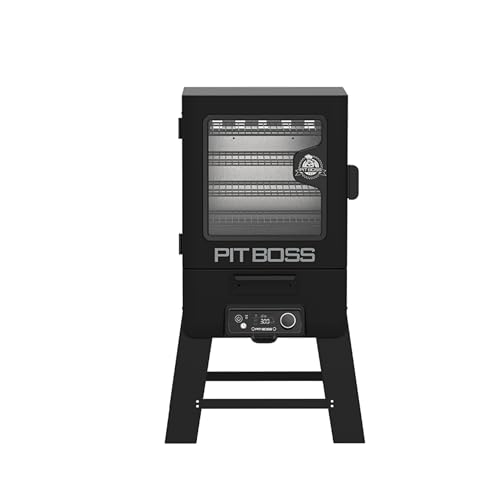
Pit Boss 3-Series WiFi Vertical Pellet Smoker — Best Compact Connected
The 3-Series WiFi distills the category to its essence for smaller households: a vertical pellet cabinet with app control and an LCD digital controller in the footprint of a modest appliance. It suits couples and small families who want pellet convenience without dedicating patio to capacity they will use twice a year. It does not suit gathering cooks, who will meet its ceiling on exactly the days that matter most.
Strengths
- Full connected control — WiFi, Bluetooth, LCD — at the compact end of the line
- Vertical format keeps the patio claim small while racks still stack usefully
- The gentlest entry into app-supervised wood-fired smoking in this guide
Trade-offs
- Capacity is the compromise; big days mean cooking in waves
- Pellet economics favor fuller loads — small cooks in any pellet cabinet are less efficient
- Connectivity setup is a real first-day task; budget the patience
Compact connected smokers are a genuinely modern answer to an old problem: most households smoke for four to six people, and their previous choices forced them between toy-sized electrics and gathering-sized everything. The 3-Series WiFi gives that household the full pellet experience — real wood, digital steadiness, phone supervision — at the scale of its actual life. Bought with clear eyes about its ceiling, it is the easiest recommendation in this guide to live with daily. Check the current price on Amazon
Best for: small households wanting the full connected pellet experience / Not suited for: event-scale batch cooking

Pellet Pro 2300 Vertical Pellet Smoker Cabinet — Best for Even Temperatures
Smoke Daddy built its name on pellet-smoker performance parts, and the Pellet Pro 2300 is that expertise turned into a cabinet: double-wall construction, a convection fan to keep the tall chamber’s air moving, and a cover in the box. It suits serious batch cooks whose frustration with other cabinets is uneven racks. It does not suit casual smokers — its virtues only appear when the cabinet is loaded and the weather is unkind.
Strengths
- Convection fan shrinks the top-to-bottom temperature gradient every vertical cabinet has
- Double-wall insulation steadies cooks in cold and wind and trims pellet use
- From a specialist maker whose business is pellet fire performance
Trade-offs
- Premium tier against Pit Boss’s aggressive value
- Big-cabinet appetite: under-filled cooks waste its engineering
- Specialist brand support is knowledgeable but smaller-scale than the giants’
The 2300’s argument is thermodynamic. A tall cabinet is a chimney of stratified air, and every rack you add multiplies the difference between the brisket at the bottom and the ribs at the top. Moving that air with a fan, inside walls that hold the heat, turns five racks into five similar cooking environments — and for the cook smoking twenty pounds of sausage or a freezer’s worth of butts, similar is the whole game. If your cooks are small, buy smaller. If they are production, this is the professional’s cabinet in the guide. Check the current price on Amazon
Best for: batch and production cooks who need rack-to-rack consistency / Not suited for: small-load casual smoking

Pellet Pro “Double D” Double Door Vertical Cabinet Pellet Smoker — Best Premium
The Double D is the enthusiast’s cabinet: a double-door vertical design with a PID controller for tight temperature holding — and the category’s most interesting trick, stick-burning capability, which lets the cabinet burn actual wood splits alongside its pellet system for cooks who want to push smoke depth toward offset territory. It suits experienced pellet cooks chasing flavor without giving up automation. It does not suit beginners, whose money and attention are better spent learning the basics on simpler machines.
Strengths
- PID controller delivers the tightest temperature discipline in this guide
- Stick-burning capability answers the pellet mildness critique from inside the category
- Double doors give chamber access with less heat loss than a single tall door
Trade-offs
- Premium pricing that only experienced, committed cooks will amortize
- More capability means more to learn — the stick-burning mode is a craft, not a button
- Specialist-scale brand, with the support profile that implies
Every automated category develops a flagship for the users who refuse to choose between convenience and character, and the Double D is pellet smoking’s. The PID control handles the ordinary days with laboratory calm; the stick-burning option handles the cook’s pride on the days when “good for a pellet smoker” is not the compliment they want. It is too much machine for a first smoker and exactly the machine a third smoker should be. Check the current price on Amazon
Best for: experienced pellet cooks wanting PID precision plus a wood-fire option / Not suited for: beginners or budget buyers

GRILLA Mammoth Vertical Pellet Smoker — Best Smoke Production
Grilla built the Mammoth around the pellet category’s standing criticism — where is the smoke? — with a five-tray vertical cabinet, a WiFi touchscreen controller and a design brief emphasizing high smoke output. It suits flavor-first pellet cooks and Grilla loyalists. It does not suit bargain hunters, and its smaller-brand service footprint is the honest caveat against its charms.
Strengths
- Designed for high smoke production — the flavor-first pellet cabinet
- Five trays of vertical capacity with a modern touchscreen WiFi controller
- Doubles as an outdoor oven for the rest of the week’s cooking
Trade-offs
- Premium pricing in a category with aggressive value competition
- Smaller brand network than Pit Boss for parts and service
- Touchscreen-centric control is a taste not every cook shares
The Mammoth’s bet is that pellet smokers have matured past convenience as a selling point — every cabinet here is convenient — and that flavor is the remaining frontier. Its controller and fire management pursue the heavier smoke that makes brisket read as brisket. In blind tastings of pellet-cooked food, smoke depth is the variable tasters actually identify, which makes the Mammoth’s brief the most consequential in this guide for cooks who serve experienced palates. Check the current price on Amazon
Best for: flavor-first cooks who found other pellet cabinets too mild / Not suited for: value shoppers or brand-network loyalists
Comparison Table
| Pick | Badge | Key spec | Best for |
|---|---|---|---|
| Pit Boss Navigator 3-Series | Best Overall | WiFi/BT, LCD controller, 5 racks, ~1,118 sq in | Connected event-scale capacity |
| Pit Boss 4-Series WiFi | Best Mid-Size | WiFi/BT, LCD controller, mid-size cabinet | Regular entertainers |
| Pit Boss 3-Series WiFi | Best Compact Connected | WiFi/BT, LCD controller, compact cabinet | Small households |
| Pellet Pro 2300 | Best Even Temperatures | Double-wall, convection fan, cover included | Production batch cooks |
| Pellet Pro Double D | Best Premium | PID controller, double doors, stick-burning option | Experienced enthusiasts |
| GRILLA Mammoth | Best Smoke Production | 5 trays, WiFi touchscreen, high-smoke design | Flavor-first pellet cooks |
How to Choose the Best Vertical Pellet Smoker
Start with the load you actually cook, because pellet cabinets punish both directions of error. Too small, and gathering days become wave cooking with the first batch resting too long. Too large, and every ordinary cook heats a hall — pellet cabinets burn fuel to warm their chambers, and an oversized cabinet taxes every Sunday for the sake of two Saturdays a year. Count your biggest regular cook in racks, honestly, and buy the cabinet that holds it with one rack of grace. Count it in the units your kitchen actually thinks in — whole briskets, racks of ribs standing in a rib rack, links of sausage by the pound — because square inches on a listing have a way of shrinking when real food, with its bones and curves and necessary breathing room, meets the racks for the very first time in your own backyard.
Second, decide how much the app matters to your life. The connected Pit Boss line sells supervision: the ability to smoke a brisket while coaching a game, working a shift or sleeping through the early hours of an overnight cook with alarms set. That supervision is transformative for busy cooks and pointless for patio-sitters who enjoy being beside the smoker. Neither is wrong; only the mismatch is. Third, weigh smoke ambition. If you have eaten offset barbecue and measure everything against it, the Mammoth’s high-smoke design or the Double D’s stick-burning are your honest candidates, and the value lines will taste like a compromise forever. If your reference is simply “good smoked food without the work,” the Pit Boss cabinets will delight you at a friendlier tier. Be honest, too, about who else eats your cooking: a household that grew up on mild, clean smoke may genuinely prefer the value lines’ profile, and cooking for the palates at your table outranks cooking for an ideology every time.
Finally, plan the support system: dry pellet storage (pellets that drink humidity crumble and jam augers), a covered home for the cabinet, power at the patio, and a cleaning rhythm for ash and grease. A pellet smoker is a small machine that cooks, and the owners who treat it like one — maintained, sheltered, fed dry fuel — get the decade of service the design promises. Include in that plan the least glamorous item in this guide: a shop vacuum dedicated to ash duty, bought once and kept with the smoker, because the correct tool at arm’s reach is what turns a fifteen-minute rhythm into a three-minute habit.
Pellet Craft: Fuel, Smoke Settings and the Overnight Cook
Pellets are both fuel and seasoning, and treating them as a recipe ingredient improves everything. Keep two or three woods in rotation: a fruitwood-forward blend for pork and poultry, a stronger hickory or oak personality for beef, and let the cabinet’s size do the rest. Store them sealed and dry — a pellet that has absorbed a humid month swells, crumbles and feeds unevenly, and most “controller problems” reported in winter are fuel problems wearing a disguise. Before a long cook, vacuum the fire pot and start with a clean burn; ash management is the pellet equivalent of a charcoal cook’s coal bed discipline.
Smoke production in a pellet system is a temperature story: pellets smolder most generously at lower cooking temperatures and burn cleaner and paler as temperatures climb. Cooks chasing deeper smoke run the first hours low — where the meat is cold and most receptive — before stepping up to finish. Smoke tubes and trays exist as supplements for the truly committed, and the Double D’s stick-burning removes the need entirely. The overnight cook is where the category earns its legend: a full hopper, a stable controller, a brisket loaded at midnight and a cook asleep while it works. Do it safely — the smoker attended by its alarms and probes, positioned per its manual’s clearances, checked before bed and on waking — and you will understand why pellet owners become evangelists.
How to Run Your First Cook on a Vertical Pellet Smoker
Begin with assembly patience and a burn-in: every pellet cabinet wants an initial high-heat run to cure coatings and burn off manufacturing oils, and skipping it flavors the first cook with the factory. Fill the hopper with dry pellets, prime the auger per the manual so the fire pot receives fuel, and let the controller demonstrate a stable hold at smoking temperature before any meat is involved. Choose a pork butt for the first real cook — the cut forgives the small surprises of a new machine — and load it onto a middle rack with the water pan, if your model uses one, filled.
During the cook, your job is supervision rather than operation: confirm the hopper stays fed, glance at the controller’s reading against a rack-level probe until you know your cabinet’s personality, and keep the door closed — pellet cabinets recover heat well, but every opening still costs smoke and time. Note how the cabinet behaves at the stall, how much pellet it consumed, and how the racks differed; those three observations are your cabinet’s fingerprint, and they make the second cook dramatically easier to plan. Finish with the shutdown procedure in the manual — pellet systems want their burn-back and cool-down respected — and clean the fire pot before the next cook rather than after it. The pellet habit is a rhythm of small courtesies to a machine, repaid in years of uneventful, excellent barbecue.
Vertical Pellet Cabinet vs Pellet Grill: Choosing the Shape
Most pellet shoppers arrive here from the pellet grill’s aisle, so the comparison deserves directness. A pellet grill is a horizontal barrel built for versatility: it grills, roasts and smokes at moderate capacity, and its single grate sits close to the fire’s character. A vertical pellet cabinet is a specialist: it gives up grilling entirely — no searing, no weeknight burgers — and in exchange stacks four or five racks of true smoking capacity into a smaller footprint, with the tall chamber’s gentle, even environment that sausage, jerky and fish prefer. The pellet grill is the better only-cooker. The vertical cabinet is the better smoker, and the better second cooker beside a grill you already own.
Capacity math makes the point concrete. A mid-size pellet grill’s grate holds a brisket and a couple of racks of ribs with negotiation. The Navigator-class cabinet holds multiples of that across its levels, and — just as important — holds them in separable layers: brisket low, ribs mid, beans and sides catching drips and smoke above. Households that smoke in quantity, process their own sausage or feed gatherings from one fire should not be talked into a grill shape by its versatility. Households that smoke monthly and grill weekly should not be talked out of it by capacity they will never load. The shape follows the calendar, as it does everywhere in this series.
Cold Smoking, Jerky and Low-Temperature Work in a Pellet Cabinet
The vertical pellet cabinet’s least-advertised talent is the bottom of its temperature range. Pellet controllers hold low temperatures with a steadiness charcoal cannot match and electrics can only equal, and the tall cabinet keeps food far from the fire pot’s direct heat. Jerky is the showcase: racks of strips drying in warm, moving, smoky air for hours, emerging with a consistency that oven-and-dehydrator methods approximate but rarely match. Sausage benefits the same way — a controlled climb through low temperatures with smoke applied evenly across hanging or racked links is precisely the process commercial smokehouses automate, reproduced here at household scale.
True cold smoking — cheese, cured fish, bacon before slicing — asks for smoke with almost no heat, and the pellet cabinet approaches it more honestly than most designs: run at its lowest settings in cool weather, or pair the cabinet with a supplemental smoke tube while the controller merely circulates air, and the tall chamber does the rest. Respect the food-safety discipline that cold smoking demands — proper curing before, prompt refrigeration after — and the cabinet becomes a small smokehouse rather than merely a smoker, which for a certain kind of cook is the entire reason to own one.
Augers, Fans and Igniters: Living with a Machine That Cooks
A pellet smoker is the only cooker in this series with a drivetrain, and honest ownership means knowing its parts by name. The auger meters pellets from hopper to fire pot; it jams when pellets swell with moisture or when fines accumulate, and it is protected almost entirely by dry fuel and a clean hopper. The fan drives combustion and convection; it is the sound a pellet smoker makes and the reason its fire responds so quickly to the controller. The igniter starts the fire and is a consumable over a long life — the part most likely to be replaced in year several, by design rather than by defect. The temperature sensor is the controller’s eye, and a grease-filmed sensor lies to it patiently until cleaned.
None of this should frighten a buyer; it should schedule them. A pellet cabinet asks for a vacuum, a brush and fifteen minutes on a rhythm — fire pot after every few cooks, grease path monthly in season, sensor wiped when readings feel wrong — and in exchange it performs a twelve-hour cook with less total attention than a charcoal smoker wants in its first hour. Owners who keep the rhythm describe their cabinets as appliances. Owners who skip it describe them as unreliable, about the same machines. Choose which description you prefer at purchase time, because the cabinet will simply be whichever one your habits make it.
Common Buying Mistakes
Storing pellets in the garage floor’s humidity. Pellets are compressed sawdust; they drink moisture, swell and disintegrate, and a jammed auger mid-brisket is the usual tuition for learning this. Sealed bins, indoors, off the floor — fuel storage is part of the smoker whether the product page mentions it or not. Rotate stock the way a pantry rotates flour: oldest bag first, new bags behind, and never top a bin of fresh pellets with the damp dregs of the last one.
Judging smoke by the first hour. Pellet cabinets smoke most visibly at startup and low temperatures. Cooks who panic and start modifying mid-cook never learn their cabinet’s actual profile. Run the full cook, taste the result, then adjust the next one. Keep a one-line note per cook — pellets used, temperature path, verdict at the table — and within a season you will own a map of your cabinet’s flavor that no review, including this one, can hand you secondhand.
Ignoring the shutdown and startup rituals. Pellet systems have procedures — priming, burn-in, shutdown burn-back — that exist to prevent auger jams and fire-pot problems. Skipping them saves minutes and costs weekends. The rituals are also diagnostic: a cabinet that primes, ignites and shuts down by the book is telling you its drivetrain is healthy, and the day it deviates is the day to investigate while the problem is still small, cheap and scheduled by you rather than by a brisket.
Buying capacity for the annual party. The Navigator class earns its keep for cooks who load five racks regularly. If your year has one big day, a mid-size cabinet plus wave cooking serves it fine and keeps fifty ordinary weekends efficient. Wave cooking, done well, is a skill rather than a surrender: cook the long items first, rest them properly — rested meat holds beautifully — and let the shorter items follow in a chamber already seasoned with smoke. A mid-size cabinet run in waves feeds the same party as a flagship run once, with a calmer cook and a warmer first batch.
Expecting offset depth from a value pellet line. The honest hierarchy stands: pellet convenience trades a measure of smoke depth. Buy the Mammoth or Double D if depth is the priority, and the value lines if it is not — but do not buy the value line and grieve the depth. The same realism applies in reverse: offset romantics who buy a pellet cabinet “for the weekdays” and then judge every weekday cook against their best stick-burner brisket have set the machine an exam it never applied for. Let each cooker be graded on its own syllabus and both will pass.
Skipping the cover and the cleaning rhythm. A pellet smoker is electronics, a fan and an auger living outdoors. A cover, a vacuumed fire pot and an emptied grease path are the difference between a ten-year appliance and a three-year lesson.
Updating the app or firmware on cook morning. Connected smokers occasionally change behavior after updates — a menu moved, a pairing reset, a default altered. Update on a quiet weekday and run a short test cook, so the brisket day contains no surprises that were not invited. This applies to every connected appliance in the yard, but the smoker is the one whose surprises arrive at hour nine of twelve, when the guests are already on their way and the meat has opinions of its own about the schedule, the weather and everything else that can possibly go sideways on the one day it truly matters most to everyone gathered around your table, hungry and hopeful and smelling the smoke. None of this is difficult; all of it is cheaper than the alternative.
Judging the cabinet by an empty test run. Pellet controllers behave differently under load: five racks of cold meat absorb heat, block airflow and test recovery in ways an empty chamber never reveals. Evaluate your cabinet on real cooks — the second and third, once startup rituals are habits — and distrust any conclusion drawn from watching an empty box hold a number.
What a Year of Vertical Pellet Ownership Actually Looks Like
Spring begins with the first brisket and a cabinet cleaned of winter: fire pot vacuumed, a fresh bag of pellets replacing the ones that overwintered in the hopper — because they did absorb moisture, whatever the optimist in you hoped — and a controller firmware check done on a weekday, not on cook morning. Spring cooks are the forgiving ones: mild weather, patient timelines, a cabinet running at its best. Summer is volume season, and the vertical cabinet’s racks earn their keep at gatherings; it is also grease season, when full loads of butts and ribs test the drip management, and the owners who empty and wipe on rhythm sail while the others meet a grease fire’s warning signs and learn the rhythm anyway.
Autumn belongs to the process cooks — sausage weekends, jerky for hunting season, bacon from the year’s curing projects — and the cabinet’s low-temperature steadiness becomes its headline virtue. Winter separates the insulated from the merely enclosed: double-wall owners cook on schedule, single-wall owners cook on mild days or pay the pellet toll gladly for the cooks that matter, like the holiday bird. Across all four seasons, the pattern is the same: the cabinet rewards the owner who treats it as a maintained machine and a stocked pantry — dry pellets on hand, probes charged, cover on between cooks — and it quietly taxes everyone else. That is not a flaw in the category. It is the category, and knowing it in advance is most of what this guide exists to give you.
Final Recommendation
For most buyers, the Pit Boss Navigator 3-Series is the vertical pellet smoker to beat: connected, capacious and priced by a company that competes on value. Smaller households should take the 3-Series WiFi, growing ones the 4-Series. Cooks whose priority is consistency across loaded racks belong on the Pellet Pro 2300; those chasing maximum craft on the Double D; and flavor-first buyers on the GRILLA Mammoth. Round out the decision with the rest of the vertical series — Best Vertical Cabinet Smokers for the all-fuel cabinet comparison, Best Vertical Meat Smokers for the charcoal-and-electric view, Best Vertical Gas Smokers for propane’s case, and Best Vertical Offset Smokers for the fire-managed benchmark these cabinets are measured against. Pellet shoppers comparing formats will also find Best Electric Smokers That Use Pellets a useful detour.
Frequently Asked Questions
How many pellets does a vertical pellet smoker use on a long cook?
Consumption rises with temperature, load and cold weather, and a big cabinet on an overnight brisket cook will work through a substantial share of a hopper. The practical habits matter more than any figure: start long cooks with a full hopper of dry pellets, and check the level at the stall rather than discovering it at the finish. Over a season, you will learn your own cabinet’s appetite in bags per month the way drivers learn a car’s fuel gauge — approximately, personally and accurately enough to never be surprised twice.
Can a vertical pellet smoker really cook overnight unattended?
That is the category’s signature use: a stable controller, a full hopper and probe alarms let a brisket cook through the night with minimal intervention. “Unattended” should still mean supervised by alarms, positioned with proper clearances and checked before bed and on waking — automation reduces attention, it does not repeal prudence. Experienced overnight cooks add two habits: a test of the alarm path before the first overnight run, so the alert that matters is proven to reach the sleeper, and a hopper check as the last act of the evening rather than an assumption made at loading time.
Why does my pellet smoker’s temperature swing?
Common causes are damp or inconsistent pellets, a dirty fire pot and temperature sensor, wind exposure, and door openings on a loaded cabinet. Work through them in that order — fuel and cleanliness solve most cases — before concluding the controller is at fault. PID models like the Double D hold tighter bands by design. One diagnostic worth learning: note whether swings correlate with the auger’s feed cycle or with the weather. Feed-cycle ripples are small, regular and harmless; weather-driven swings are large, slow and cured by shelter, not by settings.
Do vertical pellet smokers produce enough smoke flavor?
For most palates, yes — genuine wood smoke, cleaner and milder than an offset’s. Cooks chasing depth have real options in this guide: the Mammoth is designed for high smoke output, the Double D can burn sticks, and running the early hours at low temperature deepens smoke uptake on any model. It helps to set the comparison honestly: against a gas or electric cabinet, the pellet cabinet is the smoky one; against a stick burner tended by an expert, it is the mild one. Most households live happily in the pellet cabinet’s position on that scale, and the ones who will not are exactly the readers the offset guide was written for.
What is the difference between the Pit Boss 3-Series, 4-Series and Navigator?
Positioning and capacity: the 3-Series WiFi is the compact connected cabinet, the 4-Series WiFi steps the room up, and the Navigator 3-Series is the large five-rack flagship of the vertical line with about 1,118 square inches. The controller philosophy — WiFi, Bluetooth, LCD — is shared; choose by the loads you cook. One more consideration separates them in practice: hopper and cabinet size together decide how truly hands-off an overnight cook is, so buyers planning regular overnight briskets should weigh the larger models’ fuel reserves as a feature in themselves, not merely as extra room.
Can I use a vertical pellet smoker in winter?
Yes, and insulation decides the experience. Double-wall models like the Pellet Pro 2300 hold temperature and sip pellets in the cold; single-wall cabinets work harder and eat more fuel. Shelter from wind helps every model, and dry pellet storage matters most in the damp months. One winter habit pays for itself immediately: preheat longer than summer taught you, and load meat into a cabinet that has genuinely stabilized, because a cold-soaked chamber lies to its controller for the first stretch of the cook.
How is a vertical pellet smoker different from an electric cabinet smoker?
The heat source and the flavor. An electric cabinet heats with an element and smolders a tray of chips for flavor; a pellet cabinet burns actual hardwood as its heat, so the smoke is the fire itself — deeper, more integrated, and governed by a digital controller in both cases. The pellet cabinet costs more to buy and to feed, and returns a flavor most cooks rank a clear step closer to charcoal.


