Disclosure: airfryerkitchensupply.com is reader-supported. When you buy through links on our site, we may earn an affiliate commission at no extra cost to you.
Where to buy
Vertical cabinet smokers are large, heavy freight items, and Amazon listings for them change configuration — leg kits, covers and bundles come and go. Use the links below to reach each model’s current listing, and check price on Amazon including any delivery notes before you commit, because a smoker this size is not something you want to return. Measure your doorways and the cabinet’s intended corner while you are at it; more than one owner has met their new smoker at the freight door and discovered the patio gate is two inches too narrow.
- Masterbuilt 30-inch Digital Electric Smoker — check price on Amazon
- Pit Boss Navigator 3-Series Pellet Vertical Smoker — check price on Amazon
- Pit Boss 3-Series Electric Vertical Smoker — check price on Amazon
- Pellet Pro 2300 Vertical Pellet Smoker Cabinet — check price on Amazon
- GRILLA Mammoth Vertical Pellet Smoker — check price on Amazon
- HAKKA Commercial Electric Smoker DSH-S50B — check price on Amazon
Shopping for the best vertical cabinet smokers means first understanding what the cabinet shape buys you. A cabinet smoker is an upright, insulated box with a front door and a stack of racks inside — closer in spirit to a refrigerator than to a grill. Heat and smoke enter at the bottom and rise past every rack, so the footprint stays small while the capacity stacks upward. That is the whole appeal: a cabinet that occupies a couple of square feet of patio can hold more briskets, rib racks and sausage links than a kettle grill three times its width, and the door gives you access to one rack without dumping the heat from all of them the way lifting a drum lid does.
The six picks below span the three fuels that dominate this shape. Electric cabinets — the Masterbuilt, the Pit Boss 3-Series Electric and the commercial HAKKA — are the set-and-forget end of the category, ideal for sausage, jerky, fish and long unattended cooks. Pellet cabinets — the Pit Boss Navigator, the Pellet Pro 2300 and the GRILLA Mammoth — add real wood-fire flavor with digital temperature control and the largest capacities here. Every model was verified against Amazon’s catalog, and the cooking areas and rack counts in the reviews come from those verified listings rather than from marketing roundups.
In this guide
Quick Picks
- Best Overall — Masterbuilt 30-inch Digital Electric: the category’s benchmark electric cabinet, with a side wood chip loader so you can add smoke without opening the door, digital controls and four chrome racks. Check the current price on Amazon
- Best Pellet Cabinet — Pit Boss Navigator 3-Series: a WiFi and Bluetooth pellet cabinet with an LCD controller and five racks, bringing app-monitored wood-fire cooking to the vertical format. Check the current price on Amazon
- Best Budget Electric — Pit Boss 3-Series Electric: an analog-controlled electric cabinet with four racks and a wood chip tray, the straightforward entry into cabinet smoking. Check the current price on Amazon
- Best Large-Capacity — Pellet Pro 2300: a double-wall pellet cabinet with a convection fan and an included cover, built for cooks who fill every rack, every time. Check the current price on Amazon
- Best Premium — GRILLA Mammoth: a five-tray vertical pellet smoker with a WiFi touchscreen controller and a reputation for heavy smoke output, aimed at enthusiasts. Check the current price on Amazon
- Best for Sausage and Big Batches — HAKKA DSH-S50B: a commercial-style electric cabinet with eight racks, sized for sausage makers, jerky producers and anyone cooking for a crowd or a market stall. Check the current price on Amazon
How These Picks Were Chosen
Cabinet smokers live or die on details that spec sheets flatten, so we judged them the way owners use them. Capacity was measured in usable racks and the space between them — a tall stack of racks spaced for jerky is a different tool from fewer racks spaced for briskets, and total square inches alone cannot tell you which you are buying. Temperature control came next: digital pellet controllers and digital electric controls hold a cabinet steady for hours, while analog electric dials demand more supervision, and we scored that honestly rather than treating every thermostat as equal. Door seal and insulation mattered because a cabinet’s whole efficiency argument collapses if heat and smoke pour out of the door gaps; double-wall construction earned its premium in this judging. We also weighed how smoke is fed — a side loader that adds chips without opening the door is a genuine cooking advantage, not a gadget — and how the cabinet handles the unglamorous jobs: grease management, rack cleaning and ash or chip tray access. Every candidate was verified so model names, rack counts and cooking areas match Amazon’s actual listings. We deliberately mixed the fuels rather than crowning one, because the cabinet category’s real fault line is not brand but energy source: the same cook will be delighted by an electric cabinet’s calm and bored by its smoke, or thrilled by a pellet cabinet’s flavor and annoyed by its fuel logistics. The reviews are written to surface that trade in each model instead of hiding it behind a single score.
The 6 Best Vertical Cabinet Smokers

Masterbuilt 30-inch Digital Electric Smoker — Best Overall
If the vertical cabinet category has a default recommendation, this is it. Masterbuilt’s 30-inch digital electric pairs the cabinet shape with the two features that make electric smoking genuinely convenient: digital temperature and time controls, and a side wood chip loader that lets you refresh the smoke mid-cook without opening the door and dumping the heat. It suits beginners who want real smoked food without fire management, and experienced cooks who want a reliable second smoker for sides, sausage and fish. It does not suit purists chasing offset-level smoke flavor — electric cabinets produce a cleaner, milder smoke by nature.
Strengths
- Side wood chip loader adds chips without opening the door, preserving heat and smoke
- Digital controls hold cabinet temperature steadily through long, unattended cooks
- 710 square inches across four chrome racks covers most family cooks without crowding
Trade-offs
- Electric heat produces a milder smoke profile than charcoal or pellet fire
- Rack spacing suits ribs, chickens and butts better than the tallest briskets standing proud
- Like all electrics, it needs an outdoor outlet within cord reach and shelter from heavy rain
The Masterbuilt’s design intelligence is in what it refuses to make you do. You do not tend a fire, you do not open the door to feed smoke, and you do not guess at temperature with a dial and a prayer. Load the water pan, set the chips, set the temperature, and the cabinet does the patient middle hours of barbecue by itself. That reliability is why this model anchors so many backyard setups: it turns smoking from a weekend project into a weeknight possibility, and its results on ribs, pork butt, salmon and sausage are consistently the ones beginners are hoping for when they buy their first smoker. Owners who later add a charcoal or pellet cooker frequently keep this cabinet for the jobs it does best — which is the surest sign a product earned its space. Check the current price on Amazon
Best for: beginners and convenience-first cooks who want steady, door-closed smoking / Not suited for: smoke-flavor purists or off-grid cooking

Pit Boss Navigator 3-Series Pellet Vertical Smoker — Best Pellet Cabinet
The Navigator brings the pellet grill’s virtues — real wood fire, digital temperature control, app monitoring — into the tall cabinet shape, and the combination is potent: five racks of capacity with WiFi and Bluetooth supervision from the couch. It suits cooks who want wood-smoke flavor with electric-style convenience and who regularly cook for gatherings. It does not suit minimalists; a connected pellet cabinet has a controller, an auger and a fan, and each is a thing that can need attention over a long ownership.
Strengths
- WiFi and Bluetooth with an LCD digital controller — monitor and adjust the cook remotely
- Five racks and over a thousand square inches make it a genuine event-capacity cabinet
- Pellet fire delivers a deeper wood-smoke flavor than electric cabinets can
Trade-offs
- Pellet consumption on long cooks is a real running cost to budget for
- More moving parts than an electric cabinet — auger, fan and igniter are service items over time
- Needs both electricity and pellet storage space, so plan the patio corner accordingly
What the Navigator understands is that capacity and attention are the two scarcities in barbecue. A cabinet this size is bought for the days when four racks are full — holidays, team dinners, a freezer-filling weekend — and those are exactly the days the cook cannot stand beside the smoker for ten hours. Remote monitoring changes the cook’s day from tending to checking, and the pellet system holds temperature through weather swings that would have an offset owner rebuilding a fire. The smoke flavor will not fool an offset devotee, but it is honestly woody, and for the cook feeding twenty people it is the right trade. Check the current price on Amazon
Best for: hosts who cook big batches and want app-supervised wood-fire flavor / Not suited for: set-it-and-forget-it minimalists avoiding moving parts
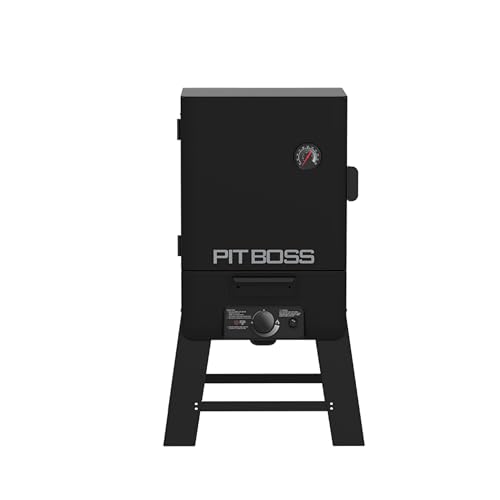
Pit Boss 3-Series Electric Vertical Smoker — Best Budget Electric
The 3-Series Electric is the cabinet category with everything non-essential removed: an analog controller, a wood chip tray, four racks and a straightforward insulated box. It suits first-time smokers, jerky and sausage makers working at low temperatures, and anyone who wants a dedicated cabinet without paying for connectivity. It does not suit cooks who need precise digital temperature holding — an analog dial asks for a separate thermometer and a bit of supervision.
Strengths
- Four racks and roughly 880 square inches — more room than its entry positioning suggests
- Simple analog control means little to configure and little to fail
- Electric heat excels at the low, steady temperatures sausage and jerky demand
Trade-offs
- Analog controller is less precise; a good probe thermometer is a necessary companion
- Adding chips means opening the door, with the usual heat loss
- Smoke intensity is mild, like all electric cabinets
There is a durable logic to simple smokers, and this Pit Boss expresses it well. The jobs electric cabinets do best — holding low temperatures for hours, smoking fish without cooking it hard, drying jerky evenly across racks — do not require an app, and the money saved on electronics is money that can go to a quality probe thermometer, which this unit genuinely needs and rewards. Treat the dial as a suggestion, verify with the probe, and the 3-Series Electric produces results that embarrass far fancier equipment in the hands of a cook who understands that arrangement. As a first cabinet or a dedicated low-temperature second cabinet, it is easy to defend. Check the current price on Amazon
Best for: beginners, sausage and jerky makers, and low-temperature specialists on a budget / Not suited for: cooks who want digital precision without a separate thermometer

Pellet Pro 2300 Vertical Pellet Smoker Cabinet — Best Large-Capacity
The Pellet Pro 2300 comes from Smoke Daddy, a name barbecue enthusiasts know from the pellet-smoker upgrade world, and it is built like it: a double-wall cabinet with a convection fan to even out temperatures across the racks and a cover included in the box. It suits serious batch cooks — the people who smoke for reunions, church events and freezer stocking — and anyone frustrated by hot spots in lesser cabinets. It does not suit small households; an under-filled cabinet this size wastes pellets and patience alike.
Strengths
- Double-wall construction holds heat efficiently and steadies the cook in cold weather
- Convection fan circulates heat and smoke, reducing the rack-to-rack differences cabinets are known for
- Home-delivery positioning and an included cover acknowledge this is a buy-once, keep-it appliance
Trade-offs
- Premium tier pricing that only batch cooking justifies
- Large and heavy — choose its home before it arrives
- Capacity encourages overbuying meat; freezer space becomes the real limit
The convection fan is the feature to understand here. Every vertical cabinet has a temperature gradient — hotter near the heat source, cooler at the top — and cooks manage it by rotating racks and accepting variation. A fan that keeps air moving shrinks that gradient, which means five racks behave more like five equal shelves and less like a ladder of climates. Combined with double walls that shrug off a cold evening, the 2300 is the cabinet for cooks whose problem is not flavor but logistics: many racks, one temperature, predictable timing. That is a narrower promise than “best smoker,” and for the batch cook it is the one that matters. Check the current price on Amazon
Best for: batch cooks who need many racks at one honest temperature / Not suited for: small households cooking one rack at a time

GRILLA Mammoth Vertical Pellet Smoker — Best Premium
The Mammoth is Grilla’s enthusiast-grade entry: five trays, a WiFi-enabled touchscreen controller and a design brief that emphasizes smoke production — Grilla’s following among pellet cooks rests on getting closer to stick-burner flavor than the category usually manages. It suits pellet enthusiasts who found mainstream pellet cabinets too mild and cooks who value controller quality. It does not suit bargain hunters or anyone who wants the simplest possible pellet experience.
Strengths
- Five-tray vertical capacity with a modern touchscreen WiFi controller
- Designed for high smoke production — the pellet cabinet for flavor-first buyers
- Works for smoking and outdoor oven duties, widening its weekly usefulness
Trade-offs
- Premium pricing against capable competition from Pit Boss and Pellet Pro
- A smaller brand’s service network compared with the giants in this guide
- Touchscreen-and-app ownership is a commitment some cooks simply do not want
Pellet smoking’s standing argument is convenience versus smoke depth, and the Mammoth is a deliberate vote that buyers should not have to choose as sharply as they once did. Its controller and fire management aim for the heavier smoke that makes brisket taste like brisket rather than like a roast that met a candle. In the cabinet format that matters doubly, because tall cabinets full of meat are exactly where weak smoke gets lost. If you have owned a pellet grill, liked the ease and wished for more smoke, the Mammoth is the vertical answer built for you. Check the current price on Amazon
Best for: pellet enthusiasts who prioritize smoke depth and controller quality / Not suited for: budget buyers or app-averse cooks

HAKKA Commercial Electric Smoker DSH-S50B — Best for Sausage and Big Batches
The HAKKA DSH-S50B is a vertical smoke oven built for production: eight racks in a stainless commercial cabinet, aimed at sausage, pastrami and smoked meats in quantities home cabinets cannot stage. It suits sausage makers, hunters processing a season’s game, market vendors and very serious hobbyists. It does not suit a casual weekend rib cook, for whom it is honest overkill with a commercial footprint and workflow.
Strengths
- Eight racks — the largest rack count in this guide — for true batch production
- Electric heat holds the low, stable temperatures cured and smoked sausage requires
- Commercial-style construction suits indoor-adjacent and production environments better than backyard units
Trade-offs
- Commercial scale and price for a home patio; measure your space and your ambitions
- Electric smoke profile is mild — production sausage makers often supplement smoke
- Fewer consumer-friendly frills; this is equipment, not an appliance experience
Every category has a point where the home version stops and the working version begins, and the HAKKA sits on that line for cabinet smoking. Sausage making is the clearest case: it is a rack-hungry, temperature-critical, batch-driven craft, and a four-rack home cabinet turns a day’s production into a week’s shifts. Eight racks with steady electric heat collapse that schedule back into a day. Hunters and charcuterie hobbyists reach the same conclusion from different directions. If your smoking ambitions are measured in pounds per batch rather than racks per dinner, this is the cabinet in the guide that speaks your language. Check the current price on Amazon
Best for: sausage makers, hunters and small-scale producers working in batches / Not suited for: casual backyard cooks smoking a rack or two
Comparison Table
| Pick | Badge | Key spec | Best for |
|---|---|---|---|
| Masterbuilt 30-inch Digital Electric | Best Overall | Electric, digital controls, side chip loader, 710 sq in, 4 racks | Convenience-first everyday smoking |
| Pit Boss Navigator 3-Series | Best Pellet Cabinet | Pellet, WiFi/Bluetooth, LCD controller, 5 racks | Big batches with remote monitoring |
| Pit Boss 3-Series Electric | Best Budget Electric | Electric, analog control, 4 racks, ~880 sq in | Beginners, jerky and sausage |
| Pellet Pro 2300 | Best Large-Capacity | Pellet, double-wall, convection fan, cover included | Batch cooks needing even rack temps |
| GRILLA Mammoth | Best Premium | Pellet, 5 trays, WiFi touchscreen, high smoke output | Flavor-first pellet enthusiasts |
| HAKKA DSH-S50B | Best for Production | Electric, 8 racks, commercial cabinet | Sausage and batch production |
How to Choose the Best Vertical Cabinet Smoker
Choose the fuel by the flavor and the lifestyle, in that order. Electric cabinets are the mildest smoke and the least work — the right answer for sausage, fish, cheese-adjacent low-temperature work and cooks who want to press a button. Pellet cabinets are the middle path: genuine wood flavor, digital discipline, and a fuel bill. Charcoal and propane cabinets exist in this shape too and are covered in their own guides in this series; within the electric-versus-pellet decision that dominates cabinet sales, be honest about whether you will actually enjoy managing anything at all. The best cabinet is the one whose fuel matches the cook you are, not the cook you admire.
Size the cabinet by racks and spacing, not by the headline area. Write down your biggest realistic cook — say, four pork butts, or six racks of ribs, or twenty pounds of sausage — and check it against rack count and the vertical gaps between racks. Tall items need spacing; flat items need area; sausage needs hooks or dense racks. A cabinet that fits your biggest cook with one rack to spare is right; bigger than that wastes fuel on every ordinary cook, and smaller turns your biggest day into two shifts.
Then judge the door and the walls, because a cabinet is a heat box and its economics are insulation. Double walls, a door that closes with a positive latch and seals that actually meet the frame keep temperatures steady and fuel bills sane, especially in cold or windy weather. Single-wall cabinets work — most of the category is single-wall — but they ask more of the heating element or the pellet feed on a January night, and the cook learns to plan around weather. If you smoke year-round in a cold climate, insulation is not a premium feature; it is the product.
Finally, plan the ownership details before the freight arrives: where the cabinet will live (level, sheltered, near power for electric and pellet models), how grease will be managed and cleaned, and whether the racks fit your dishwasher or sink. Cabinet smoking is a years-long relationship with a large appliance, and the cooks who think about placement and cleaning on day one are the ones still smoking happily in year three.
Rack Management: Cooking on Five Levels Without Five Results
The vertical cabinet’s blessing and curse is stratification: heat and smoke rise, so the cabinet is a stack of slightly different cooking environments wearing one thermostat. Experienced cabinet cooks exploit this instead of fighting it. Dense, forgiving items — pork butts, briskets — ride the hotter lower racks where they can take the energy. Delicate items — fish, sausage near the end of its cook, anything that dries easily — live higher and cooler. Fatty items never sit above lean ones, because dripping is gravity’s business and a butt basting a rack of chicken is a flavor decision you should make on purpose, not by accident.
Rotation is the other half of the craft. On long cooks, moving racks up or down a level once or twice evens out the differences the cabinet cannot. Do it quickly, with the door open for seconds rather than minutes, and ideally at a moment when you are opening the door anyway to spritz or wrap. Cabinets forgive door openings better than drum smokers do — the door exposes one face rather than the whole cooking chamber — but the heat you lose is still heat the element or fire must replace. Plan door openings like a budget: few, purposeful and combined.
How to Run Your First Cook in a Vertical Cabinet Smoker
Start with a seasoning run: no food, a light coat of cooking oil on the racks and interior, and a few hours at moderate temperature with smoke. This burns off manufacturing residues and lays down the first layer of the seasoning that will protect the steel and flavor future cooks. Then choose a forgiving first cook — a pork butt is the classic for a reason — and load the cabinet in a deliberate order: water pan filled, wood chips or pellets ready, meat on the racks with space between pieces for smoke to circulate. Crowding racks edge-to-edge is the beginner’s way to steam meat instead of smoking it.
During the cook, your job is mostly restraint. Verify the cabinet temperature with a probe at rack level rather than trusting any single built-in readout, note the difference once, and then leave the door closed. Add chips through the side loader if your cabinet has one; if it does not, combine chip changes with other necessary openings. When the meat stalls — and a butt will — the cabinet’s steadiness is your friend: hold temperature, keep the door shut, and let time work. Finish by resting the meat properly, then clean while the cabinet is still warm: racks out, grease tray emptied, interior wiped. A cabinet cleaned warm in ten minutes stays a pleasure; a cabinet cleaned cold next weekend becomes a chore that quietly ends smoking seasons.
Cabinet vs Drum vs Offset: Choosing the Shape Before the Brand
Buyers often compare cabinet smokers against each other for weeks while skipping the prior question of whether the cabinet shape suits their cooking at all. The drum smoker — a barrel with a hanging or rack system — is the cabinet’s closest rival: it is cheaper per capacity, superbly efficient on charcoal, and produces a distinctive direct-heat flavor from drippings hitting the coals. What it lacks is the cabinet’s access and rack flexibility; everything goes in and comes out through the top, and delicate batch work like jerky is fussier. The offset is a different philosophy altogether — a horizontal chamber fed by a side firebox — offering the deepest smoke flavor and the most demanding fire management, in a footprint several times a cabinet’s. The kettle grill that smokes on weekends is the fourth option, and the honest one for people who smoke four times a year.
The cabinet wins its owners on three specific grounds. First, density: no other shape puts this much rack area on this little patio. Second, process foods: sausage, jerky, bacon, fish and cheese all prefer the cabinet’s gentle, even, low-temperature environment and its many racks. Third, access: the door makes mid-cook adjustments — moving a rack, foiling a brisket, pulling one item early — routine rather than disruptive. If your smoking life is mostly brisket-and-ribs theatre for a crowd, the drum and offset argue back hard. If it is varied, frequent and space-limited, the cabinet is not a compromise; it is the correct tool, and the only remaining question is which of the six above fits your fuel and batch size.
Wood Choices for Cabinet Smokers: Chips, Chunks and Pellets
Cabinet smokers burn their wood in small, controlled doses, and the choice of wood shapes flavor more than the choice between two similar cabinets does. Chips are the electric and propane cabinet standard: they ignite quickly, smoke briefly and suit the loader-and-tray systems these cabinets use. Their short smoke cycle is why electric cabinets taste mild — the fix is not a different wood but a rhythm of replenishment, or accepting the mildness as the style. Pellets are a complete fuel rather than a flavoring, and pellet cabinets let you choose the wood species as a recipe decision: fruitwoods for pork and poultry, stronger hickory and mesquite personalities for beef, blends for everyday cooking.
Species matching rewards a light touch. Delicate foods — fish, cheese, vegetables, poultry — take smoke quickly and are easily overwhelmed; mild fruitwoods and alder-style profiles flatter them. Pork sits in the middle and tolerates almost anything, which is why it is the beginner’s friend. Beef brisket is the one common cook that genuinely wants a assertive wood, and even there, a cabinet’s enclosed, smoky environment concentrates flavor more than an open grill does, so err one step milder than your instinct. The universal rule is that smoke should be a seasoning you can identify, not a coating you can scrape: thin, clean smoke over hours beats thick smoke for an hour, in a cabinet most of all, because the box holds whatever you put into it around the food for the entire cook.
Common Buying Mistakes
Buying by square inches alone. Area without rack spacing is a meaningless number. A cabinet can advertise a huge area across racks spaced for jerky and still fail to fit the briskets you bought it for. Check rack count and the gaps between them against your actual cooks.
Expecting offset flavor from an electric cabinet. Electric cabinets make clean, mild smoke and excellent food — but a different food from a stick-burner’s. Buy electric for convenience and low-temperature control, pellet for a step toward wood flavor, and neither under a misapprehension.
Ignoring the door seal on a cheap cabinet. Heat and smoke leaking from door gaps wreck temperature stability and stain patios. A cabinet is a box; if the box does not close properly, nothing downstream can save the cook.
Forgetting the electrical reality. Electric and pellet cabinets need outdoor power, weather protection for the connection and a cord path that is not a trip hazard across the patio. Confirm the setup before the freight arrives, not after.
Skipping the probe thermometer. Built-in readouts measure where the sensor sits, not where your brisket sits. A dual-probe thermometer — one for the rack, one for the meat — is the cheapest accuracy upgrade in all of barbecue, and analog cabinets effectively require it.
Overloading the racks. Smoke needs to circulate and heat needs to rise. A cabinet packed solid cooks unevenly and slowly, and the disappointed owner blames the smoker for a loading decision. Leave gaps between pieces — an inch of daylight around each item is a good rule — and accept a second batch when the cook is genuinely too big for the box. Two relaxed batches beat one crammed cook every time, and the first batch rests happily, wrapped and warm, while the second one finishes smoking slowly.
Sizing a Cabinet to Your Household, Honestly
Cabinet product pages speak in square inches; households speak in occasions. Translate before you buy. A couple that smokes a rack of ribs or a small butt on Sundays lives entirely inside the 30-inch electric class, and will use the fourth rack twice a year. A family that hosts holiday dinners — a turkey-adjacent cook here, four racks of ribs there — needs the five-rack pellet class or a 40-inch electric, not because weekly cooking demands it, but because the year’s three biggest days do, and those are the days a too-small smoker hurts most. The batch and production cooks — sausage weekends, hunting season, a freezer to fill — should skip the arithmetic entirely and buy by rack count: the HAKKA’s eight racks or the Pellet Pro’s even-tempered stack.
The counterweight is that oversizing has a daily cost nobody advertises. A big cabinet heats a big empty box for a single chicken, burns more fuel doing it, and takes longer to come to temperature. The sweet spot is the cabinet that fits your biggest regular cook — not your biggest imaginable one — with one rack of grace. Rent, borrow or batch-in-shifts for the once-a-year outlier; live happily with the right-sized box the other fifty weekends. That discipline is what separates the cabinets still smoking in year five from the impressive ones listed for sale in year two.
Running Costs and Ownership: Pellets, Chips, Power and Parts
The purchase price of a cabinet smoker is the beginning of its cost, and the fuels diverge enough to matter over years. Electric cabinets are the cheapest to run per cook — an element sipping power for ten hours costs little, and wood chips are bought by the bag and used by the handful. Propane cabinets sit in the middle, with a tank lasting many cooks. Pellet cabinets are the most expensive to feed on long cooks, because pellets are both the heat and the smoke; a big cabinet working through a cold night eats accordingly. None of this should decide the purchase alone — flavor and convenience dominate — but a cook who smokes weekly should run the arithmetic honestly, because the “expensive” cabinet that gets used constantly is cheaper per meal than the bargain that sulks in the garage.
Parts and longevity follow the same pattern. Electric cabinets have an element and a control board as their wear items; both are replaceable, and brands like Masterbuilt have the parts pipelines of mass-market appliances. Pellet cabinets add an auger, a fan and an igniter to the list — more capable, more serviceable, more to maintain. The commercial HAKKA trades consumer support for industrial simplicity. Across all of them, the habits that extend life are unglamorous: keep the cabinet covered and dry, empty grease before it becomes a fire story, and never let ash or chip residue sit wet against steel between cooks. A cabinet smoker is a decade-scale appliance for owners who do those three things, and a three-year disappointment for owners who do none of them.
Final Recommendation
For most buyers, the Masterbuilt 30-inch Digital Electric is the cabinet to start with: steady, convenient and honest about what electric smoking is. Pellet buyers should choose between the Navigator’s connected capacity, the Pellet Pro 2300’s even-tempered batch design and the Mammoth’s smoke-first premium build. Budget and low-temperature cooks belong on the Pit Boss 3-Series Electric, and production-minded smokers on the HAKKA. Explore the rest of the vertical family before deciding — Best Vertical Gas Smokers for propane’s set-and-forget alternative, Best Vertical Pellets Smokers for the pellet-only deep dive, Best Vertical Meat Smokers for the all-fuel view, and Best Vertical Offset Smokers for the traditional fire-managed end of the shape. If your cooks lean electric generally, Best Electric Smokers With Bluetooth is worth a look as well.
The Water Pan: Small Tray, Outsized Influence
Nearly every cabinet in this guide includes a water pan, and nearly every beginner underestimates it. The pan does three jobs at once. It buffers temperature — a mass of water absorbs heat spikes and releases steadiness, smoothing the cabinet’s response when the door opens or the weather shifts. It humidifies the cooking chamber, and moist air helps smoke cling to meat and slows surface drying during the long middle hours of a cook. And it catches drippings before they reach the heat source, which keeps flare-ups and acrid grease smoke out of the flavor. Filling the pan is the default for brisket, butts and ribs; running it empty or foiled is a legitimate choice for poultry when crisper skin matters more than moisture, and for jerky, where the entire point is drying. Sand is the old hand’s alternative filler — pure thermal mass without humidity — and suits cooks fighting a cabinet that runs damp. What the pan should never be is forgotten: a pan that boils dry mid-cook quietly removes the buffer you were counting on, and a pan of cold water added to a hot cabinet steals heat at the worst moment. Top it up with hot water, at a moment when the door is already open, and it will repay you in steadier cooks.
Frequently Asked Questions
What is the advantage of a cabinet smoker over a drum or kettle?
Capacity per square foot and access. The vertical stack holds more food on a small patio footprint, and the front door lets you reach one rack without exposing the whole cooking chamber the way lifting a drum lid does. Cabinets also tend to offer more racks, which suits batch foods like jerky and sausage.
Electric or pellet — which cabinet fuel is better?
Neither in the abstract. Electric is simpler, steadier at low temperatures and milder in smoke — ideal for sausage, fish and convenience cooking. Pellet gives real wood flavor with digital control and suits brisket-and-ribs cooks who want convenience without giving up fire. Choose by the food you cook most.
How much food fits in a 30-inch cabinet smoker?
As a working picture, a 30-inch electric cabinet with four racks and about 710 square inches handles several racks of ribs, a couple of pork butts with room to spare, or a batch of sausage across all racks — but not all of those at once. Judge by your single biggest cook, and leave a rack of headroom.
Do cabinet smokers work in winter?
Yes, with insulation deciding how gracefully. Double-wall cabinets hold temperature in cold weather with modest extra fuel. Single-wall electric cabinets work hardest in winter and may struggle to reach high temperatures on the coldest days; sheltering the cabinet from wind helps every design. Placement matters more than most owners expect: a cabinet tucked against a wall, out of the prevailing wind, can behave a full class better than the same cabinet exposed on an open deck, and a welding blanket over a cold-weather cook is an old, effective trick — kept clear of vents and heat sources, and never on a unit whose manufacturer warns against covering it.
Can I cold-smoke cheese or fish in a cabinet smoker?
The cabinet shape is well suited to it because the tall chamber keeps food far from the heat source. Electric cabinets run at their lowest settings, often paired with a separate smoke tube for cold smoking. Keep temperatures genuinely low and treat food-safety times and temperatures seriously for cured and cold-smoked products. Cold smoking is a preservation-adjacent craft, not merely a flavoring step: cure fish properly before it meets smoke, keep cheese below the point where it sweats and slumps, and refrigerate promptly. The cabinet makes the environment easy to hold; the discipline around it remains the cook’s.
How often do the racks need rotating?
On long cooks, once or twice is typical — enough to even out the cabinet’s natural top-to-bottom gradient without bleeding heat through constant door openings. Convection models like the Pellet Pro 2300 reduce the need; small single-wall cabinets benefit from it most.
Do I need to season a new cabinet smoker?
Yes. A seasoning run — oil the interior and racks lightly, then run the empty cabinet with smoke for a few hours — burns off manufacturing residue and lays down a protective coating that resists rust and improves flavor. Skipping it risks a chemical note on your first cook and a cabinet that ages faster.
Can a cabinet smoker replace my grill?
For low-and-slow cooking it can be your primary outdoor cooker, but cabinets are not built for high-heat searing, burgers or weeknight grilling speed. Most owners pair a cabinet with an inexpensive kettle or gas grill: the cabinet owns the long cooks, the grill owns the fast ones, and each does its job better than a compromise cooker.


