Disclosure: airfryerkitchensupply.com is reader-supported. When you buy through links on our site, we may earn an affiliate commission at no extra cost to you.
Where to buy
If you are shopping for the best stand mixers for baking, start with this verified shortlist. Every mixer here was verified as a current Amazon listing before a link was attached, with bowl sizes, speed counts and included tools taken from the listings themselves. We do not print prices — check price on Amazon through each link and confirm the colour and bundle, since baking bundles sometimes swap the beater set.
- KitchenAid Artisan 5-Qt Tilt-Head Stand Mixer KSM150PS, Contour Silver — Best Overall for Baking
- Cuisinart Precision Master 5.5-Qt Stand Mixer SM-50, White Linen — Best Value for Baking
- KitchenAid 5.5-Qt Bowl-Lift Stand Mixer KSM55, Porcelain White — Best for Bread-and-Cake Bakers
- Cuisinart Precision Pro Digital Stand Mixer SMD-50, 5.5-Qt — Best for Methodical Bakers
- SMEG SMF04 Classico Stand Mixer, Cream — Best Looking Baking Mixer
- Aucma Stand Mixer 6.5-QT 660W Tilt-Head, Black — Best Big-Bowl Budget for Baking
The best stand mixers for baking are not necessarily the best stand mixers for anything else. Baking asks a specific set of things from a machine: gentle speeds that fold without destroying air, honest creaming power for butter and sugar, a bowl shaped so small quantities of sponge mix as evenly as big ones, and — for the bread bakers — enough composure to knead without walking across the counter. A mixer can be a fine general appliance and a mediocre baking partner if it fails those specific tests.
This guide is written from the baking bench outward. The six verified machines below cover the way home bakers actually work: the benchmark all-rounder that does every bake well, a value 5.5-quart alternative with unusually fine speed control, a bowl-lift machine for bakers whose repertoire runs from meringue to sourdough, a digital model for bakers who follow timed methods, a design-led machine that still performs, and a big-bowl budget option for families who bake in volume.
If your baking is mostly one thing — only bread, only cookies, only celebration cakes — our dedicated guides go deeper. This one is for the general baker, whose week might hold a Victoria sponge, a tray of flapjacks, a pizza night and a birthday cake, and who needs one machine that respects all of them.
In this guide
Quick Picks
Best Overall for Baking — KitchenAid Artisan 5-Qt Tilt-Head Stand Mixer KSM150PS, Contour Silver: The reference baking all-rounder: creams, whips, folds and kneads with the deepest accessory support in baking. Check the current price on Amazon.
Best Value for Baking — Cuisinart Precision Master 5.5-Qt Stand Mixer SM-50, White Linen: Twelve speeds and a 5.5-quart bowl — fine low-speed control for folding, at a value tier. Check the current price on Amazon.
Best for Bread-and-Cake Bakers — KitchenAid 5.5-Qt Bowl-Lift Stand Mixer KSM55, Porcelain White: Bowl-lift stability for bakers whose week includes bread as well as cakes; the serious baker’s step up. Check the current price on Amazon.
Best for Methodical Bakers — Cuisinart Precision Pro Digital Stand Mixer SMD-50, 5.5-Qt: Programmed settings and a digital readout for bakers who bake by the timer and want repeatable batches. Check the current price on Amazon.
Best Looking Baking Mixer — SMEG SMF04 Classico Stand Mixer, Cream: Retro looks with a real 600W planetary drive and Smooth Start to keep flour in the bowl, not on you. Check the current price on Amazon.
Best Big-Bowl Budget for Baking — Aucma Stand Mixer 6.5-QT 660W Tilt-Head, Black: A 6.5-quart bowl on a budget for family-scale baking days; capacity first, finesse second. Check the current price on Amazon.
How These Picks Were Chosen
Baking-specific selection meant weighting the low end of the speed range as heavily as the top. A mixer that cannot stir gently will knock the air out of a whisked sponge and toughen a scone dough, so every pick here had to offer genuinely slow speeds — including, at the top of the range, a half-speed fold setting. Creaming performance came next: the beater geometry and bowl coverage that turn butter and sugar pale and fluffy without constant scraping. Dough ability was the third test, because most home bakers knead at least occasionally, and a baking mixer that fears dough is half a machine.
All six were verified as current listings, and specifications in the reviews — bowl sizes, speed counts, included beaters — come from those listings. We favoured machines whose included tools cover the baking trio (flat beater, whisk, dough hook) in the box, because a baking mixer that needs an immediate extra purchase is mispriced however you look at it.
Baking selection also considered the recipe ecosystem a machine joins. Standard home baking recipes are written, implicitly, around the 5-quart class of bowl and a ten-speed planetary machine; deviating far from that centre in either direction means translating quantities and timings as you learn. Every pick here either sits at that centre or offers a clear reason — capacity, control, design — for the translation it asks of you. A baking mixer should disappear into the recipe, and that disappearance is a specification too.
The 6 Best Stand Mixers for Baking — Reviewed

KitchenAid Artisan 5-Qt Tilt-Head Stand Mixer KSM150PS, Contour Silver — Best Overall for Baking
The Artisan fits the baker who does a bit of everything and does it often. Its bowl size is the home baking standard, its speeds run from a true stir to a fast whip, and when a recipe calls for an attachment — a pasta roller for a special weekend, a grain mill later — the hub is waiting. It is the mixer baking books silently assume you own.
In a general baking week — sponges on Tuesday, a tray of brownies at the weekend — the KitchenAid Artisan 5-Qt Tilt-Head Stand Mixer KSM150PS, Contour Silver covers the repertoire without special pleading, and its bowl and speed range are sized for the mixed workload that defines home baking rather than for one speciality.
Strengths
- The benchmark bowl size: written into a generation of recipes, so quantities just work
- A stir-to-whip speed range that covers the whole home repertoire without gaps
- Ownership infrastructure — spares, bowls, beaters, service — that no rival matches for depth
Trade-offs
- Its popularity means colour pricing is a lottery; patience finds the same machine cheaper
- A tilt-head will always be less rigid than a bowl-lift at the extremes of dough
- It is the default choice, which makes it the least personal one on this list
| Specification | Detail |
|---|---|
| Bowl | 5 qt, stainless steel |
| Design | Tilt-head |
| Speeds | 10 speed settings |
| Included | Pouring shield, flat beater, dough hook, wire whip (per listing) |
Ask a room of experienced home bakers what mixer they own and the Artisan is the answer you will hear most — not because it tops every specification, but because it has no weak chapter. Creaming: excellent. Whipping: excellent. Dough at home scale: capable and calm. Support in year nine: a phone call, not a research project. Machines become defaults by accumulating years of unremarkable reliability, and the Artisan has accumulated more of those years, in more kitchens, than anything else in this guide.
Best for: all-round home baking, several times a month or more / Not suited for: very small kitchens with no counter to spare
Check the current price on Amazon

Cuisinart Precision Master 5.5-Qt Stand Mixer SM-50, White Linen — Best Value for Baking
The SM-50 fits the baker who reads specifications and folds carefully. Twelve speeds is not a gimmick when three of them live at the gentle end where folding and starting dry ingredients happen; combined with the 5.5-quart bowl, it suits bakers whose batches are growing but whose budget is not.
For all-round baking the question is whether a machine handles the easy 80 percent beautifully and the hard 20 percent adequately; the Cuisinart Precision Master 5.5-Qt Stand Mixer SM-50, White Linen passes that test, moving from whisked sponges to enriched doughs without a change of machine.
Strengths
- Twelve speeds with real granularity where bakers live — the bottom half of the dial
- The included splash guard has a pour spout, so additions mid-mix stay clean
- A 5.5-quart stainless bowl with the trio of tools every recipe assumes
Trade-offs
- Cuisinart’s attachment catalogue is a shelf, not the library the hub platforms offer
- The head-lift design still needs the same cabinet clearance check as any tilt-head
- Resale and spares depth trail the market leader, even though cover is perfectly adequate
| Specification | Detail |
|---|---|
| Bowl | 5.5 qt, stainless steel |
| Design | Tilt-head style head lift |
| Speeds | 12 speeds |
| Included | Chef’s whisk, mixing paddle, dough hook, splash guard with pour spout |
What the SM-50 understands is that most bakers are not buying a symbol; they are buying Tuesday. On Tuesday the recipe needs butter creamed properly, a batter folded without fear, and a bowl that fits the batch the family actually eats — and the Cuisinart does all three with a little more room and a little more speed control than the famous default, usually for a little less money. It is the rationalist’s mixer, and rationalists bake very well on it for very long.
Best for: careful bakers who fold, cream and start dry mixes gently / Not suited for: the deepest attachment collecting
Check the current price on Amazon
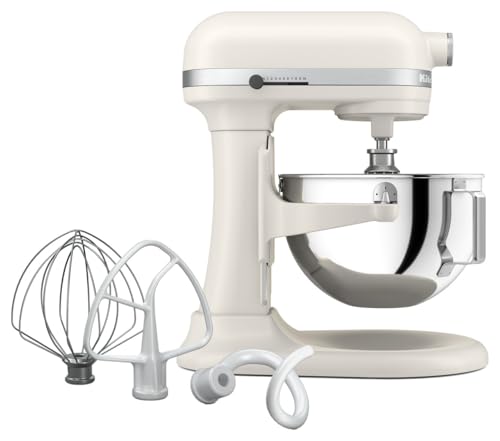
KitchenAid 5.5-Qt Bowl-Lift Stand Mixer KSM55, Porcelain White — Best for Bread-and-Cake Bakers
The KSM55 fits the baker whose repertoire has a split personality: delicate cakes on Saturday, a sourdough boule every Sunday. The bowl-lift frame keeps the dough work calm, and the 11 speeds with a gentle fold keep the cake work honest. It is the natural upgrade when a tilt-head starts rocking during kneads.
In a general baking week — sponges on Tuesday, a tray of brownies at the weekend — the KitchenAid 5.5-Qt Bowl-Lift Stand Mixer KSM55, Porcelain White covers the repertoire without special pleading, and its bowl and speed range are sized for the mixed workload that defines home baking rather than for one speciality.
Strengths
- Eleven speeds including a true fold, rare at this size of bowl-lift machine
- The lift mechanism keeps the head perfectly still through long kneads
- A 5.5-quart bowl that matches the one-to-two-loaf, family-cake rhythm of real homes
Trade-offs
- You will measure your cabinets before buying — bowl-lift height is non-negotiable
- The bowl’s lift-on, lift-off handling is slower than a tilt-head’s casual tilt
- It asks for a permanent counter home; this is not a cupboard machine
| Specification | Detail |
|---|---|
| Bowl | 5.5 qt, stainless steel |
| Design | Bowl-lift |
| Speeds | 11 mixing speeds |
| Included | Flat beater, dough hook, wire whip |
The KSM55 rewards bakers who found their tilt-head’s limits and can name them: the nod under dough, the walk across the counter, the batch split in two. Every one of those limits is answered by the lift frame and the extra half-quart, while the fold speed answers the opposite complaint — that serious machines bully delicate mixtures. It is a considered machine for a considered baker, and its compromises (size, weight, permanence) are the honest price of its composure.
Best for: bakers split between cakes and regular bread / Not suited for: cupboard storage or low overhead clearance
Check the current price on Amazon
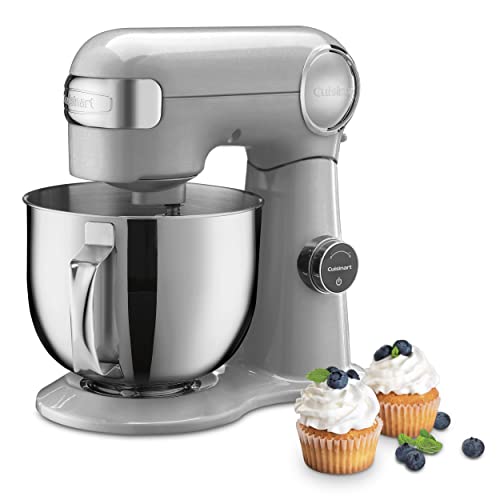
Cuisinart Precision Pro Digital Stand Mixer SMD-50, 5.5-Qt — Best for Methodical Bakers
The SMD-50 fits the methodical baker — the one with a notebook, a preferred creaming time, and strong opinions about consistency between batches. Programmed settings turn ‘mix on medium for three minutes’ into a button press, and the digital readout makes a successful batch exactly repeatable.
For all-round baking the question is whether a machine handles the easy 80 percent beautifully and the hard 20 percent adequately; the Cuisinart Precision Pro Digital Stand Mixer SMD-50, 5.5-Qt passes that test, moving from whisked sponges to enriched doughs without a change of machine.
Strengths
- Preprogrammed settings take the guesswork out of common jobs like kneading and whipping
- Digital control makes repeat batches consistent — same speed profile every time
- The 5.5-quart bowl and full accessory set cover the whole home baking range
Trade-offs
- Digital controls are one more system to learn compared with a simple lever
- Costs more than the manual SM-50 while sharing much of the same hardware
- Touch-style controls and floury hands are not always friends; keep a towel handy
| Specification | Detail |
|---|---|
| Bowl | 5.5 qt |
| Design | Digital control dial |
| Speeds | 12 speeds, 3 preprogrammed food prep settings |
| Included | Whisk, flat mixing paddle, dough hook, splash guard |
The SMD-50 takes the SM-50 formula and adds a digital brain. For bakers who follow timed methods — knead eight minutes, rest, knead again — the preprogrammed settings and clear speed readout remove friction and make results repeatable week after week. It suits the baker who treats recipes as protocols. If you prefer to mix by feel and sound, the manual version is the same kitchen tool for less; if you like pressing a button and walking away, this is the one.
Best for: timed, repeatable, recipe-driven baking / Not suited for: bakers who mix purely by feel and dislike digital controls
Check the current price on Amazon

SMEG SMF04 Classico Stand Mixer, Cream — Best Looking Baking Mixer
The SMEG SMF04 fits the baker whose kitchen is also their favourite room. It performs the full baking repertoire credibly — the planetary drive and 600W motor are real — and its Smooth Start is a genuinely baking-relevant feature, because flour clouds are a baking problem before they are a cleaning problem.
In a general baking week — sponges on Tuesday, a tray of brownies at the weekend — the SMEG SMF04 Classico Stand Mixer, Cream covers the repertoire without special pleading, and its bowl and speed range are sized for the mixed workload that defines home baking rather than for one speciality.
Strengths
- The retro design is the point — a countertop statement piece that also mixes properly
- Smooth Start tames the flour-cloud problem when starting dry ingredients
- A 600-watt motor and 5-quart bowl put it in genuine all-rounder territory
Trade-offs
- You pay a real premium for the design language
- Accessory ecosystem is far smaller than KitchenAid’s
- Steady Mix marketing aside, very stiff doughs still deserve sensible batch sizes
| Specification | Detail |
|---|---|
| Bowl | 5 qt, stainless steel |
| Design | Planetary mixer, retro 50s styling |
| Power | 600W motor (per listing) |
| Speeds | 10 speeds, Smooth Start and Steady Mix system |
SMEG sells the kitchen as a designed space, and the SMF04 is its mixer manifesto: 1950s curves, a proper 600-watt planetary drive underneath, and details like Smooth Start that show the engineering kept pace with the styling. It creams, whips and kneads credibly for a home baker, and it will be photographed more than any other appliance you own. Buy it because the look brings you joy every day — the mixing performance simply has to be good enough, and it is.
Best for: design-conscious bakers who still bake weekly / Not suited for: maximising capacity or attachments per pound
Check the current price on Amazon

Aucma Stand Mixer 6.5-QT 660W Tilt-Head, Black — Best Big-Bowl Budget for Baking
The Aucma fits the family baker producing volume on a budget: school-fete trays, big birthday cakes, double cookie batches. Its 6.5-quart bowl is the point. It asks you to accept a thinner support story in exchange for capacity that would cost far more from the heritage brands.
For all-round baking the question is whether a machine handles the easy 80 percent beautifully and the hard 20 percent adequately; the Aucma Stand Mixer 6.5-QT 660W Tilt-Head, Black passes that test, moving from whisked sponges to enriched doughs without a change of machine.
Strengths
- A big 6.5-quart bowl at a tier where most rivals give you four quarts
- The 660-watt motor rating is strong for the price class and handles family-size batches
- Suction-cup feet help it stay planted, which lighter budget mixers often struggle with
Trade-offs
- Brand support and long-term parts availability are thinner than the legacy names
- Fit and finish are a step below premium machines, even if day-to-day mixing is fine
- Tilt-head geometry plus a tall bowl needs generous clearance under cabinets
| Specification | Detail |
|---|---|
| Bowl | 6.5 qt |
| Design | Tilt-head |
| Power | 660 watts (per listing) |
| Included | Dough hook, wire whip, beater |
Aucma’s pitch is simple arithmetic: more bowl and more motor for the money than the famous badges offer. For family baking — big cookie batches, sandwich loaves, celebration cakes — that arithmetic is persuasive, and owners generally find the machine willing as long as doughs stay within sensible hydration and batch limits. What you give up is the deep service network and decade-long parts shelf of the heritage brands. Treat it as strong value with a shorter guaranteed horizon, and the trade makes sense.
Best for: family-volume baking on a firm budget / Not suited for: fine, delicate work as the main event
Check the current price on Amazon
Comparison Table
| Pick | Badge | Key spec | Best for |
|---|---|---|---|
| KitchenAid Artisan 5-Qt Tilt-Head Stand Mixer KSM150PS, Contour Silver | Best Overall for Baking | 5 qt, stainless steel | all-round home baking, several times a month or more |
| Cuisinart Precision Master 5.5-Qt Stand Mixer SM-50, White Linen | Best Value for Baking | 5.5 qt, stainless steel | careful bakers who fold, cream and start dry mixes gently |
| KitchenAid 5.5-Qt Bowl-Lift Stand Mixer KSM55, Porcelain White | Best for Bread-and-Cake Bakers | 5.5 qt, stainless steel | bakers split between cakes and regular bread |
| Cuisinart Precision Pro Digital Stand Mixer SMD-50, 5.5-Qt | Best for Methodical Bakers | 5.5 qt | timed, repeatable, recipe-driven baking |
| SMEG SMF04 Classico Stand Mixer, Cream | Best Looking Baking Mixer | 5 qt, stainless steel | design-conscious bakers who still bake weekly |
| Aucma Stand Mixer 6.5-QT 660W Tilt-Head, Black | Best Big-Bowl Budget for Baking | 6.5 qt | family-volume baking on a firm budget |
How to Choose a Stand Mixer for Baking
Begin with your bake list, not with machines. Write down the last ten things you baked and mark each with the tool it needed: beater, whisk or hook. Most home bakers find the beater dominates — cakes, cookies, brownies, frostings — with the whisk second and the hook an occasional guest. That profile wants a 5-quart-class tilt-head with great low speeds. If the hook appears in half your bakes, weight the decision toward bowl-lift stability or the specialist dough machines in our bread guide. If the whisk dominates — meringues, sponges, mousses — bowl shape and whisk coverage matter more than motor muscle.
Speed range is the specification bakers should read first. You need a stir speed slow enough to fold flour into a whisked sponge without deflating it, a medium band where creaming happens, and a top speed that whips cream before your patience ends. Ten to twelve speeds is the comfortable zone; what matters is that the bottom speed is genuinely slow. A machine whose ‘speed 1’ is brisk will splash milk, puff flour and bully batters, and no other specification compensates.
Bowl considerations are practical: a handle helps when you are pouring batter one-handed with a spatula in the other; a pouring shield or splash guard earns its place on flour-heavy baking days; and a second bowl — the accessory bakers actually use most — transforms recipes with two mixtures, like a cake plus its meringue frosting. Check second-bowl pricing for your shortlisted model while you shop, not after.
Tilt-Head or Bowl-Lift for Baking?
For most baking, tilt-head is the friendlier design: the head lifts back, the bowl is right there, beaters swap in seconds and adding a handful of chocolate chips mid-mix is a one-handed job. That friendliness is why tilt-head machines dominate home baking. Their weakness appears with stiff dough and big batches, where the head can nod and the machine can wander — manageable at 5-quart scale with sensible batches, which is where most baking lives.
Bowl-lift trades a little of that friendliness for composure. The bowl rises to the tools on a lever, the frame is one rigid piece, and heavy work happens without theatre. Bakers who knead weekly, double recipes or make stiff enriched doughs will feel the benefit in every batch. The costs are height, weight and a bowl that is slightly more awkward to scrape. Neither design is ‘better for baking’ in the abstract — the answer is written in your bake list, which is why we keep sending you back to it.
The Baking Accessories That Actually Matter
Three accessories earn their money for bakers. A flex-edge beater, which scrapes the bowl as it turns, cuts the stop-and-scrape rhythm of creaming and batter work — the single most-used upgrade in home baking. A second bowl makes two-component bakes flow and costs less than most attachments. A pouring shield pays for itself the first time you start a flour-heavy dough on a slow speed and the cloud stays in the bowl. Everything else — pasta rollers, mills, spiralizers — is a lovely later decision that the hub machines in this guide leave open.
What you can skip: duplicate beaters in exotic materials, decorative bowl upgrades bought before the first bake, and any bundle whose extras you cannot name a recipe for. Baking rewards a small kit used constantly over a large kit used guiltily.
Bowl Materials and Beater Choices for Baking
Stainless steel is the default for good reasons: light for its size, unbreakable in normal use, happy in the dishwasher and neutral for every mixture. Glass bowls let you watch a batter’s consistency and judge creaming by colour, at the cost of weight and a chip risk that matters in busy kitchens. Ceramic is beautiful and heavy in equal measure. For baking specifically, steel’s lightness wins when you are pouring batter one-handed; glass wins when the recipe is judged by eye — meringue stages, caramel-adjacent work — and many serious bakers eventually own one of each, which the platform machines in this guide make easy.
Beaters divide similarly. The standard flat beater is the baking workhorse; the flex-edge variant adds a silicone sweep that scrapes as it turns and is, for creaming and batters, a genuine improvement rather than an accessory indulgence. Burnished and coated beaters differ mainly in washing — some are dishwasher-happy, some are hand-wash only — and in a baking household that detail decides whether the beater gets used daily or avoided. Check the care instructions for the exact tools in the box before buying; baking is a high-frequency hobby and small frictions compound.
Reading Your Own Baking: A Two-Week Test Before You Buy
If you are torn between two picks in this guide, run the two-week test: bake as you normally would for a fortnight, with your current equipment, and note every moment the equipment is the problem. A bowl too small for the double batch. A hand mixer that leaves your arm aching at the creaming stage. Dough that your current setup cannot knead at all. Those notes are a specification written in your own kitchen’s language, and they point at one of these six machines with embarrassing precision.
The test also protects against the opposite error — buying for imagined baking. If the fortnight contains one cake and one tray of cookies, the flagship bowl-lift is a monument, not a tool, and the honest pick is the mid-tier machine plus a year of excellent ingredients. Baking equipment should be bought by the baker you observably are, with one size of headroom for the baker you are becoming — no more, because headroom beyond that is where good money goes to gather dust.
How to Use a Stand Mixer for Better Baking: The Core Techniques
Creaming is the foundation skill. Butter at cool room temperature — it should dent under a finger, not slump — goes in with the sugar on a medium speed for a full three to five minutes, until the mixture is visibly paler and lighter. Bakers under-cream more than any other error; the mixer makes the full time easy, so take it. Eggs go in one at a time, each beaten in fully, with a spoonful of the recipe’s flour alongside if the mixture threatens to curdle.
Folding is where the mixer’s slowest speed earns its keep. When flour joins a whisked sponge or a creamed batter, use the lowest setting and mix only until the last streaks disappear — seconds, not minutes — or finish by hand with a spatula if your machine’s slowest speed is brisk. Every extra turn at this stage is air leaving and toughness arriving. The half-speed fold setting on the bowl-lift KitchenAid in this guide exists precisely for this moment.
For whisking, bowl and whisk must be grease-free, and the machine does the patience: egg whites to firm peaks, cream to soft folds, always stopping a breath early because carry-over is real and an over-whipped bowl cannot be un-whipped. For kneading, let the hook work at the manufacturer’s dough speed — usually a low setting — and judge the dough, not the clock: smooth, elastic, pulling cleanly from the bowl’s sides, with the exact minutes varying by flour and hydration.
Finish with the habits that keep baking pleasant: scrape the bowl once, properly, halfway through any batter; bring ingredients to temperature before the machine starts rather than asking it to fix cold butter; and wash the beater and bowl while the bake is in the oven, so the mixer is ready for the frosting when the cake comes out.
One more technique repays learning early: the beater clearance check. With the bowl empty and the flat beater fitted, the beater should pass very close to the bowl’s bottom without striking it — close enough that a sheet of paper is just gripped. Too high, and a layer of unmixed butter lives under every batter; too low, and the beater strikes and wears. Most machines in this guide have a simple adjustment for this, described in their manuals, and checking it twice a year is the entire secret behind many ‘my mixer suddenly mixes better’ stories.
And a word on ingredient temperature, the variable no machine can fix. Butter for creaming should dent, not slump; eggs crack less and whip better at room temperature; milk and water for doughs should match the recipe’s intent. The mixer will faithfully process whatever temperature you give it — including faithfully producing a curdled batter from cold eggs. Ten minutes of ingredient patience before the machine starts is worth more than any speed setting after it.
Three Baking Days, Three Right Machines
Day one: a child’s birthday — a layered sponge, a whipped frosting, a batch of cupcakes for the class. The work is creaming, whisking and gentle folding in standard quantities. The Artisan or the SM-50 owns this day entirely; the bowl-lift would be idle capacity and the budget machine would manage but make the frosting stage slower. This is the centre of home baking, and the centre picks are built for it.
Day two: the bread day — a sourdough boule, a tray of enriched buns, pizza dough for the evening. The work is kneading, sustained and heavy, with one delicate frosting if the buns are iced. The KSM55 owns this day: bowl-lift composure for the doughs, a fold speed for the icing, one machine across the whole repertoire. This is why repertoire, not any single recipe, should drive the choice.
Day three: the production day — a bake sale, a freezer restock, cookies in the hundreds. The work is repetition: batch after identical batch. The SMD-50’s programmed consistency, or the Aucma’s sheer bowl at the budget end, owns this day. Three ordinary baking days, three different right answers — and a baker who knows which day is most typical in their kitchen knows exactly which review above to re-read.
Altitude, Climate and Other Kitchen Variables Bakers Forget
A stand mixer does not bake in a vacuum; it bakes in your kitchen, and two kitchens differ in ways that change what the machine should do. At altitude, whipped mixtures over-aerate faster and batters rise and collapse on different rules — the whisk stages want a gentler hand and a watchful eye, and machines with fine low-to-mid speed control forgive altitude’s surprises better. In humid climates, flour absorbs moisture from the air and doughs run slacker than the recipe expects; in dry winter kitchens the same recipe drinks extra liquid. The mixer’s role in all of this is consistency: it removes its own variability so the climate’s variability is the only one you are correcting for.
Oven character is the other forgotten variable, and the mixer’s uniformity is what exposes it. When every batter is mixed identically, the cake that domes, the tray that browns unevenly and the sponge that dips in the middle stop being mysteries and become data about the oven. Serious bakers keep the mixer constant precisely so the oven can be calibrated — one reason the ‘upgrade the mixer’ itch is so often an oven problem in disguise.
None of this changes the shortlist. It changes how you use the machine you choose: speeds adjusted to your air, timings adjusted to your flour’s thirst, and a notebook that records your kitchen’s corrections until they become your version of every recipe. The best baking mixer is the one consistent enough to let you learn your own kitchen — and all six picks here clear that bar.
Storing the Mixer Like a Baker
Baking households develop a geography around the mixer, and getting it right in the first month pays for years. The tools live in the bowl or the drawer beneath; the flour lives within one step, because every baking session begins with it; the scale lives beside the machine, not across the kitchen, because weighing is part of mixing now. A pouring shield that is stored on the machine gets used; one stored in a box gets remembered after the flour cloud. Small geography, large consequences — baking frequency is set by friction more than by enthusiasm.
If the mixer must be covered, cover it with something that lifts off in one motion; if it must be moved, give it the sliding tray. And keep one small towel that belongs to the mixer alone — for hands during a bake, for the bowl’s base before it meets the counter, for the thousand small contacts of a baking day. Bakers’ kitchens look effortless because a hundred tiny frictions were designed out; the mixer station is where that design starts.
Common Buying Mistakes
Under-creaming to save two minutes. Pale, fluffy, fully creamed butter and sugar is where cake texture comes from. A stand mixer’s whole purpose is to make the full creaming time effortless — stopping early because the mixture ‘looks mixed’ is the most common cause of dense homemade cakes.
Adding all the flour at top speed. The result is a flour cloud, a toughened crumb and a kitchen dusted white. Start dry ingredients at the slowest speed, add in portions, and let the shield do its work. Every mixer in this guide has a slow speed for exactly this moment.
Kneading dough on high speed. Dough hooks are designed for low speeds. High speed overheats the dough, strains the machine and can walk a tilt-head across the counter. Low and patient develops gluten better and is how the manufacturers rate their machines.
Ignoring bowl size when scaling recipes. A doubled cake batter in a 5-quart bowl leaves no room for proper mixing action and overflows at the whisk stage. Scale to your bowl, or split the batch — the machine’s capacity is a recipe ingredient.
Skipping the mid-mix scrape. Even the best planetary action leaves a layer at the bowl’s bottom and a ring at the sides. One deliberate scrape halfway through any batter is the difference between an even crumb and a marbled accident.
Storing the mixer where it is hard to reach. Baking frequency follows friction. A mixer buried behind other appliances gets used monthly; the same mixer on the counter gets used weekly. Choose a size your kitchen can keep accessible — it is a baking feature, not a storage detail.
Final Recommendation
For the general baker, the KitchenAid Artisan remains the reference: buy it and stop thinking about mixers for a decade. Value hunters should take the Cuisinart SM-50’s speed control seriously, bread-and-cake bakers the KSM55’s bowl-lift composure, and methodical bakers the SMD-50’s programmed consistency. The SMEG is the joyful pick, the Aucma the capacity bargain. Go deeper by speciality with Best Stand Mixers For Bread Making, Best Stand Mixers For Cookies and Best Stand Mixers For Beginners, or compare the full field in Best Kitchen Stand Mixers.
Confirm the beater set in the box on the live listing before ordering — baking bundles vary — and if a flex-edge beater is offered as an option for your chosen model, it is the one extra worth adding on day one.
The shortlist, if you are deciding today: KitchenAid Artisan 5-Qt Tilt-Head Stand Mixer KSM150PS, Contour Silver for the headline recommendation, Cuisinart Precision Master 5.5-Qt Stand Mixer SM-50, White Linen as the value alternative, and KitchenAid 5.5-Qt Bowl-Lift Stand Mixer KSM55, Porcelain White where the specific need in this guide is strongest. Each name links to its verified listing, where you can check price on Amazon and confirm the exact configuration before you commit.
Frequently Asked Questions
What size stand mixer is best for baking?
For most home bakers, 5 to 5.5 quarts is the sweet spot: big enough for a family cake, a double cookie batch and a standard loaf, small enough to mix a single sponge evenly. Go smaller only if you bake small deliberately; go bigger only when double batches are your normal, not your exception.
How many speeds does a baking mixer need?
Ten to twelve is comfortable, but the distribution matters more than the count. You need a genuinely slow stir for folding and starting flour, a steady medium for creaming, and a fast top for whipping. A mixer with twelve speeds whose slowest is brisk is worse for baking than a ten-speed machine with a true stir.
Is a tilt-head or bowl-lift mixer better for cakes?
Tilt-head, marginally, for pure cake work: easier access, faster beater changes, friendlier scraping. Bowl-lift pulls ahead as soon as bread and big batches enter the picture. Most mixed-repertoire bakers are happy with either, which is why both designs appear in this guide.
Can a stand mixer overmix a cake?
Yes — the machine removes the effort that used to stop you. Once flour is added, every extra second of mixing develops gluten and expels air. Use the slowest speed, stop when the last flour streak vanishes, and finish with two folds of a spatula. The mixer makes overmixing easy; the baker’s job is timing.
Do I need a flex-edge beater for baking?
Not strictly, but it is the highest-value accessory in baking. It scrapes the bowl continuously during creaming and batter work, cutting out most stop-and-scrape interruptions. If your chosen model offers one and you bake monthly or more, it earns its place quickly.
Why does my mixer struggle with small quantities?
Stand mixers are sized around their bowls; a single egg white in a 7-quart bowl barely meets the whisk. If small batches are your normal, choose a 3.5 to 5-quart machine, or keep quantities honest — most ‘weak mixer’ complaints are really ‘wrong bowl for the batch’ complaints.
Can I bake bread and cakes well in the same machine?
Yes — that is precisely the mixed repertoire this guide is built around. Choose a machine whose low speeds fold honestly and whose frame kneads calmly; the bowl-lift and mid-tier picks here do both. The specialist bread machines in our bread guide knead better still, but they ask more compromises of cake work; for most bakers, one good all-rounder beats two specialists.


