Disclosure: airfryerkitchensupply.com is reader-supported. When you buy through links on our site, we may earn an affiliate commission at no extra cost to you.
Where to buy
If you are shopping for the best stand mixers for beginners, start with this verified shortlist. Every mixer in this beginner guide was verified as a current Amazon listing before a link was attached, with bowl sizes, speeds and included tools taken from the listings themselves. We do not print prices — use each link to check price on Amazon, and check what is in the box, because a first mixer should arrive with everything a beginner needs to start the same day.
- KitchenAid Classic Series 4.5-Qt Tilt-Head Stand Mixer K45SS, Onyx Black — Best First Mixer Overall
- Hamilton Beach 4-Qt Electric Stand Mixer, 7 Speeds, Black — Best Budget First Mixer
- Kitchen in the Box Stand Mixer 3.2Qt, Black — Best Small First Mixer
- Dash Everyday Stand Mixer, 3-Qt, Red — Best for Tiny Kitchens
- KitchenAid Artisan Mini 3.5-Qt Tilt-Head Stand Mixer KSM3316X, Contour Silver — Best Small-but-Serious First Mixer
- Cuisinart Precision Master 5.5-Qt Stand Mixer SM-50, White Linen — Best First Mixer to Grow Into
The best stand mixers for beginners are not the most powerful mixers, the biggest mixers or the mixers with the longest feature lists. A beginner needs a machine that is forgiving: controls that make sense without a manual open on the counter, a bowl size matched to normal recipes rather than banquet batches, speeds that start gently instead of redecorating the kitchen in flour, and a price tier that does not turn a new hobby into a financial commitment before the first cake has even worked.
This guide is built around the first year of baking. In that year, most people make a predictable set of things — sponge cakes, cookies, brownies, pizza dough on a Friday, whipped cream for everything — and they make predictable mistakes: adding flour at full speed, over-whipping cream, kneading dough too fast, doubling a recipe into a bowl that cannot hold it. The six verified mixers below were chosen for how kindly they treat exactly those moments, from the honest budget options to the small-but-serious machines a beginner can grow with for a decade.
One reassurance before the reviews: there is no wrong door here. Every machine in this guide will make the first year of baking easier and more fun than a hand mixer and a hopeful arm. The differences are about fit — kitchen size, batch size, budget and how ambitious your baking plans already are — and the guide sections after the reviews will help you read your own fit honestly.
In this guide
Quick Picks
Best First Mixer Overall — KitchenAid Classic Series 4.5-Qt Tilt-Head Stand Mixer K45SS, Onyx Black: The classic first serious mixer: real KitchenAid speeds, bowl and attachment future, sized for normal recipes. Check the current price on Amazon.
Best Budget First Mixer — Hamilton Beach 4-Qt Electric Stand Mixer, 7 Speeds, Black: The budget-friendly start: planetary mixing, light to store, perfect for cakes and frostings while you learn. Check the current price on Amazon.
Best Small First Mixer — Kitchen in the Box Stand Mixer 3.2Qt, Black: A properly small, light first mixer for daily baking in compact kitchens — easy to store, easy to love. Check the current price on Amazon.
Best for Tiny Kitchens — Dash Everyday Stand Mixer, 3-Qt, Red: The tiny-kitchen pick: 3 quarts, counter-friendly, made for small households and small batches. Check the current price on Amazon.
Best Small-but-Serious First Mixer — KitchenAid Artisan Mini 3.5-Qt Tilt-Head Stand Mixer KSM3316X, Contour Silver: The compact connoisseur’s start: full Artisan manners in a 3.5-quart body for small-batch bakers. Check the current price on Amazon.
Best First Mixer to Grow Into — Cuisinart Precision Master 5.5-Qt Stand Mixer SM-50, White Linen: The grow-into-it pick: 5.5 quarts and 12 speeds for beginners who already know baking will stick. Check the current price on Amazon.
How These Picks Were Chosen
Beginner suitability was scored on five things. First, control clarity: can a new baker guess what each speed is for? Second, gentle starts: does the lowest speed fold and start flour without drama? Third, batch realism: does the bowl match the single standard recipes beginners actually cook? Fourth, storage honesty: will this machine fit the kitchen it is bought for, or will it live in a box and stop being used? Fifth, the day-one box: beater, whisk and dough hook included, so the first weekend needs no extra orders.
Every pick was verified as a current Amazon listing, and the specifications quoted come from those listings. We deliberately included a ladder — two budget routes, two compact routes, one classic all-rounder and one step-up — because ‘beginner’ describes a stage of experience, not a budget, and a beginner with a big kitchen and serious intentions deserves a different answer from a beginner in a studio flat.
We also filtered for a quality beginners rarely think to ask about: how a machine behaves when misused. Beginners will start a mixer with the speed too high, forget the bowl is unlocked, and knead a dough slightly too big. The picks here are tolerant machines — they splash rather than explode, strain audibly rather than silently, and forgive the learning curve instead of punishing it. A beginner’s mixer should be a kind teacher, and kindness, in a machine, is mostly a matter of gentle starts, clear controls and honest limits.
The 6 Best Stand Mixers for Beginners — Reviewed

KitchenAid Classic Series 4.5-Qt Tilt-Head Stand Mixer K45SS, Onyx Black — Best First Mixer Overall
The Classic fits the beginner who wants to start properly: the full KitchenAid speed range and ecosystem in the simplest, most affordable full-size form. It is the first mixer least likely to be replaced in year three, because its limits — bowl size — only appear when baking becomes a serious, batch-doubling habit.
For a beginner, the KitchenAid Classic Series 4.5-Qt Tilt-Head Stand Mixer K45SS, Onyx Black has the right kind of forgiveness: it does not punish small mistakes in speed choice or order of ingredients, and it lets you watch the mixture change so you learn what ‘soft peaks’ and ‘cleared the bowl’ actually look like.
Strengths
- Full 10-speed range and 59-point planetary coverage at the lowest KitchenAid tier
- Metal construction that can be serviced rather than a sealed unit that cannot
- The same attachment hub as the flagship models, so accessories bought later still fit
Trade-offs
- A 4.5-quart bowl is a single-batch world; plan doubles as two singles
- Fewer bundled extras than the Artisan — the shield and spare tools are later purchases
- The design is deliberately plain; you are buying mechanism, not jewellery
| Specification | Detail |
|---|---|
| Bowl | 4.5 qt |
| Design | Tilt-head, metal construction |
| Speeds | 10 speeds |
| Mixing action | 59 touchpoints around the bowl (per listing) |
There is a reason the Classic has introduced more bakers to stand mixing than any other machine: it removes every decision except the baking. The speeds are the real range, the bowl is the recipe-book size, the hub accepts the whole accessory future, and the price of entry is the lowest that still buys the genuine article. Bakers who start here and stay with it for a decade are not settling — they are demonstrating that the centre of the KitchenAid range was the right address all along.
Best for: beginners who want a first mixer that lasts for years / Not suited for: bakers already doubling every recipe
Check the current price on Amazon

Hamilton Beach 4-Qt Electric Stand Mixer, 7 Speeds, Black — Best Budget First Mixer
The Hamilton Beach fits the beginner on a real budget, or the uncertain beginner testing whether baking is for them. It mixes cakes, frostings and soft doughs hands-free at the lowest tier here, and its light weight means it can live in a cupboard without becoming a gym exercise.
Learning to bake with the Hamilton Beach 4-Qt Electric Stand Mixer, 7 Speeds, Black is a low-stress route in — the controls make sense on day one, and the results arrive quickly enough to keep a new baker’s enthusiasm alive through the first dozen recipes.
Strengths
- Planetary coverage means the beater reaches the bowl’s edges without constant scraping
- Suction-friendly light weight plus a carry handle — built to be fetched and stored
- A full three-tool set and splash guard included at the lowest tier in this guide
Trade-offs
- Keep dough batches small and soft; the 300-watt drive is honest about its limits
- The 4-quart bowl is a ceiling, not a suggestion, for batch size
- On glossy counters it can travel under load without a mat beneath it
| Specification | Detail |
|---|---|
| Bowl | 4 qt |
| Design | Planetary mixing action, easy-carry handle |
| Speeds | 7 speeds |
| Power | 300 watts (per listing) |
| Included | Whisk, flat beater, dough hook, splash guard |
Judged on its own brief — affordable, light, planetary — this Hamilton Beach is a small triumph of priorities. The money went into the mixing action and the tool set, not into mass or theatre, and the result is a machine that makes the weekly bake dramatically easier for the price of a few bags of flour over a hand mixer. It will not be the last mixer a keen baker owns, but as the first one, or the cupboard one, or the holiday-home one, it understands its assignment completely.
Best for: first-time buyers on the tightest budget / Not suited for: stiff bread dough or big family batches
Check the current price on Amazon
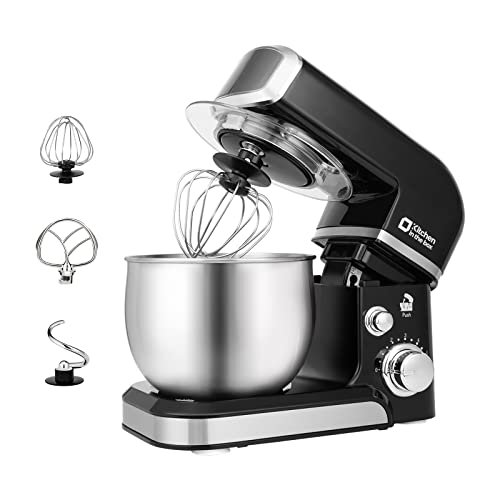
Kitchen in the Box Stand Mixer 3.2Qt, Black — Best Small First Mixer
The Kitchen in the Box 3.2Qt fits the beginner in a small kitchen who bakes small on purpose: daily bakes, single loaves of banana bread, weekend pancakes for two. Its lightness and size remove the friction that stops new bakers using their machines.
For a beginner, the Kitchen in the Box Stand Mixer 3.2Qt, Black has the right kind of forgiveness: it does not punish small mistakes in speed choice or order of ingredients, and it lets you watch the mixture change so you learn what ‘soft peaks’ and ‘cleared the bowl’ actually look like.
Strengths
- Properly small and light — easy to store, easy to move, easy to clean
- A full three-attachment set covers whisking, beating and light dough work
- An accessible entry tier for a first stand mixer
Trade-offs
- 3.2 quarts caps you at small batches permanently
- Light doughs only; stiff bread dough is beyond its design brief
- Long-term parts and support are limited compared with heritage brands
| Specification | Detail |
|---|---|
| Bowl | 3.2 qt |
| Design | Portable, lightweight, small footprint |
| Speeds | 6 speeds |
| Included | Egg whisk, dough hook, flat beater |
Kitchen in the Box built the mixer equivalent of a city car: small, light, cheap to own and perfectly matched to daily short trips. Daily use is literally in its listing — egg whisk, dough hook and flat beater cover breakfast batters, weeknight cakes and soft dinner-roll doughs. It will not grow with you into batch baking, but as a first mixer or a small-kitchen mixer it removes every excuse not to have one.
Best for: small kitchens and daily small-batch baking / Not suited for: growing into batch baking
Check the current price on Amazon

Dash Everyday Stand Mixer, 3-Qt, Red — Best for Tiny Kitchens
The Dash Everyday fits the beginner whose kitchen is genuinely tiny — a studio, a shared house, a narrowboat of a galley — and whose recipes are scaled accordingly. It is the mixer that can live on the counter where bigger machines simply cannot.
Learning to bake with the Dash Everyday Stand Mixer, 3-Qt, Red is a low-stress route in — the controls make sense on day one, and the results arrive quickly enough to keep a new baker’s enthusiasm alive through the first dozen recipes.
Strengths
- Small enough to live on the counter of even a tiny kitchen, so it actually gets used
- Six speeds cover the everyday jobs: batters, whipped cream, soft doughs
- Lightweight and easy to clean, which suits quick weeknight baking
Trade-offs
- Three quarts is a hard ceiling — plan on single, small batches only
- Not the tool for stiff bread dough; the motor and frame are built for lighter work
- Fewer accessories and attachments than full-size systems
| Specification | Detail |
|---|---|
| Bowl | 3 qt, stainless steel |
| Design | Compact tilt-head |
| Speeds | 6 speeds |
| Included | Standard beater and dough hook set (per listing range) |
The Dash Everyday understands its job: it is the mixer for small kitchens and small batches, priced and sized so that owning it needs no justification. Pancake batter, a single loaf of banana bread, a bowl of whipped cream — the everyday recipes in its name are exactly where it shines. Ask it to behave like a full-size machine and it will disappoint; keep it in its lane and it is one of the most sensible small-appliance buys in the kitchen.
Best for: studio flats and the smallest counters / Not suited for: households baking for a crowd
Check the current price on Amazon

KitchenAid Artisan Mini 3.5-Qt Tilt-Head Stand Mixer KSM3316X, Contour Silver — Best Small-but-Serious First Mixer
The Artisan Mini fits the beginner who bakes small but seriously: one or two people, high standards, limited counter. It keeps the full Artisan control set and tilt-head ease, and it will not embarrass itself as your skills grow — it will simply keep batch sizes honest.
For a beginner, the KitchenAid Artisan Mini 3.5-Qt Tilt-Head Stand Mixer KSM3316X, Contour Silver has the right kind of forgiveness: it does not punish small mistakes in speed choice or order of ingredients, and it lets you watch the mixture change so you learn what ‘soft peaks’ and ‘cleared the bowl’ actually look like.
Strengths
- A genuinely smaller footprint that fits under standard cabinets and in small kitchens
- Same 10-speed control and tilt-head ease as the full-size Artisan
- Ideal batch size for one or two people — less waste, less bowl-scraping of tiny quantities
Trade-offs
- The 3.5-quart bowl rules out big doughs and double batches from day one
- Per-quart you pay for the compact design rather than for capacity
- Attachment choice is shared with the wider range but bowl-sized accessories are more limited
| Specification | Detail |
|---|---|
| Bowl | 3.5 qt |
| Design | Tilt-head, compact footprint |
| Speeds | 10 speeds |
| Included | 3 accessories (per listing) |
The Artisan Mini answers a real problem: most stand mixers are sized for families and batch baking, and they punish small households with poor mixing of small quantities and a big footprint. The Mini keeps the Artisan’s manners — the same speed range, the same tilt-head convenience — and shrinks the stage to fit single cakes, small doughs and everyday whisking. For apartment bakers it is often the difference between a mixer that lives on the counter and one that lives in a box.
Best for: small households with serious standards / Not suited for: large batches or big doughs
Check the current price on Amazon

Cuisinart Precision Master 5.5-Qt Stand Mixer SM-50, White Linen — Best First Mixer to Grow Into
The Cuisinart SM-50 fits the beginner who is not really a beginner in spirit: someone who has baked with a hand mixer for years, knows the hobby has stuck, and wants the first stand mixer to be the last one for a long while. The 5.5-quart bowl and 12 speeds give years of headroom.
Learning to bake with the Cuisinart Precision Master 5.5-Qt Stand Mixer SM-50, White Linen is a low-stress route in — the controls make sense on day one, and the results arrive quickly enough to keep a new baker’s enthusiasm alive through the first dozen recipes.
Strengths
- Twelve speeds give finer low-end control than most rivals, useful for creaming and folding
- The 5.5-quart bowl is a useful step up from 4.5–5 qt machines without going oversize
- A complete accessory set in the box, including a splash guard with a pour spout
Trade-offs
- The lighter build can move a little on the counter under the heaviest dough loads
- Accessory ecosystem is smaller than KitchenAid’s hub-based range
- Head-lift clearance still needs checking against low wall cabinets
| Specification | Detail |
|---|---|
| Bowl | 5.5 qt, stainless steel |
| Design | Tilt-head style head lift |
| Speeds | 12 speeds |
| Included | Chef’s whisk, mixing paddle, dough hook, splash guard with pour spout |
Cuisinart’s SM-50 is the thinking person’s alternative to the default choice: a touch more bowl, a touch more speed control, and a price position that usually undercuts the equivalent big-name machine. In use it feels composed with cake batters and cookie doughs, and the low speeds are genuinely low, which is where cheaper mixers often cheat by starting too fast and throwing flour. It is a strong pick when you want capability per pound spent rather than a badge on the counter.
Best for: committed beginners who want headroom to grow / Not suited for: absolute first bakes on a minimal budget
Check the current price on Amazon
Comparison Table
| Pick | Badge | Key spec | Best for |
|---|---|---|---|
| KitchenAid Classic Series 4.5-Qt Tilt-Head Stand Mixer K45SS, Onyx Black | Best First Mixer Overall | 4.5 qt | beginners who want a first mixer that lasts for years |
| Hamilton Beach 4-Qt Electric Stand Mixer, 7 Speeds, Black | Best Budget First Mixer | 4 qt | first-time buyers on the tightest budget |
| Kitchen in the Box Stand Mixer 3.2Qt, Black | Best Small First Mixer | 3.2 qt | small kitchens and daily small-batch baking |
| Dash Everyday Stand Mixer, 3-Qt, Red | Best for Tiny Kitchens | 3 qt, stainless steel | studio flats and the smallest counters |
| KitchenAid Artisan Mini 3.5-Qt Tilt-Head Stand Mixer KSM3316X, Contour Silver | Best Small-but-Serious First Mixer | 3.5 qt | small households with serious standards |
| Cuisinart Precision Master 5.5-Qt Stand Mixer SM-50, White Linen | Best First Mixer to Grow Into | 5.5 qt, stainless steel | committed beginners who want headroom to grow |
How to Choose Your First Stand Mixer
Start with the recipes, not the machines. A beginner’s realistic first year is cakes, cookies, brownies, frostings, whipped cream and the occasional pizza or bread dough. Every mixer in this guide handles that list. The differences appear at the edges: how big your batches are, how small your kitchen is, and whether bread will be a weekly event or a yearly experiment. Choose for the centre of your list, and let the edges be slightly inconvenient — that is the correct economics of a first machine.
Bowl size is the decision beginners most often get wrong in both directions. Too big — a 7-quart flagship — and your single sponge batter spreads thin and mixes poorly, teaching you that stand mixers are overrated. Too small — a 3-quart — and Christmas baking becomes a relay race. For most beginners, 4 to 5.5 quarts is the honest zone, which is why this guide’s centre of gravity sits there. The compact picks are for kitchens and households that are small on purpose, not as a compromise.
Speeds deserve one clarification: you do not need many, you need the right ones. A slow stir for folding and starting flour, a medium for creaming, a fast for whipping. Ten speeds covers it with room to spare; six well-chosen speeds covers it too. What you must avoid is a machine whose slowest speed is fast — ask the flour cloud how that goes. Every pick here starts gently enough for a beginner’s first flour addition.
What Beginners Actually Need — and What Can Wait
Needed on day one: the flat beater (cakes, cookies, frostings), the whisk (cream, eggs, meringues) and the dough hook (pizza night, first loaves). All six picks include the trio or its equivalent, and that is not a coincidence — it was a selection rule. Needed in year one, maybe: a pouring shield if your recipes are flour-heavy, and a second bowl if you fall for two-component bakes. Both can wait for the first sale or the first birthday list.
Can definitely wait: every hub attachment, every specialty beater, every decorative extra. The attachment ecosystems are wonderful and they are also a trap for enthusiastic beginners, who can spend a second mixer’s worth of money on tools for recipes they have not yet cooked. Cook first. The attachments will still be there when a recipe genuinely demands one, and on the platform machines in this guide they will fit when it does.
What cannot be bought later is the right size of machine. Attachments are addable; bowl capacity and counter footprint are not. That is why this guide pushes you to think hardest about batch size and kitchen space, and to relax about everything else.
Your First Month With a Stand Mixer: A Sensible Plan
Week one, bake something you already know by hand — a favourite cake or cookie — and let the machine do the creaming and mixing while you watch what proper creaming looks like. That comparison teaches more than any tutorial: this is the colour butter and sugar should reach, this is how a batter should ribbon. Week two, whip something: cream, or egg whites for a pavlova, and learn your machine’s speeds at the fast end, including how quickly ‘soft peaks’ becomes ‘over-whipped’ when a motor does the work.
Week three, knead something forgiving — pizza dough or an enriched bun dough — at the low dough speed, and watch the dough clear the bowl and turn smooth. Week four, bake something new that you chose because you now own the machine: a layered cake with a whipped frosting, say, where the second bowl would have helped and you feel the workflow properly for the first time. By the end of the month you will know your machine’s voice, its speeds and its limits — which is the entire content of ‘being good with a stand mixer’.
The Beginner’s Budget, Spent in the Right Order
A first mixer is not the whole purchase. The sensible beginner budget, in order: the machine itself; the ingredients for a month of enthusiastic practice (flour, butter, eggs and sugar are a real line item when everything is new); one or two small tools the machine does not replace — a good spatula, a digital scale, an oven thermometer; and nothing else until the baking tells you what is missing. Beginners who invert this order — flagship machine, no scale, cheap ingredients — bake worse cakes than beginners with a budget mixer and a scale, because baking rewards measurement and material more than machinery.
The digital scale deserves emphasis, because it changes beginner baking more than any mixer upgrade. Recipes measured by weight succeed the first time; recipes measured by scooped cups vary with the scooping. Every mixer in this guide will happily process a well-measured batter, and no mixer at any price can rescue a batter whose flour was off by a third. If the budget forces a choice between a bigger mixer and a scale, buy the scale and the smaller mixer, and accept our congratulations on out-baking people who spent three times as much.
Hand Mixer, Stand Mixer, or Both? The Beginner’s Honest Answer
A hand mixer is not a failed stand mixer; it is a different tool that some bakers prefer for small, quick jobs forever. The stand mixer’s gifts are specific: hands-free sustained creaming, real kneading, and batches at a scale a hand mixer cannot hold. If your baking is a cake a month, a hand mixer plus a strong arm is a legitimate endpoint. If your baking is weekly, or bread is calling, or your wrists object — the stand mixer stops being a luxury and becomes the difference between baking and not baking.
Many experienced bakers own both and use the hand mixer for a single bowl of frosting without a flicker of guilt. Beginners should not read that as a shopping list: start with the machine that matches your ambitions — for most readers of this guide, the stand mixer — and let the second tool arrive when a real recipe asks for it. Equipment bought in response to recipes is equipment that gets used; equipment bought in anticipation is furniture.
How to Use a Stand Mixer for the First Time (Without the Flour Cloud)
Set the machine on a clear, dry counter with room to tilt the head or lift the bowl, and lock the bowl in place before any ingredient goes near it. Fit the flat beater for a first cake. Add room-temperature butter and sugar, and — this is the step that saves your kitchen — start on the lowest speed for thirty seconds before stepping up to medium. Ingredients that begin gently stay in the bowl; ingredients that begin at speed six redecorate.
Cream for longer than feels necessary: three to five minutes, until the mixture is visibly paler. Add eggs one at a time, letting each disappear before the next. When the flour arrives, add it in two or three portions at the lowest speed, mixing only until each portion vanishes. Stop the machine and scrape the bowl’s bottom and sides once with a spatula — every beginner should build this habit from the first bake, because no machine reaches everywhere.
Finish the batter with two or three slow turns or a few folds by hand, then bake. While the cake is in the oven, wash the bowl and beater immediately — dried batter is tomorrow’s argument with a sponge — and dry the whisk for next time. Total hands-on machine time for your first cake: perhaps four minutes. That ratio, a few minutes of machine work replacing twenty of arm work, is what you bought.
For your first dough, the rules change slightly: the hook, a low speed (the dough speed in your manual, usually the second setting), and patience. The dough will look shaggy, then sticky, then — around the point beginners panic and add flour — it will clear the sides and turn smooth and elastic. Let it. Judging dough by eye is the core skill, and your first month of baking is mostly the machine teaching it to you.
Learn the sound of your machine in its first week. Run it empty through every speed and listen: that smooth, even note is the baseline. Creaming sounds different from kneading, and a happy knead has a rhythm to it. Later, any new sound — a knock, a grind, a laboured drop in pitch — is the machine reporting a problem early, when it is cheap. Beginners who know their machine’s voice catch the overloaded dough and the drifting beater clearance months before beginners who do not.
Keep a beginner’s baking notebook for the first dozen bakes: recipe, speed used, minutes at each stage, and one line on the result. It feels like homework and works like magic — by bake twelve you will have a personal manual for your machine and your oven that no book could have given you, and your ‘instincts’ that experienced bakers talk about will turn out to have been notes all along.
Your First Five Bakes: A Beginner’s Syllabus
Bake one: a simple sponge or pound cake. It teaches creaming, the fold, and your oven’s personality, and it forgives nearly everything. Bake two: chocolate chip cookies, for the add-in fold and the lesson of the test cookie. Bake three: whipped cream and a pavlova or meringue, for the fast end of the speed dial and the discipline of stopping early. Each bake adds exactly one new skill, which is how skills actually accumulate.
Bake four: pizza dough, the friendliest knead in baking — soft, quick and almost impossible to ruin — which teaches the dough hook without the stakes of a loaf. Bake five: a proper loaf of sandwich bread, now that the hook is a friend, with the windowpane test as the graduation exercise. Five bakes, five skills, and by the end of it you are no longer a beginner in any sense that matters — you are a baker with a machine you understand, which was the entire point of choosing it well.
Notice what the syllabus does not include: anything bought. No new attachments, no specialty tins beyond the basics, no ingredients you cannot pronounce. The first year of baking is a skills project wearing a shopping costume, and the beginners who thrive are the ones who see through the costume early.
When Things Go Wrong: A Beginner’s Troubleshooting Table in Words
Problem: the mixture looks curdled after the eggs go in. Cause: cold eggs or eggs added too fast. Fix for next time: room-temperature eggs, added one at a time; fix for this time: a spoonful of the recipe’s flour and thirty seconds of mixing usually brings it home. Problem: flour everywhere. Cause: starting speed. Fix: lowest speed, portions, a shield or a towel — and the humility to accept that every baker has done it exactly once per machine. Problem: cream that turned grainy and loose. Cause: over-whipping, seconds past the peak. Fix: none for this batch — it becomes butter for toast — and a note in the notebook that your machine reaches the peak faster than the recipe’s author assumed.
Problem: dough that will not stop climbing the hook. Cause: a stiff dough at the machine’s comfortable limit. Fix: stop, push down, continue; next time, a slightly smaller batch or a touch more liquid. Problem: a cake with a tough, bready crumb. Cause: the flour stage mixed too long or too fast. Fix: the slowest speed, the briefest mixing, the spatula finish. Problem: a mixer that walks during kneading. Cause: batch size or a smooth counter. Fix: a mat underneath, a smaller batch, and respect for what the machine is reporting.
Read that table again and notice the pattern: almost every beginner problem is a settings-and-patience problem, not an equipment problem. That is the most encouraging fact in this entire guide. The machine you can afford, used with the techniques in these pages, will out-bake the flagship used carelessly — and the gap only widens as your notebook fills.
The Beginner’s Second Month: Where to Go Next
By the second month, the pattern of your baking will be visible in the notebook: the recipes you repeated, the stage you enjoyed, the bake you keep meaning to attempt. Follow that evidence. If the bread bakes multiplied, our bread guide is your next read and your machine’s dough work becomes the centre of practice. If the cakes layered up, the baking guide’s creaming and folding depth is waiting. If everything shrank to cookies, wonderful — the cookie guide was written for exactly your kitchen.
Resist, in month two, the two classic beginner purchases: the attachment bought for a recipe you have not cooked, and the upgrade bought for a limitation you have not met. Your machine’s real limits will announce themselves in the notebook, in writing, with dates. Until they do, the best second purchase in baking remains what it was in week one: good ingredients, a scale if you somehow still lack one, and the next recipe that scares you slightly.
Common Buying Mistakes
Starting at high speed with flour in the bowl. The single most common beginner moment, and the most avoidable. Dry ingredients always start at the lowest speed, in portions. The cloud is optional; the setting is the choice.
Buying the biggest mixer ‘to grow into’. Oversized bowls mix small beginner batches badly, and early disappointing results kill hobbies. Grow into a mixer by outgrowing a right-sized one — that takes years of happy baking, and the upgrade will feel earned rather than corrective.
Over-whipping cream and egg whites. A motor reaches stiff peaks while you are looking for the vanilla. Whip at a medium-high speed, watch continuously near the end, and stop a breath early — carry-over is real, and over-whipped cream cannot be rescued, only re-purposed.
Kneading dough at high speed to save time. High speed overheats dough, strains the machine and develops gluten worse than the correct low speed does. Bread rewards patience in every other step too; the knead is not the place to hurry.
Adding flour to ‘fix’ sticky dough too early. Dough is sticky before it is developed. Give the hook its full time before adjusting, and adjust by the spoonful. Beginners who flour early bake bricks and blame the recipe.
Never using the machine because it lives in a cupboard. A first mixer earns its keep through frequency. If your kitchen cannot counter-store a full-size machine, choose a compact pick you can leave out — a used-weekly small mixer beats a stored flagship every time.
Final Recommendation
If in doubt, start with the KitchenAid Classic: it is the first mixer that behaves like a long-term answer. On a firm budget, the Hamilton Beach will teach you the craft honestly; in a small kitchen, the Kitchen in the Box or the Dash removes every storage excuse; for small-but-serious baking, the Artisan Mini; and for beginners certain the hobby has already stuck, the Cuisinart SM-50. When the first year is done, go further with Best Stand Mixers For Baking and Best Stand Mixers For Cookies, or see the whole field in Best Kitchen Stand Mixers.
One last beginner tip that is really a buying tip: order the machine that fits the kitchen you have today. Every pick above was verified as a current listing, and the best first mixer is the one that is out of its box and creaming butter this weekend.
The shortlist, if you are deciding today: KitchenAid Classic Series 4.5-Qt Tilt-Head Stand Mixer K45SS, Onyx Black for the headline recommendation, Hamilton Beach 4-Qt Electric Stand Mixer, 7 Speeds, Black as the value alternative, and Kitchen in the Box Stand Mixer 3.2Qt, Black where the specific need in this guide is strongest. Each name links to its verified listing, where you can check price on Amazon and confirm the exact configuration before you commit.
Frequently Asked Questions
Is a stand mixer worth it for a beginner, or should I start with a hand mixer?
If you bake monthly or more, a stand mixer is worth it: hands-free creaming and kneading remove the two most tiring, most-skipped steps in baking, and skipped creaming is why beginner cakes disappoint. A hand mixer is the right start only if you bake a few times a year or have no storage at all — and several compact picks in this guide exist precisely for small spaces.
What size stand mixer should a beginner get?
For most, 4 to 5.5 quarts: it matches standard recipes exactly, mixes small quantities properly and handles a double cookie batch. Choose 3 to 3.5 quarts only if your kitchen or household is genuinely small; choose larger only if you already bake in bulk, which most beginners honestly do not.
How many speeds does a beginner need?
Six to ten is plenty. What matters is a genuinely slow first speed for folding and flour, a steady medium for creaming, and a fast setting for whipping. Extra speeds beyond ten are refinement, not necessity, for the first years of baking.
What is the first thing I should bake in a new stand mixer?
A recipe you already know — your usual cake or cookies — so the only new variable is the machine. You will see proper creaming for the first time and learn the speeds on familiar ground. Save the ambitious new recipe for the second bake, when the machine is no longer the experiment.
Can a beginner damage a stand mixer?
Only by overloading it: dough batches beyond the bowl’s sensible capacity, kneaded at high speed, are the classic strain. Stay within the manual’s flour limits, knead at the dough speed, and a beginner cannot hurt a decent machine — they are built for exactly this learning curve.
Should a beginner buy a cheap mixer or save for a better one?
Buy the best right-sized machine your current budget allows, from this guide’s ladder. A budget planetary mixer used weekly teaches more baking than a flagship saved for over a year. If the hobby sticks — and the machine helps it stick — the upgrade path is clear and your first mixer becomes a gift to another beginner.
What if I buy a beginner mixer and outgrow it in a year?
Then the year was a success — you baked enough to outgrow a machine, which is the hobby working as intended. Right-sized beginner machines hold decent resale or gift value, and the upgrade decision will be easy because your baking will tell you exactly what it needs next. The expensive mistake is the opposite: a flagship bought for an imagined future, underused in the present, teaching you that baking is not for you when really the fit was wrong.

