Disclosure: airfryerkitchensupply.com is reader-supported. When you buy through links on our site, we may earn an affiliate commission at no extra cost to you.
Where to buy
In this category ‘spice mixer’ means the machine that turns whole spices into fresh, even powders and blends — electric spice grinders and mixer-grinders. Use the listings below to check the current price on Amazon, and note whether a model is a blade grinder or a full mixer-grinder with jars, because they solve different sizes of the same problem.
- Cuisinart Spice and Nut Grinder SG-10 — Check the current price on Amazon
- Preethi Eco Plus Mixer Grinder — Check the current price on Amazon
- KRUPS Precision Electric Grinder — Check the current price on Amazon
- BLACK+DECKER One Touch Coffee and Spice Grinder — Check the current price on Amazon
- Hamilton Beach Fresh Grind Electric Grinder — Check the current price on Amazon
- Wancle Electric Coffee and Spice Grinder — Check the current price on Amazon
Freshly ground spice is not a refinement; it is a different ingredient. A cumin seed ground thirty seconds before it hits hot oil carries aromatic compounds that a jar of pre-ground spice lost months ago on a warehouse shelf. The best spice mixers — the grinders and mixer-grinders in this guide — exist to make that freshness a thirty-second habit rather than a mortar-and-pestle workout, and to blend your own garam masala, chaat masala, rasam powder or barbecue rub in quantities that suit your kitchen.
Two machine families share this job, and choosing between them is the first real decision. Blade grinders are small, fast and inexpensive: a motor spins a blade through whole spices, and you control fineness by time and shaking. Mixer-grinders, the workhorses of Indian kitchens, use multiple jars and far stronger motors to handle everything from a spoonful of peppercorns to wet chutneys and batter-scale grinding. This guide includes the best of both, and each review is explicit about which jobs its machine should never be asked to do.
One truth applies to every pick: spices are oily, aromatic and staining, and they flavour everything ground after them. A grinder that is hard to clean will quietly become a coffee-only or spice-only machine whether you planned it or not. Cleaning design is therefore judged in every review below as a core feature, not housekeeping trivia.
In this guide
Quick Picks
From a dedicated spice-and-nut grinder to a full Indian mixer-grinder, six ways to make pre-ground spice jars obsolete.
Cuisinart Spice and Nut Grinder SG-10 — Best Overall. A purpose-built spice grinder: heavy-duty motor, stainless bowl and a lid designed for storing what you grind. Check price on Amazon.
Preethi Eco Plus Mixer Grinder — Best Mixer-Grinder for Indian Cooking. The real thing: a multi-jar mixer-grinder built for Indian kitchens, in the 110-volt version made for the USA and Canada. Check price on Amazon.
KRUPS Precision Electric Grinder — Best for Coffee-and-Spice Double Duty. A 200-watt classic with a 3-ounce capacity — the dependable dual-purpose grinder found in a million kitchens. Check price on Amazon.
BLACK+DECKER One Touch Coffee and Spice Grinder — Best Simple One-Touch Pick. Push the button, get ground spice: a 2/3-cup capacity and stainless blades in the simplest possible package. Check price on Amazon.
Hamilton Beach Fresh Grind Electric Grinder — Best Easy-Clean Design. A removable, dishwasher-safe grinding chamber — the cleaning problem, solved at a budget-friendly tier. Check price on Amazon.
Wancle Electric Coffee and Spice Grinder — Best Budget Pick. One-touch grinding with a cleaning brush in the box — the lowest-cost route into fresh-ground spice in this guide. Check price on Amazon.
How These Picks Were Chosen
From the verified results we kept only machines genuinely suited to spices: several results in the raw search (salt-and-pepper mill sets, for instance) were excluded because they season at the table rather than grind and blend in the kitchen.
The judging criteria were spice-specific. Grinding quality means an even powder without scorched patches — blade design, bowl shape and motor behaviour under load decide it. Capacity was judged against real recipes: a tablespoon of garam masala, not a laboratory maximum. Heat matters too, because a grinder that runs hot cooks the aromatics you bought it to protect, so realistic duty cycles are discussed honestly.
Finally, we weighted cleaning and flavour carry-over heavily. Removable cups, dishwasher-safe parts and designs you can wipe truly clean scored well; sealed bowls that trap last month’s chilli under this week’s cinnamon did not. Where a machine is really a coffee grinder moonlighting with spices, the review says so and explains the compromise.
The 6 Best Spice Mixers and Grinders

Cuisinart Spice and Nut Grinder SG-10 — Best Overall
Most machines in this category are coffee grinders with spice ambitions. The Cuisinart SG-10 is the reverse: a grinder designed from the start for spices and nuts, and the details show it. The stainless steel bowl is sized for spice quantities rather than coffee batches, the blades are shaped to pull whole spices down into the cutting path, and the push-top operation gives you pulse control — the difference between cracked, ground and powdered is a matter of seconds and attention.
It suits cooks who grind spices weekly: curry blends, rubs, dukkah, spice pastes’ dry components. The storage lid is a genuinely thoughtful touch, letting a blend rest in its bowl rather than being decanted immediately. Its limits are capacity and scope — it will not make chutney, batter or a week’s worth of anything, and cooks who need those jobs should look at the Preethi below. As a dedicated spice tool, though, this is the benchmark the others are measured against.
Strengths
- Designed for spices and nuts, not adapted from coffee duty
- Pulse control via push-top lid for texture control
- Storage lid lets blends rest in the grinding bowl
Trade-offs
- Small capacity: batch cooking needs multiple rounds
- Blade grinding gives slightly less uniform powder than a burr mill
- Not suitable for wet grinding or pastes
Key specs: Electric blade grinder, stainless steel bowl, push-top operation, dishwasher-safe parts.
The SG-10’s party trick is judgement-free consistency for small blends. Because the bowl is small, the spices stay in the blade path instead of escaping up the walls, so a tablespoon of mixed whole spices — coriander, cumin, dried chillies, a shard of cinnamon — emerges evenly ground without the shake-dance larger grinders demand. For the way most home cooks actually use spices, that small-bowl honesty beats headline capacity.
Best for: weekly spice grinders and blend makers working in recipe-sized batches / Not suited for: wet grinding, large batches or batter work
Check the current price on Amazon
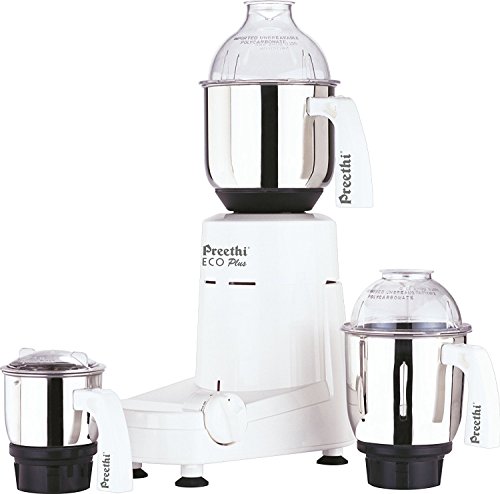
Preethi Eco Plus Mixer Grinder — Best Mixer-Grinder for Indian Cooking
If your spice work includes wet masalas, coconut chutneys, ginger-garlic paste or idli batter, a blade grinder is the wrong tool and the Preethi Eco Plus is the right one. Mixer-grinders are the standard appliance of Indian home cooking precisely because they do all of it: interchangeable jars sized for dry spices, wet pastes and larger liquid jobs, driven by a motor built for sustained, heavy work rather than ten-second bursts.
Crucially, this is the 110-volt version specified for the USA and Canada — the single most important detail in this entire guide, because the same model family sold for the Indian market runs on 220–240 volts and will fail or burn out on North American power. It suits households cooking Indian food regularly and anyone whose ‘spice mixer’ needs honestly extend to pastes and chutneys. Casual users who grind a teaspoon of pepper twice a month are buying far more machine than they need.
Strengths
- Multiple jars cover dry spices, wet pastes and chutneys
- Motor built for sustained heavy grinding, not bursts
- Correct 110V specification for USA and Canada
Trade-offs
- Loud under load — mixer-grinders make no apology for it
- Takes real counter or cupboard space
- Overkill for occasional dry-spice-only use
Key specs: Mixer-grinder with multiple stainless jars, 110V for USA/Canada.
The jar system is the insight Western kitchens keep missing. A small dry jar keeps a tablespoon of spices in the blade path; a wet jar’s shape pulls chutney down into a vortex; you stop decanting half-ground spice from an oversized blender jug forever. If your cooking lives in that world even twice a week, the Preethi replaces three appliances and a lot of frustration — and its dry jar alone out-grinds every coffee-style unit here on tough spices like dried turmeric root.
Best for: households cooking Indian food regularly, including wet masalas and chutneys / Not suited for: occasional users who only ever grind a little dry spice
Check the current price on Amazon

KRUPS Precision Electric Grinder — Best for Coffee-and-Spice Double Duty
The KRUPS grinder is the appliance equivalent of a reliable old knife: undramatic, effective and seemingly immortal. Its 200-watt motor and oval bowl — a shape that genuinely improves circulation of the contents — handle coffee beans on weekday mornings and whole spices on weekend curry nights with equal competence. The 3-ounce capacity is the largest among the blade grinders here, which matters for rub-makers and batch cooks.
It suits households that want one grinder for everything and accept the one real compromise of double duty: flavour memory. Coffee oils and spice aromatics both linger in any blade grinder, so households serious about both often keep the KRUPS for one job and add a second, dedicated unit later. As a first grinder, or the household’s spice-first machine, it remains the safest recommendation in its class — proven design, honest performance, nothing to learn.
Strengths
- Oval bowl circulates spices for a more even grind
- Generous 3oz capacity among blade grinders
- Simple one-touch operation with lid safety switch
Trade-offs
- Flavour carry-over between coffee and spice duty
- Blade grind uniformity trails dedicated designs slightly
- Bowl is fixed, so cleaning is a wipe-out rather than a wash
Key specs: 200W motor, 3oz capacity, stainless blades, one-touch operation.
A practical technique elevates this grinder’s spice work: pulse in short bursts and shake the unit gently between them, letting unground pieces fall back into the blade path. Ninety seconds of that discipline produces powder fine enough for any masala, without the heat build-up of one long continuous run. It is the kind of unglamorous craft that separates fresh-tasting blends from dusty ones, on any blade grinder in this guide.
Best for: households wanting one proven grinder for coffee and spices / Not suited for: purists who refuse any flavour carry-over between jobs
Check the current price on Amazon
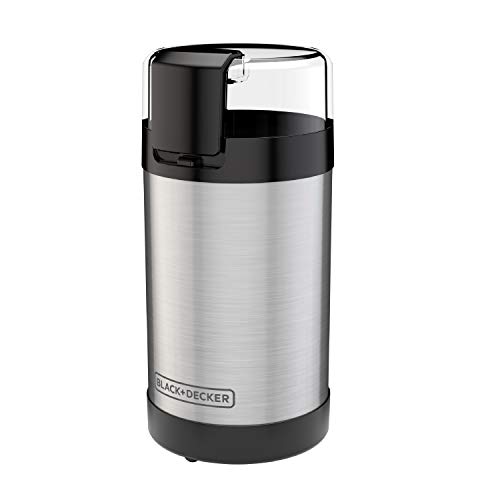
BLACK+DECKER One Touch Coffee and Spice Grinder — Best Simple One-Touch Pick
The BLACK+DECKER One Touch is built around a single honest idea: grinding should be a button press, not a project. Its two-thirds-cup capacity is generous for a compact grinder, the stainless blades handle coffee, spices, nuts and herbs, and the one-touch control means the grind is exactly as long as your thumb says it is — coarse cracked pepper at two seconds, fine masala powder at thirty.
It suits cooks who value simplicity and counter space over specialisation, and households grinding for one or two recipes at a time. The brand’s ubiquity is a practical virtue: this is the grinder most likely to be available, replaceable and familiar. Its compromises are the class compromises — a fixed bowl to wipe clean, blade-grind uniformity that rewards the pulse-and-shake technique, and no pretensions toward wet grinding or heavy daily duty.
Strengths
- True one-touch simplicity — nothing to programme or mis-set
- Useful 2/3-cup capacity in a compact body
- Widely available and easy to replace
Trade-offs
- Fixed bowl limits cleaning to wiping out
- No pulse button finesse beyond your own timing
- Not built for wet pastes or sustained heavy loads
Key specs: 150W, 2/3-cup capacity, stainless steel blades, one-touch control.
This grinder makes an excellent household’s second grinder — the dedicated spice unit that ends coffee-versus-curry flavour wars. At its modest tier, buying two simple grinders (one permanently for coffee, one permanently for spices) delivers a better daily experience than one premium machine asked to forget yesterday’s job. If your household grinds both daily, that two-grinder strategy, built on picks like this one, is the connoisseur’s actual secret.
Best for: simple, everyday grinding and as a dedicated second grinder for spices / Not suited for: wet grinding or fine-uniformity obsessives
Check the current price on Amazon

Hamilton Beach Fresh Grind Electric Grinder — Best Easy-Clean Design
Hamilton Beach looked at the blade grinder’s oldest flaw — the fixed bowl you can only wipe — and simply removed it. The Fresh Grind’s grinding chamber lifts out, goes in the dishwasher, and returns innocent of yesterday’s chillies. For spice work specifically, that is not a convenience feature; it is the difference between a grinder that stays a spice grinder and one that gradually becomes unusable for anything delicate.
It suits cooks who alternate between strongly flavoured jobs — coffee in the morning, garam masala at night, a mild herb blend for a child’s meal — and refuse to let flavours bleed across. Capacity covers up to twelve cups’ worth of coffee grounds, generous for spice batches too, and hidden cord storage keeps counters honest. The grind itself is standard good blade-grinder work: even enough with pulsing, never burr-mill perfect. Buy it for the chamber; keep it because the grinding is perfectly respectable.
Strengths
- Removable chamber is dishwasher-safe — true flavour separation
- Generous capacity for batch grinding
- Cord storage keeps the counter tidy
Trade-offs
- Blade uniformity still depends on pulse technique
- Plastic chamber parts prefer top-rack care
- No dedicated spice-specific blade shaping
Key specs: Removable dishwasher-safe chamber, stainless blades, cord storage.
Cleaning deserves one more paragraph, because it decides this category’s long-term satisfaction. Ground spice plus residual moisture plus a sealed, unwashed bowl equals stale, rancid flavours that contaminate everything after. A chamber you can actually wash resets the machine to neutral in a way wiping never quite does. If you grind oily spices — mustard, fenugreek, dried chilli — more than monthly, weight that fact heavily in this grinder’s favour.
Best for: cooks alternating coffee, spices and herbs who prioritise real cleaning / Not suited for: users wanting a metal-bowl, spice-dedicated design
Check the current price on Amazon

Wancle Electric Coffee and Spice Grinder — Best Budget Pick
The Wancle is the grinder for cooks who are curious about fresh-ground spice but not yet committed — and there is no shame in that, because fresh-ground curiosity usually converts to commitment within one curry. It is a simple one-touch blade grinder for beans, spices and more, sensibly supplied with a small cleaning brush, which matters more than it sounds: a brush is the correct daily tool for a fixed-bowl grinder, clearing powder from the blade well that a cloth cannot reach.
It suits students, small households, gift-buyers introducing someone to real spice cooking, and anyone designating a cheap unit as the permanent chilli-and-pepper grinder. Its limits are the honest limits of its tier: capacity is modest, the build is lighter than the Cuisinart or KRUPS, and it asks for the pulse-and-shake technique to grind evenly. As an experiment that costs less than a few jars of premium pre-ground spice, it is an easy yes.
Strengths
- Lowest-cost entry to fresh grinding in this guide
- Cleaning brush included — the right tool for a fixed bowl
- Simple one-touch operation for beans and spices
Trade-offs
- Modest capacity for batch cooks
- Lighter build than the premium picks
- Evenness depends on your pulsing technique
Key specs: One-touch blade grinder, cleaning brush included, compact body.
Here is the budget strategy this grinder enables: dedicate it, permanently and only, to your hottest, oiliest spices — dried chillies, black pepper, Sichuan pepper. Those are the flavours that contaminate other grinders worst and the ones that benefit most from freshness. A cheap dedicated unit for the aggressive spices, while a better grinder handles delicate blends, is how many serious home cooks actually organise their counters.
Best for: beginners, small households and a dedicated hot-spice grinder / Not suited for: large batches or heavy daily duty
Check the current price on Amazon
Comparison Table
| Pick | Badge | Key spec | Best for |
|---|---|---|---|
| Cuisinart Spice and Nut Grinder SG-10 | Best Overall | Dedicated spice/nut grinder, stainless bowl | weekly spice grinders and blend makers working in recipe-sized batches |
| Preethi Eco Plus Mixer Grinder | Best Mixer-Grinder for Indian Cooking | Multi-jar mixer-grinder, 110V US version | households cooking Indian food regularly, including wet masalas and chutneys |
| KRUPS Precision Electric Grinder | Best for Coffee-and-Spice Double Duty | 200W, 3oz capacity, oval bowl | households wanting one proven grinder for coffee and spices |
| BLACK+DECKER One Touch Coffee and Spice Grinder | Best Simple One-Touch Pick | 150W, 2/3-cup, one-touch | simple, everyday grinding and as a dedicated second grinder for spices |
| Hamilton Beach Fresh Grind Electric Grinder | Best Easy-Clean Design | Removable washable chamber, up to 12-cup grounds | cooks alternating coffee, spices and herbs who prioritise real cleaning |
| Wancle Electric Coffee and Spice Grinder | Best Budget Pick | Budget one-touch grinder, brush included | beginners, small households and a dedicated hot-spice grinder |
Blade Grinder vs Mixer-Grinder: Choosing Your Spice Machine Family
Decide by moisture and volume, not by price. If everything you grind is dry — whole spices, coffee, nuts, dried chillies — a blade grinder covers you completely, occupies a corner of a cupboard, and costs a fraction of a mixer-grinder. The moment your cooking includes wet work — chutneys, fresh masala pastes, soaked lentil or rice batters — only a mixer-grinder’s jar system and motor genuinely do the job, and struggling along with a blade grinder and a prayer stops being frugal and starts being miserable.
Volume is the second axis. Blade grinders shine at recipe scale: the tablespoon-to-quarter-cup quantities real cooking uses. Their small bowls keep spices in the blade path, which is why they often out-grind a huge blender jug on small quantities. Mixer-grinders with a dedicated small dry jar match that performance and then keep going — larger batches, harder materials like dried turmeric root, and sustained running that would overheat a small blade unit.
The third axis is honesty about frequency. Twice a month, any pick here delights. Daily Indian cooking justifies the Preethi on its first month. Occasional experimentation justifies the Wancle. Match the machine to the calendar, not to the cook you occasionally imagine being.
How to Grind Spices Properly: Toasting, Pulsing and Heat Discipline
Start dry and, for most whole spices, start toasted. A minute or two in a dry pan until fragrant wakes the aromatic compounds and makes seeds brittle enough to powder finely. Let toasted spices cool fully before grinding — warm spices grind pasty and cake in the bowl — and never grind anything with surface moisture unless your machine is a wet-capable mixer-grinder.
Pulse, do not hold. Short bursts with a shake between them keep the powder circulating through the blades and, critically, keep it cool. A blade grinder run continuously for a minute is a small oven, and heat is the enemy of exactly the volatile aromatics you are grinding to capture. Thirty to sixty seconds of pulsed work produces finer, brighter powder than two punishing continuous minutes.
Grind in the order the recipe deserves. Blend components together when the recipe wants them married — garam masala’s spices ground together taste integrated — but grind pungent soloists like chilli or turmeric separately when you need to dose them independently. Store ground spice airtight, away from light, and treat six weeks as the horizon for peak flavour; the entire point of owning the grinder is that you never need to store it longer.
Keeping Flavours Separate: Cleaning Systems That Actually Work
Every grinder keeps a ghost of its last job. Managing that ghost is a system, not a hope. The classic dry method: grind a tablespoon of plain rice or a torn slice of white bread, which scours oils and powder from the bowl and blades, then brush and wipe. It works respectably on fixed bowls like the KRUPS and BLACK+DECKER, especially with the brush technique the Wancle’s included tool encourages.
Removable chambers, like the Hamilton Beach design, break the compromise entirely — wash, dry fully, and the machine is genuinely neutral again. If your household grinds coffee daily and spices weekly, that washable chamber or a strict two-grinder dedication (one machine per job, however humble) are the only two strategies that fully protect a delicate blend from yesterday’s espresso.
Whatever your system, dry is non-negotiable. A bowl put away damp grows stale flavours faster than any spice can outrun, and wet blades invite corrosion. Grind, clean, dry, store open for an hour if needed — thirty seconds of discipline that keeps a grinder tasting like nothing but the spice you just put in it.
The Whole-Spice Pantry: What to Buy, How to Store, When to Grind
A spice grinder changes what you should buy. Whole spices keep their aromatics for a year or more in airtight jars away from light — several times longer than ground spice — so the grinder lets you stock the whole forms confidently: coriander and cumin seed, black and green cardamom, cinnamon sticks, dried chillies of several heats, mustard and fenugreek seed, whole nutmeg. Buy from shops with turnover, in quantities your cooking will use within the year, and label everything with the purchase date.
Storage discipline is unglamorous and decisive. Glass jars, tight lids, a dark cupboard away from the stove’s steam — heat and humidity are the enemies, and the convenient spice rack above the hob is the worst address in the kitchen. Whole spices stored properly are a savings account; ground spice is cash under the mattress, losing value daily, which is precisely the economics your grinder exists to fix.
Grinding rhythm follows from storage: grind blends monthly at most, single spices as recipes demand, and delicate aromatics like cardamom in the smallest, freshest batches of all. The machines in this guide make those small batches effortless — which is the entire point. Freshness is not a special-occasion virtue; with the right grinder it becomes the default texture of your cooking.
Beyond Curry: Rubs, Dukkah, Spice Salts and Everything Else a Grinder Unlocks
Owning a capable spice mixer quietly expands a kitchen’s repertoire in directions the purchase never mentioned. Barbecue rubs become house blends tuned to your own smoke and heat preferences instead of a supermarket’s compromise. Dukkah — toasted nuts, seeds and spices, pulsed coarse — takes four minutes and transforms eggs, salads and bread-and-oil into something guests ask about. Flavoured salts, from chilli-lime to porcini, are one pulse away once dried ingredients meet a grinder.
The texture control that pulsing gives you is the creative key. The same cumin seed is a fine powder for a curry, a coarse crack for a rub, and whole-but-just-bruised for a tempering in hot oil — three ingredients wearing one name, all from the same jar and the same machine. Recipes written for pre-ground spice cannot even describe those distinctions, which is why cooks who start grinding often describe it as learning a new dimension of seasoning rather than a new appliance.
A final frontier worth the warning label: dried chillies. Grinding your own chilli flakes and powders — ancho for depth, arbol for fire, Kashmiri for colour — is transformative and mildly hazardous; open the lid away from your face and let the dust settle for thirty seconds first. Every experienced grinder owner has learned this exactly once.
Troubleshooting Grind Problems: Texture, Heat and Stubborn Seeds
When a grind comes out uneven, the cause is almost always load or technique rather than the machine. An overfilled bowl lets whole seeds ride above the blades indefinitely; a two-thirds load, pulsed with shakes, fixes it in one attempt. An underfilled bowl has the opposite problem — too little material to circulate — which is why the small-bowl designs in this guide, and the Preethi’s dedicated small dry jar, outperform cavernous blender jugs at recipe scale.
Some ingredients are simply hard, and deserve strategy rather than force. Dried turmeric root and hard cinnamon sticks should be broken into small pieces first — a sharp crack with the flat of a knife or a few seconds in a mortar — because blade grinders cut what they can catch, and a whole bark stick mostly just rattles. Fenugreek is the opposite problem: so hard it can turn bitter if overworked, so grind it with softer companions that cushion the process.
Heat in the bowl is information, not just a hazard. If the powder emerges warm and fragrant-weak, your bursts are too long; if the motor note climbs and strains, your load is too ambitious. Both are corrected by the same patience: smaller loads, shorter pulses, a minute’s rest between rounds. A grinder used with that rhythm will out-grind and outlast one that is thrashed, on any budget tier in this guide.
Building Signature Blends: A Method for Your Own House Recipes
The real destination of owning a spice mixer is a shelf of blends that exist nowhere else — your house garam masala, your barbecue rub, your taco seasoning tuned to your family’s exact relationship with heat. Getting there is a method, not an inspiration. Start from a respected published recipe, make it faithfully once, and write down what you would change. Change one variable per batch. Keep the dated jars; your palate’s memory lies, but a labelled shelf does not.
Ratios are the grammar of blends. Learn the load-bearing proportions — the coriander that forms a masala’s base, the salt percentage that makes a rub behave — and your variations become composition rather than gambling. Grind components together when integration is the goal, separately when you need dosing control, and add the fragile aromatics like cardamom at the end of the process so their top notes survive.
Share the results and take notes on the feedback. Blends improve the way recipes always have: by being cooked for people, adjusted, and cooked again. Within a year of that quiet discipline, the grinder on your counter stops being an appliance and becomes the author of your kitchen’s accent — which is, in the end, the best argument for buying a good one.
Spice Blends of the World: A Starter Atlas for Your Grinder
Once the grinder is on the counter, the world’s blend traditions become a library you can cook from rather than a shelf of jars you buy. Garam masala you have already met in this guide’s how-to. Its cousins reward the same method: panch phoron from Bengal, left whole and bloomed in oil rather than ground; baharat from the Levant, warm with black lime and allspice; shichimi togarashi from Japan, where texture and citrus peel matter as much as heat; and ras el hanout from Morocco, the famous ‘head of the shop’ blend whose ingredient list is a shopkeeper’s signature.
The lesson inside the atlas is that blends are arguments about balance, written in seeds. Sweet warmth against heat, earth against brightness, the bass note of cumin under cardamom’s soprano — every tradition tunes the same small orchestra differently. Your grinder lets you read those arguments in the original language of whole spice, then start annotating them for your own table, which no pre-ground jar has ever permitted.
Keep a blend notebook with the same seriousness as the dated jars. Record the source recipe, your changes, and the dish that judged it. Within a year that notebook becomes the most personal cookbook you own — and the grinder that enabled it will have justified itself not as an appliance, but as the instrument that taught your kitchen its own accent, one small fresh batch at a time.
Key Takeaways
Freshness is the whole argument. Whole spices keep for a year; ground spice fades in weeks. A spice mixer converts that gap into flavour, in thirty seconds, at recipe scale — that is the entire case for owning one.
Family follows moisture. Dry spices only: a blade grinder suffices and excels. Wet masalas, chutneys or batter in your week: only a multi-jar mixer-grinder, like the Preethi, genuinely does the job.
Voltage is the trap in this category. Mixer-grinders built for the Indian market run on 220–240V and fail on North American power. Buy only the explicit 110V USA/Canada version, and verify it on the listing.
Pulse, cool, and grind small. Toasted spices must cool before grinding, bursts must stay short to protect aromatics, and batches should stay small enough to use within weeks. Technique, not wattage, makes powder taste alive.
Cleaning is a flavour system. Washable chambers, rice-or-bread scouring, or a dedicated second grinder for aggressive spices — choose one strategy deliberately, or coffee and curry will eventually taste of each other.
One Last Thought Before You Spend
The cooks who get the most from a spice mixer share one trait: they grind on ordinary Tuesdays, not just for dinner parties. Freshness stops being an event and becomes the default, and the machine that enables that is the one that fits your real cooking — dry blends in small bowls, or the full wet-and-dry repertoire of a mixer-grinder — without friction, without a cleaning ordeal, without a voltage mistake hiding in the order. Choose that machine from this guide, grind something small and fresh this week, and taste the difference while it can still change your mind about everything else in the spice cupboard.
A Note on Grinding for Others
The first time you cook with your own fresh-ground blend for friends, expect the question — and expect, soon after, the requests. Ground spice makes a genuinely personal gift: a small jar of your house masala or rub, labelled with its date and its ingredients, costs little and lands like a letter. Grind gift batches the day before giving, seal them well, and write the date on the lid; your standards are the brand, and freshness is the whole of it.
How to Make Your Own Garam Masala with a Spice Grinder
A homemade garam masala is the recipe that justifies this entire category. It takes ten minutes, most of it toasting, and it will recalibrate what you expect from every curry afterward.
- Measure whole spices: two tablespoons coriander seed, one tablespoon cumin seed, two teaspoons black peppercorns, one teaspoon green cardamom pods, a two-inch cinnamon stick broken up, six cloves and a small piece of mace or a grating of nutmeg.
- Toast the coriander, cumin, cinnamon and cloves in a dry pan over medium heat, stirring, until fragrant and a shade darker — about two minutes. Add cardamom and peppercorns for the final thirty seconds.
- Tip the spices onto a cold plate and let them cool completely, at least five minutes; grinding warm spices makes paste, not powder.
- Load your grinder no more than two-thirds full. Pulse in five-second bursts, shaking gently between bursts, until no whole seeds remain — usually under a minute total.
- Sieve if you want refinement: shake through a fine sieve, return the coarse remainder for ten more seconds of pulsing, and combine.
- Store in a small airtight jar away from light. Label it with the date; peak flavour is the first month, and your grinder makes small fresh batches the entire point.
- Use within recipes at the end of cooking for aroma, or bloomed briefly in hot oil at the start for depth — homemade masala rewards both, differently.
Adjust the next batch like a cook, not a follower: more cardamom for fragrance, more pepper for heat, a dried chilli for fire. The recipe above is a starting dialect; your household’s version, ground fresh on your own machine, is the destination.
Common Buying Mistakes
Buying a 220V mixer-grinder for a North American kitchen. Mixer-grinders sold for the Indian market run on 220–240V and fail on US power. Only buy the explicitly 110V USA/Canada version, like the Preethi listing in this guide, and check the listing before ordering.
Grinding warm, freshly toasted spices. Warm spices turn pasty and coat the bowl instead of powdering. Cool them fully on a plate first — five patient minutes decides the texture.
Running a blade grinder continuously until it smells hot. Heat cooks off the aromatics you are trying to capture and stresses a small motor. Pulse with shakes between bursts; the powder will be finer and brighter.
Storing months of ground spice ‘while you’re at it’. Ground spice fades in weeks. The grinder’s whole gift is freshness in small batches — grinding a season’s supply at once throws the gift away.
Using one unwashed grinder for coffee and delicate blends. Coffee oils will colonise your garam masala and vice versa. Wash if your chamber allows it, scour with rice or bread between jobs, or dedicate separate grinders.
Final Recommendation
If one pick has to represent this guide: the Cuisinart SG-10 is the best spice mixer for most kitchens, because it is the rare machine designed for spices first — right-sized bowl, pulse control and honest performance at recipe scale. Choose the Preethi Eco Plus instead the moment your cooking includes wet masalas, chutneys or batter, and confirm you are ordering the 110-volt North American version.
For double duty, the KRUPS remains the proven all-rounder; the Hamilton Beach Fresh Grind wins households that alternate flavours thanks to its washable chamber; and the BLACK+DECKER and Wancle make fresh grinding — or a dedicated hot-spice second grinder — affordable for anyone. Check the current price on Amazon for the model you choose, verify the voltage on mixer-grinders twice, and grind something fresh this week: the first batch will explain the category better than this entire guide.
More from this programme: Best Blenders For Indian Cooking Spices Mix Best Commercial Mixers For Kitchen Best Stand Alone Mixers Best Small Kitchen Mixers
Best Blenders For Indian Cooking Spices Mix Best Commercial Mixers For Kitchen Best Stand Alone Mixers Best Small Kitchen Mixers
Frequently Asked Questions
What is a spice mixer, exactly?
In kitchen terms it means the machine that grinds and blends spices: either an electric blade grinder for dry spices, or a mixer-grinder — the multi-jar appliance standard in Indian kitchens — that handles dry spices plus wet pastes, chutneys and batters. This guide covers both families and says plainly which jobs each machine should and should not attempt.
Can I grind spices in a coffee grinder?
Yes — most blade coffee grinders grind dry spices well, and several picks here are exactly that style of machine. The cautions are flavour carry-over between coffee and spices, and cleaning: fixed bowls can only be wiped and scoured, while a removable washable chamber resets flavours completely. Many households end up dedicating one grinder to each job.
Why does my ground spice taste dull even though I grind it myself?
Usually heat or staleness in disguise. Grinding continuously until the bowl warms cooks off aromatics; pulsing with pauses keeps them. Toasting before grinding, cooling fully, and using the powder within a few weeks completes the fix. Also check your whole spices — old, faded seeds cannot grind into bright powder.
Is a mixer-grinder worth it if I only cook Indian food occasionally?
For occasional cooking, honestly, no — a good blade grinder like the Cuisinart SG-10 covers dry spice blends completely. The mixer-grinder earns its counter space when wet work enters your week: chutneys, fresh masala pastes, dosa or idli batter. Twice a month of that, and it stops being a luxury.
How fine can a blade grinder get spice powder?
Fine enough for any masala, rub or curry powder, provided you pulse and shake rather than run it continuously, and sieve-and-regrind the coarse remainder for very fine results. It will not match a burr mill’s uniformity particle-for-particle, but in cooked food that difference is effectively undetectable.
How do I stop spices staining and flavouring the grinder?
Clean immediately after grinding: brush out powder, scour with a tablespoon of dry rice or torn white bread ground briefly, then wipe. Wash removable chambers with warm soapy water and dry fully. Oily, staining spices like turmeric and chilli are the worst offenders — a cheap dedicated grinder for them is a legitimate strategy.


