Disclosure: airfryerkitchensupply.com is reader-supported. When you buy through links on our site, we may earn an affiliate commission at no extra cost to you.
Where to buy
Church sound has a unique brief: a spoken word that must be understood in the last row, music that ranges from a whisper to a full band, operators who are usually volunteers, and a system that must work identically every single week. Every mixer below was verified against its current listing, and the spec boxes state only what the listings claim — channel counts, format, control approach and recording features — because in a sanctuary, the honest details decide the purchase.
- Mackie ProFX16v3 (Best Overall for Most Churches) — Check the current price on Amazon
- Yamaha MG16XU (Best Analogue Reliability) — Check the current price on Amazon
- Behringer X32 (Best Digital Upgrade) — Check the current price on Amazon
- Soundcraft Ui24R (Best Rack / Remote Mixing) — Check the current price on Amazon
- Allen & Heath CQ-20B (Best Compact Digital) — Check the current price on Amazon
- Behringer X AIR XR18 (Best Budget Digital) — Check the current price on Amazon
No fixed prices are printed here; church budgets deserve current numbers, so check the current price on Amazon for the exact model and configuration. If your church is choosing between an analogue board and a digital console, read the workflow sections first — in this category, who operates the mixer matters as much as what the mixer can do.
The best sound mixers for churches are not simply the best sound mixers with a cross on the brochure. Worship sound balances two masters that pull in opposite directions: speech intelligibility — the sermon, the readings, the prayers, which fail completely if a single row cannot understand them — and music, from a lone acoustic guitar to a full contemporary band with drums, keys and backing tracks. A church mixer must serve both, in a room that is often acoustically lively, operated by a rota of volunteers whose skill varies from professional to willing.
That volunteer reality is the category’s defining constraint, and this guide treats it as a first-class specification. A mixer that a trained engineer loves but a nervous volunteer fears will produce worse Sunday sound than a simpler board the whole team can run confidently. Two philosophies answer the problem: analogue boards, where every control is visible and nothing can be lost in a menu, and digital consoles, where the week’s settings can be saved as a scene, locked, and recalled identically by whoever is on duty. Both philosophies are represented and badged below, because the right choice depends on your team’s honest makeup.
Scale varies as widely as churches do. A chapel with a pastor’s mic, a piano and playback needs a fraction of what a contemporary service with a seven-piece band, four vocalists, a choir and a livestream consumes. The picks span that range — from a 16-channel analogue workhorse to rack digital consoles that mix from a tablet at the back of the hall — and each review states plainly which congregation size and service style it fits.
One more church-specific note: the livestream is now a second congregation. Most picks here can feed a stream or record the service, and the guide treats that feed as a real output with its own mix needs, not an afterthought split from the main speakers. Your online listeners deserve a mix made for them, and several picks make that practical for a volunteer team.
In this guide
Quick Picks
- Mackie ProFX16v3 — Best Overall for Most Churches. A 16-channel analogue Mackie whose listing names churches outright: Onyx preamps, GigFX effects, USB recording — the volunteer-friendly board for a real worship band. Check the current price on Amazon
- Yamaha MG16XU — Best Analogue Reliability. Yamaha’s 16-input, 6-bus MG with built-in effects — the set-it-up-properly-once board whose reputation for decade-long service is the specification churches actually buy. Check the current price on Amazon
- Behringer X32 — Best Digital Upgrade. The console that brought digital depth to church budgets: 40 inputs, 25 buses, motorised faders, scene recall and per-channel processing per its listing — the step up when the band and the team outgrow analogue. Check the current price on Amazon
- Soundcraft Ui24R — Best Rack / Remote Mixing. A rackmount 24-input digital mixer controlled from a tablet or laptop per its listing — the sound desk that lives at the stage and is mixed from the congregation, where the sound actually is. Check the current price on Amazon
- Allen & Heath CQ-20B — Best Compact Digital. Allen & Heath’s compact digital stagebox with WiFi and Bluetooth per its listing — digital recall and processing for the small-to-mid church that does not need the X32’s scale. Check the current price on Amazon
- Behringer X AIR XR18 — Best Budget Digital. An 18-channel, 12-bus tablet-controlled digital mixer with 16 Midas preamps and multi-channel USB per its listing — scene recall and multitrack at the friendliest digital tier. Check the current price on Amazon
How These Picks Were Chosen
Every candidate was verified: exact model, honest channel and mic-input counts, effects and processing, USB or recording behaviour, and control format. Powered mixers (with built-in amplifiers) were considered separately and excluded from the main ranking, since most sanctuaries either already own amplification or are better served by a mixer plus powered speakers; DJ and studio-recording desks were likewise excluded. What remains are mixers a church can build a decade of Sundays around.
Ranking weighed volunteer operability first — can the whole rota run it confidently by week three? — then speech intelligibility tools (EQ, high-pass filters, feedback-fighting processing), honest mic-input count for the band and choir, monitor capability for the platform, and stream/record outputs. Build and brand support closed the assessment, because church equipment is bought rarely and must be repairable, replaceable and understandable for years.
The 6 Best Sound Mixers for Churches
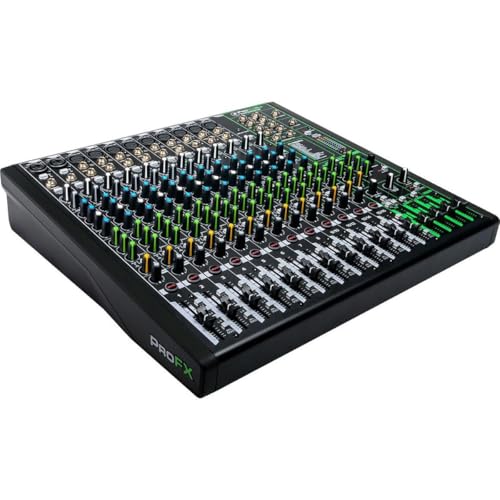
Mackie ProFX16v3 — Best Overall for Most Churches
The ProFX16v3 takes the overall badge because its listing might have been written from a church brief: a 16-channel analogue mixer with GigFX effects and USB recording, positioned for bands, churches and small venues. Sixteen channels honestly covers the contemporary service — pastor, worship leader, backing vocals, acoustic, electric, keys, bass, a manageable drum setup and playback — on a surface where every control is visible and nothing hides in a menu.
Strengths
- Analogue surface a volunteer rota can learn in weeks: what you see is what the mix is
- Onyx preamps and GigFX effects give vocals clarity and polish without outboard gear
- USB recording captures services for archive, podcast and stream workflows
Trade-offs
- No scene recall: consistency across operators is a discipline (and a board photograph), not a button
- A large band plus choir will outgrow 16 channels — count your fullest service, including Christmas
- Analogue processing is per-channel basics; surgical feedback work wants the digital picks’ tools
- Channels: 16-channel analogue (as listed)
- Preamps: Onyx mic preamps
- Effects: GigFX engine
- USB: USB recording
The Mackie’s church genius is legibility. A new volunteer can be taught the signal path in one rehearsal — gain, EQ, fader, monitors — because the board shows its whole state at a glance, and an experienced hand can rescue a struggling mix from across the room by reading the surface. In volunteer organisations, that transparency is worth more than processing depth, and it is why analogue boards of this class anchor so many sanctuaries.
Sonically it is fully serious: Onyx preamps keep the spoken word clean at the gains podium mics demand, the EQ is voiced for voices, and GigFX supplies the modest reverb that helps a congregation sing confidently. The USB feed covers the service recording and a basic stream, which discharges the modern obligations without a second system.
Its ceiling is success itself: the church that grows a bigger band, adds a choir loft of microphones, or wants per-service scene recall will eventually shop the digital picks below. Until that day — which for most churches is years away or never — the ProFX16v3 is the board this guide installs first.
Best for: small-to-mid churches with a worship band and a volunteer rota wanting analogue clarity / Not suited for: large productions needing scene recall or 24-plus inputs
Check the current price on Amazon

Yamaha MG16XU — Best Analogue Reliability
The MG16XU is the traditionalist’s answer, and traditionalists have data on their side: its listing states a 16-input, 6-bus mixer with effects, from the MG line that has mixed worship for a generation. The six-bus structure gives proper subgroup and monitor flexibility, the preamps are Yamaha-clean, and the whole unit carries the air of equipment that will be unremarkable, in the best sense, for a very long time.
Strengths
- 6-bus architecture supports subgroups and multiple monitor mixes beyond entry-level boards
- Yamaha preamps and build: the reliability benchmark of the analogue class
- One-knob compressors on key channels tame enthusiastic vocalists without engineering
Trade-offs
- Analogue limits apply: no scenes, stereo-class USB, settings recalled by photograph and habit
- Sixteen inputs is the same ceiling as the Mackie — growth means a different console class
- Fewer creator-era conveniences (no Bluetooth playback) than the Mackie line
- Inputs: 16-input, 6-bus (as listed)
- Effects: Built-in SPX-class effects
- USB: USB audio (stereo)
- Build: Metal chassis, MG series
Churches buy Yamaha for the same reason schools do: the equipment outlasts the committee that bought it. The MG16XU’s value proposition is a decade of identical Sundays — preamps that stay quiet, faders that stay smooth, a layout every new volunteer can be taught from the same laminated diagram year after year. For a traditional or blended service — pulpit, choir, piano, organ, a few band pieces — its channel and bus structure is not merely adequate; it is correctly sized.
The 6-bus design deserves its sentence: subgrouping the choir, the band and the speech microphones lets one fader ride each family in the mix, which is how a single operator manages a full service gracefully. That is a professional feature hiding in an unpretentious board, and experienced church engineers notice it immediately.
Choose it over the Mackie if your services lean traditional, your team’s instinct is analogue, and your planning horizon is measured in decades. Choose the Mackie for the more contemporary, stream-aware brief. Either way, the analogue case in this guide rests on these two boards, and both are honourable.
Best for: traditional and blended services valuing bus flexibility and long-haul reliability / Not suited for: churches needing scene recall or planning a large contemporary band
Check the current price on Amazon

Behringer X32 — Best Digital Upgrade
The X32 is the most consequential church mixer of its era, because it took the digital feature set — total scene recall, per-channel EQ, compression and gates, motorised faders, deep monitor routing, multitrack recording options — and priced it within a church building fund. Its listing states a 40-input, 25-bus digital console. For the growing contemporary church, it is less a mixer than an infrastructure decision, and a very good one.
Strengths
- Scene recall ends the volunteer-consistency problem: Sunday loads identical, whoever is on duty
- Per-channel processing — gates for drums, compression for vocals, surgical EQ for feedback — transforms difficult rooms
- Capacity (40 inputs, 25 buses) absorbs bands, choirs, events and conferences without a second console
Trade-offs
- A learning curve the analogue boards do not impose: budget training time and a setup engineer for the install
- Digital failure modes are systemic — protect it with power conditioning and a settings backup habit
- Small chapels will use a tenth of it; buy to your service, not your aspirations
- Inputs: 40-input, 25-bus digital (as listed)
- Surface: Motorised faders, scene recall
- Processing: Full per-channel DSP
- Class: Digital console
The X32’s church argument is repeatability at scale. The Christmas production, the regular Sunday, the funeral with two mics and a piano: each is a scene, recalled exactly, with the volunteer’s job reduced to riding a handful of faders inside a mix an engineer built once and locked. That division of labour — expert setup, volunteer operation — is the only model that scales with a growing ministry, and the X32 is its most accessible platform.
Its processing depth also answers the room. Difficult sanctuaries — glass, stone, low ceilings over drums — need gates, precise EQ and delay management that analogue boards cannot offer. Churches that have fought feedback for years often find the fight was a tools problem, and this is the tool.
The cautions are organisational, not sonic: someone must own the initial configuration, the team must be trained rather than handed the surface, and the file of scenes must be backed up like the asset it is. Churches that do those three things rarely look back; the X32’s ubiquity in worship is earned.
Best for: growing contemporary churches needing recall, processing depth and capacity / Not suited for: small chapels or teams with no one willing to own the digital setup
Check the current price on Amazon

Soundcraft Ui24R — Best Rack / Remote Mixing
The Ui24R relocates the sound desk. Its listing states a rackmountable, laptop- or tablet-controlled 24-input digital mixer with onboard signal processing. The rack sits on stage — short mic cables, no expensive snake — and the operator mixes from a tablet anywhere in the room, including the seat with the worst acoustics, which is the seat the mix should be built for. For churches whose ‘sound booth’ is a corner with a chair, that is a revolution.
Strengths
- Mix from the congregation’s ears, not from behind glass or in a corner — the single biggest quality lever available
- 24 inputs with full digital processing and scene storage in a stage rack: no desk footprint at all
- Multiple operators can adjust their own monitor mixes from their own devices — a volunteer-team superpower
Trade-offs
- No physical faders: mixing is a touchscreen skill, and some operators will always prefer hardware
- The system depends on network reliability — a dedicated router and setup discipline are part of the purchase
- A dead tablet battery is a dead surface; keep a charged backup device as rig policy
- Inputs: 24-input digital (as listed)
- Control: Tablet/laptop browser control
- Format: Rackmount stagebox
- Processing: Onboard DSP, scenes
Every church sound person knows the booth problem: the mix sounds balanced at the desk and wrong everywhere else, because the desk is in the one seat nobody worships from. The Ui24R’s answer — walk the room with the mix in your hands — is not a convenience; it is the difference between mixing the room and mixing a rumour of the room. Volunteers adapt to tablet control faster than sceptics expect, especially younger rotas who grew up on touchscreens.
The monitor story is equally strong: musicians adjusting their own in-ear or wedge mixes from their phones removes the operator’s busiest interruptions and gives the platform ownership of its sound. Churches consistently report that this feature alone justifies the format.
Its risks are the format’s risks, and they are manageable: a dedicated, well-configured network; a hardwired backup control option understood by the team; settings exported and stored. Churches that treat those as part of the install get a 24-input digital system with no desk, no snake and no booth problem — a combination no traditional console in this guide can offer.
Best for: churches without a proper booth, multi-use halls, and teams happy to mix from tablets / Not suited for: operators who need physical faders or venues with unreliable network discipline
Check the current price on Amazon

Allen & Heath CQ-20B — Best Compact Digital
The CQ-20B is digital for the rest of us: a compact stagebox-format mixer with built-in WiFi and Bluetooth connectivity per its listing, carrying Allen & Heath’s processing pedigree into a unit a small church can afford, carry and understand. It suits the congregation whose band has outgrown a basic analogue board’s processing but whose sanctuary, team and budget have not outgrown simplicity.
Strengths
- Digital scenes and processing in a compact, affordable stagebox — recall without the flagship commitment
- Built-in WiFi simplifies the control setup: fewer boxes, fewer cables, faster deployment
- Allen & Heath sound quality and an interface designed for non-engineers to succeed with
Trade-offs
- Stagebox format means tablet/phone control — the physical-fader loyalists should choose the X32 or analogue
- Input count serves small-to-mid worship teams; large productions need the bigger consoles
- Newer platform: your team’s training materials will come from the manufacturer and community rather than a decade of church lore
- Format: Compact digital stagebox (as listed)
- Connectivity: WiFi + Bluetooth built in
- Control: App-based control
- Brand: Allen & Heath CQ series
The CQ concept recognises that most churches’ digital need is not forty inputs — it is consistency, feedback control and a stream feed, in a package the rota can run. Built-in WiFi removes the external-router friction of older stagebox systems, Bluetooth covers playback and interval music, and the processing gives the spoken word the clarity tools — EQ, compression, feedback management — that sanctuaries actually struggle without.
Allen & Heath’s interface design is the quiet differentiator: the CQ apps are built so that a willing volunteer reaches a good mix by guidance rather than by expertise, with deeper layers available as confidence grows. That learning ramp is precisely what a church rota needs and what professional consoles rarely bother to provide.
Choose it when the X32 is honestly too much console and the Ui24R’s channel count is more than the platform requires. It is the considered middle of the digital road, from the brand whose analogue pick also appears in the general guide — consistency of pedigree across both philosophies.
Best for: small-to-mid churches wanting digital recall and processing without flagship scale / Not suited for: large productions or fader-first operators
Check the current price on Amazon
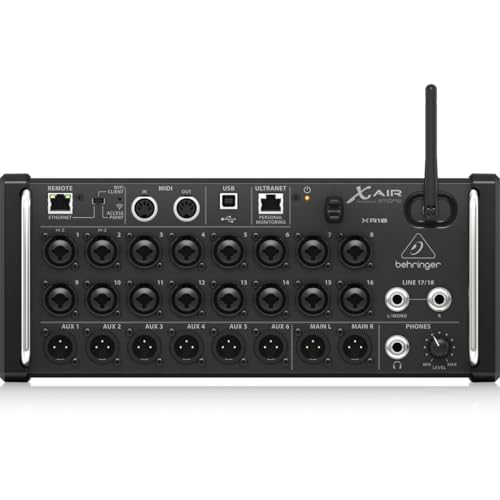
Behringer X AIR XR18 — Best Budget Digital
The XR18 is where digital stops being a capital campaign. Its listing states an 18-channel, 12-bus digital mixer for tablets with 16 programmable Midas preamps, an integrated WiFi module and a multi-channel USB audio interface. Sixteen real mic preamps of Midas design, full scene recall, and multitrack USB recording of the service — at a tier that competes with analogue boards. For the budget-led church that needs digital’s consistency, this is the door.
Strengths
- 16 Midas-designed mic preamps: genuine input count and quality at a budget digital tier
- Multi-channel USB records every input separately — service archives and virtual soundchecks become possible
- Scene recall delivers digital consistency to churches that could never fund a flagship console
Trade-offs
- Tablet-only control with integrated WiFi that experienced users often supplement with an external router for reliability
- No physical surface: a backup device and network discipline are mandatory, not optional
- Support and longevity expectations should be set to the tier — it is excellent value, not a twenty-year heirloom
- Channels: 18-channel, 12-bus digital (as listed)
- Preamps: 16 Midas programmable preamps
- Control: Tablet via integrated WiFi
- USB: Multi-channel audio interface
The XR18’s multitrack USB deserves emphasis, because it changes a church’s week: record Sunday’s multitrack, and Wednesday’s rehearsal can run a virtual soundcheck — the band’s own performance played back through the system while the operator refines the mix without the band present. That workflow was a flagship luxury within living memory; here it is the budget pick’s standard feature, and churches that adopt it improve faster than any other single change produces.
The Midas preamps matter to the spoken word especially: podium and headset mics at high gain are where budget digital usually confesses, and the XR18’s front end is a cut above its price class — one reason it became a fixture in small churches and venues far beyond its intended market.
Its disciplines are the stagebox disciplines, stated in the Ui24R review and doubly important at this tier: external router if your building’s network is busy, charged backup tablet, exported settings. Honour them and the XR18 delivers a digital church system whose capability embarrasses its cost; neglect them and the failure will be a network failure misattributed to a mixer.
Best for: budget-led churches needing digital recall, 16 mic inputs and multitrack recording / Not suited for: teams wanting physical faders or unwilling to manage a control network
Check the current price on Amazon
Comparison Table
| Pick | Badge | Key spec | Best for |
|---|---|---|---|
| Mackie ProFX16v3 | Best Overall for Most Churches | 16ch analogue, Onyx preamps, GigFX, USB recording | small-to-mid churches with a worship band and a volunteer rota wanting analogue clarity |
| Yamaha MG16XU | Best Analogue Reliability | 16-input, 6-bus, built-in effects, Yamaha build | traditional and blended services valuing bus flexibility and long-haul reliability |
| Behringer X32 | Best Digital Upgrade | 40-in/25-bus digital, motorised faders, scene recall | growing contemporary churches needing recall, processing depth and capacity |
| Soundcraft Ui24R | Best Rack / Remote Mixing | 24-input rack digital, tablet control, stagebox format | churches without a proper booth, multi-use halls, and teams happy to mix from tablets |
| Allen & Heath CQ-20B | Best Compact Digital | Compact digital stagebox, WiFi + Bluetooth, A&H processing | small-to-mid churches wanting digital recall and processing without flagship scale |
| Behringer X AIR XR18 | Best Budget Digital | 18ch/12-bus digital, 16 Midas preamps, multitrack USB | budget-led churches needing digital recall, 16 mic inputs and multitrack recording |
How to Choose the Best Sound Mixers for Churches: Start With the Team, Not the Spec Sheet
Write two lists before shopping. The first is the fullest service you actually run — Christmas, Easter, the conference — counted in microphones: platform mics, every vocalist, every instrument needing a channel, choir mics, playback, plus two spares. The second list is your operators: who they are, how many, how technical, how stable the rota is. The first list sets the channel floor; the second chooses the philosophy. A confident, stable team can own any console here. A rotating cast of the willing argues for analogue transparency or for digital scenes locked by one expert — the two models that protect a service from its operator’s learning curve.
Then count monitors and outputs, the church-specific trap. The platform needs its own mixes — wedges or in-ears for the band, a feed for the worship leader that is not the congregation’s mix — and the building needs its own: foyer, nursery, hearing assistance, and the stream. Each is an output the mixer must provide. Churches routinely count inputs carefully and outputs not at all, then discover the nursery feed has nowhere to come from. Count both, on paper, before any model is discussed.
Analogue versus digital, for churches specifically
Analogue’s church case: total visibility, instant teachability, no boot time, no passwords, and a failure mode that is usually one channel rather than the whole service. Digital’s church case: scenes that make every service identical, processing that fights feedback and polishes speech, personal monitor mixing that frees the operator, and multitrack recording for training and streams. The deciding question is who sets the mixer up: if one competent person can configure and lock a digital system, digital’s consistency wins for rotas. If setup knowledge is as scarce as operating knowledge, analogue’s honesty wins. Both answers are respectable; pretending the question away is not.
Speech intelligibility: the non-negotiable
Music forgives; speech does not. The tools that serve the sermon are high-pass filters on every mic (removing rumble and handling noise), EQ that can carve the muddy low-mids from a podium mic, gentle compression that keeps a preacher’s dynamic range inside the intelligible zone, and enough clean gain for quiet speakers. Every pick here provides them in some form; the digital picks add gates and finer EQ for difficult rooms. When comparing finalists, audition them on a spoken voice at the back row — that test outranks every music demo.
The Livestream Mix: Your Second Congregation
A stream fed directly from the main mix inherits the room’s compromises: the congregation’s singing is missing, the band is balanced for a reverberant hall rather than earbuds, and the sermon is either perfect or buried depending on the room’s day. Better practice, within a volunteer team’s capacity, is a dedicated stream feed — a matrix or aux mix with its own balance, room microphones blended in so online listeners hear a congregation rather than a studio, and levels checked on a phone, which is where the stream will actually be heard.
Multitrack recording, offered by the XR18 and the digital consoles’ ecosystems, is the training tool that makes stream mixes better over time: review the recording midweek, adjust the scene, and the next Sunday improves without a single extra rehearsal. Churches that adopt that loop close the quality gap between their room and their stream within a season — which matters, because for a growing share of the congregation, the stream is the church’s front door.
Monitors on the Platform: The Mix Nobody Hears but Everybody Feels
Singers who cannot hear themselves sing worse, louder and with less confidence — and the congregation hears all three. Platform monitoring is therefore a pastoral technology as much as an audio one. The analogue picks provide aux-fed wedge mixes an operator builds; the digital picks add the transformative option of personal mixing, where each musician adjusts their own in-ear balance from a phone or personal mixer. Churches that move the band to personal in-ear mixes consistently report the same trio of benefits: lower stage volume, a cleaner house mix, and musicians who stop asking the operator for changes mid-service.
Budget the transition honestly: in-ear systems, their receivers and the mixer’s monitor outputs are one purchase. Counting aux buses and bus outputs while choosing the mixer — as the first guide section insists — is what makes that transition possible later without replacing the console.
Training the Rota: The Mixer Is Only Half the System
Every church in this guide’s research that sounds consistently good has a training habit, and it costs nothing but organisation. New volunteers shadow two services, run rehearsals for a month with an experienced hand beside them, and only then take a Sunday solo — with the checklist from this guide’s setup section laminated at the desk. Digital churches add a locked ‘training scene’ that cannot damage the service scenes; analogue churches add the photographed board layout and a rule that faders return to the marks after any event.
Recruitment follows from the same realism: the best future operators are often the musically literate teenagers and the quietly technical retirees already in the congregation, and both groups respond to being trained properly rather than being handed a desk and a prayer. A mixer chosen for teachability — the consistent thread of this guide’s ranking — multiplies the return on that training, because every hour invested stays valid for the decade the board will serve.
Buying for a Decade: Committees, Budgets and Total Cost
Church mixers are bought by committees, rarely, from funds raised slowly — so total cost and service life dominate the real decision. Include in the budget: the mixer, any stageboxes or routers its format needs, a power conditioner, a case or cover, training time for the rota, and a contingency for the cables and DI boxes the new channel count suddenly requires. The analogue picks minimise the ancillary list; the digital picks repay theirs in consistency. Either way, a proposal that prices only the console is under-priced, and committees should send it back.
Longevity evidence is available if you look: ask churches of similar size what they run and how long they have run it. The models in this guide recur in those conversations because they survive volunteer rotas, building works, and the occasional spilled coffee. Buy the mixer your successor will thank you for — in church life, that is not a metaphor; it is the actual planning horizon.
How to Set Up a Church Mixer for a Sunday Service
Consistency is a checklist. This sequence — suitable for any pick in this guide — produces the same good service regardless of who is on duty.
- Arrive to a known state: recall the service scene (digital) or set the board from the team’s photographed standard layout (analogue), masters down.
- Line-check every input in order — pulpit, lectern, worship mics, instruments, playback — with a spoken ‘one, two’ and a played phrase, listening for crackles and dead channels while there is time to fix them.
- Set gains properly on the loudest expected moment of each source: the preacher’s emphasis, the worship leader’s chorus, the drummer’s accent — headroom is planned, not hoped for.
- Apply the speech chain to spoken-word mics: high-pass filter, gentle EQ for clarity, light compression — then leave it alone for the rest of the service.
- Build monitor mixes from the platform’s requests during rehearsal, and confirm each musician can hear what they asked for before the service, not during it.
- Balance the house mix from the congregation’s seats — walk the room during the band’s rehearsal number, including the back row and under any balcony.
- Set and check the stream/recording feed on headphones and a phone: speech clear, music balanced, congregation audible in the room mics.
- During the service, operate sparingly: ride the lead vocal and the preacher, mute unused mics, and let the prepared system do its work. After the service, save any changes deliberately and note them for the team.
The deeper principle is that Sunday excellence is manufactured on weekdays: scenes maintained, checklists laminated, new volunteers trained on rehearsals rather than services. The mixer you choose either supports that system (recall, visibility, consistency) or fights it — which is why this guide ranked operability alongside sound from the first paragraph.
Close the loop after the service with a two-minute team habit: note anything that crackled, clipped or confused, in a shared log with the date. Next week’s operator reads it before line-check, the trainer spots the pattern by the third entry, and the committee gains an evidence base when equipment genuinely needs replacing. Church sound improves the way congregations do — by small faithful repetitions, honestly recorded.
Common Buying Mistakes
- Buying channels for the average Sunday. Christmas and Easter are the specification. Count the fullest service of the year, plus spares, or rent your way out of the same problem annually.
- Forgetting the outputs. Nursery, foyer, hearing assistance, stream and recording all need feeds. Count outputs as rigorously as inputs.
- Handing volunteers an unlocked digital console. Digital consistency comes from scenes built by the competent and recalled by everyone. An unlocked flagship is a different mix every week — the worst of both worlds.
- Feeding the stream the raw house mix and never listening to it. Check the stream on a phone weekly. Your online congregation hears only what that feed gives them.
- Neglecting platform monitors. The band’s ability to hear itself decides the congregation’s experience. Budget monitor mixes and in-ears as part of the mixer decision.
- Pricing only the console. Routers, stageboxes, power conditioning, training and cables are part of the purchase. Committees should fund the system, not the centrepiece.
Final Recommendation
Most churches should start with the Mackie ProFX16v3: honest channels, volunteer-legible analogue, recording for the stream era, and a price that leaves budget for the microphones and monitors around it. The Yamaha MG16XU is its traditional-service counterpart, bought for buses and decades. When growth, difficult acoustics or operator consistency demand digital, the Behringer X32 is the proven step, with the Soundcraft Ui24R solving the no-booth problem from a stage rack, the Allen & Heath CQ-20B bringing digital grace at compact scale, and the XR18 delivering recall and multitrack at the friendliest digital tier.
Whichever philosophy your church chooses, choose it for the team that will actually stand behind it on a wet Sunday in February, with two volunteers called in sick. The best church mixer is not the one with the longest feature list — it is the one that makes the Word clear in the last row, every week, whoever is on duty. Judge the finalists by that sentence and you will not choose wrong.
And involve the operators in the final decision if you possibly can: let the rota’s hands touch the shortlisted surfaces, in the room, with the band playing. Committees buy specifications; operators live with surfaces. A mixer the team chose is a mixer the team will learn, maintain and defend — and in the long economy of church sound, that ownership is worth more than any single feature this guide has discussed.
Keep exploring the cluster: Best Sound Mixers Best Sound Mixers For Musical Theatre Best Sound Mixers For Streaming Best Sound Mixers For Podcasting
Frequently Asked Questions
How many channels does a church mixer need?
Count the fullest service of the year — every vocalist, instrument, choir microphone and playback source — then add two spares. A small traditional service may need eight; a contemporary band with choir moments often lands at sixteen to twenty-four honest mic inputs. Remember that headline channel counts include stereo line channels, so count XLR inputs specifically against your list.
Should our church buy analogue or digital?
If one competent person can set up and lock a digital system, digital’s scene recall gives a volunteer rota unmatched consistency, plus processing that genuinely helps difficult rooms. If technical confidence is thin across the whole team, a quality analogue board’s transparency produces better real Sundays. The honest state of your team — not fashion, not the salesperson — decides it.
Can one mixer handle both the room and the livestream?
Yes, with the right outputs: use a dedicated aux or matrix feed for the stream with its own balance, ideally including room microphones so online listeners hear the congregation. Several picks here also record the service — the XR18 and digital consoles can capture multitrack — which lets you improve the stream mix week by week. What does not work is splitting the main mix and never monitoring the result. Assign the stream to a named volunteer with headphones, even if that person is also doing something else; an unowned feed degrades silently for months while the room mix, with a room full of witnesses, gets all the attention.
What is a scene, and why do churches love them?
A scene is the console’s complete settings — gains, EQ, effects, routing, fader positions on digital surfaces — stored and recalled in one action. For a church it means the service starts from an identical, expert-built state every week regardless of operator, with variations (regular Sunday, funeral, Christmas production) stored as their own scenes. It is the single most valuable digital feature for volunteer teams. Build scenes deliberately and name them plainly — date and service, not ‘final v2’ — and keep an exported backup off the console, because a scene library represents dozens of hours of skilled work that a factory reset should never be able to erase.
Do we need in-ear monitors for the band?
Not necessarily, but the transition is the most commonly praised upgrade in church sound: stage volume falls, the house mix clears, and musicians control their own balance on digital systems with personal mixing. Wedges remain entirely workable, especially for smaller platforms. Decide by your room’s volume problems and your monitor-output count — which is why this guide insists on counting outputs before choosing the mixer. Whichever route you take, rehearse the change properly: a band’s first in-ear service should be a rehearsal, not a Sunday, because the sensation is disorienting for exactly one week and then never missed again.
How long should a church mixer last?
A quality mixer in church service should be planned as a decade-scale asset: weekly use is gentle compared with touring, and the brands in this guide have the build and support for it. Longevity is protected by power conditioning, dust covers, trained operators and keeping the configuration backed up. Buy once, at the right size for your fullest service, and the mixer becomes part of the building’s furniture in the best sense. When it finally is replaced, it usually retires to the youth room or the chapel rather than the skip — plan that cascade when you buy, and the effective cost per year of the whole system falls again.


