Disclosure: airfryerkitchensupply.com is reader-supported. When you buy through links on our site, we may earn an affiliate commission at no extra cost to you.
Where to buy
Small kitchen mixers overlap heavily with compact stand mixers and 2-in-1 designs, so read each listing for the bowl size, the included attachments and the machine’s stored dimensions before ordering. Every pick below links to its Amazon listing so you can check price on Amazon; if your constraint is a specific cabinet or shelf, compare the listing’s measurements against your space first — that single check prevents most returns in this category.
- Dash Everyday Stand Mixer, 3-Quart (Red) — Check the current price on Amazon
- KitchenAid Artisan Mini 3.5-Qt Tilt-Head Stand Mixer (White) — Check the current price on Amazon
- bella 3.5 Qt Hand & Stand Mixer, 2-in-1 (Oatmilk) — Check the current price on Amazon
- CKEMU Stand Mixer SM-2549A (Black) — Check the current price on Amazon
- West Bend Two Sweet 2-in-1 Hand & Stand Mixer (Red) — Check the current price on Amazon
- KitchenAid Classic Series 4.5 Quart Tilt-Head Stand Mixer K45SS (Onyx Black) — Check the current price on Amazon
The best small kitchen mixers are chosen backwards from most appliances: you start with the kitchen, not the mixer. How much counter can it honestly surrender? Which cabinet or shelf will store it, and what is that space’s height? How many people cook, and how often? A small kitchen mixer is a space decision that also mixes — and when the space decision is right, even a modest machine feels like a triumph, because it is there, reachable and ready, instead of exiled to a box in the garage.
This guide approaches the category from storage and workflow rather than raw power. The picks include a Dash Everyday in red for the tiniest footprints, KitchenAid’s Artisan Mini in white for premium smallness, a bella 2-in-1 that converts between hand and stand duty, a CKEMU compact designed explicitly around space-saving, a West Bend 2-in-1 with a rotating bowl and eleven speeds, and KitchenAid’s Classic 4.5-quart — the largest ‘small’ option, for kitchens that can stretch a little. If your priority is food-first rather than space-first, our best small food mixers guide ranks the same territory by batch and dough; if you have settled on hand mixers only, see the best small hand held mixers. Here, the tape measure leads.
Every model was cross-checked against Amazon’s catalog before earning a link, and prices stay off the page by design — check price on Amazon for the current figure on the exact model and color.
Bring your measurements to this guide — counter depth, cabinet height, shelf width — because the reviews assume them. A pick described as perfect is perfect for a kitchen it fits; the same machine in a kitchen two inches smaller is a daily annoyance. The tape measure is the first review tool; the six picks are what it will be choosing among.
Finally, a note on how this guide treats the word ‘best.’ There is no single best small kitchen mixer below — there are six best answers to six differently shaped kitchens, and the reviews are blunt about each pick’s demands as well as its gifts: the space it needs, the weight it asks you to lift, the batches it refuses. If you finish this page knowing which machine your kitchen is asking for, the guide has done its job. When two picks still contend, choose by the storage you actually have, not the storage you plan to have someday.
In this guide
Quick Picks
Best Tiny Footprint — Dash Everyday Stand Mixer, 3-Quart (Red). The 3-quart Dash in red — a genuinely small tilt-head mixer that parks on a sliver of counter or a single shelf. Check on Amazon
Best Premium for Small Kitchens — KitchenAid Artisan Mini 3.5-Qt Tilt-Head Stand Mixer (White). KitchenAid’s Mini in white: flagship build, attachment hub and 3.5 quarts in a footprint made for smaller counters. Check on Amazon
Best Convertible Value — bella 3.5 Qt Hand & Stand Mixer, 2-in-1 (Oatmilk). A 3.5-quart stand mixer whose head works as a hand mixer — bella’s space-doubling design in a soft Oatmilk finish. Check on Amazon
Best Space-Saving Design — CKEMU Stand Mixer SM-2549A (Black). A compact stand mixer designed around saving space, with a stainless bowl, 300W motor and dishwasher-safe attachments. Check on Amazon
Best Feature-Rich Convertible — West Bend Two Sweet 2-in-1 Hand & Stand Mixer (Red). Eleven speeds with turbo boost, a 4.4-quart rotating bowl, and beaters, hooks and whisk included — the most equipped convertible here. Check on Amazon
Best ‘Stretch’ Small Mixer — KitchenAid Classic Series 4.5 Quart Tilt-Head Stand Mixer K45SS (Onyx Black). The 4.5-quart Classic: KitchenAid’s entry flagship, for small kitchens that can stretch to near-standard size and want decades of service. Check on Amazon
How These Picks Were Chosen
Our filter began with dimensions and storage logic: each pick had to fit a realistic small-kitchen scenario — a 12-inch-deep shelf, a corner of apartment counter, a pantry bin — and be light enough for one-handed retrieval. Convertibles earned special attention because one stored unit doing two jobs is the strongest space play in the category.
Within the space filter we still demanded mixing competence: planetary or rotating-bowl action for even results, a speed range with a gentle low end, and the core attachments included rather than sold separately wherever possible. The result is a list organized by kitchen situation rather than by spec sheet, which is how small-kitchen buying actually works.
The 6 Best Best Small Kitchen Mixers

Dash Everyday Stand Mixer, 3-Quart (Red) — Best Tiny Footprint
For the kitchen with effectively no spare counter, the red Dash Everyday is the mixer that still fits: a 3-quart bowl, six speeds, and a body that stores where a toaster oven would not. It serves one- and two-person batches — muffins, small cakes, frosting, whipped toppings — with cheerful simplicity.
Strengths
- Smallest storage story in this guide
- 6 speeds cover the everyday small-batch repertoire
- Light enough to move with one hand, every time
Trade-offs
- 3-quart bowl caps every ambition at single small batches
- Light body needs a steadying hand on heavier mixes
- Not built for bread dough beyond small, soft portions
Key specs: 3-quart stainless steel bowl; 6 speeds; tilt-head; compact body; Red.
Small-kitchen veterans know the real spec is not watts — it is whether the appliance earns its cubic inches daily. The Dash does, by being grabbable: out of the cabinet in one motion, mixing in a minute, washed and back before a big mixer would have been assembled. Its limits are the class limits, stated plainly in its other appearances in this cluster: small batches, gentle doughs. In red it also does the one thing small appliances rarely do — it makes a tiny kitchen look intentional rather than compromised.
In red, the Dash becomes the small kitchen’s exclamation point — and, not incidentally, the appliance guests ask about. Its service record in tiny homes is one of constant small use: a frosting here, a batter there, always within arm’s reach. Appliances that are loved get maintained; this one’s cheerfulness is a genuine ownership feature in a space where every object is on display.
Best for: The smallest kitchens and one- to two-person households / Not suited for: Families, bread bakers or batch cooks of any kind

KitchenAid Artisan Mini 3.5-Qt Tilt-Head Stand Mixer (White) — Best Premium for Small Kitchens
The white Artisan Mini is for the small kitchen with big standards — the baker who measures a mixer in years of service and wants the pasta roller and grinder hub available, but whose counter cannot host a full Artisan. It is the compact that asks the fewest apologies.
Strengths
- Metal KitchenAid build sized down for small counters
- Powered hub unlocks the full attachment ecosystem
- 10 speeds including a true gentle fold
Trade-offs
- Premium price in a compact body
- White finish is a commitment to wiping it down
- Batch ceiling is real: singles, not doubles
Key specs: 3.5-quart bowl; 10 speeds; tilt-head; powered attachment hub; White.
In a small kitchen, one great appliance beats three mediocre ones, and the Mini is the great one: planted on the counter, quiet in its work, precise at low speed, and backed by the deepest parts and attachment ecosystem in the category. The white finish suits the bright, small kitchens it usually lands in, at the cost of showing every berry splash until wiped. If your space is small but permanent — you are not moving every year, and this mixer is a fixture — the Mini is the buy-once answer in this guide.
The white Mini suits the bright, compact kitchens of new apartments and renovated galley spaces, where it reads as part of the architecture rather than an appliance parked in it. Its decade-scale service life means the color choice is a long one — white is the safe, light choice that small kitchens rarely regret. Beneath the finish sits the same hub-equipped thoroughness as every Artisan Mini.
Best for: Permanent small kitchens with flagship expectations / Not suited for: Renters on a budget or anyone needing double batches

bella 3.5 Qt Hand & Stand Mixer, 2-in-1 (Oatmilk) — Best Convertible Value
The bella 2-in-1 is aimed at the kitchen that cannot justify two mixers but does two kinds of mixing: stand duty for batters and doughs in its 3.5-quart bowl, hand duty lifted free for potatoes, quick whips and mixing in the serving bowl. One stored unit, both workflows.
Strengths
- Hand-and-stand conversion doubles function per stored inch
- 3.5-qt bowl is the right size for small households
- Soft-finish styling designed to live on small counters
Trade-offs
- Convertible mechanisms add a failure point dedicated machines lack
- Power is compact-class in both modes
- Newer model line — long-term track record still forming
Key specs: 3.5-quart bowl; 2-in-1 hand and stand design; Oatmilk finish.
The space math of a convertible is unbeatable in a small kitchen: the drawer or shelf holds one appliance, and the counter gets both a stand mixer and a hand mixer as needed. Bella executes the idea in a friendly size and a finish meant to be seen, which matters in open-plan small homes where the kitchen is also the room. Performance is honest compact-class in both modes — small batches, sensible speeds, no flagship illusions. For the renter or small-home cook building a kitchen from scratch, it is one of the smartest single purchases in this guide.
The bella’s Oatmilk finish signals its intent: this is furniture-grade small appliance design, meant to sit out in calm, modern small homes. Its conversion rhythm — stand for the bake, hand for the finish — becomes second nature within a few uses, and its single-unit storage keeps a small kitchen’s limited cabinetry honest. It is the renter-friendly face of the convertible idea.
Best for: Small homes wanting stand and hand mixing from one stored unit / Not suited for: Heavy users who would wear a convertible’s mechanism hard
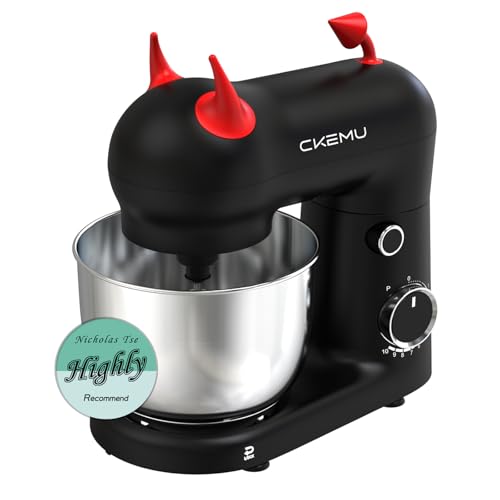
CKEMU Stand Mixer SM-2549A (Black) — Best Space-Saving Design
CKEMU built this model with the small-kitchen brief in its name — compact and space-saving — and it suits the cook who wants a dedicated stand mixer (not a convertible) that still disappears into apartment storage. The stainless bowl and dishwasher-safe attachments keep the whole routine low-effort.
Strengths
- Designed explicitly for compact storage
- Stainless steel bowl at a friendly tier
- Dishwasher-safe attachments simplify small-kitchen cleanup
Trade-offs
- 300W compact motor — small, gentle batches only
- Lesser-known brand: support network is thinner than legacy names
- Design-led shape may not suit traditional tastes
Key specs: Compact stand mixer; stainless steel bowl; 300W motor; dishwasher-safe attachments; model SM-2549A; Black.
Every category has a challenger that wins by focusing on one brief, and CKEMU’s is storage: the proportions, the bowl, the whole silhouette assume a small kitchen and refuse to apologize for it. Mixing performance is standard compact fare — batters, creams and light doughs handled pleasantly, big ambitions declined. The gamble is brand depth: if a beater breaks in year three, replacement is a question the legacy brands answer more certainly. For buyers who prize the design and the price tier, it is a coherent, likeable choice.
CKEMU’s compact repays owners who organize around it: a designated low shelf, attachments in the bowl, and a machine that is out, mixing and back in under a minute. Its playful silhouette divides opinion — some see a design object, others a toy — but its mixing is earnest compact-class work. In a market of lookalike boxes, distinctiveness plus storage sense is a real position.
Best for: Design-conscious small kitchens wanting a dedicated compact stand mixer / Not suited for: Buyers who prioritize long-established service networks

West Bend Two Sweet 2-in-1 Hand & Stand Mixer (Red) — Best Feature-Rich Convertible
West Bend’s Two Sweet suits the small kitchen that wants maximum function per appliance: eleven speeds is stand-mixer territory, the 4.4-quart bowl rotates for even mixing, and the head detaches for hand duty. It is the convertible for cooks who read spec sheets.
Strengths
- 11 speeds with turbo boost — widest range among the convertibles
- 4.4-qt rotating bowl improves mixing evenness
- Beaters, dough hooks and whisk all included
Trade-offs
- Feature richness means more parts to store and learn
- Rotating-bowl design differs from planetary action purists prefer
- Convertible class limits still apply to heavy dough
Key specs: 4.4-quart rotating bowl; 11 speeds with turbo boost; tilt-head; beaters, dough hooks and whisk included; Red.
Where the bella convertible sells simplicity, West Bend sells equipment. The rotating bowl is an old, effective idea — the bowl turns so the beaters meet all the mixture — and eleven speeds give this unit unusual finesse at the low end and enthusiasm at the top. The included whisk makes it a real whipping tool in either mode. It asks a little more storage for its attachments and a little more learning from its owner, and returns the most capable convertible performance in this guide. Small kitchens that bake often and variedly will use everything it offers.
The Two Sweet’s eleven speeds spoil its owners: tasks get ‘their’ speed — a remembered number for cream, another for dough — and repeatability follows. The rotating bowl’s steady turn means less stopping to rotate by hand, and the full attachment set means the small kitchen’s mixing shelf holds exactly one machine. It is the enthusiast’s convertible, and it behaves like one.
Best for: Enthusiast small-kitchen bakers wanting one fully equipped unit / Not suited for: Minimalists who want the simplest possible appliance

KitchenAid Classic Series 4.5 Quart Tilt-Head Stand Mixer K45SS (Onyx Black) — Best ‘Stretch’ Small Mixer
The K45SS is the pick when ‘small’ is a preference, not a hard constraint: at 4.5 quarts with a tilt head and the full hub, it handles standard batches — a full cookie recipe, a proper loaf — while still parking more compactly than the big bowl-lift machines. It is the small-kitchen mixer for households that cook like big ones.
Strengths
- 4.5-qt capacity covers standard recipes without splitting batches
- KitchenAid metal build and hub, in the Classic’s proven form
- 59-point planetary mixing for thorough bowl coverage
Trade-offs
- Largest and heaviest pick here — measure your storage honestly
- 10 speeds but no soft-start flour finesse of newer lines
- Entry flagship pricing, above the compact class
Key specs: 4.5-quart bowl; 10 speeds; tilt-head; 59 touchpoints planetary mixing; Onyx Black; model K45SS.
Every ‘small’ guide needs its boundary case, and the Classic is this one’s: include it because many small kitchens can, in fact, fit it — and those that can get a categorically more capable machine. Standard recipes fit whole; the hub opens the attachment world; the build is the one measured in decades. The discipline is measuring first: counter depth with the head tilted, cabinet height for storage, and the lift in and out. If the tape measure says yes, this is the last mixer most households buy. If it says no, the Artisan Mini above is the same brand’s answer at true compact size.
The Classic in a small kitchen is a statement of priorities: counter space spent on capability. Households that bake for gatherings from a small base camp here, because standard batches fit and the hub ecosystem multiplies the machine’s jobs. Its Onyx Black finish suits serious kitchens, flour dust notwithstanding. If the tape measure allows it, this is the small-kitchen mixer with the longest future.
Best for: Small kitchens that can fit near-standard size and bake standard batches / Not suited for: Truly tiny storage or anyone who moves appliances daily
Comparison Table
| Pick | Badge | Key spec | Best for |
|---|---|---|---|
| Dash Everyday Stand Mixer, 3-Quart (Red) | Best Tiny Footprint | 3 qt, 6 speeds, mini footprint | The smallest kitchens and one- to two-person households |
| KitchenAid Artisan Mini 3.5-Qt Tilt-Head Stand Mixer (White) | Best Premium for Small Kitchens | 3.5 qt, 10 speeds, hub-equipped | Permanent small kitchens with flagship expectations |
| bella 3.5 Qt Hand & Stand Mixer, 2-in-1 (Oatmilk) | Best Convertible Value | 3.5 qt, 2-in-1 hand/stand | Small homes wanting stand and hand mixing from one stored unit |
| CKEMU Stand Mixer SM-2549A (Black) | Best Space-Saving Design | Compact, 300W, stainless bowl | Design-conscious small kitchens wanting a dedicated compact stand mixer |
| West Bend Two Sweet 2-in-1 Hand & Stand Mixer (Red) | Best Feature-Rich Convertible | 4.4 qt rotating bowl, 11 speeds | Enthusiast small-kitchen bakers wanting one fully equipped unit |
| KitchenAid Classic Series 4.5 Quart Tilt-Head Stand Mixer K45SS (Onyx Black) | Best ‘Stretch’ Small Mixer | 4.5 qt, 10 speeds, planetary | Small kitchens that can fit near-standard size and bake standard batches |
Measure First: The Small-Kitchen Mixer Fitting Guide
Measure three spaces before you shop: the counter spot (width, depth, and clearance under upper cabinets with the tilt head raised), the storage spot (height matters most — tilt-head mixers store shorter than they stand while tilting), and the path between them. Write the numbers down and shop with them open on your phone. A mixer that fits storage but cannot tilt open on your counter will annoy you weekly.
Weight is the second measurement. If the mixer will live in a cabinet, you will lift it hundreds of times; under roughly ten pounds is one-hand territory, above that is a two-hand commitment. Convertibles cheat this math by splitting into pieces. Countertop residents can ignore weight and prioritize stability instead — a heavier base walks less under load. Match the machine’s living arrangement to your real habits, not your aspirational ones.
Rotating Bowl, Planetary Action and Convertibles: How Small Mixers Actually Mix
Planetary action — the beater spinning while orbiting the bowl — is the thoroughness benchmark, found on the KitchenAid picks and better stand models. Rotating-bowl designs, like the West Bend here, turn the bowl beneath fixed beaters; done well, results are close, and the mechanism is simple and durable. Basic fixed-bowl, fixed-beater compacts rely on you to scrape and turn the bowl by hand — acceptable at the lowest tiers if you know it going in.
Convertibles add a different variable: the same motor works in your hand, where you supply the movement, and on the stand, where the design does. Judge a convertible by both modes — a great stand mixer with a clumsy hand mode (or the reverse) fails its own premise. Both convertibles in this guide were picked because neither mode feels like the afterthought.
Small Kitchen Workflow: Making One Mixer Do Everything
In a small kitchen the mixer competes with the food processor, blender and hand mixer for the same shelf. The winning strategy is consolidation around your actual top jobs. If baking leads, a hub-equipped KitchenAid (Mini or Classic) can absorb pasta, grinding and spiralizing through attachments, retiring other gadgets. If quick savory mixing leads, a convertible covers hand jobs too, and the shelf holds one box instead of two.
Sequence your kitchen around the mixer’s home. Store attachments in the bowl, keep the beater you use most attached, and park the machine where the baking actually happens. Small kitchens reward systems: the best small kitchen mixer is the one whose storage, setup and cleanup you have made thoughtless.
The Small-Kitchen Appliance Audit: Deciding What the Mixer Must Replace
Before buying, list every mixing-adjacent appliance you own or want: hand mixer, stand mixer, food processor, blender, immersion blender. Mark each one’s top three jobs. The overlaps reveal the purchase: if the stand mixer’s jobs are all small-batch, a compact or convertible covers them and the shelf frees up; if the hand mixer’s jobs include in-pot work, a convertible or a separate hand mixer stays necessary.
This audit is why this guide contains convertibles and a stretch full-size model alongside true minis: ‘small kitchen mixer’ is a role, not a dimension, and the role is defined by what the machine must absorb. Do the fifteen-minute audit and the right pick usually identifies itself — the rest of the guide then becomes confirmation rather than searching.
Countertop Living vs Cabinet Storage: Designing for Your Choice
Countertop residents should be chosen like furniture: finish, silhouette and footprint all matter, and stability under load matters most — a heavier base is a feature here. Keep the resident’s zone sacred: no mail, no clutter creep, or the mixer becomes the thing you move to cook, which is a stored mixer with extra steps.
Cabinet-stored mixers should be chosen like luggage: weight, grab points and whether attachments ride inside. Measure the shelf height with the door’s swing in mind, and rehearse the retrieval path once before buying — a mixer that must be threaded past the blender will be retrieved rarely. Both lifestyles work beautifully when the machine is chosen for them deliberately, which is the entire argument of this guide.
Budget Planning for a Small Kitchen: Where the Money Goes
In small mixers, money buys three things in order: control (gentle low speeds, steady pace under load), construction (metal gearing and housings that age well), and ecosystem (attachments and parts that exist in five years). The budget picks here deliver the first adequately; the premium picks deliver all three. Neither is the ‘wrong’ spend — it depends on baking frequency.
A useful rule: if you will mix weekly for five years, the premium tier’s cost per use drops below the budget tier’s replacement cycle. If you mix monthly, the budget and convertible picks are the rational spend, and the savings belong in ingredients. Either way, reserve a little for the unglamorous kit — a scale, a scraper, a second bowl where offered — which improves results more than the next model up.
Small Mixers in Rental Kitchens: The No-Commitment Playbook
Renters face a special brief: no installation, easy moves, and appliances that work in the next kitchen too. Convertibles and light compacts are the rental aristocracy — one box to move, every job covered, nothing mounted or plumbed. The Dash and bella picks here are practically designed for the rental lifecycle.
Buy for the kitchens you will have, not only the one you have: standard bowl sizes and mainstream brands (whose attachments are sold everywhere) travel best across homes and years. And keep the box if storage allows — mixers move safest in their original packaging, a small foresight that pays off at every lease’s end.
Small Kitchen Counters: A Layout That Gives the Mixer a Home
Divide a small counter into three honest zones: a wet zone by the sink, a hot zone by the stove, and a work zone — the mixer’s territory — with the outlet it needs and the flour within a step. Everything that does not serve those zones daily earns a cabinet or a farewell. A mixer with a permanent work zone gets used; a mixer in a rotation of countertop guests gets skipped.
Vertical thinking helps: a wall-mounted rail for utensils frees the drawer a hand mixer would take; a shelf riser doubles a cabinet’s mixer-and-bowl storage. The goal is a kitchen where the mixer’s retrieval is a single motion. Every pick in this guide was measured against that standard as much as against any recipe.
One Mixer, Many Households: Buying for Life Stages
The student apartment, the first shared kitchen, the small family home and the downsized condo ask similar things of a mixer — small footprint, honest capacity, low fuss — which is why the picks here recur across life stages. A convertible bought for a studio often becomes the second mixer in a family kitchen; a Mini bought for an apartment becomes the downsizer’s last mixer decades later.
Buy for the stage you are entering, not only the one you are in, when the difference is small: the Artisan Mini and the Classic both span stages gracefully. And when a stage truly changes — the baking business, the six-person household — the small mixer does not become obsolete; it becomes the specialist it always secretly was.
Troubleshooting Small Mixers: Five Fixes Before You Replace
Mixer strains on dough? The batch is too big or too dry — split it, or add liquid a teaspoon at a time. Beaters leave unmixed pockets? Scrape once mid-job and check beater-to-bowl clearance on adjustable models. Machine walks on the counter? The load is heavy and the feet are floury — wipe the feet, steady the base, lower the speed. Motor smells hot? Stop, rest it ten minutes; compact motors are honest about their limits.
Attachments will not seat? Flour and batter migrate into sockets — clean the socket and the shaft, then reseat with a firm push and twist per the manual. Most ‘broken’ small mixers are one of these five stories. The brands in this guide publish parts and guidance for the rest, which is the final reason they are the picks.
Small Kitchens Abroad: Compact Mixers in Galley and Studio Living
The galley kitchen — long, narrow, one cook wide — is the small mixer’s ancestral home, and its rules apply everywhere: appliances earn linear inches, workflows move in one direction, and anything stored above shoulder height effectively does not exist. In such kitchens the convertible and counter-light picks here are not compromises; they are the correct engineering.
Studio living adds an audience: the kitchen is the living room, so noise and appearance join the specification list. The quieter, calmer motors and the furniture-grade finishes in this guide (the bella, the Delish-adjacent compacts, the matte KitchenAids in the sister guide) exist for exactly this life. Small is not a limitation to apologize for; it is a design brief, and these mixers answer it.
Extending a Small Mixer’s Life Into Its Second Decade
The mixers that reach a second decade share owners, not just engineering: loads kept honest, dough kept small and slow, cords kept unkinked, sockets kept clean, and storage that does not involve being buried under heavier appliances. Add one habit — an annual empty run through the speeds, listening — and most developing problems announce themselves while they are still cheap.
When something does wear, the brands in this guide answer with parts and documentation rather than a shrug. That is the long game of the premium picks, and the reason this guide keeps returning to ecosystems: in a small kitchen, the mixer you can repair is the mixer you keep, and keeping is the most economical strategy of all.
The Sound of a Healthy Small Mixer
Learn your mixer’s normal voice in its first week: a steady hum that deepens slightly under load and recovers when the load passes. Changes are diagnostic — a new whine at a familiar speed, a rattle from the head, a pitch drop that lingers. Caught early, most are cleaning or load issues; ignored, they become repairs.
Compact motors also speak through heat: a warm head after dough is normal, a hot one is a stop signal. Owners who listen get the long service lives this guide keeps promising, because machines rarely fail silently — they announce, quietly, in the weeks before. Your ear is the cheapest diagnostic tool in the small kitchen.
Key Takeaways
- Measure first: counter clearance with the head tilted, storage height, and the lift in between decide everything.
- Picks by kitchen: Dash for the tiniest footprint, Artisan Mini for premium permanence, bella and West Bend convertibles for two-in-one storage, KitchenAid Classic for stretch capacity.
- Workflow wins: attachments stored in the bowl, a clear landing zone, a two-minute reset after every use.
How to Set Up a Small Kitchen Mixer Station That Actually Works
Step 1: Claim the spot. Choose the counter or shelf nearest your baking supplies and outlet. If the mixer must travel from storage, clear its landing zone permanently — a landing zone that needs clearing is a reason not to bake.
Step 2: Store attachments in the bowl. Beaters, hooks and whisk ride inside the bowl under the head. One grab moves the whole system; nothing hides in drawers.
Step 3: Add a small staging tray. A quarter-sheet pan beside the mixer holds measuring cups, the scraper and the recipe. In a small kitchen, a defined staging area prevents the counter creep that makes cooking feel chaotic.
Step 4: Manage the cord. Coil excess cord behind the machine or use the mixer’s wrap points. A cord across a small counter is a spill waiting for a sleeve.
Step 5: Do a two-minute reset after every use. Bowl and attachments washed or in the dishwasher, head wiped, machine back in its spot. The station stays ready, which is the entire point of owning a small, convenient mixer.
The weekly five-minute audit: once a week, notice what actually got mixed, where the machine lived, and what annoyed you. Small kitchens evolve; the station that worked in January may deserve a shelf swap by June. The best small-kitchen setup is not installed once — it is tuned, lightly and often, which is only possible because everything in this guide is small enough to move.
One last station upgrade: a small wall clock or timer within sight of the mixer zone. Small batches finish fast, and the difference between perfect and overmixed is often ninety seconds. Timing is the cheapest precision tool in the small kitchen — cheaper than any mixer upgrade, and it improves every recipe this guide’s picks will ever make.
Rehearse the first retrieval: before the mixer’s first real recipe, practice the full loop once — out of storage, onto the counter, bowl fitted, cord managed, and back again. Any friction you feel in that empty rehearsal will be ten times worse mid-recipe with flour on your hands, and it is far cheaper to rearrange the station now than to resent it for a year.
Common Buying Mistakes
Shopping by bowl size alone. A 4.5-quart mixer that does not fit your cabinet is worse than a 3.5-quart that does. Dimensions and weight decide small-kitchen happiness.
Forgetting the tilt. Tilt-head mixers need vertical clearance to open. Measure with the head up, both on the counter and in the storage spot.
Buying a convertible but using one mode. If you never detach the head, a dedicated stand mixer would serve you better; if you never mount it, buy a hand mixer and save the money.
Letting attachments scatter. Small kitchens lose small parts. Bowl-storage or a single pouch keeps the kit whole.
Overloading to avoid a second batch. Two comfortable batches beat one strained one — for the mixture’s quality and the motor’s lifespan alike.
Final Recommendation
Match the mixer to the kitchen: the Dash for the tiniest footprint, the Artisan Mini for premium permanence, the bella for simple two-way flexibility, the CKEMU for space-first design, the West Bend for the fully equipped convertible, and the KitchenAid Classic for small kitchens that can stretch to standard batches.
Cross-check your shortlist against the cluster: Best Small Food Mixers ranks by batch and dough first, Best Small Hand Held Mixers covers the drawer-stored alternative, and Best Small Kitchenaid Mixers goes deep on the brand two of these picks come from. Measure your space, then check price on Amazon for the model that fits it.
Ready to shop? Compare the picks directly: Dash Everyday Stand Mixer, 3-Quart (Red), KitchenAid Artisan Mini 3.5-Qt Tilt-Head Stand Mixer (White), bella 3.5 Qt Hand & Stand Mixer, 2-in-1 (Oatmilk), CKEMU Stand Mixer SM-2549A (Black), West Bend Two Sweet 2-in-1 Hand & Stand Mixer (Red), KitchenAid Classic Series 4.5 Quart Tilt-Head Stand Mixer K45SS (Onyx Black).
Frequently Asked Questions
What is the best mixer size for a small kitchen?
For most small kitchens, 3.5 quarts is the sweet spot — real capacity for household batches in a body that stores easily. Go 3 quarts for the tightest spaces and one-person cooking; stretch to 4.5 quarts only if your storage measurements honestly allow it.
Are 2-in-1 hand and stand mixers worth it in small kitchens?
Yes, when you genuinely use both modes — they halve the stored volume of your mixing kit. If your mixing is all stand work or all hand work, a dedicated machine does that one job better for similar money.
How do I know if a mixer will fit under my cabinets?
Compare the listing’s height with the head tilted open — not just closed — against your counter-to-cabinet clearance. Tilt-head models need several extra inches to open fully. When in doubt, plan to pull the mixer forward to the counter edge for use.
Can a small kitchen mixer handle weekly bread?
A single loaf weekly, yes — the KitchenAid picks and the stronger compacts here manage it at low speed with sensible hydration. Daily or double-batch bread is standard-mixer territory.
Where should a small mixer live: counter or cabinet?
Wherever retrieval is effortless. Frequent bakers should claim counter space — the mixer gets used more and earns it. Occasional bakers can cabinet-store a light compact or convertible, provided the lift is one-handed and the landing zone stays clear.
Do pricier small mixers mix better, or just last longer?
Both, but the order matters: the first gains are control (gentler low speeds, steadier pace under load) and thoroughness (planetary action). Longevity follows from metal gearing and brand support. Light users may never feel the difference; regular bakers feel it weekly.
What is the lightest type of small kitchen mixer?
Convertible hand-and-stand units and the smallest compacts like the Dash are the lightest to retrieve, because their motors and bodies are compact-class. If lifting is the constraint, weigh the hand-mixer route too — a hand mixer plus a good bowl can be the lightest complete system of all.
Do small kitchen mixers need special recipes?
No — standard recipes scaled to the bowl. Single batches of most home recipes are written for standard bowls, so 3.5–4.5 quart models take them whole; 3-quart models may need a half-batch of the largest recipes. Weighing ingredients makes scaling painless.
How do I stop a light mixer from walking on the counter?
Lower the speed, steady the base with one hand for heavy moments, wipe flour off the feet, and place the mixer on a damp towel or silicone mat for grip. Walking is feedback: the load is at the machine’s edge.
Can a small kitchen mixer sit on a rolling cart instead of a counter?
Yes — a sturdy kitchen cart is a classic small-kitchen move, effectively adding a movable work zone. Choose a lighter compact or convertible, confirm the cart locks or is heavy enough not to travel under mixing vibration, and keep the cord’s path to the outlet clear of the cart’s wheels.
Are glass bowls better than stainless for small mixers?
Glass lets you see unmixed pockets and chills well for whipping, but it is heavier and breakable; stainless is light, durable and the small-kitchen default. Choose by your storage and your clumsiness, honestly assessed.
Should I buy an extended warranty for a small mixer?
For budget compacts used weekly, a reasonably priced plan can make sense because the replacement cost is the whole machine. For premium metal-drive models with strong manufacturer support, most owners are better served by the brand’s own service network. Read what the plan covers — motor and gears are the clauses that matter.

