Disclosure: airfryerkitchensupply.com is reader-supported. When you buy through links on our site, we may earn an affiliate commission at no extra cost to you.
Where to buy
Hand mixers are sold by speed count and attachment bundle, and the same model often appears in several colors and bundles — match the listing to the exact model number in each review (KHM512, HM-90S and so on) before ordering. Every pick below links to its Amazon listing so you can check price on Amazon and confirm whether the storage case, whisk and dough hooks are included in that particular bundle.
- KitchenAid 5 Ultra Power Speed Hand Mixer KHM512 (Contour Silver) — Check the current price on Amazon
- KitchenAid 7 Speed Hand Mixer KHM7210 (White) — Check the current price on Amazon
- KitchenAid 9 Speed Hand Mixer KHM926 (Contour Silver) — Check the current price on Amazon
- Cuisinart Power Advantage Plus 9-Speed Hand Mixer HM-90S — Check the current price on Amazon
- Hamilton Beach 6-Speed Electric Hand Mixer 62682G — Check the current price on Amazon
- KitchenAid Go Cordless Hand Mixer KHMR762 (Black Matte, Battery Included) — Check the current price on Amazon
The best small hand held mixers are the most honest appliances in the kitchen: they do one job — mixing, whipping and light kneading in whatever bowl, pot or pan you already own — and they do it from a drawer. No counter footprint, no bowl-size ceiling, no ten-minute setup. For mashed potatoes they work right in the cooking pot; for egg whites, in the bowl you will serve from; for a quick cake batter, in the big mixing bowl a stand mixer’s bowl would crowd. If your mixing life is quick, varied and small-batch, a hand mixer is not the compromise choice. It is the right tool.
This guide ranks the proven small hand mixers by the things that separate them in daily use: low-speed control (the difference between folding and a flour cloud), beater design, storage sense, and whether the motor stays composed under a thick cookie dough. KitchenAid fields three entries at five, seven and nine speeds because the brand genuinely differentiates them; Cuisinart’s nine-speed with its snap-on case is the storage champion; Hamilton Beach’s six-speed is the budget benchmark with a bowl-rest trick; and KitchenAid’s cordless Go model cuts the cord entirely for cooks who move around the kitchen. One honest note up front: hand mixers knead only small, soft doughs — bread ambitions belong to the stand mixers in our best small food mixers guide.
Every model here was cross-checked against Amazon’s catalog before earning its link, and we do not print prices — check price on Amazon for the exact bundle, since hand mixers are frequent visitors to the sale pages.
A word on expectations before the picks: a hand mixer will not knead your sourdough, and this guide will not pretend otherwise in any review. What it will do — superbly, from a drawer, for years — is the other ninety percent of home mixing. Judge the picks on that ninety percent and you will choose well.
Finally, a note on how this guide treats the word ‘best.’ There is no single best small hand held mixer below — there are six best answers to six different kitchens, from the drawer-minimalist to the cordless island cook, and each review states its pick’s limits as plainly as its strengths. If you finish this page knowing which mixer is yours and why the other five are not, the guide has done its job. When two picks still contend, choose by the job you do weekly, not yearly — frequency is the tiebreaker that never lies.
In this guide
Quick Picks
Best for Most People — KitchenAid 5 Ultra Power Speed Hand Mixer KHM512 (Contour Silver). Five well-chosen speeds, lockable swivel cord and Turbo Beaters — the simple, durable hand mixer most kitchens actually need. Check on Amazon
Best Mid-Range — KitchenAid 7 Speed Hand Mixer KHM7210 (White). Seven speeds plus a Pro Whisk and soft-start — the step-up that adds real whisking ability and gentler starts. Check on Amazon
Best Full-Featured — KitchenAid 9 Speed Hand Mixer KHM926 (Contour Silver). Nine speeds, whisk, dough hooks and blending rod in one kit — the hand mixer that tries hardest to replace a stand mixer for small jobs. Check on Amazon
Best Storage — Cuisinart Power Advantage Plus 9-Speed Hand Mixer HM-90S. Nine speeds, SmoothStart, and a snap-on case that stores the mixer and every attachment as one tidy unit. Check on Amazon
Best Budget — Hamilton Beach 6-Speed Electric Hand Mixer 62682G. 250 watts, QuickBurst, a bowl-rest feature and a snap-on case at a budget tier — the value benchmark for hand mixers. Check on Amazon
Best Cordless — KitchenAid Go Cordless Hand Mixer KHMR762 (Black Matte, Battery Included). Seven speeds with soft start and no cord at all — mix at the stove, the island or the picnic table, battery included in this bundle. Check on Amazon
How These Picks Were Chosen
We filtered for mixers with genuine low-speed finesse, because that is where cheap hand mixers fail: a lowest speed that still launches flour is a design flaw, not a quirk. Soft-start features, well-spaced speed ranges and beaters shaped to pull ingredients down rather than climb the bowl all earned points. We also required sane storage — a case, a cord wrap or at least beaters that store with the body — because a hand mixer’s home is a drawer shared with everything else.
Attachment bundles mattered too. A pro whisk turns a hand mixer into a legitimate cream-and-egg-white machine; dough hooks extend it to small soft doughs; a storage case keeps the whole kit together. Each pick below represents a distinct priority — simplicity, versatility, storage, budget, or freedom from the cord — rather than six versions of the same mixer.
The 6 Best Best Small Hand Held Mixers

KitchenAid 5 Ultra Power Speed Hand Mixer KHM512 (Contour Silver) — Best for Most People
The KHM512 is the default hand mixer recommendation: light in the hand, simple to control, and strong enough for cookie dough, cake batter, whipped cream and mashed potatoes without drama. Its swivel cord locks to the left or right, a small kindness for left-handed cooks and awkward outlets alike.
Strengths
- Turbo Beater accessories mix efficiently with no center post to clog
- Lockable swivel cord keeps the cord out of the bowl from any angle
- Light, balanced body for fatigue-free longer jobs
Trade-offs
- Five speeds means coarser steps than 7- or 9-speed rivals
- No whisk or dough hooks in the base bundle — beaters only
- Not the pick for frequent egg-white or dough work
Key specs: 5 speeds; Stainless Steel Turbo Beater II accessories; lockable swivel cord; Contour Silver; model KHM512.
Most hand-mixer jobs live between speeds one and four, and the KHM512’s range is spaced exactly for that reality: a genuinely gentle first speed for folding in flour, and enough top end to whip cream without a wait. The beaters eject with one button and rinse clean in seconds, and the whole unit stands in a drawer without a case because there is nothing extra to lose. It is the mixer equivalent of a good chef’s knife — not the most featured, simply right. Buy it unless your baking specifically needs a whisk attachment or dough hooks, in which case its bigger siblings below are waiting.
Over months of drawer life, the KHM512’s appeal is the absence of friction: no case to open, no cord wrestling (the swivel lock handles that), no attachment hunt. It is the mixer that gets chosen for the five-minute job, which is most jobs. Kitchens that own both this and a stand mixer report the hand mixer winning the weekday count by a wide margin — convenience is a feature that compounds.
Best for: Everyday bakers wanting a simple, durable, drawer-friendly mixer / Not suited for: Frequent whisk or dough-hook users who need the fuller bundles
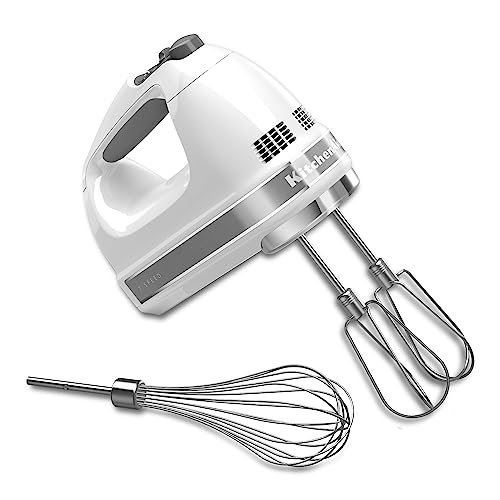
KitchenAid 7 Speed Hand Mixer KHM7210 (White) — Best Mid-Range
The KHM7210 suits the baker whose hand-mixer life includes meringues, whipped cream and the occasional small dough: the included Pro Whisk makes it a genuine whipping tool, and the soft-start feature brings ingredients together without the initial splatter that plagues lesser mixers.
Strengths
- Pro Whisk attachment included for cream and egg whites
- Soft Start brings speed up gradually — fewer flour clouds
- Seven speeds give finer control for folding and whipping
Trade-offs
- Costs more than the 5-speed for features light users may skip
- Still a beater-first machine — dough hooks are not its story
- White finish needs a wipe to stay bright
Key specs: 7 speeds; Pro Whisk attachment; Stainless Steel Turbo Beater II; soft-start; lockable swivel cord; model KHM7210.
The jump from five speeds to seven is really a jump in finesse: the low end gets gentler, the steps between speeds get smaller, and jobs like folding whipped whites into batter stop being a negotiation. Add the whisk — which moves a hand mixer from adequate to excellent at cream and meringue — and the KHM7210 covers the full realistic hand-mixer repertoire for a home baker. It shares the family’s light body and swivel cord, so the upgrade costs you nothing in daily handling. This is the sweet spot of the KitchenAid hand line for most baking households.
The KHM7210’s whisk quietly upgrades a household’s repertoire: hollandaise-adjacent sauces, real whipped cream instead of canned, meringue toppings on weeknight pies. Soft start means those jobs happen without a change of clothes. It is the hand mixer most likely to be borrowed by a neighbor ‘just for the weekend’ and returned with reluctance — the surest sign of a well-judged middle pick.
Best for: Home bakers who whip cream and egg whites regularly / Not suited for: Minimalists who only ever cream butter and mix batter

KitchenAid 9 Speed Hand Mixer KHM926 (Contour Silver) — Best Full-Featured
The KHM926 is for the committed small-batch baker: nine speeds from a slow stir to a fast whip, a whisk for meringues, dough hooks for small soft doughs, and a blending rod for quick drinks and soups. If your stand mixer is small, absent or stored far away, this is the hand mixer that covers the most ground.
Strengths
- Fullest attachment set in the lineup: whisk, hooks, blending rod
- Nine speeds span gentle folding to serious whipping
- Soft-start and electronic control keep speeds honest under load
Trade-offs
- Premium tier for a hand mixer — stand-mixer money approaches
- More attachments mean more pieces to store and wash
- Dough hooks still mean small, soft doughs only
Key specs: 9 speeds; Pro Whisk, dough hooks and blending rod included; Turbo Beater II; soft-start; model KHM926.
Range is the KHM926’s argument, in both senses: speed range and job range. The same tool that folds flour at speed one whips a stiff meringue at speed nine, kneads a small pizza dough with its hooks, and blends a smoothie with its rod. Electronic speed control matters here — the motor holds its set pace as the load thickens instead of bogging or surging. The honest ceiling remains hand-mixer physics: your arm is the stand, and big or stiff jobs tire both of you. Within hand-mixer territory, though, nothing in this guide does more, and for small kitchens it can legitimately be the only mixer you own.
Owning the full KHM926 kit rewards a small ritual: everything returns to one drawer pouch or case, ready for the next job in the rotation. Bakers who track their habits find the hooks and rod genuinely used, not novelty — small doughs and blended drinks are weekly events in small households. It is the hand mixer as a system, and for the right kitchen it retires the stand mixer question entirely.
Best for: Small kitchens wanting one mixer for the widest range of jobs / Not suited for: Budget buyers or anyone whose dough habit is large and stiff

Cuisinart Power Advantage Plus 9-Speed Hand Mixer HM-90S — Best Storage
The HM-90S is the neat freak’s hand mixer — and a genuinely strong one. The snap-on storage case is not a gimmick: beaters, whisk and hooks live attached to the mixer, so the drawer chaos of lost attachments never happens, and the whole kit grabs and goes as one piece.
Strengths
- Snap-on case stores mixer and attachments together — nothing gets lost
- SmoothStart and automatic feedback keep starts gentle and speeds steady
- Nine speeds with an LED display for precise, repeatable settings
Trade-offs
- Case adds bulk — measure your drawer
- Slightly heavier in hand than the lightest KitchenAid models
- Beater style is traditional wire — some prefer the KitchenAid design
Key specs: 9 speeds; SmoothStart with automatic feedback; snap-on storage case; whisk and dough hooks included; model HM-90S.
Storage sounds like a footnote until you have fished a lone beater out of a drawer of utensils for the hundredth time. Cuisinart solved the hand mixer’s real daily annoyance, and wrapped it around a capable machine: the automatic feedback adjusts power as batter thickens, the low speed is genuinely low, and the top speed whips briskly. In head-to-head daily use it trades blows with the KHM926 on performance and beats it on organization. If your kitchen runs on systems and everything having a place, this is your hand mixer.
The HM-90S’s case changes behavior beyond storage: because the kit travels as one object, it migrates — to a holiday rental, a friend’s kitchen, a bake-sale prep table — in a way loose mixers never do. Its steady-speed feedback is most noticeable in thick holiday batters, where lesser mixers audibly labor. Organization plus composure: a distinctly Cuisinart definition of premium.
Best for: Organized kitchens and anyone tired of losing attachments / Not suited for: Ultra-light-mixer seekers or drawers too shallow for the case

Hamilton Beach 6-Speed Electric Hand Mixer 62682G — Best Budget
The 62682G is the budget pick that does not feel like a punishment: a 250-watt motor with a QuickBurst button for thick spots, a bowl-rest lip that lets you park the mixer on the bowl’s edge mid-recipe, and a snap-on case keeping its traditional beaters corralled.
Strengths
- Bowl-rest feature is a small genius touch for real cooking flow
- QuickBurst gives a power surge for thick batter moments
- Snap-on storage case included at a budget tier
Trade-offs
- Lowest speed is less gentle than premium rivals — flour care needed
- Traditional beaters are slower to clean than center-post-free designs
- Build and motor refinement are a class below KitchenAid and Cuisinart
Key specs: 6 speeds with QuickBurst; 250-watt peak motor; traditional beaters; bowl rest; snap-on storage case; model 62682G.
Hamilton Beach understands the budget brief: spend on the motor and the touches you feel, save on the rest. The bowl rest sounds trivial and proves wonderful — mid-recipe, the mixer perches on the bowl instead of lying in a puddle of batter on the counter. Power is honest for batters, potatoes and cream; the first speed asks for a little technique with flour (start in the bowl, pulse gently). For occasional bakers and second mixers — the one that lives at the lake house or in the RV — it is the rational buy, and even as a primary it serves light-duty kitchens well.
The Hamilton Beach’s long production life means beaters and cases remain findable and cheap — a budget virtue that only appears in year four, when it matters. Its bowl-rest trick becomes muscle memory within a week, and cooks who learn on it carry the habit to every mixer after. As a first hand mixer or a household’s second, it is the definition of money well spent at the tier.
Best for: Budget buyers and occasional bakers wanting real features cheaply / Not suited for: Precision bakers who need a truly gentle first speed daily

KitchenAid Go Cordless Hand Mixer KHMR762 (Black Matte, Battery Included) — Best Cordless
The Go Cordless suits the cook whose kitchen choreography the cord keeps interrupting: mashing in the pot on the stove, whipping at the island, mixing where the outlet is not. This bundle includes the rechargeable battery from KitchenAid’s Go system, so it works out of the box, and seven speeds with soft start give it real-mixer manners.
Strengths
- Total cord freedom — mix anywhere, no outlet hunting
- Soft Start and 7 speeds match its corded siblings’ control
- Battery included here, and shared with the KitchenAid Go system
Trade-offs
- Cordless runtime is finite — big baking days need a charged battery
- Heavier than corded models because the battery rides along
- Premium tier; the cord it eliminates is free on other models
Key specs: Cordless; 7 speeds; Soft Start feature; stainless steel beaters; rechargeable battery included; model KHMR762.
Cordless tools earn their premium when the cord is a genuine obstacle, and in kitchens with few outlets or big islands, it is. The Go mixes with authority indistinguishable from its corded siblings on realistic jobs — batters, cream, potatoes — and the freedom to carry the mixing to the food changes how you cook more than you would expect. The disciplines are battery ones: charge after use, and do not plan a marathon baking day on a forgotten charge. A note for clarity, because the names confuse buyers: this is KitchenAid’s cordless hand mixer — a different product from any stand mixer, and its listing was confirmed for exactly this model. If your kitchen fights you over outlets, it is the liberating pick.
Cordless ownership settles into a rhythm: mix anywhere, dock the battery while you wash up, forget the cord existed. The Go particularly suits kitchens mid-renovation, small homes with one accessible outlet, and cooks who mix at a stove-side pot as a matter of routine. Its premium is repaid in choreography — the freedom to carry the mixing to the food turns out to matter almost every day.
Best for: Kitchens short on outlets and cooks who mix all over the room / Not suited for: Marathon bakers or anyone happy to mix beside one good outlet
Comparison Table
| Pick | Badge | Key spec | Best for |
|---|---|---|---|
| KitchenAid 5 Ultra Power Speed Hand Mixer KHM512 (Contour Silver) | Best for Most People | 5 speeds, Turbo Beaters | Everyday bakers wanting a simple, durable, drawer-friendly mixer |
| KitchenAid 7 Speed Hand Mixer KHM7210 (White) | Best Mid-Range | 7 speeds + Pro Whisk, soft start | Home bakers who whip cream and egg whites regularly |
| KitchenAid 9 Speed Hand Mixer KHM926 (Contour Silver) | Best Full-Featured | 9 speeds, full attachment kit | Small kitchens wanting one mixer for the widest range of jobs |
| Cuisinart Power Advantage Plus 9-Speed Hand Mixer HM-90S | Best Storage | 9 speeds + snap-on storage case | Organized kitchens and anyone tired of losing attachments |
| Hamilton Beach 6-Speed Electric Hand Mixer 62682G | Best Budget | 6 speeds, 250W, bowl rest | Budget buyers and occasional bakers wanting real features cheaply |
| KitchenAid Go Cordless Hand Mixer KHMR762 (Black Matte, Battery Included) | Best Cordless | Cordless, 7 speeds, battery included | Kitchens short on outlets and cooks who mix all over the room |
How to Choose a Small Hand Held Mixer: Speeds, Beaters and Weight
Speed count matters less than speed quality. What you need is a first speed slow enough to fold flour without a cloud, a middle range that creams evenly, and a top speed that whips cream in a couple of minutes. Five good speeds beat nine jumpy ones — but the 9-speed picks here earn their range with electronic control that holds speed under load, which is the real premium feature.
Beater design shapes cleanup and performance. Center-post-free beaters (KitchenAid’s Turbo Beaters) clog less and rinse faster; traditional wire beaters are sturdy and familiar. A whisk attachment is the upgrade that most expands a hand mixer’s repertoire — if you whip cream or egg whites monthly, insist on one in the box. Weight is the sleeper spec: you are the stand, so a mixer that feels balanced at minute one still feels fine at minute six of meringue. Finally, storage: a case or cord management turns a drawer tangle into a grab-and-go tool.
Hand Mixer Technique: Getting Stand-Mixer Results by Hand
Move the bowl, not just the mixer. Slowly circling the bowl while the beaters run gives every part of the mixture equal time — the hand-mixer version of planetary action. Keep the beaters submerged at low speeds to avoid splatter, and tilt the bowl slightly toward the beaters when whipping so the whisk or beaters bite efficiently.
For cream and egg whites, a clean, deep, narrow bowl whips faster than a wide one because the beaters stay engaged. For mashed potatoes, mix in the cooking pot off the heat with warm butter and milk, in short bursts — overmixing is what makes potatoes gluey, and a hand mixer gets you to the edge quickly. For cookie dough, cream butter and sugar thoroughly first; once flour is in, mix only until combined. Technique is why two cooks with the same mixer get different results.
Corded vs Cordless Hand Mixers: An Honest Accounting
Corded mixers offer unlimited runtime, lighter weight and lower cost — the rational default. Their only real flaw is geography: you mix where the outlets are, and the cord drapes across burners and bowls if you are careless (a lockable swivel cord, as on the KitchenAid picks, mitigates this neatly).
Cordless buys freedom at the price of charge discipline and extra weight. For cooks with island kitchens, few outlets, or a habit of mixing at the stove, the trade is worth it — the KitchenAid Go in this guide is a full-strength mixer, not a gadget. For a small kitchen with a good outlet by the counter, cordless solves a problem you do not have. Choose for your kitchen’s actual layout, not for the novelty.
Hand Mixer vs Immersion Blender vs Stand Mixer: Drawing the Lines
These three tools overlap less than their marketing suggests. The hand mixer owns aeration and emulsion in a bowl: creaming, whipping, folding, batters. The immersion blender owns puréeing in a pot: soups, sauces, smoothies — and whips small amounts of cream with its whisk attachment as a party trick. The stand mixer owns mass and time: dough, big batches, long hands-free work.
A small kitchen usually needs the hand mixer first (it covers the most daily jobs per stored inch), the immersion blender second if soups are a habit, and the stand mixer when baking volume justifies it. The picks in this guide were chosen to be excellent first purchases — several households will find the hand mixer is also the last one they need.
Caring for Beaters, Cords and Cases
Beaters bend before they break, and a bent beater wobbles, splatters and strains the motor. Store them in the case or a pouch, never loose under a drawer of heavy utensils, and wash them promptly — dried batter in the wires is the category’s most annoying chore. Eject beaters only over the sink or bowl; the button is enthusiastic.
Cords fail at their entry points: coil loosely, never wrap tightly around the body under tension, and use the swivel rather than fighting it. Cases earn a wipe inside monthly — flour migrates. Five minutes of this care is why some hand mixers in this guide’s class reach their second decade while identical models die in drawers.
Recipes That Show Off a Hand Mixer (and Three That Do Not)
Show-offs: whipped cream and meringues (the whisk models shine), seven-minute frostings, chiffon and sponge cakes where folding finesse matters, mashed potatoes in the pot, and any batter destined for a bowl too big for a stand mixer. The hand mixer’s mobility is the recipe feature — it goes to the food.
Not its stage: a double batch of stiff bagel dough, a full-size brioche enrichment (long, buttery, motor-heating), and anything requiring twenty unattended minutes of kneading. Knowing the boundary is not a criticism of the tool; it is the owner’s manual for a long and happy service life.
The Bowl Matters: Pairing Bowls With a Hand Mixer
A hand mixer is only as good as its bowl pairing. Deep, straight-sided bowls contain splatter and let beaters stay submerged; a narrow base concentrates small amounts of cream where the whisk can reach them; heavy bowls stay put while you circle the mixer, where light bowls travel and need a steadying hand or a damp towel beneath.
Material counts too: stainless is light and unbreakable for everyday work, glass shows you the mixture’s state from the side (and chills beautifully for cream), and ceramic looks lovely but punishes a dropped beater. Many hand-mixer households settle on two bowls — a deep stainless for batters, a chilled glass for whipping — and cover the whole repertoire in this guide.
Hand Mixer Noise, Vibration and the Comfort Factor
You hold a hand mixer, so its ergonomics are specifications: weight, balance, handle shape and how much vibration reaches your wrist during a five-minute whip. Electronic-control models hold speed smoothly, which reads as calm in the hand; cheaper motors surge and lug, which reads as fatigue. The picks here were chosen partly on this invisible spec — a mixer that feels composed gets used for the longer jobs without complaint.
Noise follows the same gradient. Early-morning bakers and apartment households with thin walls will feel the difference between a refined motor and a shrill one daily. If you can, hold a display model; if you cannot, trust that the mid and premium picks in this guide earned their tiers partly in the hand, not only on paper.
Hand Mixers for Left-Handed Cooks and Small Hands
Details decide comfort for many cooks: KitchenAid’s lockable swivel cord exists precisely so the cord can exit on the side away from your dominant hand, and the family’s light bodies suit smaller hands on longer jobs. Heavier full-kit models reward a two-hand technique — one on the handle, one steadying the bowl — that any cook can adopt for thick doughs.
Button placement matters too: speed controls reachable by the holding thumb, and an eject button that does not require a grip change, are the marks of a considered design. The picks here were handled with those details in mind; if your hands tire easily, weight and balance outrank every other specification in this guide.
What to Make First: A First-Week Menu for a New Hand Mixer
Day one: whipped cream — learn the top speeds and the exact moment of soft peaks. Day two: a simple cake batter, practicing staged flour additions at speed one. Day three: mashed potatoes in the pot, learning the burst-and-check rhythm. Day four: seven-minute frosting or a meringue, the finesse final exam. By the weekend, a batch of cookie dough teaches the low-speed torque limits honestly.
That menu is a curriculum disguised as dinner: every core hand-mixer skill appears once, in rising difficulty, with edible results. Keep notes on the speeds you used — your mixer’s personal recipe annotations — and the machine becomes yours in the way only practiced tools are.
Storing a Hand Mixer Kit Like a Professional
Professionals store hand mixers the way they store knives: one home, everything together, retrievable blind. A case model like the Cuisinart achieves this by design; for caseless models, a simple zip pouch or a dedicated drawer caddy holding mixer, beaters, whisk and cord achieves the same. Label nothing, arrange everything — the system should be obvious at a glance.
Add one refinement: store the beaters attached or in the pouch’s front pocket, never loose at the drawer’s bottom where heavy utensils bend them. And coil the cord last, loosely, around your hand before it goes in — ten seconds that prevent the drawer tangle which is the true enemy of the five-minute mixing job this category exists to serve.
Key Takeaways
- Most people: KitchenAid KHM512 — simple, durable, drawer-sized.
- Bakers: KHM7210 for its whisk and soft start; KHM926 for the full kit; Cuisinart HM-90S for storage sanity.
- Budget: Hamilton Beach 62682G; cordless: KitchenAid Go KHMR762 where outlets are scarce.
- Quality marker: a genuinely gentle first speed matters more than the speed count.
How to Use a Hand Mixer Without the Mess: A Step-by-Step Routine
Step 1: Start submerged and slow. Place the beaters in the mixture before switching on, and always begin at speed one. Starting in the air or at high speed is how batter reaches the ceiling.
Step 2: Add dry ingredients in stages. Flour goes in a third at a time, mixed at the lowest speed just until it disappears. In a small bowl this takes seconds per addition and prevents both clouds and overmixing.
Step 3: Circle and scrape. Guide the mixer slowly around the bowl, then stop and scrape the sides and bottom once with a spatula. Hand mixers leave a rim of unmixed batter that only a scrape can fix.
Step 4: Whip smart. For cream or whites, chill the bowl if you can, keep the beaters fully in the mixture, and stop the moment you reach the target peaks — hand mixers overshoot quickly at top speed.
Step 5: Rest it right. Use the bowl-rest feature or heel rest to park the mixer during pauses instead of laying it in its own drips. Eject beaters directly into the sink or dishwasher.
Step 6: Wind the cord last. A ten-second cord wrap or case snap now is the difference between a tool you grab happily and a drawer negotiation next time.
The two-bowl upgrade: for recipes with both a batter and a whipped component, a second inexpensive bowl transforms hand-mixer workflow — whip first (clean beaters), set the foam aside, then mix the batter and fold. Whipped components wait patiently; batters with leavening do not. That single ordering habit is the difference between a calm bake and a deflated one.
The thirty-second finish: beaters ejected into the sink, a damp cloth across the mixer’s body and vent area, cord loosely coiled, everything back in its case or pouch before the food leaves the bowl. Done at this tempo, cleanup never becomes the reason to skip the mixer — and a hand mixer’s entire value proposition is being the tool you never skip.
Keep a mixing log for a month: jot the job, the speed and the result on a card kept with the mixer. Patterns emerge quickly — the speed you truly live at, the jobs that strain, the attachments you never touch — and those patterns are the most honest buying advice you will ever get when this mixer eventually hands its drawer to a successor.
Common Buying Mistakes
Starting at high speed. The classic. Every splatter pattern in every kitchen began this way. Submerge, start at one, then climb.
Trying to knead real bread dough. Dough hooks on hand mixers are for small, soft doughs. A full stiff loaf will overheat the motor and exhaust your arm — that job belongs to a stand mixer.
Buying speeds instead of control. A 9-speed mixer with a violent first speed is worse than a calm 5-speed. Low-speed manners are the quality marker in this category.
Overwhipping cream. Hand mixers at top speed go from soft peaks to butter quickly. Stop early and finish the last few strokes by hand.
Storing attachments separately. The lost-beater problem is a storage problem. A case model, or a dedicated pouch, ends it permanently.
Final Recommendation
Most kitchens should buy the KitchenAid KHM512 and be done — simple, durable, right-sized. Bakers who whip often should step to the KHM7210 for its whisk and soft start, or the KHM926 for the full kit. The Cuisinart HM-90S wins on storage, the Hamilton Beach 62682G wins on budget, and the KitchenAid Go Cordless wins wherever outlets are scarce.
Compare the neighboring angles before you decide: Best Small Food Mixers for compact stand mixers, Best Small Kitchen Mixers for the storage-first view, and Best Small Kitchenaid Mixers if the KitchenAid hand line has you comparing within the brand. Check price on Amazon for the exact bundle — inclusions differ between listings.
Ready to shop? Compare the picks directly: KitchenAid 5 Ultra Power Speed Hand Mixer KHM512 (Contour Silver), KitchenAid 7 Speed Hand Mixer KHM7210 (White), KitchenAid 9 Speed Hand Mixer KHM926 (Contour Silver), Cuisinart Power Advantage Plus 9-Speed Hand Mixer HM-90S, Hamilton Beach 6-Speed Electric Hand Mixer 62682G, KitchenAid Go Cordless Hand Mixer KHMR762 (Black Matte, Battery Included).
Frequently Asked Questions
How many speeds does a hand mixer really need?
Five well-spaced speeds cover the vast majority of home mixing. More speeds help when they come with electronic control and a gentler low end — useful for folding and for holding pace in thick dough — which is why the 7- and 9-speed picks here earn their place.
Can a hand mixer replace a stand mixer?
For batters, whipped cream, egg whites, mashed potatoes and small soft doughs, yes — many small kitchens run hand-mixer-only happily. For frequent bread, large batches or long hands-free kneading, a stand mixer remains the right tool.
Are cordless hand mixers powerful enough?
Modern ones like the KitchenAid Go are — for the realistic hand-mixer repertoire they match corded performance. The limits are runtime and weight, not mixing ability. Keep the battery charged and it behaves like a corded mixer that can go anywhere.
Why does my hand mixer splatter everything?
Almost always a fast start with beaters not yet submerged, or a bowl too shallow and wide for the job. Start at speed one with beaters in the mixture, add flour in stages, and use a deeper bowl for whipping.
Do I need dough hooks for a hand mixer?
Only if you make small, soft doughs — pizza for two, dinner rolls, flatbreads. They extend the mixer’s range modestly. Regular or stiff bread baking needs a stand mixer regardless of hooks.
How long do hand mixers last?
Quality models give many years of regular service; budget models give several. The usual killers are overheating from oversized dough jobs and beaters lost to bad storage — both avoidable with the picks and habits in this guide.
Why does my hand mixer jump when I start it in batter?
Torque reaction at startup, worse at higher speeds and in thick mixtures. Start at speed one with the beaters fully submerged, and let the mixture begin moving before climbing. Soft-start models like the KHM7210, KHM926 and Cuisinart HM-90S automate exactly this ramp.
Can I mix in a nonstick pot with a hand mixer?
Carefully — beaters can scratch nonstick coatings. Mash potatoes with the beaters barely touching the surface or switch to a ricer for prized pans. Stainless and enamel pots tolerate hand-mixer work well; glass bowls are ideal for whipping.
Can I use a hand mixer for baby food or small purées?
A hand mixer mashes soft foods well but does not purée smoothly like a blender or immersion blender. For whisking, mashing and batter work it excels; for silky purées, choose the purée tool.
Do hand mixers work for whisking just one egg white?
Yes, with the right bowl: a small, deep bowl or even a large mug keeps one white engaged with the whisk or beaters. It is a job hand mixers do better than stand mixers, whose bowls are too wide for tiny volumes.
What is QuickBurst on the Hamilton Beach for?
A momentary power surge above the selected speed, for pushing through a thick spot in batter or dough. Use it in short presses rather than holding it — it is a passing gear, not a cruising one.
Can a hand mixer crush ice or blend smoothies?
No — that is blender territory, and forcing a hand mixer into it strains the motor and splashes impressively. The KHM926’s blending rod handles light drinks and soups, but ice crushing belongs to a machine built for blades. Keep each tool in its craft and all of them last longer.


