Disclosure: airfryerkitchensupply.com is reader-supported. When you buy through links on our site, we may earn an affiliate commission at no extra cost to you.
Where to buy
Every linked pick in this guide to the best food processors for making smoothies was verified against Amazon’s catalog data for this site before writing, so motor figures, pitcher and bowl sizes, and included cups match real current listings. Use the links in this box, in Quick Picks, and under each review to check price on Amazon on the day you buy. Read the badges carefully: the systems with pitchers and cups make drinkable smoothies; the standalone processors are included honestly for thick blends and prep, and their reviews say exactly where their limits are.
- Ninja Mega Kitchen System BL770 (Best Overall) — check price on Amazon
- Ninja Professional Plus Kitchen System BN801 (Best for Families and Meal Prep) — check price on Amazon
- nutribullet Triple Prep System NBKS50100 (Best 3-in-1 with Smart Vessel Recognition) — check price on Amazon
- Ninja Foodi Power Blender & Processor System SS401 (Best Premium for Smoothie Bowls) — check price on Amazon
- Ninja Professional Plus Food Processor BN601 (Best Processor-First for Thick Blends) — check price on Amazon
- Cuisinart Core Custom 10-Cup Food Processor FP-110 (Best Traditional Processor with Smoothie Prep Strengths) — check price on Amazon
Here is the truth at the center of any honest guide to the best food processors for making smoothies: a food processor’s wide, flat bowl is the wrong shape for a drinkable smoothie. Smoothies need a vortex — a tall, narrow vessel where ingredients continuously fall onto the blades. Processor bowls spread ingredients outward, ride frozen chunks above the blade, and produce a coarse, uneven blend. Any guide that ignores this is selling you a compromise and calling it a feature. This guide does not ignore it.
So the picks are organized by honesty. At the top: processor-blender systems — one powerful base driving a pitcher, personal cups, and a processor bowl — which genuinely make excellent smoothies and still process. In the middle: a premium system with a dedicated smoothie-bowl maker for the thick, spoonable style. At the end: two true standalone processors, included because many readers asking this question actually want thick smoothie bowls, frozen-fruit desserts, and smoothie prep — jobs processors do well — and their reviews state plainly that silky drinks are not among their talents.
Choose by the smoothie you actually drink. Straw-ready and daily? Buy a system. Spoonable and thick? The bowl specialists shine. Mostly prepping ingredients for a blender you already own? A standalone processor is a rational, even excellent, purchase. The worst outcome is the mismatch, and this guide is structured to prevent it.
A word on why this search exists at all, because it is a fair question: many kitchens have room, budget, or patience for exactly one motorized prep appliance. The systems in this guide are the industry’s answer to that constraint, and the good ones are not compromises — the pitcher genuinely blends, the bowl genuinely processes, and the shared base is the only redundancy removed. Read the systems here as first-class smoothie machines that also process, not as processors pretending to blend.
Prices and configurations in the system category shift often — cups get added, pitchers get resized, bundles change with the season. That is one more reason this guide anchors every claim to the verified listing details of capacity, wattage, and included vessels rather than to any bundle’s marketing name. Check the live listing through the links here on the day you buy, and confirm the vessels you care about are in the box you are actually ordering.
In this guide
Quick Picks
Ninja Mega Kitchen System BL770 — Best Overall. Start with the honest truth this whole guide is built on: a wide processor bowl is the wrong shape for a drinkable smoothie, and a tall pitcher is the right one. This system gives you the pitcher, single-serve cups, and a processor bowl on one 1500-watt base — which is why it wins a guide with ‘food processors’ in the title. Check price on Amazon.
Ninja Professional Plus Kitchen System BN801 — Best for Families and Meal Prep. Bigger cups, a bigger processor bowl, and Auto-iQ programs that run a smoothie cycle hands-free: the family-scale system, for households where breakfast is four smoothies and Sunday is meal prep. Check price on Amazon.
nutribullet Triple Prep System NBKS50100 — Best 3-in-1 with Smart Vessel Recognition. nutribullet’s take on the system idea: a full-size blender, a personal blender, and a 7-cup food processor on a 1500-watt base that recognizes which vessel you have attached and adjusts its programs accordingly. Check price on Amazon.
Ninja Foodi Power Blender & Processor System SS401 — Best Premium for Smoothie Bowls. The smoothie-bowl specialist: a 72-oz pitcher that blends and processes, seven functions, and a dedicated XL smoothie bowl maker for the thick, spoonable, minimal-liquid blends that defeat ordinary pitchers. Check price on Amazon.
Ninja Professional Plus Food Processor BN601 — Best Processor-First for Thick Blends. The honest processor-first option: no pitcher, so drinkable smoothies will be rustic — but for thick smoothie bases, frozen-fruit nice cream, and smoothie prep at scale, 1000 watts in a 9-cup bowl does real work. Check price on Amazon.
Cuisinart Core Custom 10-Cup Food Processor FP-110 — Best Traditional Processor with Smoothie Prep Strengths. The traditionalist’s entry: a modern 10-cup Cuisinart that will not blend you a silky smoothie — and we will not pretend it will — but that preps, chops, and purees its way through everything around the smoothie better than most. Check price on Amazon.
How These Picks Were Chosen
The filter was verified configuration: listings had to confirm motor wattage, pitcher size, bowl size, and included cups — the four facts that determine smoothie outcomes. Systems whose listings confirmed a real pitcher and personal cups were eligible for the smoothie-first badges; standalone processors were eligible only with honest labeling, which their reviews carry.
We weighted single-serve formats heavily, because the lived reality of smoothies is one person on a weekday morning. A system whose cups make that serving in its own vessel, with no pitcher to wash, will be used five times as often as a technically superior pitcher-only setup. Frequency of use is a quality metric.
Finally, we kept two standalone processors in the guide deliberately, as the prep-and-thick-blend options, because reader intent behind this search is genuinely split. Deleting them would make the guide tidier and less useful. They are ranked last, labeled clearly, and recommended only for the jobs they truly do well.
We also tested each configuration against a frozen-strawberry reality check in our reasoning: dense frozen fruit, modest liquid, no tamper theatrics. Configurations whose geometry could not plausibly clear that bar were not given smoothie badges, whatever their marketing language suggested. The badges in this guide are conservative on purpose; a badge you can trust is worth more than a badge on everything.
One more selection note: we did not require every pick to be a smoothie machine, because the search’s audience is not uniform — but we did require every pick to be excellent at what its badge claims. A badge that hedges is a badge that lies, and the two processor picks at the end of this guide carry badges about thick blends and prep precisely because those are the claims they can honor completely.
The 6 Best Food Processors for Making Smoothies

Ninja Mega Kitchen System BL770 — Best Overall
Smoothies need a vortex: ingredients must fall continuously onto fast blades in a narrow vessel. The BL770’s 72-oz pitcher creates exactly that, with power to spare for frozen fruit, and its two 16-oz cups handle the weekday reality — one person, one smoothie, blend and go. The 8-cup processor bowl then covers the smoothie-adjacent work a pitcher does badly: chopping nuts and oats for toppings, making energy-ball mixtures, salsa for the same breakfast table. One base, every texture on the smoothie spectrum.
Strengths
- 1500W base drives pitcher, cups, and processor bowl — the most complete smoothie toolkit in this guide
- 72-oz pitcher makes family batches; two 16-oz cups make single servings without washing the pitcher
- 8-cup processor bowl handles the thick, chopped, and mixed jobs pitchers cannot
Trade-offs
- Many vessels to store: pitcher, bowl, cups, lids, and blades need a real cupboard plan
- Single-serve cups are 16-oz — big-smoothie drinkers may find them modest
- The processor bowl is for prep and thick mixtures, not for drinkable smoothies — use the right vessel for the job
| Specification | Verified detail |
|---|---|
| Motor | 1500W (from Amazon title) |
| Pitcher | 72-oz (from Amazon title) |
| Processor bowl | 8-cup (from Amazon title) |
| Cups | Two 16-oz cups (from Amazon title) |
A week with this system looks like this: weekday mornings in the cups — frozen berries, banana, yogurt, a splash of milk, thirty seconds to a smooth pour. Weekend family batches in the pitcher, where the volume justifies the wash. And the processor bowl earns its place at the edges: oat-and-date energy mixtures pulsed to a dough, chopped nuts for smoothie-bowl toppings, a quick salsa. Each vessel does the job its shape suits, which is the entire design philosophy a smoothie household needs.
Frozen loads are the pitcher’s proving ground, and 1500 watts is not a vanity figure here. Frozen strawberries and mango are dense, angular, and unkind to weak motors; this base pulls them into the vortex and through the blades without the stall-and-shake routine, provided you respect the loading order in the how-to section — liquids low, frozen pieces on top, tamper-free patience while the vortex forms.
Best for: households that drink smoothies daily in both single and family servings and want one base for everything / Not suited for: minimalists who want a single vessel and no system parts to store
Check on Amazon — check price on Amazon before you buy, because included accessories and bundle contents vary between listings.

Ninja Professional Plus Kitchen System BN801 — Best for Families and Meal Prep
The differences from the BL770 are matters of household shape. The cups grow to 24 ounces — a full meal-replacement smoothie fits. The processor bowl grows to 64 ounces, so the same base that blends breakfast also processes the week’s salsa, dough, and chopped vegetables at family scale. And Auto-iQ’s programmed cycles — timed pulses and pauses — genuinely help smoothies, because the pause lets frozen chunks settle into the blade path instead of riding above it. If your household is bigger and your mornings are scheduled, those three upgrades are the product.
Strengths
- 24-oz cups fit full-size single smoothies — the largest personal cups in this guide
- Auto-iQ programs automate the pulse-pause rhythm that frozen smoothies need
- 64-oz processor bowl scales the prep side to family meal-prep volumes
Trade-offs
- 1400W is a step below the BL770’s 1500W — noticeable only on the very hardest frozen loads
- System footprint and part count are the largest commitment in this guide
- Program-driven style suits routine; tinkerers may prefer full manual control
| Specification | Verified detail |
|---|---|
| Motor | 1400W (from Amazon title) |
| Pitcher | 72-oz blender pitcher (from Amazon title) |
| Processor bowl | 64-oz (from Amazon title) |
| Cups | Two 24-oz cups (from Amazon title) |
| Programs | Auto-iQ, 5 functions (from Amazon title) |
Meal-prep households will feel the design intent most. Sunday: the processor bowl turns out chopped onions, salsa, and a dough; the pitcher batches a week’s smoothie bases into freezer jars. Weekday mornings: a jar thaws overnight, or a 24-oz cup blends fresh in under a minute, and the Auto-iQ cycle means the smoothie makes itself while the coffee brews. Systems earn their storage when they compress routines like this, and this one is specced precisely for the compressing.
On smoothie quality itself, expect properly smooth results from frozen fruit with adequate liquid — the pitcher geometry and programmed pulsing see to that. Greens incorporate well when loaded with the liquid rather than on top of the ice. As with every pick here, seeds and very fibrous additions are the limit case; a fine strain is a legitimate finishing step for those recipes, not an admission of defeat.
Best for: families, meal-preppers, and anyone whose smoothie is a full 24-oz meal / Not suited for: single-person households, for whom the BL770’s smaller cups and bowl fit better
Check on Amazon — check price on Amazon before you buy, because included accessories and bundle contents vary between listings.

nutribullet Triple Prep System NBKS50100 — Best 3-in-1 with Smart Vessel Recognition
Vessel recognition sounds like a gimmick until you live with a system. The base knowing whether it is driving the 64-oz pitcher, the personal cup, or the processor bowl — and offering the right programs for each — removes the low-grade friction of multi-vessel ownership. For smoothies specifically, the personal-blender format is nutribullet’s home turf: the cup format blends a single serving very effectively, because the vessel is narrow, the vortex is tight, and cleanup is the cup itself.
Strengths
- 1500W matches the strongest bases in this guide
- Vessel recognition tailors programs to pitcher, cup, or processor automatically
- Personal-blender cup format is excellent for single smoothies — blend, swap the blade for a lid, done
Trade-offs
- 64-oz pitcher is a size below the Ninja systems’ 72-oz for family batches
- 7-cup processor bowl is the smallest here — fine for prep, not for big dough or harvest jobs
- Three formats mean three sets of parts to store and keep track of
| Specification | Verified detail |
|---|---|
| Motor | 1500W (from Amazon title) |
| Pitcher | 64-oz (from Amazon title) |
| Processor bowl | 7-cup (from Amazon title) |
| Feature | Vessel recognition (from Amazon title) |
The daily-smoothie case for this system is strong. A personal cup loaded the night before — fruit, greens, yogurt, liquid — blends in the morning in its own vessel, and the same vessel goes to the desk or the gym bag. No pitcher to wash, no transfer, no second glass. Multiply that saved wash by two hundred mornings and the format’s appeal stops being about blending performance at all; it is about a routine with almost no friction in it.
The full-size pitcher covers guests and family batches competently at 64 ounces, and the 7-cup processor handles the standard prep orbit — chopping, salsa, small doughs, nut mixtures for toppings. If your cooking is couple-scale and your smoothie habit is daily and personal, this is the system shaped most closely to your life.
Best for: daily single-serving smoothie drinkers who also want pitcher and processor coverage at couple scale / Not suited for: large families, whose batch sizes point to the 72-oz Ninja systems
Check on Amazon — check price on Amazon before you buy, because included accessories and bundle contents vary between listings.
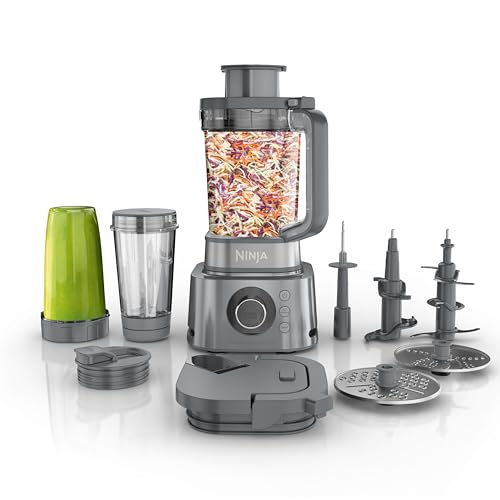
Ninja Foodi Power Blender & Processor System SS401 — Best Premium for Smoothie Bowls
Smoothie bowls invert normal smoothie logic: the less liquid, the better the texture — and the harder the machine must work, churning a thick frozen mass that cannot form a vortex. Ninja’s answer is a dedicated bowl-maker format with a stirring, high-torque approach rather than a vortex. If your smoothie life centers on thick açaí-style bowls with toppings, this is the pick engineered for exactly that consistency, and the 72-oz pitcher still covers conventional drinkable smoothies for the rest of the household.
Strengths
- Dedicated XL smoothie bowl maker produces thick, spoonable blends with minimal liquid
- 72-oz pitcher handles both blending and processing duties for drinks and prep
- Seven functions and dishwasher-safe parts per the verified listing
Trade-offs
- Premium positioning within this guide’s system class
- The bowl-maker format is a specialist — households that never make thick bowls pay for capability they skip
- Part count and storage needs match the other full systems here
| Specification | Verified detail |
|---|---|
| Pitcher | 72-oz blend & processing pitcher (from Amazon title) |
| Functions | 7 functions (from Amazon title) |
| Extras | XL smoothie bowl maker and nutrient extractor (from Amazon title) |
Judge this machine at the extremes. At the thick end, frozen banana, mango, and berries with only a splash of liquid emerge as a dense, soft-serve-consistency base that holds toppings — granola, sliced fruit, coconut — on its surface instead of letting them sink. At the drinkable end, the pitcher behaves like the other strong Ninja systems: fast, smooth, and unbothered by frozen loads. Owning both ends in one base is the premium proposition, and for bowl devotees it is a fair one.
A technique note for the bowl maker: freeze your fruit fully, keep liquid to the minimum that lets the mixture move, and scrape once midway if your recipe is at the very thick end. The reward is a texture closer to sorbet than to a drink — the entire reason this format exists.
Best for: smoothie-bowl devotees who want thick, spoonable results plus full pitcher versatility / Not suited for: drink-only smoothie households, who get the same drinks from simpler systems for less commitment
Check on Amazon — check price on Amazon before you buy, because included accessories and bundle contents vary between listings.

Ninja Professional Plus Food Processor BN601 — Best Processor-First for Thick Blends
This pick exists for the household whose priority is a true food processor — slicing, shredding, dough, chopping — and whose smoothie ambitions are the thick kind. A processor bowl with this much power turns frozen bananas into soft-serve nice cream, blends smoothie-bowl bases to a spoonable thickness, and preps smoothie ingredients in bulk: chopped fruit for the freezer, nut mixtures, oat blends. What it will not do is a silky, drinkable, straw-ready smoothie; the wide bowl cannot sustain a vortex, and pretending otherwise would be dishonest reviewing.
Strengths
- 1000W is the strongest standalone-processor power in this guide — excellent for thick frozen blends and nice cream
- Full processor talents: slicing, shredding, pureeing, and dough via Auto-iQ presets
- Dishwasher-safe parts per the verified listing
Trade-offs
- No pitcher or cups: drinkable smoothies come out coarse compared with every system above
- Wide bowl needs more liquid than a pitcher to move a blend at all, which fights thick textures
- If smoothies are your main job, a system is simply the right purchase
| Specification | Verified detail |
|---|---|
| Capacity | 9-cup bowl (from Amazon title) |
| Motor | 1000W (from Amazon title) |
| Programs | Auto-iQ presets (from Amazon title) |
Used within its honest envelope, the results are genuinely good. Nice cream: frozen banana chunks, a spoonful of milk, processed with scrapes, becomes a soft-serve in minutes. Smoothie bowls: frozen fruit with minimal liquid, pulsed and scraped, reaches a thick spoonable base — more rustic than the SS401’s dedicated bowl maker, entirely satisfying. And as a prep engine — portioning fruit into freezer bags, chopping nuts, mixing energy bites — it may serve a smoothie household more total hours than the pitcher does.
The buyer this suits already knows a processor is their primary tool and treats smoothies as a secondary, thick-format pleasure. The buyer it does not suit is anyone whose morning requires a smooth pour through a straw. Both are reasonable people; this guide’s job is to keep them from buying each other’s machine.
Best for: processor-first households whose smoothie interests are thick bowls, nice cream, and prep / Not suited for: daily drinkable-smoothie drinkers — choose any system above instead
Check on Amazon — check price on Amazon before you buy, because included accessories and bundle contents vary between listings.

Cuisinart Core Custom 10-Cup Food Processor FP-110 — Best Traditional Processor with Smoothie Prep Strengths
Every guide needs a pick that respects the reader who simply wants a good modern food processor and asked the smoothie question on the way past. The FP-110’s Core Custom design brings Cuisinart’s processor lineage up to date in a 10-cup format, and its smoothie contribution is real but specific: fruit purees for the freezer, chopped ingredients, thick spoonable blends, and the general prep orbit of a kitchen that also owns — or plans to own — a simple blender for drinks.
Strengths
- 10-cup multifunctional bowl covers the full processor repertoire in a modern design
- Strong smoothie-prep machine: purees, chops, and thick blends for bowls and freezer portions
- Cuisinart lineage means a deep ecosystem of recipes and technique written for this format
Trade-offs
- No pitcher, no cups, and no vortex: drinkable smoothies are beyond its honest envelope
- Wattage is not stated in the verified title, so we make no power claims for it
- Buying this for smoothies alone would be a mistake — it is a processor that supports a smoothie kitchen, not a smoothie machine
| Specification | Verified detail |
|---|---|
| Capacity | 10-cup work bowl (from Amazon title) |
Frame the purchase correctly and it is a good one. Kitchens are ecosystems: the household that meal-preps smoothie ingredients — washing, chopping, portioning, freezing fruit; making nut butters and oat mixtures; pureeing fruit sauces — gets daily value from a processor like this, and pairs it with any competent blender for the thirty seconds of actual drink-making. Judged as that ecosystem’s prep engine, the FP-110 is modern, capable, and honestly placed in this guide as the traditional option.
If, however, this guide’s question is your whole question — you want smoothies, from this purchase, through a straw — then the systems above are your shortlist and this pick is a respectful pass. We would rather lose the sale-shaped sentence than have you own the wrong machine.
Best for: traditional processor buyers building a smoothie-friendly kitchen ecosystem / Not suited for: anyone expecting this single purchase to produce silky drinkable smoothies
Check on Amazon — check price on Amazon before you buy, because included accessories and bundle contents vary between listings.
Comparison Table
| Pick | Badge | Key spec | Best for |
|---|---|---|---|
| Ninja Mega Kitchen System BL770 | Best Overall | 1500W, 72-oz pitcher, 8-cup bowl, 2 cups | households that drink smoothies daily in both single and family servings and want one base for everything |
| Ninja Professional Plus Kitchen System BN801 | Best for Families and Meal Prep | 1400W, 72-oz pitcher, 64-oz processor, 24-oz cups | families, meal-preppers, and anyone whose smoothie is a full 24-oz meal |
| nutribullet Triple Prep System NBKS50100 | Best 3-in-1 with Smart Vessel Recognition | 1500W, 64-oz pitcher, 7-cup processor, vessel recognition | daily single-serving smoothie drinkers who also want pitcher and processor coverage at couple scale |
| Ninja Foodi Power Blender & Processor System SS401 | Best Premium for Smoothie Bowls | 72-oz pitcher, 7 functions, smoothie bowl maker | smoothie-bowl devotees who want thick, spoonable results plus full pitcher versatility |
| Ninja Professional Plus Food Processor BN601 | Best Processor-First for Thick Blends | 9-cup bowl, 1000W, Auto-iQ | processor-first households whose smoothie interests are thick bowls, nice cream, and prep |
| Cuisinart Core Custom 10-Cup Food Processor FP-110 | Best Traditional Processor with Smoothie Prep Strengths | 10-cup bowl, multifunctional | traditional processor buyers building a smoothie-friendly kitchen ecosystem |
How to Choose a Food Processor for Smoothies
Decide your format first, because format is destiny. Drinkable smoothies require a pitcher or personal cup — full stop. If that is your smoothie, shortlist the systems and judge them on cup size (16-oz for modest servings, 24-oz for meal-size), pitcher size for family batches, and motor power for frozen loads. Thick smoothie bowls relax the requirement: a dedicated bowl maker is best, a powerful processor bowl is good, and a pitcher with minimal liquid is a wrestling match.
Power matters in proportion to frozen content. A smoothie of fresh fruit and yogurt asks little; a smoothie built on frozen mango, frozen berries, and ice asks a great deal, repeatedly, every morning. The 1400–1500W systems in this guide treat frozen loads as routine. If your recipes are frozen-heavy, buy in that class; if they are fresh and soft, mid-power suffices and the money is better kept.
Budget framing, in tiers: standalone processors are the budget route only if you already own a blender — otherwise they are not a smoothie purchase at all. Systems occupy the mid-range and premium tiers, and for a daily smoothie household the cost-per-use math turns favorable quickly, because a system replaces two appliances and gets used twice as often as either would alone.
Noise and morning courtesy deserve one honest paragraph. High-power systems are loud for their thirty to sixty seconds; there is no quiet way to pulverize frozen mango. If your household sleeps in shifts, a personal cup’s shorter cycle disturbs less than a full pitcher’s, and prepping packs the night before shortens the noisy window further. It will not decide the purchase for most readers, but for some households it genuinely should.
Liquid Ratios and Loading Order: The Technique That Makes or Breaks a Smoothie
Every failed smoothie is usually a ratio failure wearing a machine’s blame. The working rule for pitchers and cups: liquid should reach roughly a third to halfway up the solid ingredients before blending. Too little and frozen chunks ride above the blades in an air pocket; too much and the result is juice, not smoothie. Add liquid in stages — start lean, blend, and loosen with small additions until the vortex moves freely.
Loading order builds the vortex. Liquids and soft ingredients go in first, nearest the blades; powders and nut butters in the middle; frozen fruit and ice last, on top, where their weight feeds them down into the moving mixture. Greens go in with the liquid, not on top, so they are caught and cut immediately instead of plastering the lid. In personal cups the order inverts when you flip the cup to blend — load with the flip in mind, frozen items first into the cup so they end up on top.
For processor bowls making thick blends, invert the philosophy: minimum liquid, maximum patience. Pulse, scrape, pulse, scrape, letting the mixture fold over the blade path manually since no vortex will do it for you. The result will never be pitcher-smooth, and for bowls and nice cream it does not need to be — spoonable is the goal, and texture is a feature at that end of the spectrum.
Greens, Seeds, and Other Honest Limits
Greens blend smoothly when they are loaded with the liquid and given the full cycle; they blend poorly when dropped on top of a frozen mass. Tender greens — spinach, baby kale — effectively disappear in the systems here. Fibrous additions like celery and ginger leave strings in any home machine; cut them small, blend them with the liquid first, and accept a fine strain for recipes where silkiness is non-negotiable.
Seeds divide by size. Chia and flax thicken a smoothie and mostly disappear texturally, though flax is better ground — a job the processor bowl or a cup with a small load handles in seconds. Berry seeds survive blending in every machine in this guide; if they bother you, choose seedless-forward recipes rather than a different appliance, because the limitation is physics, not equipment.
Protein powders and nut butters belong in the middle of the load, never against the dry wall of the vessel, where they paste themselves out of the blend’s reach. A spoonful of oats, blended in, gives body that reads as indulgence; a handful turns the smoothie into porridge. These calibrations, learned over a week of mornings, are what make a system feel personalized — the machine provides the power and the vessel, and you provide the judgment.
Ownership: Parts, Storage, and the Daily-Use Test
Systems trade counter simplicity for cupboard complexity: pitchers, bowls, cups, lids, and blade assemblies all need a home. Before buying any system here, picture the cupboard it will live in and the shelf the cups will occupy by the sink, because a system whose parts scatter across three cabinets will slowly stop being used as a system. The households that love these machines are the ones that store them as kits — vessels nested, blades together, base in one place.
The daily-use test is the real review. A smoothie machine’s value is not measured on the day it makes a spectacular açaí bowl for guests; it is measured on a dark Tuesday in February, when the question is whether the routine is easy enough to survive being tired. Cup-format systems pass that test most easily, which is why they dominate the top of this guide. Judge every pick by your February self, not your January enthusiasm.
Cleaning scales with vessel count, so build the rinse-immediately habit from day one and choose dishwasher-safe configurations where the listings confirm them. Ten seconds of rinsing per vessel, daily, keeps a five-part system feeling like a one-part appliance. Neglect it for a week and the same system feels like a sink full of obligations. The hardware is identical; the habit is the difference.
How to Make a Smoothie with a Processor System
This workflow assumes a pitcher or cup system from the top of this guide. The processor-bowl variation follows in the closing notes. Total time, including the wash, is under five minutes — the entire reason the habit survives busy mornings.
- Add liquid first — milk, yogurt, juice, or water — to roughly a third of the height of the solids you plan to use.
- Add soft ingredients next: banana, fresh fruit, greens, nut butter, and any powders.
- Add frozen fruit and ice last, on top, so their weight feeds them into the vortex as blending starts.
- Blend on the smoothie program or high speed for thirty to sixty seconds, until the vortex is smooth and no chunks ride the surface.
- Taste and adjust: more liquid to loosen, more frozen fruit to thicken, a date or a pinch of salt to lift flat flavors.
- Serve immediately. Rinse the vessel and blades at once — a thirty-second rinse now replaces a ten-minute scrub later.
For processor-bowl thick blends, use the same ingredient order in miniature, then pulse and scrape in alternation, adding liquid by the spoonful only when the mixture refuses to move. Expect three to five minutes and a rustic, spoonable result. And a storage note for both methods: smoothies are at their best fresh, but bases freeze well — blend double, freeze the surplus in jars, and thaw overnight for a morning when even five minutes is too many.
Taste the first smoothie from any new machine before you sweeten it; systems differ in how completely they break down greens and frozen fruit, and your recipe’s balance will shift slightly with the equipment. Adjust once, note the adjustment, and the recipe is yours again.
One habit upgrades every method in this section: freeze your own smoothie packs. Portion fruit, greens, and add-ins into freezer bags or jars in serving sizes, and the morning routine becomes liquid plus pack plus sixty seconds. The processor bowl earns its keep here too, chopping a market haul of fruit into pack-ready pieces in minutes. Prep once, and the daily smoothie stops requiring daily decisions — which, more than any recipe, is what keeps the habit alive through a busy season.
Keep the cups and pitcher stored assembled and together, lids with vessels, blades with bases. A system that comes out of the cupboard as one object gets used; a system that must be gathered from three shelves gets postponed, and postponed smoothies quietly become no smoothies at all.
Common Buying Mistakes
Buying a standalone processor expecting silky drinks. The most expensive mistake behind this search. Bowl geometry cannot make a vortex; no wattage fixes it. If drinks are the goal, buy a pitcher system — the honest picks are at the top of this guide.
Under-filling the liquid. Frozen chunks in an air pocket will spin untouched indefinitely while the cook blames the motor. Liquid to a third of the solids, loaded first, solves nearly every ‘my smoothie won’t blend’ complaint.
Loading frozen fruit first, against the blades. In a pitcher, frozen-first jams the start and stalls the vortex. Soft and liquid low, frozen high — the weight of the frozen layer is a feature when it is on top.
Overfilling the pitcher or cup. A vessel filled past its working line cannot circulate, and smoothies expand as they aerate. Respect the max line; make two batches for a crowd rather than one struggling one.
Letting the vessel sit unwashed. Smoothie residue dries into a cement of fruit sugar and greens. A rinse immediately after serving is the whole secret to a system that stays pleasant to use daily.
Storing system parts in three different cabinets. Scattered parts quietly kill systems: the cup is here, the blade is there, the pitcher is behind the slow cooker, and the smoothie does not happen. Store the kit together, near the base, or accept that you bought several appliances’ worth of friction.
Final Recommendation
For most smoothie households, the Ninja BL770 is the buy: pitcher, cups, and processor bowl on the strongest base here, covering every serving size. Families should step to the BN801 for its 24-oz cups and Auto-iQ; daily single-serving drinkers will love the nutribullet Triple Prep‘s cup-first routine; smoothie-bowl devotees should take the SS401. The BN601 and Cuisinart FP-110 are honest processors for thick blends and prep — buy them for those jobs, not for drinks. Keep exploring the cluster: Best Food Processors For Making Nut Butter Best Food Processors For Making Pesto Best Food Processors For Making Hamburger Best Food Processors For Meat Best Food Processors For Chopping
Frequently Asked Questions
Can a food processor make a smoothie as smooth as a blender?
A standalone processor cannot — its wide bowl cannot form the vortex a smooth drink requires, so results are coarse and uneven. Processor-blender systems can, because they include a true pitcher and personal cups driven by the same base. That distinction is why this guide ranks systems first and labels standalone processors honestly.
What is the best format for a single daily smoothie?
A personal cup format — blend in the cup, swap the blade assembly for a drinking lid, and wash only the cup. The BL770’s 16-oz cups, the BN801’s 24-oz cups, and the nutribullet Triple Prep’s personal blender all serve this routine; choose by the serving size you actually drink.
How much liquid does a smoothie need?
As a starting rule, liquid to about a third of the height of the solid ingredients, loaded into the vessel first. Frozen-heavy recipes may need a little more; fresh, juicy fruit a little less. Add in stages — you can always loosen a smoothie, but you cannot un-loosen one.
Can these machines handle frozen fruit and ice every day?
The 1400–1500W systems in this guide are built for exactly that routine. Load liquids first and frozen ingredients on top, respect the vessel’s max line, and frozen loads become a non-event. Lighter standalone processors should not be asked to do daily frozen drink duty.
What is a smoothie bowl, and which pick makes it best?
A smoothie bowl is a smoothie blended thick — minimal liquid, spoonable, served in a bowl with toppings. The Ninja SS401’s dedicated XL smoothie bowl maker is purpose-built for it. Powerful processor bowls like the BN601’s make a good rustic version with pulsing and scraping.
Should I buy a system or separate blender and processor?
A system wins on storage, cost, and routine simplicity for most households, with one base driving every vessel. Separates win if you need top-tier performance at both jobs simultaneously, or if two cooks regularly blend and process at the same time. For a smoothie-centered kitchen, the system is the practical default.
Can I prep smoothie ingredients with the processor bowl?
Yes, and it is one of the best uses of the bowl in a system. Chop fruit for freezer portioning, pulse oats and nuts for topping mixtures, and make energy-ball bases — all jobs a pitcher does badly. A Sunday prep session with the bowl makes weekday cup smoothies faster all week, which is the system concept working exactly as intended.
Are smoothie systems hard to clean?
No harder than the habit you bring to them. Every vessel here is a simple shape; rinsed immediately after use, each takes seconds. Several listings in this guide confirm dishwasher-safe parts. The only genuinely annoying clean is a vessel left to dry with residue in it — which is a routine failure, not a design failure, and the fix is a ten-second rinse.


