Disclosure: airfryerkitchensupply.com is reader-supported. When you buy through links on our site, we may earn an affiliate commission at no extra cost to you.
Where to buy
Shopping for the best blenders for smoothies and shakes is mostly a decision about cups: blend-and-go single servings, a family pitcher, or both in one box. Every pick below is sold on Amazon and each model name links to its listing so you can check price on Amazon and confirm which cups and jars are actually included, because bundle contents — not the base motor alone — are what separate most of these machines in daily life, week after week, year after year.
- nutribullet Pro+ N12-1001MK, 1200W — check price on Amazon
- Ninja Nutri-Blender Pro BN401, 1100 Peak Watts — check price on Amazon
- KitchenAid Pure Power Blender KSB2078, 1700W Peak — check price on Amazon
- Ninja Professional Plus DUO BN751, 1400W Peak, 72 oz — check price on Amazon
- nutribullet Pro 900 Special Edition, 900W, White — check price on Amazon
- Hamilton Beach Portable Blender 51172G, 300W Peak — check price on Amazon
The best blenders for smoothies and shakes are really two product categories wearing one title. The smoothie half rewards the familiar virtues — enough power for frozen fruit, a jar that circulates, a texture with no flecks or ice chips. The shake half is fussier: protein shakes punish any blender that leaves powder clumped on the cup wall or foam whipped into the top half, and milkshakes punish any blender too weak to pull ice cream and frozen mix-ins down into the blades without melting everything into soup.
That is why personal blenders dominate this list. A shake is a single-serving drink by nature — one scoop, one banana, one cup of milk, one person leaving for the gym — and a sealed cup that blends, travels and rinses in seconds fits that ritual better than a family pitcher washed four times a day. The pitcher picks earn their places for households: families making smoothie rounds and milkshake nights need volume, and two of the machines below deliberately bundle both formats so nobody has to choose.
Every pick was verified by brand and model against the retailer’s catalog data before it received a link, and the spec boxes quote only what those listings confirm. This guide prints no prices and no ratings — both change constantly — and instead judges the things that decide whether a shake habit survives contact with real mornings: clump control, cup quality, cleanup speed and honest power for frozen ingredients.
Read the badges as use-cases rather than ranks. The best overall pick is the one we would hand to the widest range of shake drinkers, but the budget travel blender at the end of the list is genuinely the right answer for a specific, common life — and the reviews say exactly whose.
A note on what this guide does not do: it does not rank these machines by the smoothies alone, because smoothie-only rankings are everywhere and shake performance is where models actually diverge. Powder behaviour, thick-load traction and cup design get the attention here that they rarely get elsewhere — weighted exactly as a daily shake drinker would weight them after a month of ownership.
In this guide
Quick Picks
Six machines spanning personal cups, a family pitcher with personal jars, and one tiny travel blender. Badges here match the badges in the full reviews, and each quick line names the shake drinker that pick was chosen for. If your week contains exactly one kind of drink, buy narrowly and happily; if it contains several, the two-format machines in the middle of the list are where your attention belongs.
- Best Overall: nutribullet Pro+ N12-1001MK, 1200W — 1200W of personal-blender power with pulse control and 32 oz and 24 oz cups — the shake specialist that also liquefies smoothies completely.
- Best for Thick Shakes: Ninja Nutri-Blender Pro BN401, 1100 Peak Watts — 1100 peak watts with Auto-iQ programs and two 24 oz cups — the personal blender that pulls ice cream and frozen fruit down without melting the shake.
- Best for Families: KitchenAid Pure Power Blender KSB2078, 1700W Peak — a 68 oz family pitcher with two 16 oz personal jars and a dedicated smoothie cycle — both formats, one base, family scale.
- Best Batch-and-Go Value: Ninja Professional Plus DUO BN751, 1400W Peak, 72 oz — a 72 oz pitcher for milkshake nights and two 24 oz cups for the daily shake — the value route to both rituals.
- Best Compact Classic: nutribullet Pro 900 Special Edition, 900W, White — the 900W personal classic in a special-edition white finish — the simple, proven shake cup for smaller kitchens and simpler routines.
- Best Budget for Travel: Hamilton Beach Portable Blender 51172G, 300W Peak — a tiny 300W-peak blender with a 14 oz travel jar that goes from blending base to gym bag to office desk in one piece.
How These Picks Were Chosen
The first filter was clump control. Protein powder is engineered by physics to misbehave: it floats, it pastes itself to dry walls, and it hides in the corners of wide jars. Machines were favoured when their cup or jar geometry, blade design or programmed cycles reliably produced a shake with no dry pockets and no gritty last sip — because a shake you have to chew through defeats its own purpose.
The second filter was frozen competence at shake scale. Milkshakes and thick smoothies are dense, cold loads that stall weak motors and air-pocket in wide jars. Personal cups with extraction blades and full-size machines with smoothie cycles both passed; what failed were underpowered travel blenders pretending to a frozen repertoire they do not have — only one honest budget pick survived, with its limits stated plainly.
The third filter was the cup itself. For shake drinkers the vessel is the product: it must seal for a gym bag, open comfortably for drinking, survive daily washing, and ideally blend and travel as the same object. Cup sizes in the spec boxes come from the verified listings, and they matter — a cup too small for your scoop, fruit and liquid forces a pitcher back into your life.
Cleanup speed was scored as a feature, not an afterthought. A shake habit is a daily habit, and daily habits die by friction. Sealed cups that rinse in seconds, dishwasher-safe jars and self-cleaning cycles all counted heavily, because the best shake blender is the one still being used, uncomplainingly, in month six.
Finally, verification discipline: brand and model cross-checked against catalog data, links only for confirmed products, specs only from confirmed listing titles. Where a bundle’s contents vary, the review tells you to confirm them on the listing rather than assuming.
The 6 Best Blenders for Smoothies and Shakes
The list opens with the two personal-blender specialists that most shake drinkers should choose between, moves through the two-format and family options, and closes with a compact classic and an honest budget traveller. Every pick makes both drinks in the title; they differ in scale, in ritual and in how much frozen punishment they accept before asking you to add more liquid.

nutribullet Pro+ N12-1001MK, 1200W — Best Overall
The Pro+ is what the personal blender grew up into: 1200 watts behind the extraction-blade format that made the category famous, plus a pulse function that earlier models lacked. For protein shakes it is close to ideal — the cyclonic action pulls powder down off the cup walls instead of leaving it pasted there, and the result pours smooth from first sip to last. The pulse matters more than it sounds: a two-second burst before the main blend wets the powder and ends the clump problem at the source.
The two cup sizes map onto real life better than a single standard cup. The 32 oz cup takes the full construction — scoop, banana, oats, milk, ice — that overflows smaller vessels, while the 24 oz cup suits the plain post-workout shake. Both seal for a gym bag and rinse in seconds, which is the entire maintenance burden of the machine on a normal day.
For smoothies it handles frozen fruit with the confidence its wattage promises, though a household making drinks for four will still want a pitcher for the batch work. It sits in the mid-range tier, and for the solo or couple shake ritual it is the most complete answer on this list: enough power, the right cups, and no daily friction worth mentioning.
Durability is the quiet final argument. The Pro line has been the category’s reference point for years, cups and blades are easy to replace when they eventually wear, and the base itself asks for nothing beyond a wipe. Shake habits are measured in years, and this is built like it knows that.
Strengths
- Pulse function wets protein powder before blending, ending clumps
- Two cup sizes cover loaded smoothies and plain shakes alike
- 1200W extraction blending liquefies frozen fruit completely
Trade-offs
- Personal format only — no pitcher for family batches
- Cups are hand-wash-friendly but blade assembly needs care
- Loud in short bursts, like all high-power personal blenders
| Specification | Detail |
|---|---|
| Power | 1200 watts |
| Cups | 32 oz and 24 oz |
| Controls | Pulse function |
Best for: daily protein-shake drinkers and smoothie-for-one households / Not suited for: families blending for three or more people at once
Check the current price on Amazon.
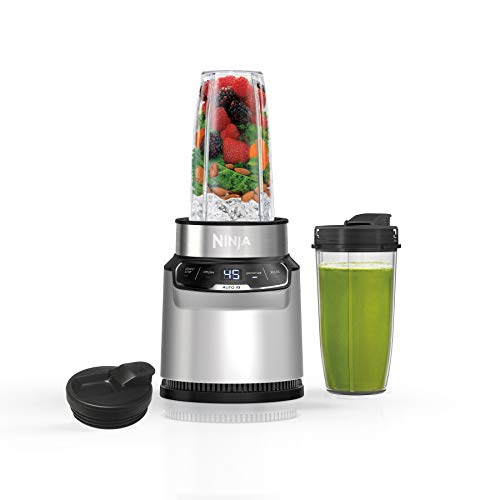
Ninja Nutri-Blender Pro BN401, 1100 Peak Watts — Best for Thick Shakes
Thick shakes are a traction problem: ice cream, frozen banana and a splash of milk form a mass that weaker personal blenders spin beneath, carving a hollow while the top half never moves. The BN401’s answer is Auto-iQ — timed pulses and pauses that let the mixture settle back onto the blades between bursts — backed by 1100 peak watts when the full blend commits. The result is a milkshake with body: cold, dense and uniform, rather than a melted drink with lumps.
Protein shakes come out equally well, with the programmed cycle handling the powder without supervision, and the two 24 oz cups mean a couple or a two-shake household is not washing between rounds. The cups travel properly — this is a blender designed around the gym-bag life, and it shows in the lids and the balance of the cup in the hand.
Against the nutribullet above, the honest differences are cup size and control philosophy: 24 oz cups only, and programs instead of your thumb on a pulse. If your shakes run large — meal-replacement constructions with oats and nut butter — the Pro+’s 32 oz cup is the better tool. If your shakes run thick, the BN401’s programmed traction is the better one. Both statements can be true, and for this brief they are.
It also earns points for what it does not ask of you: no pitcher to store, no settings to learn, no technique to develop. Put the ingredients in the cup in the order the guide below describes, press the button, and the shake is handled. For a 6 a.m. ritual, that absence of decisions is a feature with real value.
Strengths
- Auto-iQ pulse patterns give thick shakes real traction
- Two travel cups suit couples and twice-a-day routines
- Programmed cycles make results repeatable without technique
Trade-offs
- 24 oz cups cap the size of loaded meal-replacement shakes
- Programs are fixed; no manual pulse for improvisers
- No pitcher option for batch work
| Specification | Detail |
|---|---|
| Power | 1100 peak watts |
| Cups | Two 24 oz to-go cups |
| Controls | Auto-iQ programs |
Best for: milkshake and thick-shake lovers who want one-button results / Not suited for: builders of very large, heavily loaded single shakes
Check the current price on Amazon.

KitchenAid Pure Power Blender KSB2078, 1700W Peak — Best for Families
Families do not have a shake ritual; they have two. There is the weekday solo protein shake, made by one person in a hurry, and the weekend round — smoothies for everyone, milkshakes for dessert — made in a pitcher. The Pure Power is built for exactly that household: a 68 oz jar for the rounds, two 16 oz personal jars for the solo jobs, and one base that drives both with 1700 peak watts behind it.
The smoothie cycle handles the pitcher work with programmed patience, and the precision speed knob gives the cook manual authority when a milkshake needs a gentler finish. In the personal jars, protein shakes blend directly in the vessel they travel in, so the weekday routine is blend, lid, bag, door — with the jar rinsed in the evening rather than a pitcher washed twice a day.
The trade-offs are size and price position. This is a full-size countertop machine with a mid-premium tier tag, and the personal jars at 16 oz suit a standard shake rather than a loaded meal replacement. But for the two-ritual household it replaces two appliances with one, and the counter space and cupboard arithmetic of that are worth as much as the blending quality — which is, for the record, thoroughly up to both jobs.
KitchenAid’s build feel is the final reassurance: this is a machine bought for a decade of family service, with the weight and finish to match. When four people’s breakfast depends on one base, that solidity stops being a luxury and becomes the point.
There is one more family scenario worth naming: the milkshake as negotiation. A pitcher machine that makes dessert shakes at home — with the mix-ins, thickness and portion under your control — quietly replaces a category of bought treats, and does it with ingredients already in the freezer. Parents tend to discover this value in the first month; it rarely appears in specification sheets, and it is real.
Strengths
- Pitcher plus personal jars cover family rounds and solo shakes
- 1700 peak watts handles frozen loads in either format
- Smoothie cycle plus manual knob covers programmed and improvised drinks
Trade-offs
- Full-size footprint and mid-premium tier pricing
- 16 oz personal jars are small for loaded meal-replacement shakes
- More parts to store than a personal-only machine
| Specification | Detail |
|---|---|
| Power | 1700 watts peak |
| Jar | 68 oz blending jar |
| Extras | Two 16 oz personal blending jars |
| Controls | Precision speed control knob with smoothie cycle |
Best for: families splitting between solo shakes and batch smoothies / Not suited for: solo dwellers, who pay for a pitcher they will rarely use
Check the current price on Amazon.

Ninja Professional Plus DUO BN751, 1400W Peak, 72 oz — Best Batch-and-Go Value
The BN751 DUO approaches the two-ritual problem from the value end: everything the KitchenAid above does in format terms — big pitcher, personal cups — delivered in Ninja’s mid-range system language. The 72 oz pitcher with stacked blades is a milkshake-night machine, pulling ice cream and frozen fruit into a uniform pour for a table of people, and the Auto-iQ programs run the cycle without the cook standing guard.
The two 24 oz cups are the weekday story: bigger than the KitchenAid’s personal jars, properly sized for a scoop, fruit and milk with headroom, and driven by the same base. A household that shakes daily and entertains monthly gets both ends covered for a single mid-range purchase, which is why this pick, rather than a second personal specialist, holds the value badge.
Its compromises are refinement ones. The stacked pitcher blade is sharp from several directions and deserves care in the sink; the programs are fixed patterns; the whole system feels like hard-working plastic rather than heirloom metal. None of that touches the drinks, which come out right at both scales. Buyers choosing between this and the Pure Power are really choosing between value and finish, and either answer is defensible.
One practical note: the cups and pitcher share the base but not the blade logic, so keep the assemblies together in one cupboard zone. Systems fail socially, not mechanically — they fail when the right cup is in the dishwasher and the right blade is in a drawer across the kitchen at 6 a.m.
Milkshake night is also where this machine quietly out-argues the personal specialists: a pitcher that turns out four uniform shakes in one cycle, while a personal blender is still on its second cup, changes the social maths of dessert. If your household entertains — or simply contains teenagers — that throughput is not a luxury feature. It is the feature.
Strengths
- Both rituals covered at a mid-range tier price
- 24 oz cups are properly sized for loaded protein shakes
- Stacked-blade pitcher makes milkshakes for a crowd evenly
Trade-offs
- Stacked blade needs careful hand-washing
- Finish and feel are utilitarian next to KitchenAid
- Fixed Auto-iQ patterns leave little room to improvise
| Specification | Detail |
|---|---|
| Power | 1400 peak watts |
| Pitcher | 72 oz |
| Extras | Two 24 oz single-serve cups |
| Controls | 3 Auto-iQ programs |
Best for: households wanting pitcher and cups without premium pricing / Not suited for: buyers who prize build finish over bundle value
Check the current price on Amazon.

nutribullet Pro 900 Special Edition, 900W, White — Best Compact Classic
Before the category grew programs and peak-watt headlines, the Pro 900 defined the personal shake: a 900W base, a cup, an extraction blade, and a drink in under a minute. This special edition in white keeps that formula intact, and for a large class of shake drinkers the formula is still sufficient — a scoop, milk, a banana, a handful of ice or frozen berries, blended smooth and drunk from the same cup.
Its virtues are the virtues of simplicity. There is nothing to program and almost nothing to learn; the base is compact enough for small counters and rental kitchens where every centimetre is argued over; and the design’s long production run means cups, blades and seals are easy to find when they wear. The white finish suits kitchens where a black appliance block would dominate.
The limits are the flip side of the same simplicity. Ninety seconds of thought before buying: 900 watts handles fresh and lightly frozen loads happily but works harder — and louder, and longer — on fully frozen, low-liquid constructions; there is no pulse for powder management, so the shake technique in the how-to below (liquid, powder, then frozen, in that order) matters more with this machine than with the Pro+.
Choose it when your shake is a simple, daily, honest drink and your kitchen is small. It is the pick for people who find the top two picks’ features genuinely unnecessary — a defensible position that this guide respects by including it without a hint of condescension.
Strengths
- Dead-simple operation with nothing to program or learn
- Compact base suits the smallest counters
- Long-running design means parts and cups are easy to replace
Trade-offs
- No pulse, so powder technique matters more
- 900W works harder on fully frozen, dense loads
- Single-format only; no pitcher path as needs grow
| Specification | Detail |
|---|---|
| Power | 900 watts |
| Format | Personal blender |
| Finish | White, Special Edition |
Best for: simple daily shakes in small kitchens / Not suited for: thick, frozen, heavily loaded constructions
Check the current price on Amazon.

Hamilton Beach Portable Blender 51172G, 300W Peak — Best Budget for Travel
The smallest honest answer to this brief: a blender whose 14 oz jar is the travel cup, designed for the protein shake made in a dorm room, an office kitchen or a hotel bathroom counter. At 300 peak watts it is not pretending to the frozen repertoire of the machines above — its job is powder, milk, a banana, soft fruit, a few ice cubes — and within that job it is genuinely competent and absurdly convenient.
The use case that justifies it is the shake that would otherwise not happen. Travellers, students and shift workers do not carry a 1200W personal blender; they carry this, or they buy a shake at a counter somewhere. The jar seals, travels, and rinses under any tap, and the base is small enough to live in a desk drawer. Judged as a travel tool rather than a kitchen appliance, it has almost no competition at its budget tier.
The limits must be stated as plainly as the virtues: frozen fruit will defeat it, thick milkshakes are beyond it, and the 14 oz ceiling means a standard shake recipe and nothing more. It is a second blender or a traveller’s blender, not a household’s only blender. This guide includes it because the brief’s readers include people whose real alternative is no shake at all — and for them, it is the best pick on the page.
If that is you, one habit doubles its usefulness: keep the powder in the jar and add liquid at the destination. The sealed jar travels dry without complaint, and the shake is thirty seconds from water, milk or a café’s willingness to help.
Strengths
- Jar is the travel cup — nothing to decant or carry separately
- Small enough for dorms, desks and suitcases
- Budget tier price makes it an easy second blender
Trade-offs
- 300 peak watts cannot handle frozen fruit or thick shakes
- 14 oz capacity caps recipes at a standard single shake
- Not a household’s main blender by any stretch
| Specification | Detail |
|---|---|
| Power | 300 peak watts |
| Jar | 14 oz travel jar |
Best for: travellers, students and office shake drinkers / Not suited for: anyone expecting frozen smoothies or milkshakes
Check the current price on Amazon.
Comparison Table
| Pick | Badge | Key spec | Best for |
|---|---|---|---|
| nutribullet Pro+ N12-1001MK, 1200W | Best Overall | 1200W, pulse function, 32 oz and 24 oz cups | daily protein-shake drinkers and smoothie-for-one households |
| Ninja Nutri-Blender Pro BN401, 1100 Peak Watts | Best for Thick Shakes | 1100 peak watts, Auto-iQ technology, two 24 oz to-go cups | milkshake and thick-shake lovers who want one-button results |
| KitchenAid Pure Power Blender KSB2078, 1700W Peak | Best for Families | 1700W peak power, 68 oz jar, two 16 oz personal jars, smoothie cycle | families splitting between solo shakes and batch smoothies |
| Ninja Professional Plus DUO BN751, 1400W Peak, 72 oz | Best Batch-and-Go Value | 1400 peak watts, 72 oz pitcher, two 24 oz cups, 3 Auto-iQ programs | households wanting pitcher and cups without premium pricing |
| nutribullet Pro 900 Special Edition, 900W, White | Best Compact Classic | 900W, personal cup format, special edition white finish | simple daily shakes in small kitchens |
| Hamilton Beach Portable Blender 51172G, 300W Peak | Best Budget for Travel | 300 peak watts, 14 oz travel jar | travellers, students and office shake drinkers |
How to Choose the Best Blenders for Smoothies and Shakes
Start with the ritual, not the specs
Count your drinks for a week. If nearly all of them are single servings made by one person, a personal blender is your category and the only real questions are cup size and power — the Pro+ and BN401 territory. If your week mixes solo shakes with family rounds, skip straight to the two-format machines. Buying a pitcher machine for a solo ritual means washing a pitcher daily, and buying cups for a family of five means blending in relays; both mistakes are made constantly because buyers shop specifications instead of Tuesdays.
Cup size is a recipe question
Write down your actual shake: liquid volume, scoop, fruit, oats or nut butter if you use them, ice. Add the volumes honestly and then add headroom, because a cup filled to the brim blends badly and seals worse. Most standard protein shakes land comfortably in a 24 oz cup; loaded meal-replacement constructions want the 32 oz. The number is printed in every spec box above precisely because it decides more satisfaction than the wattage does.
Power buys frozen forgiveness
Within personal blenders, power is the difference between a machine that handles your worst-case recipe and one that handles your average recipe. Frozen banana chunks, ice and low liquid are the worst case. The 1100–1200W picks absorb that load; the 900W classic manages it with more liquid and more time; the 300W traveller should not be asked. There is no shame in any tier — there is only mismatch, and mismatch is what this guide exists to prevent.
Protein Powder, Milkshakes and the Physics of a Good Shake
Powder clumps because it meets liquid unevenly: the outside of a powder pile hydrates into a gel skin that protects the dry inside. The defences are order and agitation. Liquid first, powder sprinkled onto liquid rather than dumped, then a pulse or five seconds of blending before any frozen ingredient goes in — that sequence, which the how-to below formalises, fixes clumps on every machine in this list, including the ones without a pulse button.
Milkshakes fail the opposite way: too much blending melts the ice cream and the shake thins as you watch. The defence is cold and speed — ingredients fridge- or freezer-cold, the blend as short as uniformity allows, and a machine with enough traction to finish in twenty seconds rather than sixty. This is the BN401’s home ground, and the reason thick-shake lovers should weight programmed pulse cycles more heavily than raw wattage.
Foam is the third enemy, and it is mostly air: over-blending a protein shake whips it into a mousse that drinks like a chore. Blend to smooth and stop. If your shake foams regardless, a thirty-second rest before drinking lets most of it settle — patience, again, functioning as an ingredient.
Noise, Lids and the Small Print of Daily Use
Personal blenders are loud in the way a knock on the door is loud: briefly, and at close range. If your shake happens at 5:30 a.m. beside a sleeping household, that thirty seconds matters, and no pick here is quiet — the honest mitigations are a towel under the base, a door closed, and the shortest effective cycle. Pitcher machines spread the same energy over a longer, lower event. Neither is a reason to choose a weaker blender, but both are reasons to choose your blending spot with the household in mind.
Lids deserve a sentence of their own, because a leaking cup in a gym bag ends the habit faster than any motor failure. The travel cups on this list were chosen partly for seal designs with a track record; even so, treat every seal as a wear item, rinse the gasket rather than baking it in a hot dishwasher cycle daily, and replace a seal that starts to weep rather than wrapping the cup in a towel and hoping.
Finally, read bundle listings like contracts. Personal blenders are sold in shifting combinations of cups, lids and blades, and the difference between a delighted purchase and an annoyed one is often a second cup that was or was not in the box. Every review above names the configuration its listing confirms; verify yours matches before the box is opened and the returns window starts ticking.
What the Tiers Buy You Here
The budget tier, represented by the travel blender, buys portability and simplicity for soft loads only. The mid-range tier — both personal specialists and the Ninja DUO — buys real frozen competence and the cup sizes real recipes need; it is where most shake drinkers should land. The mid-premium tier buys format flexibility and build: the KitchenAid’s two rituals on one base, finished like furniture.
Notice what no tier buys: immunity from technique. Order of ingredients and blend-to-smooth-and-stop matter on the most expensive machine here almost as much as on the cheapest. Spend for your ritual and your loads, then learn the thirty seconds of technique in the next section, and every tier performs at its best.
How to Build a Smoothie or Shake That Blends Perfectly Every Time
The sequence below works in cups and pitchers alike, for protein shakes, fruit smoothies and proper diner-style milkshakes of every flavour. It exists because most bad shakes are assembly errors, not equipment failures — the same ingredients, loaded in a different order, blend into a different drink.
- Liquid first, always. Pour milk, water or juice into the cup or jar before anything else. Liquid at the blades creates the vortex that pulls everything else down; powder or fruit at the bottom creates a stuck layer the blades spin beneath.
- Powder second, sprinkled. Add protein powder or cocoa onto the liquid’s surface, spread rather than dumped. Give it a pulse or a five-second blend now, before anything frozen joins — this is the clump cure.
- Soft ingredients third. Banana, yogurt, nut butter, oats and fresh fruit go in next, where the forming vortex can catch them easily.
- Frozen ingredients last. Frozen fruit and ice sit on top and get pulled down into an already-moving mixture. Loaded the other way, they bridge over the blades and stall the start.
- Blend to smooth, then stop. Personal cups: thirty to forty-five seconds. Pitchers: the smoothie cycle, or forty-five to sixty seconds ramped low to high. Milkshakes: the shortest blend that looks uniform — twenty to thirty seconds — to protect the body of the drink.
- Check once, adjust once. Too thick, add liquid a splash at a time. Too thin, add frozen fruit for smoothies or a scoop of ice cream for milkshakes — never more ice, which dilutes flavour as it melts.
- Rinse immediately, every single time. Protein residue dries into cement and smoothie sugars turn sticky within the hour. A ten-second rinse now, or the dishwasher tonight, keeps the daily habit frictionless.
Troubleshooting, briefly: a shake with dry powder on the cup wall was loaded powder-first or never pulsed — scrape and re-blend for five seconds this time, and fix the order next time. A milkshake that pours like milk was blended too long or built from soft ice cream; next time, colder ingredients and a shorter cycle. A smoothie with ice chips needs more time at full speed, or smaller ice — large cubes are the last thing any blade fully catches.
For the gym routine specifically, the cup-in-bag discipline matters: blend at home, seal, and keep the cup upright in transit. Shakes blended fresh at the office from a dry-loaded jar — powder and oats in the cup, liquid added on arrival — taste noticeably better than a shake that sat blended for three hours, and the travel pick above exists for exactly that manoeuvre.
One more construction worth mastering is the layered smoothie — thick base, thinner top — which is less about looks than about drinking order: the dense, sustaining half first, the bright, cold half second. Blend the thick half with minimal liquid, pour, rinse the cup for ten seconds, blend the light half, and pour it over the back of a spoon. It takes one extra minute and makes a weekday drink feel like a café one, which is the kind of small reward that keeps habits alive.
Common Buying Mistakes
Loading powder first. Powder at the bottom pastes itself out of the liquid’s reach and survives the blend as clumps. Liquid first, powder sprinkled on top, pulse, then everything else.
Buying cups too small for the recipe. An overflowing cup blends badly, seals worse and teaches you to dread the ritual. Add your recipe up honestly and buy the cup with headroom.
Blending a milkshake like a smoothie. A full minute of blending melts the very thing a milkshake is. Cold ingredients, short cycle, stop at uniform.
Expecting a travel blender to do frozen fruit. A 300W-peak machine has a job description, and frozen mango is not on it. Match the machine to the load or the machine loses, daily.
Leaving the cup unwashed until evening. Dried protein residue is the leading cause of shake habits being abandoned. Rinse in ten seconds, immediately, every time.
Chasing wattage past your needs. A simple fresh-fruit smoothie does not need 1700 peak watts, and the money saved buys a lot of frozen berries. Buy for your worst realistic recipe, not your imaginary one.
Trusting printed prices or ratings in guides. Both change constantly and neither measures clump control. Check price on Amazon at purchase time and judge by cup, format and honest power.
Final Recommendation
Most shake drinkers should start with the personal specialists: the nutribullet Pro+ for its pulse, its two cup sizes and its all-round completeness, or the Ninja BN401 if your shakes run thick and you want Auto-iQ to manage the traction. Between them they cover the great majority of daily rituals at a mid-range tier.
Households with two rituals should buy two formats: the KitchenAid Pure Power for build and polish, the Ninja BN751 DUO for value. The Pro 900 remains the compact classic for simple drinks in small kitchens, and the Hamilton Beach traveller is the honest budget answer for shakes that happen away from home. Choose by your week, not by the spec sheet, and the machine will feel obvious in hindsight.
The neighbouring guides in this cluster sharpen the choice further: Best Blenders For Protein Shakes, Best Blenders For Shakes And Smoothies, Best Blenders For Shakes With Ice, Best Blenders For Protein Smoothies and Best Blenders For Smoothies And Milkshakes each take one sub-ritual and examine it in full.
Frequently Asked Questions
What is the difference between a smoothie blender and a shake blender?
In practice, very little hardware — and that is the honest answer. Shakes are usually single servings built on milk and powder or ice cream, which favours personal cups and traction at thick textures. Smoothies are more often pitcher drinks built on fruit, which favours circulation and volume. The machines on this list were chosen because they cover both, with the reviews noting which side each one leans toward.
How do I stop protein powder clumping in the cup?
Use the order from the how-to: liquid first, powder sprinkled onto the surface, a pulse or five-second blend before adding anything frozen. If your machine has no pulse, the same effect comes from blending the liquid and powder alone for a few seconds first. Clumps are an assembly problem far more often than a power problem.
Can a personal blender really crush ice and frozen fruit?
The 1100–1200W picks can, routinely, provided there is enough liquid for a vortex. The 900W classic manages moderate frozen loads with a little more time. The budget travel blender cannot, and this guide says so in its review rather than letting you discover it. Ice size matters everywhere: standard cubes break down faster than large, dense freezer-tray blocks.
Are milkshakes bad for a blender’s motor?
Thick, cold loads are hard work but well within the design brief of the mid-range and premium picks, especially in short cycles. The risk is technique, not the recipe: a stalled, unmoving load left running will heat any motor. If the mixture stops circulating, stop the machine, add a splash of milk, and restart — traction first, power second.
How long do the cups and blades last?
With daily use, expect cups and seals to be the wear items over a period of years rather than months, and blade assemblies to dull gradually rather than fail suddenly. The long-running designs on this list — the nutribullet Pro line especially — have widely available replacements, which is a genuine ownership advantage over obscure models with proprietary everything.
You can extend all of it with two habits: rinse immediately so acidic fruit and protein never dry onto seals, and avoid blending anything hot in a sealed personal cup, where steam pressure stresses both the seal and the cup itself. Hot drinks belong in pitchers with vented lids — or in the soup guide elsewhere in this cluster, not in a travel cup.
Is it worth buying a blender with both a pitcher and cups?
Only if your week genuinely contains both rituals — solo shakes and group rounds. The two-format machines cost and store like the compromise they are, in the good sense: one base, every drink. If you blend alone ninety percent of the time, a personal specialist plus the patience to blend twice for guests is the leaner purchase, and this guide’s top two picks exist for exactly that reader.


