Disclosure: airfryerkitchensupply.com is reader-supported. When you buy through links on our site, we may earn an affiliate commission at no extra cost to you.
Where to buy
Start here if you are shopping for the best blenders for sauces: every pick in this guide was verified, and every specification quoted comes from the verified listing for that exact model.
Sauce blending spans silky purees, emulsions and hot soup-sauces, so this guide’s picks were verified and judged on the features sauce work actually uses: variable speed, tampers, container size and — in one pick’s listing — an explicit mention of sauces.
The six machines in this guide are: Vitamix 5200 Professional-Grade Blender, 64 oz, Black, Vitamix Propel Series 750, 64 oz, Black, Ninja Nutri Blender BQ301, 900 peak W, (3) 20-oz cups, Blendtec Classic 575, WildSide+ Jar, KitchenAid K400 with Tamper KSB4028, Contour Silver, Oster Pro 1200, glass jar, 7 speeds, dual direction blade, 24 oz smoothie cup. Check the current price on Amazon for the model you choose, and check price on Amazon again before ordering if you are comparing configurations, because capacities, included accessories and finishes vary by listing.
Introduction: Sauces Need a Vortex, Heat Tolerance and Control
The best blenders for sauces are not simply the most powerful blenders. Sauce work divides into three jobs: pureeing cooked vegetables and legumes into silk (a romesco, a roasted pepper sauce, a velouté), emulsifying oil into a stable sauce (aioli-style and vinaigrette-based pan sauces), and grinding small potent batches — pesto, chimichurri, harissa — where a big jar can actually be a liability. Each job rewards different hardware, and this guide maps picks to jobs honestly.
Two hardware features dominate sauce outcomes. Variable speed lets you start slow so hot liquids do not erupt and emulsions do not break, then climb to the vortex that makes a puree glossy. A tamper keeps thick sauces — romesco with its nuts and bread, hummus-adjacent bean sauces — moving without stopping to scrape. Heat is the third factor: hot sauces demand a container and lid rated for hot blending and a cook disciplined about batch size and venting.
One pick’s verified listing names sauces outright — the Ninja Nutri Blender BQ301 describes its cups as blending smoothies and sauces — while the Vitamix and Blendtec picks bring the professional puree pedigree. Every ASIN is listing-verified; check the current price on Amazon before ordering.
In this guide
Quick Picks
Best Overall — Vitamix 5200 Professional-Grade Blender, 64 oz, Black: the Vitamix 5200 again, on merit: 64 oz, variable speed, stainless blades and a tamper workflow — the reference machine for silken purees and hot sauces. Check the current price on Amazon.
Best with Programs — Vitamix Propel Series 750, 64 oz, Black: Vitamix’s Propel 750 adds four programs to the 64 oz platform — set a soup-sauce or puree cycle and let the machine ramp speeds the way a cook would. Check the current price on Amazon.
Best for Small Batches — Ninja Nutri Blender BQ301, 900 peak W, (3) 20-oz cups: Ninja’s BQ301 Nutri Blender: a 900-peak-watt push-to-blend base with three 20-oz cups whose listing says ‘smoothies and sauces’ — the pesto and chimichurri specialist. Check the current price on Amazon.
Best Alternative Power — Blendtec Classic 575, WildSide+ Jar: Blendtec’s Classic 575: a 90 oz WildSide+ jar, five speeds and four preprogrammed cycles — the wide-jar vortex that purees sauces with minimal tamper work. Check the current price on Amazon.
Best Mid-Range — KitchenAid K400 with Tamper KSB4028, Contour Silver: KitchenAid’s K400: preset programs, a five-speed dial, Intelli-Speed motor control and a tamper — steady power for sauces that thicken as they blend. Check the current price on Amazon.
Best Glass Jar Value — Oster Pro 1200, glass jar, 7 speeds, dual direction blade, 24 oz smoothie cup: Oster’s Pro 1200: a glass jar, seven speeds, dual-direction blade technology and Smart Settings — plus a 24 oz smoothie cup for small sauce batches. Check the current price on Amazon.
How These Picks Were Chosen
Picks were chosen on sauce mechanics: variable or well-stepped speed control, tamper availability, container geometry for both large and small batches, and listings that evidence smoothie-and-sauce or soup capability — hot sauces are close cousins of soups.
We deliberately mixed formats: full-size high-performance machines for purees and hot sauces, a mid-range all-rounder, and a personal blender for small potent batches where a 64 oz jar would smear pesto up its walls instead of grinding it.
Brand reputation was ignored unless the verified listing supported the claim — every spec in the spec boxes comes from the listed title of that exact model.
The 6 Best Blenders for Sauces

1. Vitamix 5200 Professional-Grade Blender, 64 oz, Black — Best Overall
For sauces, the 5200’s case is control plus circulation: variable speed from a bare stir to a full vortex, self-cleaning between sauce batches, and the tamper discipline that keeps romesco, nut sauces and thick bean purees moving until they turn glossy.
Strengths
- Variable speed protects emulsions and hot liquids alike
- Tamper keeps thick nut and vegetable sauces circulating
- 64 oz container scales from family sauces to batch cooking
Trade-offs
- Small pesto batches spread too thin in the big container
- Premium positioning across the whole guide
- Manual controls require the cook’s attention throughout
| Specification | Detail |
|---|---|
| Container | 64 oz |
| Controls | Variable speed, high-speed switch |
| Blades | Stainless steel |
| Cleaning | Self-cleaning |
Hot sauce technique on the 5200 is the professional pattern: fill no more than half with hot liquid, lid vented per the manual, start at the lowest speed and climb over twenty seconds. The result — a roasted pepper or squash sauce with a pourable, glossy body — is what restaurant purees are made of.
For emulsions, the low end of the dial is the feature: a slow, steady vortex lets you drizzle oil into a stable aioli-style sauce without the violence that breaks it.
Best for: serious sauce makers doing purees, hot sauces and emulsions / Not suited for: tiny-batch pesto as the main use case
Check on Amazon — check the current price on Amazon before you buy.

2. Vitamix Propel Series 750, 64 oz, Black — Best with Programs
The Propel 750 suits cooks who want Vitamix puree quality with programmed ramps: four programs including a self-cleaning cycle, a 64 oz container, and pulse plus variable speed when you prefer your own hand on the dial.
Strengths
- Four programs automate speed ramps for purees and hot blends
- 64 oz container matches family and batch sauce work
- Pulse and variable speed remain available for manual control
Trade-offs
- Programs are presets, not judgement — thick sauces still need the tamper habit
- Premium positioning, marginally below the flagship lines
- Large container shares the small-batch limitation of all big jars
| Specification | Detail |
|---|---|
| Container | 64 oz |
| Programs | 4 programs including self-cleaning |
| Controls | Pulse, variable speed |
Programmed ramps shine on hot sauces: the machine starts gently, protecting you from the hot-liquid surge, then builds to the puree vortex while you portion the next course. It is the closest thing to an autopilot for soup-sauces.
Choose the 750 over the 5200 if your household blends daily and values repeatability; choose the 5200 if you prefer the simplest, most manual machine in the line.
Best for: daily blenders who want programmed ramps with Vitamix puree quality / Not suited for: minimalists who want dial-only operation
Check on Amazon — check the current price on Amazon before you buy.

3. Ninja Nutri Blender BQ301, 900 peak W, (3) 20-oz cups — Best for Small Batches
Small potent sauces are where big blenders fail: a cup of pesto in a 64 oz jar coats the walls and never grinds. The BQ301’s 20-oz cups concentrate the work, its listing names sauces explicitly, and three cups mean one sauce can chill while the next blends.
Strengths
- Listing explicitly credits smoothies and sauces
- 20-oz cups grind small batches big jars cannot
- Three cups with spout lids suit make-ahead sauce prep
Trade-offs
- Push-to-blend gives pulse control, not speed finesse
- Hot sauces are out — cups are for cool and warm work
- 20 oz caps batch size for family-scale purees
| Specification | Detail |
|---|---|
| Power | 900 peak watts |
| Cups | (3) 20-oz to-go cups |
| Controls | Push-to-blend |
| Listing note | Blends smoothies and sauces |
For pesto, chimichurri, romesco-for-two and sandwich spreads, the cup format is simply correct: ingredients stay in the blade path, texture stays coarse where you want it, and the cup goes to the fridge with a lid.
Treat it as the specialist alongside a household’s main blender, or as the only blender for a small kitchen whose sauce ambitions are fresh and small-scale.
Best for: pesto, chimichurri and small-batch sauce makers / Not suited for: hot soup-sauces and large purees
Check on Amazon — check the current price on Amazon before you buy.

4. Blendtec Classic 575, WildSide+ Jar — Best Alternative Power
Blendtec’s design philosophy answers the tamper question differently: the WildSide+ jar’s fifth side creates a vortex that pulls mixtures down on its own, across five speeds and four programmed cycles, in a 90 oz jar that swallows double sauce batches.
Strengths
- WildSide+ jar geometry self-circulates thick mixtures
- 90 oz capacity is the largest in this guide
- Four preprogrammed cycles plus five manual speeds
Trade-offs
- Wide jar is weakest exactly where cups win: small batches
- Blunt-blade power style is loud at full tilt
- Hot-liquid discipline still applies at this capacity
| Specification | Detail |
|---|---|
| Jar | 90 oz WildSide+ Jar |
| Speeds | 5 speeds |
| Programs | Four preprogrammed blending cycles |
| Cleaning | Self-cleaning |
For smooth vegetable sauces in volume — a cauldron of roasted tomato sauce blended in two jarfuls instead of five — the Classic 575 is the throughput pick, and its programmed cycles keep the ramps consistent batch after batch.
Its honest weakness is the single cup of herb sauce, which the BQ301 handles better. Kitchens that batch-cook will not care; pesto purists should pair accordingly.
Best for: batch cooks pureeing large volumes of smooth sauce / Not suited for: small-batch herb sauces as the primary job
Check on Amazon — check the current price on Amazon before you buy.

5. KitchenAid K400 with Tamper KSB4028, Contour Silver — Best Mid-Range
Sauces thicken mid-blend — a puree catches, nuts release oils, a roux-based sauce sets up — and the K400’s Intelli-Speed control exists for exactly that moment, holding blade speed as load rises instead of bogging down.
Strengths
- Intelli-Speed maintains speed as sauces thicken
- Tamper included in this configuration for dense mixtures
- Five-speed dial plus presets cover puree and emulsion ranges
Trade-offs
- Preset names target drinks, so sauce work is manual-dial work
- Mid-power platform: the thickest nut sauces need patience and liquid
- Verify the tamper configuration on the exact listing
| Specification | Detail |
|---|---|
| Programs | Ice Crush, Icy Drinks, Smoothie presets |
| Controls | 5-speed variable dial |
| Motor | Intelli-Speed Motor Control |
| Included | Tamper (KSB4028) |
Work sauces on the dial: start at one until the mixture moves, climb a step at a time, and let the motor control hold the vortex as the sauce comes together. That steadiness is worth more in sauce work than another hundred watts.
As the household’s only blender it covers smoothies and icy drinks too, making it the balanced single purchase in this guide.
Best for: one-blender households making sauces weekly / Not suited for: maximum-volume batch pureeing
Check on Amazon — check the current price on Amazon before you buy.
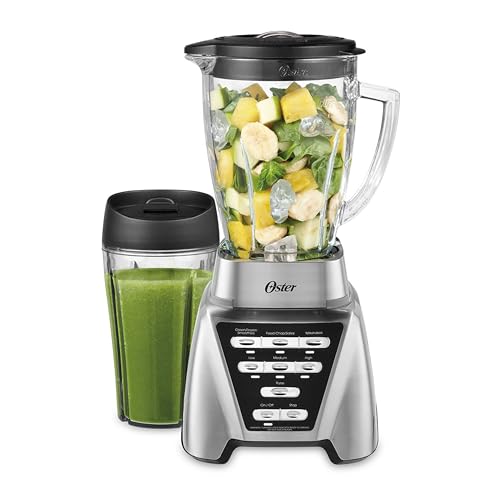
6. Oster Pro 1200, glass jar, 7 speeds, dual direction blade, 24 oz smoothie cup — Best Glass Jar Value
The value pick covers both sauce scales: the glass jar for family purees that will not stain or scent the vessel, dual-direction blades that reverse to pull stubborn mixtures back into the vortex, and a 24 oz cup for the small batches the big jar handles badly.
Strengths
- Glass jar resists sauce staining and odour carryover
- Dual-direction blade helps thick mixtures recirculate
- Jar plus 24 oz cup covers large and small sauce batches
Trade-offs
- Seven stepped speeds lack a true variable dial’s finesse
- Glass jar weight and fragility apply
- Hot blending requires strict fill and vent discipline
| Specification | Detail |
|---|---|
| Jar | Glass jar |
| Speeds | 7 speeds, Smart Settings Technology |
| Blade | Dual Direction Blade |
| Extra | 24 oz smoothie cup included |
Dual-direction blending is a genuinely useful sauce trick: when a thick puree cavitates — spinning a hole around the blades — the reverse pulse collapses the pocket and restarts circulation without opening the lid.
For budget-conscious sauce makers, the glass jar is the deciding feature: last night’s arrabbiata will not haunt tomorrow’s béchamel-adjacent blender sauce.
Best for: value buyers wanting glass plus a small-batch cup / Not suited for: cooks needing true variable-speed emulsion control
Check on Amazon — check the current price on Amazon before you buy.
Comparison Table
| Pick | Badge | Key spec | Best for |
|---|---|---|---|
| Vitamix 5200 Professional-Grade Blender, 64 oz, Black | Best Overall | 64 oz, variable speed, tamper | serious sauce makers doing purees, hot sauces and emulsions |
| Vitamix Propel Series 750, 64 oz, Black | Best with Programs | 64 oz, 4 programs | daily blenders who want programmed ramps with Vitamix puree quality |
| Ninja Nutri Blender BQ301, 900 peak W, (3) 20-oz cups | Best for Small Batches | 900PW, (3) 20-oz cups | pesto, chimichurri and small-batch sauce makers |
| Blendtec Classic 575, WildSide+ Jar | Best Alternative Power | 90 oz WildSide+ jar | batch cooks pureeing large volumes of smooth sauce |
| KitchenAid K400 with Tamper KSB4028, Contour Silver | Best Mid-Range | 5-speed, Intelli-Speed, tamper | one-blender households making sauces weekly |
| Oster Pro 1200, glass jar, 7 speeds, dual direction blade, 24 oz smoothie cup | Best Glass Jar Value | Glass jar, 7 speeds, 24 oz cup | value buyers wanting glass plus a small-batch cup |
Emulsions in Depth: Aioli, Vinaigrettes and Pan Sauces
An emulsion is a suspension built drop by drop, and the blender’s role is to supply a calm, steady vortex rather than violence. Start the base — yolk, mustard, garlic, acid — moving at low speed, then add oil in the thinnest stream the lid opening allows. On variable-speed machines like the Vitamix picks, the low end of the dial is the emulsion gear; on stepped machines, use the lowest speed that keeps the surface moving.
Broken emulsions are recoverable and the rescue is worth learning: pour the split sauce out, put a spoon of water or a fresh yolk in the clean jar, start the vortex, and drizzle the broken sauce back in as if it were the oil. Nearly every broken aioli returns this way. What cannot be rescued is an emulsion blended at full speed from the start — the structure never forms.
Nut and Seed Sauces: Romesco, Satay-Style and Mole-Inspired Blends
Nut sauces are where tampers and patience pay. Romesco — roasted peppers, almonds, hazelnuts, bread — begins as a mixture too thick to vortex, and the correct technique is to tamper the corners down while adding olive oil and a splash of the peppers’ liquid until the mass suddenly catches and turns glossy. That catch moment is visible and audible; stop adding liquid the moment it happens or the sauce thins past recovery.
Peanut and sesame sauces follow the same physics with different liquids: warm water or coconut milk, added gradually, turns a stiff paste into a pourable sauce. Cold liquid shocks nut pastes into seizing, which is why the how-to’s warm-liquid rule exists. Big jars handle double batches for freezing; the BQ301’s cups handle the weeknight single portion without waste.
Cheese and Cream Sauces Without a Roux Pan
Blenders have quietly become the cheese-sauce machine of modern kitchens: hot milk or cooking liquid, grated cheese, and a thirty-second vortex produce a smooth sauce without a roux or a whisk arm. The rules are thermal — the liquid must be hot but not boiling, the cheese added gradually, and the blend kept short, because overworking a cheese sauce at high speed can turn it stringy.
Vegetable-based cream sauces — cauliflower, cashew, white bean — are the blender’s other gift: cooked until soft, blended with their liquid and a little fat, they emerge with a dairy-like body. The high-performance picks make them silky; mid-range machines need an extra thirty seconds and a tamper’s help, which is a fair trade at their positioning.
Hot Sauces and Soup-Sauces: The Safety Deep Dive
Hot blending accidents follow one script: a sealed jar, a full load, a high-speed start, and steam pressure that removes the lid. Every element is preventable. Fill no more than half — a third for very hot, thin liquids. Remove the lid’s centre cap or vent as the manual directs, cover with a folded towel, keep a hand resting lightly on the lid, and start at the lowest speed for a full ten seconds before climbing. The vortex must form before the energy does.
Container choice matters here: the full-size glass and Tritan-class jars of the flagship picks are built for this duty when used as directed, while personal cups are not hot vessels at all — the BQ301’s role in this guide is explicitly cold and warm sauces. Respecting that boundary is not caution theatre; it is the difference between a technique and an incident.
Done right, hot blending is transformative: a roasted squash soup-sauce emerges with a texture no amount of straining matches, because the vortex incorporates a thread of cream or butter into a stable, glossy emulsion. This is the restaurant technique, available at home, priced at one habit of care.
The Sauce Wardrobe: Twelve Sauces, One Machine
A blender that sauces well quietly reorganises a kitchen’s repertoire. The puree family — romesco, roasted pepper, squash velouté, bean — covers weeknight proteins. The emulsion family — aioli-style, herb vinaigrettes, Caesar-style dressings — covers salads and sandwiches. The herb family — pesto, chimichurri, zhug-style — covers everything grilled. The nut family — satay-style, mole-inspired, romesco again — covers the freezer-friendly batch cooks.
Notice that the wardrobe maps exactly onto this guide’s picks: purees want the Vitamix vortex, emulsions want its low speed, herb sauces want the Ninja’s small cups, nut sauces want the tamper and the Blendtec’s circulation, and the everyday middle wants the K400’s steadiness. A household does not need all five machines; it needs to know which two families it cooks weekly, and to buy for those.
The wardrobe also explains why sauce people keep blenders for decades: the machine is not an appliance in their kitchen, it is a technique — the puree, the emulsion, the grind — that shows up in dinner four nights a week. Buy the technique you will live in.
Small-Batch Sauces: The Cup Blender Manifesto
Most sauce failures in big blenders are geometry failures: a cup of chimichurri in a 64 oz jar coats the walls in a green film and the blades spin in air beneath it. The minimum practical batch in a full-size jar is roughly two cups of liquid-bearing mixture; below that, the vortex cannot form and the tamper merely relocates the problem. This is a law of the format, not a flaw in any brand.
Cup blenders invert the law: their minimum batch is a few tablespoons, their maximum is the cup, and the entire working range of single-meal sauces — a pesto for tonight’s pasta, a pan sauce for two cutlets, a sandwich spread — sits inside it. The BQ301’s three cups extend the logic to prep: sauce in one, marinade in another, tomorrow’s dressing in the third.
Households that sauce nightly in small quantities should weight this section heavily: the correct second blender is a cup machine, and for small kitchens it can be the correct only blender. The flagships win the batch cooks; the cups win the Tuesdays.
Freezing Sauces: What Survives and What Does Not
Pureed vegetable and nut sauces freeze beautifully — romesco, roasted pepper, satay-style and tomato-based sauces return from the freezer at near-fresh quality, especially frozen flat in bags that thaw in minutes under warm water. Herb sauces freeze acceptably when covered with a thin oil layer, losing a little brightness but keeping their character for pastas and grains.
Emulsions are the exception: mayonnaise-family sauces split when frozen, because the emulsion’s structure cannot survive ice crystals. Cream-heavy sauces sit in between — they freeze, but they return grainy unless re-blended briefly with a splash of liquid, a rescue the blender itself performs happily. Cheese sauces should be frozen only as a last resort and re-blended with hot milk.
The batch logic follows: when the big jars come out for a sauce session, make double of the freezable families and single of the emulsions. A freezer stocked with flat bags of romesco and pepper sauce is a weeknight insurance policy that cost one washing-up.
Sauce Consistency: Reading and Correcting Texture
Sauce consistency has a vocabulary worth learning: nappe coats a spoon and holds a line drawn through it; ribbon falls from a spoon in a thick band; pourable means a steady stream; spoonable means it mounds. Blenders overshoot thin more often than thick, because liquid is easy to add mid-blend and hard to remove — so the professional habit is to blend with three-quarters of the recipe’s liquid and add the rest in spoons until the texture reads right.
Correcting a thin sauce depends on its family: purees thicken with more of their own solids, nut sauces with more nuts or bread, emulsions with more oil added slowly to a restarted vortex. Correcting a thick sauce is always easier — liquid, a spoon at a time, at low speed. When in doubt during the blend, stop thick; you hold the easier correction.
Resting changes the reading: starch-bearing and nut sauces set up as they cool, herb sauces relax as their solids hydrate. Judge consistency after five minutes, not off the blade — the same patience rule as the how-to, worth repeating because impatience is the most common sauce error in home kitchens.
Cleaning Between Sauces: Flavour Discipline
Sauce work is sequential — the romesco follows the pesto in the same jar on a batch day — and carryover is the tax on carelessness. The self-clean cycle is the answer between compatible sauces: warm water, a drop of soap, thirty seconds, rinse. Between incompatible ones — anything garlicky before anything delicate — add a second cycle and a sniff test of the gasket, which holds more flavour than the jar does.
Colour carries too: a beet or turmeric sauce will tint the next pale sauce unless the jar gets the full treatment. Batch-day planners order their sauces pale-to-dark for the same reason party slushie lines do, and keep one white sauce for the next day if the schedule allows a full wash in between.
Blade assemblies deserve the soak rule from the salsa guide: ten minutes assembled in warm soapy water beats any scrubbing near blades. The machines in this guide are designed to clean themselves with their own vortex — the discipline is simply to run it now, not after the sauce has dried into the seams.
When a Blender Is the Wrong Sauce Tool
Three sauce jobs belong elsewhere, and naming them protects the blender’s reputation. Reduction sauces — pan sauces built by simmering — need a stove, not a vortex; the blender can finish them but cannot create them. Chunky ragùs and rustic salsas need texture a blender destroys; a knife and a pan own those. And whipped preparations — chantilly, foams — need whisk geometry, because a vortex incorporates air differently and usually worse.
The immersion blender also has its territory: a soup already in its pot, a sauce in a narrow pan. This guide covers countertop machines because they win on puree quality, emulsion stability and batch work — but a household that only ever blends soup in the pot should buy the stick and spend the difference on ingredients.
Knowing the boundaries makes the recommendation stronger, not weaker: for purees, emulsions, nut and herb sauces at any scale from a cup to a batch, the machines here are the right tools, chosen on evidence. Everything else is somebody else’s guide.
Sauce and the Weeknight Protein Problem
Most weeknight cooking is not a recipe problem; it is a plain-protein problem — the same chicken, fish or tofu, rescued nightly by a different sauce. This is the blender’s deepest household value: a freezer stocked with romesco and pepper sauce, a fridge holding a fresh herb sauce and an emulsion, turns four proteins into a fortnight of distinct dinners without a single new technique.
The system takes one batch session a week: an hour, two jarfuls of a freezable sauce, one fresh small-batch sauce in a cup, and the self-clean rhythm between them. Households that adopt it stop asking what is for dinner in the anxious sense; the protein rotates, the sauce decides, and the blender — the machine this guide ranked — quietly runs the programme.
Buy for that system and the purchase logic clarifies: the flagship for the batch sauces, the cup machine for the fresh ones, or the steady mid-range pick doing both jobs at household scale. The badges in this guide map onto the system’s roles almost exactly.
Acid, Fat, Salt: Balancing a Blended Sauce
Blended sauces obey the same triangle as all cooking, with one blender-specific twist: blending incorporates air and emulsifies fat so effectively that a sauce can taste richer than its ingredients, while its acid gets muted by the fat’s coating effect. Season in the order fat, then salt, then acid — and add the acid last, off the blend, stirred in by hand, so it stays bright on top of the emulsion instead of being buried in it.
Under-seasoned blended sauces are the norm in home kitchens because tasters judge them warm and thick from the jar, when they will be served cooler and thinner over food. Taste on a piece of the food itself, or at least on a spoon cooled for ten seconds. The difference between the two tastings is the difference between the sauce you made and the sauce you serve.
Heat — chilli heat — behaves like acid: it blooms after resting. Season a blended sauce to just under your target and let the fifteen-minute rest finish the sentence.
Sauces for the Freezer, Revisited as a System
Flat-bag freezing deserves its system status: label with sauce, date and heat level; freeze on a tray so the bags stack like files; thaw under warm water in ten minutes or in the fridge overnight. A freezer drawer holding six varieties in flat bags is a sauce library that takes less space than two tubs of ice cream — the most space-efficient flavour insurance a kitchen can buy.
Rotation keeps the library honest: oldest bags forward, a quick inventory when a new batch session happens, and a rule that nothing crosses its third month unspent. The batch sessions in the previous section exist to feed this system; the system exists to make Tuesday taste like somebody planned it.
When a bag thaws, give the sauce ten seconds in the blender or a vigorous whisk — freezing relaxes emulsions and purees weep slightly. That single re-blend is the difference between frozen sauce tasting stored and tasting made.
Teaching the Household to Sauce
A sauce blender becomes household infrastructure when more than one person can drive it, and the teaching curriculum is short: the load order, the low-start rule for anything warm, the tamper’s purpose, the self-clean before you walk away. Four sentences, demonstrable in one batch, and the machine stops being one cook’s instrument and becomes the kitchen’s.
Write the house sauces on cards that live with the machine — ratios, speeds, times, the correction notes from the troubleshooting sections. Cards outlast memory and visitors; a guest who can reproduce your romesco from a card is a guest who will cook for you again.
The deeper point is that sauce skill compounds: every batch teaches the vortex’s sound and the emulsion’s look, and a household that sauces weekly develops a palate that improves all its other cooking. The blender is the tuition. The palate is the degree.
The Last Word on Lumps
Every sauce maker meets the lump — the unblended pocket, the nut fragment, the herb stem that surfed the vortex. The professional response is diagnostic, not emotional: the load order put a dry ingredient where the vortex could not reach it, or the batch was too small for the jar, or the blend stopped one stage early. Each cause has its fix earlier in this guide, and none of them is the machine’s character flaw.
Straining remains the honourable last resort for a sauce that must be flawless — a velouté for a celebration — and there is no shame in it; restaurants strain as a matter of doctrine. What straining should never be is the nightly tax on a machine whose technique was never learned. Learn the vortex, and the sieve returns to being a choice.
Smooth is a skill before it is a spec. The machines here provide the physics; the cook provides the last ten seconds of attention. That partnership is the whole guide in one sentence.
Sauce Is a System, and You Now Own It
Look back at what this guide actually assembled: a way to choose the machine by the sauces you cook, a safe method for hot blends, an emulsion rescue, a freezing library, a balancing order, and a cleaning rhythm that keeps flavours honest. The blender was the purchase; the system is the asset. Run the first batch session this week — one freezable puree in the big jar, one fresh herb sauce in the small vessel — and the system starts paying its rent immediately.
Sauce people are made, not born, and they are made one glossy, well-balanced jar at a time. You have the map and the machines are ranked. The rest is dinner.
A Note on Blending Oil-Rich Sauces and Staining
Oil-rich sauces — romesco with its olive oil, satay-style blends, turmeric-bearing curries — are the staining stress test of any jar, and they reward the same discipline as salsa with one addition: blend them last in a batch session, because their pigments and fats coat the jar in a film that perfumes the next sauce unless the full soap self-clean intervenes. Glass, represented here by the Oster Pro 1200, shrugs the film off most easily; polymer jars need the immediate cycle and, for turmeric, a paste of baking soda left for ten minutes before rinsing.
There is also a texture note unique to oil-rich blends: they emulsify as they puree, so a romesco blended long becomes glossier and more unified than one blended briefly — and both are correct, for different tables. The brief blend suits rustic service over grilled vegetables; the long blend suits the sauce as a plate’s foundation. Decide before you blend, because the machine will faithfully execute either instruction, and the difference is thirty seconds you cannot take back.
How to Choose a Blender for Sauces
Match the machine to your sauce types
Puree-heavy cooks need vortex power and a tamper; emulsion makers need a gentle low speed; herb-sauce makers need a small vessel. List your three most-made sauces and buy for those — the mapping in this guide’s badges is built exactly that way.
Variable speed is the sauce control
Stepped speeds work, but a variable dial or well-designed ramp protects hot liquids and emulsions. If you blend hot sauces weekly, treat low-speed gentleness as a safety feature, not a luxury.
Container size cuts both ways
Big jars scale family sauces and batch cooking; they fail at a cup of pesto. Households that do both should either pick a system with two vessel sizes or accept a personal blender as the small-batch partner.
Hot blending rules are non-negotiable
Whatever you buy: fill no more than half with hot liquid, vent the lid as the manual directs, start slow, and keep a hand towel over the lid. The best blender for sauces is the one whose manual you follow on heat.
How to Blend Sauces Smoothly and Safely
Five steps cover the core sauce techniques — purees, hot sauces and emulsions — on any pick in this guide.
Build the vortex gradually
Start at the lowest speed until the mixture begins moving as one mass, then climb in steps. A vortex that forms gently incorporates everything; a vortex slammed open throws sauce up the walls and traps air.
Use the tamper as a corner tool
Push mixture from the corners down into the blades while blending — that is the tamper’s whole job. Never use utensils in a running blender, and never tamper through a lid not designed for it.
For emulsions, drizzle into a slow vortex
With the machine at low speed, add oil in a thread through the lid opening. The sauce should thicken visibly; if it splits, stop, add a spoon of water or yolk base, and restart slowly.
Blend hot sauces warm, in halves
Warm ingredients puree silkier than cold. Fill the jar no more than half with hot liquid, vent per the manual, and blend in two batches rather than one heroic one.
Rest, then judge consistency
Sauces thicken as they stand and cool. Blend a shade thinner than your target, rest five minutes, then decide whether another ten seconds — or a spoon of cooking liquid — finishes it.
Common Buying Mistakes
Blending a full jar of hot liquid
Steam expansion can blow a lid. Half-fill, vent, start slow — every time, on every machine.
Adding all the oil at once to an emulsion
Emulsions form drop by drop at first. A dumped cup of oil is salad dressing soup, not aioli.
Using a 64 oz jar for a cup of pesto
The mixture coats the walls and the blades spin beneath it. Small batches belong in small vessels.
Stopping at the first smooth look
Silk takes twenty to thirty seconds beyond ‘looks blended’ for purees. Give the vortex time to finish the texture.
Skipping the self-clean between sauces
A drop of water and a short blend cycle between batches keeps flavours — and colours — where they belong.
Final Recommendation
If you want the shortest possible shortlist, start with these three: Vitamix 5200 Professional-Grade Blender, 64 oz, Black, Vitamix Propel Series 750, 64 oz, Black, Ninja Nutri Blender BQ301, 900 peak W, (3) 20-oz cups. Each links to its Amazon listing, where you can check the current price on Amazon and confirm the exact configuration before deciding.
The Vitamix 5200 is the sauce reference: control, tamper and vortex in one machine. The Propel 750 adds programmed ramps for daily blenders, and the Blendtec 575 is the volume alternative whose jar circulates thick mixtures on its own.
For small potent sauces the Ninja BQ301’s cups are the correct tool, the K400 is the steady mid-range household pick, and the Oster Pro 1200 brings glass-jar value with a small-batch cup included. Check the current price on Amazon, and match the machine to the sauces you actually make.
Keep exploring the cluster: Best Blenders For Salsa Best Blenders For Shakes And Smoothies Best Blenders For Slushies Best Air Fryers Large Capacity Best Blenders For Shakes With Ice
Frequently Asked Questions
What makes a blender good for sauces specifically?
Variable or gently ramping speed, a vortex that keeps thick mixtures moving, a tamper for dense purees, and a vessel sized to your batches. Raw power matters less than control and circulation.
Can I blend hot sauce in any of these blenders?
Hot blending is a technique, not a model feature: half-fill the jar, vent the lid as the manual directs, start at low speed and climb slowly. Full-size jar models here suit hot work; personal cups are for cool and warm sauces.
Why did my emulsion break in the blender?
Usually speed or oil rate: the vortex was too violent, or the oil went in too fast. Restart low, drizzle the oil in a thread, and rescue a split sauce by blending a spoon of water or fresh base and re-adding the broken sauce slowly.
Is a tamper really necessary for sauces?
For thick sauces — romesco, nut sauces, dense vegetable purees — it is the difference between stopping to scrape five times and blending in one motion. Thin sauces never need it.
What size blender is best for pesto and chimichurri?
Small. A 20-oz cup concentrates a cup or two of herb sauce in the blade path, where a 64 oz jar smears it up the walls. That is why a personal blender appears in this guide alongside the flagships.
How do I stop sauces staining my jar?
Glass jars — like the Oster pick — resist staining best. For plastic, rinse immediately, self-clean with warm water and a drop of soap right after use, and store the jar unsealed.


