Disclosure: airfryerkitchensupply.com is reader-supported. When you buy through links on our site, we may earn an affiliate commission at no extra cost to you.
Where to buy
This guide starts with the fact the whole category is built on: there is no native 220 volt Keurig. Every Keurig below is a 120 volt North American machine, labelled as such, and the verified step-down transformers beside them are the honest way to run one in a 220 volt country. Nothing in this article dresses a 120V machine up as a 220V one.
- Keurig K-Mini Single Serve K-Cup Pod Coffee Maker (Best Keurig to Take Abroad): Check the current price on Amazon
- Keurig K-Express Single Serve K-Cup Pod Coffee Maker (Best for Households Abroad): Check the current price on Amazon
- Keurig K-Mini Mate Single Serve K-Cup Pod Coffee Maker (Best Compact Alternative): Check the current price on Amazon
- VEVOR Voltage Converter Transformer, 2000W Step Up/Down (Best Transformer for a Keurig): Check the current price on Amazon
- LVYUAN Voltage Transformer Converter 2000 Watt Step Up/Down (Best Transformer with Universal Outlets): Check the current price on Amazon
- LiteFuze 2000 Watt Voltage Converter Transformer Step Up/Down (Best Grounded-Cord Alternative): Check the current price on Amazon
Let us answer the search behind best 220 volt keurig directly, because a straight answer will save you money and possibly a coffee maker: Keurig does not make a native 220 volt machine. Keurig brewers are built for the North American market and run on 120 volts. There is no dual-voltage Keurig, no export Keurig and no setting hidden in a menu that changes this. Any listing, anywhere, that appears to offer a 220 volt Keurig is either bundling a converter without saying so clearly, using the phrase loosely to attract exactly your search, or simply wrong.
That does not mean you cannot enjoy a Keurig in a 220 volt country. It means there are exactly two honest routes. Route one: buy the Keurig you want and run it through a properly sized step-down transformer that converts your 220 volt supply down to the 110 to 120 volts the machine expects. Route two: skip the Keurig brand and buy a pod machine sold locally in your market, built natively for your voltage, your plug and your warranty system. This guide covers route one in full, because that is what an Amazon.com buyer can actually order, and it treats route two with the respect it deserves in the buying guide.
The three Keurig models below were verified, and the three transformers beside them had their step-down conversion, 220 volts in, 110 to 120 volts out, confirmed in their listing titles. What no title can confirm is a Keurig’s voltage, because Keurig titles do not state it; the 120 volt specification in each spec box below comes from the brand’s North American market positioning and is stated in this guide as a warning, not hidden as a footnote. Size your transformer by the rules given here, and a Keurig abroad works beautifully. Ignore them, and the first brew can be the last.
In this guide
Quick Picks
- Keurig K-Mini Single Serve K-Cup Pod Coffee Maker — Best Keurig to Take Abroad: The compact 6 to 12 ounce single-serve Keurig, with cord storage, and the gentlest demand on a step-down transformer. A 120V machine: converter required. — Check price on Amazon
- Keurig K-Express Single Serve K-Cup Pod Coffee Maker — Best for Households Abroad: A reservoir Keurig with a 42 ounce removable tank, three brew sizes and a strong brew button. A 120V machine: converter required, sized generously. — Check price on Amazon
- Keurig K-Mini Mate Single Serve K-Cup Pod Coffee Maker — Best Compact Alternative: A newer compact Keurig brewing up to 12 ounces, positioned for dorms and offices. A 120V machine: converter required. — Check price on Amazon
- VEVOR Voltage Converter Transformer, 2000W Step Up/Down — Best Transformer for a Keurig: A heavy-duty 2000W transformer whose title confirms 220V to 110V step-down conversion, with US and EU outlets and CE certification. — Check price on Amazon
- LVYUAN Voltage Transformer Converter 2000 Watt Step Up/Down — Best Transformer with Universal Outlets: A verified 2000 watt alternative converting 220-240V down to 110-120V, with two US and two universal outlets. — Check price on Amazon
- LiteFuze 2000 Watt Voltage Converter Transformer Step Up/Down — Best Grounded-Cord Alternative: A third verified 2000 watt step-down option, notable for a fully grounded cord stated in its title, with universal and US outlets. — Check price on Amazon
How These Picks Were Chosen
The Keurig picks were chosen as the machines people most sensibly take abroad: compact, mechanically simple brewers with the fewest features to object to a new life overseas. The K-Mini family leads because a small single-serve machine draws less power, travels better and asks the least of a transformer. The K-Express represents the step up to a removable reservoir for households brewing several cups a day. All three were verified as current listings.
The transformers were chosen by a stricter test: the listing title had to state step-down conversion from the 220 to 240 volt range to the 110 to 120 volt range, with a wattage rating in the class a coffee maker’s heating element demands. Lightweight travel converters were excluded entirely; a Keurig’s heater is a serious load, and the difference between a real transformer and a travel gadget is the difference between a working kitchen and a burnt smell. Sizing guidance in this guide keeps a deliberate safety margin, because heating appliances punish optimistic maths.
The 6 Best 220 Volt Keurig Options

Keurig K-Mini Single Serve K-Cup Pod Coffee Maker — Best Keurig to Take Abroad
If one Keurig earns a place in a suitcase or a shipping box to a 220 volt country, it is the K-Mini. It brews one cup at a time, anywhere from 6 to 12 ounces, from any K-Cup pod, with no reservoir to keep filled and a footprint small enough for a studio kitchen, a dorm room or an office desk. Cord storage keeps it tidy in transit. And the essential fact, stated as plainly in this review as in the introduction: this is a 120 volt North American machine. In a 220 volt country it runs only through a correctly sized step-down transformer, and its spec box below says so in writing.
Strengths
- Smallest, simplest Keurig format, which makes it the easiest to power correctly through a transformer
- One-cup reservoir means no standing water, ideal for occasional use and second homes
- Cord storage and a compact body travel and store better than any reservoir model
Trade-offs
- 120 volt only: plugging it directly into a 220 volt socket, or via a plug adapter alone, will destroy it
- No reservoir means filling for every single cup
- Single-serve only, with no carafe option for households that brew in volume
| Voltage | 120V North American model — NOT native 220V; step-down transformer required |
| Brew size (from listing title) | 6 to 12 oz |
| Format (from listing title) | Single serve K-Cup pod |
| Storage (from listing title) | Cord storage |
The K-Mini’s virtue abroad is restraint. A transformer setup rewards the appliance that asks for less: one cup heated at a time, a short brew cycle, then off. Pair it with a transformer sized by the rules in this guide, switch the transformer on, brew, and switch off rather than leaving the pairing energised all day. Treated that way, the arrangement is uneventful for years, which is the highest praise any voltage workaround can earn.
Who should skip it? Households. If three people queue for coffee every morning, the fill-brew-wait rhythm of a reservoir-free machine becomes a daily irritation, and the K-Express below exists for exactly that kitchen. The K-Mini is the personal machine: one drinker, one desk, one holiday flat, perfected.
Best for: Single drinkers, students, offices and second homes in 220 volt countries, run through a proper transformer / Not suited for: Anyone unwilling to use a transformer, or households brewing many cups back to back

Keurig K-Express Single Serve K-Cup Pod Coffee Maker — Best for Households Abroad
The K-Express is the Keurig for a household that has committed to the transformer route. Its 42 ounce removable reservoir covers a morning of cups without refilling, it offers three brew sizes, a strong brew button for a more intense cup, and travel-mug-friendly clearance, and it works with all K-Cup pods. It is also, like every Keurig, a 120 volt machine. The bigger reservoir changes nothing electrically except convenience, but the household duty cycle, several brews in a row, is one more reason to size its transformer with the full margin this guide insists on.
Strengths
- 42oz removable reservoir suits multi-cup households and refills easily at the sink
- Three brew sizes plus a strong brew option cover most tastes without complexity
- Travel mug friendly, which matters in real morning routines more than most features
Trade-offs
- 120 volt only, and household use means the transformer works harder and longer each day
- Standing water in a reservoir needs regular refreshing and descaling, especially in hard-water 220V regions
- Larger and heavier to relocate than the K-Mini models
| Voltage | 120V North American model — NOT native 220V; step-down transformer required |
| Reservoir (from listing title) | 42 oz, removable |
| Brew sizes (from listing title) | 3 brew sizes |
| Features (from listing title) | Strong brew button, travel mug friendly, works with all K-Cup pods |
In a family kitchen abroad, the K-Express setup becomes infrastructure: transformer placed once, ventilated and left in position, Keurig on top of the routine. That permanence is an argument for doing the installation properly the first time, with the transformer on a hard surface, its vents clear, and the Keurig plugged directly into it. Do that, descale on schedule with the local water in mind, and the machine delivers exactly the push-button consistency people buy Keurigs for.
Pod supply is the other household reality to plan. K-Cup availability outside North America ranges from easy online ordering to effectively none, so households relocating should confirm a pod supply route, or stock up, before the machine becomes the centre of the morning. A reusable refillable pod also deserves consideration abroad, both for supply security and for waste.
Best for: Households in 220 volt countries committed to a permanent, properly sized transformer setup / Not suited for: Occasional users, who should take the K-Mini route, or anyone without a reliable K-Cup supply
Keurig K-Mini Mate Single Serve K-Cup Pod Coffee Maker — Best Compact Alternative
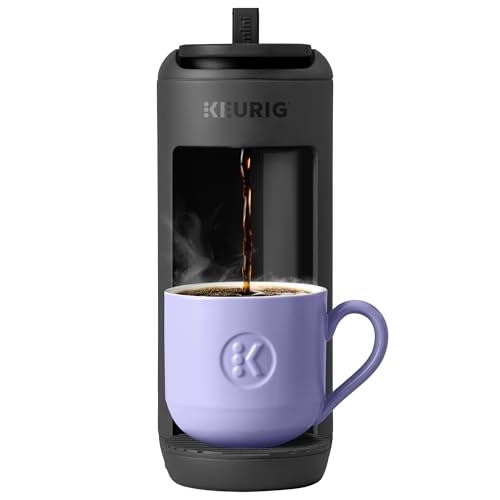
The K-Mini Mate is the current-generation take on the same idea as the original K-Mini: a compact, portable single-serve machine brewing up to a 12 ounce cup, aimed by Keurig at dorms, offices and small spaces. For the 220 volt reader it offers a second verified compact option if the original K-Mini is unavailable or in a colour you dislike, with the same electrical reality: 120 volts, North American, transformer required, no exceptions and no shortcuts.
Strengths
- Compact portable format that relocates and stores as easily as the original K-Mini
- Brews up to a full 12 oz cup, covering travel-mug drinkers in one cycle
- A second verified compact option improves your chances of finding stock and a finish you like
Trade-offs
- 120 volt only, with exactly the same transformer requirement as every Keurig
- One-cup format still means filling for every brew
- Newer model lines can have thinner accessory and parts availability overseas
| Voltage | 120V North American model — NOT native 220V; step-down transformer required |
| Brew size (from listing title) | Up to 12 oz |
| Format (from listing title) | Single serve K-Cup pod, compact portable |
| Positioning (from listing title) | Small spaces, dorms and offices |
Choosing between the K-Mini and the K-Mini Mate is a matter of availability and small preferences rather than capability; both make the same cup from the same pods in the same single-serve rhythm. For the abroad buyer, that redundancy is genuinely useful, because the machine is only half the purchase: if one model is out of stock, the other keeps your transformer plan, your pod order and your moving date intact.
One discipline applies to both compacts in shared spaces like dorms and offices abroad. Label the setup. A Keurig on a desk in a 220 volt country invites a well-meaning colleague to plug it straight into the wall, and a small note on the transformer, always use together, has saved more relocated appliances than any other single habit in this guide.
Best for: Dorm, office and small-space users in 220 volt countries who want the current compact Keurig / Not suited for: Multi-cup households, or anyone who finds the original K-Mini cheaper and available
VEVOR Voltage Converter Transformer, 2000W Step Up/Down — Best Transformer for a Keurig
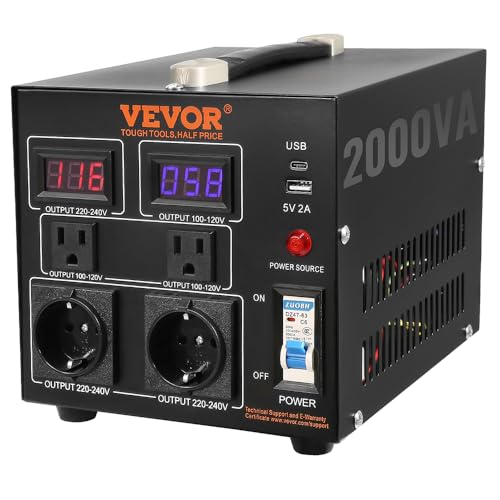
A Keurig is only half of this purchase; this transformer is the other half. The VEVOR unit’s listing title confirms the conversion that matters, from 220 volt down to 110 volt, alongside the reverse direction, at a 2000 watt heavy-duty rating with US and EU outlets and CE certification stated. That 2000 watt class is chosen deliberately: a Keurig’s heating element is a heavy load while it brews, and the sizing rule in this guide, keep the appliance’s draw comfortably inside the transformer’s rating, rules out the small travel converters that fill search results for this search.
Strengths
- Step-down conversion from 220V to 110V confirmed in the listing title
- 2000W heavy-duty rating gives a Keurig’s heater the headroom safe operation demands
- US and EU outlets plus stated CE certification suit a permanent kitchen-corner installation
Trade-offs
- Adds a heavy box to your counter and a soft hum while it works
- Wastes a little power as heat; switch it off between uses rather than leaving it energised
- One transformer should serve the Keurig alone during brewing, not a cluster of appliances at once
| Type (from listing title) | Step up/down voltage converter transformer |
| Rating (from listing title) | 2000W |
| Conversion (from listing title) | 220V to 110V and 110V to 220V |
| Outlets (from listing title) | US outlet, EU outlet, 5V USB port |
Installation is a five-minute job done once: transformer on a hard, ventilated surface near the socket, Keurig plugged into its US outlet, transformer plugged into the wall. Then a habit to build: transformer on, brew, transformer off. That rhythm protects the transformer, saves standby losses and removes any temptation for the machine to be used without conversion, because the Keurig’s plug lives in the transformer permanently.
Respect the one-appliance rule. It is tempting, with spare outlets visible, to add a US toaster or kettle to the same transformer. Heating appliances are the worst possible sharers; two heaters together can exceed the rating even when each alone is fine. Give the Keurig its transformer, or at least its moment, and the pairing will bore you with reliability.
Best for: Any Keurig owner in a 220 volt country who wants one verified, correctly sized transformer / Not suited for: Anyone hoping a pocket travel converter will do the same job safely

LVYUAN Voltage Transformer Converter 2000 Watt Step Up/Down — Best Transformer with Universal Outlets
The LVYUAN covers the same essential ground as the VEVOR: its title confirms conversion from 220-240 volts down to 110-120 volts at a 2000 watt rating. Where it differs is the socket layout, two US outlets and two universal outlets, which suits the relocating household whose US appliances extend beyond the Keurig to a grinder, a milk frother or a blender used one at a time. It earns its place as the flexible alternative, with the same sizing discipline stated in full.
Strengths
- Title confirms 220-240V to 110-120V step-down conversion at 2000 watts
- Two US and two universal outlets cover a small fleet of relocated appliances, used one at a time
- A genuine second option when transformer stock fluctuates
Trade-offs
- Universal outlets make casual overloading easier; the one-heater-at-a-time rule is on you
- Same heat, hum and standby considerations as any transformer in this class
- Does not convert frequency, so the Keurig runs on your local 50Hz supply once voltage is stepped down
| Type (from listing title) | Voltage transformer converter, step up/down |
| Rating (from listing title) | 2000 watt |
| Conversion (from listing title) | 220-240V to 110-120V and reverse |
| Outlets (from listing title) | 2 US outlets, 2 universal outlets |
Frequency deserves its sentence here because this is the pick where a mixed appliance fleet makes it relevant. A step-down transformer changes voltage, not frequency: your 220 volt, 50Hz supply becomes 110 to 120 volt, 50Hz power. Keurig heating elements do not care about that difference in any way you will taste, and simple motors mostly tolerate it, which is why the Keurig route works. Precision electronics with timing motors are the appliances to think twice about, not the coffee maker.
Choose between the LVYUAN and the VEVOR on your socket needs and on stock. Both are verified for the conversion, both sit in the right wattage class, and both will serve a Keurig faithfully under the same rules. What neither can do is rescue a setup that ignores those rules, so the guide repeats them rather than apologising for it.
Best for: Relocators powering a Keurig plus other small US appliances, one at a time, from one verified unit / Not suited for: Anyone planning to run two heating appliances simultaneously

LiteFuze 2000 Watt Voltage Converter Transformer Step Up/Down — Best Grounded-Cord Alternative
The LiteFuze completes the transformer trio with one detail worth singling out: its title states a fully USA grounded cord, alongside 2000 watt step up and step down conversion, a universal outlet socket, two US outlets and CE certification. Grounding is not glamour, but for a metal-bodied heating appliance running daily in a kitchen, a properly grounded converter chain is the version of this workaround you want. Three verified transformers in one guide is not padding; stock in this category genuinely comes and goes, and a Keurig plan should not collapse because one listing sold out.
Strengths
- 220v to 110v conversion confirmed in the title at a 2000 watt rating
- Fully grounded cord stated in the title, the right foundation for a daily-use heating appliance
- Universal socket plus two US outlets and stated CE certification
Trade-offs
- Same class limits as the other transformers: one heater at a time, ventilation, switch off between uses
- A grounded cord only helps if your wall socket’s earth is real; older buildings vary
- Still a workaround: a locally bought native pod machine avoids the whole apparatus
| Type (from listing title) | Voltage converter transformer, step up/down |
| Rating (from listing title) | 2000 watt |
| Conversion (from listing title) | 220v to 110v and 110v to 220v |
| Cord (from listing title) | Fully USA grounded cord |
| Outlets (from listing title) | Universal outlet socket, 2x US outlets |
There is a temptation, once three similar boxes are on the page, to hunt for a dramatic difference between them. Resist it. The honest summary is that all three are verified 2000 watt class step-down transformers, and the deciding factors are grounding, socket layout, price on the day and availability in your region. The LiteFuze’s grounded cord gives it a principled edge for a permanent kitchen installation, which is why it is recommended here without hesitation for buyers who can get it.
Whichever transformer you choose, buy it from a listing whose title states the conversion direction and wattage as plainly as these three do. Vague converter listings are where this category’s accidents are born. If a listing cannot bring itself to say 220 to 110 and a wattage in the same breath, it has not earned a place under your coffee maker.
Best for: Buyers who want the grounded option for a permanent Keurig station in a 220 volt kitchen / Not suited for: Buyers whose local stock makes another verified transformer the practical choice; the difference is small
Comparison Table
| Pick | Badge | Key spec | Best for |
|---|---|---|---|
| Keurig K-Mini Single Serve K-Cup Pod Coffee Maker | Best Keurig to Take Abroad | 120V (converter required), 6-12 oz single serve | Single drinkers, students, offices and second homes in 220 volt countries, run through a proper transformer |
| Keurig K-Express Single Serve K-Cup Pod Coffee Maker | Best for Households Abroad | 120V (converter required), 42 oz reservoir, 3 brew sizes | Households in 220 volt countries committed to a permanent, properly sized transformer setup |
| Keurig K-Mini Mate Single Serve K-Cup Pod Coffee Maker | Best Compact Alternative | 120V (converter required), up to 12 oz, compact | Dorm, office and small-space users in 220 volt countries who want the current compact Keurig |
| VEVOR Voltage Converter Transformer, 2000W Step Up/Down | Best Transformer for a Keurig | 2000W step-down 220V to 110V (title-confirmed) | Any Keurig owner in a 220 volt country who wants one verified, correctly sized transformer |
| LVYUAN Voltage Transformer Converter 2000 Watt Step Up/Down | Best Transformer with Universal Outlets | 2000W step-down 220-240V to 110-120V (title-confirmed) | Relocators powering a Keurig plus other small US appliances, one at a time, from one verified unit |
| LiteFuze 2000 Watt Voltage Converter Transformer Step Up/Down | Best Grounded-Cord Alternative | 2000W step-down, grounded cord (title-confirmed) | Buyers who want the grounded option for a permanent Keurig station in a 220 volt kitchen |
How to Choose a Transformer for a Keurig in a 220 Volt Country
Start from the load. A Keurig is a heating appliance: its element draws heavily while brewing, in the same league as a small kettle. That single fact eliminates most of what search results will show you. Travel converters rated for a few hundred watts, or advertised for hair tools and chargers, are not candidates, and the lightweight voltage gadgets with no stated wattage are worse than useless here because they fail hot.
Look for three things stated plainly in the listing, as they are in all three transformers in this guide: step-down conversion from the 220 to 240 volt range to the 110 to 120 volt range, a rating in the 2000 watt class, and a grounded connection. Then apply the working rule: the appliance’s draw should sit comfortably within the transformer’s rating rather than at its edge, because a transformer run at its badge maximum all day runs hot and dies young. One appliance at a time, plugged directly in, with no power strips between transformer and wall.
Finally, plan the physical installation as part of the purchase. A transformer needs a hard, ventilated spot, clearance around its vents and a permanent home where the Keurig’s plug stays in it. If your kitchen cannot give it that corner, that is useful information too: it may be the nudge toward the local native machine discussed next.
Keurig on a Transformer vs a Local Pod Machine: The Honest Trade-Off
The case for the Keurig route is taste, habit and pods. If your household runs on specific K-Cup varieties, if the machine is a gift with sentimental weight, or if you are posted abroad for a defined period and will return to a 120 volt home, the transformer setup preserves your routine exactly. Thousands of relocated households run Keurigs this way for years without incident, because the rules are simple and the machines are not fragile.
The case for a local machine is everything else. A pod brewer bought in your 220 volt market plugs straight into the wall, carries a local warranty, uses locally sold pods and asks nothing of you electrically. During our research we searched specifically for a dual-voltage pod machine whose listing confirmed the claim, and none did, so this guide links none; but your local retailers will stock native machines from the big pod ecosystems, and for a permanent move that is usually the grown-up purchase. Decide by duration: a posting favours the transformer, a new life favours the local machine.
Staying Safe: The Rules That Make a 120V Keurig Work Abroad
Rule one: a plug adapter is not a voltage converter. An adapter changes the shape of the plug and nothing else; a Keurig on an adapter alone in a 220 volt socket is a Keurig being destroyed. Rule two: the transformer is part of the appliance now. Keep them together, label them if the space is shared, and never lend the Keurig without its transformer. Rule three: switch the transformer off between uses. It draws power and generates warmth at idle, and the off switch is also your guarantee that nobody brews through a half-connected setup.
Rule four: respect water. Descale on the manufacturer’s rhythm, sooner if your local water is hard, and remember that a machine under warranty in North America may have no service route in your new country, which is one more reason the gentle, correct setup matters. Follow those four rules and the story of your Keurig abroad will be a boring one, which is exactly what you want from an electrical arrangement.
The Relocation Checklist: Moving a Keurig Overseas Without Drama
A Keurig relocation succeeds in the packing, not at the destination. Drain the machine before it travels: a reservoir model should be emptied and dried, because a machine shipped wet arrives as a hygiene project. Photograph the rating information on the base, pack the machine in its original box if you kept it, and put the transformer decision on the same checklist as the shipping decision, not as an afterthought for the first jet-lagged morning when coffee matters most and judgement matters least.
At the destination, resist the first-morning plug-in. Set the transformer station up properly, ventilated corner, label if the home is shared, water-only test brew, and only then the real cup. Households that follow that order tell boring stories about their Keurig abroad. Households that improvise on morning one are the source of every cautionary tale in this category, and the tales all end with the same smell of hot electronics.
K-Cup Supply Abroad: Planning the Pod Pipeline
The machine is the easy half of a Keurig life overseas; the pods are the logistics. In some 220 volt countries, K-Cups are stocked by import shops and online marketplaces at a premium. In others they are effectively unavailable, and a household that discovers this after relocating owns a beautiful ornament. Research your destination’s supply before you ship the machine: check the local online marketplaces you will actually use, price a case of your usual variety delivered, and decide whether the numbers still make the routine worthwhile.
The reusable refillable pod is the supply-independent answer and deserves serious consideration abroad. It takes your own ground coffee, which every country sells, removes the import premium and the packaging waste in one move, and turns the Keurig into a small single-serve brewer of whatever local beans you fall in love with. Many relocated households end up preferring it to the imported pod pipeline they originally planned around.
Why Keurig Never Made a 220 Volt Model: The Market Logic
It is worth understanding why the product you want does not exist, because the reason predicts the future. Keurig’s business is a pod ecosystem anchored in North American retail: machines placed cheaply into homes, revenue earned on pods sold through North American channels. Exporting the machine without the pod infrastructure earns the company little, complicates its safety certifications across dozens of electrical regimes, and serves a market, expatriates and the military, too small to justify the programme. No conspiracy, no oversight: a rational absence.
That logic also explains why the workaround ecosystem is so mature. Transformers, relocation guides and forums full of posted-abroad coffee drinkers exist precisely because the demand is real but niche. You are not doing something strange by running a Keurig through a verified step-down transformer; you are doing the standard, well-trodden thing, provided you do it with the sizing and safety discipline this guide repeats, deliberately, until it is impossible to miss.
Descaling and Water: Keeping a Relocated Keurig Alive for Years
The silent killer of relocated Keurigs is not voltage, once the transformer is right; it is water. Many 220 volt regions have harder water than the North American suburbs these machines were designed for, and mineral scale builds inside the heating path until brew temperatures sag, flow slows and the machine begins its slow decline. The defence is a rhythm: descale on the manufacturer’s schedule or sooner if your kettle furs up quickly, because your kettle is the free diagnostic instrument for your local water’s intentions.
Filtered water softens the whole problem and improves the coffee as a side effect. A simple jug filter where you fill the machine becomes, over a posting of several years, the difference between a Keurig that soldiers on and one that retires early with no service network to save it. Abroad, prevention is not a virtue; it is the entire maintenance strategy, and it costs almost nothing compared with replacing a machine across an ocean.
Troubleshooting a Keurig on a Transformer: A Calm Diagnostic Order
When a relocated Keurig misbehaves, diagnose in the order that rules out the electrical arrangement before blaming the machine. First, confirm the transformer is on, set to the correct input and warm rather than hot; a transformer that has tripped its protection or been switched to the wrong direction explains a dead machine more often than any brewer fault. Second, test the transformer’s outlet with a lamp or phone charger to prove power is present. Third, run the Keurig on water only and watch the full cycle, listening for a pump that strains or a heater that never quite arrives.
Most remaining faults abroad are the ordinary Keurig faults wearing travelling clothes: scale from harder water, answered by the descaling rhythm in this guide; a clogged needle from pod grounds, answered by the standard cleaning routine; an air lock after shipping, answered by the manufacturer’s priming steps. True electrical damage, the burnt smell, the machine dead after a direct plug-in, is the one diagnosis with no home remedy, and it is the reason this guide’s safety rules are written the way they are. Work the order calmly and you will almost always find the fault is water, air or a switch, not the machine’s end.
How to Set Up a Keurig with a Step-Down Transformer, Step by Step
Ten careful minutes at installation prevent every common failure in this category. Work through the steps in order, and do not brew the first cup until the last step.
- Place the transformer on a hard, flat, ventilated surface near the wall socket, with clear space around its vents and no cloth, paper or cabinet door enclosing it.
- Confirm the transformer’s input selector or input socket matches your supply, 220 to 240 volts, following its manual; many step up/down units serve both directions and must be set correctly.
- Plug the transformer into the wall socket. Do not use an extension lead or a multi-way strip between the wall and the transformer.
- Plug the Keurig directly into the transformer’s US outlet. From now on, the Keurig’s plug lives there permanently.
- Add a small label to the transformer if anyone else uses the space: Keurig and transformer always together, never plug Keurig into the wall.
- Switch the transformer on, fill the Keurig, and run one water-only brew cycle. Watch and listen: normal brewing sounds, no crackling, no hot smells, no transformer strain.
- Brew your first real cup, then switch the transformer off. Build the on-brew-off rhythm from day one.
- In the first week, check the transformer after brewing sessions. Warm is normal; too hot to rest a hand on is a stop signal that the pairing is undersized or faulty.
Set up this way, the arrangement fades into the kitchen routine, which is the goal. If anything in the first week feels electrically dramatic, heat, noise, smells or tripped breakers, unplug everything and reassess the sizing before the next cup.
Common Buying Mistakes
- Believing a 220 volt Keurig exists. It does not. Any listing implying one is bundling a converter quietly or misleading you; buy the machine and the transformer as the two separate, honestly labelled things they are.
- Using a plug adapter alone. Adapters change shape, not voltage. This is the single most destructive mistake in the category.
- Buying a travel converter for a heating appliance. A Keurig’s element needs a real transformer in the 2000 watt class, sized with headroom, not a pocket gadget rated for chargers.
- Running other heaters on the same transformer. A kettle or toaster alongside the Keurig can exceed the rating even when each appliance alone is within it.
- Leaving the transformer on permanently. It idles warm and wastes power, and an always-live setup invites someone to use the Keurig in a half-configured state.
- Ignoring pod supply. A Keurig abroad without a K-Cup supply route is an ornament. Confirm pods, or a reusable pod plan, before you relocate the machine.
Final Recommendation
The working recipe is simple. Take the K-Mini if you brew for one, the K-Express if you brew for a household, and the K-Mini Mate if the current compact model is the one in stock. Pair whichever you choose with one of the three verified 2000 watt step-down transformers, VEVOR for the straightforward kitchen installation, LVYUAN for universal outlets across a small fleet of US appliances, LiteFuze for the grounded cord, and follow the setup steps and safety rules exactly. That combination is the entire honest content of the phrase 220 volt Keurig.
If your move is permanent and your attachment is to pod coffee rather than to the Keurig badge, price a native pod machine in your local market before ordering anything. It is the one alternative this guide cannot link for you, and for many readers it will be the right final answer.
The shortlist in one line: Keurig K-Mini Single Serve K-Cup Pod Coffee Maker; Keurig K-Express Single Serve K-Cup Pod Coffee Maker; Keurig K-Mini Mate Single Serve K-Cup Pod Coffee Maker; VEVOR Voltage Converter Transformer, 2000W Step Up/Down; LVYUAN Voltage Transformer Converter 2000 Watt Step Up/Down; LiteFuze 2000 Watt Voltage Converter Transformer Step Up/Down.
Keep exploring related guides on this site: Best 220 Volt Microwave Best 220 Volt Portable Air Conditioner Best 220 Volt Icecream Maker Machine Best Keurig Coffee Makers Best Single Serve Coffee Makers
Frequently Asked Questions
Does Keurig make a 220 volt or dual-voltage model?
No. Keurig brewers are built for the North American market and run on 120 volts. There is no native 220 volt Keurig and no dual-voltage Keurig. Running one in a 220 volt country requires a step-down transformer, or choosing a different, locally sold pod machine instead.
Can I just use a plug adapter with my Keurig abroad?
No. A plug adapter only changes the shape of the plug so it fits the socket; it does nothing to the voltage. A 120 volt Keurig plugged into a 220 volt socket through an adapter will be damaged, typically immediately. You need a step-down transformer that actually converts the voltage.
What size transformer does a Keurig need?
A Keurig is a heating appliance, so think in the same class as a small kettle rather than a phone charger. The transformers verified in this guide are 2000 watt step-down units, chosen so the brewer’s draw sits comfortably within the rating. Undersized travel converters are the common cause of failure and overheating in this setup.
Will a transformer change the taste of the coffee?
No. The transformer delivers the voltage the machine was designed for, and the brewer heats and pumps exactly as it does at home. A step-down transformer does not convert frequency, so your 50Hz supply stays 50Hz, but that does not affect the taste of a Keurig brew in any way you will notice.
Is it safe to leave the transformer switched on all the time?
It is better practice to switch it off between uses. Transformers draw some power and generate warmth at idle, and an off transformer guarantees nobody uses the Keurig in a partially connected state. The on-brew-off rhythm takes a week to become automatic.
What if I am moving permanently to a 220 volt country?
Seriously consider buying a pod machine locally when you arrive. It will plug straight in, carry a local warranty and use locally available pods. The Keurig-plus-transformer route shines for defined postings and for households attached to specific K-Cup varieties; permanent movers often find the local machine is the simpler long-term answer.
Will a step-down transformer work for a Keurig with a clock or display?
Yes. The transformer supplies the voltage the machine was designed for, and clocks, displays and brew controls operate normally. A transformer does not convert frequency, so on a 50Hz supply a clock may drift slightly over time on some models; the brewing itself is unaffected.
Can I use the same transformer for my Keurig and my US kettle?
One at a time, yes, if each appliance individually sits comfortably within the transformer’s rating. Never together: two heating appliances running simultaneously is the classic way to exceed a converter’s capacity. Brew the coffee, switch off, then boil the kettle, or give the heavier appliance its own transformer.