Disclosure: airfryerkitchensupply.com is reader-supported. When you buy through links on our site, we may earn an affiliate commission at no extra cost to you.
Where to buy
Here is this guide’s central fact, placed before any product: after targeted Amazon listing data searches on 2026-11-22, not one electric ice cream maker listing stated 220V in its title. So nothing below is sold to you as a native 220 volt machine. Instead you get verified machines with their voltage status stated honestly, verified step-down converters, and one genuinely voltage-free hand-crank pick.
- Cuisinart ICE-30BCP1 2 Qt. Ice Cream Maker Machine (Best Freezer-Bowl Pick (Via Converter)): Check the current price on Amazon
- Cuisinart ICE-21P1 1.5-Quart Ice Cream Maker (Best Compact Freezer-Bowl Pick): Check the current price on Amazon
- Whynter ICM-201SB Upright Ice Cream Maker 2.1 Qt Compressor (Best Compressor Pick — With Cautions): Check the current price on Amazon
- Immergood 6 qt. Stainless Steel Ice Cream Maker — Hand Crank (Best Voltage-Free Pick): Check the current price on Amazon
- VEVOR Voltage Converter Transformer, 2000W Step Up/Down (Best Transformer for Freezer-Bowl Machines): Check the current price on Amazon
- LVYUAN Voltage Transformer Converter 2000 Watt Step Up/Down (Best Transformer Alternative): Check the current price on Amazon
The search for the best 220 volt icecream maker machine runs into a wall that this guide will not pretend away. Ice cream makers sold on the US storefront are built for the North American market, and across repeated, specifically targeted searches of Amazon listing data, not a single electric ice cream maker listing stated 220 volts, 230 volts or 240 volts in its title. Not the freezer-bowl models, not the compressor models, not the commercial soft-serve machines. Where a microwave search turns up a small honest export range, the ice cream maker search turns up silence on voltage, and silence means unconfirmed.
So this guide is built the honest way, around three real routes. Route one is the freezer-bowl machine run through a step-down transformer: these little motors draw modest power, which makes them among the most transformer-friendly appliances in any kitchen, and the verified Cuisinart models below are the class leaders. Route two is the compressor machine, the no-pre-freeze luxury, with a frank warning that its bigger electrical appetite makes the transformer maths more serious. Route three needs no electricity at all: a hand-crank maker, which in a 220 volt country is not a compromise but a genuinely elegant answer, and the only pick in this guide that is voltage-proof by physics.
What you will not find here is a US ice cream maker with 220 volt typed hopefully beside it. If you are furnishing a permanent home in a 220 volt country, your local market sells native machines and the buying guide says so plainly. If you are ordering from Amazon.com, the routes below, each with its voltage status in writing, are what honest shopping looks like for this search.
In this guide
Quick Picks
- Cuisinart ICE-30BCP1 2 Qt. Ice Cream Maker Machine — Best Freezer-Bowl Pick (Via Converter): A 2 quart freezer-bowl machine with a heavy-duty motor and large ingredient spout. Voltage not stated in listing: treat as a US model and run via step-down transformer. — Check price on Amazon
- Cuisinart ICE-21P1 1.5-Quart Ice Cream Maker — Best Compact Freezer-Bowl Pick: The smaller, simpler Cuisinart: 1.5 quarts, one-switch operation and an easy mix-in spout. Voltage not stated in listing: transformer route applies. — Check price on Amazon
- Whynter ICM-201SB Upright Ice Cream Maker 2.1 Qt Compressor — Best Compressor Pick — With Cautions: A 2.1 quart built-in compressor machine needing no pre-freezing, with LCD display and timer. Voltage not stated in listing: the heaviest caution in this guide applies. — Check price on Amazon
- Immergood 6 qt. Stainless Steel Ice Cream Maker — Hand Crank — Best Voltage-Free Pick: A premium 6 quart stainless steel hand-crank maker: the only pick in this guide that no voltage on Earth can harm. — Check price on Amazon
- VEVOR Voltage Converter Transformer, 2000W Step Up/Down — Best Transformer for Freezer-Bowl Machines: A verified 2000W step-down transformer that runs a freezer-bowl ice cream maker with an enormous safety margin. — Check price on Amazon
- LVYUAN Voltage Transformer Converter 2000 Watt Step Up/Down — Best Transformer Alternative: A second verified 2000 watt step-down option with two US and two universal outlets for a small fleet of US kitchen gadgets. — Check price on Amazon
How These Picks Were Chosen
Verification discipline defined this shortlist. We searched Amazon listing data with multiple 220 volt phrasings and recorded the result honestly: no electric model confirmed. Picks were therefore chosen as the best representatives of the three workable routes, each verified as a current listing, each labelled with exactly what is and is not known about its voltage. Freezer-bowl picks were judged on capacity, bowl design and simplicity of motor, because a simple low-draw motor is what makes the transformer route so workable. The compressor pick was judged as the class benchmark and carries the strongest cautions in the guide.
The converters earned their places the strict way: step-down conversion from the 220 to 240 volt range to the 110 to 120 volt range stated in the listing title, at ratings far above what a freezer-bowl motor needs, which is precisely why this category is the friendliest in the whole 220 volt series. The hand-crank pick needed no electrical verification at all, only a design that has worked for a century.
The 6 Best 220 Volt Ice Cream Maker Machines

Cuisinart ICE-30BCP1 2 Qt. Ice Cream Maker Machine — Best Freezer-Bowl Pick (Via Converter)
The ICE-30 is the machine this guide would buy first for the transformer route. Its 2 quart double-insulated freezer bowl is the generous end of the home freezer-bowl class, the motor is described in its title as heavy-duty, and the large ingredient spout lets you add mix-ins mid-churn without stopping the paddle. Its voltage status is stated here exactly as the evidence allows: the listing title does not state a voltage, so treat it as a US-market model, power it through one of the verified step-down transformers below, and confirm the rating label when it arrives.
Strengths
- 2 quart capacity is the family-size end of freezer-bowl machines, enough for a gathering in one churn
- Freezer-bowl motors draw modest power, making this one of the most transformer-friendly appliances you can run abroad
- Large ingredient spout makes adding chips, fruit and sauces mid-churn genuinely easy
Trade-offs
- Voltage is not confirmed as 220V anywhere in the listing; a step-down transformer is required equipment, not an accessory
- The bowl needs a long pre-freeze, typically overnight, and eats freezer space while it waits
- Like all freezer-bowl machines, texture softens if the base is warm or the bowl was under-frozen
| Voltage | Not stated in listing title — NOT confirmed 220V; treat as US model, transformer required |
| Capacity (from listing title) | 2 Qt |
| Bowl (from listing title) | Double-insulated freezer bowl |
| Motor (from listing title) | Heavy-duty motor |
| Feature (from listing title) | Large ingredient spout |
Freezer-bowl economics are why this route works so well abroad. The machine itself is simple, a motor turning a paddle in a pre-frozen bowl, and simple motors are light electrical loads. Against a 2000 watt class transformer, an ICE-30 is a rounding error, which means cool running, huge safety margin and none of the sizing anxiety that surrounds kettles, microwaves and compressor appliances. If any appliance deserves to immigrate on a transformer, it is this one.
The discipline it demands is freezer discipline. The bowl must be properly, thoroughly frozen, stored at the back of a cold freezer for a full night or longer, and the base should be chilled before churning. Households that build the habit, bowl lives in the freezer, base lives in the fridge, get dense, scoopable results on demand. Households that improvise get soft-serve soup and blame the machine. In a 220 volt kitchen the routine is identical to the one in Ohio; only the plug arrangement behind the transformer differs.
Best for: Families in 220 volt countries happy to run a simple, low-draw machine through a verified transformer / Not suited for: Anyone who wants a confirmed native 220V machine with no converter, or who lacks freezer space for the bowl

Cuisinart ICE-21P1 1.5-Quart Ice Cream Maker — Best Compact Freezer-Bowl Pick
The ICE-21 is the compact sibling: 1.5 quarts, one-switch operation, a double-insulated bowl that requires pre-freezing and an easy mix-in spout, in a clean white finish. For couples, small households and anyone whose freezer is already a contested territory, the smaller bowl is a feature rather than a compromise, and the one-switch design is the simplest in home ice cream. The voltage note is identical to its sibling’s and is repeated without softening: the listing does not state a voltage, this is not a confirmed 220 volt machine, and the transformer route is how it runs in a 220 volt country.
Strengths
- One-switch operation is the simplest possible churning routine
- 1.5 quart bowl fits smaller freezers and suits couples and small batches
- Same low-draw freezer-bowl motor logic, so transformer sizing is effortless
Trade-offs
- Voltage unconfirmed in the listing; transformer required, exactly as with the 2 quart model
- Smaller batches mean a second churn for parties
- Bowl still needs a full pre-freeze, so spontaneity requires a bowl kept frozen in advance
| Voltage | Not stated in listing title — NOT confirmed 220V; treat as US model, transformer required |
| Capacity (from listing title) | 1.5 quart |
| Operation (from listing title) | One switch operation |
| Bowl (from listing title) | Double-insulated bowl, requires pre-freezing |
| Feature (from listing title) | Easy mix-in spout |
Small-batch ice cream is underrated. A 1.5 quart churn is the right size for experimenting, a new flavour every weekend without a freezer full of leftovers, and for households where ice cream is a treat rather than a food group. Sorbet in particular shines at this scale: fruit, sugar, a chill and twenty minutes of churning produce something fresher than anything a shop sells, in any country, at any voltage.
As a second machine it also makes sense in a way the bigger model does not. Families who entertain sometimes keep the ICE-21’s bowl frozen alongside the ICE-30’s, running both through one transformer for a party, vanilla in one and something more adventurous in the other. The transformer barely notices either motor, which is the quiet superpower of the whole freezer-bowl class.
Best for: Couples, small households and experimenters in 220 volt countries using the transformer route / Not suited for: Large families, or anyone who refuses the pre-freeze routine on principle
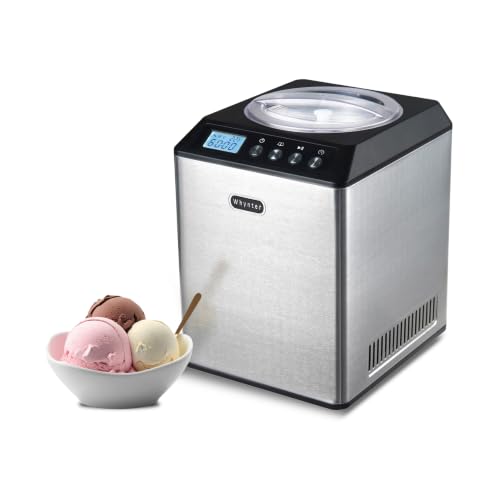
Whynter ICM-201SB Upright Ice Cream Maker 2.1 Qt Compressor — Best Compressor Pick — With Cautions
The Whynter is the machine people dream about: a built-in compressor, no pre-freezing, a 2.1 quart capacity, an LCD display and a timer, churning batch after batch whenever the mood strikes. It is included because it is the benchmark of its class and because readers will find it on their own if this guide omits it. It also carries the strongest electrical caution in this article. Its listing title does not state a voltage, a compressor is a substantially heavier and more complex load than a freezer-bowl motor, and compressor appliances are exactly the wrong candidates for casual converter experiments.
Strengths
- Built-in compressor means no pre-freezing and back-to-back batches on demand
- 2.1 quart capacity is the largest home batch size in this guide
- LCD display and timer give it the most controlled churning here
Trade-offs
- Voltage is not confirmed in the listing, and a compressor load makes transformer sizing a serious, professional-grade question
- Compressors contain refrigerant systems that dislike being run outside their designed electrical conditions
- Heaviest, largest and most expensive class of home ice cream maker to relocate
| Voltage | Not stated in listing title — NOT confirmed 220V; do not assume, verify with the seller and size any conversion professionally |
| Capacity (from listing title) | 2.1 Qt |
| Cooling (from listing title) | Built-in compressor, no pre-freezing needed |
| Controls (from listing title) | LCD display and timer |
The honest advice splits by reader. If you are in a 220 volt country and want compressor ice cream, the correct purchase is a compressor machine sold natively in your market, where the compressor, the electrics and the warranty all match your supply; several global brands sell exactly that through local retailers. The Whynter’s presence here is for the reader who specifically wants this model and is prepared to do the electrical work properly: confirm the rating label, consult the manufacturer about 50Hz operation, and size conversion with an electrician’s help rather than a guess.
Why so much more caution than for the freezer-bowl machines? Because a compressor is a motor doing heavy continuous work against pressure, with starting surges well above its running draw, and because frequency differences can matter to compressor behaviour in ways they never do to a paddle motor. None of this makes the machine bad; it makes it a considered purchase. Buy it with open eyes and professional sizing, or buy its native-voltage equivalent locally with none.
Best for: Dedicated makers who will verify voltage and arrange professional-grade conversion, or who buy the native equivalent locally / Not suited for: Casual converter use, first-time buyers, or anyone who needs a machine that simply plugs into a 220V wall
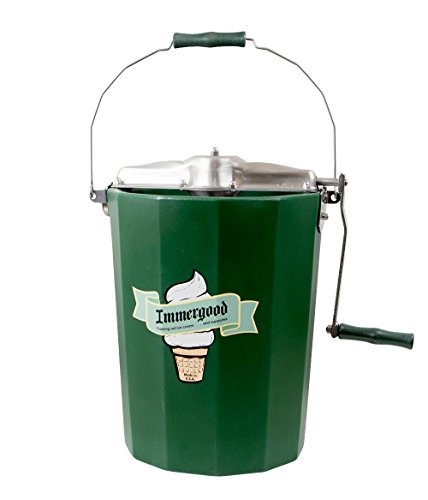
Immergood 6 qt. Stainless Steel Ice Cream Maker — Hand Crank — Best Voltage-Free Pick
Every other pick in this guide negotiates with electricity. This one ignores it. The Immergood is a premium 6 quart stainless steel ice cream maker turned by hand, in the tradition of the great American churn makers: a canister, a dasher, ice and rock salt around it, and a crank that asks for twenty to thirty minutes of sociable effort. In a guide about voltage anxiety, it earns its badge by making the entire problem disappear. There is no plug, no motor, no label to verify and no country on Earth where it does not work.
Strengths
- Genuinely voltage-free: works in every country, off-grid, at cabins, beaches and garden parties
- 6 quart capacity is the biggest batch in this guide, built for gatherings
- Stainless steel build in a premium, repairable, buy-it-for-decades design
Trade-offs
- Hand cranking is real work, best shared in shifts or treated as part of the event
- Needs a supply of ice and rock salt for every batch
- No motor means no walking away; the churn needs a human throughout
| Power (from listing title) | Hand crank — no electricity, no voltage |
| Capacity (from listing title) | 6 qt |
| Build (from listing title) | Stainless steel, premium |
Do not mistake hand-crank for primitive results. The ice-and-salt freezing method is thermodynamically excellent, reaching temperatures that produce dense, smooth ice cream, and generations of makers swore by exactly this format long before compressors existed. The texture rewards the effort, and the ritual, friends taking turns at the crank on a warm evening, is the kind of food memory electric machines rarely create. For a holiday home in a 220 volt country, it may be the most joyful purchase in this entire guide.
Practical notes: budget ice generously, keep the salt ratio sensible, and let the finished ice cream ripen in a freezer for an hour if you want firm scoops. The machine’s simplicity is also its longevity: there is almost nothing in it that can become obsolete, unsupported or electrically incompatible, which in a cross-voltage life is a form of luxury all its own.
Best for: Gatherings, off-grid and holiday homes, traditionalists, and anyone who wants the voltage question gone forever / Not suited for: Anyone who wants push-button ice cream on a weeknight with zero effort
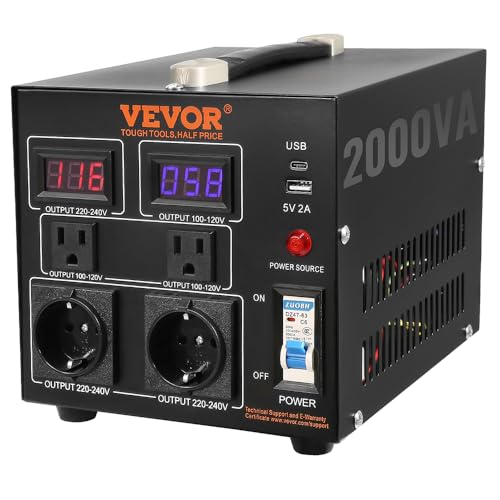
VEVOR Voltage Converter Transformer, 2000W Step Up/Down — Best Transformer for Freezer-Bowl Machines
This is the enabling half of the freezer-bowl route. The VEVOR transformer’s title confirms conversion from 220 volt down to 110 volt at a heavy-duty 2000 watt rating, with US and EU outlets and CE certification stated. Against a freezer-bowl motor’s modest draw, that rating is not merely sufficient, it is lavish, and lavish is exactly what you want from a transformer: cool running, no strain, and a pairing you never have to think about again once it is set up in the corner of the kitchen.
Strengths
- Step-down conversion from 220V confirmed in the listing title at a 2000W rating
- A freezer-bowl motor uses a small fraction of that capacity, giving an exceptional safety margin
- US and EU outlets and stated CE certification suit a permanent installation
Trade-offs
- Still a box to house, ventilate and switch off between uses
- Does not convert frequency, which is irrelevant for a paddle motor but worth knowing
- Must not be borrowed for the compressor machine’s sake without the professional sizing that pick demands
| Type (from listing title) | Step up/down voltage converter transformer |
| Rating (from listing title) | 2000W |
| Conversion (from listing title) | 220V to 110V and 110V to 220V |
| Outlets (from listing title) | US outlet, EU outlet, 5V USB port |
Setup mirrors the other guides in this series: transformer on a hard ventilated surface, machine plugged directly into it, no strips or extension leads, on to churn and off afterwards. With a freezer-bowl machine the session is short and the load is light, so the transformer will barely warm. That cool, unbothered operation is the signature of a correctly sized pairing, and it is achievable here more easily than in any other appliance category in the 220 volt programme.
One boundary bears repeating in this pick’s own review: the comfort of this pairing applies to the freezer-bowl machines. The moment a compressor appliance enters the plan, the sizing conversation changes completely, and this transformer should not be assumed adequate for it. Keep each appliance in its own honest category and the whole system stays safe.
Best for: Running the Cuisinart freezer-bowl picks, and similar small-motor appliances, in 220 volt countries / Not suited for: Compressor ice cream makers or any heavy appliance without professional sizing

LVYUAN Voltage Transformer Converter 2000 Watt Step Up/Down — Best Transformer Alternative
The LVYUAN offers the same verified essentials, conversion from 220-240 volts down to 110-120 volts at a 2000 watt rating, with a socket layout aimed at the relocating kitchen: two US outlets and two universal outlets. An ice cream maker rarely travels alone; it arrives with a blender, a food processor or a stand mixer in the same shipping boxes. One correctly sized transformer, used with one appliance at a time, can serve that whole small fleet, and this is the unit shaped for the job.
Strengths
- Title confirms 220-240V to 110-120V step-down conversion at 2000 watts
- Four outlets across US and universal formats cover a relocated kitchen’s small appliances
- Freezer-bowl ice cream motors sit far inside its capacity, as with the VEVOR
Trade-offs
- Multiple outlets invite simultaneous use; the one-appliance-at-a-time rule still applies
- Same standby warmth and hum as any transformer; switch off between sessions
- Not a licence to run the compressor pick without professional sizing
| Type (from listing title) | Voltage transformer converter, step up/down |
| Rating (from listing title) | 2000 watt |
| Conversion (from listing title) | 220-240V to 110-120V and reverse |
| Outlets (from listing title) | 2 US outlets, 2 universal outlets |
Choose between the two transformers on outlets and availability; for the freezer-bowl machines both are equally, almost excessively, capable. The LVYUAN’s advantage shows over a year of kitchen life, when the same corner unit serves the ice cream maker in summer, the US blender in the morning and a visiting relative’s appliance at Christmas, each in turn, each within the rules.
Keep a small discipline with universal outlets: they accept many plug shapes, which makes it easy to connect something inappropriate absent-mindedly. A strip of tape and a handwritten note listing the approved appliances sounds humble and works perfectly. In cross-voltage kitchens, humble systems beat clever ones.
Best for: Relocated households running a freezer-bowl ice cream maker plus other small US appliances from one unit / Not suited for: Simultaneous appliance use, or compressor machines without professional advice
Comparison Table
| Pick | Badge | Key spec | Best for |
|---|---|---|---|
| Cuisinart ICE-30BCP1 2 Qt. Ice Cream Maker Machine | Best Freezer-Bowl Pick (Via Converter) | 2 Qt freezer bowl; voltage unconfirmed — converter route | Families in 220 volt countries happy to run a simple, low-draw machine through a verified transformer |
| Cuisinart ICE-21P1 1.5-Quart Ice Cream Maker | Best Compact Freezer-Bowl Pick | 1.5 Qt freezer bowl, one-switch; voltage unconfirmed | Couples, small households and experimenters in 220 volt countries using the transformer route |
| Whynter ICM-201SB Upright Ice Cream Maker 2.1 Qt Compressor | Best Compressor Pick — With Cautions | 2.1 Qt compressor, no pre-freeze; voltage unconfirmed | Dedicated makers who will verify voltage and arrange professional-grade conversion, or who buy the native equivalent locally |
| Immergood 6 qt. Stainless Steel Ice Cream Maker — Hand Crank | Best Voltage-Free Pick | 6 qt hand crank — zero electricity | Gatherings, off-grid and holiday homes, traditionalists, and anyone who wants the voltage question gone forever |
| VEVOR Voltage Converter Transformer, 2000W Step Up/Down | Best Transformer for Freezer-Bowl Machines | 2000W step-down 220V to 110V (title-confirmed) | Running the Cuisinart freezer-bowl picks, and similar small-motor appliances, in 220 volt countries |
| LVYUAN Voltage Transformer Converter 2000 Watt Step Up/Down | Best Transformer Alternative | 2000W step-down 220-240V to 110-120V (title-confirmed) | Relocated households running a freezer-bowl ice cream maker plus other small US appliances from one unit |
How to Choose an Ice Cream Maker When Voltage Is the Real Question
Decide your route before you decide your machine, because in this category the route is the decision. If you are buying in a 220 volt country for a permanent home, start locally: native freezer-bowl and compressor machines are sold in every major 220 volt market, with correct plugs and warranties, and no US-storefront guide can link them for you. If you are ordering from Amazon.com, accept the framework of this guide: freezer-bowl machines through a verified transformer, hand-crank with no electricity at all, and compressor machines only with verified voltage and professional sizing.
Within the freezer-bowl route, choose on capacity and freezer reality. Two quarts serves a family and a dinner party; one and a half quarts suits couples and flavour experimenters. Both demand the same discipline: a freezer cold enough to freeze the bowl solid and space to keep it there. If your freezer is a small compartment above a fridge, measure before ordering, because a bowl that cannot lie flat and freeze fully will never churn properly.
Judge any listing you find elsewhere by the standard applied here. If a seller claims a 220 volt ice cream maker, ask where the voltage is stated: in the specifications, on the rating label, in writing. A claim that lives only in a headline adjective, with no specification behind it, is marketing, not evidence, and your money deserves evidence.
Freezer-Bowl, Compressor and Hand-Crank: Texture, Effort and Honest Costs
Freezer-bowl machines make excellent ice cream when the bowl is properly frozen and the base is chilled; their texture ceiling is high and their running costs are trivial. Their price is planning: the bowl must be frozen ahead, every time. Compressor machines remove the planning and add spontaneity and back-to-back batches, at the cost of size, weight, price and, in the cross-voltage context, the most serious electrical homework in this guide.
Hand-crank machines are the dark horse. Their freezing method, ice and salt around a canister, is powerful and proven, their capacity is the largest here, and their independence from electricity is total. Their cost is effort and a supply of ice. For gatherings, that effort is social rather than burdensome; for a quiet Tuesday night, it is fair to call it a project. Match the format to the life you actually live, not the life a product photograph suggests.
Ice Cream Technique That Works at Any Voltage
Great homemade ice cream is mostly technique, and technique is gloriously voltage-independent. Chill your base thoroughly, ideally overnight, before churning; a cold base freezes faster and smoother in every machine format. Do not overfill: ice cream expands as it churns and incorporates air, and an overfilled canister churns poorly and freezes unevenly. Add delicate mix-ins in the last few minutes so they distribute without being pulverised.
Expect churned ice cream to emerge at soft-serve consistency and plan a ripening rest in the freezer, one to two hours in a shallow container, for firm scoops. Store leftovers with cling film pressed directly on the surface to fight ice crystals. None of this changes whether your motor turns on 120 volts stepped down from 220, or your arm turns the crank; the physics of the dessert is the same everywhere on Earth.
The Local-Market Compressor Machines This Guide Cannot Link
Because honesty is this article’s foundation, it should name what it cannot sell you. In 220 volt countries, the major appliance ecosystems sell native ice cream makers through local retail: freezer-bowl models from the big European kitchen brands, compressor machines from Italian and German makers with long dessert traditions, and budget local lines that never appear on a US storefront at all. A reader furnishing a permanent home in such a country will usually find a native machine at a fair local price with a plug that fits and a warranty that functions.
The US-storefront routes in this guide earn their place for specific situations: the relocator whose kitchen is already American, the buyer in a market with thin local retail, the gift sent across borders, and the household that wants a specific model like the Cuisinarts above. Knowing both menus, local and imported, and choosing deliberately between them is what separates a good purchase from a defaulted one.
Freezer-Bowl Troubleshooting: Fixing Soft, Icy or Grainy Results
Soft results almost always trace back to temperature discipline: a bowl that was not frozen solid, a base that went in warm, or a freezer running warmer than its dial suggests. Fix the chain in order: bowl at the back of the freezer for a full night or more, base chilled overnight, machine assembled cold and filled promptly. If the result is still soft, your freezer itself is the suspect, and a cheap freezer thermometer will confirm it in a day.
Icy or grainy texture is a different fault with different cures. Large crystals form when freezing is slow or the mixture is too lean; a base with adequate fat and sugar, churned promptly and ripened in a shallow container, freezes smoother. Graininess in custard bases usually means the eggs were overheated before churning, a stovetop error no machine can undo. Diagnose by texture and the fix follows, at any voltage, in any country, which is the quiet comfort of a mechanical dessert.
Ice, Salt and the Hand-Crank Method: A Short Masterclass
The hand-crank maker’s freezing power comes from a simple trick: salt lowers the melting point of ice, so the ice-and-salt mixture surrounding the canister becomes far colder than ice alone, cold enough to freeze the base against the canister wall while the dasher scrapes it smooth. Layer ice and salt around the canister as the maker directs, keep the mixture topped up as it melts, and crank steadily rather than heroically; the dasher should meet gentle, growing resistance as the ice cream sets.
Know the finish line. The crank grows heavy as the dessert thickens, and experienced makers stop when the resistance says the mass is uniformly set, then pack the canister down and let it ripen, traditionally under a blanket of fresh ice, for an hour. Serve from that ripening and you will understand why this format survived a century of electric competition: the texture is dense, the flavour clean, and the making of it was half the pleasure.
Serving and Storing: The Last Mile of Homemade Ice Cream
Homemade ice cream’s reputation is decided after the churning stops. Serve it at soft-serve consistency straight from the machine for the creamiest possible texture, or ripen it in the freezer for firm scoops, but store it correctly either way: a shallow, airtight container, film pressed directly onto the surface, and the coldest part of the freezer rather than the door, where temperatures swing with every opening. Stored that way, a good base keeps its texture for a week; stored carelessly, it becomes a sweet ice block in two days.
Scooping is a small craft of its own. A scoop warmed in hot water between servings cuts cleanly and releases neatly, and letting a ripened container stand at room temperature for five to ten minutes before scooping restores the texture the freezer hardened. None of this depends on the machine, the voltage or the country, which is the fitting final lesson of this guide: once the electrical question is answered honestly, everything else about ice cream is craft, and craft travels anywhere.
How to Make Your First Batch with a Freezer-Bowl Machine on a Transformer
This walkthrough assumes the most common setup in this guide: a Cuisinart freezer-bowl machine powered through a verified step-down transformer in a 220 volt kitchen.
- The night before, place the freezer bowl at the back of your freezer, upright and level, and leave it for a full night or longer until it is frozen completely solid.
- Make your base and chill it thoroughly in the fridge, ideally overnight alongside the bowl; a cold base is the single biggest texture upgrade available to you.
- Set the transformer on a hard, ventilated surface, plug it into the wall directly, and plug the ice cream maker into the transformer’s US outlet.
- Assemble the machine with the frozen bowl, paddle and lid before switching anything on.
- Switch on the transformer, start the motor first, then pour the chilled base through the ingredient spout; motor-first prevents the base freezing to the bowl wall in a solid lump.
- Churn until the mixture thickens and climbs the paddle, typically twenty to thirty minutes, adding mix-ins through the spout in the final few minutes.
- Transfer to a shallow container, press film onto the surface, and ripen in the freezer for one to two hours for firm scoops.
- Switch the transformer off, wash the paddle and lid in warm soapy water, let the bowl return to room temperature before washing it, dry it fully, and return it to the freezer ready for next time.
Followed once, this routine becomes muscle memory, and the transformer fades into the background of a kitchen that simply makes good ice cream. The only step that must never be skipped is the order: transformer on first, machine second, every single time.
Common Buying Mistakes
- Believing a listing that implies a 220V machine without stating it. In this category, our targeted API searches found no electric model whose title states 220V. If the voltage is not in the specifications or on the rating label, it is not confirmed.
- Plugging a US ice cream maker straight into a 220V socket. Even a small motor is destroyed by double voltage. The transformer is not optional equipment for the electric picks.
- Treating a compressor machine like a freezer-bowl machine. Compressor loads are heavier, surge on starting and are sensitive to electrical conditions. They need verified voltage and professional sizing, not optimism.
- Under-freezing the bowl. A bowl that had a few hours in a weak freezer produces soup. Freeze it fully, at the back of a cold freezer, for a full night or more.
- Churning a warm base. A room-temperature base overwhelms a freezer bowl. Chill the base thoroughly and the same machine produces a different dessert.
- Forgetting the hand-crank option exists. For gatherings and holiday homes, the voltage-free route is not a compromise; it is often the best tool in this entire guide.
Final Recommendation
Start with the route, then the machine. For most Amazon.com buyers in 220 volt countries, the Cuisinart ICE-30 through the VEVOR transformer is the sweet spot: family capacity, a simple low-draw motor and an enormous electrical safety margin, with the ICE-21 as the compact alternative and the LVYUAN as the transformer for a whole fleet of small US appliances. For gatherings and anywhere electricity is a question, the Immergood hand-crank removes the question entirely and makes the biggest batch here. For compressor luxury, buy natively in your local market, or take the Whynter route only with verified voltage and professional sizing.
Above all, hold the line this guide was written around: no electric ice cream maker in the US catalogue confirmed 220 volts, so no honest guide can sell you one. Buy the route that matches your life, with the voltage facts in writing, and the ice cream will take care of itself.
The shortlist in one line: Cuisinart ICE-30BCP1 2 Qt. Ice Cream Maker Machine; Cuisinart ICE-21P1 1.5-Quart Ice Cream Maker; Whynter ICM-201SB Upright Ice Cream Maker 2.1 Qt Compressor; Immergood 6 qt. Stainless Steel Ice Cream Maker — Hand Crank; VEVOR Voltage Converter Transformer, 2000W Step Up/Down; LVYUAN Voltage Transformer Converter 2000 Watt Step Up/Down.
Keep exploring related guides on this site: Best 220 Volt Microwave Best 220 Volt Keurig Best 220 Volt Portable Air Conditioner Best Ice Cream Makers Best Compressor Ice Cream Makers
Frequently Asked Questions
Is there a native 220 volt ice cream maker I can buy on Amazon.com?
We could not verify one. Across targeted Amazon listing data searches using several 220 volt phrasings, no electric ice cream maker listing stated 220V, 230V or 240V in its title. Native 220 volt machines certainly exist in local markets overseas, but on the US storefront the honest options are the transformer route, or the hand-crank machine that needs no electricity at all.
Can I run a US ice cream maker on a transformer safely?
For freezer-bowl models, yes, and it is one of the easiest transformer pairings in any kitchen, because the motor draw is modest and the verified transformers in this guide are rated far above it. Follow the standard rules: step-down conversion confirmed, appliance plugged directly into the transformer, one appliance at a time, transformer off between uses.
Why is the compressor model treated so much more cautiously?
A compressor is a heavier, more complex load than a paddle motor, with starting surges and a refrigerant system designed around specific electrical conditions. Its listing also does not confirm a voltage. That combination deserves verified information and professional sizing rather than a hopeful plug-in, which is why this guide recommends buying compressor machines natively in your own market where possible.
How long does a freezer bowl need to freeze before churning?
A full night is the working rule, longer in a weak or crowded freezer, with the bowl upright at the back where the cold is most stable. Shake the bowl before use: if you hear liquid moving, it is not ready, and churning anyway produces soft, icy results.
Does the hand-crank maker really make good ice cream?
Yes. The ice-and-salt method reaches very low temperatures and has produced excellent ice cream for generations. Expect twenty to thirty minutes of cranking, ideally shared, and a short ripening rest in the freezer for firm scoops. What it asks in effort it repays in capacity, texture and total independence from any electrical supply.
What should I check on a second-hand or locally listed 220 volt machine?
Ask for a photograph of the rating label and check the stated voltage and frequency against your supply in writing. Confirm the plug type, ask whether the machine was designed for your market or imported, and be wary of any seller who describes a machine as 220 volt but cannot show the label that proves it.
How many watts does a freezer-bowl ice cream maker use?
Very few compared with heating appliances: the motor only turns a paddle in a pre-frozen bowl. That modest draw is exactly why the freezer-bowl class pairs so comfortably with the 2000 watt transformers verified in this guide, running far inside their ratings. Always confirm a specific machine’s rating label when it arrives, as with any appliance used on a converter.
Can I leave the freezer bowl in the freezer permanently?
Yes, and many owners do exactly that: a bowl stored in the freezer is always ready, which removes the planning barrier that stops people using these machines. Just keep it upright, sealed from freezer odours if your freezer is crowded, and confirm it is frozen solid, with no liquid sound when shaken, before each churn.