Disclosure: airfryerkitchensupply.com is reader-supported. When you buy through links on our site, we may earn an affiliate commission at no extra cost to you.
Where to buy
The best inexpensive 4 slice toasters prove that family capacity does not require a family-sized budget — provided you spend on the things that matter (slots, controls, crumb tray) and let the makers save on the things that do not (displays, apps, sculpture). Every pick below is a four-slice machine verified against its own listing for this guide, positioned in the accessible tiers of its maker’s range. Use the links to check price on Amazon — this guide prints no prices, because the point of the category is the value you confirm at purchase, not a number that ages.
- Hamilton Beach 4 Slice Toaster 24796 Digital — Best Overall Inexpensive: Check the current price on Amazon
- Cuisinart CPT-142P1 4-Slice Compact Plastic Toaster — Best Compact Inexpensive: Check the current price on Amazon
- BLACK+DECKER 4-Slice Toaster with Dual Shade Controls — Best Dual Controls for the Money: Check the current price on Amazon
- Proctor Silex 4 Slice Toaster 24215G — Best Simple and Basic: Check the current price on Amazon
- bella Fits-Anywhere Slim Toaster 4 Slice — Best Slim for Tight Counters: Check the current price on Amazon
- Cuisinart CPT-180P1 4-Slice Toaster — Best Step-Up Inexpensive: Check the current price on Amazon
Four slices is the family format, and inexpensive is the family budget’s first language, so this category matters out of proportion to its glamour. The good news, established by the picks below, is that the four-slice essentials are genuinely affordable: extra-wide slots, dual or well-judged single controls, bagel and defrost functions, shade ranges that span real preferences, and crumb trays that come out without a struggle. Those essentials live in the accessible tiers of every major maker’s line, because four-slice toasters are a mature, high-volume product where the engineering was paid off long ago.
The discipline of this guide is knowing what inexpensive should not cost you. It should not cost you slot width — a four-slice machine that cannot take a bagel is a two-slice machine with delusions. It should not cost you shade range or a cancel button. And it should not cost you the second year: the false economy of this category is the machine so cheaply built that it is replaced annually, at which point it costs more than the mid-tier machine it imitated. Every pick here is from a maker whose four-slice line has the production history to be a multi-year purchase — that, more than any feature, is what ‘best inexpensive’ means in this guide.
One honest framing before the picks: inexpensive four-slice machines compete on completeness and competence, not on the last degree of browning artistry. If your household’s bread is uniform and your mornings are busy, that trade is not a compromise at all — it is the correct allocation of a family’s money, and the toast will be good every single day.
In this guide
Quick Picks
Six four-slice machines from the accessible tiers: digital and dial, slim and standard, simple and dual-controlled. All verified; each is the value answer to a slightly different family.
- Hamilton Beach 4 Slice Toaster 24796 Digital — Best Overall Inexpensive: The complete value formula with a digital face: extra-wide slots, bagel setting, Toast Boost, slide-out tray, auto-shutoff, cancel, and defrost per its listing. Check price on Amazon
- Cuisinart CPT-142P1 4-Slice Compact Plastic Toaster — Best Compact Inexpensive: Four slices in a compact footprint: Cuisinart’s space-saving four-slice in white — the small-kitchen family’s machine from a first-rank maker. Check price on Amazon
- BLACK+DECKER 4-Slice Toaster with Dual Shade Controls — Best Dual Controls for the Money: Two shades at once, at a value tier: dual shade controls, extra-lift levers, and pull-out crumb trays per its listing — the two-preference family’s inexpensive answer. Check price on Amazon
- Proctor Silex 4 Slice Toaster 24215G — Best Simple and Basic: The no-nonsense pick: extra-wide slots for bagels, seven shade settings, auto shutoff, Toast Boost, slide-out tray, and cancel per its listing — in white, without a single unnecessary idea. Check price on Amazon
- bella Fits-Anywhere Slim Toaster 4 Slice — Best Slim for Tight Counters: The footprint solution: a slim four-slice with an extra-long, wide slot per its listing, in bella’s Oatmilk finish — four-slice capacity for counters that run front-to-back, not side-to-side. Check price on Amazon
- Cuisinart CPT-180P1 4-Slice Toaster — Best Step-Up Inexpensive: The stretch pick: dual independent controls and six-setting dials in brushed stainless per its listing — the classic four-slice formula for buyers whose inexpensive stretches one tier up. Check price on Amazon
How These Picks Were Chosen
The first filter was the four-slice essentials checklist, applied without mercy: four genuine slots (not two long slots in disguise — though one pick’s long-slot layout earns its place honestly), extra-wide geometry or a named bagel capability, a shade range of at least six or seven settings, defrost and cancel functions, and a removable or slide-out crumb tray. Machines missing essentials were excluded no matter how low their tier. Every linked pick was verified against its own Amazon listing, and every feature named here is the listing’s own.
The second filter was maker staying power. Inexpensive is only inexpensive if the machine lasts and can be replaced like-for-like; the picks therefore come from Hamilton Beach, Cuisinart, BLACK+DECKER, Proctor Silex, and bella — lines with deep four-slice production history at exactly these tiers.
The set was then spread across the real variations families ask for: a digital model for households that like a display’s clarity, a compact model for small counters, a slim long-slot model for galley kitchens, a dead-simple model for households that want dials and nothing else, and one step-up model for buyers whose ‘inexpensive’ stretches to the classic stainless formula. Whatever your family’s shape, one badge below is written for it.
The 6 Best inexpensive 4 slice toasters
Prices are deliberately absent — check them at the links. Judge these reviews on completeness, geometry, and which family’s morning each machine fits, because at these tiers the differences that matter are fit, not finesse.
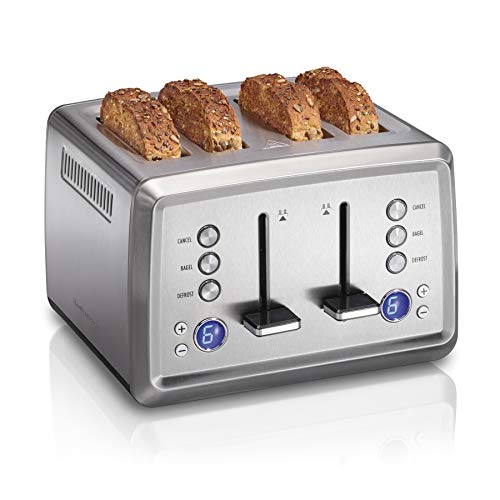
Hamilton Beach 4 Slice Toaster 24796 Digital — Best Overall Inexpensive
The 24796 takes the value formula from Hamilton Beach’s two-slice line and scales it to the family format without losing a single item. Per its verified listing: four extra-wide slots, a bagel setting, Toast Boost for small slices, a slide-out crumb tray, auto-shutoff and cancel, and digital controls with a defrost function, in stainless steel. The digital interface is the differentiator at this tier — shade selection you can read at a glance and repeat exactly — paired with the mechanical virtues (boost, tray, wide slots) that decide daily life. As an overall inexpensive pick, it is the machine with the fewest asterisks in the guide.
Strengths
- Complete essentials: extra-wide slots, bagel, defrost, cancel, auto-shutoff per the listing
- Toast Boost solves the small-slice problem that plagues family machines
- Digital controls give repeatable, readable shade selection for a multi-person household
Trade-offs
- Digital interface is a preference, not a universal good — dial loyalists have picks below
- Value-tier fit and finish, as across this guide
- Stainless at this tier is a finish as much as a structure; treat it kindly
| Specification | Detail |
|---|---|
| Slots | 4, extra-wide (per verified listing) |
| Controls | Digital, with defrost function |
| Functions | Bagel setting, cancel, auto-shutoff |
| Lift | Toast Boost |
| Crumb tray | Slide-out |
Families are hard on toasters in a specific way: many operators, no training, no mercy. The 24796’s specification reads like a response to that environment — controls that state their setting visibly, a boost that forgives small slices, a tray that slides out before the crumbs become a smoky complaint, and an auto-shutoff standing guard over the distracted. None of these is a luxury. Together they are why this machine, at its tier, generates fewer household grievances than rivals with better brochure browning.
Buy it as the default family answer when the brief is ‘four slices, complete, affordable, done.’ Households with strong feelings about dials, counters, or simplicity have their own picks below — but they are refinements of taste around this pick’s completeness, not corrections of it.
Best for: Families wanting the complete four-slice feature set at an accessible tier / Not suited for: Dial purists or tiny counters
Check the current price on Amazon
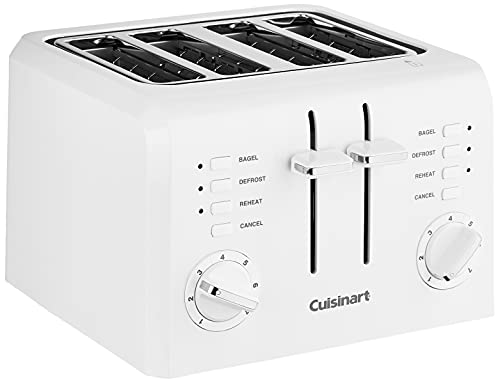
Cuisinart CPT-142P1 4-Slice Compact Plastic Toaster — Best Compact Inexpensive
Counter space is the tax small kitchens pay on every appliance, and the CPT-142P1 is Cuisinart’s answer: a four-slice toaster in a compact body, in white, from the maker whose toaster line anchors this site’s home guide. Compact four-slice machines are a genuinely useful format — the capacity of a family machine with a footprint closer to a two-slice’s — and buying it from Cuisinart rather than from a novelty brand means the compactness is packaging, not a euphemism for flimsiness. For apartments, galley kitchens, and counters shared with a coffee station and a knife block, it is the format that fits real life.
Strengths
- Four-slice capacity in a compact body — the small kitchen’s format
- Cuisinart’s toaster lineage and support behind an accessible-tier machine
- White finish suits bright, small kitchens where stainless crowds visually
Trade-offs
- Plastic body construction is the tier’s trade — lighter and less premium in hand than metal models
- Compact slots reward standard bread; the most extreme artisan cuts belong to wider machines
- White shows toast-era evidence and asks for a wipe-down habit
| Specification | Detail |
|---|---|
| Slots | 4, compact format |
| Body | Plastic, white (per verified listing) |
| Model | CPT-142P1 |
| Maker | Cuisinart |
The compact four-slice is an underrated answer to a common mis-buy: the family that purchases a two-slice machine for its footprint and then spends years running double cycles — paying in time and machine wear what it saved in inches. The CPT-142P1 refuses that trade. It asks for modestly more counter than a two-slice and returns full family simultaneity, which on school mornings is the entire game. Its accessible tier is achieved through body material and simplicity, not through missing functions or undersized ambition.
Choose it where the counter is the constraint and the family is not. Dorm-adjacent apartments, first family homes, holiday flats, and office kitchenettes all fit its brief. If your counter is generous, the standard-size picks give you more slot and more substance for similar money — but inches are a real currency, and this is the pick that spends them best.
Best for: Small kitchens and apartments needing true four-slice capacity / Not suited for: Homes with generous counters wanting metal construction
Check the current price on Amazon
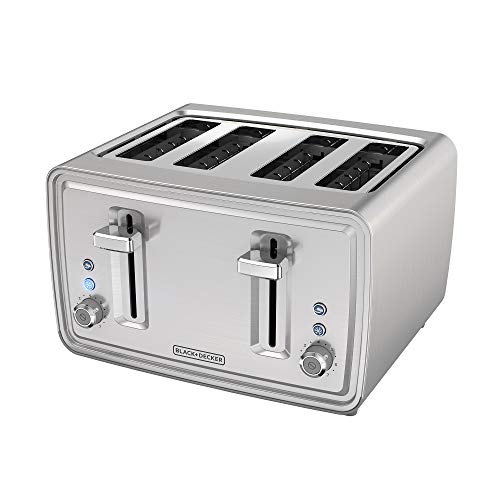
BLACK+DECKER 4-Slice Toaster with Dual Shade Controls — Best Dual Controls for the Money
Dual controls are the family feature this guide keeps praising, and BLACK+DECKER’s four-slice brings them to the accessible tier: per its verified listing, dual shade controls let two sides run different browning simultaneously, extra-lift levers raise small slices into reach, and pull-out crumb trays make cleanup easy. That trio is a thoughtful value specification — it spends on the three interactions families perform daily (set two shades, retrieve small toast, empty crumbs) and saves on everything they do not. For the household split between light and dark toast loyalists, it is the inexpensive machine that ends the argument.
Strengths
- Dual shade controls per the listing — the family feature, at a family price tier
- Extra-lift levers address small-slice retrieval without utensils
- Pull-out crumb trays, plural, for straightforward cleanup
Trade-offs
- Value-tier materials and browning finesse, in line with this guide’s honest framing
- No digital display or inspection functions — dial-era simplicity
- Brand’s strength is ubiquity and value rather than premium longevity
| Specification | Detail |
|---|---|
| Slots | 4 |
| Controls | Dual shade controls (per verified listing) |
| Lift | Extra lift levers |
| Crumb trays | Pull-out trays |
There is a design intelligence in knowing which features survive a budget. Displays crack, apps deprecate, and designer finishes date — but dual controls, a tall lift, and an easy tray are as useful in year five as on day one, because they map to permanent facts about families rather than to fashion. BLACK+DECKER, which has sold four-slice toasters at this tier for generations, builds exactly to that map, and the result is the pick for households that comparison-shop features-per-dollar with a clear head.
Its ceiling is the category’s ceiling: browning artistry and material richness belong to higher tiers, and a household that graduates to daily artisan bread will eventually graduate its toaster too. Until then, this machine covers the family’s actual requirements with nothing missing and nothing wasted — which is the definition of a good inexpensive purchase.
Best for: Two-shade families wanting dual controls at an accessible tier / Not suited for: Single-preference households or artisan specialists
Check the current price on Amazon

Proctor Silex 4 Slice Toaster 24215G — Best Simple and Basic
Proctor Silex occupies the honest-basics corner of the appliance world, and the 24215G is that philosophy in a four-slice toaster. Its verified listing is quietly complete: extra-wide slots sized for bagels, browning control across seven shades — more gradation than most of this guide — auto shutoff, Toast Boost, a slide-out crumb tray, and a cancel button, in a white body. Nothing here is a headline; everything here is used daily. For households that view a toaster the way they view a kettle — an appliance, not an interest — this is the pick that respects the view.
Strengths
- Seven shade settings per the listing — the widest gradation in this guide
- Extra-wide slots explicitly for bagels, plus Toast Boost for small slices
- Complete safety and cleanup set: auto shutoff, cancel, slide-out tray
Trade-offs
- White plastic-era presentation; it will never be mistaken for a premium appliance
- Single control scheme — dual-shade households should take the BLACK+DECKER above
- Basics-tier longevity expectations: years, not decades
| Specification | Detail |
|---|---|
| Slots | 4, extra-wide for bagels (per verified listing) |
| Shades | 7 browning settings |
| Functions | Auto shutoff, cancel, Toast Boost |
| Crumb tray | Slide-out |
| Finish | White |
Seven shades deserves a moment, because it inverts the usual value logic: the basics brand offers finer browning gradation than several premium-trim rivals. For the household member with an exact toast preference — and every family has one — gradation is the feature that determines whether the machine is loved or tolerated. Paired with genuinely wide slots and the boost, the 24215G covers the preference-sensitive family better than its plain white body suggests.
Buy it for second homes, rental properties, first family kitchens, and any counter where the toaster’s job is to be complete, safe, and unremarkable. It is the least exciting pick in this guide and, for a significant share of real households, the most correct one.
Best for: Basics-first households, rentals, and second homes / Not suited for: Dual-shade families or design-led kitchens
Check the current price on Amazon

bella Fits-Anywhere Slim Toaster 4 Slice — Best Slim for Tight Counters
Bella’s Fits-Anywhere line is built around a real kitchen geometry: many counters are deep but narrow, with the usable run broken by sinks, stoves, and coffee stations. A slim toaster — long and narrow rather than wide and square — slots into runs where a conventional four-slice body cannot. Per its verified listing, this model serves four slices through an extra-long, wide slot arrangement, in the line’s Oatmilk finish. The long slot is also a bread statement: full artisan slices laid lengthwise toast in their natural shape, which standard slots force into two compromised rounds.
Strengths
- Slim profile fits narrow counter runs that reject standard four-slice bodies
- Extra-long, wide slot per the listing — artisan slices toast whole, lengthwise
- Contemporary Oatmilk finish suits modern kitchens at a value tier
Trade-offs
- Long-slot layout toasts four standard slices in a row; shade can vary slightly along a long element’s length compared with paired slots
- Single-zone control — no dual shades for split households
- Bella is a value design brand; longevity expectations should match the tier
| Specification | Detail |
|---|---|
| Layout | 4-slice, extra-long and wide slot (per verified listing) |
| Profile | Slim, Fits-Anywhere line |
| Finish | Oatmilk |
| Maker | bella |
Layout is the under-discussed toaster decision, and this pick exists to make it discussable. Paired slots — the standard four-slice — give the most independent control. Long slots give shape freedom: the bakery loaf’s full slice, four slices in a file, a footprint that threads between the kettle and the wall. Households whose bread is bakery-shaped and whose counters are galley-shaped will find this pick answers two problems with one appliance, which is exactly what good value design is supposed to do.
The compromises are stated plainly above: one control zone, and long-element evenness that rewards rotating long slices halfway in the first week while you learn your machine. For the kitchens it fits — literally — those are small prices. Measure your counter run before ordering anything in this guide; if the run is narrow, this review just became the most relevant one on the page.
Best for: Galley kitchens, narrow counters, and artisan-slice households / Not suited for: Dual-shade families or buyers wanting paired-slot independence
Check the current price on Amazon
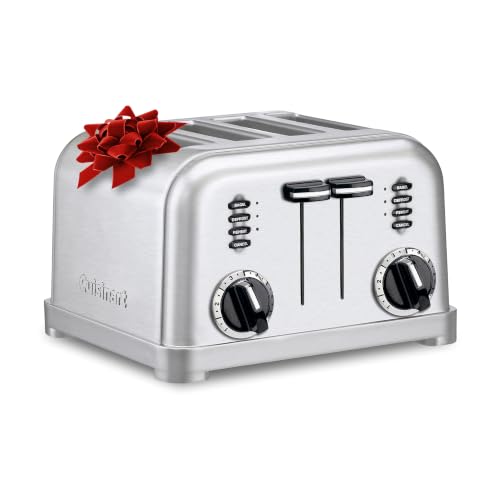
Cuisinart CPT-180P1 4-Slice Toaster — Best Step-Up Inexpensive
Every value guide needs its stretch pick — the machine for the buyer who came for inexpensive and can be persuaded, by arithmetic, to buy once at the classic tier instead. The CPT-180P1 is that machine: per its verified listing, four extra-wide slots, dual independent controls with six-setting browning dials, in brushed stainless steel. It appears in this site’s home toasters guide as the classic family formula, and it appears here because its price tier, while above the other picks’, is still within the honest meaning of inexpensive for a machine expected to serve a family for many years — the per-year cost is where it wins its argument.
Strengths
- Dual independent controls with proper dials — the complete family control scheme
- Brushed stainless construction at the durable end of the accessible market
- Extra-wide slots cover the full family bread range
Trade-offs
- The highest tier in this guide — it is the stretch, not the bargain
- No digital or inspection features; classic dial operation
- Four-slice footprint in full standard size
| Specification | Detail |
|---|---|
| Slots | 4, extra-wide (per verified listing) |
| Controls | Dual independent, 6-setting dials |
| Body | Brushed stainless steel |
| Model | CPT-180P1 |
The per-year argument deserves to be made explicitly, because it is the one that decides real purchases. A machine at the classic tier that serves seven years costs less per breakfast than a basics-tier machine replaced twice in the same span — and delivers better toast, dual controls, and metal construction throughout. That is not an upsell; it is amortization, and it is why this guide, devoted to inexpensive machines, ends with a pick that asks for a little more on day one.
Choose it if the budget has any flex at all and the household is settled — this is the four-slice toaster a family buys when it stops moving house every two years. The dials will be learned in a weekend, the slots will take whatever the bakery sends, and the stainless will outlast the kitchen’s next two color schemes.
Best for: Settled families able to stretch one tier for a multi-year machine / Not suited for: Strict-budget or temporary-living purchases
Check the current price on Amazon
Comparison Table
Six ways to buy four slices wisely. Controls and slot claims are from the verified listings; prices are yours to check at the links, as this guide’s category demands.
| Pick | Badge | Key spec | Best for |
|---|---|---|---|
| Hamilton Beach 4 Slice Toaster 24796 Digital | Best Overall Inexpensive | 4 extra-wide slots, digital, Toast Boost | Families wanting the complete four-slice feature set at an accessible tier |
| Cuisinart CPT-142P1 4-Slice Compact Plastic Toaster | Best Compact Inexpensive | 4 slots, compact body, white | Small kitchens and apartments needing true four-slice capacity |
| BLACK+DECKER 4-Slice Toaster with Dual Shade Controls | Best Dual Controls for the Money | 4 slots, dual shade controls, extra lift | Two-shade families wanting dual controls at an accessible tier |
| Proctor Silex 4 Slice Toaster 24215G | Best Simple and Basic | 4 extra-wide slots, 7 shades, Toast Boost | Basics-first households, rentals, and second homes |
| bella Fits-Anywhere Slim Toaster 4 Slice | Best Slim for Tight Counters | Slim long-slot x4, Oatmilk finish | Galley kitchens, narrow counters, and artisan-slice households |
| Cuisinart CPT-180P1 4-Slice Toaster | Best Step-Up Inexpensive | 4 extra-wide slots, dual dials, stainless | Settled families able to stretch one tier for a multi-year machine |
How to Choose the Best Inexpensive 4 Slice Toasters
Hold the essentials line. At the accessible tiers, the negotiation with the maker should go like this: you may save on displays, finishes, and brand theater; you may not save on slot width, shade range, defrost and cancel functions, auto shutoff, or a crumb tray that removes without tools. Every pick in this guide holds that line — extra-wide or bagel-named slots, six or seven shade settings, the full function set. A cheaper machine that breaks the line is not a better bargain; it is a different, lesser product wearing the same slot count.
Decide your control scheme by household politics. Two shade preferences under one roof make dual controls — offered here by the BLACK+DECKER and the step-up Cuisinart — the single most valuable feature in the category, worth more than any display. One-preference households should pocket the savings and take a single-control machine without a second thought. Digital versus dial is taste, not quality: digital reads clearly and repeats exactly; dials are intuitive for every guest and child. Both appear here because both are right for somebody.
Fit the footprint before the features. Standard four-slice bodies need a square of counter; the compact Cuisinart shrinks the square; the slim bella threads a narrow run and toasts long slices whole. Measure the actual run the toaster will live on — between the kettle and the wall, under the cabinet’s true clearance — and let the tape measure eliminate picks before preference argues. A toaster that does not fit gets stored, and a stored toaster is a daily tax on breakfast.
Finally, price the machine per year, not per purchase. The inexpensive tier’s trap is the annual replacement: two cheap machines in three years cost the classic tier’s price and deliver worse toast throughout. The picks here are chosen from lines with the production depth to last — that is the real content of ‘best inexpensive.’ Set a five-year expectation, keep the crumb tray empty, and any machine on this page will come in under the per-year cost of the disposable alternative.
What You Give Up at This Tier — and What You Don’t
Honesty about tiers helps buyers relax. What you do not give up in this guide’s picks: capacity, slot width, shade range, the safety functions, or competent everyday browning on standard breads. A family’s Tuesday toast from these machines is, slice for slice, a good breakfast. What you do give up lives at the margins: the last degree of edge-to-edge evenness on wildly uneven artisan slices, premium materials and heft, inspection electronics, and the decades-long repairability story of the heritage machines in this cluster’s high end guide.
For most families, those margins are correctly traded away — the money serves better elsewhere in a household budget. The buyers who should not trade are the daily artisan bakers and the buy-once-for-decades households, and this site has guides for both. Everyone else can buy from this page with confidence that ‘inexpensive’ here means ‘wisely specified,’ not ‘barely adequate.’
Reading Four-Slice Specifications Like a Skeptic
Value-tier listings reward skeptical reading, and three specifications deserve translation. ‘Extra-wide slots’ has no legal definition, so compare the claim against the foods the listing names — the picks here name bagels explicitly, which is the width claim that matters, and one listing in this cluster’s wider research stated slot dimensions outright. When dimensions are stated, use them: measure your thickest regular slice and demand clearance, not contact. A slot your bread must be persuaded into will toast it unevenly no matter what the shade dial promises.
Shade counts need the same treatment. Six, seven, or eight settings are only as good as their spread: some machines cluster their settings at the light end and jump to dark in the last notch. The calibration routine in this guide — test slices at successive settings in week one — exposes a machine’s true spread immediately, and the picks here were chosen from lines whose spreads owners consistently describe as usable across the range. Treat the first week’s toast as the specification sheet you can eat.
Finally, wattage at this tier is worth one glance. Four slots share the machine’s power budget, and very low-powered four-slice machines toast slowly and pale on back-to-back family rounds. You need not chase numbers — the established lines in this guide power their four slots adequately by design — but a suspiciously low figure on an unknown brand is the specification that predicts the most common value-tier disappointment: toast that takes forever and never quite crisps. Skepticism, applied to three numbers, is the whole skill of buying well at this tier.
The Family Breakfast System Around the Toaster
An inexpensive four-slice toaster succeeds as part of a system, and the system costs almost nothing. Stage the bread at the toaster, not across the kitchen — every step saved is a slice served hotter. Butter and spreads belong at the landing zone beside the machine, because toast waits for no one’s walk to the refrigerator and still be crisp. A small rack or a tent of finished slices keeps early rounds from steaming while later rounds run, solving the four-slice machine’s only real scheduling problem: the first slices are done before the eggs are.
Assign the machine a captain on big mornings. Four slots, two controls, and three helpers producing four different requests is how orders get crossed; one person running the toaster — taking requests like a short-order cook — turns the same equipment into a small, cheerful production line. Children graduate to this job happily, and a household that runs its breakfast like a diner for ten minutes eats like one too.
None of this requires a better toaster. It requires treating the inexpensive machine you bought as equipment rather than as an apology — calibrated, staged, captained, and crumb-emptied. Do that, and the conclusion most families reach is the one this guide opened with: at the breakfast table, the gap between this page’s machines and the flagship guides’ machines is far smaller than the gap between a system and a scramble.
Accessories That Are Worth It at This Tier
The inexpensive philosophy extends to accessories: buy the few that multiply the machine, skip the rest. Worth it, first: wooden toast tongs, which end the small-slice retrieval problem safely on any machine without a boost or high lift, and cost less than a loaf of the bread they rescue. Second, a simple wire rack beside the toaster, so finished rounds rest without steaming while the family’s later rounds run — the accessory that most improves four-slice output costs almost nothing and has no moving parts to fail.
Third, for households that freeze bread — which is to say, most households that buy in bulk — a freezer routine is an accessory in spirit: slice before freezing, freeze flat, and toast from frozen through the defrost mode. The machine already owns the technology; the routine is what unlocks it, and it converts the inexpensive toaster into a fresh-bread system that outperforms a premium machine fed stale loaves.
What to skip: warming racks that perch over slots and warm unevenly, novelty covers that trap heat and crumbs against the body, and any electronic add-on promising to make a value toaster smart. The picks in this guide were chosen complete; their honest accessories are a pair of tongs, a rack, and a freezer habit — a total outlay smaller than the price difference between any two machines on this page.
Second Homes, Rentals, and Shared Kitchens
A significant share of inexpensive four-slice machines are bought not for a family’s main kitchen but for the kitchens around its edges — the holiday flat, the rental property, the office kitchenette, the student house — and those environments have their own specification. Operators are strangers: controls must explain themselves, which favors dials and clearly labeled functions over idiosyncratic interfaces. Use is intermittent but occasionally intense. And the machine will be cleaned by whoever loses the argument, which argues for the simplest crumb arrangements in this guide.
For those seats, this guide’s ranking quietly reorders itself: the Proctor Silex’s plain completeness and the BLACK+DECKER’s self-evident dual dials rise, while digital interfaces and layout novelties fall. Durability expectations should also be set by the environment rather than by the badge — a rental kitchen’s toaster lives a harder, less loved life than a family machine, and the correct response is not a more expensive toaster but a replacement budgeted as a consumable of the property. Bought with that honesty, the inexpensive four-slice is not merely a home appliance; it is the standard equipment of every secondary kitchen that feeds people properly.
One last shared-kitchen habit is worth adopting everywhere, secondary kitchen or not: leave the machine’s settings where the next person can read them, and leave the crumb tray emptier than you found it. Shared appliances fail socially before they fail mechanically — the operator who inherits a mystery dial setting and a tray full of a stranger’s crumbs stops trusting the machine, and an untrusted toaster gets used carelessly. The inexpensive tier’s real durability test is not metallurgical; it is whether a dozen different hands can operate the thing kindly. The picks in this guide, with their legible dials, clear functions, and simple trays, were chosen to pass exactly that test, in the family kitchen and in every kitchen beyond it.
How to Get Great Toast From an Inexpensive 4-Slice Toaster
Value machines reward the same calibration disciplines as premium ones — arguably more, since their controls ask the operator to supply a little of the finesse. These habits close most of the gap between tiers.
- Calibrate each side separately. On dual-control machines the two sides are independent instruments; on all machines, run a test slice per bread type in the first week and note the winning settings where the household can see them.
- Pre-warm on marathon mornings. The first round of a cold machine toasts lighter than later rounds on every toaster ever made. When feeding a crowd, run one empty cycle first and every round that follows will match.
- Keep slice thickness consistent within a round. Mixed thicknesses in shared slots are the leading cause of one-pale-one-dark results — a bread habit, not a machine fault, and free to fix at the cutting board.
- Use defrost for frozen, bagel for bagels. The modes exist because those foods toast differently, not as decoration. Frozen slices on a high bread setting are this category’s most common self-inflicted wound.
- Rotate long slices in long-slot machines. If your pick is the slim long-slot model, turning long artisan slices halfway through evens the result along the element — a two-second habit learned in week one.
- Empty the tray weekly. At family volume, crumbs accumulate fast and are the first cause of smoke, off-flavors, and uneven heat. Every pick here has a removable or slide-out tray; use it on a rhythm, cool and unplugged.
Follow these and the honest conclusion of most households is that the tier gap narrows to nearly nothing at the breakfast table — which is precisely why this category is the smart money’s favorite.
Common Buying Mistakes
Buying the absolute cheapest four-slice machine available. Below this guide’s tier floor, slot width, shade range, and lifespan collapse together. The savings are repaid, with interest, at the replacement purchase.
Ignoring dual controls in a two-preference house. The daily treaty over a single dial costs more goodwill than the dual-control upgrade costs money. Know your household’s politics before you shop.
Assuming four slots means four identical slots. Long-slot, compact, and paired layouts toast differently and fit counters differently. Read the layout in the reviews as carefully as the slot count.
Skipping the tape measure. Four-slice bodies are the largest common toasters. A machine that migrates to a cupboard has failed its only job, whatever its specification.
Judging by the first slice. Every toaster in this guide needs its calibration week — settings learned per bread, per side. Households that skip it conclude the machine is inconsistent; households that do it stop thinking about toast entirely, which is the goal.
Final Recommendation
The Hamilton Beach 24796 is the inexpensive four-slice to buy for most families: the complete checklist, digitally controlled, with Toast Boost’s daily kindness included. Two-shade households should take the BLACK+DECKER’s dual controls or stretch to the Cuisinart CPT-180P1’s classic stainless formula; small counters should take the compact CPT-142P1; narrow counters and long loaves, the slim bella; and basics-first households, the Proctor Silex with its seven honest shades.
Inexpensive, specified wisely, is not a compromise a family apologizes for — it is the category where the engineering is mature, the competition is fierce, and the buyer keeps the change. Every pick here will feed a family well for years.
- Hamilton Beach 4 Slice Toaster 24796 Digital (Best Overall Inexpensive): Check price on Amazon
- Cuisinart CPT-142P1 4-Slice Compact Plastic Toaster (Best Compact Inexpensive): Check price on Amazon
- BLACK+DECKER 4-Slice Toaster with Dual Shade Controls (Best Dual Controls for the Money): Check price on Amazon
- Proctor Silex 4 Slice Toaster 24215G (Best Simple and Basic): Check price on Amazon
- bella Fits-Anywhere Slim Toaster 4 Slice (Best Slim for Tight Counters): Check price on Amazon
- Cuisinart CPT-180P1 4-Slice Toaster (Best Step-Up Inexpensive): Check price on Amazon
More in the Toasters cluster: Best Home Toasters · Best Heavy Duty Toasters · Best High End Toasters · Best 4 Slice Toasters · Best Inexpensive Toasters
Frequently Asked Questions
Can an inexpensive 4-slice toaster really last?
Yes — if it comes from a line with real production depth, as every pick here does, and if the crumb tray is emptied on a rhythm. The category’s early failures are concentrated in no-name machines below this guide’s tier floor. Buy the established lines’ accessible models and a multi-year life is the normal outcome, which is what makes them genuinely inexpensive per year of service.
Is digital control better than dials at this tier?
Neither is better in browning quality; they serve different operators. Digital settings read at a glance and repeat exactly — good for multi-operator families. Dials are instantly understood by guests, children, and grandparents. Choose by who will stand in front of the machine at 6 a.m., not by which looks more modern in a photograph.
Do I need dual controls?
Only if two shade preferences regularly toast at the same time. That describes most families with teenagers and many couples, which is why two picks here offer dual controls. Single-preference households gain nothing from the second dial and should let simpler machines save them the money.
Will these fit under my cabinets?
Four-slice machines are the largest common toasters, and compact and slim variants exist precisely because standard bodies do not fit everywhere. Measure the counter run and the under-cabinet clearance, compare with the model’s stated dimensions at its listing, and remember the machine needs air space around it in use — the tape measure is part of this purchase.
Why do the two sides of my four-slice toast differently?
On dual-control models, first check that both sides are actually set alike — mismatched dials are the usual culprit. On all models, element aging and crumb buildup can drift one side over time. The calibration habit in this guide — test per side, note settings — manages the difference in a week; a young machine with a dramatic side difference is a warranty conversation.
What breads challenge inexpensive toasters most?
Very thick, uneven artisan slices and high-moisture homemade loaves — they demand slot width and element authority simultaneously. The wide-slot picks here handle standard bagels and bakery slices well; households whose daily bread is a rustic boule should consider stepping up within this cluster’s home or high end guides, where artisan performance is the explicit brief.


