Disclosure: airfryerkitchensupply.com is reader-supported. When you buy through links on our site, we may earn an affiliate commission at no extra cost to you.
Where to buy
Every linked pick in this guide to the best home vacuum food sealers was verified against Amazon’s catalogue on 2026-11-22: the product name and ASIN below come from that check, not from memory. Prices move constantly, so this guide never prints them — use a link to see today’s figure.
- FoodSaver FM2100 Vacuum Sealer Machine — check price on Amazon
- Nesco Deluxe VS-12 Vacuum Sealer — check price on Amazon
- Anova Culinary Precision Vacuum Sealer Pro — check price on Amazon
- FoodSaver Elite All-in-One Liquid+ Vacuum Sealer — check price on Amazon
- Bonsenkitchen Vacuum Sealer Machine — check price on Amazon
- MEGAWISE Vacuum Sealer Machine, 80kPa — check price on Amazon
The best home vacuum food sealers earn their counter space in a single currency: food that does not get thrown away. A vacuum sealer pulls air from a bag, seals it against freezer burn and oxidation, and turns a bulk buy, a garden glut or a Sunday batch-cook into weeks of ready food. The six machines here were chosen for home kitchens specifically — sealing food, daily, without the size, noise or ceremony of commercial equipment.
Home sealing has its own failure modes, and we screened against them. Weak pumps leave air that frost finds within a month. Narrow seals fail silently in the freezer. Machines without a moist-food mode turn chicken marinades into a mess inside the pump. Every pick was verified, and each was chosen because its verified specification — modes, seal system, storage and accessory support — matches a real home pattern: the bulk buyer, the sous vide cook, the meal prepper, the small kitchen.
We excluded chamber machines from this guide deliberately; they are wonderful and they belong to a different counter and a different budget. This is the home list: external sealers that live in a drawer or a slim counter slot and pay for themselves in rescued food.
In this guide
Quick Picks
Best Overall — FoodSaver FM2100 Vacuum Sealer Machine. The FM2100 is the home vacuum sealer against which the category is organised, because it assembles the whole workflow in one machine: the roll lives inside, the cutter trims bags to size, the accessory port and hose handle jars and containers, and dry/moist modes cover everything from crackers to marinated chicken. Check the current price on Amazon.
Best for Delicate Foods — Nesco Deluxe VS-12 Vacuum Sealer. The VS-12’s virtue is restraint. Check the current price on Amazon.
Best for Sous Vide Homes — Anova Culinary Precision Vacuum Sealer Pro. Anova makes the circulators half the sous vide world cooks with, and the Precision Sealer Pro is designed from that side of the kitchen: wet and dry modes tuned for marinated proteins, seals that survive hours in a water bath, and a 19-foot roll in the box because sous vide households consume bags like ingredients. Check the current price on Amazon.
Best for Soups and Liquids — FoodSaver Elite All-in-One Liquid+ Vacuum Sealer. Every home sealer owner learns the liquid lesson once: soup races the vacuum toward the seal bar and ruins both. Check the current price on Amazon.
Best Compact Value — Bonsenkitchen Vacuum Sealer Machine. Bonsenkitchen’s compact sealer is aimed squarely at the meal-prep household: multiple modes covering normal, moist and dry foods, in a body small enough to live in a drawer and come out on Sunday afternoon. Check the current price on Amazon.
Best Budget — MEGAWISE Vacuum Sealer Machine, 80kPa. The MEGAWISE makes the budget argument with numbers: 80kPa of suction, dry and moist modes, one-touch operation, and bags plus a cutter in the box so the machine works the day it arrives. Check the current price on Amazon.
How These Picks Were Chosen
Verification was listing-first: each ASIN matched its Amazon title, and mode claims — dry and moist settings, roll storage, accessory ports, double seals — come from those verified titles rather than from roundup folklore. Machines whose listings could not confirm basic sealing modes were excluded.
For home use we weighted seal reliability first, because a failed seal discovered in month two wastes both food and trust. Pump strength and moist-food handling came next, then bag economics — machines that accept standard rolls keep running costs sane — and finally storage footprint, because a home sealer that cannot be put away will not be used.
The list balances the category’s real households: one all-round benchmark, one gentle-handling specialist, one sous vide favourite, one liquids-capable flagship, one compact value machine and one budget workhorse.
The 6 Best Home Vacuum Food Sealers

FoodSaver FM2100 Vacuum Sealer Machine — Best Overall
The FM2100 is the home vacuum sealer against which the category is organised, because it assembles the whole workflow in one machine: the roll lives inside, the cutter trims bags to size, the accessory port and hose handle jars and containers, and dry/moist modes cover everything from crackers to marinated chicken. One-touch operation means the household actually uses it, which is where food savings live.
Strengths
- The complete home system: storage, cutter, hose and modes in one unit
- Dry and moist modes cover the real range of home food
- FoodSaver’s bag and parts ecosystem is the deepest available
Trade-offs
- Counter footprint is family-size, not drawer-size
- One-touch simplicity hides a learning curve on very wet foods
- Consumables cost most with brand rolls — though standard rolls fit
| Modes: dry and moist food settings, one-touch sealing |
| Storage: built-in roll storage and cutter |
| Extras: accessory port and hose, starter bags and roll included |
| Use: food storage and sous vide |
It wants a permanent counter slot rather than a drawer, and very wet foods still reward the paper-towel trick — a strip at the bag mouth to catch liquid before it reaches the seal. Those are the honest limits of a benchmark. For the mainstream home pattern of bulk buys, leftovers and freezer organisation, this remains the machine we recommend first.
The FM2100 becomes a Sunday institution: the shop is portioned, labelled and frozen in one session, with the roll living inside the machine and the cutter ending bag waste arguments. The accessory hose quietly expands its territory — the cheese drawer, the coffee canister, the jar of rice. Owners should expect the moist mode to need one experiment per food type; after that, settings become household knowledge.
Best for: most home kitchens wanting one sealer that does everything / Not suited for: tiny kitchens with no counter to spare.
Check on Amazon — check price on Amazon for the current figure.

Nesco Deluxe VS-12 Vacuum Sealer — Best for Delicate Foods
The VS-12’s virtue is restraint. A vacuum sealer’s job is removing air, but breads, berries, baked goods and delicate garden produce need air removed gently, and Nesco’s deluxe platform has built its home reputation on controlled, variable sealing that stops before the crush. The viewing lid sounds minor until you have aligned a hundred bags blind — seeing the bag mouth sit correctly across the seal bar prevents the mis-seals that waste bags and food.
Strengths
- Gentle handling options protect soft foods from crushing
- Viewing lid makes bag alignment foolproof
- Compact body suits real home storage
Trade-offs
- Smaller batch pace than the heavy-duty picks
- Silver finish shows kitchen splashes
- Accessory ecosystem is smaller than FoodSaver’s
| Power: 130 watts |
| Design: compact, viewing lid |
| Kit: bags included |
| Brand: Nesco deluxe platform |
At 130 watts and a compact footprint it is a home machine in pace as well as size: batch processors working through a deer should look at the Weston in our companion guide. For the weekly rhythm of a home kitchen — leftovers, garden gluts, bake sales — its gentleness is the feature that matters most.
The VS-12 earns affection from bakers and gardeners specifically: rolls go in uncrushed, berries keep their shape, and the viewing lid ends the misaligned-bag waste that plagues blind machines. Its pace suits a kitchen garden’s rhythm — a basket at a time, sealed properly — and its compact body returns to the cupboard without a negotiation about counter space.
Best for: home bakers and gardeners sealing soft, crushable food / Not suited for: high-volume hunters processing a whole animal at once.
Check on Amazon — check price on Amazon for the current figure.

Anova Culinary Precision Vacuum Sealer Pro — Best for Sous Vide Homes
Anova makes the circulators half the sous vide world cooks with, and the Precision Sealer Pro is designed from that side of the kitchen: wet and dry modes tuned for marinated proteins, seals that survive hours in a water bath, and a 19-foot roll in the box because sous vide households consume bags like ingredients. The 2-year warranty signals how the maker expects it to be used — constantly.
Strengths
- Built by a sous vide company for sous vide households
- Wet mode handles marinated proteins confidently
- Generous included roll and a real warranty
Trade-offs
- Slim home pace for very large batches
- Sous vide focus is wasted on non-cooking households
- Bag roll storage is external, unlike the FoodSaver
| Modes: wet and dry dual sealing |
| Included: large 19 ft bag roll |
| Warranty: 2-year |
| Design focus: sous vide and long-term storage |
If your kitchen never cooks sous vide, some of this excellence is surplus; the FoodSaver above is the broader home tool. But for the growing number of homes where a water bath runs twice a week, a sealer designed by the people who design the bath is the obvious match — seals hold, marinades stay in the bag, and dinner behaves.
Anova Pro ownership follows the water bath’s schedule: proteins sealed on shopping day, marinades working overnight, long cooks started without seal anxiety. The included roll lasts long enough for the household to learn its true consumption rate before reordering. It is the sealer least likely to be described as an appliance and most likely to be described as part of the cooking setup itself.
Best for: sous vide households sealing proteins weekly / Not suited for: buyers who will never cook in a water bath.
Check on Amazon — check price on Amazon for the current figure.

FoodSaver Elite All-in-One Liquid+ Vacuum Sealer — Best for Soups and Liquids
Every home sealer owner learns the liquid lesson once: soup races the vacuum toward the seal bar and ruins both. The Elite Liquid+ is FoodSaver’s engineered answer — a machine designed to seal liquids like soups and sauces as a primary job, with six custom settings to match vacuum strength and seal time to what is actually in the bag. For batch-cooking households, this is the difference between freezing the Sunday sauce flat and not freezing it at all.
Strengths
- Liquid sealing is its designed purpose, not a workaround
- Six settings tune the seal to the food precisely
- All-in-one format keeps the full FoodSaver ecosystem
Trade-offs
- Flagship tier within home sealers
- Capability exceeds dry-goods-only households’ needs
- Larger footprint than compact picks
| Specialty: seals liquids like soups and sauces |
| Settings: 6 custom sealing settings |
| Platform: FoodSaver Elite all-in-one |
It sits at the flagship end of home sealers in size and tier, and a household sealing only dry goods pays for talent it will never use. But homes that cook in pots and freeze in portions — soups, stews, curries, stocks — will find this machine removes the category’s most annoying limitation entirely.
The Liquid+ changes what its household freezes: sauces become a category, soups become meal prep, and the freezer fills with flat, labelled, stackable dinners. Six settings sound like complexity until each maps to a family food — after which the machine feels less like settings and more like memory. It is the pick whose owners most often say they should have bought it years earlier.
Best for: batch cooks who freeze soups, sauces and stews / Not suited for: households sealing only dry goods and cheese.
Check on Amazon — check price on Amazon for the current figure.
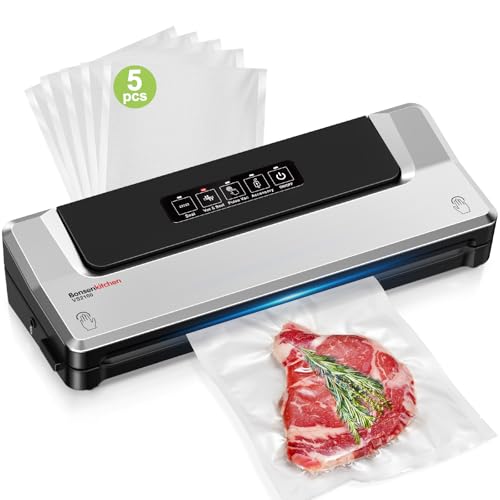
Bonsenkitchen Vacuum Sealer Machine — Best Compact Value
Bonsenkitchen’s compact sealer is aimed squarely at the meal-prep household: multiple modes covering normal, moist and dry foods, in a body small enough to live in a drawer and come out on Sunday afternoon. That storage profile matters more than any specification — the sealer that is put away gets used, and the used sealer is the one that saves food and money.
Strengths
- Mode range usually found on larger machines
- Compact body suits drawer and small-counter homes
- Meal-prep orientation matches weekly home rhythms
Trade-offs
- No built-in roll storage at this size
- Brand ecosystem is younger than FoodSaver’s
- Batch pace suits households, not harvest processing
| Modes: multiple — normal, moist, dry and more |
| Design: compact, silver |
| Focus: meal prep and kitchen food storage |
There is no roll storage inside, so bags live in the drawer beside it, and its pace is household rather than harvest-scale. Within the weekly pattern it was designed for — proteins portioned, vegetables prepped, leftovers rescued — it delivers the category’s core value at a compact size and a value position.
The Bonsenkitchen’s drawer life is its charm: out on Sunday, away by dinner, modes enough for the week’s variety. Meal preppers value its consistency across dozens of identical bags — the same seal, the same portion, the same weekday lunch. It asks only for a drawer deep enough and a roll stored beside it.
Best for: meal preppers in small kitchens / Not suited for: bulk processors needing maximum throughput.
Check on Amazon — check price on Amazon for the current figure.
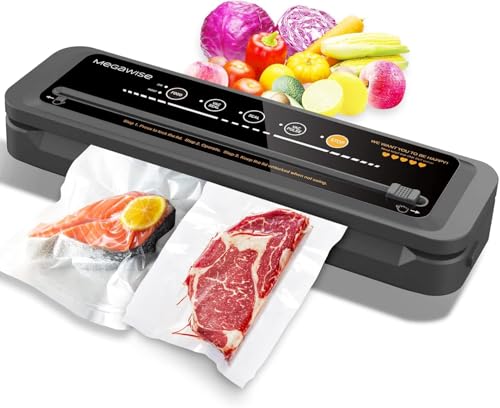
MEGAWISE Vacuum Sealer Machine, 80kPa — Best Budget
The MEGAWISE makes the budget argument with numbers: 80kPa of suction, dry and moist modes, one-touch operation, and bags plus a cutter in the box so the machine works the day it arrives. For a first sealer — the household testing whether vacuum sealing fits its life — that completeness at a budget position is exactly right.
Strengths
- 80kPa suction is strong for the budget tier
- Dry and moist modes both included
- Bags and a cutter in the box — sealing starts day one
Trade-offs
- Build and finish are budget-grade
- No accessory hose ecosystem
- Long production pedigree is shorter than the big brands’
| Suction: 80kPa |
| Modes: dry and moist, one-touch operation |
| Included: bags and cutter |
| Design: compact |
Finish and long-term pedigree are where the savings show, and a household that ends up sealing daily should expect to graduate to the FoodSaver class eventually. But many households seal weekly, and for them this machine’s strong suction and honest modes deliver the essential benefit — food that lasts — without the flagship bill.
The MEGAWISE introduces households to sealing without ceremony: bags and cutter in the box, one touch, strong suction, done. First-time owners learn the craft on it — headroom, dry seals, flat freezing — and many discover their sealing stays weekly, in which case the MEGAWISE simply remains the right machine. Those who graduate keep it as the backup that never complains.
Best for: first-time sealer buyers and budget kitchens / Not suited for: heavy daily users who should buy a tier up.
Check on Amazon — check price on Amazon for the current figure.
Comparison Table
| Pick | Badge | Key spec | Best for |
|---|---|---|---|
| FoodSaver FM2100 Vacuum Sealer Machine | Best Overall | dry and moist food settings, one-touch sealing | most home kitchens wanting one sealer that does everything |
| Nesco Deluxe VS-12 Vacuum Sealer | Best for Delicate Foods | 130 watts | home bakers and gardeners sealing soft, crushable food |
| Anova Culinary Precision Vacuum Sealer Pro | Best for Sous Vide Homes | wet and dry dual sealing | sous vide households sealing proteins weekly |
| FoodSaver Elite All-in-One Liquid+ Vacuum Sealer | Best for Soups and Liquids | seals liquids like soups and sauces | batch cooks who freeze soups, sauces and stews |
| Bonsenkitchen Vacuum Sealer Machine | Best Compact Value | multiple — normal, moist, dry and more | meal preppers in small kitchens |
| MEGAWISE Vacuum Sealer Machine, 80kPa | Best Budget | 80kPa | first-time sealer buyers and budget kitchens |
How to Choose a Home Vacuum Food Sealer
Seal quality is the whole product
Everything else is convenience. Judge a home sealer by seal width and consistency, pump strength and whether owners’ bags stay sealed at month two. A moist mode and a pulse or gentle option extend that reliability across the foods homes actually seal.
Decide how you will handle liquids
Soups and marinades are where home sealers struggle. If you freeze liquids weekly, buy a machine designed for them — the Liquid+ pattern — or learn the pre-freeze method: freeze soup flat in the bag first, then seal. Either way, decide before the first batch, not during it.
Bag economics decide running cost
Machines that accept standard third-party rolls keep costs low forever; proprietary-only ecosystems tax every bag. Built-in roll storage and a cutter reduce waste further by sizing bags to food instead of food to bags.
Storage decides whether it gets used
Measure the drawer or counter slot the sealer will live in. A compact machine that comes out weekly saves more food than a flagship exiled to a high shelf.
How to Vacuum Seal Food for the Freezer, Step by Step
- Portion first. Seal meal-sized amounts, not bulk blocks — portions thaw faster, waste less and stack flatter in the freezer.
- Leave headroom: at least three inches between food and the bag mouth, more for liquids, so the seal zone stays clean and dry.
- For moist foods, fold a paper towel strip inside the bag mouth to intercept liquid travelling toward the seal, and choose the moist mode if your machine has one.
- Smooth the bag flat across the seal bar, check alignment through the lid if fitted, and run the full automatic cycle — then inspect the seal: it should be a continuous, clear band with no channels.
- Label with contents and date before freezing, lay bags flat until frozen solid, then file them upright like books. Flat-frozen bags thaw in minutes under water and stack like they were designed.
Common Buying Mistakes
Sealing liquids on a dry-only routine
Liquid in the seal channel causes weak seals that fail in the freezer. Use a moist/liquid mode, pre-freeze, or the paper towel intercept — never hope.
Overfilling the bag
Food too close to the mouth contaminates the seal. Headroom is not wasted bag; it is the seal’s working space.
Skipping the seal inspection
Ten seconds checking each seal saves discovering a frost-filled failure in two months. A channeled or wrinkled seal should be cut and redone immediately.
Using non-embossed bags in an external sealer
Home external sealers need textured, embossed bags for air channels. Smooth commercial bags will not evacuate properly in these machines.
Freezing bags in a pile before they are solid
Bags frozen in a heap weld into a single iceberg. Freeze flat on a tray first, then stack — your future self, chiselling dinner, thanks you.
Why Vacuum Sealing Actually Preserves Food
Freezer burn is dehydration plus oxidation: exposed surfaces lose moisture to the freezer’s dry air while oxygen attacks fats and pigments. A vacuum bag removes most of the air, presses the barrier against the food and slows both processes dramatically. It does not sterilise anything and it does not stop time — it buys quality, measured in months instead of weeks.
That is why seal integrity matters more than any other specification. A bag with a slow leak is just a bag, and the food inside ages on the normal schedule while you believe otherwise. The inspection habit in our how-to is not fussiness; it is the entire technology, verified one seal at a time.
Bags, Rolls and the Real Running Costs
The machine is the small purchase. A household sealing weekly will spend more on bags across five years than on the sealer itself, which is why roll compatibility and a built-in cutter matter financially: rolls cost less per bag than pre-cuts, and cutting to size ends the waste of sealing two chicken breasts in a bag built for a roast.
Reusable container systems and jar attachments, run from the accessory port on machines like the FoodSaver, shift the economics further for foods you open often — cheese, coffee, deli meats — where a bag would be cut and discarded weekly. Match the consumable to the food’s rhythm, not just its shape.
External Sealers vs Chamber Machines, for Home Kitchens
Chamber sealers are objectively stronger with liquids and cheaper in bags, and objectively wrong for most homes: they weigh like a microwave full of bricks, occupy a counter permanently and cost like a major appliance. The home category exists because most households seal mostly solids, sometimes moist foods, and occasionally liquids with a workaround — a profile external sealers serve at a fraction of the size and cost.
The honest exception is the household processing liquids or harvest volumes weekly, which should read our chamber guide with this guide’s blessing. For everyone else, the machines here are not the compromise; they are the correct tool, sized to the actual job.
What Each Step Up Buys in Sealing
The budget tier buys the core miracle — air out, seal closed, food lasting months longer — with simpler build and fewer modes. The middle tier buys workflow: roll storage, cutters, moist and gentle modes, accessory ports. The flagship tier buys problem removal: liquids sealed natively, automatic detection, settings memory. Each step is real, and none makes the tier below it foolish.
The correct tier is set by your freezer’s contents. Dry goods and proteins forgive everything; a household freezing weekly soups should buy the liquid solution directly rather than learning the lesson through a ruined seal and a wasted batch.
The Paper Towel Trick and Other Moist-Sealing Craft
Experienced home sealers share a folk technology for wet foods: a strip of paper towel folded inside the bag mouth intercepts travelling liquid; a brief partial freeze firms sauces before sealing; a double seal insures long sous vide cooks. None of this appears in manuals and all of it works, because the physics is simple — keep the seal channel dry and the seal will hold.
Machines with moist modes automate part of this craft by extending seal time and adjusting vacuum, which is why this guide weights the mode so heavily. But the craft still matters: even the Liquid+ rewards a cook who portions sensibly and leaves headroom. Technology plus technique is the whole game.
Freezer Organisation as a System
A vacuum sealer’s deepest benefit is not longevity but order: flat, labelled, identical bags convert a freezer from a dig site into a filing cabinet. Households that adopt the flat-freeze and inventory habits in our how-to routinely discover they ‘shop’ their own freezer first, wasting less and buying less — the sealer’s second, quieter dividend.
The system needs only three rules: everything flat, everything labelled, everything listed. Break any one and entropy returns within a month. Keep all three and a modest freezer feeds a household with a competence that feels, from the inside, like a much larger kitchen.
Meal Prep Sunday: A Sealer Workflow That Sticks
The households that save real money with a food sealer share one habit: a single weekly session. Proteins are portioned to recipe size, vegetables are prepped and sealed for the week’s plan, and leftovers from the session itself are sealed before they can become fridge casualties. The machine lives within reach, the bags are pre-cut or the roll is loaded, and the whole ritual takes less time than the shop did.
Systems fail at friction points, so engineer them out in advance. Keep labels and a marker on the machine. Freeze liquids flat the night before if your sealer is not a liquid model. And end every session with the seal inspection — ten seconds per bag that protects a week of food.
Within a month the session stops feeling like a chore and starts feeling like the week’s first act of competence, with a freezer full of evidence.
Sealing for One and Two: Small Households, Real Savings
Vacuum sealing is marketed at bulk buyers, but small households may benefit most. The single chicken breast, the half loaf, the expensive cheese bought for one recipe — these are the foods that die in small fridges, and a sealer rescues exactly them. Portioning to one and two converts warehouse pricing into small-household economics.
Choose the compact picks in this guide without apology; your sealing volume is small but your waste per item is high, which is the profile sealing fixes best. Pre-cut bags suit small households better than rolls, since sessions are short and storage is tight.
The quiet prize is variety: a freezer holding twelve different single portions is a restaurant menu. Small households with sealers eat more diversely, not just more cheaply.
Sous Vide, Marinades and the Sealer’s Second Job
A food sealer’s vacuum does more than exclude air for storage — it transforms preparation. Marinades penetrate faster under vacuum as air leaves the food’s surface and liquid is drawn into contact. Sous vide cooking depends on the seal entirely: no air pockets insulating the food, no water invading the bag across a long bath.
Technique scales with ambition. For marinades, leave generous headroom and use the moist mode, or freeze the marinade around the protein first for a perfect seal. For long sous vide cooks, double-seal both ends; the second seal costs ten seconds and insures a three-hour bath.
Households that adopt either practice find the sealer migrating from storage tool to cooking tool — which is why the Anova pick, designed from the cooking side, earns its place beside the storage-first FoodSavers.
Troubleshooting Seals That Fail
When bags lose vacuum, work the diagnosis in order. First, the seal itself: a channel, wrinkle or crumb in the band means the bag never sealed — re-cut below the fault and reseal. Second, the bag: sharp contents puncture silently, so pad bones and edges. Third, the machine: a gasket compressed from latched storage or a drip tray full of yesterday’s marinade will quietly halve your suction.
Most ‘broken’ sealers are maintenance cases. Clean the channel, empty the tray, store the lid unlatched overnight and test again on a dry bag before concluding anything expensive. The machines in this guide are built to be maintained back to full strength by exactly these small acts.
Keep notes on failures by food type. A household that learns ‘ribs need padding, soup needs pre-freezing’ stops having failures worth troubleshooting — the craft becomes the system.
What Vacuum Sealing Cannot Do
A clear-eyed guide owes its readers the limits. Vacuum sealing does not make perishable food safe at room temperature, does not rescue food that was already tired when sealed, and does not stop all quality loss — it slows oxidation and dehydration dramatically, which buys months of quality, not immortality. Frozen food still ages; it simply ages in slow motion.
Some foods actively dislike the vacuum. Soft cheeses need to breathe. Fresh mushrooms sweat and slime in airless bags. Cruciferous vegetables — broccoli, cabbage, cauliflower — release gases raw and should be blanched before sealing. Delicate berries need the gentle modes this guide highlights, or a pre-freeze on a tray before the bag.
Knowing the exclusions protects the technology’s reputation in your own kitchen. Every failure traced to a food that should never have been sealed teaches the wrong lesson about a tool that, used within its physics, is close to miraculous.
Portion Science: Sizing Bags to Appetites
The unglamorous skill that decides a sealer’s value is portioning. Seal in the units your household actually eats: proteins by the meal’s headcount, vegetables by the recipe, sauces frozen flat in single-dinner slabs. A freezer full of correctly portioned bags cooks like a meal kit service; a freezer full of giant blocks cooks like a quarrying operation.
Err smaller than instinct suggests. Two small bags thaw faster, waste less and forgive a changed plan; one large bag commits you. The roll-and-cutter machines in this guide exist to make portion discipline cheap — every bag exactly its contents’ size, no more plastic than the meal requires.
Label portions on the bag, not in your memory: ‘2 chicken breasts — tacos’ is a future dinner decided. The households that sustain sealing for years are the ones whose freezers answer questions instead of asking them.
The Freezer Inventory: A Sheet of Paper That Pays
Beside every serious sealing household’s freezer hangs an inventory — a list, a whiteboard, a note on the door — and it is the least technological and most valuable item in this entire guide. Vacuum sealing extends food life so effectively that unlisted food outlives memory: the bag at the bottom is excellent and entirely forgotten, which is waste wearing a disguise.
The inventory’s rules are three: write every bag in, cross every bag out, and plan one meal a week from the list’s oldest entries. That third rule converts storage into rotation, and rotation is where the money saved becomes money visible — in smaller shops, calmer weeks and a freezer that always seems to contain dinner.
Upgrade the paper only when it fails you. Most households find the sheet outlasts every app they try, because it hangs where the food is and asks nothing but a pencil.
Sealing Through the Seasons
A home food sealer’s year has seasons, and planning for them multiplies its value. Spring: herbs, blanched and sealed in recipe quantities. Summer: the garden’s glut and the berry harvest, gently sealed or tray-frozen first. Autumn: batch sauces, soups and the Liquid+ machine’s finest hours. Winter: holiday excess rescued, bulk buys portioned, the freezer audited against the inventory.
Each season uses a different strength from this guide’s list — gentleness in summer, liquids in autumn, throughput whenever a bulk buy lands. That is why the category supports six legitimate picks rather than one winner: households live different years.
Mark your own calendar honestly before choosing. The sealer that matches your busiest season will carry the quiet ones without complaint; the reverse is rarely true.
Cheese, Charcuterie and the Deli Drawer
The refrigerator’s deli drawer is a small museum of air damage: cheese drying at the edges, cured meats oxidising, opened packets ageing by the day. A food sealer — especially one with an accessory hose and canisters, or a gentle mode for softer items — extends this drawer’s life dramatically, sealing between uses in seconds.
Hard and semi-hard cheeses are the standout winners, holding for weeks beyond their wrapped life. Soft cheeses should be sealed gently or not at all, and everything should return to the fridge promptly; the vacuum extends the clock, it does not stop it. Judged with that honesty, the deli drawer becomes one of the sealer’s most profitable territories.
Bread, Baked Goods and the Gentle Touch
Bread is vacuum sealing’s paradox: the food that most needs protection from freezer air is the food most easily crushed by its removal. The solutions are the gentle and pulse modes this guide highlights, a partial pre-freeze that firms the crumb before sealing, and slicing before freezing so portions leave the loaf without thawing it whole.
Baked goods — muffins, cakes, the holiday baking surplus — follow the same rules and reward them: a freezer that returns baked goods as baked goods, weeks later, rather than as frostbitten archaeology. Households that bake in batches consider this application alone sufficient reason to own the right machine.
Herbs, Spices and the Flavour Pantry
Fresh herbs freeze beautifully when sealed flat in recipe-sized portions, with a whisper of oil or blanched, depending on the herb and its destiny. Dried spices, once opened, stale by oxidation on a schedule the vacuum canister slows to a crawl. The sealer’s pantry work is unglamorous and cumulative: flavour, preserved at purchase strength, months deeper into the year.
Label herb portions by recipe, not just by plant — ‘chimichurri base’, ‘soup finish’ — and the freezer starts answering cooking questions instead of merely storing ingredients. That shift, from storage to system, is the mature stage of owning any machine in this guide.
Sealing for Neighbours, Gifts and the Community Fridge
A food sealer’s benefits leak pleasantly beyond its household. The neighbour’s garden surplus, portioned and sealed, returns as winter meals. The batch of sauce gifted in a flat, labelled bag travels and stores better than any jar. Community and church fridges, stocked with sealed, dated portions, waste visibly less than those stocked with hope and cling film.
If your machine sits idle between your own sessions, lend its capacity, not the machine: a sealing afternoon for a friend’s harvest buys goodwill out of all proportion to its cost, and spreads the craft this guide exists to teach.
When to Replace Bags, Gaskets and Eventually the Machine
Consumables announce their own retirement. Bags that will not hold a seal despite a clean channel are done — check the roll’s age and storage before blaming the machine. Gaskets that stay compressed after a night unlatched, and no longer spring back, are a small, orderable part on the major platforms here, and replacing one restores a machine that seemed to be dying.
The machine itself earns replacement when seals fail after gasket and channel care, when the pump audibly labours on dry bags, or when your household’s pattern has outgrown its class. Buy the next machine for the pattern you have become, using everything the first one taught you.
Your First Five Bags: A Starter Curriculum
New owners should seal in a deliberate order. Bag one: something dry and forgiving — rice, beans, coffee — to learn alignment and the seal’s look. Bag two: something moist, with the paper towel trick, to learn respect. Bag three: a portioned protein for the freezer, labelled properly. Bag four: a liquid, by whichever route your machine supports. Bag five: something delicate, gently, to learn restraint.
Five bags, five lessons, and the machine’s whole craft is in your hands. Households that improvise their first sessions learn the same lessons eventually — usually at the cost of the food that taught them.
Storing the Machine and Its Supplies as One Kit
Keep the sealer, its bags or roll, the labels, the marker and the spare gasket — where the platform supports one — in a single home, whether that is a drawer, a cupboard shelf or the counter corner this guide keeps recommending. A kit that lives together gets used together; supplies scattered across three rooms quietly tax every session until sessions stop happening.
Restock on a trigger, not on an empty drawer: when the roll reaches its last quarter, the replacement goes on the shopping list. The households that seal for years are, without exception, the households that never face an empty bag supply on a Sunday afternoon.
Final Recommendation
The FoodSaver FM2100 is the home default for a reason — complete system, deep ecosystem, every mode a household needs. Nesco’s VS-12 handles delicate food with unusual care, Anova’s Pro serves sous vide homes, the Liquid+ removes the soup problem, and Bonsenkitchen and MEGAWISE bring the core benefit to compact spaces and tight budgets.
Buy the machine that matches the food you actually freeze, inspect every seal, and the savings stop being a promise and become a routine.
Related guides on this site: Best Home Vacuum Sealers Best Vacuum Sealers Best Chamber Vacuum Sealers Best Handheld Vacuum Sealers Best Vacuum Sealers For Sous Vide
Revisit the top picks: FoodSaver FM2100 Vacuum Sealer Machine.
Revisit the top picks: Nesco Deluxe VS-12 Vacuum Sealer.
Revisit the top picks: Anova Culinary Precision Vacuum Sealer Pro.
Related guides
Frequently Asked Questions
How much longer does vacuum sealed food last in the freezer?
Typically two to three times longer than conventionally wrapped food before quality drops — frozen meats and prepared meals commonly hold good quality for many months. Vacuum sealing preserves quality; always label with dates and rotate stock.
Can I vacuum seal soups and sauces at home?
Yes, with the right approach: a machine designed for liquids like the FoodSaver Liquid+ pick, or pre-freeze the liquid in the bag until firm, then seal. Never let liquid reach the seal channel.
Do vacuum sealers work for sous vide?
Yes — external sealers are the standard home sous vide tool. Use the moist mode for marinated foods and double-seal bags destined for long cooks for insurance.
What bags fit a home vacuum sealer?
External home sealers need embossed/textured bags or rolls. Most machines here accept standard third-party rolls; check width against your seal bar length before buying in bulk.
Why did my sealed bag lose its vacuum in the freezer?
Usually a compromised seal — liquid, fat or a wrinkle in the seal channel — or a puncture from a sharp bone or ice edge. Inspect seals when made, and pad sharp edges with a fold of bag or paper towel.
Is a chamber sealer better for home use?
Chamber machines seal liquids effortlessly and use cheaper bags, but they are large, heavy and priced for commerce. Most homes are better served by the external machines in this guide.

