Disclosure: airfryerkitchensupply.com is reader-supported. When you buy through links on our site, we may earn an affiliate commission at no extra cost to you.
Where to buy
The best home toasters are the ones that disappear into the morning: wide enough slots for the bread your family actually eats, controls nobody has to think about, and results that repeat without supervision. Every pick below was verified against its own listing for this guide, spanning the two-slice countertop classics and the four-slice family machines. Use the links to check price on Amazon, and choose by your household’s real breakfast — how many people, what bread, how much counter — because those three facts, not any feature list, decide this purchase.
- Cuisinart CPT-160P1 2-Slice Metal Classic Toaster — Best Overall Home Toaster: Check the current price on Amazon
- Breville BTA720XL Bit More Toaster 2 Slice — Best for Artisan Bread: Check the current price on Amazon
- Hamilton Beach 2 Slice Toaster 22794 — Best Value Home Toaster: Check the current price on Amazon
- GE 2 Slice Stainless Steel Toaster — Best for Even Toasting Power: Check the current price on Amazon
- KitchenAid KMT4115 4-Slice Manual Lift Toaster, Empire Red — Best 4-Slice for Families: Check the current price on Amazon
- Cuisinart CPT-180P1 4-Slice Toaster — Best Classic 4-Slice: Check the current price on Amazon
A home toaster has the most honest job description in the kitchen: make toast, bagels, and the occasional frozen waffle, evenly, quickly, every morning, for years, without becoming a topic of conversation. The best home toasters are therefore not the most powerful or the most beautiful machines on this site — they are the ones with the fewest failure modes in ordinary domestic life. Slots wide enough for a halved bagel. A crumb tray that actually slides out. A high-lift lever so small slices do not require a fishing expedition. Controls a guest can operate without a briefing.
The six picks below cover the shape of real households. Two-slice machines from Cuisinart, Breville, Hamilton Beach, and GE serve couples and small kitchens, each with a distinct strength — classic simplicity, artisan-bread intelligence, value completeness, and raw even-toasting power respectively. Four-slice machines from KitchenAid and Cuisinart serve families, with dual controls so two people can run different shades at once. Every one was verified, and the specifications quoted come from those verified listings rather than from anyone’s brochure memory.
What this guide optimizes for, explicitly, is the absence of regret. Home toasters are bought once and judged a thousand times, in half-asleep conditions, by people who did not choose them. The reviews below therefore spend as much time on levers, trays, slot geometry, and cleaning as on browning performance — because in a home, those are the same subject.
In this guide
Quick Picks
Four two-slice picks for couples and small counters, two four-slice picks for families — all mainstream, all verified, each with a clear reason to exist.
- Cuisinart CPT-160P1 2-Slice Metal Classic Toaster — Best Overall Home Toaster: The default done right: brushed stainless, 1.5-inch slots, and a simple six-setting dial per its listing — the two-slice home toaster against which the category is measured. Check price on Amazon
- Breville BTA720XL Bit More Toaster 2 Slice — Best for Artisan Bread: The thoughtful two-slice: wide slots for thick artisan bread, plus Lift & Look and A Bit More per its listing — for households whose bread deserves supervision tools. Check price on Amazon
- Hamilton Beach 2 Slice Toaster 22794 — Best Value Home Toaster: The complete value package: extra-wide slots, bagel setting, Toast Boost, slide-out crumb tray, auto-shutoff, cancel, and defrost per its listing — nothing missing, at the accessible end of the home tiers. Check price on Amazon
- GE 2 Slice Stainless Steel Toaster — Best for Even Toasting Power: The power play: 1500 watts and seven shade settings per its listing, with slots measured at 1.38 by 5.50 inches and room for bagels and waffles — speed and evenness for impatient households. Check price on Amazon
- KitchenAid KMT4115 4-Slice Manual Lift Toaster, Empire Red — Best 4-Slice for Families: The family classic in Empire Red: four extra-wide slots with dual independent controls per its listing, and a manual lift lever that puts the toast in your hand, not in the air. Check price on Amazon
- Cuisinart CPT-180P1 4-Slice Toaster — Best Classic 4-Slice: The four-slice version of the classic formula: extra-wide slots, dual independent controls, and six-setting browning dials per its listing, in brushed stainless. Check price on Amazon
How These Picks Were Chosen
The selection filter for home use was domestic reality. Every candidate needed the modern baseline — wide slots, bagel and defrost functions, a removable crumb tray, auto shutoff — because a home toaster missing any of those generates a specific recurring annoyance that owners then live with for years. Every linked pick was verified against its own Amazon listing, and the features named in this guide are the listings’ own: shade counts, slot dimensions where stated, wattage where stated, and named functions like Toast Boost and Lift & Look.
The set was balanced across household shapes rather than ranked by laboratory browning alone. Couples, small kitchens, artisan-bread households, value-first buyers, and families have genuinely different best answers, and the badges say so. Two makers appear twice — Cuisinart at both sizes, Hamilton Beach in the value slot — because their home lines have earned that representation over many product generations.
Excluded, deliberately: commercial machines (they have their own guide in this cluster), design-statement toasters whose premium buys no domestic function, and ultra-budget models whose thin construction makes them annual purchases. A home toaster should be bought on a five-year horizon at minimum, and every pick here is built to that horizon.
The 6 Best home toasters
Read for the details that decide mornings: slot width, lift height, tray design, and whether the controls forgive a half-awake operator. Browning quality is table stakes at this level — the reviews note where a pick genuinely rises above it.

Cuisinart CPT-160P1 2-Slice Metal Classic Toaster — Best Overall Home Toaster
Some products become the default by being the best-balanced answer for the most people, and the CPT-160P1 is the two-slice home toaster in that position. Per its verified listing: a brushed stainless steel body with a retro-inflected design, 1.5-inch slots that take bagels and thick slices without drama, and a six-setting browning dial that a guest can understand at a glance. There is nothing here you have not seen — and that is the point. Every element of the home toaster brief is present, competently executed, in a metal body that belongs to the keep-for-years class rather than the replace-annually one.
Strengths
- 1.5-inch slots per the listing — genuinely bagel- and artisan-capable, not merely wide-ish
- Six-setting dial is the control scheme every household member already knows
- Brushed stainless metal body at the durable end of the home category
Trade-offs
- Two slices is two slices; families should jump straight to the four-slice picks
- Retro styling is a taste — it suits most kitchens without thrilling any
- No inspection or smart functions; you toast by setting and experience, as households have for decades
| Specification | Detail |
|---|---|
| Slots | 2, 1.5 in wide (per verified listing) |
| Browning | 6 settings, dial control |
| Body | Brushed stainless steel |
| Style | Retro design (per listing) |
The CPT-160P1’s excellence is statistical: across the thousands of mornings a home toaster serves, it produces the fewest bad ones per dollar of attention demanded. The dial’s six settings span the useful range without false precision; the slots center ordinary bread and swallow bagels; the body wipes clean and does not date. Owners replacing one after many years very often buy the same model again, which is the home appliance market’s most honest review format.
Choose it if your household is one or two people, your bread ranges from sandwich slices to bakery cuts, and your ambition for a toaster is that it should be excellent and then invisible. It is not the cheapest pick here, nor the cleverest — it is the one with nothing missing, and in home appliances that is usually the correct definition of best.
Best for: Couples and small households wanting one durable, do-everything two-slice toaster / Not suited for: Families of four or more at breakfast
Check the current price on Amazon

Breville BTA720XL Bit More Toaster 2 Slice — Best for Artisan Bread
The ‘A Bit More’ is Breville’s answer for homes where bread is a serious subject. Its verified listing promises even toasting of bagels and thick, artisanal bread in wide slots, and names the two signature functions: Lift & Look, to check a slice mid-cycle without canceling, and A Bit More, to add the finishing increment when a slice lands just short. Add a defrost function for the freezer-to-counter reality of home bread storage, and you have the two-slice machine for households that buy loaves, not sliced bread in bags.
Strengths
- Lift & Look per the listing — check progress without restarting the cycle
- A Bit More ends the underdone-slice dilemma without a scorching second round
- Wide slots specified for thick, artisanal bread and bagels
Trade-offs
- Premium tier within the home category; sandwich-bread households will not use its talents
- Two-slice ceiling, as with the overall pick
- More electronics than the dial machines — the standing trade for its intelligence
| Specification | Detail |
|---|---|
| Slots | 2, wide (per verified listing) |
| Functions | Lift & Look, A Bit More, defrost (per listing) |
| Body | Brushed stainless steel |
| Bread focus | Bagels and thick, artisanal bread |
Artisan bread is where home toasters go to be exposed: uneven thickness, high moisture, dense crumb — a combination that produces the classic pale-middle, dark-edge slice from ordinary elements. The Bit More’s combination of wide slots, strong even heating, and mid-cycle inspection is a direct answer, and its A Bit More function is calibrated for exactly the artisan problem, where ‘almost’ is the most common result and the correction needed is thirty seconds, not a new cycle.
It is the pick for the home baker and the bakery customer — the households whose bread costs more than the toaster’s electricity by an order of magnitude and deserves equipment that respects it. If your bread comes pre-sliced and uniform, the Cuisinart above serves you as well for less ceremony; if your bread has a crust with opinions, this is your machine.
Best for: Home bakers and artisan-bread households of one or two / Not suited for: Families, or uniform sandwich-bread households
Check the current price on Amazon

Hamilton Beach 2 Slice Toaster 22794 — Best Value Home Toaster
Hamilton Beach’s home lines win their following by refusing to omit things, and the 22794’s verified listing reads like the category’s checklist completed: extra-wide slots, a bagel setting, Toast Boost to lift small slices clear of the slots, a slide-out crumb tray, auto-shutoff and a cancel button, and a defrost function, in stainless steel. Toast Boost deserves its mention — the small-slice retrieval problem is the home toaster’s most universal annoyance, and a boost that raises little slices to grabbing height solves it mechanically instead of with a wooden utensil and a prayer.
Strengths
- Toast Boost per the listing — small slices lift clear, ending the fishing problem
- Complete function set: bagel, defrost, cancel, auto-shutoff, extra-wide slots
- Slide-out crumb tray — the cleaning design that actually gets used
Trade-offs
- Value-tier materials and feel; it is a working appliance, not a counter statement
- Two-slice capacity, like the other small picks
- Browning finesse is good rather than exceptional — its case is completeness per dollar
| Specification | Detail |
|---|---|
| Slots | 2, extra-wide (per verified listing) |
| Functions | Bagel setting, defrost, cancel, auto-shutoff |
| Lift | Toast Boost |
| Crumb tray | Slide-out |
| Body | Stainless steel |
Value picks earn their badge two ways: by costing less, or by omitting nothing. The 22794 does both, which is rarer than it sounds — most budget toasters delete the crumb tray’s convenience, the boost, or the bagel function and dare you to notice at home. Here the specification is whole. For first apartments, rental kitchens, second homes, and any household that wants the toaster question answered completely and affordably, this is the end of the search.
Its honest ceiling is refinement: the shade-to-shade nuance and the fit and finish belong to the tier, and a household that toasts artisan bread daily will eventually want the Breville above. But as the complete, competent, nothing-missing home toaster at the accessible end of the market, it has no rival in this guide — and its owners’ replacement pattern (buy another Hamilton Beach) says the ownership experience matches the specification.
Best for: First homes, rentals, and value-first households wanting a complete feature set / Not suited for: Artisan-bread specialists or design-led kitchens
Check the current price on Amazon
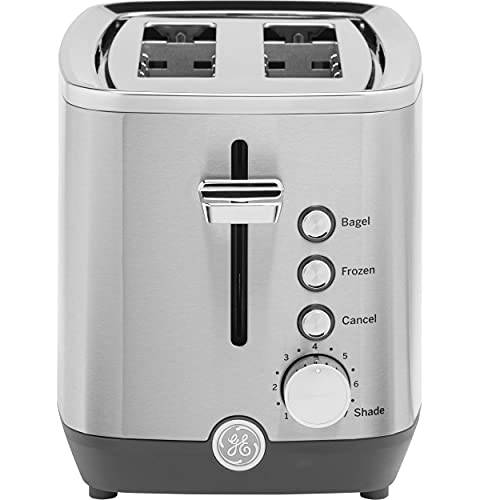
GE 2 Slice Stainless Steel Toaster — Best for Even Toasting Power
GE’s entry makes its argument in numbers its listing is happy to state: 1,500 watts of toasting power, seven shade settings, extra-wide slots dimensioned at 1.38 by 5.50 inches, a removable crumb tray, and explicit fitness for bagels and waffles with a defrost function. Wattage is the under-discussed home toaster specification — it is what produces a crisp exterior before the interior dries, and what recovers between back-to-back rounds when two people breakfast in sequence. At 1,500 watts, this is the strongest two-slice motor in the guide, and its seven shades give that power a finer control ladder than the usual six.
Strengths
- 1500W per the verified listing — the most power among the two-slice picks, for crisp-fast results
- Seven shade settings give finer browning gradation
- Slot dimensions stated in the listing (1.38 x 5.50 in) — buy with your bread measured, not guessed
Trade-offs
- Power is not subtlety; delicate thin slices need the lower shades and a watchful first week
- Two-slice format, as with its peers
- A newer entrant in a category of decades-old lines; its long-term parts story is still being written
| Specification | Detail |
|---|---|
| Slots | 2, extra-wide; 1.38 x 5.50 in (per verified listing) |
| Power | 1500W (per verified listing) |
| Shades | 7 settings |
| Functions | Defrost; fits bagels and waffles (per listing) |
| Crumb tray | Removable |
The case for wattage deserves one paragraph of physics. Toasting is a race between surface browning and interior drying: high, even power browns the surface fast, sealing in a tender middle; weak power takes so long that the whole slice desiccates into a crispbread. That is why the same bread tastes better from a powerful toaster, and why back-to-back rounds — the second person’s toast — stay consistent when the elements have recovery headroom. GE’s specification is aimed squarely at that experience, and the listing’s decision to publish slot dimensions suggests a maker confident in the details.
Choose the GE if your household’s complaints about its current toaster are ‘slow’ and ‘pale,’ if waffles and bagels share the roster with bread, and if two people toast in sequence every morning. It is the engineer’s home pick: specified, powerful, and unpretentious about everything else.
Best for: Households wanting fast, crisp, consistent two-slice results / Not suited for: Delicate-bread minimalists or four-slice families
Check the current price on Amazon

KitchenAid KMT4115 4-Slice Manual Lift Toaster, Empire Red — Best 4-Slice for Families
KitchenAid’s KMT4115 is the four-slice home toaster as a piece of household infrastructure. Its verified listing specifies four extra-wide slots, dual independent controls — so one side can run dark for one parent while the other runs light for a child — adjustable shade control with a bagel function, and a manual lift lever in place of the spring pop. That lever is a philosophy: the toast rises when you lift it, stays warm in the slot until you do, and never launches. In a family kitchen at 7 a.m., that calm is worth more than any countdown display, and the Empire Red finish makes the machine a deliberate presence rather than an apology.
Strengths
- Dual independent controls per the listing — two shades, one machine, no negotiations
- Manual lift lever: no launching, and toast waits warm instead of cooling on top
- Four extra-wide slots cover the family’s full bread range at once
Trade-offs
- Manual lift means no automatic pop-up — a habit change for spring-toaster households
- Four-slice footprint is a real counter commitment
- Empire Red is a commitment of its own; be sure the kitchen wants it
| Specification | Detail |
|---|---|
| Slots | 4, extra-wide (per verified listing) |
| Controls | Dual independent, adjustable shade |
| Lift | Manual lift lever |
| Functions | Bagel setting |
| Finish | Empire Red |
Dual controls are the family feature that marketing underrates and households prize, because breakfast preferences in a family are not a compromise — they are a spectrum, often from barely-warm to nearly-dark, and a single-control four-slice machine forces a treaty every morning. Independent pairs end the treaty. Combined with the manual lever’s patience — toast that waits in the warm slot while eggs finish, rather than cooling on the counter — the KMT4115 is engineered around the actual choreography of family breakfast in a way spec-sheet flagships rarely are.
It is also, frankly, the pick for people who like their appliances to feel like KitchenAid appliances: weighted, enameled, mechanical in the right places. If your stand mixer is Empire Red, this review is a formality. If it is not, the machine’s domestic logic still stands on its own — four wide slots, two controls, no launches, no drama.
Best for: Families wanting simultaneous toast at two different shades / Not suited for: One- or two-person households, or pop-up traditionalists
Check the current price on Amazon
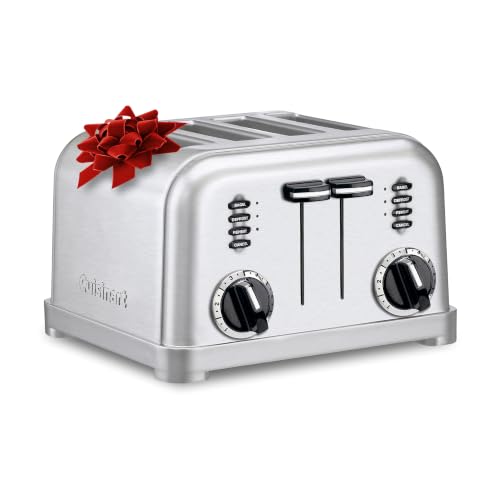
Cuisinart CPT-180P1 4-Slice Toaster — Best Classic 4-Slice
The CPT-180P1 is the overall pick’s bigger sibling, and the family toaster for households that want the classic formula without the statement finish: per its verified listing, four extra-wide slots in brushed stainless steel, dual independent controls, and six-setting browning dials on each side. It is the same argument as the CPT-160 — nothing missing, nothing precious — scaled to the family breakfast. Two dials, two shades, four slices, every morning, for years: the CPT-180’s longevity in Cuisinart’s line is itself the review.
Strengths
- Dual independent controls with proper six-setting dials per side
- Extra-wide slots handle the family’s bagels and thick slices
- Brushed stainless neutrality suits any kitchen without a color commitment
Trade-offs
- Spring pop-up operation, without the KitchenAid’s manual-lift patience
- No inspection or smart functions — dial-and-experience toasting
- Four-slice footprint, the standing family tax
| Specification | Detail |
|---|---|
| Slots | 4, extra-wide (per verified listing) |
| Controls | Dual independent, 6-setting dials |
| Body | Brushed stainless steel |
| Model | CPT-180P1 |
Choosing between this and the KitchenAid is a study in household temperament. The Cuisinart is the conventional machine executed classically: dials, pop-up, dual controls, stainless discretion. The KitchenAid adds the manual lever’s calm and a color’s confidence. Neither is wrong; families divide by whether they want the toaster to announce itself. On pure function-per-fuss, the CPT-180P1 is arguably the most rational family purchase in this entire guide — the classic formula, at family scale, from the line that defined it.
It closes the picks as the safe family answer: the one to buy when the household cannot agree on anything except that the current toaster is done. Its dials will be learned in a weekend, its slots will take whatever the bakery sends home, and its stainless will still look like a kitchen appliance in a decade — which, for a home toaster, is the whole assignment.
Best for: Families wanting the classic four-slice formula in neutral stainless / Not suited for: Design-led kitchens or two-slice households
Check the current price on Amazon
Comparison Table
The home essentials in one view: slot format, the control scheme, and the household each pick serves. All feature claims are from the verified listings.
| Pick | Badge | Key spec | Best for |
|---|---|---|---|
| Cuisinart CPT-160P1 2-Slice Metal Classic Toaster | Best Overall Home Toaster | 2 slots x 1.5 in, 6-setting dial, stainless | Couples and small households wanting one durable, do-everything two-slice toaster |
| Breville BTA720XL Bit More Toaster 2 Slice | Best for Artisan Bread | 2 wide slots, Lift & Look, A Bit More | Home bakers and artisan-bread households of one or two |
| Hamilton Beach 2 Slice Toaster 22794 | Best Value Home Toaster | 2 extra-wide slots, Toast Boost, full functions | First homes, rentals, and value-first households wanting a complete feature set |
| GE 2 Slice Stainless Steel Toaster | Best for Even Toasting Power | 2 slots, 1500W, 7 shades | Households wanting fast, crisp, consistent two-slice results |
| KitchenAid KMT4115 4-Slice Manual Lift Toaster, Empire Red | Best 4-Slice for Families | 4 extra-wide slots, dual controls, manual lift | Families wanting simultaneous toast at two different shades |
| Cuisinart CPT-180P1 4-Slice Toaster | Best Classic 4-Slice | 4 extra-wide slots, dual 6-setting dials | Families wanting the classic four-slice formula in neutral stainless |
How to Choose the Best Home Toasters
Count mouths before slots. One or two people at breakfast: a two-slice machine is faster to heat, smaller on the counter, and entirely sufficient — four of the six picks here serve you. Three or more, especially with school-morning simultaneity: four slots stop being a luxury and become the schedule. The most common home toaster regret in this guide’s experience is the beautiful two-slice machine in a five-person kitchen; the second most common is the family machine heating two slots’ worth of air for a single person’s slice. Match the machine to the household’s actual arithmetic.
Measure your bread, then read slot specifications like contracts. The listings in this guide state slot widths from 1.38 to 1.5 inches and name their intended foods — bagels, waffles, thick artisan slices. Your thickest regular bread is the specification that matters; a slot that takes it without squeezing is the difference between toasting and negotiating. Households that bake or buy bakery loaves should weight the wide-slot, artisan-named picks most heavily.
Choose controls for the least technical person who will use them. Dials beat menus at 6 a.m.; dual controls beat single ones wherever two shades coexist in one household; a cancel button and auto-shutoff are safety and sanity features, not luxuries. Inspection functions — Lift & Look and its cousins — genuinely help with variable home-baked bread, and are wasted on uniform sliced loaves. Buy the intelligence your bread requires, not the intelligence the showroom admires.
Finally, think in years and crumbs. A home toaster’s real costs are a crumb tray that is annoying enough to be ignored (choose slide-out or removable, as every pick here offers), a body finish that shows every morning’s evidence, and construction that survives daily lever cycles for a five-year horizon minimum. The picks here are the mainstream’s durable core for a reason: parts, replacements, and sheer production volume stand behind them in a way novelty brands cannot match.
Two Slots or Four: The Household Arithmetic
The two formats fail differently. A two-slice machine in a big household fails by queue — breakfast becomes sequential, somebody’s toast is always cold, and the machine runs so many back-to-back cycles that it lives a harder life than a four-slice machine doing the same work in half the rounds. A four-slice machine in a small household fails by overhead — counter space, cleaning surface, and heating capacity spent on slots that sit empty eleven mornings out of twelve.
The tie-breaker is simultaneity, not appetite. Two people who eat together at the same time are a four-slice household even if they eat modestly, because toast’s enemy is the wait between rounds. Two people on different schedules are a two-slice household even if both eat enormously. Judge by the clock on your kitchen wall, not by the size of your appetites, and the format chooses itself.
The Supporting Cast: Bread Storage and the Rest of the Toast System
A home toaster can only toast the bread it is given, and the largest single upgrade available to most households is not a machine in this guide — it is how the bread is stored. Sliced bread kept in its bag at room temperature toasts predictably for days. Bakery loaves belong in a bread box or a cloth bag, cut side down, and never in the refrigerator, where starch retrogrades fastest and produces the stale crumb that no toaster setting can rescue. Bread that must be kept longer should be sliced and frozen, then toasted through the defrost function every pick here provides — frozen-to-toast, done properly, beats fresh-kept-badly by a wide margin.
Cutting is the second half of the system. Even slices toast evenly; the tapered end of a hand-cut loaf toasts like two different breads sharing a slot. A simple bread guide or a practiced sawing motion — long strokes, no downward force — produces the uniformity that lets one setting serve the whole loaf. Households that blame their toaster for uneven toast while feeding it wedges are misdiagnosing a cutting problem as an appliance problem, and the fix costs nothing.
Finally, the plate matters more than it should: toast parked on a cold ceramic plate steams its own underside soft in two minutes. A small rack, a warm plate, or simply propping slices tent-style against each other while the eggs finish preserves the crispness the machine worked to create. The best home toaster in this guide, fed well-kept bread cut evenly and served unsteamed, will outperform a flagship fed badly — the system is the appliance, and the appliance is only its most expensive part.
When to Replace a Home Toaster
Home toasters rarely die dramatically; they fade, and the fade has recognizable stages. The first is shade drift — the setting that was perfect for years now runs light, because elements age and lose output unevenly. Recalibrating buys time and is legitimate. The second stage is asymmetry: one side of the slice, or one slot, browning markedly differently from the other, which indicates an element section failing rather than a global fade. The third is mechanical — a carriage that will not stay down, a lever that will not catch, a crumb tray warped by heat — at which point repair economics for mainstream machines point firmly at replacement.
Two symptoms are not fade but warnings, and they end the conversation immediately: any smell of hot wiring rather than hot bread, and any breaker involvement. A toaster is a high-wattage resistive appliance; electrical symptoms are retirement announcements, not quirks. Unplug, do not troubleshoot beyond the plug and the outlet, and replace.
When replacement day comes, this guide’s advice is to change as little else as possible. The household’s habits — slot format, control type, the calibration map on the bread bin — are accumulated capital. Replacing like with like, or stepping one badge across within these picks, preserves that capital. The families who treat the toaster as a system tend to have one bad breakfast during a changeover; the families who treat it as a fresh decision have a month of them.
Safety and the Household Rules That Matter
A toaster is among the highest-wattage appliances in a home, and its safety rules deserve the same standing as the stove’s. The non-negotiables are short. Never leave a toasting cycle entirely unwatched as a habit — modern auto-shutoff features, present across these picks, are a backstop, not a permission. Never reach into a slot with anything metal, and teach children the wooden-tong rule with the same seriousness as the knife rule. Keep the machine clear of curtains, paper, and the tea towel draped where it has always been draped, because a toaster’s top surface in a long breakfast session is genuinely hot.
Two subtler rules repay attention. The first is the stuck-slice rule: if a slice lodges and the cycle ends, unplug before retrieving — the elements can re-energize with a nudge, and the combination of a lodged slice and a live element is the one scenario where a toaster can genuinely start a fire. Oversized or irregular pieces that must be forced into a slot are how slices lodge; the wide-slot picks in this guide exist partly as safety equipment for real bread.
The second is the crumb rule, repeated here because it is safety and not housekeeping: a deep bed of dry crumbs beneath live elements is fuel awaiting a long cycle. Weekly emptying, with the machine cool and unplugged, closes the risk almost entirely. Households that keep these three rules — watch, unplug to retrieve, empty the tray — will find the home toaster what it should be: the most boringly reliable appliance they own.
Counter Placement in Real Kitchens
The best home toaster in this guide will underperform in the wrong square of counter, so placement gets its paragraph. Keep the machine out from directly beneath low cabinets — rising heat and steam age finishes and cabinet undersides alike — and give it a hand’s width of air on all sides. It belongs near the bread storage and the butter, on the landing side of the kitchen’s morning traffic, not in the corridor between sink and stove where elbows and water live. Cord management matters more than it sounds: a toaster that must be dragged forward to reach an outlet will be dragged, daily, across its own crumbs, and its feet and finish will show it within a year.
Households with small children should place with the same logic used for the kettle: back from the counter’s edge, cord short and routed away from small hands, and the machine’s hot top surface treated as stove territory in the family rules. None of this diminishes the appliance’s convenience; it is the difference between a machine that serves a decade of breakfasts gracefully and one that accumulates a history of small incidents. Choose the square of counter as deliberately as you chose the machine, and both decisions will disappear into the morning — which is, once more, the entire point of a home toaster.
How to Set Up Your Home Toaster for Perfect Daily Toast
Ten minutes of calibration in the first week pays back for the life of the machine. These steps work for every pick in this guide.
- Run two empty cycles first. New elements carry manufacturing residues; burn them off before the first slice so breakfast does not taste of the factory.
- Calibrate with your real bread. Toast one slice at each setting around the middle of the dial and note where your household’s ‘perfect’ lives for white, whole grain, and your bakery loaf. Settings are consistent on these machines; the calibration holds.
- Write the household map. If your machine has dual controls, assign sides: one person’s shade lives on the left pair, the other’s on the right. It sounds trivial and ends a thousand tiny morning negotiations.
- Use defrost as a separate mode, not a longer toast. Frozen bread wants the defrost cycle’s gentler profile. Toasting frozen slices on a high setting produces the dark-outside, cold-middle failure every household knows.
- Bagels cut-side in, per your machine’s marking. Bagel functions toast the cut side harder and the crust side gently — but only if the halves face the way the machine expects. Check the manual’s diagram once and the habit is set.
- Empty the crumb tray weekly, cool and unplugged. Slide-out and removable trays — fitted across these picks — make this a twenty-second task. Old crumbs are the leading cause of toaster smoke, off flavors, and mysterious morning alarms.
After calibration, a home toaster should vanish from your attention — which is the state every pick in this guide was chosen to achieve. If yours has not vanished, the fault is usually a mismatch this guide’s buying section can diagnose: wrong size, wrong slots, wrong controls for the household.
Common Buying Mistakes
Buying by looks for a machine judged by mornings. The counter photograph lasts a day; the lever, tray, and slot geometry last a decade. Weigh the daily interactions first.
Forgetting the small-slice problem. Little ends and half-slices vanish into deep slots. Toast Boost, high-lift levers, and manual lifts — all represented here — exist because this annoyance is universal. Check the lift before you buy.
One shade setting for every bread. Dense whole grain, white sandwich, and frozen waffles are three different toasting jobs. Households that calibrate per bread (see the setup steps) stop having ‘the toaster is inconsistent’ conversations — the toaster was fine; the settings were fiction.
Metal utensils in live slots. The fishing-for-toast habit with a fork is a genuine hazard and a warranty story. Unplug first, use wooden toast tongs, and buy the high-lift machine next time.
Never cleaning until it smokes. Crumb management is the whole maintenance burden of a home toaster, and it is twenty seconds a week. The smoke alarm at 7 a.m. is the invoice for skipping it.
Final Recommendation
For most households, the Cuisinart CPT-160P1 is the home toaster to buy: the classic two-slice formula with nothing missing and years of production behind it. Artisan-bread homes should take the Breville Bit More; value-first homes, the Hamilton Beach with its complete checklist; speed-and-crispness homes, the 1500-watt GE. Families divide between the KitchenAid’s dual-control, manual-lift calm in Empire Red and the Cuisinart CPT-180P1’s classic stainless four-slice formula — both are right, for different kitchen temperaments.
A home toaster is a small purchase with a thousand repetitions in it. Choose the one whose repetitions you will never have to think about, and breakfast takes care of itself.
- Cuisinart CPT-160P1 2-Slice Metal Classic Toaster (Best Overall Home Toaster): Check price on Amazon
- Breville BTA720XL Bit More Toaster 2 Slice (Best for Artisan Bread): Check price on Amazon
- Hamilton Beach 2 Slice Toaster 22794 (Best Value Home Toaster): Check price on Amazon
- GE 2 Slice Stainless Steel Toaster (Best for Even Toasting Power): Check price on Amazon
- KitchenAid KMT4115 4-Slice Manual Lift Toaster, Empire Red (Best 4-Slice for Families): Check price on Amazon
- Cuisinart CPT-180P1 4-Slice Toaster (Best Classic 4-Slice): Check price on Amazon
More in the Toasters cluster: Best Heavy Duty Toasters · Best High End Toasters · Best Inexpensive 4 Slice Toasters · Best 4 Slice Toasters · Best 2 Slice Toasters
Frequently Asked Questions
What is the best toaster for a family of four?
A four-slice machine with dual independent controls — both family picks in this guide qualify — because family breakfast is simultaneous and shade preferences are not. The KitchenAid adds a manual lift that keeps toast warm in the slot; the Cuisinart CPT-180P1 is the classic stainless formula. Either ends the morning queue; choose by temperament and finish.
Are wider slots always better?
Wider slots are better for the bread that needs them — bagels, thick artisan slices, waffles — and the listings here run from 1.38 to 1.5 inches. Very thin bread in very wide slots can sit off-center and toast unevenly, which is why self-centering racks and sensible slot sizing matter. Match the slot to your thickest regular bread and let centering handle the rest.
How long should a home toaster last?
Buy on a five-year horizon at minimum. The mainstream metal-bodied machines in this guide are built to that standard and beyond with nothing more than crumb-tray discipline. Ultra-budget plastic machines are the false economy of the category: replaced twice, they cost the durable machine’s price and deliver a worse breakfast throughout.
What does Toast Boost or high-lift actually do?
It raises the carriage higher at the end of the cycle so small slices — heels, half-slices, little ends — clear the slots where fingers can reach them safely. It sounds minor and is the feature owners mention most, because the small-slice fishing expedition is every household’s shared annoyance. If your bread includes small loaves, weight it heavily.
Should I use the bagel setting for bagels?
Yes — it is not a longer toast, it is a different one: more intensity on the cut side, gentler on the crust, which is what a bagel actually wants. Face the cut sides as your machine’s diagram directs. Households that toast bagels on the bread setting and compensate with shade are solving the wrong problem well.
Why does my toast brown unevenly?
Usually one of four causes: bread off-center in a wide slot, a crumb bed insulating one side, mixed slice thicknesses in the same round, or a machine whose elements have aged unevenly. The first three are habits this guide’s setup steps fix. The fourth, in a young machine, is a warranty conversation; in an old one, it is the machine telling you its years are counted.


