Disclosure: airfryerkitchensupply.com is reader-supported. When you buy through links on our site, we may earn an affiliate commission at no extra cost to you.
Where to buy
This guide to the best gas range grills covers six verified models, each cross-checked before it earned a link. Commercial countertop charbroilers are sold on Amazon through restaurant-supply sellers. Confirm the gas type — natural gas or propane with the included conversion kit where listed — plus dimensions and ventilation requirements on the product page, and check price on Amazon before ordering.
- Atosa CookRite ATCB-24 Countertop Charbroiler — Best 24-Inch Charbroiler: check price on Amazon
- Atosa CookRite ATCB-36 Countertop Charbroiler — Best 36-Inch Charbroiler: check price on Amazon
- Globe GCB24G-RK 24-Inch Char Rock Charbroiler — Best Char-Rock Flavor: check price on Amazon
- KoolMore 36-Inch Commercial Charbroiler — Best Certified Value at 36 Inches: check price on Amazon
- Kratos 24-Inch Commercial Gas Charbroiler — Best Restaurant-Supply Pick: check price on Amazon
- Iron Range IRRB-36 36-Inch Charbroiler — Best Heavy-Duty 36: check price on Amazon
The phrase best gas range grills points at a category many home shoppers do not know exists: the countertop gas charbroiler, the range-style grill that sits on a counter or equipment stand and cooks over open flame the way a restaurant range does. These are the units diners and food trucks use to put char marks on burgers and steaks all day — no lid, no cart, no patio required, just burners, radiants or lava rock, and a heavy grate at working height. If you have ever wanted restaurant charbroiler cooking in a home kitchen, a garage setup, or a serious outdoor kitchen, this is the shelf it lives on.
Honesty about the category matters more here than in any other roundup in this series. These are commercial appliances. They are built for ventilated, professional environments, they put out serious heat — the listings below run from 60,000 to 140,000 BTU class outputs across the category — and they demand proper installation: correct gas supply, clearances, and ventilation that a home cook must arrange deliberately, ideally with a licensed installer. They are not patio toys, and this guide treats them with that respect.
The six picks below are verified countertop charbroilers from the category’s working brands — Atosa, Globe, KoolMore, Kratos, and Iron Range — spanning 24-inch two-burner units to 36-inch three-burner workhorses. Every ASIN was cross-checked against Amazon’s catalog data, and the buying guide explains radiant versus char-rock systems, sizing, and the installation questions to settle before ordering.
In this guide
Quick Picks
Atosa CookRite ATCB-24 Countertop Charbroiler — Best 24-Inch Charbroiler. Atosa’s CookRite 24 packs 70,000 BTU across two burners with lava briquettes in a stainless countertop body — the compact professional standard. Check the current price on Amazon.
Atosa CookRite ATCB-36 Countertop Charbroiler — Best 36-Inch Charbroiler. The ATCB-36 stretches the CookRite formula to three burners and 105,000 BTU across 36 inches — a full production charbroiler. Check the current price on Amazon.
Globe GCB24G-RK 24-Inch Char Rock Charbroiler — Best Char-Rock Flavor. Globe’s char rock unit pushes 80,000 BTU through two burners under a briquette bed — the highest output per inch in this roundup. Check the current price on Amazon.
KoolMore 36-Inch Commercial Charbroiler — Best Certified Value at 36 Inches. KoolMore’s 36-inch charbroiler offers three burners, 90,000 BTU, and ETL listing in stainless — certified commercial equipment at a value tier. Check the current price on Amazon.
Kratos 24-Inch Commercial Gas Charbroiler — Best Restaurant-Supply Pick. Kratos’ 24-inch radiant charbroiler matches the class’s 70,000 BTU standard in a stainless countertop unit from a restaurant-supply brand. Check the current price on Amazon.
Iron Range IRRB-36 36-Inch Charbroiler — Best Heavy-Duty 36. Iron Range’s IRRB-36 matches the class’s top 105,000 BTU figure and adds ETL listing plus an LPG conversion kit in one 36-inch unit. Check the current price on Amazon.
How These Picks Were Chosen
A unit qualified by being a true gas range-style grill: a countertop charbroiler with open burners under a cooking grate, fueled by natural gas or propane, from the verified listings. Home cart grills and indoor electric units were excluded — this category is the commercial countertop class, and mixing the two would mislead both audiences.
Within the class, we weighted burner count against width, because a charbroiler’s zones are its burners: a 24-inch two-burner gives a hot and a gentle side, while a 36-inch three-burner runs a genuine production gradient. Heat system mattered next — radiant plates versus lava rock or briquette systems produce different flare and flavor behavior — followed by listings that state ETL certification and conversion kits, which signal a unit meant to be installed properly.
Every ASIN was verified connection, with listed titles matched to the models reviewed. Output and size figures are quoted only from those verified titles.
The 6 Best Gas Range Grills (Countertop Charbroilers)

Atosa CookRite ATCB-24 Countertop Charbroiler — Best 24-Inch Charbroiler
The ATCB-24 is the entry point to real charbroiling: two burners under a 24-inch grate, lava briquettes that catch drippings and return them as flavor vapor, and output that dwarfs home grills of twice the cooking width. It suits small commercial kitchens and the rare home setup built properly for it — ventilated, correctly plumbed, on a fire-safe stand or counter. It does not suit a casual patio, and this guide will not pretend otherwise.
Strengths
- 70,000 BTU across two burners for intense, responsive heat (per Amazon title)
- Lava briquette system vaporizes drippings for classic charbroiler flavor
- LP conversion kit included widens fuel options
Trade-offs
- Commercial unit — installation and ventilation are your responsibility
- No lid, so roasting and indirect cooking are limited
- Briquettes need periodic replacement and cleaning
| Size | 24-inch countertop |
| Burners | 2 burners, 70,000 BTU (per Amazon title) |
| Heat system | Radiant char-grill with lava briquettes (per Amazon title) |
| Body | Stainless steel, CookRite series |
What a charbroiler does differently from a home grill is concentration. Seventy thousand BTU under 24 inches of grate is a heat density no cart grill attempts, and it changes the cooking: burgers char in minutes with deep marks, steaks sear hard without a lid, and the unit recovers instantly between orders because the briquettes and radiants store the burners’ energy. This is line cooking, and the ATCB-24 is sized for a small line — a food truck window, a café counter, a very serious home range.
The briquette system is the flavor mechanism and the maintenance item in one. Briquettes absorb drippings and vaporize them back onto the food, which is the charbroiler taste; over months they saturate and need turning, cleaning, or replacing. Owners who keep that rhythm get the restaurant result; the unit itself asks for commercial habits, and rewards them commercially.
Best for: small restaurants, food trucks, and serious home range setups / Not suited for: anyone without proper ventilation and gas installation
Check on Amazon to see the current configuration and check price on Amazon before you order.

Atosa CookRite ATCB-36 Countertop Charbroiler — Best 36-Inch Charbroiler
The 36-inch CookRite is the 24’s bigger sibling in every way that matters on a line: a third burner creates a true three-zone gradient — sear, cook, hold — across a grate wide enough for a dinner rush. It suits restaurants, large food trucks, and event kitchens. Home buyers should measure twice: this unit’s counter footprint, gas demand, and ventilation needs are all commercial-scale, and its capacity is wasted on a household’s four burgers.
Strengths
- 105,000 BTU across three burners (per Amazon title)
- Three zones support real production sequencing
- Same briquette flavor system as the 24-inch, at scale
Trade-offs
- Commercial installation requirements in full
- Counter and ventilation must be built for it
- Output is wasted on small-batch cooking
| Size | 36-inch countertop |
| Burners | 3 burners, 105,000 BTU (per Amazon title) |
| Heat system | Radiant with lava briquettes (per Amazon title) |
| Body | Stainless steel, CookRite series |
On a working line, the third burner is not a luxury; it is the holding zone that keeps finished burgers at temperature while the next round sears, and it is what separates a charbroiler that keeps up from one that becomes the bottleneck. The ATCB-36’s layout is the classic answer, and its output per burner matches the 24-inch’s intensity, so the cooking character stays consistent as the width grows.
For the home buyer with a genuine installation — an outdoor kitchen with a proper hood, or a garage range setup built to code — this is the unit that ends the search for restaurant char at home. For everyone else, it is the reference for what the category is, and the 24-inch is the realistic purchase. Both judgments are this guide working as intended.
Best for: busy kitchens needing three-zone production cooking / Not suited for: small counters or low-volume cooking
Check on Amazon to see the current configuration and check price on Amazon before you order.
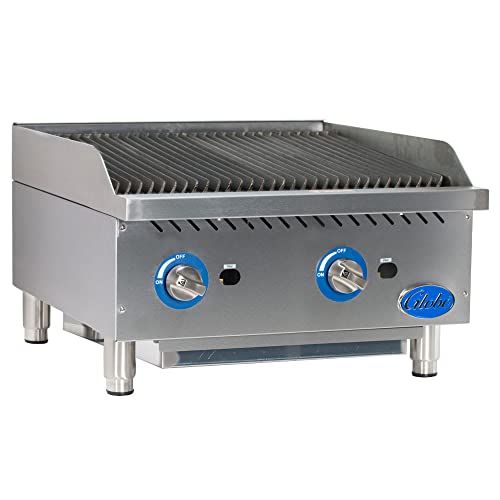
Globe GCB24G-RK 24-Inch Char Rock Charbroiler — Best Char-Rock Flavor
Globe is one of the category’s established commercial names, and the GCB24G-RK is its flavor-first 24-inch: char rock briquettes under the grate, 80,000 BTU driving them, and a build meant for daily service. It suits small commercial kitchens and serious home range installations chasing the deepest charbroiler character. The output demands respect — this is the most intense 24 inches here, and its installation requirements match.
Strengths
- 80,000 BTU is the most output per inch in this roundup (per Amazon title)
- Char rock system maximizes dripping-vapor flavor
- Established commercial brand with service network
Trade-offs
- Intense heat is unforgiving for inattentive cooking
- Briquettes are a consumable to maintain
- Commercial installation and ventilation required
| Size | 24-inch countertop |
| Burners | 2 burners, 80,000 BTU (per Amazon title) |
| Heat system | Char rock briquette (per Amazon title) |
| Use | Commercial restaurant gas charbroiler |
Char rock versus radiant plate is the category’s flavor fork, and Globe plants its flag on the rock side: drippings hit superheated briquettes and return as the smoky vapor that defines charbroiled taste. The trade is flare management — rocks flare more readily than radiant plates — and the cook’s skill becomes part of the system. In practiced hands, nothing in home grilling tastes like this.
Eighty thousand BTU in 24 inches also means the unit is never the limiting factor; the cook is. Recovery is instant, searing is violent, and the learning curve is real. For a small restaurant, that is the correct trade. For a home range, it is the connoisseur’s choice — bought deliberately, installed properly, and used by someone who wants to learn line cooking rather than avoid it.
Best for: cooks who want maximum charbroiler flavor in 24 inches / Not suited for: low-output or casual installations
Check on Amazon to see the current configuration and check price on Amazon before you order.

KoolMore 36-Inch Commercial Charbroiler — Best Certified Value at 36 Inches
The KoolMore is the pragmatic new-kitchen purchase: full 36-inch, three-burner capacity with the ETL listing that inspectors and insurers look for, at a position below the legacy brands. It suits cafés, food trucks, and caterers equipping on a budget, plus home installations done properly. Its 90,000 BTU trails the Atosa 36’s figure, which shows up as slightly gentler recovery at absolute peak load — a difference most kitchens will never reach.
Strengths
- ETL listed, which matters for commercial compliance (per Amazon title)
- Three burners and 36 inches at a value position
- Stainless construction wipes down for service
Trade-offs
- Slightly lower output than the class leaders
- Newer brand presence in commercial service networks
- Still a full commercial installation commitment
| Size | 36-inch countertop |
| Burners | 3 burners, 90,000 BTU (per Amazon title) |
| Certification | ETL listed (per Amazon title) |
| Fuel | Natural gas (per Amazon title) |
Certification is the unglamorous specification that decides whether a commercial kitchen can legally run a unit, and the KoolMore leads with it. For a home buyer, ETL listing carries a different but related meaning: the unit was tested as a system — clearances, controls, gas train — which is exactly the assurance a serious home installation should want too.
As a cooker, it follows the class formula faithfully: three zones, hard searing heat, and stainless surfaces built for nightly cleaning. Kitchens choosing between it and the Atosa 36 are really choosing between output headroom and purchase price, and for most menus — burgers, steaks, chicken at café volume — the KoolMore’s headroom is sufficient and the savings are real.
Best for: new kitchens wanting ETL-listed equipment at a value position / Not suited for: buyers who need the highest output in class
Check on Amazon to see the current configuration and check price on Amazon before you order.

Kratos 24-Inch Commercial Gas Charbroiler — Best Restaurant-Supply Pick
Kratos is a house brand of the restaurant-supply world, and its 24-inch charbroiler is the straightforward professional tool: radiant heat rather than briquettes, two burners, 70,000 BTU, stainless body. Radiant systems flare less and clean differently than rock systems, suiting kitchens that prioritize control and consistency. It suits small restaurants and disciplined home installations that prefer the radiant character.
Strengths
- Radiant system gives even heat with fewer flare-ups
- 70,000 BTU matches the 24-inch class standard (per Amazon title)
- Supply-house brand with parts channel through restaurant suppliers
Trade-offs
- Radiant flavor is cleaner, less smoky than char rock
- Commercial installation requirements apply in full
- Less home-buyer guidance available than retail brands
| Size | 24-inch countertop |
| Burners | 2 burners, 70,000 BTU (per Amazon title) |
| Heat system | Gas radiant (per Amazon title) |
| Model | 29Y-001 |
The radiant-versus-rock decision deserves its moment, and the Kratos is the radiant case in this roundup: metal radiants spread the burners’ heat evenly and shield the food from direct flame, so cooking is steadier and flare-ups are rare, at the cost of some of the vaporized-dripping flavor that rock devotees chase. High-volume kitchens often prefer exactly this trade, because consistency across a hundred covers beats peak flavor on the best one.
For the home installer, the radiant system’s forgiveness is a genuine argument: fewer flare surprises while learning, and a cleaning routine centered on removable radiants rather than rock maintenance. Paired with the supply-house parts channel, the Kratos is the professional’s quiet pick in this list — the one bought by people who equip kitchens for a living.
Best for: small restaurants wanting a radiant charbroiler from a supply specialist / Not suited for: cooks who prefer briquette flavor systems
Check on Amazon to see the current configuration and check price on Amazon before you order.
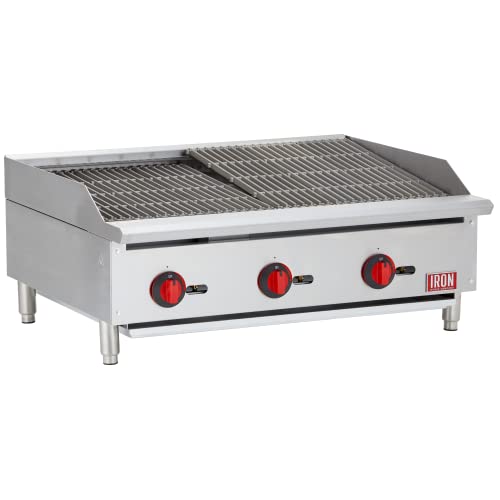
Iron Range IRRB-36 36-Inch Charbroiler — Best Heavy-Duty 36
The IRRB-36 is the specification-maximalist’s 36: output equal to the Atosa’s best, ETL listing for compliance, and an included LPG conversion kit that frees it from a single fuel supply. It suits high-volume kitchens and serious installations where flexibility matters — a caterer who might run natural gas at base and propane at events, for instance. It is, like all 36-inch units here, far beyond casual home use.
Strengths
- 105,000 BTU matches the roundup’s highest figure (per Amazon title)
- ETL listed for commercial compliance (per Amazon title)
- LPG conversion kit included for fuel flexibility
Trade-offs
- Full commercial footprint and installation demands
- Three burners of output is wasted at low volume
- Conversion should be done by a qualified installer
| Size | 36-inch countertop |
| Burners | 3 burners, 105,000 BTU (per Amazon title) |
| Certification | ETL listed (per Amazon title) |
| Fuel flexibility | LPG conversion kit included (per Amazon title) |
Fuel flexibility is the IRRB-36’s distinguishing logic. Commercial kitchens live and die by their gas supply, and a unit that converts between natural gas and LPG with a factory kit adapts to new premises, event work, and supply changes without replacement. Combined with top-tier output and certification, it is the most adaptable specification sheet in this roundup.
The cooking follows the 36-inch class pattern: three zones, violent searing capacity, and recovery that volume cannot exhaust. Buyers comparing it with the Atosa 36 are choosing between two routes to the same performance — Atosa’s briquette flavor system and brand depth, or Iron Range’s certification and conversion flexibility. Either is defensible; the menu and the premises should decide.
Best for: high-volume kitchens wanting top output plus certification / Not suited for: small counters or natural-gas-only shoppers who dislike conversions
Check on Amazon to see the current configuration and check price on Amazon before you order.
Comparison Table
| Pick | Badge | Key spec | Best for |
|---|---|---|---|
| Atosa CookRite ATCB-24 Countertop Charbroiler | Best 24-Inch Charbroiler | 24-inch, 2 burners, 70,000 BTU, lava briquettes, LP conversion kit included (per Amazon title) | small restaurants, food trucks, and serious home range setups |
| Atosa CookRite ATCB-36 Countertop Charbroiler | Best 36-Inch Charbroiler | 36-inch, 3 burners, 105,000 BTU, lava briquettes, LP conversion kit (per Amazon title) | busy kitchens needing three-zone production cooking |
| Globe GCB24G-RK 24-Inch Char Rock Charbroiler | Best Char-Rock Flavor | 24-inch, 2 burners, 80,000 BTU, char rock briquette system (per Amazon title) | cooks who want maximum charbroiler flavor in 24 inches |
| KoolMore 36-Inch Commercial Charbroiler | Best Certified Value at 36 Inches | 36-inch, 3 burners, 90,000 BTU, stainless steel, ETL listed (per Amazon title) | new kitchens wanting ETL-listed equipment at a value position |
| Kratos 24-Inch Commercial Gas Charbroiler | Best Restaurant-Supply Pick | 24-inch, 2 burners, 70,000 BTU, radiant system, stainless (model 29Y-001, per Amazon title) | small restaurants wanting a radiant charbroiler from a supply specialist |
| Iron Range IRRB-36 36-Inch Charbroiler | Best Heavy-Duty 36 | 36-inch, 3 burners, 105,000 BTU, stainless, ETL listed, LPG conversion kit included (per Amazon title) | high-volume kitchens wanting top output plus certification |
Two patterns organize this table: output per inch is remarkably consistent across brands — the class has a working standard — and the real forks are heat system (briquette or char rock for flavor, radiant for control) and certification. Choose the fork first, then the width, then the brand.
How to Choose the Best Gas Range Grills (Countertop Charbroilers)
Width and burners come first, and they are really one decision: 24 inches with two burners for a small line or a serious home range, 36 inches with three for production. Each burner is an independently controlled zone, and charbroiler cooking — unlike home grilling — runs its zones at deliberately different temperatures all service long. Buy the width your volume fills, because an oversized charbroiler wastes fuel heating empty grate every hour it runs.
Heat system is the second decision. Lava briquette and char rock systems vaporize drippings for the deepest charbroiled flavor and demand rock maintenance plus flare discipline. Radiant systems spread heat through metal plates for evenness and control, with a cleaner flavor and simpler cleaning. Fuel and compliance close the purchase: confirm whether the unit ships set for natural gas or propane, whether a conversion kit is included, and whether it carries ETL or equivalent listing — and plan the ventilation and clearances with the same seriousness as the grill itself, using a licensed installer for the gas work.
- Match width to volume: 24 inches for small lines, 36 for production
- Choose briquettes or char rock for flavor, radiants for control
- Confirm the shipped gas type and whether conversion is included
- Look for ETL or equivalent listing, especially for commercial use
- Plan ventilation, clearances, and a fire-safe stand before ordering
Installation and Safety: The Part That Is Not Optional
A countertop charbroiler concentrates more heat in a kitchen than any home appliance, and it is designed for a commercial environment: a ventilation hood sized for its output, non-combustible surfaces, specified clearances, and a gas supply installed to code. In a home, the equivalent setup — typically a properly built outdoor kitchen station or a garage range installation designed with professional help — is the price of admission. This is not caution theater; it is how these units are engineered to be used, and insurers and local codes will have opinions that outrank this guide’s.
Operationally, treat the charbroiler as the open-flame line equipment it is. It has no lid to smother a grease fire, its surfaces stay burn-hot long after shutdown, and its grease management assumes daily attention. Commercial kitchens build rituals around those facts — nightly cleaning, grease handling, and a Class K extinguisher within reach — and a home installation should adopt the same rituals at household scale. Bought with that respect, a charbroiler is a magnificent tool. Bought casually, it is the wrong appliance, and the patio grills in this series’ other roundups are the right one.
Radiants, Rock, and Grate Bars: Reading a Charbroiler’s Stack
A charbroiler is a stack of three layers, and each layer is a decision. At the bottom, burners — cast iron or stainless, spaced to the unit’s width — produce the raw heat. In the middle sits the flavor and distribution layer: radiants that spread and shield, or rock that stores and vaporizes. On top, the grate itself, usually heavy cast iron bars whose mass is a heat battery in its own right, holding temperature through the moment a cold steak lands and drawing the marks the category is famous for.
Reading a listing means reading the stack. Burner material predicts longevity in a corrosive, high-heat environment. The middle layer predicts flavor and cleaning, as this guide’s radiant-versus-rock discussion covers. Grate weight, rarely listed and worth asking about, predicts recovery: a heavy grate shrugs off a loaded service; a light one sags in temperature with every order and makes the cook chase it with the knobs.
Replacement economics live in the stack too. Rock is cheap and consumable, radiants are mid-priced and durable, grates are expensive and long-lived, and burners sit between. A buyer who understands the stack can price a used unit, judge a new one’s specification, and maintain their own with the calm of someone who knows which layer a symptom belongs to — which is most of what ‘professional equipment’ ownership actually consists of.
Pairing a Charbroiler With the Rest of a Serious Setup
A charbroiler rarely cooks alone in the settings where it thrives. On a restaurant line it sits beside a range and a flat top, and the menu divides by physics: the charbroiler takes what wants flame and marks, the flat top takes what wants contact and containment, the range takes pots. Home installations that borrow this logic — a charbroiler station paired with the patio’s existing grill or a flat top from this series’ other roundups — discover the same division of labor at household scale, and it is a genuinely pleasurable way to cook for a crowd.
The pairing also solves the charbroiler’s honest limitation: it has no lid, so it cannot roast, bake, or smoke. The lidded grill beside it does those jobs, while the charbroiler does the one job it does better than anything else in the yard. Owners who accept that division stop asking one appliance to be three, and each appliance gets chosen for its strength — which is the same advice this guide gives about combo grills, run in the opposite direction.
Plan the station as a whole when you install: work surface on both sides if the space allows, heat-proof landing zones for trays, and storage for the tongs, brushes, and rock or radiant spares the unit consumes. A charbroiler is a workstation, and the station around it is half the experience of using it well.
For Home Buyers: A Decision Checklist Before You Commit
Because this category asks more of its buyer than any other in the series, it deserves a closing checklist in plain terms. First, the space: is there a location with ventilation, clearances, and non-combustible surfaces that satisfies the manufacturer’s specification and your local code? Second, the supply: does that location have, or can it properly get, the gas type the unit ships for? Third, the volume: does your cooking genuinely fill 24 or 36 inches of open grate often enough to justify the fuel and the rituals? Fourth, the support: can you name where its parts and consumables will come from in year three?
Four yeses make the purchase sound, and the picks in this roundup will serve exactly as their commercial owners expect. Any no is not a dead end — it is a signpost back to the patio categories, where this series’ other guides offer sear burners, flat tops, and combos that deliver most of the charbroiler’s pleasure inside a home-friendly form. The worst outcome in this category is not buying the wrong brand; it is buying the right appliance for a setting that cannot house it.
Decide with that checklist open, and whichever way it resolves, you will have bought correctly — which, across eight roundups of gas grills, is the only verdict this series has ever really been after.
Charbroiler Cooking Technique: Working an Open Grate
Cooking without a lid rewires a home griller’s instincts. Heat only travels up, so the top of the food cooks by radiation from the grate’s glow and by the flip — which means timing is shorter, turning is more frequent, and thickness is destiny. Thin items are the charbroiler’s home turf: burgers, steaks under an inch and a half, chicken breasts butterflied even, vegetables sliced for contact. Thick roasts and whole birds belong on lidded equipment; forcing them onto an open grate produces charred exteriors over raw centers, and no zone management fully rescues geometry.
Marks come from patience in miniature. Food releases from a hot grate when its crust forms; moving it early tears the surface and leaves the char behind on the metal. The line cook’s rhythm — down, wait, quarter-turn for crosshatch if the house style wants it, flip once, rest — produces the photographs. Sugary marinades are the exception that burns: on a charbroiler’s direct heat they carbonize fast, so sweet glazes go on in the final minute, at the holding zone’s edge, rather than at the sear.
Carryover cooking matters more here too, because food leaves the grate hotter and keeps cooking on the plate. Pull items a shade early, rest them in the holding zone’s warmth or on a warm tray, and let the center coast to temperature. That restraint, more than any specification, is what separates restaurant results from enthusiastic ones.
Where a Charbroiler Fits: Kitchens, Trucks, and Outdoor Builds
The natural homes for these units explain their design. In a small restaurant or café, a 24-inch charbroiler is the grill station entire — the source of every burger, chicken sandwich, and charred vegetable on the menu, running zoned all service. In a food truck, the same unit’s countertop footprint and instant recovery suit a window that lives or dies on ticket times. In both settings the appliance is infrastructure, maintained nightly and judged on uptime as much as flavor.
The home settings that work are the ones that borrow that seriousness: an outdoor kitchen with a real hood and non-combustible counters, a garage cooking station built deliberately with ventilation and clearances, a catering operation run from a home base. In each, the owner has answered the installation questions first and bought the grill second, which is the order this guide keeps insisting on because it is the order that ends well.
The settings that do not work deserve equal clarity: a wooden deck under a low awning, a kitchen counter under ordinary cabinets with a window for ventilation, a rental where the gas supply cannot be modified. In those spaces, the right purchase is one of this series’ patio grills, which deliver ninety percent of the pleasure with none of the installation burden — and knowing that is worth as much as any pick in this roundup.
Running Costs and Consumables: The Commercial Ledger
A charbroiler’s purchase price is the beginning of its ledger, and honest buying means reading the whole page. Fuel is the largest running cost: open, lidless cooking at these outputs burns gas at a rate home grills never approach, which is why zoning discipline — heating only the width in use — is an economic skill as much as a culinary one. A 24-inch run at two zones for a home cook is reasonable; a 36-inch run flat-out for four burgers is a bonfire with a grate on it.
Consumables follow. Briquettes and char rock saturate over months of service and need replacement; radiants last longer but eventually warp and are replaced as a set; grates, the heaviest wear part, last years and are priced like it. None of these costs is hidden — commercial suppliers publish them — but home buyers accustomed to a grill’s near-zero consumables should budget for them, because a charbroiler maintained on schedule cooks like new and one maintained on hope does not.
Set against the ledger’s other side: these units are built to be repaired, not replaced, with parts channels through restaurant suppliers that stock for the trade. A decade of service from a charbroiler is unremarkable in commercial life. For the home installation that cooks seriously and often, that longevity amortizes the whole ledger — purchase, fuel, and rocks — into a cost per cook that competes with far lesser appliances replaced twice in the same span.
A Brief History of the Charbroiler on the American Line
The countertop charbroiler descends from the under-fired broilers of early twentieth-century American restaurants, where cooking over open flame at a range station became the house style for steaks and chops. The format that survives today — burners below, radiants or rock in the middle, grate on top, all of it at counter height in a line of matching equipment — standardized with the postwar diner and steakhouse, whose menus were built on exactly the char this guide describes.
That lineage explains the category’s stubborn consistency. The widths are range widths, the controls are line controls, and the output figures assume a cook who works in zones for hours. Home buyers are adopting a professional tool essentially unchanged, which is both the appeal and the warning that runs through this roundup: the charbroiler does not adapt to the home; the home installation adapts to the charbroiler.
It also explains why the flavor is so hard to fake. Charbroiled taste is not a seasoning or a sauce; it is the physics of drippings meeting superheated rock and returning as vapor, repeated a thousand times a service. Appliances that imitate it with flavor bars and sear plates approximate the result respectably — this series recommends several — but the countertop charbroiler remains the original instrument, and for the cook who wants the original, there is no substitute category.
One Last Word on Respect for the Appliance
Every appliance in this series asks something of its owner, but the charbroiler asks it in the open: real ventilation, real clearances, real daily cleaning, in exchange for a kind of cooking no other home appliance reproduces. Meet it on those terms and it is among the most satisfying tools a serious cook can own — fast, honest, and built to be repaired rather than replaced. Meet it casually and it will decline the arrangement, one way or another. The checklist above exists so that the decision is made with eyes open, before the crate arrives and the questions get expensive.
How to Set Up and Run a Countertop Charbroiler Station
Assuming a correct, code-compliant installation is in place, daily operation follows the rhythm of a restaurant line. The sequence below covers startup through shutdown for a typical service or a serious home cook.
- Before lighting, confirm the area is clear, the grease tray is in place and not full, and the ventilation hood is running.
- Light the burners per the manufacturer’s sequence and let the grates and radiants or rocks preheat fully — commercial units need real time to load their mass with heat.
- Set zones deliberately: the searing zone high, the finishing zone medium, the holding zone low, rather than running the whole width at one temperature.
- Cook with the flare, not against it: move food rather than dousing, and keep a spray of nothing near the grate — water on a hot charbroiler is steam and splatter.
- Rest finished items on the holding zone’s edge, and rotate stock through the zones as orders or courses progress.
- At shutdown, burn off residue on high briefly, brush the grates, let the unit cool fully, then empty grease and wipe surfaces as the manufacturer’s routine specifies.
The line cook’s habit worth stealing is mise en place: everything staged before the burners light, because a charbroiler’s speed punishes mid-cook trips to the refrigerator. With staging done, the unit’s intensity becomes a pleasure — food cooks in minutes, in sequence, at temperatures home grills cannot reach — and the station runs the way its designers intended.
Common Buying Mistakes
This category’s mistakes are more consequential than most, and they cluster around treating a commercial appliance like a patio toy.
- Installing a charbroiler without proper ventilation and clearances
- Doing gas conversion or hookup without a qualified installer
- Running the whole width at maximum instead of setting zones
- Neglecting grease management until it becomes a fire risk
- Expecting lid-style roasting from an open charbroiler
- Buying 36 inches of capacity for 24 inches of volume and paying for the air
Final Recommendation
For most buyers entering this category, the Atosa CookRite ATCB-24 is the right scale: genuine charbroiler cooking, briquette flavor, and a footprint a small kitchen can house. Flavor maximalists should take the Globe char rock, control-minded kitchens the Kratos radiant, and production buyers the 36-inch trio — Atosa for output and brand depth, KoolMore for certified value, Iron Range for output plus conversion flexibility.
Whichever unit you choose, settle the installation before the order: ventilation, clearances, gas supply, and a qualified installer. A charbroiler bought that way is the most exciting cooking appliance in this entire series. Bought any other way, it is a problem with burners.
Start your comparison with the three picks most buyers end up choosing between: Atosa CookRite ATCB-24 Countertop Charbroiler, Atosa CookRite ATCB-36 Countertop Charbroiler, Globe GCB24G-RK 24-Inch Char Rock Charbroiler — check price on Amazon for each, confirm the fuel version and configuration, and match the layout to the way your household actually cooks.
Best Gas Powered Grills Best Gas Grills With Searing Burner Best Gas Outdoor Flat Top Grills
Frequently Asked Questions
What exactly is a gas range grill?
In this category it means a countertop charbroiler: an open-burner gas unit that sits on a counter or stand like a range, cooking food on a grate over radiants, lava rock, or char rock. It is the restaurant charbroiler format — no lid, no cart — distinct from both patio grills and stovetop grill pans.
Can I use a commercial charbroiler at home?
Only with a proper installation: adequate ventilation, non-combustible surfaces and clearances, and gas work done to code, ideally by a licensed installer. Many home buyers place them in outdoor kitchens designed for the purpose. Used casually indoors without ventilation, they are unsafe and often against local code.
What is the difference between radiant and briquette charbroilers?
Radiant models spread burner heat through metal plates for even, controlled cooking with fewer flare-ups. Briquette and char rock models heat a bed of rock that vaporizes drippings, producing deeper charbroiled flavor with more flare management and rock maintenance. Kitchens choose by whether control or flavor leads.
Natural gas or propane for a charbroiler?
Follow your supply. Most units ship set for one fuel; several picks here include an LPG conversion kit for the other. Conversion involves orifice and regulator changes and should be done by a qualified installer. Output figures are the same once the unit is correctly set for its fuel.
Why are charbroiler BTU figures so much higher than home grills?
Because the heat is concentrated and lidless. A home grill traps heat under a lid in a small firebox; a charbroiler radiates most of its heat away and must replace it continuously to keep an open grate at searing temperature across a service. The figures reflect that open design, not waste.
How do I clean a charbroiler?
Daily: burn off residue, brush grates hot, empty the grease tray once cool. Periodically: remove and clean radiants, or turn and eventually replace briquettes as they saturate, and wipe the stainless body. Commercial units are designed to come apart for exactly this routine, which is part of their appeal.
Best Gas Grills With Side Burner Best Gas Grills With Stainless Steel Grates Best Gas Grills With Stove


