Disclosure: airfryerkitchensupply.com is reader-supported. When you buy through links on our site, we may earn an affiliate commission at no extra cost to you.
Where to buy
This guide to the best gas grills with searing burner covers six verified models, each cross-checked before it earned a link. Every grill in this roundup is sold through Amazon, and several ship in both propane and natural gas versions, so confirm the fuel variant on the product page before ordering. Prices on large grills move with the season, so use the links below to check price on Amazon rather than trusting any number quoted elsewhere.
- Weber Spirit E-435 Gas Grill — Best Overall: check price on Amazon
- Weber Spirit E-325 Gas Grill — Best Compact Sear Zone: check price on Amazon
- Kenmore 5-Burner Propane Gas Grill — Best for Big Cookouts: check price on Amazon
- Charbroil Pro Series Amplifire Infrared 4-Burner Grill — Best Infrared Sear: check price on Amazon
- Napoleon Rogue PRO 625 Propane Grill — Best Premium Sear Station: check price on Amazon
- Feasto 5-Burner Propane Gas Grill — Best Value Sear Burner: check price on Amazon
If you are shopping for the best gas grills with searing burner setups, you already know the frustration this feature solves: a standard grill burner tops out at temperatures that cook a steak through before the crust ever forms. A dedicated searing burner — whether it is a boosted zone inside the main firebox or an infrared side burner — concentrates far more heat into a small area, so the surface of the meat hits crust-forming temperature in the first minute instead of the fifth.
The catch is that ‘searing burner’ means three different things across brands. Weber’s Sear Zone adds extra burner power between the main burners. Char-Broil’s Amplifire system uses infrared emitters that cook with radiant heat across the whole grate. Napoleon puts a small, extremely hot infrared burner on the side shelf, sized for one or two steaks at a time. All three approaches work, but they suit different cooks, and this guide separates them honestly.
Below are six verified models that genuinely sear, chosen across budgets and footprints. Every product was cross-checked against Amazon’s catalog data before it earned a link here, and the buying guide further down explains how to judge searing claims on any grill, including the ones that did not make this list.
In this guide
Quick Picks
Weber Spirit E-435 Gas Grill — Best Overall. Weber’s four-burner Spirit pairs a Boost-fired Sear Zone inside the firebox with a separate side burner, so steaks crust over high heat while a pan sauce bubbles a foot away. Check the current price on Amazon.
Weber Spirit E-325 Gas Grill — Best Compact Sear Zone. The three-burner Spirit E-325 shrinks the Sear Zone formula into a smaller cart, keeping the Boost burners and cast-iron grates while dropping the side burner. Check the current price on Amazon.
Kenmore 5-Burner Propane Gas Grill — Best for Big Cookouts. Kenmore’s five-burner pairs a dedicated searing zone and a side burner with 644 square inches of cooking space and 66,000 BTU of total output, per the verified listing. Check the current price on Amazon.
Charbroil Pro Series Amplifire Infrared 4-Burner Grill — Best Infrared Sear. Char-Broil’s Amplifire infrared system puts emitter plates between flame and food, delivering intense radiant heat across the grate with almost no flare-ups. Check the current price on Amazon.
Napoleon Rogue PRO 625 Propane Grill — Best Premium Sear Station. Napoleon’s Rogue PRO 625 moves the sear to a dedicated infrared side burner that gets ripping hot for steakhouse crusts, backed by five main burners and 74,000 BTU. Check the current price on Amazon.
Feasto 5-Burner Propane Gas Grill — Best Value Sear Burner. Feasto’s five-burner includes a built-in sear burner and a side burner across 686 square inches, positioning searing features at a value tier. Check the current price on Amazon.
How These Picks Were Chosen
Each pick had to meet one non-negotiable test: a manufacturer-designed high-heat feature, named in the product listing itself — a sear zone, a boost burner, or an infrared burner. Grills that merely claim ‘high BTU’ without a dedicated searing feature were excluded, because total BTU spread across a large grate does not produce a sear.
Beyond that, we weighted burner layout, grate material, firebox construction, and how the searing feature integrates with everyday cooking. A sear zone you have to dismantle the grill to use is a sear zone you will stop using. We also balanced the list across sizes, from compact three-burner patios grills to five-burner models for large families, and across price tiers, described in words rather than fixed numbers since grill pricing shifts constantly.
Finally, every ASIN in this article was verified against Amazon listing data, matching the returned product title to the model described. Where a model is sold in several colors or fuel types, the link points to the verified configuration named in the review.
The 6 Best Gas Grills With Searing Burner Setups

Weber Spirit E-435 Gas Grill — Best Overall
The Spirit E-435 is the grill most households actually picture when they search for the best gas grills with searing burner features: a mainstream four-burner cart grill whose Sear Zone sits between the main burners and fires with extra Boost output. It suits cooks who grill four to six nights a month and want the sear built into the main grate, not bolted onto the side. It is less suited to cooks feeding crowds of twelve, who will find the grate spoken for quickly.
Strengths
- Sear Zone with Boost burners concentrates heat where steaks actually sit
- Side burner handles sauces, onions, and side dishes without a trip indoors
- Porcelain-enameled cast-iron grates hold heat and release food cleanly
Trade-offs
- Sear Zone covers part of the grate, not all of it
- Four-burner footprint is substantial for small patios
- Boost mode burns propane noticeably faster while engaged
| Fuel | Liquid propane |
| Burners | 4 main burners plus side burner |
| Searing feature | Sear Zone with Boost burners |
| Grates | Porcelain-enameled cast iron (per Amazon title family) |
What makes the E-435 work is sequencing. You light the whole grill, let the cast-iron grates soak up heat, then fire the Boost burners under the Sear Zone for the first ninety seconds of a steak’s life. The crust forms fast, and because the sear happens on the main grate, you can slide the meat to a cooler burner to finish without moving it to a separate station or losing the pan drippings you were collecting.
The side burner earns its shelf space more often than owners expect. Chimichurri warming, onions caramelizing in a cast-iron skillet, corn blistering in a pan — all of it happens beside the grill instead of on a kitchen stove, which keeps the cook outside with the food. Weber’s parts network is the other quiet advantage: flavorizer bars, igniters, and grates for Spirit grills remain orderable years later, so the sear zone you buy today is maintainable rather than disposable.
Best for: families who sear weekly and also simmer sauces outside / Not suited for: tiny balconies or anyone who never uses a side burner
Check on Amazon to see the current configuration and check price on Amazon before you order.

Weber Spirit E-325 Gas Grill — Best Compact Sear Zone
The E-325 answers the most common compromise in this category: a small grill that does not give up the sear. Its three-burner firebox includes the same Sear Zone with Boost concept as its bigger sibling, sized for a household of two to four. Apartment and townhouse patios are the natural home for it. What it will not do is stretch to a dozen burgers plus corn without batch cooking.
Strengths
- Real Sear Zone with Boost in a compact three-burner body
- Cast-iron grates retain the heat a good crust depends on
- Smaller propane appetite than four- and five-burner rivals
Trade-offs
- No side burner for sauces or skillet sides
- Sear Zone fits two large steaks comfortably, not four
- Grate space fills fast when vegetables join the meat
| Fuel | Liquid propane |
| Burners | 3 main burners |
| Searing feature | Sear Zone with Boost burners |
| Format | Compact cart grill (per Amazon title) |
On a three-burner grill, burner layout matters more than raw power, and the E-325’s layout is sensible: the Sear Zone sits where the middle and right burners overlap, leaving the left side as a genuine low zone for finishing, resting vegetables, or holding cooked food warm. That two-zone flexibility is what separates a searing grill from a grill that merely gets hot.
For weeknight cooking — two ribeyes, a pair of salmon fillets with crisped skin, or chicken thighs that need a hard char before gentle finishing — the E-325 covers the brief without heating a huge firebox. Owners stepping up from a basic two-burner will feel the difference most in the first minute of a steak cook, when the Boost burners do the work that used to require a cast-iron pan indoors.
Best for: couples and small patios that still want a real crust / Not suited for: cooks who regularly grill for eight or more people
Check on Amazon to see the current configuration and check price on Amazon before you order.

Kenmore 5-Burner Propane Gas Grill — Best for Big Cookouts
This is the volume pick. Five main burners, a searing zone, and a side burner spread across a wide stainless cabinet give the Kenmore the batch capacity the Webers cannot match: two zones of steaks searing while a third zone holds finished meat and a skillet of peppers works on the side burner. It suits hosts and big households. It is overkill — in size, fuel use, and cleaning time — for a couple grilling twice a month.
Strengths
- 644 sq. in. of cooking area swallows party-sized batches
- Searing zone plus side burner covers crust and sauce at once
- 66,000 BTU total output recovers heat fast between batches
Trade-offs
- Large footprint demands real patio space
- More burners mean more parts to clean and eventually replace
- Heats a lot of firebox for a two-steak weeknight dinner
| Fuel | Propane |
| Burners | 5 main burners, searing zone, side burner |
| Total output | 66,000 BTU (per Amazon title) |
| Cooking area | 644 sq. in. (per Amazon title) |
Batch searing is where big grills earn their keep, and it exposes weak designs: open the lid, load cold meat, and grate temperature crashes. The Kenmore’s total output gives it the recovery headroom to get the second batch crusting instead of steaming, provided you work in a rotation — sear, move to the hold zone, load the next round — rather than crowding everything at once.
The stainless-steel body also matters at this size, because a grill this wide lives outdoors year-round for most owners. Keep the searing zone’s burner ports brushed clean; on any high-output zone, a few clogged ports turn an even sear into a striped one. Budget a cover and ten minutes of post-cook brushing into ownership and the Kenmore stays a workhorse rather than a chore.
Best for: large families and hosts who sear in batches / Not suited for: small decks or cooks who hate cleaning big grills
Check on Amazon to see the current configuration and check price on Amazon before you order.

Charbroil Pro Series Amplifire Infrared 4-Burner Grill — Best Infrared Sear
The Amplifire Pro Series takes a different road to the same destination: instead of one hot zone, its infrared emitters turn the whole cooking surface into a searing surface. That suits cooks who grill fatty cuts — ribeyes, burgers, chicken skin — and are tired of flare-up fires scorching the outside while the inside lags. Purists who believe char must come from open flame licking the meat will find the flavor profile different, cleaner and less smoky.
Strengths
- Infrared emitters sear across the full grate, not one zone
- Emitter plates virtually eliminate flare-ups from dripping fat
- Cabinet body with side burner keeps tools and sauces at hand
Trade-offs
- Emitter plates need regular cleaning to keep pores open
- Radiant heat cooks fast — timing takes a learning curve
- Less open-flame char character than conventional burners
| Fuel | Propane |
| Burners | 4 main burners plus side burner |
| Searing feature | Amplifire infrared technology (per Amazon title) |
| Body | Cabinet style, black (model 463281024) |
Infrared searing works because the emitter plate, not the flame, touches your food’s heat budget. The plate glows and radiates evenly, so a steak’s surface dehydrates and browns uniformly — no cold stripes between burner tubes. Juices that drip hit the hot plate and vaporize back up as flavor instead of pooling and flaring, which is why infrared owners describe the result as steakhouse-like: deep crust, juicy interior, minimal drama.
The discipline infrared demands is cleaning. The emitter plates have thousands of small ports; let them clog with carbonized grease and the even field develops hot and cold patches. A stiff brush while the plates are still warm, plus a periodic burn-off, keeps the system honest. Treat that as the price of admission and the Amplifire is the most forgiving searing grill here for fatty cuts.
Best for: cooks who hate flare-ups and want edge-to-edge radiant searing / Not suited for: traditionalists who want open-flame char flavor
Check on Amazon to see the current configuration and check price on Amazon before you order.
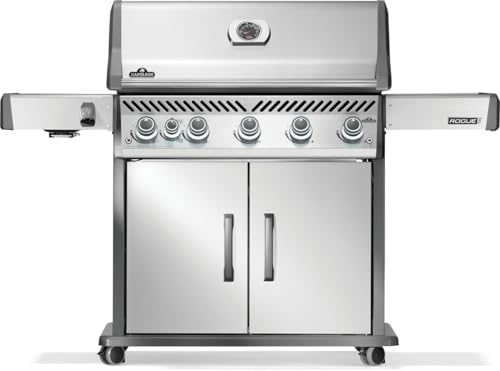
Napoleon Rogue PRO 625 Propane Grill — Best Premium Sear Station
The Rogue PRO 625 is built around the side-station philosophy: grill space stays grill space, and searing happens on a small infrared burner on the side shelf that reaches temperatures the main firebox cannot. It suits enthusiasts who cook steaks in small numbers and want the hardest possible crust, plus grillers who value the folding shelf and backlit knobs for evening cooks. The premium tier pricing position makes it a considered purchase, not an impulse one.
Strengths
- Infrared side burner reaches true searing-station temperatures
- Five main burners and 988 sq. in. total area handle crowds
- Backlit knobs and folding shelf suit evening, space-aware cooking
Trade-offs
- Sear station fits one or two steaks at a time
- Premium positioning across purchase and replacement parts
- Large total footprint even with the shelf folded
| Fuel | Propane |
| Burners | 5 main burners plus infrared side burner |
| Total output | 74,000 BTU (per Amazon title) |
| Total area | 988 sq. in. (per Amazon title) |
A dedicated infrared station changes steak night workflow. The main grill runs at a moderate temperature for vegetables, potatoes, or the reverse-sear’s slow first phase, while the side burner idles at maximum. When the meat hits its target internal temperature, sixty to ninety seconds per side on the infrared grate finishes it. That division of labor is exactly how steakhouses work, and the Rogue PRO is the closest home equivalent in this roundup.
Be honest about the station’s size, though. It is a one-to-two-steak tool. For a dinner party of eight ribeyes, you will sear in rotations and hold finished steaks in the main grill’s warm zone — workable, but if your life is mostly big-batch searing, the Kenmore’s in-box zone fits better. The Napoleon rewards the cook who sears small and precisely.
Best for: enthusiasts who want a separate infrared sear station / Not suited for: budget shoppers or small households
Check on Amazon to see the current configuration and check price on Amazon before you order.
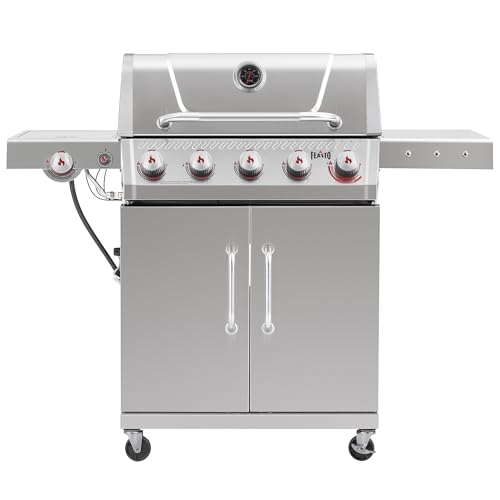
Feasto 5-Burner Propane Gas Grill — Best Value Sear Burner
Feasto is the answer for shoppers whose budget rules out the Weber and Napoleon badges but who still want a purpose-built sear burner rather than a marketing claim. Five burners, a dedicated sear burner, a side burner, and 686 square inches of space cover the same feature checklist as grills a full tier above. The trade is in the unknowns: thinner track record, and a parts network that cannot match Weber’s decade-deep catalog.
Strengths
- Built-in sear burner at a value-tier position
- 686 sq. in. gives genuine multi-zone room
- Side burner included, which value grills often drop
Trade-offs
- Long-term parts and support network is thinner than legacy brands
- Fit and finish trail the premium picks
- High-output sear burner needs diligent port cleaning
| Fuel | Propane |
| Burners | 5 main burners, sear burner, side burner |
| Total output | 58,000 BTU (per Amazon title) |
| Cooking space | 686 sq. in. (per Amazon title) |
Judged purely on the cooking, the Feasto layout is right: sear burner positioned for a hot zone, enough grate to run a cool zone beside it, and a side burner for the pan work. Steak results come down to preheat discipline — give any grill fifteen minutes with the lid down before the first steak lands, and value hardware performs far closer to premium hardware than the price gap suggests.
Ownership is where expectations should be set. Register the warranty, photograph the model plate, and order a spare igniter early rather than mid-season. None of that is unique to Feasto — it is simply more likely to matter. For a household that grills hard for a few seasons and views the grill as a tool rather than an heirloom, the value math here is genuinely compelling.
Best for: shoppers who want a built-in sear burner without premium pricing / Not suited for: buyers who prioritize long-term parts availability
Check on Amazon to see the current configuration and check price on Amazon before you order.
Comparison Table
| Pick | Badge | Key spec | Best for |
|---|---|---|---|
| Weber Spirit E-435 Gas Grill | Best Overall | 4 burners, Sear Zone with Boost, plus side burner | families who sear weekly and also simmer sauces outside |
| Weber Spirit E-325 Gas Grill | Best Compact Sear Zone | 3 burners with Sear Zone and Boost, small footprint | couples and small patios that still want a real crust |
| Kenmore 5-Burner Propane Gas Grill | Best for Big Cookouts | 5 burners plus searing zone, 644 sq. in., 66,000 BTU (per Amazon title) | large families and hosts who sear in batches |
| Charbroil Pro Series Amplifire Infrared 4-Burner Grill | Best Infrared Sear | Amplifire infrared system, 4 burners, cabinet with side burner | cooks who hate flare-ups and want edge-to-edge radiant searing |
| Napoleon Rogue PRO 625 Propane Grill | Best Premium Sear Station | 5 burners, infrared side burner, 74,000 BTU, 988 sq. in. total area (per Amazon title) | enthusiasts who want a separate infrared sear station |
| Feasto 5-Burner Propane Gas Grill | Best Value Sear Burner | 5 burners plus built-in sear burner, 58,000 BTU, 686 sq. in. (per Amazon title) | shoppers who want a built-in sear burner without premium pricing |
Read the key spec column as a layout map, not a power ranking: an in-grate sear zone, a whole-grate infrared system, and a side sear station all reach crust temperature, but they organize your cooking differently. Match the layout to how many steaks you sear at once.
How to Choose the Best Gas Grills With Searing Burner Features
Start by choosing your searing architecture. An in-box sear zone, like Weber’s Boost-fired section of the main grate, is best when you sear several pieces at once and want to finish them in the same firebox. An infrared side station, like Napoleon’s, reaches the highest peak temperatures and is best for one or two steaks cooked with steakhouse sequencing. A whole-grate infrared system, like Char-Broil’s Amplifire, removes flare-ups from the equation entirely and sears everything, everywhere, at once.
Next, look at what surrounds the sear. Grate material decides how much heat the surface holds between the burner cycles: porcelain-enameled cast iron stores heat and marks beautifully, while stainless rod grates heat and cool faster and clean easier. Burner count decides whether you can hold a true cool zone beside the sear — three burners is the practical minimum for two-zone cooking, and five gives you a sear zone, a finishing zone, and a holding zone simultaneously.
- Match sear-station size to your typical steak count, not your biggest party
- Prefer cast-iron or heavy rod grates for maximum crust formation
- Check that the sear feature is named in the listing, not implied by total BTU
- Confirm fuel type — several picks here come in propane and natural gas versions
- Plan for a cover; high-output burners and igniters age fastest when left exposed
What Searing Temperatures Actually Do to Meat
A crust is chemistry, not just heat. The browning reactions that create steakhouse flavor accelerate once the meat’s surface dries and climbs well past the boiling point of water, which is why a merely hot grill steams a steak grey: surface moisture keeps the temperature pinned until it evaporates. A searing burner’s job is to blast through that wet phase in the first minute, drying the surface so browning can begin before the interior overcooks.
This is also why preheating the grate matters as much as the burner. The grate is the contact surface; a screaming burner under a lukewarm grate still steams. Fifteen minutes of preheat with the lid closed, on the sear setting where fitted, loads the metal with the energy the first side of the steak will draw down. Flip once, let the second side crust, then move the meat to a cooler zone to coast to temperature.
Sear Zone vs Infrared Station vs Infrared Grate: Which Layout Fits Your Cooking?
The three searing architectures in this roundup behave differently enough that choosing between them matters more than choosing between brands. An in-box sear zone, the Weber approach, keeps everything inside one firebox. Its strength is flow: sear, slide, finish, serve, all under one lid, with drippings and heat staying in the same chamber. Its limit is peak temperature — a boosted conventional burner gets very hot, but an infrared emitter gets hotter, because it converts nearly all of its energy into radiant heat at the cooking surface rather than heating air that escapes around the meat.
The infrared side station, the Napoleon approach, inverts the priorities. Peak heat is the whole point, and the station’s small size is a feature for the cook searing two steaks to order: less fuel burned, faster preheat, and a grate that recovers instantly between pieces. Its limit is throughput. The station cannot help with a tray of chicken thighs, and during a big cook it can become a bottleneck that the main grill has to wait on. Cooks who entertain in volume should read that as a genuine constraint, not a footnote.
The whole-grate infrared system, Char-Broil’s Amplifire approach, removes the zone question entirely. Every square inch sears, which sounds like a luxury until you try to hold a gentle zone for vegetables or a finishing area for thick cuts — then the system’s uniformity becomes the thing you manage around, using burner control and lid discipline to create the gradient the hardware does not provide. None of the three is objectively best. The right choice is the one whose constraint you will mind least across hundreds of cooks.
Fuel, Preheat, and the Real Cost of a Great Sear
Searing is the most fuel-hungry phase of grilling, and it is worth understanding where the propane actually goes. The fifteen-minute preheat typically consumes more fuel than the sear itself, because all burners run at full output to load the grate and firebox with heat. The sear that follows lasts two to four minutes. This is why shrinking the preheat — by choosing a grill sized to your household rather than your largest imaginable party — saves more fuel over a season than any burner efficiency claim.
Natural gas versions of several picks in this roundup change the equation in a different way: the fuel cost per cook drops and the tank never empties mid-sear, but the grill becomes a fixed installation tied to the gas line’s location. Households that rearrange their patio or expect to move should weigh that permanence honestly. Renters and frequent movers are better served by propane’s flexibility, accepting the ritual of the spare tank.
There is also a time cost that rarely appears in buying guides. A grill with a proper sear feature shortens the active cooking window for steaks to minutes, which changes weeknight math: steak night stops being a project. That convenience, repeated across a season, is what owners actually pay for when they step up to a searing model — not the specification itself, but the Tuesday-evening version of a steakhouse dinner it makes possible.
Keeping Searing Performance Consistent Season After Season
Searing performance degrades gradually, which makes it easy to miss. Burner ports narrow with carbonized grease, igniter electrodes foul, and infrared emitter plates clog pore by pore. The steak that seared beautifully in May takes noticeably longer by September, and most owners blame the meat or the weather before they blame maintenance. A simple seasonal routine prevents nearly all of it: brush grates hot after every cook, run a full high-heat burn-off monthly during the season, and inspect the sear burner’s port row each spring with a flashlight, clearing blocked ports with the tool or method the manufacturer specifies.
Grate care matters as much as burner care. Porcelain-enameled cast iron should be brushed, not scraped with metal that chips the enamel, because chips become rust points that stick to food and shed heat unevenly. Infrared emitters want the opposite respect: keep them free of marinade sugars and heavy rubs directly over the plate where possible, since caramelized residue is what clogs the pores that make the heat even.
Finally, store the grill covered and, in harsh climates, disconnect and store the regulator indoors over winter. Searing burners and their igniters are the most weather-sensitive parts of these grills precisely because they are the most engineered. Protect them, and the sear you bought is the sear you still have in year five.
- Brush grates while hot after every cook; deep-clean the sear zone monthly in season
- Inspect and clear sear burner ports each spring before the first steak night
- Keep infrared emitter plates free of sugary marinades directly over the plate
- Cover the grill between uses and store the regulator indoors in winter climates
Matching a Searing Grill to Your Household Size and Space
Searing grills are usually bought one size too large, because shoppers picture the biggest cook of the year — the Fourth of July, the graduation party — and buy for that day. The other fifty weeks then pay for it in preheat time, fuel, and cleaning. A more honest sizing method starts with the steaks: count the pieces you sear in a typical cook, not a peak one. Two to four steaks points to a three-burner with a sear zone, like the Spirit E-325, where the whole firebox is working every time. Five to eight pieces, plus sides on the grate, is four-burner territory. Beyond that, the five-burner models stop being indulgences and start being the right tool.
Space deserves the same honesty. Measure the patio footprint with the lid open and the side shelves up, then add the working room you need to stand with a tray. A sear station on the side shelf, as on the Napoleon, needs clearance on that side specifically; a grill that fits with its shelf folded but not open does not fit. Balcony cooks should also check building and lease rules before falling for any large gas grill, since some properties restrict tank size or grill placement regardless of the model chosen.
Household size also predicts which sear architecture ages best. Small households sear small, so the infrared station’s one-or-two-steak limit rarely binds, and its fast preheat suits weeknight cooking. Large households live in batches, where an in-box zone keeps the line moving. The Feasto and Kenmore exist for the cooks in the second group whose budgets are in the first group’s territory — a reminder that matching layout to household matters more than matching badges to aspirations.
Finally, think about who else cooks. A sear zone with simple knob logic gets used by everyone in the house; a multi-station flagship with a broiler and rotisserie tends to become one person’s instrument. Neither is wrong, but the grill that only one person dares to light is the grill that sits cold on the nights that person is out. The best searing grill for a household is the one the whole household will actually fire up.
Beyond Steak: What Else a Searing Burner Is Good For
Steak justifies the sear burner, but the feature quietly upgrades half the grill menu. Tuna and swordfish steaks, which need a hard exterior and a rare center, are nearly impossible to time on a moderate grill and straightforward over a sear zone: a minute a side and the fish is done before the middle warms through. Salmon skin crisps properly only when the grate is hot enough to render and release it, which is exactly the heat a sear burner provides — the difference between skin that lifts cleanly and skin that stays welded to the grate.
Vegetables benefit in a different way. Asparagus, scallions, shishito peppers, and halved lemons all want brief, violent heat rather than a long roast: char at the edges, snap in the middle. A sear zone gives you that intensity in a defined patch of grate, so the delicate items can flash while the chicken finishes gently beside them. Flatbreads and pizzas on a stone also reward the extra burner power during preheat, bringing the stone to temperature faster and recovering between pies.
Even burgers change character. A smash burger needs a surface hot enough to crust the meat before the fat renders out, and a sear zone under a cast-iron griddle plate delivers that diner-style edge at home. The pattern across all of these is the same: foods whose cooking time is measured in seconds-to-minutes, and whose quality is decided at the surface, belong over the hottest part of the grill.
Knowing this widens the buying case honestly. A household that rarely cooks steak but grills fish, vegetables, and flatbreads weekly may use a sear burner more than a steak household does. When you evaluate the picks in this roundup, count all the fast, surface-driven cooking you do — that total, not steak night alone, is the feature’s real workload.
A Note on Covers, Tanks, and Sear-Ready Storage
Two unglamorous purchases protect everything this guide has discussed. The first is a fitted cover, because sear burners, boost valves, and electronic igniters are the components weather attacks first, and a covered grill lights faster and sears more evenly in its third season than an uncovered one does in its second. The second is a spare propane tank, kept filled: nothing ruins a sear like a tank dying mid-preheat, when the grate never reaches crust temperature and the first side of the steak steams. Neither purchase is exciting, and together they do more for your actual searing results than the next tier of grill would.
How to Sear a Steak on a Gas Grill With a Searing Burner
The sequence below works on every architecture in this roundup — in-box zone, infrared station, or infrared grate. The principles are identical: dry surface, fully preheated metal, minimal flipping, and a gentler zone for finishing.
- Pat the steak completely dry and season it; moisture is the enemy of the first-minute crust.
- Preheat the grill on high for at least fifteen minutes with the lid closed, sear burner or zone engaged.
- Oil the grate lightly or oil the steak, then lay the meat on the hottest section and do not touch it for ninety seconds to two minutes.
- Flip once with tongs — never a fork — and sear the second side for the same time.
- Move the steak to a cooler burner zone, close the lid, and let it coast to your target doneness.
- Rest the steak on a warm plate for at least five minutes so juices redistribute before slicing.
For the reverse-sear variation, run the sequence backwards: cook the steak gently in the cool zone first until it nears temperature, then finish with a fast pass over the sear burner. Thick cuts over an inch and a half benefit most, because the gentle phase renders the interior evenly while the final sear stays brief enough not to grey the edges.
Common Buying Mistakes
Most disappointing sears trace back to a handful of repeatable errors rather than the hardware. Fix these and even a mid-tier sear burner performs.
- Judging a grill by total BTU instead of by whether it has a dedicated searing feature
- Skipping the preheat, so the grate steams the steak instead of searing it
- Searing wet meat straight from the package without drying the surface
- Crowding the sear zone, which drops grate temperature for every piece at once
- Pressing steaks with a spatula, squeezing out the juices the sear was meant to keep in
- Never cleaning sear-burner ports, then blaming the grill for uneven stripes
Final Recommendation
For most households, the Weber Spirit E-435 is the right answer: the Sear Zone lives inside the main grate where batch cooking happens, and the side burner quietly becomes the most-used feature on the grill. If your patio is smaller, the Spirit E-325 keeps the same searing idea in a compact body. Cooks who sear for crowds should look at the Kenmore’s wide firebox, while flare-up-weary grillers will appreciate the Char-Broil Amplifire’s infrared calm.
Enthusiasts chasing the hardest crust should choose the Napoleon Rogue PRO 625 and its infrared side station, and value shoppers can get a genuine built-in sear burner from the Feasto without stepping up a tier. Whichever layout you choose, dry meat, a fully preheated grate, and one confident flip will do more for your steaks than any specification on the box.
Start your comparison with the three picks most buyers end up choosing between: Weber Spirit E-435 Gas Grill, Weber Spirit E-325 Gas Grill, Kenmore 5-Burner Propane Gas Grill — check price on Amazon for each, confirm the fuel version and configuration, and match the layout to the way your household actually cooks.
Best Gas Grills With Side Burner Best Gas Grills With Stainless Steel Grates Best Gas Powered Grills
Frequently Asked Questions
Do I really need a dedicated searing burner, or is a high-BTU grill enough?
Total BTU spread across a whole firebox rarely matches a dedicated sear feature. A searing burner concentrates output into a small area, pushing grate temperature high enough to crust meat in the first minute. A powerful standard grill can sear, especially with cast-iron grates and a long preheat, but the dedicated zone does it faster and more consistently.
Is an infrared side burner better than an in-grate sear zone?
They suit different cooking. An infrared side station reaches higher peak heat and gives the hardest crust on one or two steaks, but cannot batch-cook. An in-grate sear zone handles several pieces at once and lets you finish them in the same firebox. Choose based on how many steaks you typically sear together.
How long should I preheat before searing?
At least fifteen minutes with the lid closed and the sear feature engaged. The grate itself must store heat, because the metal touching the meat does the searing. A grill whose air thermometer reads high but whose grate is still warming will steam the first side of the steak.
Can I sear on a searing burner and finish elsewhere on the grill?
Yes — that two-zone method is exactly what these grills are designed for. Sear hard for ninety seconds to two minutes per side, then move the meat over burners set low or off, close the lid, and let it coast to temperature without burning the crust you built.
How do I keep a sear burner performing like new?
Brush the grate after each cook while it is warm, and periodically check that every burner port along the sear burner is open. A wire brush or a port-cleaning tool clears carbonized grease that causes uneven stripes. Keep the grill covered between uses to protect the igniter and burner from weather.
Does a searing burner use much more propane?
Only while it is engaged. Boost and infrared burners draw more fuel per minute than a standard burner, but a sear takes two to four minutes total. Across a whole cookout the difference is small compared with the main burners’ preheat and finishing time.
Best Gas Grills With Smoker Box Best Gas Outdoor Flat Top Grills Best Gas Grills With Stove


