Disclosure: airfryerkitchensupply.com is reader-supported. When you buy through links on our site, we may earn an affiliate commission at no extra cost to you.
Where to buy
Start with this shortlist of the best food processors for making baby food. Every linked pick below was verified against Amazon’s own catalog data for this site before this guide was written, so the model names and capacities in this article match real, current listings. Use the links in this box, in Quick Picks, and under each review to check price on Amazon on the day you buy, because bundles and included accessories change between listings. If a pick is marked as unlinked anywhere in this guide, that means we could not confirm the exact configuration, and you should compare live listings carefully instead of trusting a headline claim.
- Béaba Babycook Solo 4-in-1 Baby Food Maker (Best Overall for First Foods) — check price on Amazon
- Béaba Babycook Neo Baby Food Maker (Best Premium Baby Food Maker) — check price on Amazon
- nutribullet Baby Steam + Blend NBY50200 (Best Steam-and-Blend Value System) — check price on Amazon
- NutriBullet Baby Complete Food-Making System NBY-50100 (Best for Freezer Batch Systems) — check price on Amazon
- GROWNSY Baby Food Maker (Best Budget Steam-and-Blend) — check price on Amazon
- Momcozy AutoMeal Baby Food Maker (Best Automated Texture Settings) — check price on Amazon
If you are shopping for the best food processors for making baby food, you are choosing between two genuinely different approaches, and this guide treats them honestly. Dedicated baby food makers steam and blend in one small machine, portion-sized for first foods and designed for one-handed use while you hold a baby. Full-size food processors with steam baskets — or paired with a pot and steamer — make much larger batches for freezer stocking, and keep working for family cooking long after the puree stage ends. The six picks below include both approaches, all verified in this site’s catalog data, so you can match the tool to your actual plan: small fresh batches daily, or a Sunday session that fills the freezer.
What baby food demands from any machine is specific. Textures must progress — silky-smooth for first tastes, then thicker, then softly lumpy — so speed control and pulse control matter more than raw power. Food-contact parts should be easy to clean thoroughly, because puree hides in blade assemblies. Batch size cuts both ways: too big a bowl wastes food and circulates a small puree badly; too small a machine makes freezer stocking tedious. And because this is food for infants, this guide stays in its lane: it covers equipment and technique, and leaves feeding schedules, ingredient introduction, and nutrition questions to your pediatrician and current official guidance.
Every linked pick was verified against Amazon’s catalog data for this site before writing, and spec boxes quote only what those listings confirm. Prices are never printed; check price on Amazon on the day you buy.
In this guide
Quick Picks
Short on time? Two dedicated steam-and-blend baby makers lead the list for first foods, the NutriBullet systems cover both philosophies, and two value picks round it out — all verified.
- Best Overall for First Foods — Béaba Babycook Solo 4-in-1 Baby Food Maker: The benchmark baby food maker: steams and blends in one 37-ounce bowl, works one-handed, and covers defrosting and reheating the portions you froze. Check on Amazon
- Best Premium Baby Food Maker — Béaba Babycook Neo Baby Food Maker: The step-up Béaba: a larger 42-ounce capacity, the same steam-and-blend one-handed workflow, and dishwasher-safe cleanup. Check on Amazon
- Best Steam-and-Blend Value System — nutribullet Baby Steam + Blend NBY50200: An all-in-one system with a steamer basket, pulse cycle for texture control, and portion cups in the box — the practical value pick with storage solved. Check on Amazon
- Best for Freezer Batch Systems — NutriBullet Baby Complete Food-Making System NBY-50100: The original NutriBullet Baby system: a 32-ounce batch blender built around making and storing purees in quantity for the freezer. Check on Amazon
- Best Budget Steam-and-Blend — GROWNSY Baby Food Maker: A budget-tier steamer-and-blender with a BPA-free elevated steam basket — the core baby food workflow at the friendliest tier here. Check on Amazon
- Best Automated Texture Settings — Momcozy AutoMeal Baby Food Maker: The automation pick: one-step auto steam-and-blend, automatic three-stage texture settings, and a self-cleaning cycle in a compact 15-ounce cup. Check on Amazon
How These Picks Were Chosen
Picks were chosen by matching verified catalog data to the stages of baby food making: steam-and-blend integration for the first months, texture control from smooth to chunkier, portion and batch sizes that match real usage, and cleaning practicality. Dedicated baby makers were verified as a group in this program’s cache; each listing confirms its steaming, blending, capacity, and food-contact features, and only those confirmed features are quoted in the spec boxes.
We deliberately mixed philosophies rather than crowning one. Parents who will make small fresh batches daily need a different machine from parents batch-cooking for the freezer, and both patterns are legitimate. No prices, star ratings, or review counts are used, and no health or nutrition claims are made — this is an equipment guide.
The 6 Best Food Processors for Making Baby Food

1. Béaba Babycook Solo 4-in-1 Baby Food Maker — Best Overall for First Foods
Choose the Babycook Solo if you want the classic dedicated solution for the first year. It steams vegetables, fruit, and proteins, then blends in the same bowl — no transferring hot food between pots — and its one-handed operation is designed for a parent holding a baby. The defrost and reheat functions close the loop for frozen portions. It suits parents making fresh small batches most days. It is not a family appliance: once purees end, it has no second career, and freezer-stockers may find the batch size small.
Strengths
- Steam and blend in one bowl — no hot transfers
- One-handed operation designed for parents
- Defrost and reheat functions handle frozen portions
Trade-offs
- Single-purpose appliance after the puree stage
- 37 oz batches are modest for big freezer sessions
- Premium tier among baby food makers
| Spec | Detail |
|---|---|
| Functions | 4-in-1: steam, blend, defrost, reheat per listing |
| Capacity | 37 oz |
| Operation | One-handed operation per listing |
| Texture range | Purees to soft solids per listing |
The Babycook’s design insight is workflow, not power. Baby food making happens in stolen minutes, often one-handed, and a machine that steams and blends in the same vessel — then reheats yesterday’s frozen portion tomorrow — removes the friction that makes parents abandon homemade purees. The listing’s texture range, from purees to soft solids, matches the progression most babies follow across the first year, so the machine stays relevant beyond the first tastes.
Capacity is the honest trade-off. Thirty-seven ounces is a sensible few days of early portions, and the listing frames it in servings accordingly, but a parent planning a month of freezer stock will run many cycles. Those parents should look at the NutriBullet system or the larger approach described in the guide. For daily freshness with minimum fuss, the Solo remains the standard the others are measured against.
Best for: Daily fresh batches through the first year / Not suited for: Bulk freezer stocking or post-puree family use
Check on Amazon — check the current price on Amazon before you buy.

2. Béaba Babycook Neo Baby Food Maker — Best Premium Baby Food Maker
Pick the Neo if you like the Babycook concept and want the larger, more refined version. The 42-ounce capacity stretches batches a little further, one-handed use remains central, and dishwasher-safe cleanup addresses the daily reality of puree in blade assemblies. It suits parents who expect heavy use across the full puree period and value the easier wash-up. Budget-focused parents should compare the Solo and the value picks below; the Neo is a premium-tier refinement, not a different category of tool.
Strengths
- Larger 42 oz capacity than the Solo
- Steam-and-blend in one bowl, one-handed
- Dishwasher-safe cleanup for daily use
Trade-offs
- Premium tier
- Still a single-purpose appliance
- Batch size still modest for month-at-once freezer sessions
| Spec | Detail |
|---|---|
| Capacity | 42 oz |
| Functions | Steam & blend per listing |
| Operation | One-handed use per listing |
| Cleanup | Dishwasher-safe cleanup per listing |
The Neo’s improvements are the ones daily users feel: a bit more capacity per cycle and cleanup that goes in the dishwasher without a second thought. Baby food making is a high-frequency, low-glamour task, and small frictions compound — a bowl that needs hand-scrubbing three times a day is a bowl that quietly stops being used. Béaba clearly designed the Neo around sustained daily use, and its listing’s phrasing — growing from purees to solids — reflects that longer arc.
As with the Solo, the boundary is purpose. This is a first-year specialist of the highest quality on this list, and it should be bought as exactly that. If your budget must also cover a family processor for the years after, the NutriBullet Baby system below splits the difference; if the first year is the priority and the budget allows, the Neo is the premium expression of the dedicated approach.
Best for: Heavy daily use with the easiest cleanup / Not suited for: Tight budgets or post-puree versatility
Check on Amazon — check the current price on Amazon before you buy.

3. nutribullet Baby Steam + Blend NBY50200 — Best Steam-and-Blend Value System
Choose the nutribullet Steam + Blend if you want the dedicated workflow without the premium tier. The steamer basket and blender cover the core job, the pulse cycle gives you texture control as your baby progresses, and the included 2- and 4-ounce storage cups mean the freezer system starts the day the machine arrives. The listing confirms BPA-free food-contact parts and dishwasher-safe cleanup. It suits practical parents who value a complete kit. Design purists may prefer the Béaba’s single-bowl elegance; this is a basket-and-blender system rather than one vessel.
Strengths
- Complete kit — storage cups included
- Pulse cycle for texture progression
- BPA-free and dishwasher safe per listing
Trade-offs
- Basket-and-blender workflow has more parts than one-bowl rivals
- Less premium feel than the Béaba machines
- Portion cups are starter quantities — keen freezers will add more
| Spec | Detail |
|---|---|
| System | All-in-one steamer basket + puree blender per listing |
| Included | 2 oz & 4 oz storage cups per listing |
| Materials | BPA-free per listing |
| Cleanup | Dishwasher safe per listing |
The included storage cups are a bigger deal than they look. Homemade baby food only saves effort if portioning and freezing is effortless, and a system that arrives with correctly sized 2- and 4-ounce cups removes the shopping-around friction at exactly the moment new parents have no time. Combined with the steamer basket, the workflow is complete: steam, blend, portion, freeze, and later defrost portions as needed.
Texture progression is handled by the pulse cycle — short pulses for chunkier later-stage foods, sustained blending for early smooth purees. That control, plus honest mid-tier positioning, makes this the value recommendation among the steam-and-blend machines. It does not have the Béaba’s one-handed single-bowl refinement, but it covers the same feeding year for a lower tier.
Best for: Practical parents wanting a complete starter system / Not suited for: Buyers who want a single-vessel premium design
Check on Amazon — check the current price on Amazon before you buy.

4. NutriBullet Baby Complete Food-Making System NBY-50100 — Best for Freezer Batch Systems
Pick the NBY-50100 if your plan is batch-and-freeze. This system was designed around producing a session’s worth of puree and portioning it for storage, in the familiar NutriBullet format. Note the honest boundary: unlike the steam-and-blend picks, this is a blending system — you steam or cook the food first in a pot or steamer, then blend and store. It suits organized parents who cook in sessions. Parents wanting one machine that steams too should choose the Steam + Blend or a Béaba.
Strengths
- Batch-oriented 32 oz blending for freezer sessions
- Established system format, simple to use
- Built around the portion-and-store workflow
Trade-offs
- Does not steam — cooking happens separately
- Fewer confirmed extras in the listing than the newer Steam + Blend
- Blending-only role ends with the puree stage
| Spec | Detail |
|---|---|
| Capacity | 32 oz |
| System | Complete food-making system per listing |
There are two kinds of baby food parents: daily makers and session makers. This system serves the second kind. Steam a pot of sweet potatoes or pears on the stove — a big pot, more than any countertop steamer basket holds — then blend in batches and freeze in portions. For that workflow, a dedicated steam function on the machine itself is almost irrelevant, and the NBY-50100’s simplicity is a virtue: fewer parts, a familiar format, and a 32-ounce batch size that moves a session along.
The trade-off is the extra pot and the transfer step the steam-and-blend machines eliminate, plus the need to manage cooking times yourself. If your kitchen routine already involves a stove pot happily, you will not miss the integration. If your routine is one-handed and interrupted, pay for the integration in the picks above.
Best for: Session cooks who steam in a pot and freeze in bulk / Not suited for: Parents wanting steaming built into the machine
Check on Amazon — check the current price on Amazon before you buy.

5. GROWNSY Baby Food Maker — Best Budget Steam-and-Blend
Choose the GROWNSY if you want the steam-and-blend workflow at a budget tier. Its listing confirms the essentials: steaming and blending in one appliance, a BPA-free elevated steam basket that keeps food above the water, and positioning for starting solids. It suits parents who are unsure how long they will make purees and do not want a premium commitment. It concedes refinement to the Béaba machines — expect a more basic ownership experience — and its listing confirms fewer extras than the nutribullet system.
Strengths
- Steam-and-blend workflow at a budget tier
- BPA-free elevated steam basket per listing
- Low commitment for parents unsure of their puree plans
Trade-offs
- Basic tier — fewer confirmed features and extras
- No storage system included per the listing
- Brand support and parts are a step below the established names
| Spec | Detail |
|---|---|
| Functions | Steamer & blender per listing |
| Basket | BPA-free elevated steam basket per listing |
| Positioning per listing | Starting solids and baby-led weaning support |
Budget baby appliances live or die on whether the core workflow is sound, and the GROWNSY’s confirmed features cover that workflow: steam in the basket, blend to puree, serve or freeze. The elevated basket design is the right approach — food steams rather than boils, which keeps more of what you cooked in the food rather than the water, and the same water can loosen a puree to the texture you want.
Buy it with clear expectations. This is the pick for the parent who thinks in terms of cost per month of use across a single baby’s puree stage, and on that math a budget machine that completes the stage is a rational purchase. Parents expecting to hand a machine down through several children may find the premium picks’ build a better long-term calculation.
Best for: Budget-conscious parents for one baby’s puree stage / Not suited for: Multi-child hand-down plans or premium expectations
Check on Amazon — check the current price on Amazon before you buy.
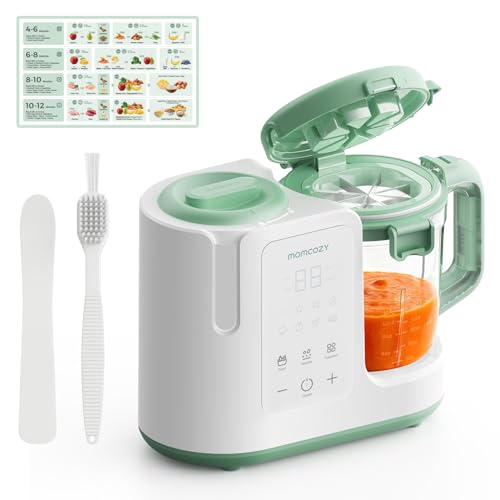
6. Momcozy AutoMeal Baby Food Maker — Best Automated Texture Settings
Pick the Momcozy AutoMeal if you want the machine to make the decisions. Its listing confirms one-step automatic steam-and-blend operation, three-stage texture settings that map to the puree progression, and a self-cleaning function — a feature set aimed squarely at exhausted parents. The 15-ounce cup is sized for fresh small batches rather than freezer sessions. It suits parents of one baby making food frequently in small amounts. Batch freezers should look at the larger systems above; this machine’s virtue is effortlessness, not volume.
Strengths
- Fully automatic steam-and-blend in one step
- 3-stage texture settings match the feeding progression
- Self-cleaning reduces the daily wash-up burden
Trade-offs
- 15 oz cup is small for batch cooking
- Automation means less manual control for confident cooks
- Newer product format than the established systems
| Spec | Detail |
|---|---|
| Functions | One-step auto steam & blend per listing |
| Capacity | 15 oz cup |
| Texture | Auto 3-stage texture settings per listing |
| Cleanup | Self-cleaning per listing |
The AutoMeal’s bet is that the scarcest resource in a new parent’s kitchen is attention, and its feature list reads like a direct response: press once for steam-and-blend, choose a texture stage rather than judging blend times, and let the machine clean itself. For a parent making a fresh small batch daily — a couple of pouches or a day or two of portions — the 15-ounce cup is correctly sized, and small batches circulate and blend more evenly than tiny quantities lost in a big bowl.
The boundaries are volume and control. A freezer-stocking session in a 15-ounce cup would take many cycles, and cooks who enjoy judging texture themselves may find preset stages limiting by the later, chunkier stage. Within its intended pattern — frequent, fresh, small, effortless — it is the most thoughtfully automated pick on this list.
Best for: Frequent fresh small batches with minimum effort / Not suited for: Freezer batch sessions
Check on Amazon — check the current price on Amazon before you buy.
Comparison Table
Decide first whether steaming must be built in, then match capacity to your pattern: small fresh batches daily, or bigger sessions for the freezer. The badge marks each machine’s working style.
| Pick | Badge | Key spec | Best for |
|---|---|---|---|
| Béaba Babycook Solo 4-in-1 Baby Food Maker | Best Overall for First Foods | 37 oz, steam/blend/defrost/reheat, one-handed use | Daily fresh batches through the first year |
| Béaba Babycook Neo Baby Food Maker | Best Premium Baby Food Maker | 42 oz, steam & blend, dishwasher-safe cleanup | Heavy daily use with the easiest cleanup |
| nutribullet Baby Steam + Blend NBY50200 | Best Steam-and-Blend Value System | Steamer basket + blender, storage cups included, BPA-free | Practical parents wanting a complete starter system |
| NutriBullet Baby Complete Food-Making System NBY-50100 | Best for Freezer Batch Systems | 32 oz complete food-making system | Session cooks who steam in a pot and freeze in bulk |
| GROWNSY Baby Food Maker | Best Budget Steam-and-Blend | Steamer & blender, BPA-free elevated steam basket | Budget-conscious parents for one baby’s puree stage |
| Momcozy AutoMeal Baby Food Maker | Best Automated Texture Settings | 15 oz cup, auto steam & blend, 3-stage texture settings, self-cleaning | Frequent fresh small batches with minimum effort |
How to Choose the Best Food Processors for Making Baby Food
Start with your batch pattern, because it decides the category. Daily fresh makers — a small batch every day or two — are best served by steam-and-blend machines with modest cups, where small quantities circulate properly and cleanup is quick. Session makers — a weekly or monthly cook-up for the freezer — need either a larger steam-and-blend capacity or a blending system paired with a big stove pot, plus a portioning system of cups or trays. Buying a small automated machine for freezer stocking, or a big system for daily single portions, frustrates in both directions.
Second, texture control. Baby food is not one texture: it progresses from thin and silky to thick and softly lumpy over the first year. Machines handle this differently — pulse cycles, blend-time judgment, or the Momcozy’s automatic three-stage settings. Any of these can work; what matters is that the machine lets you stop at chunkier textures rather than forcing everything to a puree. Check the listing language: ‘purees to soft solids’ and staged settings are the phrases that confirm a machine grows with the baby.
Third, the unglamorous essentials: food-contact materials confirmed in the listing (several picks here confirm BPA-free parts), cleanup that is dishwasher-safe or self-cleaning, and a storage plan for what you make. Puree in a blade assembly left unwashed is a hygiene problem, not a nuisance, so cleanup design deserves real weight in this category — more than in any other processor purchase.
- Batch pattern first: daily-fresh vs freezer-session decides the machine class
- Steam integration: one-vessel steam-and-blend vs blend-only with a stove pot
- Texture range: the listing should confirm progression beyond smooth puree
- Cleanup: dishwasher-safe parts or self-cleaning — puree punishes hand-wash-only designs
- Storage plan: included portion cups or your own trays, decided before the first session
Dedicated Baby Food Maker vs Full-Size Processor: Which Approach?
The dedicated makers on this list — Béaba, GROWNSY, Momcozy, and the nutribullet Steam + Blend — optimize the first year: small bowls that circulate small quantities, integrated steaming, one-handed or automatic operation, and reheating for frozen portions. Their cost is a short career; when purees end, they are done. The blending-system approach, represented by the NutriBullet Baby, trades integration for session scale and still ends with the puree stage.
The third approach — not a pick here but worth naming — is a full-size food processor from this site’s other guides, used with a stove steamer. It makes the largest batches, handles the chunkier later textures beautifully, and works for family food for a decade. Its weaknesses are real: small early batches circulate poorly in a big bowl, and there is no integrated steam or reheat. Families who already own a good full-size processor often need nothing else; families starting from zero usually get more first-year ease from a dedicated machine. Neither answer is wrong — they optimize different years of your kitchen’s life.
Portioning, Freezing, and Reheating: The System Around the Machine
The machine is half the system. The other half is portioning: small cups or ice-cube-style trays in the 2- to 4-ounce range let you freeze puree in meal-size units, defrost only what you need, and combine flavors at serving time. Two of the picks here include starter cups; for the others, budget for trays or cups as part of the purchase, because a freezer bag of solid puree is a frustrating object at 6 a.m.
Reheating deserves the same planning. The Béaba machines’ defrost and reheat functions exist because frozen portions are the norm, not the exception. If your machine lacks them, a small saucepan or a microwave with careful stirring does the job — always stir and check temperature evenly, since reheated puree heats unevenly. Label frozen portions with the contents and the date you made them; in the fog of the first year, your future self will thank you.
How to Make and Freeze a Batch of Baby Food Puree
This general method works with any pick on the list. It covers equipment technique only — what to feed, when, and in what order belongs to your pediatrician and current official guidance.
- Prepare the produce: wash it, peel where appropriate, and cut it into even, small pieces so it steams at the same rate. Even sizing matters more than any machine feature for an even result.
- Steam until completely soft — a piece should crush between your fingers with no resistance. In a steam-and-blend machine, load the basket and run the steam cycle; in a blend-only system, steam in a pot, then transfer with a slotted spoon.
- Blend with a little of the steaming liquid, adding it gradually until you reach the texture stage you want: fully smooth and pourable for first tastes, thicker for later stages, and pulse-only for soft lumps. Stop and check rather than assuming.
- Cool the puree promptly, then portion it into your cups or trays. Fill, seal, and label each portion with the contents and today’s date before freezing.
- To serve, defrost a portion in the fridge or use your machine’s defrost and reheat functions, stir thoroughly to even out the temperature, and check the temperature before serving. Discard unfinished portions from a served bowl rather than refrigerating them again.
Clean everything that touched the puree straight away — blade assemblies and gaskets especially — and let parts dry fully before reassembly. If a puree comes out too thick, loosen it with steaming liquid, water, or your baby’s usual milk at serving time; too thin, and a longer steam next time (so less water is absorbed) or a spoonful of a thicker puree mixed in will fix the bowl in front of you.
Texture Stages and How Each Machine Type Handles Them
Baby food texture is a journey with recognizable stages, and the machines here handle the stages differently enough to matter. The first stage is a thin, completely smooth puree — the consistency of a pourable sauce — which demands sustained blending with enough liquid and is where steam-and-blend machines and the NutriBullet systems are most at home. The second stage is thicker: a puree that holds a spoon’s shape, made by blending the same foods with less liquid and slightly less time. Any pick here manages it, and it is the stage where parents most often overshoot into stage one again by blending on autopilot — watch the bowl, not the clock.
The third stage introduces soft lumps: foods pulsed rather than blended, or blended smooth and then stirred together with a fork-mashed portion. This is where pulse control earns its keep — the nutribullet Steam + Blend’s pulse cycle and the general technique of short bursts let you stop at lumpy rather than arriving at smooth. The Momcozy’s automatic three-stage settings exist to map this progression onto buttons, which parents who distrust their own judgment at 2 a.m. tend to appreciate more than they expected.
Beyond lumps lies finger food, which is not machine food at all — soft pieces the baby handles directly — and at that point your baby food maker retires to reheating and the occasional smoothie-style puree. Knowing the machine’s career ends there is not a criticism of it; it is the planning fact that should set your budget, as the mistakes section argues. Buy the machine for the stages it will actually serve, at the tier your number of children justifies.
Cleaning, Sterilizing, and Living With a Baby Food Maker
No appliance in your kitchen will be washed as often as this one, and the ownership experience is mostly a cleaning experience. Puree insinuates itself into blade shafts, gaskets, and the underside of lids, and dried sweet potato is a genuine adhesive. The habits that work are boring and effective: rinse everything immediately after use, even if the full wash waits; dismantle the blade assembly rather than washing it in place; and let parts air-dry fully before reassembly, because a sealed damp unit grows stale smells that transfer to the next batch.
The picks divide honestly on this labor. Dishwasher-safe designs — confirmed on the Béaba Neo and the nutribullet Steam + Blend — convert the daily wash into a loading task. The Momcozy’s self-cleaning cycle handles the bowl between deeper washes. The simpler machines ask for hand-washing and reward it with fewer parts to lose. Whichever you own, a small bottle brush for the blade area and a weekly inspection of gaskets for trapped residue are the two unglamorous purchases that keep the system hygienic.
Storage is the last daily friction: a baby food maker used three times a day must live on the counter, not in a cupboard, or it will quietly stop being used. Measure its footprint against your counter’s honest free space before buying — in the first year, the best baby food maker is the one that is already out, already clean, and ready in the thirty seconds you actually have.
Safety and Hygiene Habits for Homemade Baby Food
Homemade baby food is simple food, and its safety rests on habits rather than technology. Start with clean hands, clean produce, and clean equipment — the machine washed and fully dried as the previous section describes. Cook foods thoroughly in the steaming stage: pieces should be soft enough to crush between your fingers, which is both the texture test and a sign the steaming was complete. Work in small enough batches that the puree moves from steaming to blending to cooling without long pauses at room temperature.
Cooling and storage deserve the same deliberateness as the cooking. Portion the puree while it is still warm into its cups or trays, seal them, and refrigerate or freeze promptly rather than letting the batch sit out through the evening. Label everything with contents and date — in the fog of the first year, unlabeled frozen portions become mystery food that gets thrown away, which wastes both food and the effort that made it.
At serving time, defrost portions in the fridge or with your machine’s defrost function, reheat until steaming where reheating is appropriate, then stir thoroughly — reheated puree heats unevenly, with hot spots — and always test the temperature yourself before the spoon goes to your baby. Discard what a served portion leaves behind rather than saving it, and when in doubt about any specific food, timing, or introduction question, ask your pediatrician rather than an equipment guide. These habits are not complicated, but they are the whole safety system, and they are worth more than any feature on any machine in this guide.
Budgeting the Puree Year: Where the Money Actually Goes
It is worth costing the puree year whole before choosing a tier, because the machine is not the only line item. Portion cups or trays, a small brush set for blade assemblies, replacement gaskets over a long career, and the produce itself all belong in the honest budget — and they argue for proportion: a premium machine paired with no storage system is a worse purchase than a mid-tier machine with the full system around it. The nutribullet Steam + Blend’s included cups look modest on a feature list and significant in this arithmetic.
The savings side is equally real. Homemade puree from ordinary produce costs a fraction of equivalent ready-made pouches across a full puree stage, which means even the premium picks here typically pay for themselves within the year for a household that uses them — and the budget picks pay for themselves within weeks. That arithmetic is why this guide’s tier advice runs through use patterns rather than price tags: the expensive mistake is never the premium machine that gets used daily, it is any machine, at any tier, that does not match how your household actually feeds.
Common Buying Mistakes
The most common buying mistake is mismatching the machine to the batch pattern. A compact automated maker bought for monthly freezer stocking means an afternoon of endless small cycles; a big system bought for daily single portions means puree smeared thin in a bowl that cannot circulate it. Decide your pattern first — the guide above exists to make that choice deliberately.
The second mistake is ignoring cleanup design. Baby food is made daily, and puree dries into every crevice of a blade assembly. A machine that is annoying to wash will be washed badly or abandoned; dishwasher-safe parts and self-cleaning cycles are core features in this category, not luxuries.
- Buying for the wrong pattern — daily-fresh and freezer-session cooking need different machines
- Skipping the storage plan — portion cups or trays are part of the purchase, not an afterthought
- Forgetting texture progression — a machine that only makes smooth puree is outgrown in months
- Overvaluing capacity — in this category, a bowl too big for small batches is a flaw, not a bonus
- Expecting the machine to answer feeding questions — equipment guides cover technique; feeding decisions belong with your pediatrician
A final mistake is buying a premium dedicated machine without counting its career honestly. If it will serve one baby’s puree year, a budget or mid-tier pick may be the rational spend; if it will serve three children, the premium build earns its tier. Both calculations are respectable — just make yours on purpose.
Final Recommendation
For most parents, the Béaba Babycook Solo is the recommendation: the one-vessel steam-and-blend workflow, one-handed operation, and defrost-and-reheat functions cover the first year with the least daily friction, and the Neo upgrades the same formula with more capacity and easier cleanup for those who want the premium version.
The nutribullet Steam + Blend is the practical value system with storage included, the NutriBullet Baby NBY-50100 serves session cooks who steam in a pot, the GROWNSY covers the workflow on a budget, and the Momcozy AutoMeal is the choice when automation matters most. Match the machine to your batch pattern, keep the pediatric questions with your pediatrician, and the puree year becomes one of the easier parts of new parenthood.
- Béaba Babycook Solo 4-in-1 Baby Food Maker — check price on Amazon
- Béaba Babycook Neo Baby Food Maker — check price on Amazon
- nutribullet Baby Steam + Blend NBY50200 — check price on Amazon
Keep exploring this category with related guides from the same program: Best Food Processors For Baby Food Best Food Processors For Hummus Best Food Processors For Chopping Best Food Processors For Home Use Best Blenders For Baby Food
A final consideration is timing your purchase. The puree stage arrives quickly and does not wait for deliberation, so the practical moment to choose is before you need the machine — ideally while you still have the leisure to compare cleaning systems and storage plans calmly. Parents who buy in the first overwhelmed week tend to buy whatever is in front of them; parents who bought a month earlier tend to own the machine this guide would have chosen for them. Either way, the equipment is the easy part: a sound machine, a freezer system, and the hygiene habits in these pages will carry the whole stage.
One more practical note belongs here: photograph your setup once it works. The arrangement of machine, cups, labels, and freezer space that you settle into by the third week is a system you will want to reconstruct after any disruption — a holiday, a house move, a second child — and a single photo of the working station is worth a page of notes. The puree stage is short, but for many families it repeats, and the households that sail through it the second time are the ones that kept the humble records — dates on portions, notes on textures, and a picture of a counter that worked.
Frequently Asked Questions
Do I need a dedicated baby food maker, or can I use a regular food processor?
Both work. A dedicated maker integrates steaming, suits small batches, and is easier one-handed; a full-size processor makes larger batches and stays useful for years but needs separate steaming and circulates small early batches poorly. Many families use a dedicated maker for the first months and a family processor after.
What size baby food maker do I need?
It depends on your pattern. Daily fresh makers do well with 15- to 37-ounce machines; freezer-session cooks should look at the larger systems or blend-only systems paired with a stove pot. In this category, too big is a genuine flaw for small batches.
How do I get different textures as my baby grows?
Early purees need sustained blending with enough liquid to go fully smooth. Later stages need less liquid and shorter processing — a pulse cycle or an automatic texture-stage setting, both confirmed on picks here, lets you stop at soft lumps instead of puree.
Can I freeze homemade baby food?
Yes — freezing in small labeled portions is the standard approach and the reason several picks include storage cups or defrost and reheat functions. Cool puree promptly, portion it, label it with contents and date, and stir thoroughly after reheating to even out the temperature.
Are the food-contact parts on these machines BPA-free?
Several picks confirm BPA-free food-contact parts in their verified listings — the nutribullet Steam + Blend and the GROWNSY among them — and those confirmations are noted in each review’s spec box. For any specific model, check the current listing before you buy, since configurations can change.
How long will I use a baby food maker?
Primarily through the puree and soft-solids stage of the first year or so. That short career is why this guide is honest about tiers: a budget machine that completes one baby’s stage can be a rational buy, while premium builds make their case across multiple children.
Can I use a baby food maker for anything after the puree stage?
A little. Steam-and-blend machines reheat portions, blend smoothies and soups in small quantities, and steam vegetables for the family’s meals, and parents often keep them in light service for those jobs. But their honest career is the first year — which is why this guide weighs tier against the number of children a machine will serve.


