Disclosure: airfryerkitchensupply.com is reader-supported. When you buy through links on our site, we may earn an affiliate commission at no extra cost to you.
Where to Buy
Shopping for the best blenders for baby food means looking past ordinary smoothie blenders: every pick below was verified by brand and model against Amazon’s catalog data for this site, and links were added only where the returned title matched the exact machine. Check price on Amazon through each review’s link before you buy — baby gear pricing changes constantly, so this page never prints static prices.
- BEABA Babycook Solo 4-in-1 Baby Food Maker, 37 oz — check price on Amazon
- NutriBullet Baby Complete Food-Making System, 32 oz — check price on Amazon
- Momcozy AutoMeal Baby Food Maker — check price on Amazon
- nutribullet Baby Steam + Blend — check price on Amazon
- Bear Baby Food Maker, Steamer & Blender, 18.5 oz — check price on Amazon
- Grownsy Baby Food Maker, Steamer & Blender — check price on Amazon
The best blenders for baby food are the ones built for the whole job, not just the blending second of it. Making baby food at home means cooking ingredients until soft, blending them to the right consistency for your baby’s stage, portioning the batch into small servings, storing those servings safely, and reheating them days later. A regular blender does exactly one of those steps well. The machines in this guide — steam-blenders, a batch-and-storage system, and one fully automatic model — are designed around the complete workflow.
Every product named here was searched by brand and model connected to this site, and the ASIN in each link comes from a verified API response whose title matched the intended machine. Specifications quoted in the reviews — bowl sizes, serving counts, included storage cups — are taken from those verified listings. We print no prices and no ratings, because both change too quickly to stay accurate; use the links to check price on Amazon on the day you order.
This guide is a companion to our broader baby blender coverage, but it narrows the lens to food production itself: how much each machine makes, how it handles the move from smooth purees to textured meals, how its storage story works, and how much of your Sunday it will consume. If you are deciding between making food fresh daily and cooking a week at a time, the badges below are organized around precisely that choice. For guidance on what and when to feed, follow your pediatrician — this page is about equipment.
A note on expectations: none of these machines will make homemade baby food effortless in the way a pouch is effortless. What the good ones do is compress the work into short, predictable sessions — twenty minutes of steaming and blending that yields days of portions — and remove the fiddly transfers and extra washing that make parents abandon the idea by week three. That compression, not raw power, is what you are paying for.
In this guide
Quick Picks
Short on time? Start here. The six picks cover the classic all-in-one, the batch-and-freeze system, a genuinely hands-free automatic, a texture specialist, a compact option and a budget starter. Badges are consistent with the detailed reviews that follow.
- BEABA Babycook Solo 4-in-1 Baby Food Maker, 37 oz — Best Overall. Steam, blend, defrost and reheat in one 37 oz bowl, up to 27 servings in 20 minutes or less — the complete baby food loop in a single appliance. — Check price on Amazon
- NutriBullet Baby Complete Food-Making System, 32 oz — Best for Batch Prep and Freezing. A 32 oz blending system designed around the batch: blend a big pot of cooked food smooth, then portion it into the included storage for the week ahead. — Check price on Amazon
- Momcozy AutoMeal Baby Food Maker — Best Hands-Free. One-step automatic steam and blend with auto 3-stage texture settings, a 6-blade design and self-cleaning — the machine for parents with no free hands at all. — Check price on Amazon
- nutribullet Baby Steam + Blend — Best Texture Control. Steamer basket plus puree blender with a pulse cycle for precise textures, and 2 oz and 4 oz storage cups in the box — the control freak’s baby food maker, in the best sense. — Check price on Amazon
- Bear Baby Food Maker, Steamer & Blender, 18.5 oz — Best Compact. An 18.5 oz one-step machine with dual-layer steam baskets — steam two ingredients at once in a footprint small enough for tight counters. — Check price on Amazon
- Grownsy Baby Food Maker, Steamer & Blender — Best Budget. The accessible entry point: an elevated BPA-free steam basket and blender in one unit, positioned for starting solids from 6+ months — check price on Amazon, it is the value pick of this guide. — Check price on Amazon
How These Picks Were Chosen
Selection started with verification. Each candidate machine was searched by brand and model; only products whose returned listing title matched the intended model exactly were eligible, and their ASINs were recorded from the listing response. Anything we could not verify in this way was excluded, however well known the name — an unverifiable pick helps nobody.
We then scored the verified field on the four things that decide success in a home baby-food routine. Workflow completeness: does the machine steam, or must ingredients be cooked separately first? Texture range: can it produce a smooth first puree and a soft, lumpy later meal? Storage logic: does it include or support sensible portioning for fridge and freezer? And cleanup: are the bowl, basket and blades dishwasher-safe, with few crevices for puree to hide in?
The final six deliberately span different philosophies rather than six versions of the same machine: two BEABA all-in-ones at different sizes, two nutribullet approaches (a batch system and a steam-blend unit), a compact Bear, an automatic Momcozy, and the budget Grownsy. If your routine is clear in your mind, one of these badges should read like it was written for you.
Finally, a note about what did not make the cut. Full-size countertop blenders can puree beautifully but fail the workflow test — no steaming, no reheating, and jars too large for small batches — so they appear in this guide only as a comparison point in the buying sections. Immersion blenders, which puree in the cooking pot, get their full treatment in our baby puree guide linked at the end.
The 6 Best Blenders for Baby Food, Reviewed in Detail
Each review explains who the machine suits, its strengths, its honest trade-offs, and the verified specifications from its listing. Prices are never printed — check the current price on Amazon through the link in each review. Read the trade-offs as carefully as the strengths: in this category the right machine is rarely the most capable one, and the wrong match is usually visible in the trade-off list before you ever plug the appliance in.

1. BEABA Babycook Solo 4-in-1 Baby Food Maker, 37 oz — Best Overall
The Babycook Solo earns Best Overall in a food-focused guide because it is the only style of machine that covers the entire life of a portion of baby food. It steams raw vegetables, blends them in the same bowl, then — days later — defrosts and reheats the frozen serving you made. That closed loop is what turns homemade baby food from a project into a routine, and the verified figures support it: batches of up to 27 servings, each cycle done in 20 minutes or less.
One-handed operation sounds like a luxury until you have held a baby through a cooking session; then it reads as essential design. The texture range, from purees to soft solids, carries the machine from first tastes through the lumpier stages without a second appliance.
The 37 oz bowl is sized for one baby’s batch habits. Parents cooking for twins, or freezing a month at a time, should look at the Duo in our baby blender guide or run the Solo twice — it is fast enough that a double session is realistic, but honesty requires naming the limit.
Strengths
- Complete loop: steam, blend, defrost and reheat in one bowl
- Up to 27 servings per batch in 20 minutes or less
- Texture range from smooth purees to soft solids; one-handed operation
Trade-offs
- 37 oz bowl is modest for twins or mega-batches
- Premium brand positioning — mid-to-upper tier
- Single-purpose appliance that will eventually be outgrown
| Bowl | 37 oz |
| Functions | Steam, blend, defrost, reheat |
| Batch | Up to 27 servings |
| Cycle | 20 minutes or less |
The detail that keeps Solo owners loyal is reheating quality. Defrosting a frozen portion in the same machine that made it, with gentle steam rather than a microwave’s hot spots, produces an even temperature that simply needs a stir and a temperature check. Parents who freeze most of what they make will use that function more than any other.
Against the rest of this list, the Solo is the balanced choice: more complete than the batch system (which cannot steam or reheat), more proven than the automatic newcomer, and bigger than the compact picks. If you buy one machine from this page without a strong reason to specialize, this is the one.
Best for: parents who want one machine for the full cook-store-reheat cycle / Not suited for: twins or very large batches in a single session
Check the current price on Amazon

2. NutriBullet Baby Complete Food-Making System, 32 oz — Best for Batch Prep and Freezing
The NutriBullet Baby system is built for a specific, popular routine: cook a large pot of vegetables or fruit on the stove, blend it thoroughly, portion it into storage, and freeze the week. Its 32 oz blending capacity and storage-focused accessories are organized entirely around that session, and for parents who think in weekly menus it is the most logical tool in this guide.
Blender-first design has a real advantage for puree quality: bullet-style blades produce a very even, smooth result, which matters most at the first-food stage when lumps are unwelcome. The system’s portioning accessories then turn that big smooth batch into baby-sized servings without improvising containers.
The compromises are structural. There is no steamer in the box, so cooking happens in your own pots first, and there is no reheat function, so frozen portions are defrosted by your usual methods. You are trading the all-in-one loop for batch scale and storage order — a good trade for the right household, a poor one for daily fresh cooks.
Strengths
- Purpose-built for weekly batch cooking and portioning
- Very smooth puree texture from the bullet-style blending action
- Storage accessories included for fridge and freezer organization
Trade-offs
- No built-in steaming — ingredients must be cooked separately
- No defrost or reheat function for frozen portions
- More separate pieces to wash after a big session
| Capacity | 32 oz |
| Format | Blending system with storage accessories |
| Steaming | Not built in |
| Best workflow | Cook, blend, portion, freeze |
Think of this system as kitchen infrastructure for a Sunday hour. A kilo of sweet potatoes and a bag of peas become, in one session, a labeled freezer drawer of portions. Parents who meal-prep their own food will recognize and enjoy the rhythm immediately.
It is less happy in daily micro-use: making two fresh spoonfuls means cooking, blending and washing a full system for a tiny return. Match it to a batch personality and it excels; force it into daily fresh cooking and the BEABA picks above will serve you better.
Best for: organized weekly batch cooks who freeze portions in advance / Not suited for: parents wanting steaming and reheating inside the same appliance
Check the current price on Amazon
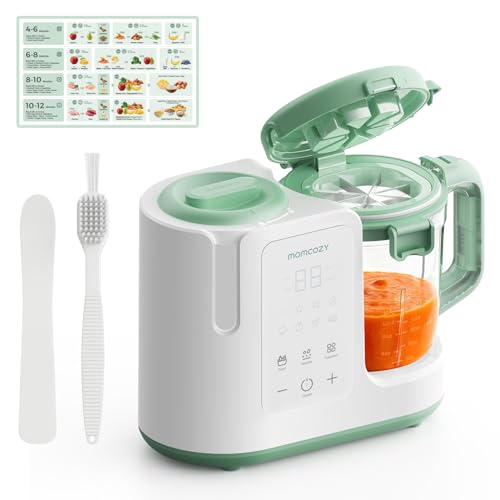
3. Momcozy AutoMeal Baby Food Maker — Best Hands-Free
The Momcozy AutoMeal attacks the problem from the automation side: load the ingredients, and its one-step program steams and then blends automatically, with three-stage texture settings that map to the progression from smooth puree toward chunkier food. For a parent cooking during a nap window that might end at any second, a machine that does not need supervising is worth a great deal.
The verified listing highlights a 15 oz cup, a 6-blade design for the blending stage, and a self-cleaning function — the last of these being the feature tired parents will appreciate most at the end of the day. Its positioning is modern and convenience-led: fewer decisions, fewer steps, food ready.
Capacity is the honest limit. Fifteen ounces is a fresh-batch size, suited to cooking every day or two rather than weekly freezing marathons. The AutoMeal is a daily-convenience machine, and it should be bought as one.
Strengths
- Fully automatic one-step steam-and-blend cycle
- Auto 3-stage texture settings follow your baby’s progression
- Self-cleaning function; 6-blade blending design
Trade-offs
- 15 oz cup limits batch size — not a freezer-stash machine
- Automation means less manual control than pulse-based rivals
- Newer entrant with a shorter track record than BEABA
| Cup | 15 oz |
| Functions | Auto steam + blend, self-cleaning |
| Textures | Auto 3-stage settings |
| Blades | 6-blade design |
Automation changes who can make baby food. A machine that runs itself can be started by a grandparent, a partner who never cooks, or a parent holding a sleeping baby in the other arm — the skill barrier drops to loading a cup and pressing start. In households where cooking confidence is the bottleneck, that matters more than bowl size.
The texture staging deserves a mention too: rather than leaving consistency to guesswork, the three automatic stages give repeatable results at each phase. You lose the fine manual control of a pulse button, but you gain the same puree on a chaotic Tuesday as on a calm Sunday.
Best for: busy parents who want automatic, unsupervised cooking cycles / Not suited for: batch cooks needing large volumes, or hands-on cooks wanting full manual control
Check the current price on Amazon

4. nutribullet Baby Steam + Blend — Best Texture Control
Where the original NutriBullet Baby is a batch system, the Steam + Blend is a true all-in-one: a steamer basket cooks in the unit, then the puree blender finishes the job. Its signature is the pulse cycle, which hands texture control to the parent in short, deliberate bursts — the most reliable way we know to land exactly on ‘soft lumps’ rather than accidentally making soup.
The included storage cups, in 2 oz and 4 oz sizes, match the real arc of appetites across the weaning months, and the listing confirms the practical details: BPA-free materials and dishwasher-safe cleanup. It is a complete, well-judged package.
Batch size sits in the middle of this guide — bigger than the Momcozy’s daily cup, smaller than the BEABA bowls at full stretch. For one baby cooked for every day or two, that middle is exactly right.
Strengths
- Steam and blend in one unit, with pulse control over texture
- Storage cups in 2 oz and 4 oz sizes included
- BPA-free and dishwasher safe, per the verified listing
Trade-offs
- Mid-size batches only; not the twin or mega-batch answer
- Starter set of storage cups will need supplementing for freezer cooks
- Less automation than the Momcozy for parents who want zero supervision
| Functions | Steam, blend, pulse |
| Storage included | 2 oz and 4 oz cups |
| Materials | BPA-free |
| Cleaning | Dishwasher safe |
Texture is the underrated variable in baby food, and this is the machine that treats it as a first-class feature. Pediatric feeding guidance generally moves babies from smooth to mashed to lumpy over the weaning months; a pulse cycle lets one appliance track that whole journey precisely, instead of producing a single house consistency.
Choose it if you are the kind of cook who tastes and adjusts. Choose the Momcozy if you would rather the machine decided. Both philosophies are respectable; they simply suit different parents.
Best for: parents who want precise, manual control over puree texture / Not suited for: mega-batch cooks, or parents wanting a fully automatic cycle
Check the current price on Amazon

5. Bear Baby Food Maker, Steamer & Blender, 18.5 oz — Best Compact
The Bear Baby Food Maker is the compact specialist of this guide. Its 18.5 oz capacity and dual-layer steam baskets let you steam two ingredients simultaneously — carrot in one layer, pear in the other — then blend in the same compact unit. For small kitchens, and for parents cooking fresh in small amounts, that layout is genuinely clever.
The verified listing describes a one-step processor that also covers warming and sterilizing duties for small items, which helps a compact appliance earn its counter space in a crowded feeding station. Materials are BPA-free, per the listing.
Compactness defines both its appeal and its ceiling: 18.5 oz is a day or two of food for one baby, not a freezer session. Buy it for freshness and footprint, not for volume.
Strengths
- Dual-layer baskets steam two ingredients at once
- Small footprint suits tight counters and feeding stations
- One-step steam-and-blend operation; BPA-free per listing
Trade-offs
- 18.5 oz capacity limits batch size
- Less established brand than BEABA or nutribullet
- No large-batch or twin suitability
| Capacity | 18.5 oz |
| Baskets | Dual-layer steam baskets |
| Functions | Steam, blend; warming/sterilizing for small items |
| Materials | BPA-free |
The dual-layer basket is more than a novelty: steaming a vegetable and a fruit separately, then blending them together — or keeping them apart for a baby still meeting single flavors — removes the second steaming cycle that slows small-batch cooking. In a compact machine, that time saving is proportionally huge.
The Bear also suits a second-location role: a grandparents’ kitchen, a holiday home, anywhere a full-size baby food station is unjustified. Its limits are honest and its niche is real.
Best for: small kitchens and fresh, small-batch cooking for one baby / Not suited for: freezer-stash batch cooking or twins
Check the current price on Amazon

6. Grownsy Baby Food Maker, Steamer & Blender — Best Budget
The Grownsy covers the essential baby food workflow — steam in its elevated basket, then blend — at the most accessible tier here. The elevated basket keeps ingredients above the cooking water during steaming, and the machine is positioned for both purees and the softer self-feeding stage, for babies from 6+ months.
Budget picks in this category live or die on whether the basics are sound, and the basics here are: BPA-free food-contact parts per the verified listing, a straightforward two-stage process, and portions sized for everyday cooking. What you do not get is the refinement layer — no defrost/reheat program, no automatic texture staging, no self-cleaning.
That makes the Grownsy the right first machine for two kinds of buyers: parents unsure how much homemade food they will really make, and families equipping a second location. Both get honest baby food without a premium commitment.
Strengths
- Most accessible tier in this guide
- Elevated steam basket; BPA-free food-contact parts
- Covers purees and the starting-solids stage from 6+ months
Trade-offs
- No reheat/defrost programs or automation extras
- Smaller batches than the BEABA bowls
- Budget build — set durability expectations accordingly
| Functions | Steam, blend |
| Basket | Elevated steam basket, BPA-free |
| Stage | From 6+ months, starting solids |
There is a sensible economic argument for starting here. If homemade food becomes a daily habit, you will know within a month — and you can upgrade with experience, keeping the Grownsy as a backup. If it stays an occasional activity, you have spent the least discovering that. Either way, the machine’s output — steamed, blended food whose ingredients you chose — is the same core result as the premium picks.
Where the savings show is in daily friction: a little more attention during cycles, a little more hand-finishing of textures, no reheat shortcut for frozen portions. Parents who value their evenings highly should weigh that honestly against the price gap before choosing.
Best for: budget-conscious parents and first-time testers of homemade baby food / Not suited for: heavy daily users who will miss the premium machines’ automation and reheat loop
Check the current price on Amazon
Comparison Table
| Pick | Badge | Key Spec | Best For |
|---|---|---|---|
| BEABA Babycook Solo 4-in-1 Baby Food Maker, 37 oz | Best Overall | 37 oz, 4-in-1, 27 servings | parents who want one machine for the full cook-store-reheat cycle |
| NutriBullet Baby Complete Food-Making System, 32 oz | Best for Batch Prep and Freezing | 32 oz system + storage | organized weekly batch cooks who freeze portions in advance |
| Momcozy AutoMeal Baby Food Maker | Best Hands-Free | 15 oz, auto steam+blend, self-clean | busy parents who want automatic, unsupervised cooking cycles |
| nutribullet Baby Steam + Blend | Best Texture Control | Steam + blend, pulse, storage cups | parents who want precise, manual control over puree texture |
| Bear Baby Food Maker, Steamer & Blender, 18.5 oz | Best Compact | 18.5 oz, dual-layer baskets | small kitchens and fresh, small-batch cooking for one baby |
| Grownsy Baby Food Maker, Steamer & Blender | Best Budget | Steam + blend, elevated basket | budget-conscious parents and first-time testers of homemade baby food |
Read this table by workflow. The BEABA Solo closes the full loop from raw vegetable to reheated portion. The NutriBullet Baby system maximizes a weekly batch. The Momcozy removes supervision. The nutribullet Steam + Blend maximizes texture control. The Bear minimizes footprint, and the Grownsy minimizes cost. Your routine picks the row; the badges just name the match. One pattern worth noticing: capacity and convenience pull in opposite directions in this category — the biggest-batch machine asks the most of you during the session, while the most automatic machine makes the smallest amount. There is no design that escapes that trade, which is why honest self-knowledge about your cooking habits is worth more here than any single specification in the table above.
What Is the Best Way to Make Baby Food at Home?
There are three honest architectures, and this guide contains all of them. Steam-blenders (BEABA, nutribullet Steam + Blend, Bear, Grownsy) cook and blend in one bowl — fewest steps, least washing, best for fresh and small-batch cooking. Batch systems (NutriBullet Baby) assume a pot on the stove and excel at volume and storage order. Automatic makers (Momcozy AutoMeal) trade capacity and manual control for a cycle you do not have to watch.
The right architecture is the one matched to your week. If you will cook during naps in unpredictable fragments, automation or a fast all-in-one wins. If you have a reliable weekend hour and freezer space, the batch system produces the most food per session. If you cook fresh daily in small amounts, a compact steam-blender is the least appliance for the job — and ‘least appliance’ is a genuine virtue in a kitchen filling up with baby equipment.
Whichever architecture you choose, the workflow discipline is the same: cook ingredients until completely soft, blend to the stage-appropriate texture, portion promptly, label everything, and reheat thoroughly with a stir to even out temperature. The machine compresses the work; the habits make it safe and repeatable.
- Steam-blender: fewest steps per meal, best for daily and small-batch cooking
- Batch system: best food volume per session, needs separate cooking first
- Automatic maker: no supervision needed, smaller fresh batches
- Any architecture: portion, label and store immediately after blending
- Texture should progress — choose a machine that can grow with your baby
How Smooth Should Baby Food Be, and When Should Texture Change?
First foods are traditionally smooth and runny enough to ribbon off a spoon, because a baby learning to eat is managing an entirely new skill. As weeks pass and confidence grows, guidance generally moves toward thicker purees, then mashed foods with soft lumps, then minced and finger foods — a progression that helps babies learn to chew and handle variety. Your pediatrician’s advice for your baby always outranks general guidance, including anything on this page.
Equipment-wise, that progression is why we weight texture control so heavily in this guide. A pulse cycle (nutribullet Steam + Blend) or staged automatic settings (Momcozy) let one machine serve the whole journey. A blender that only produces one consistency will still make fine first foods — you will simply finish later textures with a fork and some patience.
A practical tip for the smooth stage: blend longer than feels necessary, and add cooking liquid gradually. Most ‘grainy’ purees are under-steamed or under-blended rather than under-powered — completely soft ingredients and a full blending cycle fix nearly every texture complaint we hear about.
How Should You Store and Reheat Homemade Baby Food?
Portion food as soon as it is blended and cooled slightly, into the small cups or trays you will serve from — the 2 oz and 4 oz sizes included with the nutribullet Steam + Blend reflect how portions grow across the first year. Label every portion with contents and the date it was made; in a freezer full of similar-looking orange cubes, labels are the difference between a system and a lottery.
Refrigerate portions you will use within the next day or two and freeze the rest promptly, following standard food-safety guidance for storage durations. When reheating — in a 4-in-1 machine’s reheat mode, or by your usual method — heat until steaming throughout, stir well to remove hot or cold spots, and test the temperature yourself before serving. Never reheat the same portion twice; serve from a clean bowl rather than the storage cup so leftovers in the cup stay uncontaminated, and discard what the baby has eaten from.
These habits matter more than any machine feature. The best appliance in this guide cannot rescue unlabeled, twice-reheated portions — and with decent habits, even the budget pick produces food you can serve with confidence.
Baby Food Maker vs Regular Blender: What Is the Real Difference?
A regular blender is a better blender. Its motor is stronger, its jar is bigger, and for pureeing a large pot of cooked vegetables it will outperform every machine in this guide on raw blending. If you already own a good one and cook in big batches, you may not need a dedicated maker at all — our batch-system pick exists precisely because that workflow is legitimate.
What a regular blender cannot do is everything around the blending: steam the raw vegetables, defrost Tuesday’s portion, reheat it gently, or handle a three-tablespoon quantity without the food hiding under the blades. Dedicated makers are workflow appliances, not blending appliances, and they should be judged on the minutes and washing-up they remove from your week.
The honest middle path is an immersion blender in the cooking pot — cheap, small, and surprisingly effective for purees — which we cover in depth in the baby puree guide linked below. Many families start there, discover they cook often, and then buy a steam-blender with clear eyes. That is a perfectly good order of operations.
What Should You Spend on a Baby Food Blender?
This category arranges itself into three honest tiers, and the right tier depends on use frequency rather than on any notion of ‘best’. The budget tier, represented here by the Grownsy, covers the core steam-and-blend job with no frills. It suits experimenters, second locations and light use. The mid tier — the nutribullet machines and the Bear — adds texture control, storage systems or compact cleverness, and suits most committed home cooks. The premium tier, where BEABA and the automatic Momcozy sit, buys the closed loop: reheating, automation, larger bowls and one-handed polish.
The useful calculation is cost per session over the machine’s working life in your kitchen. A premium machine used daily for a year costs very little per batch; the same machine used twice costs a fortune per batch. Be honest about frequency before being impressed by features — and remember that a mid-tier machine matched to a real routine outperforms a premium machine matched to an imaginary one on every measure that matters, including how much homemade food your baby actually eats.
Also budget for the small things: extra storage cups if you freeze seriously, a spare gasket, and the ingredients themselves. None of the picks in this guide requires proprietary consumables, which keeps running costs at the price of fresh produce — exactly where they should be.
How to Batch-Cook a Week of Baby Food in One Session
This session plan assumes a steam-blender or batch system from this guide, two staple ingredients, and about an hour of mostly unattended time. Adjust quantities to your freezer space, and follow your pediatrician’s guidance on introducing new foods one at a time.
- Choose two staples. Pick one vegetable and one fruit your baby already accepts (for example sweet potato and pear), so the whole batch is usable. New foods get introduced separately, in small test quantities.
- Prep in bulk. Wash, peel and chop everything into even cubes before any machine starts. Even sizes steam evenly, and a single prep session is faster than two.
- Steam the first ingredient completely soft. Run the steam cycle and fork-test: pieces should collapse without resistance. Under-steamed food is the main cause of grainy puree.
- Blend to the stage texture. Blend fully smooth for early weaning, or pulse to soft lumps for later stages, adding cooking liquid a spoonful at a time until the consistency ribbons off a spoon.
- Portion while fresh. Spoon the batch into labeled cups or trays — contents and date on every one — filling the sizes your baby actually eats.
- Repeat with the second ingredient. While the first batch cools for the freezer, run the second. Two staples give you mix-and-match meals all week.
- Freeze flat and fast. Get portions into the freezer promptly once cooled, arranged so they freeze quickly and stack neatly.
- Plan the week’s defrosts. Move tomorrow’s portions to the fridge the night before, or use a 4-in-1 machine’s defrost-and-reheat cycle on the day — and note what gets eaten enthusiastically, because that log writes next week’s shopping list.
After two or three sessions this becomes a rhythm rather than a project: prep while the kettle boils, steam while you tidy, blend, portion, done. The parents who sustain homemade baby food are not the ones with the most equipment — they are the ones whose session fits inside an ordinary hour, which is exactly what the machines in this guide are designed to allow.
Keep the session boring on purpose. The temptation to improvise elaborate combinations fades fast at 6 a.m. on a workday; what survives is a short rotation of staples your baby likes, made the same way each time, with one new food introduced deliberately now and then. Your future self — tired, one-handed, holding a hungry baby — is the real user of everything you set up today, so set it up kindly.
Common Buying Mistakes
Baby food making rewards simple systems and punishes improvisation. These are the mistakes we see most often, collected from the routines that quietly failed — the machines abandoned by month two almost never failed mechanically; they failed because one of these small frictions repeated until cooking at home stopped feeling worth it. Every one of them is fixable in a single session, which is the good news buried in this list.
- Buying a blender when you needed a workflow. If your bottleneck is steaming, reheating and washing — not blending power — a dedicated maker or system will serve you better than a stronger blender.
- Making one giant batch of a new food. Introduce new foods in small quantities first. A freezer full of a puree your baby rejects is an expensive lesson.
- Skipping the label. Contents and date, every portion, every time. Frozen purees all look alike by week two.
- Blending under-steamed vegetables. Grainy texture is a cooking problem. Steam until pieces collapse under a fork before blenders get involved.
- Reheating the same portion twice. Serve from a clean bowl, keep the storage cup uncontaminated, and discard what has been eaten from.
- Forgetting texture progression. Months of only-smooth puree underserves a developing eater. Choose equipment that can thicken up as your baby does.
Final Recommendation
For most families, the BEABA Babycook Solo is the best blender for baby food overall: it steams, blends, defrosts and reheats in one bowl, in batches that suit a real week. Weekly batch cooks will get more from the NutriBullet Baby system, hands-full parents from the Momcozy AutoMeal, and texture-focused cooks from the nutribullet Steam + Blend. The Bear is the compact answer and the Grownsy the budget start. Whichever matches your routine, check price on Amazon before ordering — and buy for the routine you have, not the one you imagine.
Related reading on this site: Best Blenders For Baby compares the wider field of baby blenders and makers, Best Blenders For Baby Puree goes deep on texture and immersion blenders, and if the same kitchen also blends for adults, Best Blenders For Athletes covers high-power machines while Best Blenders Easy To Clean focuses on the cleanup side of every format. Expecting twins or cooking for siblings too? Start with Best Blenders College for budget-friendly secondary setups for grandparents’ houses and second kitchens.
Related guides
Frequently Asked Questions
What is the difference between a baby food maker and a baby blender?
A baby blender blends; a baby food maker usually steams and blends in one appliance, and 4-in-1 models also defrost and reheat portions. If you already cook ingredients separately, a blender system with storage may be all you need. If you want the whole process in one small machine, choose a steam-blender.
How much baby food does one batch make?
It depends on the bowl. In this guide, the BEABA Solo’s verified listing quotes up to 27 servings from its 37 oz bowl, while compact machines like the 15 oz Momcozy and 18.5 oz Bear are sized for a day or two of fresh food. Match batch size to your freezer space, not just your ambition.
Can I use a normal blender for baby food?
Yes, for the blending step — cook ingredients until soft first, blend with enough liquid, and be aware that small quantities can get lost under the blades of a big jar. What a normal blender cannot do is steam, defrost or reheat, which is why dedicated machines exist. An immersion blender in the pot is a good budget middle path.
When should baby food stop being completely smooth?
General feeding guidance moves from smooth purees toward thicker, mashed and lumpy textures over the weaning months, at a pace that suits your baby. Follow your pediatrician’s advice for your child. Equipment with pulse or staged texture settings makes that progression easier to follow precisely.
How long can homemade baby food be stored?
Follow current food-safety guidance for your region: refrigerate portions you will use within a day or two, freeze the rest promptly in labeled portions, and use frozen portions within the recommended period. Reheat until steaming, stir well, test the temperature, and never reheat a portion twice.
Is a baby food maker worth it for a second child?
Often more so than for a first: you already know your routine, so you can choose the architecture that fits it precisely, and time is scarcer with two children. The automatic and 4-in-1 picks in this guide earn their keep fastest in experienced, busy households. If your first child’s machine is still in the cupboard, check its seals and blades before the new arrival — a replacement gasket usually restores it fully, and the routine knowledge you built last time is worth more than any upgrade.
Can I make baby food without any special equipment?
Yes. A lidded pot or steamer basket, a fork or potato masher for later textures, and any blender or food mill for smooth purees will do the job — families managed for generations with less. Special equipment buys time, consistency and convenience, not permission. If budget is the constraint, start with what you own, cook twice, and let your actual routine tell you which machine, if any, would earn its counter space. That is a better buying process than any guide, including this one, can give you.


