Disclosure: airfryerkitchensupply.com is reader-supported. When you buy through links on our site, we may earn an affiliate commission at no extra cost to you.
Where to buy
Every pick in this guide to the best kitchen family friendly faucets was cross-checked against live Amazon listings before it earned a link. Prices move with promotions and finish choice, so each pick below says check price on Amazon rather than printing a number that could be stale tomorrow. Start with the shortlist:
- Delta Essa Touchless Kitchen Faucet 9113TL-AR-DST, Arctic Stainless — Best Overall for Families. Check the current price on Amazon.
- Moen Essie MotionSense Wave Kitchen Faucet 87014EWBL, Matte Black — Best Touchless. Check the current price on Amazon.
- KOHLER Maxton Touchless Kitchen Faucet R26281-SD-CP, Polished Chrome — Best Touchless with Dispenser. Check the current price on Amazon.
- Delta Essa Touch Kitchen Faucet 9113T-AR-DST, Arctic Stainless — Best Touch-Activated. Check the current price on Amazon.
- Moen Belfield 7255SRS Two-Handle High Arc Kitchen Faucet, Spot Resist Stainless — Best No-Electronics Family Pick. Check the current price on Amazon.
- Moen Bexley 87403 Two-Handle Lever Kitchen Faucet with Sprayer, Chrome — Best Budget Family Pick. Check the current price on Amazon.
The best kitchen family friendly faucets are designed around the people who actually use a family kitchen: children learning to wash hands and fill cups, grandparents whose grip is not what it was, and parents operating the faucet with a wrist while holding a toddler or a hot pan. This guide ranks verified faucets by the features that serve those users, touch and touchless activation, lever handles that need no grip, finishes that forgive small fingerprints, and temperature behavior that stays predictable. Every linked pick was verified against its listing first.
A note on scope and honesty. This is a convenience and usability guide, not a medical one. Features like touch activation and lever handles genuinely make a faucet easier and more hygienic-feeling to use for small or weak hands, and predictable temperature control genuinely helps households manage hot water sensibly. We make no health claims beyond that, and we flag the household’s real scald defense where it belongs: the water heater setting and supervision, discussed plainly in the buying guide.
The picks span the realistic family budgets and tech appetites: full touchless platforms at the top, a touch-activated model that keeps a manual handle, and two lever-handle two-handle faucets that deliver most of the accessibility with none of the electronics. Families differ; the right tier is the one your household will actually maintain.
In this guide
Quick Picks
Six verified faucets ordered from most assisted to most mechanical, so families can pick their comfort level with technology.
Best Overall for Families — Delta Essa Touchless Kitchen Faucet 9113TL-AR-DST, Arctic Stainless. Hands-free and touch activation on a proven pull-down platform: the easiest faucet in the guide to operate with full or small hands.
Best Touchless — Moen Essie MotionSense Wave Kitchen Faucet 87014EWBL, Matte Black. A single-sensor wave-activated faucet: water answers a hand passed over the sensor, with a handle for manual control.
Best Touchless with Dispenser — KOHLER Maxton Touchless Kitchen Faucet R26281-SD-CP, Polished Chrome. Touchless activation plus an included soap dispenser: the handwashing station, complete in one box.
Best Touch-Activated — Delta Essa Touch Kitchen Faucet 9113T-AR-DST, Arctic Stainless. Tap the spout to start or stop water: touch activation for families who want assistance without full sensor automation.
Best No-Electronics Family Pick — Moen Belfield 7255SRS Two-Handle High Arc Kitchen Faucet, Spot Resist Stainless. The mechanical family answer: ADA compliant levers, independent temperature handles, and nothing electronic to maintain.
Best Budget Family Pick — Moen Bexley 87403 Two-Handle Lever Kitchen Faucet with Sprayer, Chrome. Lever accessibility at a budget tier: two easy handles and a sprayer, no electronics anywhere.
How These Picks Were Chosen
Verification followed the standing process: each model searched by brand and model connection, with the returned listing confirming the activation type, handle style, and finish. Touchless and touch models were required to be genuine platform products from established makers; a feature-stacked touchless listing from an unknown brand that appears in our broader cache work was deliberately excluded, because a family faucet that fails electronically fails completely.
Ranking weighed operability first: can a child, an elder, or a cook with full hands get water without a grip-and-twist? Temperature predictability came second, favoring models with memory or independent handle control. Third was graceful failure: the best family faucets still work as faucets when batteries die or sensors are switched off, a criterion that quietly eliminates several impressive listings. Finish forgiveness and platform support complete the order.
The 6 Best Kitchen Family Friendly Faucets

Delta Essa Touchless Kitchen Faucet 9113TL-AR-DST, Arctic Stainless — Best Overall for Families
The Essa Touchless leads because it offers families two assisted ways to run water: touchless sensing for hands that should not touch anything, and Delta’s touch activation, where a tap on the spout or handle starts and stops flow, on top of a conventional pull-down faucet. For a parent with raw chicken on their hands, a child who cannot yet manage a lever’s resistance, or a grandparent who finds handles genuinely hard, that redundancy is the product. It suits busy family kitchens ready to maintain batteries as the price of admission.
Strengths
- Touchless and touch activation cover different family moments
- Pull-down sprayer for the real work of a family sink
- Established platform with mainstream support
Trade-offs
- Electronics need batteries and eventual sensor care
- Premium tier for the category
- Single-hole mounting; check deck plate needs for multi-hole sinks
| Activation | Touchless with touch technology (per Amazon title) |
| Configuration | Single-hole pull-down |
| Finish | Arctic stainless |
Family reality check: assisted faucets earn their keep in the messy middle of cooking, not in showroom demos. Touch activation means the faucet answers an elbow, a wrist, or the back of a floury hand, and children old enough to wash up can operate it without climbing or forcing a stiff handle. The ownership duties are real but small: batteries on a schedule, and a manual override you should learn before you need it. Households happy with that trade get the most capable family faucet in this guide.
Best for: busy families wanting maximum operating assistance / Not suited for: households that refuse battery-dependent fixtures
Check on Amazon — check price on Amazon for the current finish options and included parts.

Moen Essie MotionSense Wave Kitchen Faucet 87014EWBL, Matte Black — Best Touchless
Moen’s MotionSense Wave reduces touchless to one gesture: pass a hand over the sensor on top of the faucet and water runs; wave again and it stops. The Essie platform underneath is the mainstream pull-down that appears across this cluster’s guides, here in matte black. For families, the single-gesture design is the easiest system for children to learn and for guests to guess. It suits modern family kitchens that want hygiene help without a learning curve.
Strengths
- One-gesture wave activation anyone can learn
- Familiar Essie pull-down platform underneath
- Handle remains for conventional manual control
Trade-offs
- Matte black shows pale scale in hard water
- Sensor system needs power and occasional cleaning of the sensor eye
- Premium tier positioning
| Activation | MotionSense Wave touchless (per Amazon title) |
| Configuration | Pull-down, single handle |
| Finish | Matte black |
The Wave’s virtue is predictability: one sensor, one gesture, no modes to cycle while a child experiments. Families should still walk through the two household rules that make any touchless faucet a success: keep the sensor eye wiped clean, since a filmed-over sensor is a sulky sensor, and teach everyone the manual handle on day one so a dead battery is an errand, not an emergency. With those habits, this is the touchless pick we would hand to a first-time assisted-faucet household.
Best for: families new to touchless faucets / Not suited for: hard-water homes avoiding dark finishes
Check on Amazon — check price on Amazon for the current finish options and included parts.

KOHLER Maxton Touchless Kitchen Faucet R26281-SD-CP, Polished Chrome — Best Touchless with Dispenser
The Maxton pairs touchless activation with the accessory family handwashing actually needs: a soap dispenser, included per the verified listing, mounted beside the pull-down faucet. That pairing turns the sink into a complete wash station for children coming in from outside and cooks moving between raw ingredients and ready food. It suits families building the habit infrastructure, not just buying a gadget, and kitchens with the deck holes to host the dispenser.
Strengths
- Touchless activation for messy-hand moments
- Soap dispenser included in the verified configuration
- Pull-down sprayer covers family sink workloads
Trade-offs
- Dispenser claims a deck hole and under-sink space
- Chrome shows the fingerprints families generate
- Electronics carry the usual battery upkeep
| Activation | Touchless (per Amazon title) |
| Configuration | Pull-down with soap dispenser |
| Finish | Polished chrome |
Think of this pick as a system rather than a faucet. The dispenser matters because the best handwashing intentions die when the soap lives in a slippery bottle behind the faucet; a deck dispenser puts soap one push away from the water the sensor just started. Chrome’s fingerprint honesty is the trade, and in a family kitchen it simply means the faucet gets wiped when the counters do. For households whose goal is a real wash station, this is the most complete answer here.
Best for: families building a proper handwashing station / Not suited for: single-hole sinks with no room for a dispenser
Check on Amazon — check price on Amazon for the current finish options and included parts.
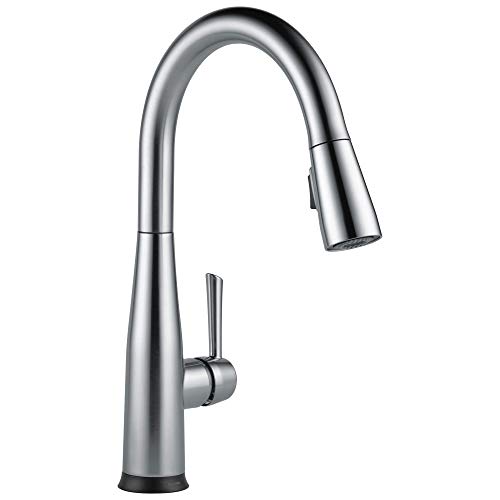
Delta Essa Touch Kitchen Faucet 9113T-AR-DST, Arctic Stainless — Best Touch-Activated
The touch version of the Essa splits the difference between manual and touchless. A tap anywhere on the spout or handle toggles the water, which a wrist, elbow, or the back of a hand accomplishes easily, while the handle still sets temperature and flow conventionally. Children find the tap game intuitive, cooks find it hygienic in practice, and skeptics of sensors find it reassuringly deterministic. It suits families who want assistance they control rather than automation they supervise.
Strengths
- Tap-on, tap-off operation needs no grip strength
- Handle still governs temperature in the familiar way
- Same Essa platform as the guide’s top pick
Trade-offs
- Touch system still needs batteries
- Very wet hands and metal cookware contact can occasionally toggle flow
- Premium over the manual Essa
| Activation | Touch2O touch activation (per cache notes) |
| Configuration | Single-hole pull-down |
| Finish | Arctic stainless |
The Essa Touch’s family advantage is temperature honesty: because the handle sets the mix, the water a child gets is the water the handle was left at, which makes the household rule simple, leave the handle at the household’s safe warm setting and the tap becomes a one-touch comfort control. That predictability, more than the novelty, is why this model has anchored family kitchens for years. It is the assisted pick for households that think in systems.
Best for: families wanting controlled, predictable assistance / Not suited for: households wanting fully automatic sensing
Check on Amazon — check price on Amazon for the current finish options and included parts.

Moen Belfield 7255SRS Two-Handle High Arc Kitchen Faucet, Spot Resist Stainless — Best No-Electronics Family Pick
Families are not obliged to buy electronics to get an accessible faucet. The Belfield’s verified features include ADA compliant lever handles, which a small hand, a weak grip, or a wrist can operate, and its two-handle layout lets a household park the hot handle at a sensible setting and let children work the cold side. The high arc and side sprayer cover family sink workloads from bottle rinsing to sheet-pan spraying. It suits multigenerational homes and anyone who wants accessibility with a thirty-year service horizon.
Strengths
- ADA compliant levers per verified features
- Independent handles support household temperature routines
- No batteries, sensors, or electronics to maintain
Trade-offs
- No hands-free operation for messy moments
- Side sprayer needs a fourth deck hole
- Two-handle workflow is deliberate, not instant
| Handles | Lever, ADA compliant (per API features) |
| Configuration | Two-handle, high arc, side spray |
| Finish | Spot Resist stainless |
This pick reframes what family friendly means: not features, but fit between the faucet and the family’s weakest grip and shortest reach. Levers pass that test every day without a battery. The temperature routine deserves emphasis because it is the family’s real comfort tool: set hot once, teach cold-only for little hands, and revisit as children grow. For households that keep faucets for decades, the Belfield is the family pick with the longest fuse.
Best for: multigenerational homes wanting durable accessibility / Not suited for: families prioritizing hands-free operation
Check on Amazon — check price on Amazon for the current finish options and included parts.

Moen Bexley 87403 Two-Handle Lever Kitchen Faucet with Sprayer, Chrome — Best Budget Family Pick
The Bexley delivers the family’s most important feature, levers, at the friendliest tier in this guide. Its verified listing confirms two lever handles and a side sprayer on a chrome two-handle platform. Levers can be pushed by a child’s palm, a grandparent’s wrist, or a cook’s forearm, which covers the daily accessibility cases that knob and cross handles fail. It suits budget renovations for family homes, rentals housing families, and grandparents’ kitchens being made easier to use.
Strengths
- True lever handles at a budget tier
- Side sprayer included for family workloads
- Simple mechanical design, easy to service
Trade-offs
- Chrome needs wiping to stay bright
- Utilitarian styling
- Four-hole deck pattern for the sprayer configuration
| Configuration | Two-handle levers, side sprayer |
| Finish | Chrome |
Accessibility spending should go where hands meet hardware, and the Bexley spends it exactly there. Everything else about the faucet is conventional in the best sense: mainstream platform, serviceable parts, no manual thicker than a postcard. Families choosing between this and an assisted model should ask one question: is our problem grip, which levers solve, or mess, which touch solves? If it is grip, this is the answer and the savings are real.
Best for: budget family kitchens and grip-first accessibility / Not suited for: households wanting hands-free activation
Check on Amazon — check price on Amazon for the current finish options and included parts.
Comparison Table
| Pick | Badge | Key spec | Best for |
|---|---|---|---|
| Delta Essa Touchless Kitchen Faucet 9113TL-AR-DST, Arctic Stainless | Best Overall for Families | Touchless plus touch activation, pull-down, single hole | busy families wanting maximum operating assistance |
| Moen Essie MotionSense Wave Kitchen Faucet 87014EWBL, Matte Black | Best Touchless | MotionSense Wave single-sensor touchless, matte black | families new to touchless faucets |
| KOHLER Maxton Touchless Kitchen Faucet R26281-SD-CP, Polished Chrome | Best Touchless with Dispenser | Touchless activation, pull-down, soap dispenser included | families building a proper handwashing station |
| Delta Essa Touch Kitchen Faucet 9113T-AR-DST, Arctic Stainless | Best Touch-Activated | Touch2O tap-on activation, pull-down, single hole | families wanting controlled, predictable assistance |
| Moen Belfield 7255SRS Two-Handle High Arc Kitchen Faucet, Spot Resist Stainless | Best No-Electronics Family Pick | Two-handle levers, ADA compliant, side spray, high arc | multigenerational homes wanting durable accessibility |
| Moen Bexley 87403 Two-Handle Lever Kitchen Faucet with Sprayer, Chrome | Best Budget Family Pick | Two lever handles, side sprayer, chrome | budget family kitchens and grip-first accessibility |
The rows are ordered by how much assistance they provide, from full touchless at the top to purely mechanical levers at the bottom. Find the row whose help matches the difficulty your household actually named, then confirm its mounting against your deck before ordering.
How to Choose a Family Friendly Kitchen Faucet
Start by naming your household’s actual difficulty. If the problem is grip, from arthritis, small hands, or hands that are always full or dirty with cooking, levers and touch activation solve it. If the problem is mess, raw meat hands, dough, garden soil, touchless or touch activation keeps the faucet itself cleaner. If the problem is temperature worry with children, the honest tools are a predictable faucet, independent handles or a handle left at a safe setting, and the water heater’s thermostat, which is the household’s real scald control and should be set with children’s safety in mind according to your plumber’s or manufacturer’s guidance.
Then audit the failure modes you are willing to own. Assisted faucets need batteries and a sensor eye kept clean; they reward that upkeep daily and sulk without it. Mechanical lever faucets need nothing and give up hands-free operation. There is no wrong answer, only a mismatch between a faucet’s upkeep and a household’s habits. Finally, check reach and height for your shortest users: a step stool plus a lever beats a tall faucet a child cannot reach the controls of, and a pull-down head lets an adult bring the water to the child’s level rather than the reverse.
Teaching Kids Safe, Independent Sink Habits
A family friendly faucet pays off when children can use the sink safely without an adult as the operating system. Set the household routine explicitly: which handle or gesture is theirs, what the water should feel like, and when to ask for help with hot tasks. Touch and touchless models make the on-off lesson easy; two-handle models make the temperature lesson visible, since hot and cold are literally separate controls a child can see and name.
Pair the faucet with the station around it: soap within the child’s reach, a stable step that does not slide on wet floors, and a towel closer than the walk across the kitchen. None of this is medical advice; it is the ordinary household engineering that turns a good faucet into a genuinely family friendly sink. Revisit the routine as children grow, because the settings and permissions that suit a five-year-old should not fossilize around a ten-year-old.
Designing the Sink for the Shortest and the Oldest Users
A family sink serves users who may be a meter apart in height and sixty years apart in grip, and the faucet is only one term in that equation. Reach is the first: controls mounted at the back of a deep sink are far away for a child on a step and for a seated user, which is one practical argument for touch and touchless activation, since the spout itself becomes the control. Where handles are the controls, levers mounted where a wrist naturally falls beat beautiful handles mounted where a shoulder must stretch.
The step deserves engineering respect. A stable, wide, non-slip step that lives at the sink permanently will be used; a wobbly stool fetched from another room will not, and a child climbing on a cabinet door is the failure mode everyone is actually designing against. Pair the step with a pull-down head and the geometry inverts happily: the water comes down to the child’s hands instead of the child rising to the water, which is safer, drier, and faster for everyone.
For older users, light and contrast join the brief. A faucet’s controls should be findable by touch and visible in dim morning light, which favors simple, distinct shapes, one lever, one gesture, over clusters of similar buttons. The assisted picks in this guide score well here almost by accident: a wave sensor and a tap-anywhere spout are controls you can operate half-asleep, which, in a family kitchen at 6 a.m., is not an edge case but the main case.
Hygiene Habits at the Family Sink, Without the Hype
This guide makes no medical claims, and this section will not start. What can be said plainly is behavioral: the dirtiest moment in cooking is the transition, raw ingredient to clean task, and every touchpoint between the two is a chance to spread the mess. A faucet that starts with an elbow, a wrist, or a wave removes the handle from that chain, and a soap dispenser at the deck removes the bottle-fumbling from handwashing. Families feel the difference as cleanliness of process, which is a real and sufficient reason to buy the feature without dressing it in laboratory language.
The habits matter more than the hardware. The most advanced touchless faucet cannot compensate for a household where the dish towel does six jobs and the sponge is a heirloom. Pair the faucet with the boring infrastructure: soap that is always present, a towel that is only for hands, and a routine children can recite. The faucet’s job in that system is to remove friction, the half-second of annoyance that makes people skip the wash, and judged on friction removal, the assisted picks in this guide earn their premiums honestly.
One caution belongs here because families ask: sensors and touch systems do not make water safer, purer, or healthier. They make it easier to start and stop. Buy them for ease, maintain them for reliability, and let the household’s ordinary hygiene habits do the rest, as they always have.
When the Kids Grow: Faucets That Age With the Household
Family friendly is a season, not a permanent condition, and the wisest purchases in this category are the ones that remain right when the season changes. Touch and touchless faucets age well because their assistance is invisible when unused: a teenager experiences the Essa Touchless as simply a good faucet, and a household of adults experiences it as a convenience during messy cooking, long after the toddler it was bought for has opinions about cars. Nothing about the assisted picks in this guide will embarrass the kitchen they grow old in.
Lever two-handle faucets age differently but equally well: they become, simply, the traditional faucet in a kitchen that no longer needs to explain itself. The Belfield bought for a grandparent’s grip is, ten years later, just the faucet, and its serviceability means it can hold that role for decades. This is the deeper argument against novelty family products, the character-themed and gadget-stacked listings this guide deliberately excluded: children outgrow themes on schedule, and a faucet should be bought on the assumption that it will still be there, being judged as a faucet, when they do.
Plan the succession at purchase time. Keep the documentation, note the battery type and the cartridge family, and choose platforms whose parts will exist when the household’s needs change again, because they will: the next season is aging in place, and it asks for exactly the levers, predictable temperatures, and assisted operation this guide was written about. A family faucet chosen well is not a purchase for a phase of life. It is the same correct answer, asked three different ways across thirty years.
Battery Day and Other Rituals: Owning an Assisted Faucet
Assisted faucets ask for a new household ritual, and the households that thrive with them are the ones that adopt it cheerfully and in writing. Battery day, twice a year alongside the smoke-detector batteries, is the core of it: fresh batteries before the old ones die, because a touchless faucet on dying batteries does not fail dramatically, it fails intermittently, which is worse, training the family to distrust a feature that is actually only hungry. Write the battery type inside the cabinet door. Keep the spares in the same cabinet. The whole ritual takes four minutes and converts the category’s only real weakness into a non-event.
The sensor eye wants its own micro-ritual: a wipe when the faucet is wiped, which in a family kitchen is often. A filmed sensor reads the world dimly and responds late, and owners who do not know this conclude the faucet is aging when it is only dirty. The touch surfaces on touch-activated models want the same logic in reverse: they must stay clean enough to sense a tap, and a heavy film of dried dough is an insulator as well as an eyesore. None of this is burdensome; it is the same cleaning the faucet always needed, now with a functional reason attached.
Finally, rehearse the outage. Once, with the whole household watching, switch the faucet to manual and run it that way for a day. The exercise proves the graceful-failure property this guide selected for, teaches every user the fallback before it is needed at a messy moment, and demystifies the electronics completely. Assisted faucets fail socially when they are mysterious. A household that has rehearsed owns a tool; a household that has not owns a magic trick that occasionally stops working.
The Family Sink at Every Age: Toddlers, Teens, and Everyone Between
Each family stage taxes the sink differently, and a good family faucet is one whose strengths rotate into relevance as the household changes. The toddler stage is about adults: hands full, patience short, and a premium on water that starts with an elbow while the other arm holds a small person who is somehow covered in yogurt. Touch and touchless models are bought in this stage and justified in a week. The equipment that matters around the faucet is the step stool and the towel, and the faucet’s job is to be operable by the adult’s remaining limb.
The school-age stage is about independence under supervision. Children can reach, with the step, can operate a lever or a tap or a wave, and are learning the household’s temperature routine as a named skill. This is the stage where two-handle faucets teach visibly, hot and cold as separate ideas, and where assisted faucets teach effortlessly, the gesture that always works. Either curriculum is sound; choose the one your household will actually teach, because the faucet cannot run the lesson by itself.
The teen stage is about volume and velocity: sports bottles, large pans after ambitious cooking projects, and a sink used at speed by people who consider it infrastructure. Pull-down reach and spray power, the kitchen virtues, dominate now, and the assisted features recede into convenience. A faucet bought in the toddler stage on a mainstream platform, which is every assisted pick in this guide, arrives at the teen stage as simply a very good faucet. That continuity, the absence of a rip-and-replace moment when the children grow, is the financial soul of the family-friendly category, and it is why this guide refuses novelty products no matter how charming their marketing.
Grandparents, Guests, and Babysitters: The Occasional Users
Family friendly design is usually argued from the daily users, but its hardest test is the occasional one: the grandparent visiting for a weekend, the babysitter meeting the kitchen for the first time at 7 p.m., the guest rinsing a glass in an unfamiliar house. These users get no training period, no household routine briefed over weeks, and no patience from a hungry toddler audience. A faucet that serves them well is one whose operation can be guessed: a lever that obviously pushes, a sensor whose gesture is printed by its placement, a touch surface that responds to the natural act of steadying the spout. Every assisted pick in this guide was chosen partly on this guessability, because a feature that needs a manual is a feature occasional users will route around, usually by forcing something.
Hosts can close the remaining gap with a thirty-second orientation that feels like hospitality rather than instruction: the faucet works like this, the hot is here, the step stool lives there. That sentence, said while handing someone a towel, converts the assisted faucet from a surprise into a small pleasure, and grandparents in particular tend to become the feature’s loudest advocates once the gesture clicks, because it returns to them a kitchen task that stiff handles had quietly taken away. Accessibility that arrives as a gadget announcement can feel like a verdict; accessibility that arrives as a good faucet feels like good hosting.
Babysitters deserve a specific note, because they operate the kitchen under maximum distraction and minimum authority to experiment. For them, the manual fallback matters most: a faucet whose handle works conventionally, whatever its electronics, is a faucet a sitter can always run. This is the practical ground beneath this guide’s graceful-failure criterion, and it is why the assisted picks here are all mainstream platforms with honest handles, rather than sealed tech objects. Design for the occasional user and the daily users are served automatically; design only for the daily users and the occasional ones will find every seam.
The Family Faucet Decision, Made Together
Most faucet purchases are made by one household member and endured by the rest, and family friendly purchases suffer most from that pattern, because the person with the strongest grip in the house is usually the one holding the catalog. The corrective is embarrassingly simple and almost never performed: before choosing, have every regular user perform the household’s three hardest sink tasks with the current faucet, filling the heavy pot, washing hands with messy hands, operating the controls with wet hands, and report where the friction lives. The reports will disagree in instructive ways. The cook’s problem is mess; the grandparent’s problem is grip; the child’s problem is reach; and the faucet that solves the loudest problem while ignoring the others will be resented in rotation.
The picks in this guide were organized to make that family negotiation tractable, because they separate the solutions cleanly: touchless for the mess problem, touch for the controlled-assistance middle, levers for grip, and predictable handles for the temperature routine. A household that can name its problem can choose its tier in one conversation, and a household that cannot name its problem should default to the lever picks, whose accessibility is universal, whose upkeep is zero, and whose virtues every generation of user discovers independently within a week.
Make the decision together, write down the reasoning with the model documentation, and revisit it only when the household changes. Faucets chosen by consensus acquire a small but real immunity: nobody relitigates a decision they helped make, and the faucet gets to be judged on its performance rather than on its provenance. In a category bought for the family’s comfort, that consensus is not a soft extra. It is the mechanism by which the comfort is actually delivered, one un-resented, well-understood, correctly specified faucet at a time.
What Family Friendly Does Not Mean: A Buyer’s Filter
The family friendly label attracts marketing the way a porch light attracts moths, so a buyer’s filter is worth stating plainly before the final recommendation. It does not mean colorful, themed, or toy-like; children outgrow themes on a schedule measured in months, while a faucet’s service life is measured in decades, and the overlap between those two numbers is where money goes to be embarrassed. It does not mean feature-stacked, because a sensor, a light, a display, and a speaker in one faucet is four failure modes wearing a trench coat, and the unknown-brand listing this guide deliberately excluded is the standing example. And it does not mean medical; no faucet in this category treats, prevents, or diagnoses anything, and any listing that implies otherwise is telling you how it will handle its other claims as well.
What the label legitimately means is narrower and more valuable: operable by the household’s weakest grip, predictable in its temperature behavior, forgiving of its finish under small fingerprints, and graceful when its assistance is unavailable. Those four properties can be tested, in a showroom or during a return window, by the actual hands the faucet will serve. A product that passes them in a mainstream platform, with documentation and parts behind it, is family friendly in the only sense that survives contact with a real family. Everything else on the shelf is a costume, and costumes are for holidays, not for plumbing.
The One-Week Family Trial
Close the purchase the way this guide opened it, with the household rather than the hardware. During the first week, deliberately route every regular user through the new faucet’s hardest ordinary moments: the child’s handwash, the grandparent’s grip test, the cook’s messy-hands start, the babysitter’s first encounter without a briefing. Adjust the one thing that is adjustable, the default temperature setting and the stool’s position, based on what the week teaches, and write the battery type and the manual-mode instructions inside the cabinet door while the knowledge is fresh. A family faucet that survives its trial week as a system, faucet, routine, and household in agreement, will not need to be thought about again for years, which is the precise definition of family friendly that this guide set out to sell you.
How to Set Up an Assisted Faucet for Family Success
Step one: during installation, learn and label the manual override. Every assisted faucet in this guide can be run conventionally; know how before the first battery dies. Step two: set the handle or handles to the household’s default warm setting and mark the routine for the family, because predictability is the safety feature. Step three: put battery replacement on the household calendar alongside smoke detector checks, with the correct battery type written on a card inside the sink cabinet.
Step four: keep the sensor eye, where fitted, on the weekly wipe list; a clean sensor is a responsive sensor. Step five: walk every regular user, including grandparents and babysitters, through the activation gesture and the manual fallback in one minute each. Step six: after the first week, ask the shortest and the oldest users what annoyed them, and adjust the default temperature setting and stool placement accordingly. Assisted faucets succeed as household systems, not as gadgets, and this setup hour is what makes them systems.
Common Buying Mistakes
Buying touchless to solve a grip problem. Levers solve grip for a fraction of the cost and upkeep. Match the technology to the difficulty.
Ignoring the manual override until the battery dies. Learn it at installation and teach it to the whole household.
Expecting the faucet to manage hot water safety alone. The water heater setting and household routines are the real controls; the faucet is the interface.
Choosing knobs for a multigenerational kitchen. Knobs are the hardest handles for small and weak hands. Levers are the family default.
Forgetting the shortest user. If a child cannot reach the controls from a stable step, the faucet is not family friendly in your kitchen, whatever the box says.
Final Recommendation
Families wanting maximum help should buy the Delta Essa Touchless; families wanting assistance with predictability should take the Essa Touch or Moen’s Wave; and families wanting accessibility without electronics should take the Belfield, or the Bexley on a budget. All four routes are honest; choose by your household’s upkeep appetite. Handle ergonomics across the wider two-handle market are compared in best kitchen 2 handle faucets, and compact second stations for a child’s rinse sink are covered in best kitchen bar sink faucets.
Delta Essa Touchless Kitchen Faucet 9113TL-AR-DST, Arctic Stainless covers the best overall for families slot. Moen Essie MotionSense Wave Kitchen Faucet 87014EWBL, Matte Black covers the best touchless slot. KOHLER Maxton Touchless Kitchen Faucet R26281-SD-CP, Polished Chrome covers the best touchless with dispenser slot.
Best Kitchen 2 Handle Faucets Best Kitchen Bar Sink Faucets Best Kitchen Arc Faucets Best Kitchen Counter Faucets Best Kitchen And Bathroom Faucets
Frequently Asked Questions
Are touchless faucets good for children?
They are easy for children to operate, since a wave or presence starts the water without grip strength, and they stop automatically in most designs, which helps with forgotten faucets. Children should still be taught the household’s temperature routine, and the manual control should be shown to every caregiver.
What is the difference between touch and touchless faucets?
Touch faucets start and stop when you tap the spout or handle; you make contact, but with any part of your hand or wrist, which keeps messy hands off the handle’s grip area. Touchless faucets sense a hand or object near a sensor and need no contact at all. Both keep a conventional handle for setting temperature.
Do assisted faucets work when the batteries die?
The models in this guide retain manual operation through their handles, which is a selection criterion we applied deliberately. Learn the manual mode at installation so a dead battery is an inconvenience, not a plumbing emergency.
Are lever handles really easier for arthritic hands?
Yes, in the ordinary mechanical sense: a lever is pushed rather than gripped and twisted, so it can be operated with a palm, wrist, or forearm. Models in this guide include levers described as ADA compliant in their verified listings, which is the formal version of the same idea.
How can a faucet help with hot water safety for kids?
By being predictable. Independent handles or a handle left at a safe warm setting means a child gets the expected temperature every time. The household’s primary hot water control is the water heater’s thermostat setting, which should be set with professional or manufacturer guidance; the faucet supports that routine but does not replace it.
Is a pull-down sprayer useful for families?
Very. It lets an adult bring water to a child’s hands or a low bowl instead of lifting the child or the bowl to the spout, and it speeds the rinsing of bottles, lunchboxes, and paint-covered hands that family sinks specialize in.


