Disclosure: airfryerkitchensupply.com is reader-supported. When you buy through links on our site, we may earn an affiliate commission at no extra cost to you.
Where to buy
Every pick in this guide to the best kitchen 2 handle bridge faucets was cross-checked against live Amazon listings before it earned a link. Prices move with promotions and finish choice, so each pick below says check price on Amazon rather than printing a number that could be stale tomorrow. Start with the shortlist:
- Kingston Brass Heritage Bridge Kitchen Faucet KS1272AXBS, Polished Brass — Best Overall. Check the current price on Amazon.
- Kingston Brass Heritage Bridge Kitchen Faucet KS1276ALBS, Polished Nickel — Best Polished Nickel Finish. Check the current price on Amazon.
- Kingston Brass Heritage Bridge Kitchen Faucet KS1277ALBS, Brushed Brass — Best Brushed Brass Finish. Check the current price on Amazon.
- Kingston Brass Heritage Bridge Kitchen Faucet KS1278ALBS, Brushed Nickel — Best for Stainless Kitchens. Check the current price on Amazon.
- Kingston Brass Bridge Kitchen Faucet KS1275AXBS, Oil Rubbed Bronze — Best Dark Finish. Check the current price on Amazon.
- WOWOW Brass Bridge Kitchen Faucet, Oil Rubbed Bronze — Best Value Bridge. Check the current price on Amazon.
If you are shopping for the best kitchen 2 handle bridge faucets, you are choosing the most theatrical layout in the kitchen faucet world: two separate handle bodies joined to the spout by an exposed horizontal bridge pipe, with hot and cold controlled independently on either side. That exposed bridge is not decoration bolted onto a normal faucet. It is the actual waterway, and it defines everything about how these faucets install, how they feel in daily use, and which sinks they fit. This guide separates real bridge faucets from two-handle faucets that merely look vintage, and it only recommends models whose listings were verified before they earned a link.
The honest market picture first. True bridge faucets are a niche inside a niche. One manufacturer, Kingston Brass, dominates the verified listings, because most large brands have moved their two-handle budgets into centerset and widespread designs instead. That concentration is not a weakness in this guide; it means the real decision is about finish, sprayer configuration, and spout shape within a proven bridge platform, rather than about which logo is stamped on the escutcheon. Where two models share a platform, we say so plainly instead of pretending they are unrelated products.
Bridge faucets also carry practical consequences buyers underestimate. The bridge layout needs an 8-inch two-hole or four-hole deck pattern depending on the sprayer, it raises the spout on two risers so tall pots clear easily, and it puts both valves out in the open where a plumber can service them without pulling the whole faucet. If your kitchen leans farmhouse, traditional, or industrial-vintage, nothing else looks right. If you want a pull-down spray head, read no further in this article, because a bridge faucet uses a fixed spout and, on most models here, a separate brass side sprayer instead.
In this guide
Quick Picks
Six verified bridge faucets, separated by finish and sprayer setup rather than by invented tiers. Every model below is a genuine exposed-bridge design with two independent handles.
Best Overall — Kingston Brass Heritage Bridge Kitchen Faucet KS1272AXBS, Polished Brass. The reference bridge faucet: exposed bridge, brass side sprayer, and a polished brass finish that suits traditional kitchens.
Best Polished Nickel Finish — Kingston Brass Heritage Bridge Kitchen Faucet KS1276ALBS, Polished Nickel. The same heritage bridge platform in polished nickel, a warmer alternative to chrome for transitional kitchens.
Best Brushed Brass Finish — Kingston Brass Heritage Bridge Kitchen Faucet KS1277ALBS, Brushed Brass. An 8-inch heritage bridge with brass sprayer in brushed brass, the forgiving version of the gold-tone look.
Best for Stainless Kitchens — Kingston Brass Heritage Bridge Kitchen Faucet KS1278ALBS, Brushed Nickel. Brushed nickel bridge with an 8-3/4 inch spout reach, the natural partner for stainless sinks and appliances.
Best Dark Finish — Kingston Brass Bridge Kitchen Faucet KS1275AXBS, Oil Rubbed Bronze. The bridge layout in oil rubbed bronze with a brass sprayer, for dark, moody traditional kitchens.
Best Value Bridge — WOWOW Brass Bridge Kitchen Faucet, Oil Rubbed Bronze. A solid brass 8-inch centerset bridge with sprayer from WOWOW, the value route into the bridge category.
How These Picks Were Chosen
We started by filtering for the defining feature: an exposed bridge connecting two separate valve bodies to a central spout. Widespread faucets with three independent pieces were excluded, because they install differently and are covered in the two-handle guide in this same cluster. Each surviving candidate was then searched by brand and model connection, and only listings whose returned title confirmed the bridge configuration, finish, and sprayer setup were kept as linked picks.
Within that verified set we scored four things. First, sprayer configuration: models with a brass side sprayer handle rinsing and sink washdown far better than a fixed spout alone, so sprayer models rank ahead of the one no-sprayer pick. Second, construction signals in the verified listing, such as solid brass sprayer components. Third, finish range, because a bridge faucet is a visual centerpiece and the finish has to match cabinet hardware you already own. Fourth, hole pattern honesty: we note exactly which models need a fourth hole for the sprayer so nobody discovers it after the countertop is drilled.
One warning carried over from our cache work on this category: commercial replacement parts sometimes surface in bridge and two-handle searches with faucet-sounding titles. We excluded anything whose listing described a part rather than a complete faucet, and we recommend you do the same when comparing listings side by side.
The 6 Best Kitchen 2 Handle Bridge Faucets

Kingston Brass Heritage Bridge Kitchen Faucet KS1272AXBS, Polished Brass — Best Overall
The KS1272AXBS is the model most people picture when they say bridge faucet. Two polished brass handle bodies stand on the deck, the exposed bridge pipe runs between them, and the central spout rises from the middle of that bridge. The matching brass side sprayer covers the jobs a fixed spout cannot do, from rinsing sheet pans to washing down the sink walls. It suits period kitchens, farmhouse renovations, and anyone restoring an older home where a pull-down faucet would look out of place.
Strengths
- Genuine exposed-bridge layout with two independent handle bodies
- Brass side sprayer included for rinsing and washdown work
- Polished brass finish reads authentically traditional
Trade-offs
- Polished brass shows water spots and fingerprints readily
- Side sprayer needs its own deck hole
- Fixed spout only; no pull-down function
| Configuration | Exposed bridge, 2-handle |
| Sprayer | Brass side sprayer (per Amazon title) |
| Finish | Polished brass |
In daily use the two-handle bridge layout rewards people who cook with both hands busy. You can set the hot handle once and feather the cold with a wrist, and the temperature stays where you left it between bursts because there is no single mixing lever to knock. The trade is speed: filling a pot takes the same time, but quick on-off rinsing is slower than a pull-down. The polished brass finish is the maintenance item here. It is a living, warm look that deepens over time, which owners either love or fight with a polishing cloth, so choose it because you want that character, not in spite of it.
Best for: traditional and farmhouse kitchens wanting the classic bridge look with a sprayer / Not suited for: buyers who want pull-down convenience or a low-maintenance finish
Check on Amazon — check price on Amazon for the current finish options and included parts.

Kingston Brass Heritage Bridge Kitchen Faucet KS1276ALBS, Polished Nickel — Best Polished Nickel Finish
Polished nickel is the finish designers reach for when chrome feels too cold and brass feels too themed, and the KS1276ALBS puts that finish on the full heritage bridge layout. The verified listing dimensions, roughly 13.9 by 8.6 by 13.1 inches, confirm the tall riser profile that gives bridge faucets their pot-clearing height. It suits transitional kitchens mixing stainless appliances with traditional cabinetry, where the faucet has to bridge both worlds, which this one does literally and visually.
Strengths
- Polished nickel finish pairs with stainless and traditional hardware alike
- Tall bridge profile clears stockpots and tall vases
- Heritage detailing suits transitional kitchens
Trade-offs
- Polished nickel costs more effort to keep spot-free than brushed finishes
- Bridge footprint needs a full 8-inch deck spread
- Sprayer configuration should be confirmed on the listing before ordering
| Configuration | Exposed bridge, 2-handle |
| Finish | Polished nickel |
| Listed dimensions | 13.88 x 8.56 x 13.13 in (per Amazon listing) |
What separates this pick from the polished brass best overall is purely the room it belongs in. Polished nickel has a slightly golden undertone that sits comfortably next to stainless steel without matching it exactly, and next to oil-rubbed bronze without clashing. The ownership note is water spots: polished surfaces show every dried droplet, so households with hard water will wipe this faucet down more often than a brushed one. If your kitchen already has polished nickel cabinet pulls, this is the coherent choice; if it does not, a brushed finish further down this list will be easier to live with.
Best for: transitional kitchens with polished nickel hardware / Not suited for: hard-water homes that hate wiping fixtures
Check on Amazon — check price on Amazon for the current finish options and included parts.
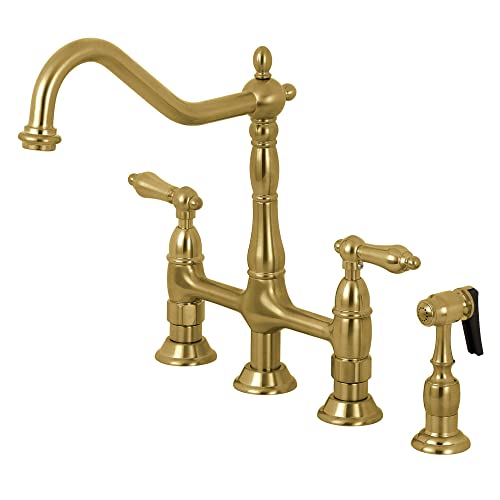
Kingston Brass Heritage Bridge Kitchen Faucet KS1277ALBS, Brushed Brass — Best Brushed Brass Finish
The KS1277ALBS keeps the 8-inch heritage bridge and the brass side sprayer, then swaps the mirror polish for brushed brass. That single change transforms ownership: the brushed texture breaks up light, hides fingerprints, and tolerates the casual wipe-down routine of a busy family kitchen. It suits the large number of kitchens renovated in the last few years with brushed gold or champagne hardware, where a polished faucet would look like it wandered in from a different decade.
Strengths
- Brushed brass hides fingerprints and water spots well
- Brass side sprayer included
- 8-inch bridge fits standard two-handle deck patterns
Trade-offs
- Brushed brass tones vary between brands, so match hardware in person if possible
- Fixed spout with separate sprayer, no pull-down
- Traditional styling will not suit minimalist kitchens
| Configuration | 8-inch exposed bridge, 2-handle |
| Sprayer | Brass side sprayer (per Amazon title) |
| Finish | Brushed brass |
Functionally this is the same proven heritage platform as the picks above it, so the analysis is about matching and maintenance. Brushed brass from one brand rarely matches brushed brass from another exactly; the undertones drift warmer or cooler. The practical approach is to treat the faucet as the anchor and choose cabinet hardware after it arrives, or accept a near match, which most visitors will never notice. On maintenance, a soft cloth and mild soap are the whole routine, and the finish forgives the days you skip it. For most buyers who want the bridge look in a gold tone, this is the easiest version to own.
Best for: kitchens with brushed gold-tone hardware and busy daily use / Not suited for: buyers matching an exact existing brass tone sight unseen
Check on Amazon — check price on Amazon for the current finish options and included parts.
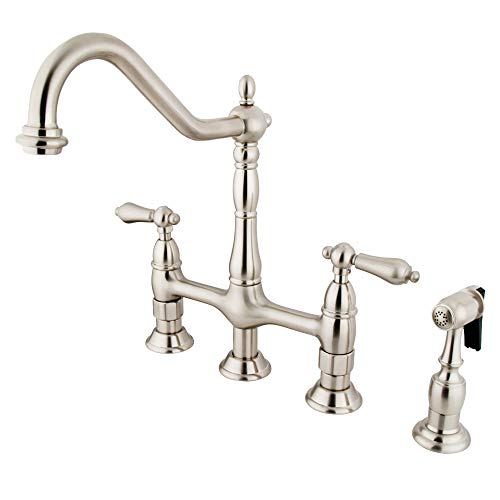
Kingston Brass Heritage Bridge Kitchen Faucet KS1278ALBS, Brushed Nickel — Best for Stainless Kitchens
Most kitchens that want a bridge faucet also have a stainless sink and stainless appliances, and brushed nickel is the finish that unifies them. The KS1278ALBS is the heritage bridge in that finish, with a verified 8-3/4 inch spout reach that puts the water stream comfortably over the middle of a standard sink bowl. It suits anyone who loves the bridge silhouette but needs the faucet to disappear into a working stainless kitchen rather than star in it.
Strengths
- Brushed nickel blends with stainless sinks and appliances
- Verified 8-3/4 inch spout reach covers standard bowls well
- Brushed texture is the lowest-maintenance bridge finish here
Trade-offs
- Understated finish gives less vintage drama than brass tones
- Sprayer adds a fourth deck hole on most installs
- Two-handle control is slower for quick rinse bursts
| Configuration | Exposed bridge, 2-handle, with sprayer |
| Spout reach | 8-3/4 in (per Amazon title) |
| Finish | Brushed nickel |
Reach is the quiet spec that decides whether a faucet annoys you daily, and 8-3/4 inches is the sweet spot for 30 to 33 inch sinks: the stream lands past the front third of the bowl, so filling a pot does not mean wedging it against the back wall. Combined with the bridge risers lifting the spout, this model handles tall stockpots gracefully. The brushed nickel finish is also the most forgiving in this roundup for households that clean fixtures weekly rather than daily. If your priority ranking is function first and period charm second, this is the bridge faucet to buy.
Best for: stainless kitchens wanting bridge style with easy upkeep / Not suited for: buyers chasing a bold brass statement piece
Check on Amazon — check price on Amazon for the current finish options and included parts.

Kingston Brass Bridge Kitchen Faucet KS1275AXBS, Oil Rubbed Bronze — Best Dark Finish
Oil rubbed bronze turns the bridge faucet into furniture. The KS1275AXBS pairs the dark, hand-rubbed-look finish with a brass side sprayer, and on dark cabinetry or a white farmhouse sink the contrast is exactly the effect most buyers are chasing with this finish family. It suits rustic, Tuscan, and traditional kitchens, and homes where the other fixtures, hinges, and pulls already live in the bronze family.
Strengths
- Oil rubbed bronze finish suits dark and rustic kitchens
- Brass side sprayer included
- Bridge profile delivers the full vintage silhouette
Trade-offs
- Dark finishes show hard-water scale as light deposits
- Finish matching across brands is notoriously inconsistent
- Living-finish character changes subtly with use
| Configuration | Exposed bridge, 2-handle |
| Sprayer | Brass side sprayer (per Amazon title) |
| Finish | Oil rubbed bronze |
Two ownership truths define this pick. First, oil rubbed bronze is not one color; it ranges from near-black to warm brown with coppery edges depending on the maker, so order cabinet hardware from the same brand family when you can, or accept tonal variation as part of the rustic look. Second, hard water leaves pale scale on dark finishes that would be invisible on chrome, so a monthly vinegar wipe on a cloth, never a soak that could disturb the finish, keeps it looking deep rather than dusty. Buyers who accept those two rules get the most characterful faucet in this guide.
Best for: rustic and traditional kitchens in the bronze finish family / Not suited for: perfectionists matching bronze tones across many brands
Check on Amazon — check price on Amazon for the current finish options and included parts.

WOWOW Brass Bridge Kitchen Faucet, Oil Rubbed Bronze — Best Value Bridge
WOWOW’s bridge entry is the challenger pick: solid brass construction per the verified listing, an 8-inch centerset bridge layout, two handles, a side sprayer, and a four-hole configuration in oil rubbed bronze. It exists for buyers who want the bridge silhouette and brass body material without paying heritage-brand prices. It suits budget-conscious renovations, rental upgrades with character, and first-time bridge buyers testing whether the layout fits their cooking style.
Strengths
- Solid brass construction stated in the verified listing
- Complete 4-hole package with side sprayer
- Value positioning within the bridge category
Trade-offs
- Newer brand with a thinner long-term parts track record
- Oil rubbed bronze tone matching caveats apply
- Confirm included valve and hose hardware on the listing
| Configuration | 8-inch centerset bridge, 2-handle, 4-hole |
| Construction | Solid brass (per Amazon listing) |
| Finish | Oil rubbed bronze |
The honest framing for this pick is material versus pedigree. The verified listing leads with solid brass construction, which is the spec that matters most for a faucet body, because brass resists the dezincification and cracking that shorten the life of cheaper alloys. What a newer brand cannot show yet is a decade of cartridge availability, so the practical hedge is to photograph the included parts and keep the model number with your home records. For the price tier this faucet plays in, that is a reasonable trade, and it is why this model earns the value badge rather than a warning.
Best for: budget renovations wanting real brass and the bridge look / Not suited for: buyers who prioritize decades-long brand parts support
Check on Amazon — check price on Amazon for the current finish options and included parts.
Comparison Table
| Pick | Badge | Key spec | Best for |
|---|---|---|---|
| Kingston Brass Heritage Bridge Kitchen Faucet KS1272AXBS, Polished Brass | Best Overall | Exposed bridge, brass side sprayer, polished brass finish | traditional and farmhouse kitchens wanting the classic bridge look with a sprayer |
| Kingston Brass Heritage Bridge Kitchen Faucet KS1276ALBS, Polished Nickel | Best Polished Nickel Finish | Exposed bridge, polished nickel finish, heritage styling | transitional kitchens with polished nickel hardware |
| Kingston Brass Heritage Bridge Kitchen Faucet KS1277ALBS, Brushed Brass | Best Brushed Brass Finish | 8-inch bridge, brass sprayer, brushed brass finish | kitchens with brushed gold-tone hardware and busy daily use |
| Kingston Brass Heritage Bridge Kitchen Faucet KS1278ALBS, Brushed Nickel | Best for Stainless Kitchens | Bridge with sprayer, 8-3/4 in spout reach, brushed nickel | stainless kitchens wanting bridge style with easy upkeep |
| Kingston Brass Bridge Kitchen Faucet KS1275AXBS, Oil Rubbed Bronze | Best Dark Finish | Exposed bridge with brass sprayer, oil rubbed bronze finish | rustic and traditional kitchens in the bronze finish family |
| WOWOW Brass Bridge Kitchen Faucet, Oil Rubbed Bronze | Best Value Bridge | Solid brass construction, 8-inch centerset bridge, 4-hole with sprayer | budget renovations wanting real brass and the bridge look |
Every row in this table is a true exposed-bridge design; the column that separates them in practice is the finish and whether the brass sprayer is part of the package. Read the key spec column against your deck first, because the sprayer rows need the fourth hole, then let the finish column settle the rest.
How to Choose a Kitchen 2 Handle Bridge Faucet
Start with the deck, because bridge faucets are the least forgiving layout about hole patterns. Count your sink or countertop holes and measure the spread. A bridge faucet mounts its two handle bodies on an 8-inch spread, and models with a side sprayer need an additional hole. If your sink has three holes in an 8-inch pattern plus a fourth for a sprayer or dispenser, most picks in this guide drop in. If you have a single-hole or 4-inch centerset sink, a bridge faucet is not a bolt-on swap; you are replacing the sink or drilling stone, and that cost belongs in the decision.
Next, decide the sprayer question honestly. A bridge spout is fixed, so the side sprayer is your only rinsing tool. Models with a brass sprayer handle sink washdown, produce rinsing, and pot spraying well. The one configuration to avoid for busy cooks is a bridge with no sprayer at all in a deep single-bowl sink, where you will miss the reach within a week. Also check spout reach against your bowl: around 8-3/4 inches centers the stream on standard bowls, while much shorter reaches push pots against the back wall.
Finally, choose the finish by maintenance appetite, not just by photograph. Polished finishes show every spot, brushed finishes hide them, and dark bronze shows hard-water scale. All three families appear in this guide precisely because the right answer depends on your water and your cleaning habits more than on the faucet itself.
Bridge vs Widespread vs Centerset: Getting the Layout Right
These three two-handle layouts are constantly confused in listings, and the difference is mechanical. A bridge faucet connects its two valve bodies with an exposed pipe that also feeds the spout; the bridge is visible and is the waterway. A widespread faucet has three fully separate pieces, handles and spout, connected by hidden flexible lines under the deck, so spacing can vary. A centerset mounts handles and spout on one shared base plate at a fixed 4-inch or 8-inch spread. Installation cost, serviceability, and look all follow from that distinction.
Choose the bridge when the exposed hardware is the point, when you want valves a plumber can reach without removing the faucet, and when your deck pattern matches. Choose widespread when your holes are drilled at a non-standard spread or you want a cleaner deck. Choose centerset for the simplest install and the easiest wipe-down, since there are no gaps between separate bodies collecting grime. Our two-handle overview guide in this cluster covers widespread and centerset picks in depth; this article stays strictly with true bridges.
Bridge Faucet Valves, Cartridges, and Long-Term Service
The bridge layout’s hidden advantage appears the first time something wears out. On a conventional faucet the valves hide inside a single body under the spout, and a cartridge change means working in the cramped space beneath the deck hardware. On a bridge faucet each valve sits in its own body at the end of the bridge, out in the open, where a homeowner with a wrench and the correct replacement cartridge can work standing up, in daylight, without disconnecting the faucet. That serviceability is a genuine ownership argument for the design, not just a styling one, and it is why bridge faucets from a single dominant platform, like the Kingston Brass models throughout this guide, make sense: one cartridge ecosystem serves the whole roundup.
Valve feel differs by design generation. Older compression valves, the kind that tighten a rubber washer against a seat, ask for a firm final twist and eventually drip when the washer hardens. Modern cartridge and ceramic-disc designs, which the current listings favor, turn with a quarter or half rotation and seal without force. When you test a bridge faucet in a showroom or on arrival, the handles should move smoothly through their travel and stop the flow without a final squeeze. If a new faucet needs force to stop dripping, that is a defect to resolve during the return window, not a personality trait to live with.
Plan the decade, not the day. Keep the model number, a photograph of the included parts, and the listing details with your home records, because the cartridge question in year eight is answered from paper, not from memory. Buy a spare aerator at installation time, since aerators clog with sediment long before valves wear, and a bridge faucet’s spout aerator is the cheapest part on the whole assembly. Owners who do those two clerical things experience bridge faucets as the lowest-drama fixtures in the house; owners who do not experience them as archaeology.
Living With a Bridge Faucet: Daily Workflow Notes
Daily life with a bridge faucet settles into patterns nobody mentions in listings. Temperature becomes a two-position memory: most households find the hot handle lives at one favorite angle for dish water, and daily adjustments happen almost entirely on the cold side. Filling the kettle in the morning is a one-handle job. Washing produce is a cold-handle job. The full two-handle ritual only appears for baths of dishwater at a deliberate temperature, which is rarer than people expect. This is why experienced bridge owners describe the layout as calm: the faucet stops being an instrument you play and becomes two switches you know.
The side sprayer develops its own choreography. It becomes the tool for the first and last thirty seconds of every cleanup, a rinse of the bowl before washing and a washdown after, and for the jobs the fixed spout cannot angle into: the corners of a roasting pan, the inside of a tall vase, the sink walls themselves. The habit worth building early is returning the sprayer to its holder with the hose looped as it wants to hang; a sprayer hose that is forced into a kink ages at the kink. Under the sink, give the hose a clear hanging path, moving the cleaning bottles that migrate into its loop.
Guests will admire the faucet and then use it wrong once, usually by treating the bridge pipe as a handle to steady themselves or to hang a dish towel. The bridge is a waterway, not a rail. A towel draped over the spout is fine; weight hung from the bridge is not. Mention it once, cheerfully, when the kitchen is new, and the faucet will outlast the conversation by decades.
Bridge Faucets and Period Kitchens: Getting the Details Right
A bridge faucet is usually bought as the keystone of a period kitchen, which raises the stakes on the surrounding details. The faucet’s finish should agree with the cabinet hardware’s finish family, and its handle style, lever versus cross, should agree with the era the room claims: cross handles read earlier and more utilitarian, levers read later and more domestic. Neither is wrong, but mixing a Victorian cross-handle bridge with sleek modern pulls produces the visual equivalent of a sentence in two tenses.
The sink participates too. Bridge faucets were born on deep, deck-mounted sinks, and they still look most convincing over a farmhouse or a heavy double-bowl deck. On a thin modern undermount with the faucet drilled into stone behind it, the bridge needs enough rear clearance for its handles, and the proportions should be checked with the dry-fit ritual from this guide’s how-to section. Scale is the quiet test: a bridge faucet is a wide, tall object, and in a small kitchen it should be the only wide, tall object competing at the sink.
Finally, let the rest of the room whisper. A bridge faucet earns its drama honestly; pairing it with a quiet backsplash, simple lighting, and hardware in the same finish family makes the whole kitchen read as considered rather than themed. Themed kitchens date; considered kitchens endure, and the faucet you are buying deserves the enduring kind.
What a Bridge Faucet Costs to Own, Beyond the Purchase
Purchase price is the loudest number in a bridge faucet decision and the least representative one. The ownership ledger has four quieter lines. Installation comes first: a bridge faucet on a matching deck is a standard plumber visit or a confident DIY afternoon, but a deck that needs modification, a new sink, a drilled stone top, converts the faucet’s price into a project price, and that conversion should happen on paper before the faucet is ordered, not on the invoice after. The second line is the sprayer hose, the hardest-working consumable in the package, which on a busy sink may want replacement inside the faucet’s first decade; on mainstream platforms it is a modest, stocked part.
The third line is finish care, which is really a time cost. Polished finishes ask for minutes weekly; brushed finishes ask for almost none; dark bronze asks for a monthly scale wipe in hard-water homes. None of these are expensive, but they are forever, and a household that knows it will not perform them should buy the finish that forgives their absence, which in this guide is brushed nickel. The fourth line is the cartridge reserve: one cartridge per side across a long life, at parts prices that reward platform loyalty. Kingston Brass’s dominance of this category, which might look like a limitation in the picks, is an ownership asset here, because a single cartridge ecosystem serves every bridge in the roundup.
Add the four lines honestly and the bridge faucet’s economics look like what they are: a mid-premium purchase with low running costs and a very long service horizon, provided the deck fit was right on day one. The expensive bridge faucet is never the one with the high price; it is the one bought for the wrong holes.
Bridge Faucet Handle Styles: Cross, Lever, and Porcelain Accents
Handle choice on a bridge faucet is an ergonomic decision wearing a costume. Cross handles are the period-correct default, four-spoke wheels that turn with a fingertip grip and read as authentically early plumbing. They offer fine temperature control because their rotation is gradual, and they suit hands that are dry and unhurried. Their weakness appears with wet, soapy, or weak hands, which must grip and twist a relatively small wheel, sometimes against a valve that has grown stiff with age and scale.
Lever handles trade a degree of period purity for daily mercy. A lever can be pushed with a wrist, a knuckle, or the back of a hand, and it communicates its position visually, so a glance tells you which side is open and roughly how far. In households with children, elders, or cooks with permanently occupied hands, levers are the handles that get thanked. Porcelain-accented levers and crosses, the white inserts and labeled hot and cold buttons of traditional design, split the difference: period looks with a slightly friendlier grip, at the cost of one more material to keep clean.
The deciding test is embarrassingly practical: mime your worst kitchen moment, hands wet and full, at the faucet you are considering, in the showroom if possible. The handle style that survives that mime is your handle style, and the bridge catalog in this guide offers the winning shapes across its finishes, so the test never has to compromise the look that brought you to a bridge faucet in the first place.
A Short History of the Bridge Faucet, and Why It Came Back
The bridge faucet is older than the single-body faucet it now outsells in vintage kitchens. Early indoor plumbing ran exposed because walls were solid, pipes were precious, and every joint had to be reachable by the plumber who would inevitably return. Two taps on two risers, joined by a pipe that also fed the spout, was simply what a kitchen faucet was: honest hardware, assembled from the same fittings as the rest of the system, repairable with the same wrench. When manufacturing learned to hide waterways inside cast bodies, the bridge did not disappear because it failed; it disappeared because hiding things became fashionable, and a generation of kitchens decided that plumbing should be invisible.
The revival that put bridge faucets back into renovated kitchens began with the farmhouse movement, but it survived that movement because the design turned out to have functional arguments that fashion did not anticipate. The exposed valves are serviceable without removing the faucet. The risers lift the spout to a working height that modern low-profile faucets had abandoned. The two handles deliver the independent temperature control that a century of cooks had quietly preferred. Buyers who came for the photograph stayed for the plumbing, which is the most durable reason any design revival can have.
Modern bridge faucets, including every pick in this guide, are not reproductions in the fragile sense. Their cartridges, seals, and finishes are contemporary engineering wearing a period silhouette, which is precisely the correct relationship between old forms and new materials. The lesson for the buyer is to judge a bridge faucet as a modern faucet first, deck pattern, valve quality, sprayer, finish durability, and as a period piece second. This guide’s picks were ranked in exactly that order, and a bridge that wins on both counts is not a compromise between past and present. It is the rare product that gets to be both.
How to Measure and Prepare for a Bridge Faucet Install
Most bridge faucet frustration is measuring failure, not product failure, so work through this sequence before ordering. Step one: with the old faucet still in place, photograph the deck from above and below; you need to know how many holes exist and what the fourth hole, if any, currently holds. Step two: measure center to center between the hot and cold mounting holes with a tape; a bridge faucet needs an 8-inch spread, and being off by half an inch is a hard stop, not an adjustment. Step three: measure from the faucet centerline to the backsplash. Bridge risers and lever handles sweep space behind the deck line, and shallow counters against a tall backsplash can cramp handle rotation.
Step four: check under-sink access and shutoff valves. Bridge installs are deck-friendly, but you still connect two supply lines and a sprayer hose in the cabinet, and corroded shutoffs should be replaced while the cabinet is empty rather than discovered mid-job. Step five: dry-fit the new faucet on the deck before connecting anything, confirm the sprayer hose reaches its hole without kinking, and confirm the spout reach lands over your bowl. Step six: after connection, run hot and cold separately, check each bridge joint and valve body for weeping, then run the sprayer and confirm the diverter switches flow cleanly. A slow ten-minute check here prevents the callback that makes people regret a beautiful faucet.
Common Buying Mistakes
Buying a widespread faucet and calling it a bridge. Listings blur the terms. If there is no exposed connecting pipe in the product photos, it is not a bridge faucet, whatever the title says.
Ignoring the sprayer hole. Ordering a four-hole bridge package for a three-hole sink means drilling or returning. Count holes first, every time.
Matching finishes by screen color. Bronze and brushed brass tones vary by brand and by screen. Anchor on the faucet, then choose hardware, or view samples in person.
Forgetting backsplash clearance. Lever handles on bridge risers need rear swing room. Measure to the backsplash before you fall in love with a tall model.
Skipping the diverter test. On sprayer models, run the sprayer during your first leak check. Diverter faults hide until the sprayer is triggered.
Final Recommendation
For most kitchens, the Kingston Brass KS1272AXBS is the bridge faucet to buy: the full exposed-bridge layout, a brass sprayer, and the classic polished brass look. Stainless kitchens should take the brushed nickel KS1278ALBS instead, and value shoppers should take the WOWOW solid brass bridge. Whichever finish you choose, measure the 8-inch spread and count your deck holes before ordering, because fit is the whole game with this layout. Readers comparing layouts should also see best kitchen 2 handle faucets for widespread and centerset alternatives, and best kitchen arc faucets if a high-arc pull-down ends up suiting your cooking better.
Kingston Brass Heritage Bridge Kitchen Faucet KS1272AXBS, Polished Brass covers the best overall slot. Kingston Brass Heritage Bridge Kitchen Faucet KS1276ALBS, Polished Nickel covers the best polished nickel finish slot. Kingston Brass Heritage Bridge Kitchen Faucet KS1277ALBS, Brushed Brass covers the best brushed brass finish slot.
Best Kitchen 2 Handle Faucets Best Kitchen Arc Faucets Best Kitchen Counter Faucets Best Kitchen Bar Sink Faucets Best Kitchen Family Friendly Faucets
Frequently Asked Questions
What is a bridge kitchen faucet?
It is a two-handle faucet whose separate hot and cold valve bodies are joined by an exposed horizontal pipe, the bridge, which also carries water to the central spout. The exposed pipe is functional, not decorative trim, and it is what separates a true bridge faucet from a widespread model with hidden under-deck connections.
Do bridge faucets come with sprayers?
Most kitchen bridge models include a separate side sprayer, often in brass, because the main spout is fixed. Check the hole count before ordering: sprayer models typically need a fourth deck hole. A bridge faucet with no sprayer is fine for small double-bowl sinks but limiting in a deep single bowl.
What hole pattern does a bridge faucet need?
The two handle bodies mount on an 8-inch spread. Add one more hole if the model includes a side sprayer. Measure center to center between your existing holes; a bridge faucet cannot adapt to a 4-inch centerset pattern.
Are bridge faucets harder to install than regular faucets?
Not harder, just less forgiving of wrong measurements. The deck work is straightforward, connections are standard supply lines plus a sprayer hose, and the exposed valves are actually easier to service later. The jobs that go wrong almost always trace back to an unmeasured spread or a missing sprayer hole.
Can a bridge faucet work with a farmhouse sink?
Yes, and it is one of the most popular pairings. Confirm the sink’s faucet deck has the 8-inch spread plus sprayer hole, or plan a countertop mount behind the sink with enough backsplash clearance for the handles to rotate.
Do two handles control temperature as precisely as one lever?
They control it differently. Two handles let you set hot and cold independently and return to the same mix by position memory, which many cooks prefer. A single lever is faster for quick on-off bursts. Neither is more precise in absolute terms; it is a workflow preference.


