Disclosure: airfryerkitchensupply.com is reader-supported. When you buy through links on our site, we may earn an affiliate commission at no extra cost to you.
Where to buy
If you are shopping for the best heavy duty table top mixers, start with the shortlist below. Table top — countertop — stand mixers live or fail on footprint as much as power: a heavy duty machine you cannot fit under your cabinets or lift onto the counter simply will not get used. Every model here was checked against its current listing data, and the reviews weigh the countertop realities — bowl size against batch needs, head style against cabinet clearance, weight against storage — alongside heavy duty capability. Start with the Cuisinart SM-50 for the best footprint-to-power balance, or the KitchenAid KSM55 if your table top work is dough-led. Check the current price on Amazon for the exact colour and bundle.
- Cuisinart Stand Mixer SM-50, 5.5 Quart — Best Overall Table Top. Check the current price on Amazon.
- KitchenAid 5.5-Qt Bowl-Lift Stand Mixer KSM55 — Best for Dough on the Counter. Check the current price on Amazon.
- Hamilton Beach 4 Qt Electric Stand Mixer — Best Compact Budget. Check the current price on Amazon.
- KitchenAid Classic Series 4.5 Quart Tilt-Head Stand Mixer K45SS — Best Classic Compact. Check the current price on Amazon.
- Cuisinart Precision Pro Digital Stand Mixer SMD-50BC — Best Digital Table Top. Check the current price on Amazon.
- SMEG SMF04 Classico Stand Mixer — Best Design-Led Flagship. Check the current price on Amazon.
The best heavy duty table top mixers solve a three-way equation that bigger buying guides ignore: enough drive and frame strength for genuinely heavy work, a bowl sized to your real batches, and a physical footprint — height under cabinets, depth front to back, weight when you move it — that fits the counter you actually have. A commercial 8-quart may be the strongest mixer on this site, but on a galley counter beneath low cabinets it is furniture, not a tool. This guide is written for the counters most people own.
Table top heavy duty starts with a structural truth: the strongest countertop machines are bowl-lift designs scaled to household bowls, because the lift frame delivers rigidity without the towering head of a commercial unit. Around them sit the well-chosen alternatives — a precision digital machine, a style-led European-style flagship, a compact 4-quart worker and the classic tilt-head that still earns its place where headroom is tight and batches are modest. Each review states plainly where its machine’s heavy duty ceiling sits, because on a countertop the cost of overbuying is paid in space every single day.
All six picks were verified against current listing data for bowl size, speeds and included tools. Countertop machines are sold in colour and bundle variants that shift value considerably, and prices move with them — so this guide prints no fixed prices. Check price on Amazon on the exact configuration you are considering, and measure your counter before you fall for any of them: the buying guide below tells you exactly what to measure.
In this guide
Quick Picks
Six countertop stand mixers that combine real heavy duty capability with footprints a normal kitchen can live with. Badges match the full reviews below.
- Cuisinart Stand Mixer SM-50, 5.5 Quart — Best Overall Table Top: Twelve speeds, a 5.5-quart stainless bowl and a full tool set with splash guard — the most complete countertop package in this guide. See it: check price on Amazon.
- KitchenAid 5.5-Qt Bowl-Lift Stand Mixer KSM55 — Best for Dough on the Counter: Bowl-lift rigidity in the countertop class: 11 speeds and a 5.5-quart stainless bowl for dough-led kitchens with normal cabinets. See it: check price on Amazon.
- Hamilton Beach 4 Qt Electric Stand Mixer — Best Compact Budget: A 4-quart, 300-watt planetary mixer with dough hook, whisk and beater included — heavy duty’s honest entry point for small counters. See it: check price on Amazon.
- KitchenAid Classic Series 4.5 Quart Tilt-Head Stand Mixer K45SS — Best Classic Compact: The classic tilt-head in durable metal with 10 speeds and 59-point planetary coverage — the proven compact for modest batches. See it: check price on Amazon.
- Cuisinart Precision Pro Digital Stand Mixer SMD-50BC — Best Digital Table Top: Digital 12-speed control with preprogrammed prep settings in a 5.5-quart countertop frame — repeatability for formula bakers. See it: check price on Amazon.
- SMEG SMF04 Classico Stand Mixer — Best Design-Led Flagship: A 600W design flagship with 10 speeds, Smooth Start and Steady Mix in a 5-quart handled bowl — the countertop statement that works hard. See it: check price on Amazon.
How These Picks Were Chosen
Selection began with the tape measure. Candidate machines were mapped by class — compact (around 4 quarts), household (5.5 quarts) and large household (7 quarts) — and within each class only genuinely heavy-capable models survived: bowl-lift frames where possible, proven drives, metal-tool construction and speed ranges with a real low gear. Machines whose footprint promised compactness but whose drives were light-duty were cut, as were oversized units whose natural home is the commercial counter covered in this site’s heavy duty stand mixer guide.
Within the survivors, the ranking weighs the countertop bargain each machine offers: capability per inch of height, batch honesty per quart of bowl, and whether the included tools cover a household’s whole workload without immediate extra purchases. The result deliberately spans the classes — a compact budget worker, two 5.5-quart all-rounders, a digital precision model, a design-led flagship and the 7-quart ceiling of sensible table top size — so you can locate your own counter in the list before you locate your favourite colour.
The 6 Best Heavy Duty Table Top Mixers, Reviewed

Cuisinart Stand Mixer SM-50, 5.5 Quart — Best Overall Table Top
Check the current price on Amazon for the current listing, configuration and included attachments before you buy.
The SM-50 is the table top sweet spot made metal: a 5.5-quart stainless bowl that matches real household batches, twelve speeds that span gentle folding to firm whipping, and — unusually at its tier — the complete working set in the box, including a splash guard with a pour spout that makes flour additions on a crowded counter a tidy operation instead of a dusting exercise. For most kitchens, this is the machine against which the countertop equation balances best.
Heavy duty honesty: the SM-50 handles double cookie batches, firm single dough batches, dense batters and full whipping loads with composure, and its speed range gives you the low gear that heavy incorporation demands. It is a tilt-head class machine in spirit — convenient, accessible, counter-friendly — which means the structural ceiling sits below the bowl-lifts: habitual stiff double dough batches belong to the KSM55 below. Within the enormous middle of home baking, it simply does everything well.
Countertop manners complete the case. The proportions suit standard cabinet heights, the bowl and tools store together sensibly, and the colour range lets it live visibly on the counter — which matters, because a mixer that lives out gets used, and a mixer that gets used earns its footprint. If you want one countertop machine for a serious household workload without flagship pricing, start here.
Strengths
- Complete tool set and splash guard included
- 12 speeds with a proper low gear for heavy loads
- Counter-friendly proportions for standard kitchens
Trade-offs
- Tilt-head class ceiling below bowl-lift rigidity
- Stiff double dough batches are beyond its brief
- Less accessory ecosystem than KitchenAid
| Specification | Detail |
|---|---|
| Bowl | 5.5 quart, stainless steel |
| Speeds | 12 |
| Included | Chef’s whisk, mixing paddle, dough hook, splash guard with pour spout |
Best for: most households wanting one complete, capable countertop mixer / Not suited for: habitual large stiff-dough production

KitchenAid 5.5-Qt Bowl-Lift Stand Mixer KSM55 — Best for Dough on the Counter
Check the current price on Amazon for the current listing, configuration and included attachments before you buy.
If your table top workload leans toward dough — weekly bread, pizza nights, enriched holiday batches — the KSM55 is the countertop answer, because it brings the bowl-lift frame down into the household size class. The rigid lift structure is what lets a machine this size knead with authority: no hinge, no head nod, no walking, just a locked bowl and eleven speeds of controlled work. On a countertop, that composure is also a safety feature — a planted machine is a predictable machine.
The 5.5-quart stainless bowl is honestly matched to the drive: family dough batches, double cookie loads and full batter work sit inside its comfortable capacity, and the included flat beater, dough hook and wire whip cover the workload without a second purchase. Its low speeds fold flour in gently — essential when the bowl sits at elbow height and a flour eruption lands on you, not the floor.
Its countertop cost is presence. Bowl-lift machines are tall in working position and heavy enough that you will choose its spot once and keep it there. Kitchens with very low cabinets should measure twice — the guide below explains how — and bakers who never make dough can save the difference with the SM-50. For dough-led counters, this is the correctly engineered resident.
Strengths
- Bowl-lift rigidity at household countertop scale
- 11 speeds with gentle, controlled low end
- Complete included tool set, stainless bowl
Trade-offs
- Tall working profile — measure cabinet clearance
- Heavy enough to be a permanent resident
- Premium over tilt-head rivals of similar bowl size
| Specification | Detail |
|---|---|
| Bowl | 5.5 quart, bowl-lift, stainless steel |
| Speeds | 11 |
| Included | Flat beater, dough hook, wire whip |
Best for: dough-led households with standard counter space / Not suited for: very low cabinets or anyone who must store the mixer away after each use

Hamilton Beach 4 Qt Electric Stand Mixer — Best Compact Budget
Check the current price on Amazon for the current listing, configuration and included attachments before you buy.
Small counters deserve a serious option, and this Hamilton Beach is it: a 4-quart planetary machine with a published 300-watt motor, seven speeds and the full working set — whisk, flat beater and a dough hook — plus a splash guard, at a tier the flagships cannot approach. Planetary action gives full bowl coverage, so small batches mix evenly instead of smearing up the walls, which is precisely the failure mode of oversized machines used for modest loads.
Scale its heavy duty claims correctly and it rewards you. Single dough batches, standard cookie and cake loads, mashed and mixed family quantities — all sit within its honest capacity, and the carry handle acknowledges the reality of compact kitchens: this machine may live in a cupboard and travel to the counter per job, so it is built to be moved. That portability is a genuine countertop feature the heavy residents above cannot offer.
The boundaries are batch size and ultimate drive strength. Double batches and stiff doughs at volume belong to the 5.5-quart class; this is the machine for one- and two-person households, small kitchens and first serious mixers bought on a budget. Judged inside that brief, nothing else in this guide delivers this much real capability per inch and per pound.
Strengths
- Full tool set including dough hook at a budget tier
- Planetary action mixes small batches evenly
- Carry handle suits cupboard-to-counter kitchens
Trade-offs
- 4-quart ceiling limits batch size
- Drive is honest household class, not flagship class
- Fewer speeds than the 11- and 12-speed picks
| Specification | Detail |
|---|---|
| Bowl | 4 quart |
| Motor | 300 watts |
| Speeds | 7 |
| Included | Whisk, flat beater, dough hook, splash guard |
| Design | Planetary mixing, easy-carry handle |
Best for: small kitchens, small households and budget buyers who still bake seriously / Not suited for: double batches or frequent stiff dough work

KitchenAid Classic Series 4.5 Quart Tilt-Head Stand Mixer K45SS — Best Classic Compact
Check the current price on Amazon for the current listing, configuration and included attachments before you buy.
The K45SS is the mixer that defined the category for a generation of home bakers, and its case in a heavy duty table top guide is durability and coverage. The metal construction shrugs off the knocks of a working counter, and the 59-point planetary action — the beater touching 59 points around the bowl per rotation — delivers the even incorporation that makes small-to-medium batches come out right without constant scraping.
Ten speeds cover the household range honestly, and the tilt-head format is the countertop-friendly classic for a reason: head up, bowl off, tools changed in seconds, and a profile that slips under cabinets that would reject a bowl-lift. For cakes, cookies, frostings, whipped work and light-to-moderate dough in single batches, it remains a deeply proven tool with an accessory ecosystem that lets it grow.
Its heavy duty ceiling is the hinge, as with all tilt-heads: stiff dough and double batches flex the format and should be occasional rather than routine. Buy the Classic as the compact all-rounder it is — for households whose heavy work is real but modest, it will still be mixing when trendier machines have been replaced.
Strengths
- Proven metal construction and planetary coverage
- Tilt-head convenience and cabinet-friendly profile
- Deep accessory ecosystem for future expansion
Trade-offs
- Hinge flex limits stiff dough frequency
- 4.5-quart bowl caps batch size
- Basic included set versus richer flagship bundles
| Specification | Detail |
|---|---|
| Bowl | 4.5 quart, tilt-head |
| Speeds | 10 |
| Construction | Durable metal |
| Action | 59-point planetary touchpoints |
Best for: modest-batch households wanting a proven, expandable classic / Not suited for: regular stiff dough or double-batch workloads
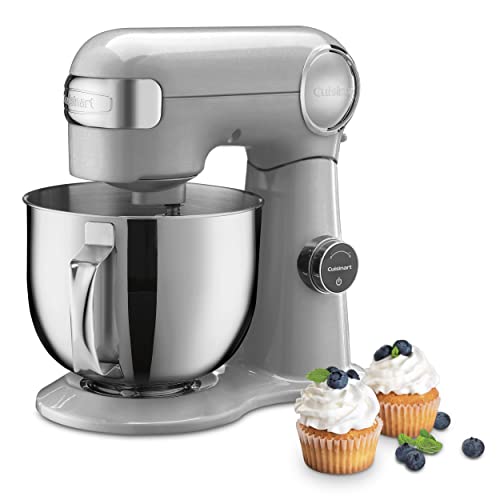
Cuisinart Precision Pro Digital Stand Mixer SMD-50BC — Best Digital Table Top
Check the current price on Amazon for the current listing, configuration and included attachments before you buy.
Countertop baking is increasingly formula baking — scaled recipes, tested ratios, repeatable results — and the Cuisinart Precision Pro is the table top machine built for that mindset. Twelve digitally governed speeds remove the guesswork of dial positions, and three preprogrammed prep settings let timed, staged work run identically every time: the same knead programme for this week’s loaf as last week’s, the same staged whip for the meringue you have perfected.
The 5.5-quart bowl keeps it in the honest household class alongside the SM-50 and KSM55, and its heavy work credentials within that class are solid: double cookie batches, firm single doughs, dense batters and full whipping loads, all started with a digital ramp that spares heavy mixtures the start-up splash and the drive the start-up shock. On a countertop at elbow height, that smoothness is worth real money in un-splattered shirts alone.
Choose it over the bowl-lift if your work is varied and precision-led; choose the bowl-lift over it if dough dominates. Its accessory world is smaller than KitchenAid’s, and its digital interface is a commitment to a modern control style. For the baker who weighs, scales and repeats, it is the most intelligent resident your counter can host at this size.
Strengths
- Digital speed discipline and repeatable programmes
- Smooth ramping for heavy mixtures at start-up
- Full household capacity in a 5.5-quart frame
Trade-offs
- Not the dough-rigidity champion of this list
- Smaller accessory ecosystem
- Digital controls will not suit traditionalists
| Specification | Detail |
|---|---|
| Bowl | 5.5 quart |
| Speeds | 12, digital control |
| Programs | 3 preprogrammed food prep settings |
Best for: formula-driven bakers with varied countertop workloads / Not suited for: dough-dominated baking or dial-and-lever traditionalists

SMEG SMF04 Classico Stand Mixer — Best Design-Led Flagship
Check the current price on Amazon for the current listing, configuration and included attachments before you buy.
Some mixers live in cupboards; the SMEG lives on the counter as a design object — and the useful truth is that a mixer which lives out gets used for everything, which is its own kind of heavy duty value. Beneath the Classico styling sits a specification that earns its place here on merit: a 600-watt motor, ten speeds, a Smooth Start that ramps into heavy mixtures gently, and a Steady Mix system that holds the chosen pace as loads change through a batch.
The 5-quart stainless bowl with a handle is a countertop-thoughtful detail — full bowls of batter and dough are genuinely easier to move, pour and scrape one-handed at counter height — and the machine’s heavy work range covers the household repertoire confidently: firm doughs in single batches, double cookie loads, dense batters and serious whipping. It is a flagship all-rounder wearing couture, not a specialist, and its reviews should be read that way.
The premium is partly for the design, and honesty requires saying so: mechanically comparable capability exists in this guide at friendlier tiers. What the SMEG adds is an object you will enjoy looking at daily for the many years it works — and in a kitchen where the mixer never leaves the counter, that daily pleasure is a rational part of the purchase, not a guilty one.
Strengths
- 600W motor with Steady Mix pace-keeping under load
- Smooth Start protects heavy mixtures and clean shirts
- Handled 5-quart bowl and counter-worthy design
Trade-offs
- Design premium over mechanically similar rivals
- Not a dough specialist at bowl-lift level
- Colour commitment — it will define your counter’s palette
| Specification | Detail |
|---|---|
| Motor | 600W |
| Bowl | 5 quart, stainless steel, with handle |
| Speeds | 10 |
| Systems | Smooth Start, Steady Mix System |
Best for: design-led kitchens wanting a flagship all-rounder that lives on display / Not suited for: budget buyers or dough-production workloads
Comparison Table
| Pick | Badge | Key spec | Best for |
|---|---|---|---|
| Cuisinart Stand Mixer SM-50, 5.5 Quart | Best Overall Table Top | 5.5-qt bowl, 12 speeds, full tool set + splash guard | most households wanting one complete, capable countertop mixer |
| KitchenAid 5.5-Qt Bowl-Lift Stand Mixer KSM55 | Best for Dough on the Counter | 5.5-qt bowl-lift, 11 speeds, dough hook included | dough-led households with standard counter space |
| Hamilton Beach 4 Qt Electric Stand Mixer | Best Compact Budget | 4-qt bowl, 300W, 7 speeds, full tool set | small kitchens, small households and budget buyers who still bake seriously |
| KitchenAid Classic Series 4.5 Quart Tilt-Head Stand Mixer K45SS | Best Classic Compact | 4.5-qt tilt-head, 10 speeds, metal construction | modest-batch households wanting a proven, expandable classic |
| Cuisinart Precision Pro Digital Stand Mixer SMD-50BC | Best Digital Table Top | 5.5-qt, 12 digital speeds, 3 prep programs | formula-driven bakers with varied countertop workloads |
| SMEG SMF04 Classico Stand Mixer | Best Design-Led Flagship | 600W motor, 5-qt handled bowl, 10 speeds, Steady Mix | design-led kitchens wanting a flagship all-rounder that lives on display |
Compare within your size class first — compact, household or large household — then by frame and control style. A machine from the wrong class never wins, however strong its motor.
How to Choose a Heavy Duty Table Top Mixer: Measure First
Before comparing a single specification, measure three things. Cabinet clearance: the height from counter to the underside of your wall cabinets, minus the room you need to tilt a head or lift a bowl — bowl-lift machines need their working height, tilt-heads need head-swing height, and both are useless if the bowl cannot come off under the cabinet. Counter depth: mixer depth plus the bowl’s removal path plus your own working stance. Storage reality: if the machine must be lifted away after use, its weight is a specification, and the Hamilton Beach’s carry handle stops being a detail and becomes the decision.
- Compact class (~4 qt): one- and two-person households, small batches, cupboard storage — Hamilton Beach and the KitchenAid Classic.
- Household class (5.5 qt): the family sweet spot — full batches, double cookies, single doughs — SM-50, KSM55, Cuisinart digital.
- Large household class (7 qt): double batches and entertaining scale, only where cabinet height and counter depth genuinely allow it — see this site’s heavy duty stand mixer guide for the 7-quart flagship.
- Head style: tilt-head for access and low profiles; bowl-lift for rigidity and dough. On a countertop this choice is as much about your cabinets as your baking.
- Included tools: a dough hook, beater and whisk in the box is the complete-workload test; splash guards matter more at counter height than anywhere else.
Budget tiers in words: the budget tier now buys real planetary mixing and a full tool set at compact size. The mid tier buys the 5.5-quart household class with complete bundles. The premium tier buys bowl-lift rigidity, digital precision or design-flagship presence. What no tier buys is immunity from your tape measure — the most returned mixers in this category are excellent machines that did not fit.
Making a Table Top Mixer Work Harder, Safely
Countertop machines reward placement discipline. Work the mixer on a clear, dry surface with the bowl’s removal path unobstructed, and never run a heavy batch with the machine perched near the counter edge — a planted, centred machine is both safer and quieter. Use the splash guard for flour work; at counter height the alternative is wearing the batch. Keep a thin mat or the machine’s own feet clean and dry so suction and grip do their job during kneads. And respect the class boundaries the reviews state: a compact machine asked to live a 7-quart life will not complain loudly — it will simply wear out early, which is the most expensive outcome in this category.
When the Table Top Is Not Enough
Three signals say your baking has outgrown the countertop class: you split batches weekly, your dough work is stiff and doubled as a matter of routine, or the mixer’s spot has become a permanent production station that crowds out cooking. At that point the honest upgrade is the full heavy duty class — the 7-quart bowl-lift flagship or the dough specialists in this site’s companion guides — placed on a dedicated surface, or even a utility cart or bakery shelf that frees your counter entirely. Many serious bakers end with two machines: a compact table top for daily work and a heavy resident for bake days. That is not excess; it is matching tools to loads, which is the whole philosophy of this guide.
How to Set Up a Table Top Mixer on Your Counter, Step by Step
A countertop mixer performs at its best — and safest — when its station is set up deliberately. This ten-minute setup pays off on every batch that follows.
- Clear the station fully: counter wiped and dried, the mixer’s footprint plus a bowl-removal path on one side and ingredient space on the other.
- Check cabinet clearance with the machine in working position — head tilted or bowl raised, whichever your model uses — and confirm the bowl lifts off without tilting into the cabinet underside.
- Seat the machine on its feet on the bare counter (skip thick mats that let it rock) and plug into a reachable socket so the cord never crosses the bowl path or a hot zone.
- Fit the bowl and the tool for your first regular job and run the machine empty at low speed for ten seconds: listen for rattles, watch for walking, and adjust placement until it sits calm.
- Store the tools with the machine — in the bowl, in an adjacent drawer, or in the model’s case — so the full set is always at the station and never bent at the bottom of a utensil crock.
- Decide the machine’s home honestly: if it will live out, give it the prime spot with light and elbow room; if it must travel from a cupboard, choose the compact class and practise the lift before the first bake day.
- After the first heavy batch, re-check the station: any flour in the vents, any drift in position, any cord wear. Adjust once, and the station is set for years.
A deliberate station turns a good countertop mixer into a fixture of your cooking rather than an appliance you negotiate with. Set it up once, properly, and every recipe afterwards starts two minutes ahead.
Tilt-Head or Bowl-Lift on a Countertop?
On a countertop the frame question gains a physical dimension the full-size guide does not face: your cabinets vote. A tilt-head machine needs swing room — the head rises back and up to free the bowl — and rewards you with the easiest bowl and tool changes in the category and a lower storage profile. A bowl-lift machine needs vertical working room and a slide-forward path for bowl removal, and rewards you with rigidity that shows up in every stiff batch. Neither is universally superior; the correct answer is written in your kitchen’s measurements and your dough habits, in that order.
The working compromise most households land on: if dough is occasional and cabinets are low, tilt-head convenience wins and the SM-50 or KitchenAid Classic will serve happily for years. If dough is weekly and the tape measure allows, the KSM55’s lift frame is worth its premium every single batch, because rigidity is not a luxury feel — it is the difference between a machine that kneads calmly and one that nods, walks and wears. Measure first, then let your baking cast the deciding vote.
Small Batches in Big Bowls, and Other Countertop Physics
The most common countertop disappointment is not weakness but mismatch: a small load in a large bowl. Two egg whites in a 7-quart bowl barely meet the whip; a single cake batter smears up the walls of a flagship bowl and mixes unevenly no matter how good the planetary action is. This is physics, not quality — tools are sized to their bowls, and below a minimum fill the geometry stops working. It is the practical reason this guide insists on class-matching: the compact machines exist because small households’ daily loads genuinely mix better in them.
The countertop corollaries are friendly ones. A handled bowl (the SMEG’s quiet virtue) matters more at counter height than anywhere, because you pour and scrape one-handed at elbow level. A splash guard matters more because the flour cloud’s target is you. And a machine light enough to move matters if the counter doubles as dining space, homework station or the household’s everything surface — which, in real kitchens, it usually does. Buy for the counter you live with, not the kitchen in the brochure.
A Countertop Workflow That Makes Heavy Work Easy
Set the station once, as the how-to section describes, and then run a mise en place discipline scaled to the counter: ingredients measured into bowls along the back edge, tools on a towel to the side, the mixer’s bowl as the only vessel in the centre. Heavy batches reward this order because additions happen at low speed in stages — flour, scrape, flour — and a cook who is not hunting for the next ingredient keeps the machine’s rhythm and the batch’s quality. After the batch, tools and bowl go straight to the sink while the counter is wiped before flour dust settles into tomorrow’s grit.
It sounds like housekeeping; it is actually machine care. A countertop mixer lives in the busiest square metre of the house, exposed to splashes, flour and the occasional knock from a passing pan. A station habit — clear space, immediate wipe-downs, tools stored with the machine — is what keeps a five-year-old countertop mixer looking and running like the machine in the review photos, rather than like a survivor.
Renting the Counter: What a Mixer Must Earn
Every countertop appliance pays rent in the only currency a kitchen has: surface. A stand mixer occupies roughly a chopping board’s worth of the most valuable real estate in the house, permanently if it is heavy, and the honest question of this guide is what it pays back. The answer is measured in use frequency, which is why the class-matching advice runs through every section: a correctly sized machine that mixes three times a week pays its rent in full, while an oversized flagship used monthly is an expensive ornament with a dough hook. Before buying, count your realistic mixing sessions for a normal month — cakes, doughs, batters, whipped work, prep jobs the hub could take — and let that number, not an imagined holiday season, choose the class.
The rent calculation also explains the guide’s affection for complete bundles. A machine that arrives with beater, hook, whisk and guard starts paying rent on day one across the whole workload; a machine that needs three accessory purchases before it can knead has a quieter, dearer first year than its sticker suggests. Likewise the carry handle on the compact Hamilton Beach: in a kitchen where the counter must be cleared for dinner, portability is not a compromise — it is the feature that keeps the rent paid, because a machine that travels easily gets used instead of resented.
Revisit the tenancy once a year. Baking lives change — children arrive, bread habits form, households shrink — and the right response to a changed rhythm is a changed class, not loyalty to a footprint. The second-hand market for the brands in this guide is healthy precisely because these machines outlast the kitchens they were bought for; selling a well-kept mixer into its next kitchen is part of the format’s economy, not an admission of failure.
The Two-Machine Kitchen, Revisited
Spend time in serious home kitchens and a quiet pattern appears: many of the happiest bakers own two mixers, and neither is the flagship of anyone’s dreams. A compact table top machine — the Hamilton Beach or Classic class in this guide — lives where the daily work happens, mixing batters, doughs for two, whipped things and prep work at a moment’s notice. Behind it, in a pantry or on a bakery shelf, sits the heavy resident for bake days: the bowl-lift or the big-batch machine that comes out when the flour order doubles. The pairing costs less than one commercial unit, fits more real kitchens, and matches tools to loads with a precision no single machine can equal.
This guide was written for the first of those machines — the daily one — because it is bought first, used most and chosen worst when buyers shop for the bake day instead of the week. If your two-machine future is plausible, buy the daily machine honestly now: compact class for small households, 5.5-quart class for families, and let the heavy resident arrive when the bake days actually demand it, informed by everything the daily machine taught you about your own rhythm. If one machine must do everything, the KSM55 and SM-50 in this guide are the deliberate compromises — sized for the week, strong enough for the occasional bake day, and honest about the boundary between the two.
Either way, the countertop decision made in this guide’s terms — class, frame, fit, then colour — is the decision that survives contact with your kitchen. That is all any buying guide can honestly promise, and it is enough.
Colours, Finishes and the Long Look
It is unfashionable in a specification-led guide to spend a section on appearance, and yet the countertop is the one place in the house where an appliance is also furniture, seen daily for a decade. Finishes divide into those that age gracefully under kitchen life and those that record every fingerprint, splash and scouring. Brushed and matte metal finishes forgive; high-gloss colours delight when new and demand wiping to stay delightful; white and cream hide flour dust best, while black shows it most — a genuine operational difference in a baking household that no reviewer should be too proud to mention.
The honest hierarchy remains the one this guide opened with: class, frame and fit first, because a beautiful machine that cannot knead your dough or fit your cabinets will annoy you daily in ways no colour can redeem. But once those are settled, choose the finish you will enjoy looking at, without apology. A mixer that pleases the eye gets left out, and a mixer left out gets used, and a mixer used weekly for ten years is the best value in this entire guide regardless of what it cost. Aesthetics, on a countertop, are a use feature.
Common Buying Mistakes
Buying before measuring. Cabinet clearance kills more countertop mixer purchases than any motor specification. Height in working position, bowl removal path, counter depth — measure all three before you fall for a flagship.
Oversizing for imaginary batches. The 7-quart bought for a once-a-year double batch makes fifty ordinary batches worse — small loads mix poorly in big bowls. Buy for your weekly reality; split the annual batch.
Assuming heavy duty means unlimited duty. Every class in this guide has a stated ceiling. Running a compact machine on production dough does not make it heavy duty; it makes it short-lived.
Storing a heavy machine you cannot lift comfortably. If the mixer must travel from cupboard to counter, its weight is a safety specification. Choose the compact class with a carry handle and keep the lift honest.
Skipping the splash guard at counter height. Bench bakers can dodge a flour puff; countertop bakers wear it. The guard exists for this format — use it for every dry addition.
Judging by colour first. Colour is the last decision, after class, frame and fit. The right machine in your second-favourite colour will please you for a decade; the wrong machine in the perfect colour will annoy you by Christmas.
Final Recommendation
For most counters, the Cuisinart SM-50 is the table top heavy duty answer: complete, capable and proportioned for real kitchens. Dough-led households should choose the KitchenAid KSM55’s bowl-lift rigidity, small kitchens the Hamilton Beach’s compact honesty or the KitchenAid Classic’s proven compact all-round game, formula bakers the Cuisinart digital’s repeatable precision, and design-led kitchens the SMEG — a flagship that works as hard as it photographs. Every one of them was chosen to fit a counter first and impress second, which is the correct order for a machine you will live with daily.
Measure your space, match your class, and buy once. The companion guides below cover the full-size heavy duty class and the bread specialists for the day your baking outgrows the counter — a good problem, arriving right on schedule.
Start with the three safest first looks: Cuisinart Stand Mixer SM-50, 5.5 Quart, KitchenAid 5.5-Qt Bowl-Lift Stand Mixer KSM55, Hamilton Beach 4 Qt Electric Stand Mixer.
Keep reading in this series: Best Heavy Duty Stand Mixers Best Heavy Duty Mixers For Bread Making Best Heavy Duty Hand Mixers Best Stand Mixers For Small Kitchens Best Stand Mixers
Frequently Asked Questions
What is the difference between a table top mixer and a stand mixer?
They are the same family — table top (countertop) describes where the machine lives and the size class it is designed for. This guide uses the term to focus on footprint, cabinet clearance and realistic household batch sizes alongside heavy duty capability.
Will a bowl-lift mixer fit under my cabinets?
Measure your counter-to-cabinet height and compare it with the machine’s working height, then check the bowl can be lifted off its pins without tilting. Many bowl-lifts fit standard cabinet heights for mixing but need to slide forward for bowl removal — plan the slide space into your station.
What size stand mixer is best for a family?
The 5.5-quart household class suits most families: full cake and cookie batches, double cookie loads and single dough batches. Compact 4- to 4.5-quart machines suit one- and two-person households; 7-quart machines suit double-batch and entertaining rhythms where the counter allows.
Can a compact stand mixer handle bread dough?
Single, moderate batches — yes, with the dough hook and sensible pacing, as the Hamilton Beach and KitchenAid Classic reviews describe. Stiff or double batches belong to the bowl-lift class; the compact machines’ ceilings are stated plainly so you can buy with open eyes.
Is a heavier mixer always better on the counter?
Weight helps stability during kneading but hurts any kitchen where the machine must be moved for storage. Match weight to your reality: permanent residents can be heavy; travelling machines should be compact with a carry solution.
Do I need a splash guard for a countertop mixer?
For flour work, effectively yes. At counter height, dry additions puff directly toward you and across the worktop. Most picks in this guide include a guard; if yours does not, add flour in stages at the lowest speed with the bowl partly covered.

