Disclosure: airfryerkitchensupply.com is reader-supported. When you buy through links on our site, we may earn an affiliate commission at no extra cost to you.
Where to buy
If you are shopping for the best heavy duty mixers for bread making, start with the shortlist below. Bread is the most punishing job in a home kitchen — stiff, elastic dough that fights the hook for ten minutes at a time — so every mixer here is a bowl-lift, rotating-bowl or commercial-class machine whose listing data was checked before it earned a place. Start with the Ankarsrum if bread is your main craft, the Bosch if you bake big batches for a crowd, or the KitchenAid 7 Quart if you want one mixer for bread and everything else. Check the current price on Amazon for the exact configuration, because bowls, hooks and bundles change what a listing includes.
- Ankarsrum Original Stand Mixer AKM6230 — Best Overall for Bread. Check the current price on Amazon.
- Bosch Universal Plus Stand Mixer 500 Watt, 6.5 Quarts Bundle — Best for Big Batches. Check the current price on Amazon.
- KitchenAid 7 Quart Bowl-Lift Stand Mixer KSM70 — Best All-Round Bread Mixer. Check the current price on Amazon.
- KitchenAid NSF Certified Commercial Series 8-Qt Bowl Lift Stand Mixer KSM8990 — Best Commercial Build. Check the current price on Amazon.
- Kenwood Chef Titanium 7 qt 800W — Best European Engineering. Check the current price on Amazon.
- KitchenAid 5.5-Qt Bowl-Lift Stand Mixer KSM55 — Best Compact Bowl-Lift for Bread. Check the current price on Amazon.
The best heavy duty mixers for bread making share one trait the ordinary stand mixer market mostly lacks: they were designed around dough first. Bread dough is not thick batter. It is an elastic, developing network that climbs hooks, slaps bowl walls and loads a motor continuously for eight to twelve minutes, batch after batch, week after week. Planetary mixers built for cake batter survive that treatment for a while; dough-first machines — rotating-bowl kneaders, bottom-drive universals and bowl-lift workhorses with metal gearing — are built for it as a way of life.
This guide separates the field by kneading method, because method decides results more than motor badges do. The Ankarsrum kneads with a roller and scraper in a rotating bowl, mimicking hand kneading and handling everything from wet ciabatta to stiff wholemeal. The Bosch drives from below with a dough hook engineered for large flour loads. The KitchenAid bowl-lifts use planetary action with the stability and gear strength that tilt-head models cannot match. The Kenwood and the commercial KitchenAid round out the set for bakers who want European gearing or certified commercial build.
Every pick was verified against current listing data before inclusion, and the one famous name you will not find linked here — the Hobart N50 — is discussed honestly in the buying guide as an unlinked reference point, because we could not confirm a current listing through our verification pass for this batch. Prices on machines in this class move with bundles and seasons, so this guide prints no fixed prices: check price on Amazon on each pick, and use the tier discussion in the guide sections to judge where your money actually goes.
In this guide
Quick Picks
Six machines that can knead real bread dough — lean, wholemeal and enriched — without walking across the counter or cooking their motors. Badges match the full reviews below.
- Ankarsrum Original Stand Mixer AKM6230 — Best Overall for Bread: The Swedish rotating-bowl kneader: a roller and scraper work dough gently and thoroughly, from wet ciabatta to stiff wholemeal. See it: check price on Amazon.
- Bosch Universal Plus Stand Mixer 500 Watt, 6.5 Quarts Bundle — Best for Big Batches: Bottom-drive power with a 6.5-quart bowl and a dough hook system famous for kneading batch after batch of whole-grain dough. See it: check price on Amazon.
- KitchenAid 7 Quart Bowl-Lift Stand Mixer KSM70 — Best All-Round Bread Mixer: A 7-quart bowl-lift with 11 speeds including a half-speed fold — the strongest mainstream choice for bread plus everything else. See it: check price on Amazon.
- KitchenAid NSF Certified Commercial Series 8-Qt Bowl Lift Stand Mixer KSM8990 — Best Commercial Build: NSF-certified commercial construction with an 8-quart bowl — built for duty cycles home mixers never see. See it: check price on Amazon.
- Kenwood Chef Titanium 7 qt 800W — Best European Engineering: An 800W European kitchen machine with a 7-quart stainless bowl and electronic variable speed — quiet, strong, system-minded. See it: check price on Amazon.
- KitchenAid 5.5-Qt Bowl-Lift Stand Mixer KSM55 — Best Compact Bowl-Lift for Bread: Bowl-lift stability and 11 speeds in a 5.5-quart frame — the bread-capable KitchenAid for smaller households and counters. See it: check price on Amazon.
How These Picks Were Chosen
Selection started from flour capacity, not bowl size. A mixer earns a bread badge by the weight of flour it can knead repeatedly without stalling, overheating or walking — so manufacturer dough capacity figures, gear construction and kneading method were weighed before any convenience feature. Bowl-lift and fixed-bowl designs scored over tilt-heads because the head cannot flex under dough load. Machines whose dough hook is a coated afterthought lost to machines whose hook geometry — spiral, roller-and-scraper or bottom-drive — is the centre of the design.
We also weighed batch rhythm: bread bakers rarely make one loaf. A machine that needs a long cool-down between batches, or whose bowl is awkward to scrape and reload, slows a bake day down. Finally, serviceability mattered — bread duty wears belts, gears and hooks, and brands with established parts support protect a serious purchase. Models were cut when their bread reputation rested on marketing rather than mechanism, when flour capacity was a fraction of the bowl’s batter capacity, or when the drive relied on parts the maker does not support with replacements.
The 6 Best Heavy Duty Mixers for Bread Making, Reviewed
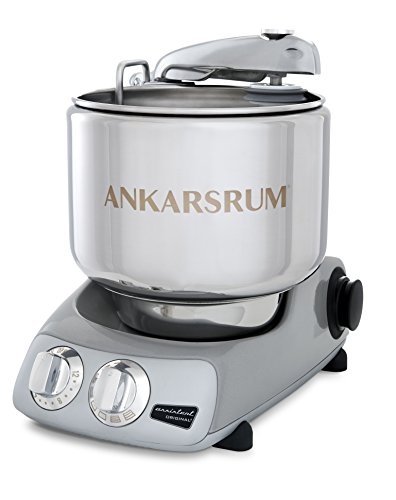
Ankarsrum Original Stand Mixer AKM6230 — Best Overall for Bread
Check the current price on Amazon for the current listing, configuration and included attachments before you buy.
If bread is the reason you are buying, the Ankarsrum is the machine the other five are measured against. Instead of a hook orbiting in a fixed bowl, its bowl rotates while a roller presses and folds the dough against the bowl wall and a scraper keeps the sides clean. The action is recognisably hand-kneading at machine pace: dough is stretched and folded rather than torn and hooked, gluten develops smoothly, and the dough mass stays in contact with the working surfaces instead of climbing away from them.
The practical consequences cover the whole bread repertoire. Wet, slack doughs that smear under a planetary hook get gathered and worked properly by the roller. Stiff wholemeal and seeded doughs knead without the machine rocking or the motor note sagging, because the load is spread through the rotating bowl rather than concentrated on one hook shaft. Large batches are this design’s home turf — the open bowl makes adding flour gradually, checking dough feel mid-knead and scraping down genuinely easy, which any regular bread baker will tell you is half the craft.
The trade-offs are real and worth stating. There is a learning curve: your first loaves involve judging roller position and speed differently from any mixer you have used before. It is a premium-tier purchase. And as a general mixer it asks you to learn its whisking bowl setup for cakes. Bakers who accept those terms routinely describe it as the last mixer they buy — for bread making specifically, nothing else in this guide kneads quite like it.
Strengths
- Roller-and-scraper kneading develops gluten gently and completely
- Handles wet slack doughs and stiff wholemeal with equal composure
- Open rotating bowl makes additions and dough checks easy
Trade-offs
- Premium tier pricing
- Technique differs from planetary mixers — expect a learning curve
- Cake and whisking work uses a separate bowl setup to learn
| Specification | Detail |
|---|---|
| Model | AKM6230 |
| Design | Rotating bowl with roller and scraper kneading |
| Finish | Jubilee Silver |
Best for: dedicated bread bakers working across lean, enriched, wet and wholemeal doughs / Not suited for: occasional bakers who mostly make cakes and want a familiar tilt-head routine
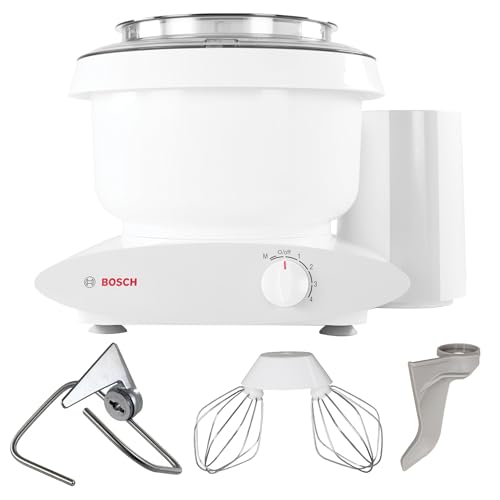
Bosch Universal Plus Stand Mixer 500 Watt, 6.5 Quarts Bundle — Best for Big Batches
Check the current price on Amazon for the current listing, configuration and included attachments before you buy.
The Bosch Universal Plus has been the big-batch bread answer for decades, and the mechanism explains why. The drive sits underneath and turns the bowl’s centre column, so the dough hook works the mass from the middle outward with the motor’s torque applied directly, not through a flexing head. In practice it kneads large flour loads — the kind of multi-loaf, whole-grain batches that make planetary mixers labour — with an unhurried competence that has made it the default recommendation in serious home-baking circles.
This bundle adds the detail experienced Bosch bakers insist on: the dough hook extender. Small and single batches can ride up the centre column of a bottom-drive bowl and escape the hook; the extender keeps modest batches engaged, which turns the Bosch from a big-batch specialist into an everyday bread machine. The 6.5-quart bowl gives the mass room to be worked rather than merely contained, and the wire whips in the box cover the lighter end of baking without a second machine.
Expect a different ownership experience from a KitchenAid. The aesthetic is functional rather than countertop jewellery, the plastic bowl components surprise people expecting all-metal at this tier, and the kneading action rewards the Bosch technique of adding flour steadily rather than dumping. Bakers who bake for families, freezer stocking or small-scale selling will not care about any of that once they watch it take a full wholemeal batch in stride.
Strengths
- Bottom-drive torque built for large, heavy flour loads
- Dough hook extender makes small batches work properly too
- 6.5-quart bowl gives dough room to develop
Trade-offs
- Utilitarian styling and some plastic bowl components
- Technique rewards gradual flour addition
- Footprint and storage differ from a classic stand mixer
| Specification | Detail |
|---|---|
| Motor | 500 watt |
| Bowl | 6.5 quarts |
| Included | Wire whips, dough hook, NutriMill dough hook extender (bundle) |
Best for: high-volume home bakers, whole-grain specialists and freezer-batch baking days / Not suited for: bakers who bake one small loaf occasionally and prize countertop looks

KitchenAid 7 Quart Bowl-Lift Stand Mixer KSM70 — Best All-Round Bread Mixer
Check the current price on Amazon for the current listing, configuration and included attachments before you buy.
The KSM70 is where the mainstream stand mixer line grows up into a bread machine. The bowl-lift frame is the foundation: the bowl locks onto a lifting arm and the head never hinges, so under dough load there is no flex, no head bounce and none of the slow mechanical protest a tilt-head makes with a stiff batch. Seven quarts of bowl swallows double batches of sandwich dough and large enriched holiday batches with headroom to spare.
Eleven speeds sound like a cake feature until you knead. The low end includes a genuine half speed for folding, which is the gear that lets you incorporate flour at the start of a batch without a flour eruption, and the kneading speeds sit in a range where the hook can work dough continuously rather than slapping it. The accessory set in the box — including the Double Flex Edge Beater — means the same machine that kneads your sourdough on Saturday creams, whips and mixes through the rest of the week’s cooking without extra purchases.
Against the two dough-first specialists above, the honest comparison is this: the Ankarsrum kneads more beautifully, the Bosch swallows bigger loads, and the KitchenAid does everything very well in one familiar machine with the deepest accessory and attachment ecosystem in the business. For a household whose bread habit shares the counter with general baking, that balance is usually the right answer.
Strengths
- Bowl-lift stability under sustained dough load
- Half-speed folding gear prevents flour eruptions at batch start
- Deepest attachment ecosystem for whole-kitchen use
Trade-offs
- Planetary hook action is very good, not dough-specialist great
- Large and heavy — it will live on the counter
- Premium tier within the KitchenAid range
| Specification | Detail |
|---|---|
| Bowl | 7 quart, bowl-lift |
| Speeds | 11, including 1/2 speed for folding |
| Included | Double Flex Edge Beater and 4 other accessories |
Best for: serious home bakers who want one machine for bread and all other mixing / Not suited for: tiny counters or bakers who only ever make a single small loaf

KitchenAid NSF Certified Commercial Series 8-Qt Bowl Lift Stand Mixer KSM8990 — Best Commercial Build
Check the current price on Amazon for the current listing, configuration and included attachments before you buy.
The KSM8990 exists for the baker whose home kitchen behaves like a small bakery: cottage-food sellers, market-stall bakers, community bakers and households kneading daily. NSF certification is not a sticker — it means the machine’s construction, materials and cleanability meet commercial food-equipment standards, and the build underneath matches that brief, with a duty cycle intended for repeated batches across a working day rather than a Sunday loaf.
Eight quarts changes batch planning. Triple batches of sandwich dough, large enriched batches for events and full-size pizza production for a crowd all fit with working room, and the bowl-lift mechanism carries those loads with the same locked-down stability as the KSM70, scaled up. For bread specifically, the value is rhythm: knead, shape, knead again, without negotiating cool-downs or splitting batches to protect a domestic motor.
The costs of commercial build are literal and practical. It is the heaviest, largest footprint class in this guide, it sits in the highest price tier here, and its accessory world is narrower and more workmanlike than the colourful domestic ecosystem. Buy it when your baking volume is a business or behaves like one; for ordinary home bread, the KSM70 above delivers the same brand’s bowl-lift virtues in a friendlier package.
Strengths
- Commercial duty cycle for back-to-back batch days
- 8-quart capacity ends batch-splitting for big recipes
- NSF-certified construction and cleanability
Trade-offs
- Highest price tier in this guide
- Heaviest footprint — dedicated counter space required
- Accessory range is functional, not extensive
| Specification | Detail |
|---|---|
| Model | KSM8990 |
| Bowl | 8 quart, bowl-lift |
| Certification | NSF certified, Commercial Series |
Best for: cottage bakers, market sellers and daily high-volume home production / Not suited for: occasional bakers or small kitchens without permanent counter space

Kenwood Chef Titanium 7 qt 800W — Best European Engineering
Check the current price on Amazon for the current listing, configuration and included attachments before you buy.
Kenwood’s Chef line is the European answer to the same question, engineered with a different accent: an 800-watt motor under electronic variable speed control, a 7-quart stainless bowl, and a system of drive outlets that turns the machine into a kitchen hub. For bread, the relevant facts are torque delivery and control. The electronic speed management holds the set pace as dough develops and resistance changes through the knead, rather than surging and fading, which produces a calmer, more even knead.
The big stainless bowl suits the bread workflow well — room for large batches, a surface that releases dough cleanly, and none of the coating worries that come with non-stick bowls under hook abrasion. Kenwood’s dough tool geometry has decades of European home-baking behind it, in markets where daily bread is a stronger tradition than in the US, and it shows in how the machine handles wholemeal and rye blends that stress lesser planetary mixers.
Ownership considerations are ecosystem ones. Kenwood’s attachment range is excellent but less ubiquitous in US retail than KitchenAid’s, so check the specific attachments you want are readily listed before committing. If you value engineering feel, quiet running and precise electronic control over sheer brand familiarity, the Chef Titanium is the connoisseur’s pick in this set.
Strengths
- 800W motor with electronic speed held under changing load
- 7-quart stainless bowl releases dough cleanly
- Refined, quiet European engineering and hub system
Trade-offs
- Attachment availability is thinner in US retail
- Less familiar service network than the US brands
- Premium tier pricing
| Specification | Detail |
|---|---|
| Motor | 800W |
| Bowl | 7 qt, stainless steel |
| Speed | Electronic variable speed control |
Best for: bakers who value precise speed control and European build for regular bread work / Not suited for: buyers who want the widest walk-in accessory and service ecosystem

KitchenAid 5.5-Qt Bowl-Lift Stand Mixer KSM55 — Best Compact Bowl-Lift for Bread
Check the current price on Amazon for the current listing, configuration and included attachments before you buy.
Not every bread baker needs seven quarts. The KSM55 brings the essential bread architecture — bowl-lift frame, 11 speeds, a proper dough hook in the box — down to a 5.5-quart machine that suits one- and two-loaf households and counters that cannot host the range-toppers. The mechanism matters more than the size: because the head does not hinge, a single stiff batch of wholemeal kneads against a rigid frame, and the mixer stays planted instead of nodding under load.
Batch planning is the discipline this size teaches. A single batch of sandwich dough, a pizza batch for a family, an enriched batch for a weekend bake — all sit comfortably inside its flour capacity. Double batches of stiff dough are where you step up to the 7-quart; the guide’s comparison table makes that boundary explicit so you can buy once, correctly. Within its class, the low speeds fold flour in gently and the kneading range holds pace through a full knead.
It also happens to be the easiest recommendation in this guide for mixed households: the included flat beater and wire whip cover cakes, cookies and whipped work at the same 11-speed control, so the bread machine is also simply the kitchen’s mixer. If your bread ambitions are real but your batches are household-sized, this is the proportionate, durable choice.
Strengths
- True bowl-lift rigidity in a mid-size frame
- 11 speeds with gentle low end for flour incorporation
- Complete included set: beater, dough hook, whip
Trade-offs
- Double stiff batches exceed its comfortable flour capacity
- Still a heavy machine to move for storage
- Fewer included accessories than the 7-quart flagship bundle
| Specification | Detail |
|---|---|
| Bowl | 5.5 quart, bowl-lift, stainless steel |
| Speeds | 11 |
| Included | Flat beater, dough hook, wire whip |
Best for: one- and two-loaf households wanting genuine bread capability without the flagship footprint / Not suited for: batch bakers who routinely double stiff recipes
Comparison Table
| Pick | Badge | Key spec | Best for |
|---|---|---|---|
| Ankarsrum Original Stand Mixer AKM6230 | Best Overall for Bread | Rotating-bowl roller kneading, AKM6230 | dedicated bread bakers working across lean, enriched, wet and wholemeal doughs |
| Bosch Universal Plus Stand Mixer 500 Watt, 6.5 Quarts Bundle | Best for Big Batches | 500W bottom drive, 6.5-qt bowl, dough hook extender bundle | high-volume home bakers, whole-grain specialists and freezer-batch baking days |
| KitchenAid 7 Quart Bowl-Lift Stand Mixer KSM70 | Best All-Round Bread Mixer | 7-qt bowl-lift, 11 speeds with 1/2-speed fold | serious home bakers who want one machine for bread and all other mixing |
| KitchenAid NSF Certified Commercial Series 8-Qt Bowl Lift Stand Mixer KSM8990 | Best Commercial Build | 8-qt bowl-lift, NSF certified commercial series | cottage bakers, market sellers and daily high-volume home production |
| Kenwood Chef Titanium 7 qt 800W | Best European Engineering | 800W motor, 7-qt stainless bowl, electronic variable speed | bakers who value precise speed control and European build for regular bread work |
| KitchenAid 5.5-Qt Bowl-Lift Stand Mixer KSM55 | Best Compact Bowl-Lift for Bread | 5.5-qt bowl-lift, 11 speeds, dough hook included | one- and two-loaf households wanting genuine bread capability without the flagship footprint |
Compare by kneading method first and capacity second: the method decides how your dough develops, and capacity decides how much of it you can make at once. Every machine here kneads real bread; they differ in how, and how much.
How to Choose a Heavy Duty Mixer for Bread Making
Choose by flour weight, not bowl quarts. Bowls are rated by liquid volume for batter; bread capacity is set by how much flour the drive can knead repeatedly. As a working rule, a mixer should loaf along with your standard batch using no more than about two-thirds of its comfortable flour capacity — headroom is what keeps motors cool and gears alive across years of bake days. Write down your biggest regular batch in grams of flour first; every other decision follows from that number.
- Kneading method: roller-and-scraper (Ankarsrum) for the gentlest, most complete development; bottom-drive (Bosch) for maximum batch size; planetary bowl-lift (KitchenAid, Kenwood) for the best all-round balance.
- Frame rigidity: bowl-lift or fixed-bowl designs only for serious bread. A hinged tilt-head flexes under dough load, and flex becomes wear.
- Hook geometry: spiral hooks and shaped dough tools that push dough down and fold it beat simple C-hooks that let dough climb and spin uselessly.
- Duty rhythm: if you bake back-to-back batches, commercial or dough-specialist designs protect you; domestic flagships need pauses between stiff batches.
- Service and parts: bread duty is wear duty. Brands with established parts and service support protect a premium purchase.
A note on the famous absentee: the Hobart N50, the 5-quart commercial planetary mixer found in bakeries everywhere, is the historical benchmark for this category and a legitimate unlinked reference — we could not confirm a current listing through our verification pass for this batch, so it carries no purchase link here. If you shop for one, you are in commercial-equipment channels, at a commercial price tier, and the machines in this guide cover the same home ground with domestic support.
Matching the Mixer to Your Bread
Lean sourdough and country loaves reward the Ankarsrum’s folding action and the Bosch’s capacity, because long kneads and large preferment batches are their natural rhythm. Enriched doughs — brioche, challah, panettone-style — reward planetary bowl-lifts with fine low-speed control, because butter incorporation is a patience exercise at low gear. Wholemeal and seeded doughs reward raw torque headroom from any method; bran and seeds both resist and abrade, and an under-sized mixer shows it within months. Pizza production at family scale sits comfortably in the 5.5- to 7-quart bowl-lift class.
Hydration changes the ranking too. High-hydration doughs are easy on motors but hard on hooks that cannot gather a slack mass — the rotating bowl wins there. Low-hydration doughs are the opposite: easy to gather, brutal to turn. If your signature loaf is a stiff bagel or pretzel dough, buy torque first and treat every other feature as secondary. The reviews above flag each machine’s comfort zone so you can match method to loaf rather than buying a badge.
Care That Keeps a Bread Mixer Alive
Bread duty rewards small habits. Add flour gradually at the lowest speed — both to keep your kitchen clean and to spare the drive the shock of a full-load start. Let stiff batches rest mid-knead; five minutes of autolyse inside the bowl does gluten work the motor would otherwise pay for. Never scrape the bowl with the hook running, and stop the machine before adding liquid to a stiff mass. Wipe flour dust from vents and seams after bake day — flour is abrasive and hygroscopic, and it works into places it should not be. Lubrication and belt or gear inspection intervals in your manual are written for batter duty; on bread duty, treat them as maximums, not targets.
How to Knead Bread Dough in a Stand Mixer, Step by Step
Mixer kneading fails in predictable ways — flour eruptions, climbing dough, overheated motors — and every one of them is a technique problem with a simple fix. This sequence works across all six machines in this guide.
- Add the flour and most of the liquid first and mix on the lowest speed just until no dry flour remains, one to two minutes. Stop and rest the covered bowl for 20 to 30 minutes: this autolyse hydrates the flour and can cut your kneading time by a third.
- Add salt (and any preferment or enrichments not yet in) and knead on the low kneading speed your manual specifies — typically the second setting on planetary machines, never high speed. High speed tears developing gluten and overheats dough.
- Watch the dough, not the clock. In the first minutes it will smear and stick; as gluten develops it will begin to clear the bowl sides and slap rhythmically. That transition is the sound of the dough taking over the work.
- If dough climbs the hook, stop, push it down, and restart — or reverse the pattern: climbers usually mean the batch is small for the bowl or the hook needs the dough re-centred. Bottom-drive and roller machines rarely climb; planetary bakers should expect to intervene once.
- Knead to the windowpane test: stretch a small piece thin enough to see light through without tearing. Sandwich and country doughs usually need 8 to 12 minutes of machine kneading after autolyse; enriched doughs longer, with butter added gradually once the base dough is strong.
- Keep dough temperature in mind on long kneads — friction warms dough measurably. Start with cool liquid in warm kitchens, and let the bulk ferment schedule absorb the difference rather than fighting it.
- Turn the dough out, shape it into a smooth ball, and let the mixer rest before a second batch. Back-to-back stiff batches without a pause are how domestic mixers age early.
Master the autolyse and the windowpane test and your mixer — whichever of the six you choose — will produce dough indistinguishable from hand-kneaded, in a fraction of the effort. The machine supplies endurance; you supply judgement.
Dough Science: What the Machine Is Actually Doing
Kneading is not stirring with more effort. Flour and water begin as a shaggy paste; kneading stretches and aligns the gluten proteins into an elastic network that can trap fermentation gas, and every mixer in this guide is a different strategy for building that network. Planetary hooks push dough around a bowl, folding it against the bowl wall and the hook itself. The Bosch’s bottom drive works the mass from the centre outward in a continuous pull. The Ankarsrum’s roller presses and folds the dough the way palms do — which is why bakers describe its dough as feeling hand-made: the network develops by extension rather than by tearing and re-gathering.
Temperature is the invisible variable the machine controls whether you watch it or not. Friction from kneading warms dough measurably over a long knead, and warm dough ferments faster and behaves differently at shaping. Dough-first machines minimise excess friction by working efficiently rather than violently; the cook’s contribution is to start with liquid at the right temperature for the room — cooler in summer kitchens — so the finished dough lands in the zone the recipe intends. This is also why the guide insists on low kneading speeds: speed adds friction heat without adding development, the worst trade in bread making.
The windowpane test remains the referee. Machines differ, flours differ, rooms differ — the gluten network does not lie. Stretch a small piece of dough thin: if light shows through an unbroken membrane, the network is built and further kneading only spends motor life and dough quality. Every technique instruction in this guide points back to that test, because it converts an anxious guess into a ten-second observation.
Batch Planning for a Real Bake Day
Bread bakers think in sequences, not single loaves, and the right mixer is the one whose rhythm matches yours. A typical home bake day — a sandwich loaf, a pizza batch for dinner, an enriched dough for the weekend — is three moderate batches with shaping and proofing between them. Every machine in this guide handles that day comfortably, because the pauses your dough needs are the pauses the machine appreciates. The calculus changes when batches stack without gaps: a market baker running six stiff batches consecutively is shopping for duty cycle, which is the KSM8990’s entire argument, or for the Ankarsrum and Bosch designs whose kneading actions run cool by nature.
Flour maths keeps the plan honest. Write your bake day in total flour weight, divide it into batches inside each machine’s comfortable capacity — remembering the reserve rule from the buying guide — and the correct machine usually names itself. Households consistently overestimate their batch sizes and underestimate their batch frequency; a machine that does frequent moderate batches beautifully (the KSM55 pattern) serves more real bakers than a giant bought for a hypothetical bake that happens twice a year.
Finally, plan the bowl logistics. A second bowl — available across the KitchenAid ecosystem and worth its shelf space — lets one dough rest or proof while the next mixes, doubling a bake day’s flow without a second machine. It is the cheapest capacity upgrade in bread making, and the one bakers discover latest.
Enriched and Wholemeal: The Two Stress Tests
Enriched dough is the patience test. Brioche-style doughs ask the machine to build a strong gluten network first, then absorb a large quantity of butter without collapsing it — a long, low-speed incorporation where planetary bowl-lifts with fine low gears and the Ankarsrum’s gentle roller both excel, and where rushing the butter addition undoes twenty minutes of good work in two. The machine virtue that matters is not power but composure: a knead that stays calm at low speed for a long time.
Wholemeal is the torque test. Bran particles cut gluten strands as they form, so the network develops more slowly and the dough resists longer; seeds add abrasion on top. This is where flour-capacity headroom stops being a slogan — a wholemeal batch at the top of a mixer’s comfort zone will run its motor hot precisely because development takes more minutes of honest work. The Bosch’s big-batch engineering and the commercial KitchenAid’s duty cycle were chosen with this test in mind, and the guide’s reserve rule — keep a third of capacity unused — was written by wholemeal bakers, for wholemeal bakers.
Second Bowls, Spare Hooks and Other Cheap Insurance
Serious bread baking wears small parts, and the cheapest insurance in this guide is spares bought before they are needed. A second bowl transforms a bake day’s flow — one dough proofing or resting while the next mixes — and across the KitchenAid ecosystem bowls are standardised enough that the investment follows you between machines. A spare dough hook is the other quiet essential: hooks take the full torque of every knead, and the day one fatigues or bends mid-season, a spare on the shelf is the difference between a paused bake day and a cancelled one. Ankarsrum and Bosch owners should note their rollers, scrapers and hooks are equally available through their channels; the principle is brand-independent.
Storage protects the investment between bake days. These are heavy machines; the counter spot chosen for them should be permanent, level and clear of the splash zone behind the sink, because a bowl-lift mixer dragged in and out of a cupboard is a mixer whose bowl pins and lift mechanism take knocks they were not designed for. Cover the machine or close the bowl with its lid where provided — flour dust is the ambient condition of a baking kitchen, and it settles into hubs, seams and vents with geological patience.
Finally, keep the manual’s service intervals in a note on the inside of a cupboard door. Bread duty shortens every interval written for cake duty: belt checks on the designs that use them, gear inspections, hook and roller condition. Five minutes of attention per season is the entire premium on an insurance policy that pays out in decades — which, for machines in this class and at these tiers, is the correct time horizon to be thinking on.
Common Buying Mistakes
Buying by bowl size instead of flour capacity. A 7-quart bowl that kneads a modest flour load is a batter machine wearing a bread costume. Compare comfortable flour weights for your actual batch size, and keep a third of capacity in reserve.
Choosing a tilt-head for serious bread. The hinge that makes tilt-heads convenient is exactly what flexes under dough load. Regular bread bakers should buy bowl-lift or fixed-bowl rigidity from day one.
Kneading on high speed to save time. Speed does not develop gluten faster; it tears it and cooks the dough with friction. The low kneading gears exist because that is where gluten forms.
Skipping the autolyse. Twenty minutes of rest before kneading does a third of the work for free. Bakers who skip it pay for the same development with motor heat and longer kneads.
Adding all the flour at once at full load. A full-load cold start is the hardest moment in a mixer’s life. Add flour in stages at low speed — your kitchen stays cleaner and your drive lasts longer.
Expecting one machine to be best at everything. The dough specialists knead best; the flagships balance best. Buying the Bosch purely for birthday cakes, or a cake-first mixer purely for sourdough, misreads both machines.
Final Recommendation
Match the machine to the loaf and the rhythm. The Ankarsrum is the bread purist’s choice and the most complete kneader here; the Bosch Universal Plus is the capacity champion for big-batch and whole-grain baking; the KitchenAid KSM70 is the best single answer for households that bake bread seriously and cook everything else too. The KSM8990 serves bakers whose volume is commercial in all but address, the Kenwood Chef Titanium rewards those who value electronic control and European engineering, and the KSM55 scales bowl-lift bread capability honestly down to household batches.
Whichever you choose, buy the flour capacity first and the badge second — and if your current baking is still at the hand-mixer stage, the companion guides below will help you judge when it is time to step up.
Start with the three safest first looks: Ankarsrum Original Stand Mixer AKM6230, Bosch Universal Plus Stand Mixer 500 Watt, 6.5 Quarts Bundle, KitchenAid 7 Quart Bowl-Lift Stand Mixer KSM70.
Keep reading in this series: Best Heavy Duty Hand Mixers Best Heavy Duty Stand Mixers Best Heavy Duty Table Top Mixers Best Stand Mixers For Bread Making Best Bread Machines
Frequently Asked Questions
What type of mixer is best for bread dough?
Dough-first designs: rotating-bowl kneaders like the Ankarsrum for the most complete development, bottom-drive machines like the Bosch for the largest batches, and bowl-lift planetary mixers like the KitchenAid KSM70 for the best balance of bread and general work. Avoid tilt-heads for regular bread duty.
How much flour can these mixers handle?
Judge by comfortable flour weight, not bowl volume, and keep roughly a third of capacity in reserve for stiff doughs. The big-batch Bosch and 7- to 8-quart bowl-lifts handle multi-loaf batches; the 5.5-quart KSM55 is happiest with one- and two-loaf batches.
Is a spiral hook better than a C-hook for bread?
Generally yes. Spiral geometry pushes dough downward and folds it, reducing climbing and improving development. Roller-and-scraper and bottom-drive systems sidestep the question entirely by changing the kneading action itself.
Can a stand mixer over-knead dough?
Yes, particularly lean doughs at too-high speed. Knead at the low designated speed and test with the windowpane method rather than running a fixed time — dough is done when the gluten network stretches thin without tearing, and beyond that point quality declines.
Why does dough climb the hook and how do I stop it?
Climbing happens when the dough mass is small relative to the bowl or sticks to the hook faster than gravity and bowl friction pull it back. Stop, push the dough down, consider a slightly larger batch, and knead at the correct low speed. Dough hook extenders, like the one in the Bosch bundle, solve it on bottom-drive machines.
Is the Hobart N50 worth it for home bread baking?
It is a superb commercial machine and a genuine benchmark, but it sells through commercial channels at a commercial tier, and we could not verify a current consumer listing for this guide, so it appears here without a purchase link. The six verified picks cover home bread baking completely, with domestic support behind them.


