Disclosure: airfryerkitchensupply.com is reader-supported. When you buy through links on our site, we may earn an affiliate commission at no extra cost to you.
Where to buy
If you are shopping for best heavy duty bread mixers, Amazon is the most practical place to compare the current versions of the models in this guide, because hand and stand mixers are sold in several colors, bundle configurations, and model-year revisions that look nearly identical in photos. Every linked pick below was matched to a verified listing before this guide was written, and each one is presented with a live price check instead of a fixed number, because mixer pricing shifts with color, season, and seller.
Bread mixers are sold by bowl size and wattage headlines, neither of which is the specification that matters — sustained dough torque and the drive design that delivers it are. Every pick below was verified against its listing before writing, and the reviews judge drive design, realistic flour capacity, and duty honesty rather than repeating headline numbers. Where a listing states wattage or capacity, the review quotes it as a listing claim and then translates it into loaves, which is the unit bakers actually think in.
- Ankarsrum Original Stand Mixer (AKM6230) (Best Overall for Bread) — check price on Amazon
- Bosch Universal Plus Stand Mixer (500 Watt, 6.5 Quart, Bundle) (Best for Big Batches and Whole Grains) — check price on Amazon
- KitchenAid 7 Quart Bowl-Lift Stand Mixer (KSM70) (Best Bowl-Lift for Enriched Doughs and Versatility) — check price on Amazon
- Waring Luna 10-Quart Planetary Stand Mixer (WSM10L) (Best for Small Commercial Volumes) — check price on Amazon
- KitchenAid Commercial 8-Quart Bowl-Lift Stand Mixer (KSM8990) (Best Certified Commercial Pick) — check price on Amazon
- Kitchen in the box Stand Mixer (8.5 Quart, 900 Watt) (Best Value Large Bowl — With an Honest Ceiling) — check price on Amazon
The best heavy duty bread mixers share one trait that has nothing to do with their marketing: they were designed around dough, not adapted to it. Bread dough is the most punishing load in home baking — a stiff, elastic mass that resists continuously for ten minutes at a time, heating motors, stressing gears, and walking lesser machines across the counter. A mixer that creams beautifully can still be a poor bread mixer, which is why this guide exists separately from every other mixer guide in this series and why its picks are all stand mixers of substance.
One honesty point must lead, because the keyword sometimes arrives from hand-mixer shoppers: no hand mixer is a heavy duty bread mixer. Hand-mixer dough hooks serve soft, enriched doughs in small batches, and using them on lean, stiff bread dough is the fastest legal way to burn out a small motor. Every pick below is therefore a stand mixer, and the guide says plainly which loaves each one can knead weekly for years and where each one’s ceiling sits.
The field divides by drive philosophy. The Ankarsrum kneads with a rotating bowl against a roller and scraper — a gentle, dough-native motion unlike anything else here. The Bosch drives from below with a compact, powerful unit famous among whole-grain bakers. The KitchenAid bowl-lifts bring planetary mixing and the largest accessory ecosystem. And the commercial-leaning Waring and KitchenAid Commercial models trade elegance for capacity and duty. Six verified picks cover those philosophies from serious home bakery to small commercial kitchen.
In this guide
Quick Picks
The Ankarsrum is the dough specialist’s pick, the Bosch the big-batch and whole-grain workhorse, and the KitchenAid 7 Quart the enriched-dough and versatility choice. The Waring Luna serves small commercial volumes, the KitchenAid Commercial 8-Qt carries certification for professional settings, and the Kitchen in the box 8.5QT is the large-bowl value entry — with its ceiling stated honestly.
- Ankarsrum Original Stand Mixer (AKM6230) — Best Overall for Bread: the Swedish rotating-bowl specialist whose roller-and-scraper kneading is gentler on dough and famous among serious bread bakers. Check on Amazon
- Bosch Universal Plus Stand Mixer (500 Watt, 6.5 Quart, Bundle) — Best for Big Batches and Whole Grains: a 500-watt, 6.5-quart bottom-drive workhorse with wire whips and dough hook — the whole-grain and big-batch favorite. Check on Amazon
- KitchenAid 7 Quart Bowl-Lift Stand Mixer (KSM70) — Best Bowl-Lift for Enriched Doughs and Versatility: a seven-quart bowl-lift with eleven speeds, a half-speed for folding, and a flex-edge beater among its accessories. Check on Amazon
- Waring Luna 10-Quart Planetary Stand Mixer (WSM10L) — Best for Small Commercial Volumes: a ten-quart bowl-lift with a 3/4-horsepower motor, three speeds, and a 99-minute timer, built for professional bakeries. Check on Amazon
- KitchenAid Commercial 8-Quart Bowl-Lift Stand Mixer (KSM8990) — Best Certified Commercial Pick: an NSF-certified commercial eight-quart bowl-lift from KitchenAid’s commercial series, for settings where certification matters. Check on Amazon
- Kitchen in the box Stand Mixer (8.5 Quart, 900 Watt) — Best Value Large Bowl — With an Honest Ceiling: an 8.5-quart tilt-head listing a 900-watt heavy-dough brief, ten speeds, and whisk, beater, and splash guard — the value route to a big bowl. Check on Amazon
How These Picks Were Chosen
Verification matched each pick to a current listing, recording capacity, speeds, stated wattage, and included attachments from the listing titles. Models were then filtered by a bread-specific bar: a drive and bowl design capable of sustained kneading, a bowl large enough for at least a standard two-loaf batch or a clearly stated single-loaf specialty role, and a construction class that tolerates weekly dough duty. Decorative stand mixers and compact models, however charming, did not pass that bar and are not padded into this list.
Judging weighted sustained performance over headline numbers: how the drive delivers torque to stiff dough, how the bowl and hook geometry keep dough kneading rather than climbing or spinning, and how the machine behaves in minute eight of a knead rather than minute one. Flour capacity is expressed in realistic batches — the amount that kneads cleanly, not the amount that physically fits — because the gap between those two numbers is where bread-mixer disappointment lives.
The 6 Best Heavy Duty Bread Mixers
Read the ceilings as carefully as the strengths. Every machine here kneads bread well inside its envelope and badly outside it, and the envelopes differ by design philosophy, not by quality ranking alone.
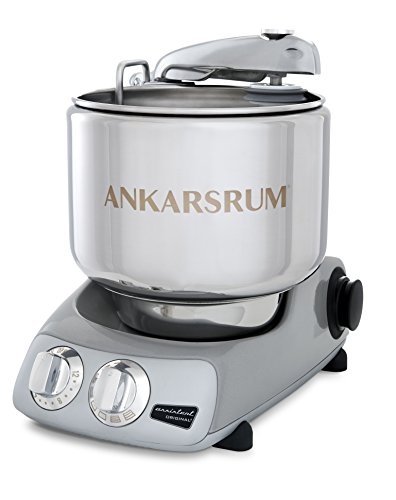
Ankarsrum Original Stand Mixer (AKM6230) — Best Overall for Bread
The Ankarsrum is the bread baker’s specialist instrument, built in Sweden around a principle no other pick here uses: the bowl rotates, and dough is worked between the bowl wall, a roller, and a scraper, folding and pressing rather than being hooked and torn. The motion mimics hand kneading more closely than any planetary hook, develops gluten with remarkably little dough heating, and handles both stiff lean doughs and large batches with a calm that has made this design a decades-long favorite of serious home bread bakers.
Strengths
- Dough-native kneading action develops gluten gently with minimal temperature rise — a real quality edge in bread
- Excels at both stiff lean doughs and the large batches that stall hook-driven rivals
- Open-bowl design makes adding flour gradually and watching dough development effortless
Trade-offs
- A learning curve: the roller-and-scraper method is unlike every other mixer, and the first loaves involve reading the manual
- Premium tier, priced like the specialist it is
- Verified listing is minimal; confirm the current configuration and included bowls on the listing before ordering
Key specs (from the verified listing)
- Model (verified listing): AKM6230, Jubilee Silver
- Design: rotating bowl with roller and scraper kneading system
Temperature is the invisible variable this machine wins on. Friction and motor heat pushed into dough during a long knead can push fermentation ahead of schedule and slacken structure; the Ankarsrum’s pressing-folding action works dough thoroughly while adding noticeably less heat, which bakers taste as better flavor development and see as more predictable proofing. For sourdough and slow-ferment bakers especially, that control is not a luxury — it is the recipe working as written.
Capacity honesty: this is the pick for bakers whose standard bake is two to four loaves, including whole-grain doughs that punish lesser drives. Hydration honesty matters too — very wet doughs need the hook alternative technique the manual describes, and very small single batches sit near its minimum comfortable load. Inside its wide envelope, it is the finest bread tool in this guide by a margin its owners tend to describe with unusual loyalty.
Best for: Serious bread bakers, sourdough and whole-grain bakers, and multi-loaf households / Not suited for: Bakers who want planetary-mixer familiarity and a vast attachment ecosystem on day one
Check on Amazon — check price on Amazon for the current configuration and color.
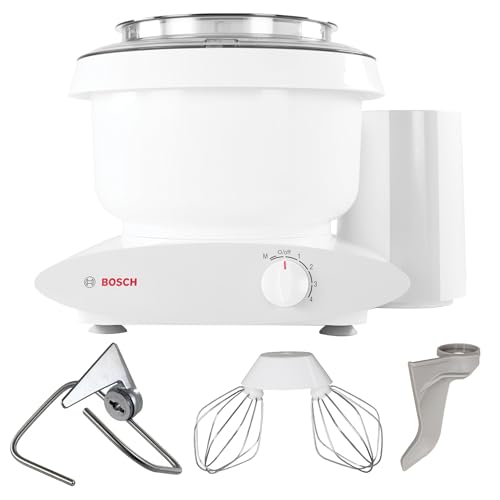
Bosch Universal Plus Stand Mixer (500 Watt, 6.5 Quart, Bundle) — Best for Big Batches and Whole Grains
The Bosch Universal Plus has been the whole-grain baker’s answer for generations, and its verified listing shows the working configuration: a 500-watt motor driving a 6.5-quart bowl from below, with wire whips and a dough hook in this bundle. Bottom drive gives the dough hook a direct, powerful path, and the open-top bowl accepts flour additions without the shower that head-obstructed designs cause. If your standard bake is a big batch of whole-wheat sandwich loaves, this is your machine.
Strengths
- Drive design famous for sustained whole-grain kneading at family-batch scale
- 6.5-quart open bowl takes gradual flour additions cleanly — a daily practical advantage
- Bundle includes whips and dough hook, covering bread and batter work in one purchase
Trade-offs
- Bowl and drive occupy a wide footprint; storage is a cupboard commitment
- Aesthetic is workshop rather than countertop jewelry, which matters to some kitchens
- Very small batches sit below its comfortable minimum; it is built for volume
Key specs (from the verified listing)
- Motor (verified listing): 500 watts
- Bowl (verified listing): 6.5 quarts
- Attachments (verified listing): wire whips, dough hook, NutriMill dough hook extender (bundle)
Whole-grain dough is the examination here: bran-rich flour drinks water slowly, develops gluten reluctantly, and punishes weak drives with heat and stall. The Bosch’s reputation rests on kneading exactly that dough, batch after batch, at volumes that make a family’s week of bread in one session. Bakers who mill or buy whole-grain flour in quantity will find this pick’s ceiling comfortably above their ambitions, which is the correct direction for a ceiling to be.
The open bowl deserves emphasis as a workflow feature: adding flour a cup at a time while the hook turns — the correct way to build a dough to feel — is natural here and awkward on tilt-head designs where the head shadows the bowl. Bread is a dough built by adjustments, and this machine is arranged around making them.
Best for: Whole-grain bakers and households baking several loaves in one session / Not suited for: Single-loaf bakers and minimalists, whose batches sit below its happy range
Check on Amazon — check price on Amazon for the current configuration and color.

KitchenAid 7 Quart Bowl-Lift Stand Mixer (KSM70) — Best Bowl-Lift for Enriched Doughs and Versatility
The KitchenAid KSM70 is the versatility pick among the heavy-duty set: a seven-quart bowl-lift — the stable, counter-planted format serious bakers prefer over tilt-heads — with eleven speeds including a half-speed for folding, and an accessory set led by a double flex-edge beater. For enriched doughs — brioche, challah, panettone-style holiday bakes — where butter incorporation and bowl scraping decide the result, that flex-edge beater and the low-speed control are worth more than raw kneading force.
Strengths
- Bowl-lift stability under dough loads, with capacity for multi-loaf batches
- Flex-edge beater scrapes as it mixes, a genuine advantage in enriched doughs and batters
- Eleven speeds with a true half-speed extend it from kneading to delicate folding in one machine
Trade-offs
- Planetary hook kneading is very good rather than dough-native; the Ankarsrum still leads on pure bread craft
- Large and heavy; it lives on the counter it is given
- Accessory ecosystem invites spending well beyond the mixer itself
Key specs (from the verified listing)
- Bowl (verified listing): 7 quarts, bowl-lift
- Speeds: 11, including 1/2 speed for folding
- Accessories (verified listing): Double Flex Edge Beater and 4 other accessories
Enriched dough technique is where this machine separates from the Bosch-and-Ankarsrum axis: butter worked into a developed dough in stages, the bowl kept clean by the flex edge so incorporation stays even, the low speeds holding the dough below the temperatures that melt butter out of the crumb. Holiday bakers and brioche regulars will recognize their exact requirements in that description, and they are this pick’s home ground.
It also carries the generalist’s insurance: when bread season pauses, the same machine anchors cakes, cookies, and the attachment ecosystem — pasta, grinding, and beyond — that no other pick here matches. Buyers choosing one flagship for a whole baking life, bread included rather than bread only, should land here with confidence.
Best for: Enriched-dough bakers and households wanting one flagship for bread and everything else / Not suited for: Pure lean-dough specialists, who will prefer the Ankarsrum’s kneading action
Check on Amazon — check price on Amazon for the current configuration and color.

Waring Luna 10-Quart Planetary Stand Mixer (WSM10L) — Best for Small Commercial Volumes
The Waring Luna steps out of the home category entirely: ten quarts of bowl-lift capacity, a three-quarter-horsepower motor, three working speeds, and a 99-minute digital timer, in a machine its listing addresses to professional bakeries and commercial kitchens. For the home baker who has become a cottage baker — selling at markets, supplying a cafe, feeding a very large household — this is the honest next step: dough in quantities the home flagships should not be asked to sustain, with a timer that suits production rhythms.
Strengths
- True ten-quart capacity for production-scale dough batches
- 3/4 HP motor class built for sustained commercial kneading duty
- Digital timer supports repeatable production schedules
Trade-offs
- Commercial scale and footprint; a home counter must be deliberately given to it
- Three speeds are working gears, not finesse; delicate non-bread work is not its brief
- Overkill — honestly, entirely — for a loaf-a-week household
Key specs (from the verified listing)
- Bowl (verified listing): 10 quarts, bowl-lift
- Motor (verified listing): 3/4 horsepower
- Speeds: 3; 99-minute digital timer; accessories included
Production changes the judging criteria: batch consistency across a morning, duty across a week, and serviceability across years matter more than any single loaf’s elegance. The Luna’s specification reads like it was written by people who run those mornings — capacity, horsepower, timer, bowl-lift stability — and cottage bakers graduating from a home flagship will feel the difference as headroom: doughs that maxed the old machine sit mid-range here.
The home buyer should hear the warning inside the praise: this machine’s minimum comfortable batch is many home bakers’ maximum. Buy it for the bakery you are actually building, with the counter and the volume to match, and it is the most capable kneader in this guide. Buy it aspirationally for Sunday loaves and it will spend its life under-kneaded and over-parked.
Best for: Cottage bakers, market bakers, and small commercial kitchens / Not suited for: Home bakers, however serious, whose batches fit the picks above
Check on Amazon — check price on Amazon for the current configuration and color.

KitchenAid Commercial 8-Quart Bowl-Lift Stand Mixer (KSM8990) — Best Certified Commercial Pick
The KSM8990’s distinction is in its verified listing’s first words: NSF Certified, Commercial Series. For bakeries, school and church kitchens, and any setting where equipment certification is a compliance question rather than a preference, that certification is the purchase. Beneath it sits an eight-quart bowl-lift KitchenAid built for commercial duty — the capacity to run serious dough batches inside a form factor and accessory world that KitchenAid-trained staff already understand.
Strengths
- NSF certification answers compliance requirements the home flagships cannot
- Eight-quart bowl-lift capacity suits sustained multi-loaf production
- KitchenAid commercial backing and familiarity ease training and service
Trade-offs
- Commercial pricing and priorities; home finesse features are not the brief
- Verified listing is concise; confirm included attachments and configuration on the listing
- Capacity exceeds any home need; buy it for the setting that requires it
Key specs (from the verified listing)
- Bowl (verified listing): 8 quarts, bowl-lift
- Certification (verified listing): NSF Certified, Commercial Series
- Model: KSM8990
Certification literacy matters in this tier: NSF listing speaks to sanitation design and materials standards that inspectors in commercial settings actually check. A home flagship, however powerful, does not carry it, and discovering that during an inspection is an expensive education. This pick exists so that the education is unnecessary — the compliance is in the listing, verifiable before purchase, which is this guide’s favorite kind of feature.
For dough work itself, expect the bowl-lift virtues at commercial scale: stability under load, repeatable planetary kneading, and batch sizes that serve a small bakery’s morning. Pair it with the production discipline the Waring pick describes — timers, schedules, batch records — and the two commercial options in this guide divide the work by ecosystem preference rather than by capability.
Best for: Commercial and institutional kitchens requiring certified equipment / Not suited for: Home bakers, who get more finesse per dollar from the KSM70 above
Check on Amazon — check price on Amazon for the current configuration and color.

Kitchen in the box Stand Mixer (8.5 Quart, 900 Watt) — Best Value Large Bowl — With an Honest Ceiling
This pick is included with its ceiling printed on the badge, because value in this category is real but must be read correctly. The listing promises an 8.5-quart bowl, a 900-watt heavy-dough brief, ten speeds, and a whisk, flat beater, and splash guard in a tilt-head design. Read the wattage as a headline figure in the way of its tier, and what remains is still meaningful: a genuinely large bowl and a full attachment set at the value end, suited to soft and medium doughs in generous batches and to the batter-and-cream work that surrounds bread in a real kitchen.
Strengths
- Largest bowl among the home picks here, at the value tier
- Full attachment set included: whisk, flat beater, splash guard
- Ten speeds give more working range than value rivals usually offer
Trade-offs
- Tilt-head format is less planted under stiff dough than the bowl-lifts above; expect more movement at the ceiling
- Headline wattage should not be read as sustained dough torque comparable to the Bosch or Ankarsrum
- Lean, stiff, full-bowl dough batches exceed its honest ceiling — work at partial capacity for bread
Key specs (from the verified listing)
- Bowl (verified listing): 8.5 quarts, with handle
- Power (verified listing): 900 watts headline rating
- Speeds: 10; tilt-head; whisk, flat beater, splash guard included
The correct ownership pattern: use the big bowl for what big bowls do best — double batches of enriched dough, rolls, pizza dough at moderate hydration, and all the batter work of a baking household — and keep lean bread doughs to partial-bowl batches where the drive stays composed. Judged inside that pattern, the value is undeniable: capacity and completeness that cost multiples more in the flagship tiers.
Buyers whose ambition is specifically lean, stiff, frequent bread should read this pick as the guide’s final act of honesty: save longer and buy the drive design your dough actually needs. Buyers whose bread life is softer, richer, and more varied can buy here happily — the ceiling is stated, the bowl is huge, and the kitchen will be busy.
Best for: Value buyers making enriched doughs, rolls, and big batter batches / Not suited for: Lean-dough specialists who need sustained torque at full capacity
Check on Amazon — check price on Amazon for the current configuration and color.
Comparison Table
| Pick | Badge | Key spec | Best for |
|---|---|---|---|
| Ankarsrum Original Stand Mixer (AKM6230) | Best Overall for Bread | Rotating-bowl design with roller and scraper kneading (model AKM6230) | Serious bread bakers, sourdough and whole-grain bakers, and multi-loaf households |
| Bosch Universal Plus Stand Mixer (500 Watt, 6.5 Quart, Bundle) | Best for Big Batches and Whole Grains | 500-watt motor; 6.5-quart bowl; dough hook and wire whips included (bundle) | Whole-grain bakers and households baking several loaves in one session |
| KitchenAid 7 Quart Bowl-Lift Stand Mixer (KSM70) | Best Bowl-Lift for Enriched Doughs and Versatility | 7-quart bowl-lift; 11 speeds including 1/2-speed fold; flex-edge beater included | Enriched-dough bakers and households wanting one flagship for bread and everything else |
| Waring Luna 10-Quart Planetary Stand Mixer (WSM10L) | Best for Small Commercial Volumes | 10-quart bowl-lift; 3/4 HP motor; 3 speeds; 99-minute digital timer | Cottage bakers, market bakers, and small commercial kitchens |
| KitchenAid Commercial 8-Quart Bowl-Lift Stand Mixer (KSM8990) | Best Certified Commercial Pick | 8-quart bowl-lift; NSF certified commercial series (KSM8990) | Commercial and institutional kitchens requiring certified equipment |
| Kitchen in the box Stand Mixer (8.5 Quart, 900 Watt) | Best Value Large Bowl — With an Honest Ceiling | 8.5-quart bowl; 900W headline rating; 10 speeds; tilt-head | Value buyers making enriched doughs, rolls, and big batter batches |
How to Choose the Best Heavy Duty Bread Mixer
Choose by drive philosophy first, because it determines the kneading itself. Rotating-bowl roller systems (Ankarsrum) press and fold dough with low heat and excel at lean and whole-grain craft. Bottom-drive units (Bosch) deliver direct power at volume with an open bowl that suits gradual flour work. Planetary bowl-lifts (KitchenAid, Waring) hook-knead with stability and bring ecosystems, finesse speeds, or commercial certification. There is no universal winner — there is a philosophy that matches your dough, your batch size, and your kitchen’s other demands.
Size by realistic flour load, not bowl volume. A bowl’s kneading capacity is set by the dough mass the drive can work without climbing, stalling, or overheating — always less than the bowl’s liquid volume, and the honest reviews above express it in loaves for that reason. Buy for your standard bake with headroom above it; a machine loafing at sixty percent of capacity outlives and out-kneads one straining at a hundred, every single week.
Finally, match the setting. Home flagships serve home bakers best; certification and production timers serve commercial settings in ways home machines cannot imitate; and value big-bowls serve varied baking households whose bread runs soft and enriched. The expensive mistake in this category is never the machine — it is the mismatch, and it is avoidable in one careful reading.
Why Hand Mixers Cannot Do This Job: A Necessary Word
The physics are unforgiving: kneading lean dough means sustaining torque against an elastic, resistant mass for many minutes. Hand mixers are built for intermittent, low-resistance work — batters, creams, brief incorporations — with motors and gearing sized accordingly, and their dough hooks are rated by their own makers for soft doughs in small amounts. A hand mixer forced through weekly bread duty overheats, wears its gears, and eventually fails, usually mid-recipe and always out of warranty’s sympathy.
This is not a sales argument for expensive machines; it is the reason this guide contains no hand mixers despite the search’s ambiguity. Soft enriched dough in a small batch is the hand mixer’s honest ceiling, and within that ceiling the picks in this series’ baking guide serve beautifully. For bread as a practice, the stand mixers above are not an upgrade — they are the correct tool category, and buying the correct category once is cheaper than buying the wrong one twice.
How to Knead Bread Dough in a Stand Mixer Without Overheating It
Even heavy duty machines reward correct dough technique. This sequence applies to every pick in this guide, with the Ankarsrum’s roller method following the same order at different hardware.
- Build the dough gradually. Combine most of the flour and all the liquid first, mix to a shaggy mass, and rest it twenty minutes (the autolyse) before kneading. The rest does gluten’s early work for free and shortens machine time.
- Add remaining flour in stages. Especially on open-bowl designs, add flour a portion at a time while the machine turns, judging by feel rather than emptying the bag on schedule. Dough consistency, not the recipe’s full flour weight, is the target.
- Knead at the dough speed only. Stand mixers knead at their low dough settings — typically the second speed on planetary machines. Higher speeds heat, tear, and walk the machine; they do not knead faster in any way that helps the loaf.
- Watch and test, do not just time. Check at intervals for the windowpane stage: a small piece stretched thin enough to pass light without tearing. Stop when the dough passes, even if the timer disagrees.
- Mind dough temperature. If the dough warms noticeably during a long knead, rest it briefly rather than pushing on. Warm dough proofs ahead of its flavor; the Ankarsrum’s gentle action helps here, but every machine benefits from the pause.
- Keep batches inside the machine’s loaf rating. Split a double batch rather than forcing it. Two calm kneads produce better gluten and a longer-lived mixer than one straining marathon.
Autolyse first, add flour by feel, knead low, test by windowpane, and respect capacity. Five habits, and even the value pick in this guide will turn out loaves that make the machine look expensive.
Flour, Hydration, and Batch Math: Sizing a Bread Mixer to Your Actual Loaves
Bread bakers think in flour weight, and translating a mixer’s loaf language into flour language prevents the classic oversizing error. A standard home loaf runs roughly a pound to a pound and a half of finished dough, built from a few hundred grams of flour; a two-loaf batch therefore asks a machine to knead a dough mass in the low kilograms, at hydrations that change its character completely. A stiff bagel-style dough at low hydration resists like clay; a wet focaccia-style dough at high hydration flows and slaps. The same machine that kneads the wet dough effortlessly can strain on half the weight of the stiff one, which is why this guide’s ceilings are expressed per dough style in the reviews rather than as a single heroic number.
Whole-grain flour shifts the math again: bran absorbs water slowly and cuts gluten strands as they form, so whole-grain doughs need longer, gentler work and reward the drives — the Ankarsrum’s pressing action, the Bosch’s sustained pull — that specialize in them. Enriched doughs shift it a third way: the flour load may be modest while the butter incorporation stage demands bowl-scraping and temperature discipline, which is the KitchenAid bowl-lift’s home ground. Size your purchase to the dough you bake monthly, not the dough you baked once for a holiday, and every pick in this guide will feel correctly chosen.
The final sizing rule is headroom direction: a machine working at sixty percent of its ceiling kneads cooler, quieter, and longer-lived than the same machine at its limit. If your standard batch lands exactly on a pick’s stated ceiling, buy the next pick up. Bread is a weekly practice measured in years; the correct machine is the one whose ceiling you rarely visit.
Maintaining a Heavy Duty Mixer: The Decade View
Heavy duty machines are bought for decades, and decades are a maintenance regime, not a hope. The daily layer is simple: wipe flour from vents and seals before it compacts, wash bowls and hooks promptly — dough dried on a hook is a chisel job — and never immerse or hose a motor housing, whatever the production kitchen’s habits suggest. The seasonal layer matters more: check that bowl-lift mechanisms still lock without play, that hooks and beaters show no coating loss where your machine uses coated tools, and that the machine still sits planted on all its feet, because a rocking mixer under dough load is a machine asking for attention.
Load discipline is the maintenance that happens during use. Knead at dough speed only, keep batches inside the loaf ceilings the reviews state, and treat unusual heat, smell, or sound as information to stop on rather than obstacles to push through. Dough will wait ten minutes while a motor cools; a burned drive will wait for a service appointment. Commercial users add the production layer: batch logs that reveal when a machine’s duty has crept beyond its class, which is the honest signal to step up to the certified, higher-capacity tier rather than to nurse a hero.
Keep the paperwork, too — model, serial, purchase channel — because machines in this class are serviced, not replaced, and service begins with identification. Owners who keep those habits routinely hand these mixers down, which is the category’s founding promise: buy the correct drive once, maintain it plainly, and let the loaves accumulate.
From First Loaf to Weekly Practice: Growing Into a Heavy Duty Mixer
The first month with a serious bread mixer has a shape worth anticipating. Week one is calibration: a familiar recipe, made by the machine’s method rather than your old one, watching how the dough behaves at dough speed and learning your drive’s signals — the sound of a comfortable knead, the look of a dough that is ready rather than merely mixed. Expect the first loaves to be good rather than great; the machine is not being broken in, you are. Week two is hydration: the same recipe adjusted by feel, flour added in stages as this guide’s how-to prescribes, and the discovery of how much cleaner dough development feels when the autolyse and the machine share the work.
By the second month the practice forms: a standard batch sized to your machine’s comfortable ceiling, a schedule that fits fermentation around a life, and the first experiments — whole grain folded into the repertoire, an enriched dough for an occasion — each chosen because the drive’s philosophy invites it. This is the stage where the purchase validates itself, not in any single loaf but in the repeatability: the same crumb, week after week, because the kneading variable has been retired. Bakers who bought the correct drive for their dough describe this stage with a particular calm. Bakers who bought against their dough describe a search for workarounds. The reviews above exist to put you in the first group, and the decade view in the maintenance section exists to keep you there.
Key Takeaways for Bread Mixer Buyers
Four sentences carry this guide. Bread kneading is sustained torque work, so drive design — roller-and-bowl, bottom drive, or planetary bowl-lift — matters more than any headline number, and each philosophy has a dough it serves best. Capacity must be read in loaves at your hydration and flour type, with headroom above your standard batch, because machines live longest and knead best below their ceilings. Hand mixers are not in this category at all: their hooks serve soft doughs, and bread as a practice requires the machines on this page. And setting decides the finalists — home craft, whole-grain volume, enriched versatility, or certified commercial production each crown a different pick here, correctly.
Choose the philosophy that matches your dough, size it above your standard bake, knead low with an autolyse and a windowpane test, and maintain the machine like the decade-long appliance it is. Do that, and the mixer stops being a purchase and becomes what it is in serious kitchens: the foundation the whole baking practice stands on.
Common Buying Mistakes
- Kneading on high speed to save time. It saves nothing: heat, tearing, and machine wear are the bill, and gluten development does not accelerate proportionally.
- Loading the bowl to its liquid volume with dough. Kneading capacity is a fraction of bowl volume. The reviews above speak in loaves precisely to prevent this mistake.
- Skipping the autolyse, then blaming the mixer. Twenty resting minutes outperform five extra kneading minutes, and cost the machine nothing.
- Buying a hand mixer for bread because it has hooks. Hooks indicate soft-dough capability, not bread capability. This guide’s second buying section exists because this mistake is so common.
- Ignoring certification in commercial settings. Power does not substitute for NSF listing where an inspector is involved. Buy the certified pick for the certified setting.
Final Recommendation
Buy the Ankarsrum (B07KQL5242) for bread as a craft — lean, whole-grain, sourdough, multi-loaf — and the Bosch (B0CJCKHQGK) for whole-grain volume with an open bowl. Buy the KitchenAid KSM70 (B0BRNWWGJ5) for enriched doughs and an all-purpose flagship life, the Waring Luna or the NSF-certified KitchenAid Commercial when the setting turns professional, and the Kitchen in the box 8.5QT when the budget leads and your doughs run soft and rich. Every ceiling above is stated in loaves; trust them.
Bread is the most demanding promise a mixer makes. Choose the drive that matches your dough, keep the batches honest, and the machine you buy this year is the machine your grandchildren’s bread will argue over.
Start your comparison with the top picks from this guide: Ankarsrum Original Stand Mixer (AKM6230), Bosch Universal Plus Stand Mixer (500 Watt, 6.5 Quart, Bundle), KitchenAid 7 Quart Bowl-Lift Stand Mixer (KSM70) — check price on Amazon for each before deciding.
Related guides in this series: Best Handheld Mixers For Baking; Best Hand Stand Mixers; Best Handheld Food Mixers; Best Hand Mixers Oster; Best Hand Mixers To Shred Chicken.
Frequently Asked Questions
What makes a mixer heavy duty enough for bread?
Sustained torque against a resistant, elastic load, delivered by a drive designed for dough, in a machine heavy and stable enough to stay planted through a ten-minute knead. Bowl-lift and bottom-drive designs, dough-native roller systems, and commercial planetary drives all qualify in this guide; the common thread is that kneading is their design center, not an advertised extra. Headline wattage alone does not qualify a machine — the reviews here judge drive design, realistic loaf capacity, and duty honesty, and express capacity in loaves because that is the unit that predicts your experience.
Can a hand mixer knead bread dough if it has dough hooks?
Not as a practice. Hand-mixer hooks are rated for soft, enriched doughs in small batches — rolls, brioche-style doughs — worked briefly. Lean bread dough demands sustained torque that overheats small motors and wears their gearing, and regular attempts end in a burned-out mixer, usually mid-recipe. This guide contains no hand mixers for that reason, despite the search’s ambiguity. If bread is occasional and soft, a hand mixer from the baking guide serves; if bread is weekly, a stand mixer from this guide is not an upgrade but the correct tool category.
How much dough can these mixers knead at once?
Less than the bowl’s volume suggests — kneading capacity is set by the dough mass the drive can work without climbing, stalling, or overheating. As a working pattern from the picks: the home flagships here (Ankarsrum, Bosch, KitchenAid 7 Quart) handle standard multi-loaf home batches comfortably, the commercial picks extend that to production volumes, and the value big-bowl pick should be worked at partial capacity for lean doughs. The reviews express each machine’s ceiling in loaves; splitting a batch is always better than forcing one, for both the gluten and the motor.
Ankarsrum, Bosch, or KitchenAid — which drive should I choose?
By dough and by kitchen. The Ankarsrum’s rotating bowl and roller knead with a gentle pressing-folding action, minimal dough heating, and excellence in lean and whole-grain craft — the specialist’s choice. The Bosch’s bottom drive delivers volume power with an open bowl that makes gradual flour addition natural — the whole-grain, big-batch choice. KitchenAid’s bowl-lift planetary design adds finesse speeds, a flex-edge beater for enriched doughs, and the largest accessory ecosystem — the flagship-for-everything choice. None is wrong; each is wrong for the other two’s bakers.
What speed should I knead dough at?
The mixer’s designated low dough speed — typically the second speed on planetary machines — and never high. Higher speeds do not knead proportionally faster; they heat the dough, tear gluten strands, walk the machine across the counter, and wear the drive. Build in an autolyse rest before kneading, add flour gradually, and judge doneness by the windowpane test — a small piece stretched thin enough to pass light without tearing — rather than by the clock. Correct speed plus correct endpoint beats any specification on the box.
Do I need an NSF-certified mixer for selling bread?
If you bake in a commercial or institutional setting subject to inspection — a licensed bakery, a school or church kitchen, many cottage-food operations depending on local rules — certification can be a compliance requirement, and the KitchenAid Commercial KSM8990 in this guide carries NSF certification stated in its verified listing. Home flagships, however powerful, do not carry it. Check your local requirements before equipping a selling operation; discovering a certification gap during an inspection is far more expensive than the price difference between the machines.


