Disclosure: airfryerkitchensupply.com is reader-supported. When you buy through links on our site, we may earn an affiliate commission at no extra cost to you.
Where to buy
If you are shopping for best handheld mixers for baking, Amazon is the most practical place to compare the current versions of the models in this guide, because hand and stand mixers are sold in several colors, bundle configurations, and model-year revisions that look nearly identical in photos. Every linked pick below was matched to a verified listing before this guide was written, and each one is presented with a live price check instead of a fixed number, because mixer pricing shifts with color, season, and seller.
Baking makes specific demands that listings blur, so each pick below was verified for the details bakers actually use: speed count, whether a whisk is in the box for egg whites, whether dough hooks are included for soft doughs, and how the beaters clean after butter-rich work. Colors and bundle variants change often; confirm the attachment list on the listing itself before ordering, because that list — not the photograph — is what arrives.
- Breville Handy Mixer (BHM800SIL) (Best Overall for Baking) — check price on Amazon
- KitchenAid 9 Speed Hand Mixer (KHM926) (Best for Serious Home Bakers) — check price on Amazon
- Cuisinart Power Advantage Plus 9-Speed Hand Mixer (HM-90S) (Best for Cakes and Batters) — check price on Amazon
- Hamilton Beach 6-Speed Electric Hand Mixer with Easy Clean Beaters (62636J) (Best Budget for Baking) — check price on Amazon
- KitchenAid 5 Ultra Power Speed Hand Mixer (KHM512) (Best for Small Batches) — check price on Amazon
- Cuisinart Power Advantage 5-Speed Hand Mixer (HM-50) (Best Simple Baker’s Second Mixer) — check price on Amazon
The best handheld mixers for baking are judged by a different scorecard than general food mixers, and this guide uses the baking scorecard without apology. Baking is a sequence of textures — butter creamed to a specific lightness, flour folded without deflating or dusting the kitchen, egg whites taken to exact peaks, a frosting held at the edge of stiffness — and a baking mixer lives or dies on its control at the transitions between those textures, not on its top speed or its wattage headline.
Three baking-specific qualities therefore dominate the picks. First, the low end: creaming and flour work happen at the bottom gears, and a mixer whose first speed is violent will cost you volume and cleanliness in every recipe. Second, the whisk: egg-white work with beaters is possible and slow, while a proper whisk attachment makes meringue a routine job instead of a project. Third, beater design and cleanup, because butter-rich mixtures punish fiddly beaters daily, not occasionally.
Six verified mixers follow, ranked for bakers: a premium control pick for the frequent baker, the nine-speed KitchenAid for the serious home bakery, the Cuisinart with its named gentle start for cake specialists, and honest budget and compact options whose limits are stated in baking terms — which doughs, which batch sizes, which techniques — rather than in vague warnings.
In this guide
Quick Picks
Frequent bakers should start with the Breville’s control or the KitchenAid 9 Speed’s complete kit. Cake and batter specialists get the calmest starts from the Cuisinart HM-90S. The Hamilton Beach Easy Clean kit is the budget baker’s complete answer, while the two five-speed models serve small batches and simple repertoires honestly.
- Breville Handy Mixer (BHM800SIL) — Best Overall for Baking: nine settings plus boost, sold explicitly for baking, with the precise control that creaming, folding, and peak work reward. Check on Amazon
- KitchenAid 9 Speed Hand Mixer (KHM926) — Best for Serious Home Bakers: the complete baker’s kit: nine speeds, a pro whisk for whites, dough hooks for soft doughs, and dishwasher-safe cleanup. Check on Amazon
- Cuisinart Power Advantage Plus 9-Speed Hand Mixer (HM-90S) — Best for Cakes and Batters: a named SmoothStart for flour-calm cake work — its listing even says cake mixer — with nine speeds and case storage. Check on Amazon
- Hamilton Beach 6-Speed Electric Hand Mixer with Easy Clean Beaters (62636J) — Best Budget for Baking: the budget baker’s complete kit: 275 watts, six speeds, beaters, dough hooks, and — crucially — a whisk, all in the box. Check on Amazon
- KitchenAid 5 Ultra Power Speed Hand Mixer (KHM512) — Best for Small Batches: five speeds and Turbo Beaters sized for the single-layer, six-cupcake, small-household baking most people actually do. Check on Amazon
- Cuisinart Power Advantage 5-Speed Hand Mixer (HM-50) — Best Simple Baker’s Second Mixer: five speeds, a 220-watt motor, and extra-long beaters that reach deep bowls — the simple, durable baker’s spare or starter. Check on Amazon
How These Picks Were Chosen
Verification matched every pick to its current listing, recording speeds, attachments, and named features from the listing titles before any baking judgment was made. A mixer could not be recommended for whisk work unless its listing confirmed a whisk in the box, nor for gentle starts unless either a named system or a demonstrably fine low-speed ladder supported the claim.
Baking criteria then ranked the verified set: low-speed spacing for creaming and folding; whisk provision and quality of the speed ladder’s top end for meringues; dough-hook provision, with the standing honesty rule that hand-mixer hooks serve soft, enriched doughs only; beater cleanup after butter; and storage, because baking tools multiply. General food performance was treated as a bonus, not the brief — the generalist judgments live in this series’ handheld food mixer guide, and this guide deliberately re-judges the same market through the baker’s narrower, deeper lens.
The 6 Best Handheld Mixers for Baking
Badges describe baking roles. Where a pick’s dough ceiling matters — and for bakers it always matters — the review states it in recipe terms: which doughs are fair work, and which belong to a stand mixer.

Breville Handy Mixer (BHM800SIL) — Best Overall for Baking
The Breville takes the baking crown because baking is a control sport and this is the control instrument: nine settings plus boost, in a mixer whose own listing names baking as its purpose and precise control as its promise. Creaming wants a confident mid-range held steadily; folding wants the bottom gears to be genuinely slow; meringue wants a top end with a final push available. A fine ladder plus a boost gear is the exact shape of those demands, and frequent bakers feel the difference in the first sponge they fold.
Strengths
- Finest speed ladder here, matched to baking’s texture transitions
- Boost serves the two moments baking needs it: finishing peaks and pushing a stiff frosting through
- Positioned and built for bakers; the control feel is the product
Trade-offs
- Premium tier; monthly bakers will not recoup it
- Verified listing is concise on attachments — confirm whisk and beater contents on the listing before ordering
- Control rewards attention; it is not a set-and-forget tool
Key specs (from the verified listing)
- Speeds: 9 settings plus boost (verified listing)
- Positioning (verified listing): hand mixer for baking, precise control
The sponge test explains the ranking. A genoise or chiffon asks you to fold flour and then beaten yolk mixture into whipped whites without surrendering the air you just built. That folding lives at the very bottom of the speed range, in seconds-long passes, and a mixer whose low gears are truly low lets a careful baker do it mechanically with better consistency than a spatula on an tired arm. This is the pick in the guide that makes that technique routine.
Boost discipline is the one skill to learn: boost is for mixtures already combined — the last lift of a meringue, the final body of a buttercream — never for incorporating dry ingredients, where it becomes a flour cannon. Used as directed by that rule, it replaces the second mixer many bakers keep for finishing work, and the premium begins to look like consolidation rather than indulgence.
Best for: Frequent bakers, sponge and meringue bakers, and anyone who bakes by texture / Not suited for: Occasional boxed-cake bakers, for whom the budget kit below is the rational buy
Check on Amazon — check price on Amazon for the current configuration and color.

KitchenAid 9 Speed Hand Mixer (KHM926) — Best for Serious Home Bakers
If the Breville is the instrument, the KHM926 is the workshop: nine speeds, a pro whisk that makes egg-white work first-class, dough hooks that handle brioche-style and roll doughs in small batches, and accessories that all go in the dishwasher after butter-heavy sessions. For the home baker whose repertoire spans layer cakes, pavlovas, frostings, and enriched doughs, this is the most complete verified hand-mixer kit in the guide, and completeness is a baking virtue because recipes do not announce their attachment needs in advance.
Strengths
- Pro whisk included — the single most valuable baking attachment after beaters
- Dough hooks extend the repertoire to soft, enriched doughs in small batches
- Nine-speed ladder plus dishwasher cleanup: capability without friction
Trade-offs
- Premium tier, justified only by a repertoire that uses the kit
- Hooks invite overreach; stiff bread dough remains stand-mixer work
- More attachments to store than beater-only models
Key specs (from the verified listing)
- Speeds: 9
- Attachments (verified listing): Pro whisk, Turbo Beater II beaters, dough hook
- Care: dishwasher-safe accessories
Meringue is where the whisk earns its shelf. Beaters whip whites adequately and slowly, trapping less air per pass; a whisk’s wire geometry is built for the job, reaching firm, glossy peaks faster and with less over-whipping risk near the end, because the mixture’s progress is easier to read. Pavlovas, Swiss buttercream, and angel cakes all live on that difference, and bakers who make them monthly should weight this pick accordingly.
The hooks deserve their honest paragraph: brioche, cinnamon-roll dough, and small pizza batches in a deep bowl, worked in passes with rests, are fair and satisfying work for this mixer. A lean, stiff sandwich dough is not, and forcing it teaches the same expensive lesson every hand mixer teaches. Respect the boundary and this kit covers a serious home bakery’s handheld needs outright.
Best for: Serious home bakers with a wide repertoire who want the complete kit / Not suited for: Narrow-repertoire bakers who need beaters and nothing else
Check on Amazon — check price on Amazon for the current configuration and color.

Cuisinart Power Advantage Plus 9-Speed Hand Mixer (HM-90S) — Best for Cakes and Batters
Cake baking is a flour-management exercise from the first addition to the last, and the HM-90S is the cake specialist: its verified listing names SmoothStart, the anti-splatter ramp that keeps flour in the bowl at every addition, and describes the machine, without embarrassment, as a cake mixer. Nine speeds then handle the cake repertoire’s full arc — creaming, combining, finishing frostings — and the snap-on case keeps the baker’s kit together between projects.
Strengths
- Named gentle start solves cake baking’s most frequent annoyance at every flour addition
- Nine speeds cover creaming through frosting with fine steps
- Case storage suits project bakers whose tools rest between bakes
Trade-offs
- White finish in a world of cocoa and food coloring; wipe promptly
- Case requires storage depth
- Whisk-dependent bakers should confirm their configuration’s contents on the listing
Key specs (from the verified listing)
- Speeds: 9
- Feature (verified listing): SmoothStart anti-splatter
- Storage: snap-on storage case included
Layer-cake consistency is a repetition game: the same batter, the same incorporation, pan after pan, week after week. A ramped start removes the one variable — the flour cloud and the compensating overmix — that makes home layer cakes mysteriously variable. Bakers chasing bakery-level repeatability in crumb will find this pick’s calm starts worth more than any headline specification in the guide.
Frosting finish is the second act: powdered sugar is flour’s escape-artist cousin, and the same gentle start that saves cake batter saves buttercream, letting you build sweetness and stiffness gradually instead of sealing the kitchen in sugar dust and then over-beating to recover. Cake specialists, this is your mixer; the badge is literal.
Best for: Layer-cake and frosting bakers who value repeatability and tidy starts / Not suited for: Whisk-first bakers whose repertoire leads with meringues
Check on Amazon — check price on Amazon for the current configuration and color.
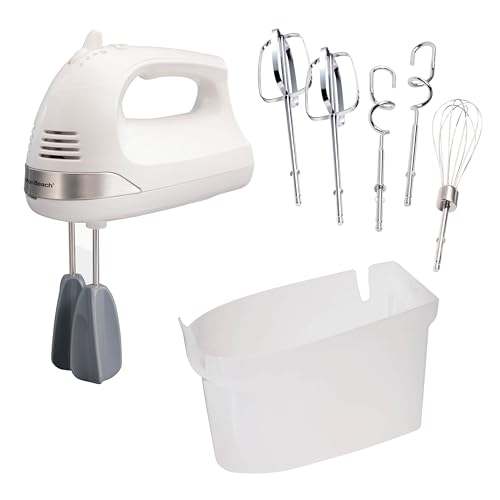
Hamilton Beach 6-Speed Electric Hand Mixer with Easy Clean Beaters (62636J) — Best Budget for Baking
Budget baking guides usually apologize for the whisk that is not in the box. This one does not have to: the 62636J includes beaters, dough hooks, and a whisk, driven by a stated 275-watt motor across six speeds, with easy-clean beaters and a storage case. That is the entire home-baking attachment brief at the budget tier, and it makes this the correct first mixer for a new baker who does not yet know which specialties will claim them.
Strengths
- Whisk included at the budget tier — meringue and cream work are in the repertoire from day one
- Easy-clean beaters rinse butter off fast, encouraging the frequent baking that builds skill
- 275-watt stated motor creams properly cold-ish butter better than weaker budget rivals
Trade-offs
- Six speeds space the folding gears coarsely; sponge work needs patience and staged additions
- Budget motor resents stiff dough; hooks are for soft doughs in small batches
- Fit and finish are utilitarian
Key specs (from the verified listing)
- Speeds: 6
- Motor (verified listing): 275 watts
- Attachments (verified listing): easy-clean beaters, dough hooks, whisk; snap-on case
Skill growth is this pick’s hidden feature. A new baker’s first year is cookies, brownies, banana bread, whipped cream, and a first layer cake — every one of which this kit performs without an asterisk — and by the time a recipe arrives that exposes the six-speed ladder’s coarseness, the baker knows exactly which premium pick above solves it and why. Buying in that order is how kitchens accumulate tools they understand instead of tools they were sold.
Creaming note for the budget tier: give butter a genuine room-temperature rest before creaming and this motor performs like a class above; ask it to cream refrigerator-cold butter and it will complain in the only language it has. That is not a flaw in the pick — it is the physics every pick in this guide obeys, priced honestly.
Best for: New and budget bakers wanting the complete attachment kit from the start / Not suited for: Sponge specialists and high-volume bakers who need fine low gears
Check on Amazon — check price on Amazon for the current configuration and color.

KitchenAid 5 Ultra Power Speed Hand Mixer (KHM512) — Best for Small Batches
Small-batch baking is real baking: the single-layer cake, the half-batch of cookies, the loaf of banana bread, the whipped cream for four. The KHM512 is sized for it — five speeds, efficient Turbo Beaters, dishwasher cleanup, and a compact body that lives in a drawer instead of a cupboard — and within that scale its performance is not a compromise at all, because small mixtures incorporate quickly and evenly under almost any competent beater.
Strengths
- Right-sized for the batches small households actually bake
- Turbo Beaters move small mixtures efficiently even at low speed, shortening fold time
- Minimal storage and cleanup footprint encourages frequent small bakes
Trade-offs
- Beaters only; meringue specialists need the whisk of the nine-speed sibling
- Double batches and stiff frostings strain its class
- Five speeds limit fine texture transitions in advanced work
Key specs (from the verified listing)
- Speeds: 5
- Attachments (verified listing): Turbo Beaters
- Care: dishwasher-safe beaters; lockable swivel cord
There is a freshness argument for small-batch tools: a household that bakes small bakes often, and frequent small bakes beat occasional productions for both skill and pleasure. This mixer’s whole design — grab, mix, dishwasher, drawer — is tuned to keep the friction of a Tuesday bake near zero, which is how baking becomes a habit rather than an event.
Know its ceiling and it will never disappoint: one standard cake, one standard cookie batch, creams and frostings at family scale. Beyond that ceiling, split the batch rather than forcing the tool; the second run takes two minutes and the mixer stays in the zone where it performs like a flagship.
Best for: Small households, new bakers, and frequent small-batch baking / Not suited for: Double-batch and celebration-scale bakers
Check on Amazon — check price on Amazon for the current configuration and color.
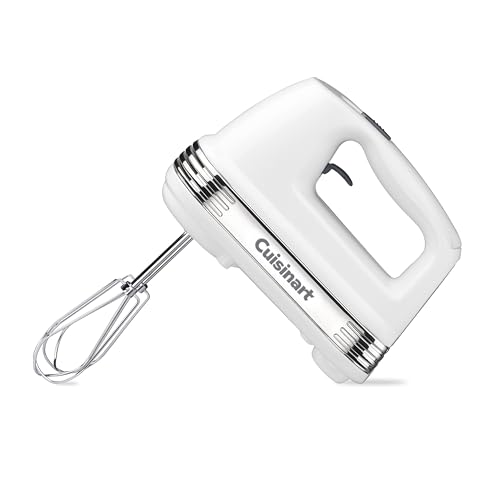
Cuisinart Power Advantage 5-Speed Hand Mixer (HM-50) — Best Simple Baker’s Second Mixer
Every serious baking household eventually wants a second mixer — for the simultaneous frosting, the holiday surge, the cabin, the college apartment — and the HM-50 is the correct shape of spare: five speeds, a stated 220-watt motor, extra-long beaters that reach the bottom of deep bowls, and nothing about it that needs explaining to whoever picks it up. As a primary mixer it serves simple repertoires faithfully; as a second, it is close to perfect.
Strengths
- Extra-long beaters suit deep bowls and larger simple batters
- Dead-simple controls make it the household’s most borrowable tool
- Dishwasher-safe beaters and a swivel cord keep it maintenance-free
Trade-offs
- Beaters only; no whisk or hooks for repertoire growth
- Five speeds are the coarse end of baking control
- White finish shows baking’s colorful evidence
Key specs (from the verified listing)
- Speeds: 5
- Motor (verified listing): 220 watts
- Beaters: extra-long, dishwasher-safe; 60-inch swivel cord
The deep-bowl point deserves its sentence in a baking guide: many home bakers mix in bowls deeper than standard beaters were designed for, leaving a stratum of unmixed batter at the bottom that becomes the cake’s dense stripe. Extra-long beaters close that gap without buying a stand mixer, which makes this humble pick the quiet fix for a specific, common baking fault.
Buy it as the spare, the starter, or the simple primary, and judge it on reliability across years of ordinary recipes. Baking history is mostly ordinary recipes made well, and the tools that make them well without fuss are the ones still in the drawer a decade later.
Best for: Second-mixer buyers, simple repertoires, and deep-bowl bakers / Not suited for: Repertoire builders who need a whisk and hooks in the box
Check on Amazon — check price on Amazon for the current configuration and color.
Comparison Table
| Pick | Badge | Key spec | Best for |
|---|---|---|---|
| Breville Handy Mixer (BHM800SIL) | Best Overall for Baking | 9 speed settings plus boost; positioned for baking with precise control | Frequent bakers, sponge and meringue bakers, and anyone who bakes by texture |
| KitchenAid 9 Speed Hand Mixer (KHM926) | Best for Serious Home Bakers | 9 speeds; Pro whisk and dough hooks included; dishwasher-safe accessories | Serious home bakers with a wide repertoire who want the complete kit |
| Cuisinart Power Advantage Plus 9-Speed Hand Mixer (HM-90S) | Best for Cakes and Batters | 9 speeds; SmoothStart anti-splatter; snap-on storage case | Layer-cake and frosting bakers who value repeatability and tidy starts |
| Hamilton Beach 6-Speed Electric Hand Mixer with Easy Clean Beaters (62636J) | Best Budget for Baking | 275-watt motor; 6 speeds; beaters, dough hooks, whisk included | New and budget bakers wanting the complete attachment kit from the start |
| KitchenAid 5 Ultra Power Speed Hand Mixer (KHM512) | Best for Small Batches | 5 speeds; Turbo Beaters; dishwasher-safe beaters | Small households, new bakers, and frequent small-batch baking |
| Cuisinart Power Advantage 5-Speed Hand Mixer (HM-50) | Best Simple Baker’s Second Mixer | 5 speeds; 220-watt motor; extra-long dishwasher-safe beaters | Second-mixer buyers, simple repertoires, and deep-bowl bakers |
How to Choose the Best Handheld Mixer for Baking
Score the low end first. Baking’s decisive moments — creaming butter to lightness without melting it, incorporating flour without dust or deflation, starting a frosting without a sugar storm — all live at the first three gears. A mixer with nine speeds is not automatically better, but a mixer whose first gear throws flour is worse for baking no matter what else it offers. Named gentle-start systems, fine ladders, and staged additions are the three routes to the same calm; the picks above cover all three at different tiers.
Score the whisk second. Egg whites are baking’s purest test of aeration, and the difference between beaters and a proper whisk is measured in minutes and in peak stability. If your repertoire includes meringues, sponges, chiffons, or Swiss buttercream more than a few times a year, a whisk in the box should be a hard requirement, not a hope — which in this guide means the KitchenAid nine-speed kit or the budget Hamilton Beach, whose inclusion of a whisk at its tier remains remarkable.
Score dough honesty third. Hand-mixer dough hooks are for soft, enriched, small-batch doughs — brioche, rolls, sweet doughs — worked in passes. Lean bread dough belongs to stand mixers, full stop, and this series’ heavy-duty bread guide exists for that purchase. A handheld bought with bread expectations will be a disappointment with a motor; bought with cake, cream, and soft-dough expectations, the picks here are capable of a decade of excellent service.
Speed Charts Lie: Reading a Mixer’s Baking Range
Listings advertise speed counts; bakers should read speed spacing. Two mixers with six speeds can behave entirely differently if one’s first gear is a crawl and the other’s is a leap. Since spacing is rarely published, use proxies: nine-speed models almost always space the low end more finely than five-speed models, named gentle-start systems guarantee at least the start itself, and boost functions tell you the top end has a reserve gear for finishing work.
Then verify in the return window with the three baking tests: flour incorporation over creamed butter at speed one (watch the rim), egg whites to peaks (time it, watch stability), and a buttercream from powdered sugar (count the towels). A mixer that passes your tests in your bowls is the right mixer, whatever any chart — including this guide’s preferences — suggested.
How to Cream, Fold, and Whip With a Handheld Mixer
Three techniques decide most baking outcomes, and each has a mixer-specific form. This sequence assumes any pick in this guide and a standard cake-and-cream repertoire.
- Creaming: room-temperature butter, mid speed, patience. Beat butter alone briefly, add sugar gradually, and hold a steady mid speed until the mixture pales and lightens. Rushing with high speed warms and melts; the crumb pays for it.
- Flour: lowest speed, staged additions, alternate with liquid. Add flour in thirds, alternating with the recipe’s liquid, beginning and ending with flour. Mix only until each addition disappears; the last traces finish by hand with a spatula.
- Folding beaten mixtures: lowest gear, seconds-long passes. For sponges and chiffons, use the mixer’s lowest speed in brief passes through the bowl, or fold by spatula if your mixer’s first gear is lively. Air is the ingredient; protect it.
- Egg whites: clean bowl, whisk if you have one, gradual speed. Start slow until foamy, raise steadily, and stop at the recipe’s peak stage — glossy and firm for most baking. Over-whipped whites turn grainy and fold badly.
- Frosting: start buried and slow. Beaters under the powdered sugar’s surface at the lowest speed until it wets into the butter, then rise to finishing speed. This order is the whole secret.
- Rest the motor on thick work. Stiff cookie dough and thick frostings get passes with brief pauses. A hand mixer worked in passes outlives one worked in marathons, and the dough cannot tell the difference.
Cream patiently, fold gently, whip attentively, and start everything dry buried and slow. Those four habits will make any pick in this guide bake above its tier.
Building a Baking Repertoire Around a Handheld Mixer
A handheld mixer’s repertoire has a natural curriculum, and following it in order is how bakers and tools grow together. The first term is creaming-based baking — cookies, brownies, butter cakes — where the skills are butter temperature, gradual sugar, and the stop-at-disappearance discipline with flour. Every pick in this guide graduates from this term, including the budget kit, which is why it is the correct place to start both a repertoire and a purchase. The second term adds aeration: whipped cream control, then egg whites to stages, then the sponges and chiffons that fold the two together. This is where whisk provision and low-speed finesse begin to separate the picks, and where the nine-speed models justify themselves in results rather than in specifications.
The third term is enrichment: frostings built to stiffness, buttercreams built on whites, and the soft doughs — brioche, rolls, sweet doughs — that hand-mixer hooks legitimately serve. Bakers who reach this term know their tool’s ceiling intimately, because they have touched it: the frosting that wanted one more gear of finesse, the dough batch that wanted splitting. That knowledge, not any review, is what should time the upgrade to a stand mixer or a premium handheld — and bakers who bought in the order this guide suggests arrive at that upgrade with a clear brief and a still-useful handheld for the jobs it does best.
Notice what the curriculum never includes: lean bread. That is not an omission but the map’s edge, marked honestly. The handheld repertoire is wide, deep, and capable of a decade of serious baking; it simply borders a country — bread — governed by different physics, and this series keeps a separate guide for that country’s equipment.
Butter, Sugar, Flour, Air: The Four Ingredients Every Baking Mixer Must Respect
Baking texts speak of ingredients; experienced bakers speak of states. Butter must be plastic — cool enough to hold air, warm enough to accept it — and the mixer’s role in creaming is to work it at a steady mid speed without melting it into oil, which is why friction-heavy high speeds betray the crumb. Sugar must dissolve progressively into that butter, added gradually so the crystals cut air pockets rather than overwhelming them. A mixer with a calm mid-range, held patiently, is the entire technology of the creamed base; everything else is commentary.
Flour must arrive without violence and leave without overwork — staged, low-speed, stopped at disappearance — because gluten development that a bread baker cultivates is precisely what a cake baker rations. Air, the fourth ingredient and the only invisible one, must be built deliberately in whites and creams and then defended through every subsequent fold. Read the picks in this guide against those four states and the badges translate themselves: control picks defend air, whisk picks build it, gentle-start picks protect flour work, and budget picks — honestly — ask the baker’s technique to carry more of each defense. All four states can be honored at every tier; the tiers differ only in how much of the honoring is the machine’s job.
Setting Up a Handheld Baking Station
Bakers who work happily with handheld mixers share a setup, and it is worth copying deliberately. The mixer lives with its attachments in one place — case, container, or dedicated drawer section — because a bake that begins with a scavenger hunt begins badly. Beside that home, the working kit assembles itself over a few bakes: two bowls in the sizes your recipes actually use, matched to your beaters’ reach; a spatula that scrapes your bowls’ exact curve; a scale, because weighed flour is consistent flour; and a small tray or sheet pan that corrals the session’s ingredients so the mixer never waits while you cross the kitchen mid-creaming.
Workflow completes the station. Ingredients measured before the mixer starts — the old mise en place — matters more with a handheld than with any other mixer type, because one of your hands is the stand. Butter comes out first to reach its plastic state; flour is weighed and staged in its additions; the cooling rack is placed before the oven is hot. None of this is equipment, and all of it is the difference between the same mixer feeling frantic in one kitchen and serene in another. Buy the pick that fits your repertoire, then build the station that fits the pick, and the combination will bake above its price for years.
The Handheld and the Stand: Knowing When to Graduate
Every serious handheld baker eventually asks whether a stand mixer is next, and the honest answer is a diagnosis rather than a date. Graduate when one of three signals repeats: your standard batches regularly exceed your handheld’s comfortable bowl work; your repertoire has moved to bread — which is not a graduation but a different category, covered in this series’ bread guide; or your hands and arms, rather than your recipes, are setting the limits on long creaming and whipping sessions. Any one signal, recurring, justifies the counter space. None of them present, a flagship handheld remains the correct flagship.
Graduation, when it comes, is not replacement. The stand takes the long, the large, and the dough; the handheld keeps the small, the quick, the in-the-pot and in-the-jug jobs it was always better at — which is why the bakers who own both rarely sell either. Buy the handheld in this guide that fits your repertoire now, without apology for its ceiling, and let the ceiling, when you finally touch it regularly, write the brief for whatever stands on your counter next.
Until that day, remember that the handheld repertoire — cakes, cookies, creams, sponges, frostings, soft doughs — is not a preliminary version of baking. It is most of baking, practiced by most bakers, in most kitchens, with tools exactly like these. The guide’s picks were chosen to honor that repertoire at full seriousness, and in disciplined hands they will.
One More Test Before You Decide: The Three-Bake Weekend
Finalists in this category deserve a working audition, and three bakes in one weekend provide it: a creamed butter cake for the low gears and flour discipline, a pavlova or meringue-topped pie for the whisk and the top end, and a batch of stiff frosting for sustained mid-range composure. Judge the trio by crumb, by peak, and by how the counter looks afterward — the three outputs this entire guide has been predicting from listings and ladders. A mixer that passes all three in your bowls, with your ingredients, has nothing left to prove, and the return window can close behind it with confidence.
Key Takeaways for Baking Buyers
Baking is a control sport, and the scorecard is short enough to memorize: a calm bottom of the speed range for creaming and flour, a whisk in the box if whites are in your repertoire, beaters that release butter into hot water without a fight, and dough expectations set at soft and small. Every pick in this guide was placed on that scorecard, and the badges are simply its results read aloud — control for the Breville, completeness for the KitchenAid kit, calm starts for the Cuisinart, honest value for the Hamilton Beach, and right-sizing for the two five-speed models.
Technique then multiplies whichever tool you chose: room-temperature butter at a patient mid speed, flour staged at the lowest gear and stopped at disappearance, whites built gradually and defended through the fold, frostings started buried and slow. A budget mixer in disciplined hands out-bakes a flagship in careless ones, every week of the year. Choose the pick whose ceiling clears your repertoire, practice the four habits until they are reflexes, and let the oven take the credit.
Common Buying Mistakes
- Buying top speed instead of low-speed control. Baking is won at the bottom gears. A violent first speed costs flour, volume, and cleanliness in every recipe.
- Skipping the whisk and attempting a meringue repertoire with beaters. Possible, slow, and discouraging. If whites matter, buy the whisk in the box.
- Kneading bread dough because hooks were included. Hooks mean soft doughs, small batches. Bread belongs to the heavy-duty guide in this series.
- Creaming cold butter at high speed. The mixture warms unevenly and the crumb suffers. Room temperature and mid speed are the technique; no mixer overrides them.
- Overmixing after flour. The most common crumb fault in home baking. Mix to disappearance, finish by hand, and let the oven do the rest.
Final Recommendation
Buy the Breville (B00XBOXUWC) if you bake frequently and by feel; buy the KitchenAid 9 Speed (B00CPSRE4U) if you want the complete verified kit with whisk and hooks; buy the Cuisinart HM-90S if cakes and frostings are your repertoire and calm starts your priority. The Hamilton Beach kit is the budget baker’s correct start, and the two five-speed models serve small batches and second-mixer duties without a wasted dollar.
Baking rewards the cook who chooses control over headlines. Every pick here was verified, badged for a real baking role, and given its honest ceiling — choose the one whose ceiling sits above your repertoire, and bake.
Start your comparison with the top picks from this guide: Breville Handy Mixer (BHM800SIL), KitchenAid 9 Speed Hand Mixer (KHM926), Cuisinart Power Advantage Plus 9-Speed Hand Mixer (HM-90S) — check price on Amazon for each before deciding.
Related guides in this series: Best Handheld Food Mixers; Best Hand Mixers With Slow Start; Best Hand Mixers Oster; Best Heavy Duty Bread Mixers; Best Hand Mixers To Shred Chicken.
Frequently Asked Questions
What makes a hand mixer good for baking specifically?
Control at the bottom of the speed range, a whisk for egg-white work, and beaters that clean easily after butter. Baking’s decisive moments — creaming butter to lightness, incorporating flour without dust or deflation, starting frosting without a sugar cloud — all happen at low speeds, so a fine ladder or a named gentle-start system matters more than top speed. The whisk matters because meringues, sponges, and buttercreams built on whites are core baking, and beaters do that work slowly. This guide ranks its picks on exactly those baking criteria rather than general power.
Do I need nine speeds for baking, or are five enough?
Five speeds are enough for a simple repertoire — single cakes, cookies, brownies, whipped cream — provided the first gear is reasonably calm and you add flour in stages. Nine speeds earn their price when your baking includes texture transitions: folding sponges, building meringues, finishing buttercreams, and creaming with precision. The steps between gears are smaller, so you can hold a mixture at an in-between consistency that a five-speed jumps past. Match the ladder to the repertoire, not to ambition alone; unused finesse is just cost.
Can I knead bread dough with a handheld mixer’s dough hooks?
Soft, enriched doughs in small batches, yes — brioche, cinnamon-roll dough, dinner rolls, small pizza batches, worked in passes with rests. Lean, stiff bread dough, no: it overheats and wears out any hand mixer motor when attempted regularly, whatever the hooks suggest. Hooks indicate a soft-dough capability, not a bread capability. If bread is a weekly practice, the correct purchase is a stand mixer from this series’ heavy duty bread guide; forcing a handheld into that role is the most expensive mistake in home baking.
Why do my cakes come out with a dense stripe at the bottom?
Usually unmixed batter at the bowl’s bottom — standard beaters in a deep bowl leave a stratum untouched, which bakes into a dense layer. Three fixes: scrape the bowl’s bottom deliberately at each addition stage; choose a bowl matched to your beater length; or use a mixer with extra-long beaters, like the Cuisinart HM-50 in this guide, designed to reach deep bowls. The stripe is a geometry problem, not a recipe problem, and it disappears the week the geometry is fixed.
How do I stop flour and powdered sugar from flying everywhere?
Combine three habits and, if you bake often, one feature. The habits: beaters submerged in the mixture before switching on; dry ingredients added in two or three stages at the lowest speed; and speed raised one gear at a time only after each addition is wetted. The feature is a named gentle-start system, like the SmoothStart in the Cuisinart HM-90S’s verified listing, which ramps the beaters up automatically. Habits alone get most bakers most of the way; the feature makes the result consistent even when your hands are busy.
What is the best first hand mixer for a new baker?
The Hamilton Beach Easy Clean kit in this guide, because it is the only budget pick whose box contains the whole baking brief: beaters, dough hooks, and a whisk, with a stated 275-watt motor and easy-clean cleanup. A new baker’s first year — cookies, brownies, banana bread, whipped cream, a first layer cake — is fully covered without a second purchase, and by the time a recipe exposes its six-speed ladder’s limits, the baker knows exactly which premium pick solves the problem and why. That is how a kitchen accumulates tools it understands.


