Disclosure: airfryerkitchensupply.com is reader-supported. When you buy through links on our site, we may earn an affiliate commission at no extra cost to you.
Where to buy
If you are shopping for best hand mixers with slow start, Amazon is the most practical place to compare the current versions of the models in this guide, because hand and stand mixers are sold in several colors, bundle configurations, and model-year revisions that look nearly identical in photos. Every linked pick below was matched to a verified listing before this guide was written, and each one is presented with a live price check instead of a fixed number, because mixer pricing shifts with color, season, and seller.
Slow start goes by several names in listings — SmoothStart, soft start, slow start, gentle start — and many mixers that start gently never name the feature at all. That is why this guide separates two things carefully: the one pick whose verified listing explicitly names its anti-splatter slow-start system, and the remaining picks, which earn their places through genuinely slow first gears and fine low-speed ladders rather than a named feature. Badges below say exactly which is which, so you never pay for a feature claim the listing itself does not make.
- Cuisinart Power Advantage Plus 9-Speed Hand Mixer (HM-90S) (Best Verified Slow Start — SmoothStart Named in Listing) — check price on Amazon
- KitchenAid 9 Speed Hand Mixer (KHM926) (Best Manual Slow Start — Finest Low-Speed Ladder) — check price on Amazon
- Breville Handy Mixer (BHM800SIL) (Best Premium Low-Speed Control) — check price on Amazon
- Hamilton Beach 6-Speed Electric Hand Mixer with Easy Clean Beaters (62636J) (Best Budget Low-Speed Control) — check price on Amazon
- Cuisinart Power Advantage 5-Speed Hand Mixer (HM-50) (Best Simple Low-Speed Starter) — check price on Amazon
- KitchenAid 5 Ultra Power Speed Hand Mixer (KHM512) (Best Compact Calm Starter) — check price on Amazon
The best hand mixers with slow start solve the oldest hand-mixer problem there is: the first second. A conventional mixer jumps straight to its set speed the instant you switch it on, and if the beaters are sitting in flour, cocoa, or powdered sugar, that jump becomes a dust cloud that coats the counter, the cook, and the top of the batter — which then mixes unevenly because part of the flour is no longer in the bowl. A slow-start mixer ramps its speed up gradually over the first moments, so dry ingredients get wetted and drawn in before real speed arrives.
Shoppers should know the honest state of the category before spending anything. Named slow-start systems are rare in hand mixers: among the current models verified for this guide, exactly one hand mixer’s listing explicitly names its anti-splatter slow-start feature. Other excellent mixers achieve a similar result through a different route — a first gear that is genuinely, unusually slow, and a fine ladder of low speeds that lets you walk the mixture up by hand. Both approaches work. They are not the same mechanism, and this guide refuses to blur them.
So the picks below are ranked by real-world splatter behavior: the verified named-feature model first, then the mixers whose low-end gearing makes manual slow starts easiest, from premium nine-speed control down to a simple five-speed whose first gear is calm enough for careful bakers. The buying-guide section explains how to test any mixer’s start behavior in your own kitchen during the return window, which is the only test that finally matters.
In this guide
Quick Picks
If you want the named feature, verified in its own listing, the Cuisinart HM-90S is the pick. If you want the finest manual low-speed control, step to the KitchenAid 9 Speed or the Breville. Budget and simplicity are covered by the two Hamilton Beach and five-speed KitchenAid options, each badged honestly for low-speed control rather than a named slow-start system.
- Cuisinart Power Advantage Plus 9-Speed Hand Mixer (HM-90S) — Best Verified Slow Start — SmoothStart Named in Listing: the only hand mixer here whose verified listing names its slow-start system — SmoothStart anti-splatter — plus nine speeds and a storage case. Check on Amazon
- KitchenAid 9 Speed Hand Mixer (KHM926) — Best Manual Slow Start — Finest Low-Speed Ladder: no named slow-start system in its listing — instead, nine speeds whose bottom gears are slow enough to walk any mixture up by hand. Check on Amazon
- Breville Handy Mixer (BHM800SIL) — Best Premium Low-Speed Control: nine settings plus boost, with precise control as the listing’s own promise — the premium route to deliberate, gentle starts. Check on Amazon
- Hamilton Beach 6-Speed Electric Hand Mixer with Easy Clean Beaters (62636J) — Best Budget Low-Speed Control: a 275-watt six-speed whose easy-clean beaters and full attachment kit make careful low-speed starts practical at a budget price tier. Check on Amazon
- Cuisinart Power Advantage 5-Speed Hand Mixer (HM-50) — Best Simple Low-Speed Starter: five speeds, extra-long beaters that stay buried in deep bowls, and a swivel cord — simplicity that helps careful starts. Check on Amazon
- KitchenAid 5 Ultra Power Speed Hand Mixer (KHM512) — Best Compact Calm Starter: five speeds and Turbo Beaters in a compact body whose first gear suits unhurried, tidy starts in small batches. Check on Amazon
How These Picks Were Chosen
Verification came first, as in every guide in this series: each pick was matched to a current Amazon listing, with model numbers and listing-stated features recorded before writing. That process is what allows the central honesty distinction in this guide — a feature is described as a slow-start system only where the verified listing itself names it, as Cuisinart’s listing does with SmoothStart. Where a listing does not name the feature, the review says so and judges the mixer on its observable low-speed gearing instead.
Performance criteria followed: fineness of the low-speed ladder, because walking a mixture up three gentle steps beats one jump; calmness of the first gear under load in flour; and the usefulness of the rest of the mixer — attachments, cleanup, storage — because slow start is a feature of a mixer you must otherwise live with daily, not a standalone gadget.
Models whose listings promised vague gentleness without either a named system or a reputation for fine low gearing were excluded rather than padded in. Six picks that can each be defended in a real kitchen beat a longer list built on adjectives.
The 6 Best Hand Mixers With Slow Start
Only the first pick carries a slow-start badge, because only the first pick’s verified listing names the system. Every other badge in this section describes low-speed control — the manual route to the same tidy result — and each review states plainly how that mixer achieves its gentle starts.

Cuisinart Power Advantage Plus 9-Speed Hand Mixer (HM-90S) — Best Verified Slow Start — SmoothStart Named in Listing
This is the pick the keyword is actually about. The HM-90S listing names SmoothStart, Cuisinart’s anti-splatter system that eases the beaters up to the selected speed instead of snapping to it. In a bowl of flour that difference is total: the first seconds wet and gather the dry ingredients at a crawl, and by the time the mixer reaches working speed there is nothing loose left to throw. If you have ever wiped flour off a cookbook, this is the feature you were wishing for.
Strengths
- Named SmoothStart system in the verified listing — the genuine article, not an implication
- Nine speeds mean the ramp lands on a fine ladder, so delicate work stays delicate after the start
- Snap-on storage case keeps the whole kit together between bakes
Trade-offs
- Premium-mid tier; you are paying for the electronics and the case, not just a motor
- White finish advertises every splash the system fails to prevent
- The ramp adds a beat of patience to every start, which impatient cooks notice at first
Key specs (from the verified listing)
- Speeds: 9
- Feature (verified listing): SmoothStart anti-splatter
- Storage: snap-on storage case included
The practical effect compounds across a recipe. Cake batters start clean, frostings built on powdered sugar stop being a two-towel operation, and cocoa-heavy mixtures — the worst offenders, because cocoa is light and hydrophobic — stay in the bowl. Bakers who pre-mix flour by hand out of habit can retire the habit, which quietly speeds up every recipe and removes the lumpy pre-mix step that causes its own problems.
One honest qualification: SmoothStart governs the start, not the whole technique. Adding a full cup of flour at once to a running mixer at speed six will still redecorate the kitchen. Pair the system with staged additions and the result is the tidiest hand mixing in this guide; treat it as a license to skip technique and it will politely decline to save you.
Best for: Bakers who start in dry ingredients daily and want the named, verified feature / Not suited for: Shoppers who start carefully anyway and would rather spend the difference on attachments
Check on Amazon — check price on Amazon for the current configuration and color.

KitchenAid 9 Speed Hand Mixer (KHM926) — Best Manual Slow Start — Finest Low-Speed Ladder
The KHM926 takes the manual route and takes it seriously. Its verified listing does not name a slow-start system, so this guide does not claim one. What it offers instead is the finest low-speed ladder among the picks: nine speeds whose lowest settings turn slowly enough that you can start in flour, watch it incorporate, and step up one gear at a time. Experienced bakers often prefer this to an automatic ramp, because the pace is theirs.
Strengths
- Nine-speed ladder gives the most gradual manual walk-up in this guide
- Pro whisk and dough hooks make it the most complete mixer here once the start is handled
- Dishwasher-safe accessories keep the whole routine low-effort
Trade-offs
- No named slow-start electronics; the gentle start is your technique, every time
- Premium tier pricing
- Nine speeds reward attention; set-and-forget cooks will use three of them
Key specs (from the verified listing)
- Speeds: 9
- Attachments (verified listing): Pro whisk, Turbo Beater II beaters, dough hook
- Care: dishwasher-safe accessories
The manual method, done well: beaters in the mixture before power, speed one until the surface is uniformly wet, speed two to gather, then working speed. With this mixer’s spacing, each step is small enough that nothing escapes. The method transfers to any mixer you will ever own, which is the quiet argument for learning it here rather than depending on a chip.
Where the automatic pick wins is consistency for beginners and for cooks whose hands are busy — holding a bowl, scraping, steadying a child helper. Where this pick wins is ceiling: the same ladder that starts flour gently also folds, whips, and finishes with a precision the ramp models match only at their best. Choose by which cook you are.
Best for: Experienced bakers who want maximum low-speed control and a complete attachment set / Not suited for: Beginners who want the mixer itself to guarantee a tidy start
Check on Amazon — check price on Amazon for the current configuration and color.

Breville Handy Mixer (BHM800SIL) — Best Premium Low-Speed Control
Breville positions this mixer on control — its verified listing promises nine speed settings plus boost for precise control — and precise control is exactly what a manual slow start consumes. The bottom settings let you begin at a crawl in dry ingredients, and the boost stays in reserve for the opposite moment, when a mixture is fully combined and needs a brief push. No slow-start system is named in the listing, and none is claimed here.
Strengths
- Fine nine-setting ladder for deliberate walk-up starts
- Boost is genuinely useful after incorporation, for meringues and thick batters
- Premium control feel for bakers who mix by texture rather than by number
Trade-offs
- Highest tier in this guide, for control rather than for a named feature
- Verified listing is concise; confirm attachments in the box on the listing before ordering
- Boost discipline required — boost in loose flour defeats the entire purpose
Key specs (from the verified listing)
- Speeds: 9 settings plus boost (verified listing)
- Positioning: premium tier, precision control
Think of this pick as the connoisseur’s answer to the same problem. Where the Cuisinart automates the first seconds, the Breville gives you instrumentation: enough settings, closely enough spaced, that a practiced hand produces ramp-like starts on demand and can also hold a mixture at an exact in-between consistency that fixed-gear mixers skip past. If you bake by feel, that granularity is the product.
It is also the pick most likely to be wasted on the wrong buyer, and this guide will say so: monthly boxed-cake bakers will not perceive the difference they paid for. Weekly bakers working with cocoa, alternative flours, and powdered sugar — the three great escape artists — will perceive it in the first session, in the form of a clean counter.
Best for: Frequent bakers who mix by feel and want the finest manual control / Not suited for: Feature shoppers who specifically want an automatic named slow-start system
Check on Amazon — check price on Amazon for the current configuration and color.
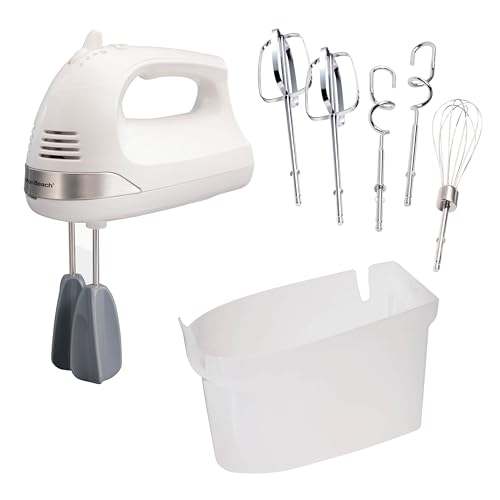
Hamilton Beach 6-Speed Electric Hand Mixer with Easy Clean Beaters (62636J) — Best Budget Low-Speed Control
Budget mixers and gentle starts are not natural partners — cheap gearing tends to lurch — so this pick earns its place on behavior you can manage: a six-speed whose lowest gear, paired with staged flour additions, keeps bowls tidy, and whose easy-clean beaters make the inevitable small escapes painless to wash off. Its listing names no slow-start system, and the review claims none; what it offers is a workable manual start at the lowest tier in this guide, plus a 275-watt motor and a full kit.
Strengths
- Strongest stated motor in the budget tier, so low speeds pull instead of stalling
- Easy-clean beaters forgive the small splashes that budget gearing allows
- Whisk, dough hooks, and case included — nothing else to buy to start baking properly
Trade-offs
- Lowest gear is livelier than the nine-speed models; technique matters more here
- Six speeds mean bigger steps when walking a mixture up
- Budget fit and finish
Key specs (from the verified listing)
- Speeds: 6
- Motor (verified listing): 275 watts
- Attachments (verified listing): easy-clean beaters, dough hooks, whisk; snap-on case
The budget slow-start technique is worth stating because it works with this mixer: chill nothing, rush nothing, and add flour in three additions at speed one with the beaters buried. The motor’s headroom matters here in an unexpected way — an underpowered mixer at its lowest gear bogs and then surges when it breaks free, which is its own splatter mechanism. Headroom keeps speed one actually slow.
If your baking is occasional and your counters are washable, this is the rational spend in this guide: most of the tidy-start benefit, all of the everyday mixing ability, and money left for ingredients. Upgrade later only if you find yourself baking weekly and cursing the gear spacing — a problem many owners never have.
Best for: Budget buyers willing to use staged additions and speed one with discipline / Not suited for: Bakers who want the start handled automatically with zero technique
Check on Amazon — check price on Amazon for the current configuration and color.
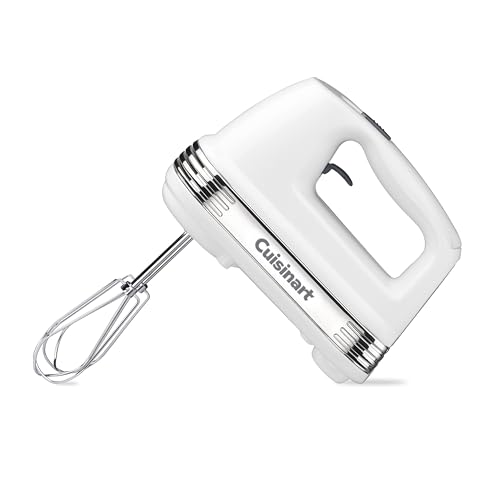
Cuisinart Power Advantage 5-Speed Hand Mixer (HM-50) — Best Simple Low-Speed Starter
The HM-50’s contribution to tidy starts is geometric rather than electronic: extra-long beaters stay submerged in deep bowls where shorter beaters ride near the surface and throw mixture. Combined with five honest speeds and a 220-watt motor, it suits the cook who starts carefully as a matter of habit and wants a simple, durable tool that rewards the habit. No slow-start system is named in its listing, and none is claimed.
Strengths
- Extra-long beaters stay buried, which is half the splatter battle in deep bowls
- Dead-simple five-speed control; nothing to misconfigure
- Swivel cord and dishwasher-safe beaters keep the whole routine easy
Trade-offs
- Five speeds mean the walk-up has fewer, larger steps
- Beaters only; no whisk or hooks in the box
- Not the tool for very thick mixtures at any speed
Key specs (from the verified listing)
- Speeds: 5
- Motor (verified listing): 220 watts
- Beaters: extra-long, dishwasher-safe; 60-inch swivel cord
Bowl pairing is this mixer’s secret: use it in the deep bowls its beaters were designed for and its starts are calm; use it in a shallow, wide bowl and any mixer would struggle. That is a useful general lesson this guide is happy to teach through a budget-friendly example — splatter is a system of mixer, bowl, speed, and additions, and the cheapest component to fix is usually the bowl.
As a second mixer — the one that lives at a cabin, a rental, or a parent’s house for holiday baking — this is close to ideal: simple, verified, inexpensive to replace, and entirely adequate for the cakes and creams those kitchens produce. Slow-start purists will look up the list; practical cooks will recognize a fit.
Best for: Careful starters, deep-bowl users, and anyone equipping a second kitchen / Not suited for: Bakers who want a named automatic system or a fine speed ladder
Check on Amazon — check price on Amazon for the current configuration and color.

KitchenAid 5 Ultra Power Speed Hand Mixer (KHM512) — Best Compact Calm Starter
Small batches forgive many things, and the KHM512 is the compact pick for them: five speeds, Turbo Beaters that move mixture efficiently even at the lowest gear, and a lockable swivel cord that stays clear while you work in smaller bowls. Its listing names no slow-start system; its case rests on a first gear that behaves in small quantities of flour, where there is simply less material available to escape.
Strengths
- Efficient beater design keeps low-speed incorporation quick, shortening the risky window
- Compact, light body suits small batches and small kitchens
- Dishwasher-safe beaters and easy-release button keep cleanup trivial
Trade-offs
- Small-batch tool; large flour quantities overwhelm any compact mixer
- Beaters only in the box
- Five-speed ladder is the coarsest here alongside the other five-speed pick
Key specs (from the verified listing)
- Speeds: 5
- Attachments (verified listing): Turbo Beaters
- Cord: lockable swivel; easy-release beater button
There is a scale truth in this category: a single-layer cake’s worth of flour in a medium bowl is a gentle problem, and almost any decent mixer’s first gear handles it; a triple batch of frosting is a violent one. This pick is honest about living at the gentle end. Within it, starts are calm, incorporation is fast because the beaters are efficient, and the whole experience feels like the category working as intended.
Buy it as the compact specialist it is — the apartment mixer, the small-household mixer, the replacement for a dead simple mixer — and the slow-start question mostly answers itself. Ask it to anchor a high-volume baking habit and you will be back in this guide reading about nine speeds, which is a fine journey, just an expensive order to take it in.
Best for: Small households and small batches where starts are naturally gentle / Not suited for: Large-batch bakers who need ramp electronics or a fine ladder
Check on Amazon — check price on Amazon for the current configuration and color.
Comparison Table
| Pick | Badge | Key spec | Best for |
|---|---|---|---|
| Cuisinart Power Advantage Plus 9-Speed Hand Mixer (HM-90S) | Best Verified Slow Start — SmoothStart Named in Listing | SmoothStart anti-splatter (named in verified listing); 9 speeds | Bakers who start in dry ingredients daily and want the named, verified feature |
| KitchenAid 9 Speed Hand Mixer (KHM926) | Best Manual Slow Start — Finest Low-Speed Ladder | 9 speeds with fine low-end spacing; whisk and dough hooks included | Experienced bakers who want maximum low-speed control and a complete attachment set |
| Breville Handy Mixer (BHM800SIL) | Best Premium Low-Speed Control | 9 speed settings plus boost; precise control positioning | Frequent bakers who mix by feel and want the finest manual control |
| Hamilton Beach 6-Speed Electric Hand Mixer with Easy Clean Beaters (62636J) | Best Budget Low-Speed Control | 6 speeds; 275-watt motor; beaters, dough hooks, whisk, and case included | Budget buyers willing to use staged additions and speed one with discipline |
| Cuisinart Power Advantage 5-Speed Hand Mixer (HM-50) | Best Simple Low-Speed Starter | 5 speeds; 220-watt motor; extra-long dishwasher-safe beaters | Careful starters, deep-bowl users, and anyone equipping a second kitchen |
| KitchenAid 5 Ultra Power Speed Hand Mixer (KHM512) | Best Compact Calm Starter | 5 speeds; Turbo Beaters; lockable swivel cord | Small households and small batches where starts are naturally gentle |
How to Choose the Best Hand Mixer With Slow Start
Decide first whether you want the mechanism or the outcome. The mechanism — a named ramp system like the SmoothStart in the first pick’s verified listing — guarantees a gentle start regardless of who is holding the mixer, which matters in teaching kitchens, busy households, and for bakers with limited hand strength who cannot finesse a trigger. The outcome — no flour on the counter — can also be reached with a fine low-speed ladder and three habits: beaters submerged before power, staged dry additions, and one gear at a time.
Then interrogate listings the way this guide does. If a listing names its system, you are buying a feature. If it does not, you are buying gearing and hoping; sometimes, as with the nine-speed picks here, the gearing is genuinely excellent and the hope is well placed. What you should never buy is an unnamed implication in a headline written by a third-party seller. Model number, named feature, named seller: the same verification triangle used throughout this series.
Finally, test in your own kitchen during the return window, because bowls differ. Put a cup of flour over a creamed base, start the mixer the way you actually bake, and watch the rim of the bowl. A mixer that keeps that test clean in your deepest bowl has passed the only slow-start examination that counts.
Slow Start, Soft Start, SmoothStart: What the Names Mean
The vocabulary is marketing’s, not engineering’s, so translate by behavior rather than by label. All three phrases describe the same intent: the beaters should not reach full selected speed instantly. Implementations differ — some ramp electronically over a second or two, some simply gear the first speed very low and let the user act as the ramp — and the honest way to compare them is the flour test, not the thesaurus.
Stand mixers, for comparison, adopted named smooth-start systems earlier and more widely, which is why shoppers sometimes assume every modern hand mixer has one. Most do not. That gap between assumption and reality is exactly why this search exists, and why this guide insists on naming which pick actually carries the feature in its verified listing.
How to Start Any Hand Mixer Slowly: The Flour Test and the Walk-Up Method
Whether your mixer has a named system or not, this method produces slow starts on any model in this guide — and the flour test at the end tells you, in one bake, whether your mixer’s start behavior suits your kitchen.
- Bury the beaters before power. Beaters start inside the mixture, touching the bottom of the bowl. Starting in air and plunging in is a splatter generator on every mixer ever made.
- Use the lowest gear for the first ten seconds. Let the dry surface wet down and darken before touching the speed control. On ramp models, let the system finish its ramp at a low selected speed rather than pre-selecting a high one.
- Add dry ingredients in two or three stages. Each addition gets its own low-speed incorporation. This is the single highest-value habit in all of hand mixing.
- Walk up one gear at a time. Spend a few seconds at each step. The mixture should look uniformly wet before speed rises, every time.
- Scrape once, deliberately. Stop, scrape the bowl wall and bottom, then resume. One planned stop beats continuous frantic scraping against moving beaters.
- Run the flour test once. With a new mixer, deliberately start a flour-over-butter mixture and observe. Clean rim: your system works. Dusty rim: add one more staged addition and one more gear step before blaming the machine.
A named slow-start system makes steps one through four nearly automatic; the walk-up method makes them available to everyone else. Either way, the counter stays clean — which was the point of the keyword all along.
The Physics of the Flour Cloud, and Why the First Second Decides Everything
A flour cloud is not random misbehavior; it is physics with a timetable. Dry flour sits loosely, full of air, with almost no cohesion. Beaters arriving at speed displace air violently, and the lightest particles — flour, cocoa, powdered sugar, in ascending order of enthusiasm — ride that air out of the bowl. Once the surface is wetted, cohesion rises dramatically and the same speeds become safe. The entire battle is therefore fought in the first seconds, before wetting, which is why slow start as a feature and the walk-up as a technique both concentrate their whole effect there.
Bowl geometry wages the same battle from the other side. A deep, narrow bowl contains the displaced air’s escape route; a wide, shallow bowl offers the cloud a broad launching surface. This is why identical mixers earn opposite reputations in different kitchens, and why this guide keeps returning to the pairing of tool and vessel. If your starts are messy, the cheapest experiment in all of baking is a deeper bowl — cheaper than any feature, and effective on every mixer ever manufactured.
Ingredient order is the third combatant. Flour added onto liquid wets faster than flour added onto fat alone; alternating flour with the recipe’s liquid, beginning and ending with flour, is standard cake method partly because it keeps the dry surface small at every moment. Slow start does not replace that method — it forgives deviations from it. Bakers who combine feature, geometry, and order bake in kitchens that stay clean, and they tend to credit whichever of the three they bought most recently.
What to Do When Your Mixer Has No Slow Start and Never Will
Most hand mixers in most kitchens have no named system, and their owners bake cleanly every week — proof that technique closes most of the gap. Beyond the walk-up method in this guide’s how-to section, three field tricks deserve permanent residence in your routine. First, the towel drape: a clean kitchen towel laid over the bowl’s rim and the mixer’s body for the first seconds of a powdered-sugar start contains the one ingredient that defeats even good systems. Remove it once the surface wets. Second, the pulse start: brief taps of power, letting the beaters stop between taps, wets a dry surface in installments no continuous low gear can match for gentleness.
Third, the pre-wet: for frostings, work a spoonful of the liquid into the powdered sugar by hand before the mixer ever arrives, converting the surface from powder to paste. Thirty seconds with a spatula removes the hazard entirely, and professional bakers do this without thinking. None of these tricks requires a purchase, which is precisely why a buying guide should teach them: the honest measure of advice is whether it still helps when you buy nothing.
If, after a month of technique, your counters still wear flour, then the feature has earned its price in your kitchen specifically — and the Cuisinart at the top of this guide is the verified way to buy it. That sequence, technique first and purchase second, is the order this series recommends in every category, and slow start is simply its clearest illustration.
Slow Start in the Wild: Three Recipes That Grade Your Mixer
Some recipes are gentle-start examinations in disguise, and baking them once teaches more than any specification. The first is a chocolate cake built on cocoa: cocoa is the most escape-prone dry ingredient in the pantry, light and water-resistant, and a mixer that incorporates it without a brown halo on the counter has passed the hardest start test in home baking. The second is a Swiss buttercream’s powdered-sugar stage — a large mass of the finest powder in the kitchen, added to a small mass of butter — where the difference between a ramped start and a lurch is measured in how much of the kitchen needs wiping afterward.
The third examination is quieter: a spice cake or gingerbread where flour arrives together with cocoa-dark spices that stain. Here the cost of a bad start is not just mess but evidence — turmeric and cinnamon announce themselves on a white mixer body and a pale countertop for days. Bakers of dark, spiced, cocoa-rich repertoires should weight gentle starts more heavily than bakers of vanilla sponges, for the simple reason that their ingredients keep score visibly.
Run these three bakes during any new mixer’s return window, with your own bowls and your own habits, and you will know — not believe, know — whether its start behavior suits your kitchen. That is the standard this guide applied in print, through verified listings and stated features, and it is the standard your countertop will apply in fact.
A Note on Triggers, Dials, and Buttons: How Start Controls Differ
Slow-start behavior is delivered through three different control designs, and the design shapes the experience beyond the first second. Dial-controlled mixers select a speed before power, which pairs naturally with ramp systems: choose low, switch on, and the machine walks itself up — the Cuisinart pattern in this guide. Trigger- and button-controlled mixers put the ramp in the finger, rewarding the walk-up technique and punishing haste in equal measure. Slide controls sit between, easy to nudge one step at a time with a thumb while the other hand steadies the bowl.
None is objectively best, but the match to the cook matters: bakers who work with occupied hands — one holding the bowl, one scraping — should prefer dial-plus-ramp designs that need no mid-start attention, while bakers who mix by feel gravitate to triggers they can feather. If you shop in a store, hold the control the way you would mid-recipe, with your other hand miming a bowl. The right design announces itself in that pantomime more honestly than any feature list.
Key Takeaways on Slow Start
Three facts organize this entire category. First, named slow-start systems are rare in hand mixers, and in this verified guide exactly one pick — the Cuisinart HM-90S, with SmoothStart in its own listing — carries the feature as a promise rather than an implication. Second, the outcome the feature produces, a clean counter and an evenly incorporated batter, is also reachable through fine low-speed ladders plus the walk-up technique, and the KitchenAid and Breville picks exist for buyers who prefer to be the mechanism. Third, no system or technique survives the three classic violations: beaters started in air, flour dumped at once, and a high speed pre-selected before a dry start.
Decide which kind of buyer you are — feature buyer or technique buyer — and the shortlist writes itself. Then run the flour test in your own deepest bowl during the return window, because that test, and not any listing’s vocabulary, is the final authority on whether your starts are slow enough for your kitchen.
Common Buying Mistakes
- Assuming every modern mixer has slow start. Most hand mixers do not name or include the feature; verify it in the listing, as this guide does, or do not pay for it.
- Pre-selecting a high speed and trusting the ramp. A ramp to speed eight is still a fast arrival. Select low, let it start, then walk up.
- Starting beaters in the air. No electronics forgive this. Submerge first, always.
- Dumping all the flour at once. Staged additions matter more than any feature name; the best system plus a full-cup dump still makes weather.
- Testing gentleness with water. Thin liquids behave nothing like flour. Test with the ingredient that actually escapes: dry, light, and unwilling — flour or cocoa.
Final Recommendation
Buy the Cuisinart HM-90S (B0034A8C4O) if you want slow start as a verified, named feature — it is the one pick in this guide whose own listing promises it, and it pairs the system with nine speeds and proper storage. Buy the KitchenAid 9 Speed or the Breville if you prefer to be the ramp yourself, with the finest low-speed ladders available. The Hamilton Beach and the five-speed models cover careful starters at friendlier tiers, honestly badged for control rather than for a feature they do not claim.
That honesty is the guide’s real recommendation: in this category, the difference between a feature and an adjective is worth money, and you should only spend it on the feature.
Start your comparison with the top picks from this guide: Cuisinart Power Advantage Plus 9-Speed Hand Mixer (HM-90S), KitchenAid 9 Speed Hand Mixer (KHM926), Breville Handy Mixer (BHM800SIL) — check price on Amazon for each before deciding.
Related guides in this series: Best Hand Mixers Oster; Best Handheld Mixers For Baking; Best Hand Mixers To Shred Chicken; Best Handheld Food Mixers; Best Hand Stand Mixers.
Frequently Asked Questions
What is slow start on a hand mixer?
Slow start — also sold as soft start, SmoothStart, or gentle start — means the beaters ramp up to the selected speed gradually over the first moments instead of jumping to it instantly. The purpose is splatter control: dry ingredients like flour, cocoa, and powdered sugar get wetted and drawn into the mixture during the gentle first seconds, instead of being thrown out of the bowl by an instant full-speed start. It is an electronic behavior, distinct from simply having a slow first gear, though a fine low-speed ladder achieves a similar result manually.
Which hand mixer in this guide actually has a named slow-start system?
The Cuisinart Power Advantage Plus 9-Speed (HM-90S). Its verified listing explicitly names SmoothStart, Cuisinart’s anti-splatter feature, so this guide badges it as the verified slow-start pick. The other picks — KitchenAid, Breville, and Hamilton Beach models — do not name a slow-start system in their verified listings, so they are badged honestly for low-speed control instead: their fine ladders and calm first gears let you produce gentle starts by technique. Any guide that blurs that distinction is asking you to pay for adjectives.
Does slow start eliminate splatter completely?
No, and any claim that it does should be distrusted. A ramped start removes the worst moment — the instant jump in loose dry ingredients — but dumping a full cup of flour into a running mixer at a high selected speed will still throw mixture. Pair the feature with the habits in this guide’s how-to section: beaters submerged before power, dry ingredients added in stages, speed selected low and walked up. Feature plus technique is completely tidy; either one alone is merely better than nothing.
Can I get slow-start results from a mixer without the feature?
Yes, with the walk-up method: start with the beaters buried in the mixture at the lowest speed, let the surface wet down for several seconds, add dry ingredients in two or three stages at that speed, then raise the speed one gear at a time. Mixers with nine speeds make this easiest because their steps are smallest. The method transfers to any mixer you will ever own, which is its advantage over a chip; the chip’s advantage is that it works even when your attention or your hands are elsewhere.
Is slow start the same as a low first speed?
Related, but not identical. A low first speed is a gearing property — the slowest the beaters can turn. Slow start is a behavior at switch-on — how quickly the beaters reach whatever speed is selected. A mixer can have a genuinely slow first gear and still lurch reaching it, and a ramped mixer can still have a first gear too fast for delicate folding. The tidiest starts come from models that offer both, which is why this guide evaluates the two properties separately for every pick.
Do stand mixers have slow start too?
Yes — named smooth-start systems are actually more common on stand mixers, where several verified listings in this series state the feature explicitly, including SMEG’s Smooth Start models. That history is partly why shoppers assume every modern hand mixer has the feature; most do not. If gentle starts matter across all your mixing and you are choosing between categories anyway, a stand mixer with a named system plus a basic hand mixer is a legitimate combination — but for hand mixers specifically, verify the feature in the listing, as this guide does, before paying for it.


