Disclosure: airfryerkitchensupply.com is reader-supported. When you buy through links on our site, we may earn an affiliate commission at no extra cost to you.
Where to buy
All six mixers in this guide to the best hand mixers kitchen appliances are sold on Amazon, and Amazon suits appliance buying well: configurations, colours and included attachments are stated plainly on each listing, and small appliances are easy to return if a variant is not what you expected. Use the links below to reach the exact verified models reviewed here. Appliance prices move with colour and season, so check the current price on Amazon on the listing itself rather than trusting figures in older roundups.
- KitchenAid 9-Speed Hand Mixer (KHM926, Contour Silver) — Best Overall Appliance: Check the current price on Amazon
- Cuisinart Power Advantage Plus 9-Speed Hand Mixer (HM-90S) — Best Storage-Smart Appliance: Check the current price on Amazon
- Hamilton Beach 6-Speed Electric Hand Mixer (62682G, White) — Best Budget Appliance: Check the current price on Amazon
- Breville Handy Mixer (BHM800SIL, Silver) — Best Premium Appliance: Check the current price on Amazon
- CHIDOYII Cordless Hand Mixer — Best Cordless Convenience: Check the current price on Amazon
- Hamilton Beach Classic Stand and Hand Mixer (Black/Stainless) — Best Hybrid Appliance: Check the current price on Amazon
Introduction
Searching for the best hand mixers kitchen appliances usually means one of two things: you are fitting out a kitchen and deciding which appliances earn a place in it, or you already own the big appliances and want the small one that quietly does the most work. Either way, the hand mixer deserves a more serious hearing than it usually gets. Of all the appliances in a typical kitchen, it is among the cheapest to buy, the smallest to store, the fastest to clean — and it handles a startling share of the mixing work that recipes actually demand.
Consider the division of labour honestly. The stand mixer owns heavy dough and huge batches but lives on the counter and costs a serious appliance budget. The food processor chops, slices and makes pastry but is clumsy at batters and hopeless at whipped cream. The blender owns liquids and ice. The hand mixer owns everything in between: cake batters, frostings, cookie dough, whipped cream, egg whites, mashed potatoes, dips and dressings — mixed in any bowl, in the pot, in the serving dish, then rinsed and back in a drawer in under a minute. In most kitchens it is used more often than all three bigger appliances combined.
This guide ranks the six best hand mixers to anchor that role, verified against Amazon’s catalogue connection. The picks span the appliance spectrum deliberately: a complete premium all-rounder, a full-kit model with storage solved, a budget appliance that outperforms its tier, a control-focused premium option, a cordless model for kitchens short on sockets, and a hybrid that bridges toward stand mixer territory. Each review places the mixer in the wider appliance lineup — what it replaces, what it complements, and what it should never be asked to do.
If you are equipping a first kitchen, read the guide sections before the reviews: they map the whole small-appliance landscape, explain where a hand mixer sits in a sensible buying order, and will stop you spending stand mixer money on hand mixer problems — or hand mixer money on a stand mixer problem.
In this guide
Quick Picks
Six verified hand mixers graded as kitchen appliances: versatility, storage footprint, cleanup and how each fits alongside the bigger machines.
- KitchenAid KHM926 — Best Overall Appliance: The complete mixing appliance: nine speeds, beaters, Pro whisk and dough hook covering nearly every mixing job a kitchen generates. Check price on Amazon
- Cuisinart HM-90S — Best Storage-Smart Appliance: A snap-on case keeps mixer and attachments as one stored unit — the appliance that never loses its own parts. Check price on Amazon
- Hamilton Beach 62682G — Best Budget Appliance: The appliance every kitchen should own before it owns almost anything else: 250 watts, six speeds, a case and a Bowl Rest at a budget tier. Check price on Amazon
- Breville Handy Mixer — Best Premium Appliance: Nine settings plus boost in a control-focused design — the connoisseur’s appliance for kitchens that mix constantly. Check price on Amazon
- CHIDOYII Cordless — Best Cordless Convenience: A rechargeable cordless mixer with three speed modes and two whisk attachments — eggs, drinks and light batters anywhere, no socket required. Check price on Amazon
- Hamilton Beach Classic 2-in-1 — Best Hybrid Appliance: A stand mixer and hand mixer in one appliance: 4-quart bowl, six speeds, 290 watts peak — the bridge for kitchens between categories. Check price on Amazon
How These Picks Were Chosen
Verification came first, as in every guide in this programme: each model was confirmed, so speed counts, motors and attachments match live listings. Judging then used appliance criteria rather than purely baking criteria. Versatility across the mixing workload came first, followed by storage footprint and cleanup speed — the two qualities that decide whether a small appliance gets used weekly or gathers dust — then build and motor adequacy for a multi-year service life, and finally how honestly the model fits its tier.
The set was composed to represent the real choices a kitchen buyer faces: premium versus budget, corded versus cordless, pure hand mixer versus hybrid. Models excluded: mini whisks that cannot do a mixer’s job, unverifiable listings, and any appliance whose kitchen role duplicated a stronger pick without adding a distinct reason to exist. The result is less a league table than a lineup — most kitchens will find their answer by role, and the reviews are written to make that role obvious.
The 6 Best Hand Mixers in the Kitchen Appliance Lineup

KitchenAid 9-Speed Hand Mixer (KHM926, Contour Silver) — Best Overall Appliance
As an appliance purchase, the KitchenAid KHM926 makes the strongest case for the hand mixer as a category: one drawer-sized tool that covers creaming, batter, folding, whipping and soft dough — the overwhelming majority of mixing a home kitchen produces. The nine speeds give it the manners for delicate work, the Pro whisk gives it the finishing tools, and the dough hook extends it into soft doughs that would otherwise argue for a stand mixer. Many kitchens that buy this mixer find their stand mixer ambitions quietly postponed for years.
Its appliance virtues are the daily ones: attachments in the dishwasher, a swivel cord that behaves, a body that stores in a standard drawer, and enough build to feel like a decade purchase rather than a seasonal one. In a fitted kitchen where every appliance must justify its footprint, the ratio of jobs done to space taken is close to unbeatable.
The premium positioning is the honest cost, and kitchens that mix monthly will not recoup it in usefulness. But as the single best answer to the question this search asks — which hand mixer should anchor a kitchen’s mixing — it is the recommendation this guide leads with.
The KHM926’s appliance longevity has a practical anchor: attachment ecosystems. A mixer whose beaters, whisks and hooks are standard, replaceable parts of a long-running model family can be maintained rather than replaced, and that maintainability is what separates an appliance from a gadget over a decade. When a beater eventually bends — someone will eventually drop one — the kitchen that can replace the part keeps the appliance.
Strengths
- Covers nearly the entire mixing workload alone
- Complete kit: beaters, Pro whisk, dough hook
- Drawer storage with dishwasher-safe attachments
Trade-offs
- Premium positioning among hand mixers
- Does not replace a stand mixer for heavy dough
- Occasional mixers will not exploit its range
Key specs (verified):
- Speeds: 9
- Attachments: Stainless Steel Turbo Beater II beaters, Pro whisk, dough hook
- Accessories: Dishwasher-safe attachments
Best for: kitchens equipping once, properly, for all mixing / Not suited for: kitchens that mix rarely and prioritise lowest spend

Cuisinart Power Advantage Plus 9-Speed Hand Mixer (HM-90S) — Best Storage-Smart Appliance
Appliance ownership has a hidden failure mode: the tool survives but its attachments scatter, until the appliance is effectively broken. The Cuisinart HM-90S is designed against that failure. Its snap-on storage case clips the attachments to the mixer as a single stored unit, so the appliance that goes into the cupboard is the complete appliance that comes out — a design decision worth more over five years of kitchen life than most spec-sheet features.
The appliance itself backs the concept up: nine speeds with an anti-splatter SmoothStart that keeps dry ingredients in the bowl, a range covering batters through whipped cream, and the composed manners of a mid-to-premium kitchen tool. In small kitchens and rental kitchens — where storage is improvised and parts genuinely vanish — it is arguably the most practical premium pick in this guide.
The case adds a little bulk, and the ramped start adds a moment to each job. Neither matters against the central proposition: this is the hand mixer most likely to still be complete, working and reachable in five years, which is what buying an appliance is actually for.
The HM-90S illustrates an appliance principle worth generalising: design for the failure you can predict. Attachments scatter, cords fray at entry points, and budget motors fade — the predictable failures. Cuisinart engineered against the first with the case; shoppers can engineer against the rest by choosing established models with replaceable parts and by storing cords loosely, as this guide’s care section describes. Appliance buying is failure management conducted in advance.
Strengths
- Snap-on case keeps the whole appliance together
- SmoothStart prevents splatter across all mixing jobs
- Nine speeds cover the full household range
Trade-offs
- Case adds storage bulk
- Deliberate ramp-up on every start
- Premium-leaning positioning
Key specs (verified):
- Speeds: 9
- Start: SmoothStart anti-splatter start
- Storage: Snap-on storage case
Best for: small kitchens and anyone who loses attachments / Not suited for: kitchens with generous dedicated appliance storage

Hamilton Beach 6-Speed Electric Hand Mixer (62682G, White) — Best Budget Appliance
If this guide were a buying order for a new kitchen, the Hamilton Beach 62682G would be near the top of the whole list — not just the mixer list. For a budget-tier outlay it delivers a 250-watt motor, six speeds plus QuickBurst, a snap-on storage case and a Bowl Rest, and it competently performs the great majority of mixing jobs a household generates: batters, frostings, potatoes, whipped finishes, boxed everything. Few appliances at any tier return so much work per unit of money and space.
Its appliance character is pure workhorse: traditional beaters that shrug off weekly use, a case that keeps it assembled, a rest that keeps it out of the mess. First kitchens, student kitchens, second homes and holiday lets are its natural habitats, but plenty of fully equipped kitchens keep one as the daily driver while grander appliances wait for weekends.
Refinement is where the tier shows — coarser speed steps, beaters that hold more mixture, a utilitarian feel. As an appliance decision, none of that outweighs the value equation. This is the mixer to buy first and upgrade only when your cooking tells you precisely why.
The 62682G is the appliance this guide would send to a rental property, a first flat or a family holiday home without hesitation — contexts where the user is unknown, the workload is real and the replacement budget is nobody’s priority. Tools that survive unknown users are a category of quality that spec sheets never capture, and this one’s combination of simplicity, strength and a case that keeps it whole is exactly that category.
Strengths
- Outstanding work-per-cost as a kitchen appliance
- 250-watt motor covers the household workload
- Case and Bowl Rest suit daily-driver duty
Trade-offs
- Coarser speed control than premium appliances
- Traditional beaters retain more mixture
- Utilitarian finish
Key specs (verified):
- Speeds: 6 plus QuickBurst
- Motor: 250 watts
- Attachments: Traditional beaters
- Storage: Snap-on storage case
- Rest: Bowl Rest feature
Best for: first kitchens and value-first buyers / Not suited for: cooks seeking premium control and finish

Breville Handy Mixer (BHM800SIL, Silver) — Best Premium Appliance
Every appliance category has a connoisseur tier, and the Breville Handy Mixer occupies it for hand mixers. Its nine settings plus boost are engineered around precise control, and the whole appliance feels designed by people who mix daily: speed changes are deliberate, the low end is genuinely gentle, and the top end finishes whipped work crisply. In a serious kitchen it reads less like a gadget and more like an instrument.
That positioning makes sense in context: a kitchen already equipped with good knives, a good oven and a good processor has a gap exactly this shape — a mixing instrument for the daily batters, creams and frostings that the big appliances handle clumsily. The Breville fills it at a standard the rest of the kitchen recognises.
The premium is real, and kitchens still building their basics will get more total value from the budget pick plus another appliance entirely. This is the mixer to buy when the kitchen is otherwise complete and mixing is the remaining craft to equip properly.
Breville’s premium appliance makes its final case on time. Daily mixers do not experience their appliances in features but in minutes — minutes saved by control that does not need correcting, by starts that do not need cleaning up after, by whipping that finishes when it should. Across a year of daily mixing, the premium pick’s price divides into a trivial sum per use, which is the arithmetic serious kitchens actually run.
Strengths
- Precision control across nine settings plus boost
- Instrument-grade feel for daily mixing
- Gentle low end and crisp top end
Trade-offs
- Premium appliance pricing
- Control focus over bundle size
- Over-equipped for occasional mixing
Key specs (verified):
- Speeds: 9 plus boost
- Control: Speed settings with boost for precise control
Best for: well-equipped kitchens completing their mixing setup / Not suited for: kitchens still buying their basic appliances

CHIDOYII Cordless Hand Mixer — Best Cordless Convenience
The CHIDOYII Cordless Hand Mixer represents the appliance category’s convenience frontier: no cord, no socket hunt, a rechargeable tool that lives wherever it is left and works wherever it is picked up. Its three speed modes and two detachable stir whisks suit its honest repertoire — eggs, omelettes, drinks, dressings, pancake-thin batters and other light mixtures — and for small kitchens, caravans, offices and breakfast stations, that repertoire covers a surprising amount of real life.
This guide includes it with its scope stated in the headline rather than the footnotes: it is a light-duty appliance. Thick batters will stall it, cookie dough is beyond it, and it is a companion to a real mixer rather than a replacement in any kitchen that bakes. Judged inside its scope, it is charming and genuinely useful; judged outside it, no cordless mini is.
Buy it as the second mixer — the one for eggs at the stove, drinks at the counter’s far end, and kitchens where the socket situation is a daily negotiation. Kitchens that bake need one of the corded picks above as the primary appliance, and this guide recommends exactly that pairing without embarrassment.
The CHIDOYII’s appliance role clarifies a category boundary the whole industry blurs: convenience appliances and capability appliances are different purchases wearing similar shapes. Judged as a capability appliance, every cordless mini fails; judged as a convenience appliance — the right light tool at the right second, with no cord negotiation — the CHIDOYII succeeds completely. Kitchens are better when both categories are bought knowingly, in that order of honesty.
Strengths
- Cordless freedom for light mixing anywhere
- Rechargeable with two detachable whisks included
- Tiny footprint suits the smallest kitchens
Trade-offs
- Light duty only — thick batters and doughs exceed it
- Three speeds limit control range
- A companion appliance, not a primary mixer
Key specs (verified):
- Speeds: 3 speed modes
- Power: Cordless, rechargeable
- Attachments: 2 detachable stir whisks
Best for: light-task mixing, small kitchens and second-mixer duty / Not suited for: any kitchen as its only mixer
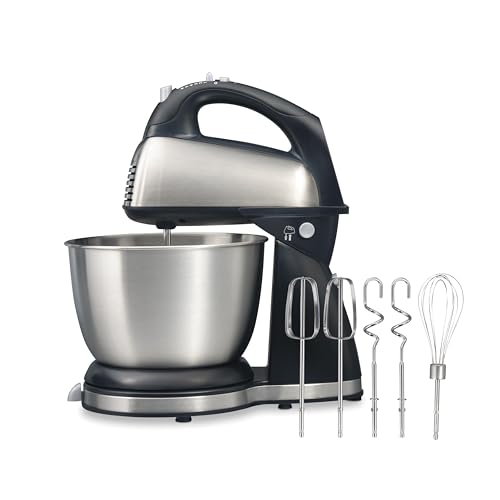
Hamilton Beach Classic Stand and Hand Mixer (Black/Stainless) — Best Hybrid Appliance
The Hamilton Beach Classic Stand and Hand Mixer is the appliance for the kitchen that cannot decide — and its answer is to refuse the decision. On its stand with the 4-quart bowl, it mixes hands-free for longer jobs: big batters, whipped batches, soft doughs worked patiently. Off the stand, it is a full hand mixer with 290 watts of peak power and QuickBurst for every pot, bowl and serving dish job. For kitchens graduating from hand mixing toward stand mixing, it is a genuinely rational bridge appliance.
The footprint argument is its strongest card: it occupies roughly a hand mixer’s storage with a stand mixer’s silhouette only while working, which suits kitchens where a permanent counter resident is impossible. Apartment kitchens, small family kitchens and second kitchens are its home ground.
The compromises are structural: peak power is not a stand mixer’s continuous geared power, heavy dough remains beyond it, and the bowl capacity suits family batches rather than bakery ambitions. As a bridge it is excellent; as a destination for serious dough bakers it is not, and this guide’s dough companion piece says so in full.
The Classic hybrid is the appliance answer to a housing reality: kitchens are shrinking while cooking ambitions are not. A tool that is two appliances in one footprint, stored like the smaller of them, addresses the constraint that actually binds modern kitchens — not budget, not skill, but cubic centimetres. Its compromises are real and stated; so is the problem it solves, and for space-bound cooks it may be the most relevant pick in this entire guide.
Strengths
- Two appliances in one footprint
- Hands-free stand mode for longer jobs
- Detaches for full hand mixer versatility
Trade-offs
- Not a true stand mixer for heavy dough
- Peak power figure flatters continuous output
- Bowl capacity is family-scale, not bakery-scale
Key specs (verified):
- Speeds: 6 with QuickBurst
- Motor: 290 watts peak power
- Bowl: 4-quart bowl in stand mode
- Modes: Stand mixer and detachable hand mixer
Best for: kitchens bridging between hand and stand mixing / Not suited for: heavy dough bakers needing a true stand mixer
Comparison Table
| Pick | Badge | Key spec | Best for |
|---|---|---|---|
| KitchenAid KHM926 | Best Overall Appliance | 9 speeds, beaters + Pro whisk + dough hook | Kitchens wanting one mixer for everything |
| Cuisinart HM-90S | Best Storage-Smart Appliance | 9 speeds, SmoothStart, snap-on storage case | Small and highly organised kitchens |
| Hamilton Beach 62682G | Best Budget Appliance | 6 speeds + QuickBurst, 250W, Bowl Rest, storage case | First kitchens and value-first equipping |
| Breville Handy Mixer | Best Premium Appliance | 9 speed settings plus boost | Serious home cooks who mix daily |
| CHIDOYII Cordless | Best Cordless Convenience | 3 speed modes, cordless, 2 detachable stir whisks | Light tasks, small kitchens, socket-poor counters |
| Hamilton Beach Classic 2-in-1 | Best Hybrid Appliance | 6 speeds + QuickBurst, 290W peak, 4-qt bowl, stand + hand | Kitchens not ready for a full stand mixer |
How a Hand Mixer Fits the Kitchen Appliance Lineup
A sensible kitchen equips by job frequency, not by drama. The jobs, in the order most households meet them: mixing batters, frostings, potatoes and cream — a hand mixer’s home ground, needed weekly; blending liquids and crushing ice — a blender’s job; chopping and pastry — a processor’s job; heavy dough and huge batches — a stand mixer’s job, and for many households a monthly or rarer event. That frequency map is why this guide treats the hand mixer as a first-rank appliance: it is bought early, used constantly, and replaced late, while the glamorous machines wait for their occasions.
Budget follows the same logic. A good hand mixer costs a fraction of a stand mixer and covers the majority of mixing; the money saved funds the blender that the hand mixer genuinely cannot replace. Kitchens equipped in frequency order rarely regret a purchase; kitchens equipped in aspiration order own a stand mixer they use monthly and no decent way to make frosting. Start with the jobs you do weekly — which is the entire premise of ranking hand mixers as appliances rather than accessories.
How to Choose Among the Best Hand Mixers Kitchen Appliances Offers
Judge it the way you would judge any appliance: by service life, running costs in time, and fit with the kitchen around it. Service life means a motor sized for your workload with headroom, attachments that survive dishwashers, and a brand whose replacement beaters exist. Time costs mean cleanup in under a minute and storage that does not require a rearrangement. Fit means a cord that reaches your sockets, a footprint your drawers accept, and a role that complements — rather than duplicates — the appliances you already own.
- Versatility first: the pick should cover your weekly mixing without help
- Storage as a unit: cases and clips decide whether the appliance stays complete
- Cleanup under a minute: dishwasher-safe attachments, wipe-clean body
- Motor headroom for your thickest regular job, not your theoretical thickest
- Complement, do not duplicate: pair with a blender for ice and liquids rather than expecting one tool to do both
Hand Mixer vs the Other Small Appliances: A Quick Map
Against a stand mixer, the hand mixer wins on price tier, storage, cleanup and bowl freedom, and loses on heavy dough, batch scale and hands-free running — except for the hybrid pick in this guide, which borrows some of that ground back. Against an immersion blender, it wins on batters, creaming and whipping, and loses on soups and sauces. Against a food processor, it wins on everything involving air — cream, whites, batters — and loses on chopping and pastry. No small appliance wins everywhere; the hand mixer’s distinction is winning the largest number of weekly jobs, which is why it anchors this guide and most sensible kitchens.
The Appliance Buying Order: A Whole-Kitchen Sequence
This guide has argued that appliances should be bought in order of job frequency, and it is worth laying that sequence out in full for readers equipping a kitchen from scratch, because the hand mixer’s place in it surprises people. First comes the equipment of daily cooking — knives, pans, a hob and oven that work. Among small appliances, the first purchase for most households is the one that handles the most frequent powered job, and for baking-and-mashing households that is the hand mixer: weekly jobs, tiny footprint, modest outlay. The blender follows for liquids, smoothies and ice. The food processor follows for households that chop, slice and make pastry at volume. The stand mixer comes last — not because it is least, but because its jobs are the least frequent in most kitchens, and buying it last means buying it knowingly, sized to doughs you demonstrably make.
Households differ, and the sequence bends honestly: a smoothie-daily household buys the blender first; a bread-weekly household promotes the stand mixer; a soup household promotes the immersion blender. What does not change is the principle — frequency first, aspiration last — and the hand mixer’s position near the front of almost every honest version of the list, because batters, frostings, potatoes and cream are weekly events in a way that laminated pastry and two-kilo doughs, for most of us, are not.
The picks in this guide map onto that sequence at every level: the Hamilton Beach 62682G as the first-appliance purchase, the Cuisinart HM-90S and KitchenAid KHM926 as the settle-for-years purchases, the Breville as the connoisseur’s completion piece, the CHIDOYII as the companion, and the Hamilton Beach Classic as the bridge toward the stand mixer you may — after a year of honest counting — decide you never needed.
Care, Storage and Service Life: Owning a Hand Mixer Well
A hand mixer asks for the least care of any powered appliance in the kitchen, and the little it asks is worth doing properly because it decides whether the appliance lasts two years or ten. Attachments should be washed or dishwashed promptly — batter and dough residues harden into cement that stresses the eject mechanism at the next use. The body wants a wipe, never a soak, and the vents want to stay clear of the flour dust that baking inevitably produces; a soft brush during a monthly kitchen tidy is sufficient. The cord should be stored loosely coiled rather than wrapped tightly around the body, which fatigues the cable at its entry point over years.
Storage is the other half of ownership. The complete appliance — body and attachments together, in a case or a dedicated drawer section — survives kitchens; separated parts do not, and a mixer whose whisk vanished in a house move is a mixer demoted for life. Bakers who move house or reorganise often should weight the Cuisinart HM-90S’s snap-on case more heavily than any performance margin in this guide, because it solves the problem structurally rather than by discipline.
- Wash attachments promptly — residues harden and stress the ejector
- Wipe the body, never soak it; keep vents clear of flour dust
- Coil the cord loosely to protect its entry point
- Store the appliance complete: body and attachments as one unit
- Stay inside the workload limits — category abuse, not age, kills most hand mixers
None of this is burdensome, which is rather the point of the appliance. The hand mixer is the kitchen’s lowest-maintenance powered tool, and treating it with these few habits makes it close to permanent.
What a Hand Mixer Cannot Do: The Complete Honest List
Appliance guides earn trust by stating limits completely, so here is this category’s full list, collected in one place. A hand mixer cannot crush ice — no blades, no mechanism, covered at length in this programme’s dedicated guide. It cannot blend soups or sauces in the pot; that is an immersion blender’s sealed, submerged design. It cannot chop, slice or grate; that is a processor’s blade-and-disc system. It cannot knead stiff dough or develop large batches; that is a stand mixer’s gearing and bowl action. It cannot juice, grind coffee, mill grain or churn ice cream, however enterprising the attachment marketing of lesser brands becomes.
What remains, after that honest subtraction, is still the largest weekly workload of any small appliance: every batter, frosting, whipped cream, egg white, mashed potato, soft dough, dip, dressing and boxed mix in the household’s repertoire. The hand mixer’s claim on a kitchen was never universality — it is frequency. It does the common jobs completely and the exotic jobs not at all, and a kitchen equipped with that understanding buys it early, pairs it with a blender for the liquid-and-ice category, and stops asking any single appliance to be the whole kitchen.
The picks in this guide were chosen inside that philosophy, and their trade-off lists repeat its refrains deliberately: this one does not replace a stand mixer, that one is a companion rather than a primary, the other will not crush anything harder than butter. Read as a set, the reviews are a map of one appliance’s true territory — drawn accurately, which is what makes the territory worth owning.
If your kitchen plan currently asks a hand mixer to cover any job on the cannot list, revise the plan, not the mixer. Add the blender, borrow the processor, or promote the stand mixer — the sequence in this guide’s buying-order section shows how — and let the hand mixer be what it verifiably is: the most frequently useful powered tool in the home kitchen.
The Ten-Year Kitchen: What This Purchase Looks Like in Retrospect
Appliance purchases are best judged from a decade out, and the hand mixer has an unusual retrospective profile: it is rarely the purchase anyone regrets, and frequently the one they describe as the best value in the kitchen. The reasons are structural. Its jobs never went out of fashion — batters, frostings, potatoes and cream are permanent features of home cooking, unlike the rotating cast of single-purpose gadgets. Its storage never became a grievance. Its cleanup never became a reason to avoid it. A tool can survive a decade on those three virtues alone, and the picks in this guide add durability and honest capability on top.
The retrospective regrets in this category are equally predictable, and they are the mistakes this guide lists: the stand mixer bought first and used monthly, the cordless mini asked to be a kitchen, the attachments lost one house move at a time, the ice crushed in a tool with no blades. Every one of them is a sequencing or category error, not a product failure — which means every one of them is avoidable at the moment of purchase, with exactly the information in this guide.
Buy the hand mixer early, buy it honestly, store it whole and keep it inside its category. Ten years from now it will still be in the drawer by the stove, doing the week’s mixing — the quiet definition of a great appliance.
Resale, Hand-Me-Downs and Second Kitchens: The Appliance Afterlife
A final appliance consideration that purchase guides rarely raise: what happens to the tool when your kitchen changes. Hand mixers have the best afterlife of any small appliance — they are gifted to children setting up first kitchens, sent to second homes and holiday lets, lent for community bakes and kept as the backup when a primary mixer fails mid-December. The picks most likely to live that second life share the traits this guide has scored all along: complete kits that travel as one unit, established models whose attachments remain findable, and builds without fragile novelty parts. The Cuisinart’s case, the KitchenAid’s ecosystem and the Hamilton Beach workhorses’ simplicity are, in this light, not features but inheritance planning. Buy the appliance your future household changes will thank you for, and the hand mixer completes its case as the kitchen’s most durable small purchase.
The Counter Test: What Earns Permanent Residence
Kitchens deliver their own appliance verdicts over time, in the form of the counter test: which tools migrate from cupboard to permanent counter residence, and which migrate the other way. The hand mixer usually fails the counter test in the most flattering direction possible — it never needs residence, because its drawer-to-batter time is already seconds. That is a design triumph disguised as a modest footprint, and it reframes how the picks in this guide should be valued: not against the appliances that dominate counters, but as the category that made counter dominance unnecessary for the most frequent powered job in the kitchen. When a tool’s storage story is this good, the correct question is never whether it earns its space. It is why every other appliance cannot manage the same trick — and the honest answer, that their jobs genuinely require size, is precisely why the hand mixer’s job is the one a kitchen performs most. Residence, in the end, is earned by frequency, and no appliance in this guide’s wider landscape is used more frequently than the one it ranks. Frequency, finally, is the whole argument.
How to Set Up a Kitchen Around a Hand Mixer
A hand mixer earns its keep when the kitchen is arranged for it. A few deliberate choices turn it from a stored gadget into the default tool it should be.
- Store the mixer with its attachments — in its case or a single drawer section — never separated from them
- Keep two mixing bowls in the sizes your recipes actually use, one deep for whipping
- Assign the mixer a home near the baking ingredients, not near the rarely used appliances
- Keep the dishwasher rule simple: attachments in, every time, so they are always clean and together
- Pair the setup with a blender for ice and liquids — the one mixing-adjacent job the hand mixer must never be given
- Review the arrangement yearly: the appliance you reach for weekly deserves the best drawer in the kitchen
The deeper point is that appliances fail kitchens by friction, not by specifications. Every second of hunting, assembling and washing is a tax on using the tool, and the hand mixer’s entire design — drawer-sized, rinse-clean, bowl-agnostic — is an argument that it should be the lowest-friction appliance you own. Arrange the kitchen to keep it that way.
Common Buying Mistakes
- Buying a stand mixer first for weekly batter-and-frosting work, then storing it because the hand mixer job was smaller than the appliance
- Expecting any hand mixer to crush ice or blend soups — category errors that damage tools
- Separating attachments from the mixer in storage, effectively breaking the appliance slowly
- Buying a cordless mini as the kitchen’s only mixer, then discovering dough and thick batter
- Ignoring cord length and socket positions until the first bake
- Overlooking replacement attachment availability when choosing an off-brand appliance
Appliance mistakes are usually sequencing mistakes: the right tools bought in the wrong order, or one tool asked to cover a category it cannot. Equip by frequency, respect each tool’s category, and the lineup in this guide will serve for years.
Final Recommendation
The final recommendation for most kitchens is the KitchenAid KHM926 — the complete mixing appliance that postpones or replaces several other purchases. Small and organised kitchens should choose the Cuisinart HM-90S, first kitchens and value buyers the Hamilton Beach 62682G, serious daily mixers the Breville Handy Mixer, socket-poor and light-task kitchens the CHIDOYII Cordless as a companion, and kitchens bridging toward stand mixing the Hamilton Beach Classic hybrid. Equip in that order of logic — frequency first — and the hand mixer will quietly become the most-used appliance you own.
Complete the picture with the sibling guides: Best Hand Mixers For Baking, Best Hand Mixers For Cakes, Best Hand Mixers Baking Low Speed, Best Hand Mixers For Dough, and Best Hand Mixers For Potatoes And Cake Mixes.
Check the current price on Amazon — KitchenAid KHM926 (Best Overall Appliance)
Check the current price on Amazon — Cuisinart HM-90S (Best Storage-Smart Appliance)
Check the current price on Amazon — Hamilton Beach 62682G (Best Budget Appliance)
Frequently Asked Questions
Is a hand mixer an essential kitchen appliance?
For most households, yes — it covers batters, frostings, whipped cream, egg whites, mashed potatoes and light doughs, which is the majority of mixing most kitchens do, in a drawer-sized, easy-clean tool. Kitchens that never bake or mash can skip it; everyone else uses it weekly.
Should I buy a hand mixer or a stand mixer first?
A hand mixer, unless heavy dough or very large batches are already your weekly reality. It covers most mixing at a fraction of the cost and storage, and using it teaches you exactly which jobs — if any — justify a stand mixer later.
Can a hand mixer replace a food processor or blender?
No, and it should not try. Processors chop and make pastry; blenders handle liquids and crush ice. The hand mixer owns the aerated, batter-based middle of cooking. A well-equipped kitchen pairs them rather than substituting between them.
Are cordless hand mixers worth it?
As a companion for light work — eggs, drinks, thin batters — yes, especially in small or socket-poor kitchens, as the CHIDOYII pick here shows. As a kitchen’s only mixer, no: thick batters and doughs need corded power.
How long should a hand mixer last as an appliance?
A well-chosen model used within its limits should serve for years of weekly use. Longevity killers are category abuse — ice, stiff dough, continuous overloading — and lost attachments. Buy within your workload, store the kit together, and the appliance will outlast most of the kitchen around it.
What is the best hand mixer for a first kitchen?
The Hamilton Beach 62682G in this guide: capable, complete with a case, and priced so a first kitchen can also afford the blender and other basics it needs. Upgrade later only when your cooking names the reason.


