Disclosure: airfryerkitchensupply.com is reader-supported. When you buy through links on our site, we may earn an affiliate commission at no extra cost to you.
Where to buy
Every pick in this guide to the best hand mixers for potatoes and cake mixes is sold on Amazon, and Amazon is the practical place to buy: these are everyday workhorse purchases where the exact bundle — storage case, whisk, bowl-rest design — differs by variant, and the listing shows it clearly. Follow the links below to the verified models reviewed. Prices on everyday mixers move often, so check the current price on Amazon rather than trusting a figure from an older list.
- Hamilton Beach 6-Speed Electric Hand Mixer (62682G, White) — Best Overall: Check the current price on Amazon
- Hamilton Beach 6-Speed Electric Hand Mixer with Easy Clean Beaters (62636J, White) — Best for Potatoes: Check the current price on Amazon
- Cuisinart Power Advantage Plus 9-Speed Hand Mixer (HM-90S) — Best for Cake Mixes: Check the current price on Amazon
- KitchenAid 5-Speed Ultra Power Hand Mixer (KHM512, Contour Silver) — Best Compact Everyday Pick: Check the current price on Amazon
- Cuisinart Power Advantage 5-Speed Hand Mixer (HM-50, White) — Best for Tight Budgets and Counters: Check the current price on Amazon
- KitchenAid 9-Speed Hand Mixer (KHM926, Candy Apple Red) — Best Premium for Both Jobs: Check the current price on Amazon
Introduction
The best hand mixers for potatoes and cake mixes serve the two most democratic jobs in home cooking. Mashed potatoes appear on weeknight tables and holiday tables alike, and boxed cake mixes are the backbone of school bakes, last-minute birthdays and more family celebrations than anyone admits. Neither job needs a premium appliance — but both punish a bad one. Gluey potatoes come from the wrong tool used the wrong way, and a lumpy, flour-clouded cake mix comes from a mixer with a violent first speed and a motor that fades in batter.
Potatoes and cake mixes make opposite demands, which is what makes this pairing interesting. Mashing potatoes needs controlled, moderate power applied in the cooking pot or a deep bowl, with beaters that break down cooked potato without whipping it into glue — technique matters as much as the tool, and this guide covers both. Cake mixes need the opposite end of the dial’s manners: a gentle start so the dry mix does not erupt, then steady medium power to build a smooth batter in the two minutes the box directs.
The six picks below were verified connection and chosen for this double duty: strong everyday motors, calm first speeds, practical features like bowl rests and storage cases that suit tools used several times a week, and honest value. There is a best overall, a potato specialist, a cake-mix specialist, a budget champion, an easy-clean option and a compact pick for small households. None requires a special occasion to justify itself.
One potato truth before the picks, because it decides results more than any model choice: potatoes turn gluey when their starch is overworked. Warm milk and butter, a light hand, and stopping the moment the mash is smooth matter more than which of these six mixers you own. The guide’s how-to section gives the full method; the reviews give you tools that make the method easy to follow.
In this guide
Quick Picks
Six everyday workhorses graded on both jobs: smooth, non-gluey mash and calm, lump-free cake mix batters.
- Hamilton Beach 62682G — Best Overall: A 250-watt motor, calm first speed and a Bowl Rest made for one-handed pot work — the weeknight champion for both jobs. Check price on Amazon
- Hamilton Beach 62636J — Best for Potatoes: The strongest motor here at 275 watts plus Easy Clean beaters — big holiday batches of mash, washed up in moments. Check price on Amazon
- Cuisinart HM-90S — Best for Cake Mixes: SmoothStart keeps dry cake mix in the bowl at switch-on, and nine speeds nail the box’s exact mixing directions. Check price on Amazon
- KitchenAid KHM512 — Best Compact Everyday Pick: Five speeds and Turbo Beaters in a compact body — single-pot mash and single-box mixes for smaller households. Check price on Amazon
- Cuisinart HM-50 — Best for Tight Budgets and Counters: Extra-long beaters reach into the potato pot, a 220W motor covers both jobs, and a long cord suits small kitchens. Check price on Amazon
- KitchenAid KHM926 Red — Best Premium for Both Jobs: Nine speeds, a Pro whisk for the fluffiest mash finish, and Turbo Beaters — in Candy Apple Red, for cooks who want the best tool even for weeknight jobs. Check price on Amazon
How These Picks Were Chosen
Every model was verified against Amazon’s catalogue, confirming motors, speeds and included features before a word was written. Selection then weighted the two jobs equally. For potatoes: moderate, controllable power, beaters suited to working in a pot or deep bowl, and features like a bowl rest that help when your other hand holds the pot steady. For cake mixes: a calm first speed, steady batter power, and beater designs that leave a smooth, lump-free result.
Everyday practicality broke ties, because these mixers live a several-times-a-week life: storage cases that keep beaters attached, dishwasher-safe parts, cords that stay out of the way, and value that respects the fact that nobody wants to over-invest in a weeknight tool. Excluded were mini cordless whisks — useless for potatoes — and any mixer whose first speed was too aggressive for a boxed mix’s dry ingredients. Premium finesse was welcomed where it appeared but never required; this is a workhorse guide.
The 6 Best Hand Mixers for Potatoes and Cake Mixes

Hamilton Beach 6-Speed Electric Hand Mixer (62682G, White) — Best Overall
The Hamilton Beach 62682G takes the top spot in this guide because it is built, almost accidentally, for exactly these two jobs. For potatoes, its Bowl Rest notch is the standout: the mixer perches on the pot or bowl rim while you add butter and warm milk or steady the pot, instead of lying on the counter dripping mash. The 250-watt motor has more than enough controlled power to break down cooked potatoes evenly, and the six speeds let you start slow — the secret of non-gluey mash — and finish with a few seconds of higher speed for fluff.
For cake mixes it is equally at home: the first speed starts dry mix without an eruption, the middle speeds build a smooth batter inside the box’s directed time, and QuickBurst deals with a stubborn pocket of dry mix at the bowl’s edge. The snap-on case keeps the traditional beaters with the body, so the tool is always assembled and ready — a real virtue in a mixer used this often.
It is a budget-tier tool with budget-tier refinement: the speed steps are workmanlike and the beaters hold more mash and batter than easy-clean designs. For the two jobs in this search, neither matters much. This is the mixer most households searching this phrase actually need.
The 62682G’s Bowl Rest has a second potato use: draining. Perched on the pot rim with the beaters over the pot, the mixer drips back into the mash rather than onto the counter while you reach for the milk — a tiny choreography that keeps the cooking area clean during the most time-pressured minutes of a family dinner. Design details earn their keep in exactly these unphotogenic moments.
Strengths
- Bowl Rest is ideal for mashing in the pot
- Calm first speed suits boxed mixes perfectly
- 250-watt motor handles both jobs with headroom
Trade-offs
- Traditional beaters retain more mixture
- Speed steps are functional rather than fine
- Budget-tier finish
Key specs (verified):
- Speeds: 6 plus QuickBurst
- Motor: 250 watts
- Attachments: Traditional beaters
- Storage: Snap-on storage case
- Rest: Bowl Rest feature
Best for: households mashing potatoes and mixing boxed cakes weekly / Not suited for: bakers seeking premium finesse for delicate work
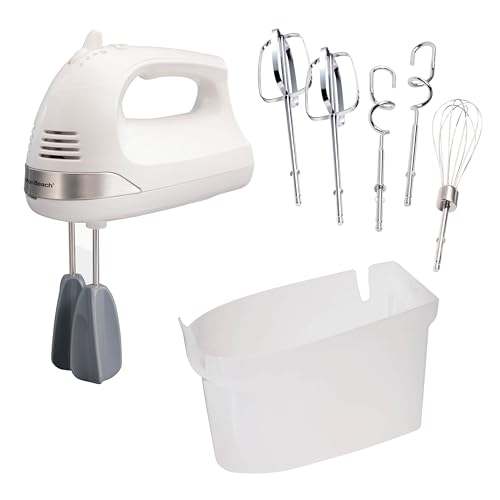
Hamilton Beach 6-Speed Electric Hand Mixer with Easy Clean Beaters (62636J, White) — Best for Potatoes
Holiday potatoes are a volume event: a pot of potatoes for a crowd, worked while three other dishes demand attention. The Hamilton Beach 62636J is the potato specialist for that moment. Its 275-watt motor — the strongest in this guide — moves through a large pot of cooked potatoes without the labouring fade that makes big batches uneven, and its Easy Clean beaters shed starchy mash instead of carrying it, which both evens the result and shortens the washing up that follows a feast.
Technique still governs the outcome, and this guide’s method section applies in full: start at the lowest speed, add warm liquid gradually, and stop the moment the mash turns smooth, because the strongest motor in the guide will make glue fastest if it is run long and high. Used with that discipline, the 62636J produces big, even, fluffy batches with the least effort of any pick here. The whisk and dough hooks in its case extend it well beyond potato duty the rest of the year.
For a couple mashing two potatoes on a Tuesday, it is more mixer than the job needs, and its speed steps are coarse for delicate baking. For households whose potato batches are measured in kilograms and whose cake mixes come in double boxes, it is the right-sized tool.
Big-batch mashing with the 62636J rewards one staging trick: mash in the pot in two passes. Break the whole batch down at low speed first, then add the warm liquid and finish the batch in halves, moving the mixer slowly through each half. Even the strongest motor mixes a full pot unevenly if it is simply held in the middle, and the two-pass method is the difference between holiday mash that is uniformly fluffy and mash with a whipped centre and lumpy edges.
Strengths
- 275-watt motor powers through large potato batches
- Easy Clean beaters shed starchy mash and wash fast
- Whisk and dough hooks broaden its year-round use
Trade-offs
- More power than small households need
- Coarse speed steps for delicate baking
- Power demands technique — overworking makes glue faster
Key specs (verified):
- Speeds: 6
- Motor: 275 watts
- Attachments: Traditional beaters, dough hooks, whisk
- Storage: Snap-on storage case
Best for: big-batch and holiday potato makers / Not suited for: small households mashing small quantities

Cuisinart Power Advantage Plus 9-Speed Hand Mixer (HM-90S) — Best for Cake Mixes
A boxed cake mix is mostly dry powder waiting to erupt, which makes the Cuisinart HM-90S — with its anti-splatter SmoothStart — the natural cake mix specialist. The beaters ramp up gently instead of lunging, so the mix wets down calmly, and the nine speeds behind the ramp map neatly onto box directions: low to combine, medium to beat for the directed minutes, with a smooth, lump-free batter at the end and the powder still in the bowl rather than on the counter.
It is no one-trick tool. The same nine speeds mash potatoes with proper control — start low, work up briefly — and the snap-on case keeps the kit together in the kind of busy kitchen where boxed mixes live. Bakers who graduate from boxes to scratch cakes will find it grows with them into frosting and batters without complaint.
The deliberate ramp adds a second or two to every start, which production-line box bakers may find precious, and its motor, while ample for both jobs here, is not the batch-crushing strength of the Hamilton Beach picks. For the cake-mix-first household, it is the most considerate design in the guide.
Boxed mixes have one HM-90S behaviour worth isolating: brownie mixes. Thick, low-moisture and prone to dry pockets, brownie batter is the boxed category’s hardest test, and the combination of a calm start and nine speeds — low to incorporate, a notch up to finish — produces the glossy, even batter that fudgy results require. Cake mixes are easy for every pick here; brownies separate the controlled from the merely strong.
Strengths
- SmoothStart eliminates the dry-mix eruption
- Nine speeds follow box directions precisely
- Snap-on case keeps an everyday tool organised
Trade-offs
- Ramp-up start adds a moment to every mix
- Motor is ample rather than class-leading for huge mash batches
- Case adds storage bulk
Key specs (verified):
- Speeds: 9
- Start: SmoothStart anti-splatter start
- Storage: Snap-on storage case
Best for: boxed mix bakers who hate the powder cloud / Not suited for: holiday-scale potato makers needing maximum motor

KitchenAid 5-Speed Ultra Power Hand Mixer (KHM512, Contour Silver) — Best Compact Everyday Pick
Smaller households make smaller batches of both jobs in this guide, and the KitchenAid KHM512 is sized for them. Its Turbo Beaters move a modest pot of potatoes evenly and build a single boxed mix into a smooth batter without drama, and the five speeds — stir, combine, beat, and enough top end to finish a mash fluffy — cover the realistic range of both tasks without a dial full of settings nobody uses.
The compact body and lockable swivel cord suit the way these jobs actually happen: one hand on the pot, the mixer in the other, cord pinned to the side away from the stove. The beaters eject at a button and go in the dishwasher, and the whole tool stores in a shallow drawer between its frequent outings.
Scale is the honest limit: a holiday pot of potatoes will make it work at the edge of its comfort, and scratch bakers who whip and fold delicately will want finer speed steps. For everyday portions of the two jobs in this search, it is the most liveable pick here.
The KHM512’s compact size makes it the pick most likely to be lent, gifted and duplicated — the mixer bought for a child leaving home or a parent downsizing. For the two jobs in this search, that matters: these are the recipes of family continuity, and a tool sized for one person’s kitchen keeps them being made. Appliance guides rarely count sentiment as a specification, but durability of habit is a real outcome.
Strengths
- Compact, light body suits one-handed pot work
- Turbo Beaters handle both mash and batter evenly
- Dishwasher-safe beaters and tidy storage
Trade-offs
- Large holiday batches strain its comfort zone
- Five speeds give coarser control
- No whisk or hooks for broader baking
Key specs (verified):
- Speeds: 5
- Attachments: Turbo Beaters
- Cord: Lockable swivel cord
- Beater care: Dishwasher-safe, easy-release button
Best for: small households making everyday portions / Not suited for: large-batch holiday cooks
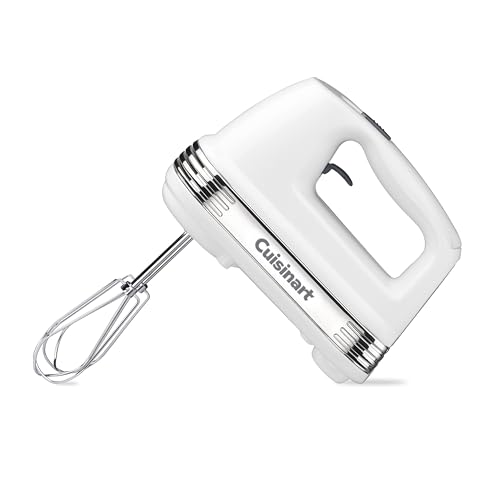
Cuisinart Power Advantage 5-Speed Hand Mixer (HM-50, White) — Best for Tight Budgets and Counters
The Cuisinart HM-50’s extra-long beaters read like a minor spec until you mash potatoes in a deep pot: they reach the bottom properly without the mixer body dipping toward the mash, and the same reach serves a boxed mix in a deep bowl. Its 220W motor covers standard portions of both jobs honestly — a family pot of potatoes, a box or two of mix — without pretending to holiday scale.
The 60-inch swivel cord is the other everyday virtue. Weeknight cooking stations are wherever the counter is clear, rarely beside a socket, and a long cord that swivels out of the way makes the tool usable everywhere in a small kitchen. The beaters are dishwasher-safe, and the compact body stores easily.
Judge it as a standard-portion tool: double batches of dense mash will slow it, and five speeds give the usual coarser steps. For renters, small kitchens and modest households, it covers this search’s two jobs completely and stores like it was never there.
The HM-50’s long cord earns a holiday mention: at a crowded festive stove, the potato pot is rarely near a free socket, and a 60-inch cord reaches the far outlet without an extension lead trailing across burners. It is the kind of specification that reads as nothing in a list and as everything on the one day a year the kitchen is at full stretch.
Strengths
- Extra-long beaters suit deep pots and bowls
- 60-inch swivel cord reaches awkward weeknight stations
- Compact storage for small kitchens
Trade-offs
- Double dense batches slow the 220W motor
- Five speeds mean coarser control
- No storage case in the listing
Key specs (verified):
- Speeds: 5
- Motor: 220W
- Beaters: Extra-long, dishwasher-safe
- Cord: 60-inch swivel cord
Best for: small kitchens and standard portions of both jobs / Not suited for: households cooking both jobs at holiday scale
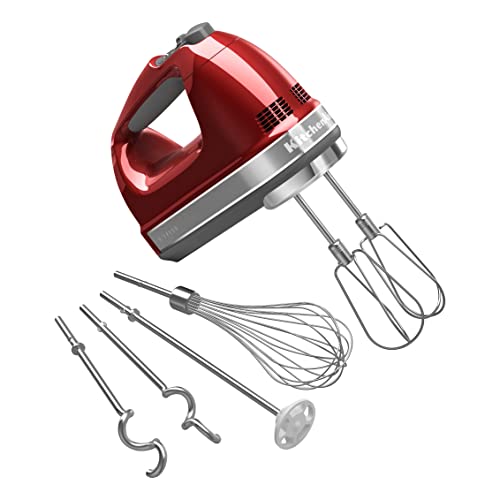
KitchenAid 9-Speed Hand Mixer (KHM926, Candy Apple Red) — Best Premium for Both Jobs
Some households simply want the best tool even for humble jobs, and the KitchenAid KHM926 — this Candy Apple Red variant was verified in this session’s API search — is the premium answer to this search. For potatoes, its gentle low speeds start the mash without splashing, its Turbo Beater II beaters break potatoes down evenly, and a brief finish with the Pro whisk produces the fluffiest result in this guide for those who like their mash light. For cake mixes, the closely spaced speeds follow box directions with unusual precision, from the calm first stir to the timed beating stage.
The complete kit — whisk, dough hook, dishwasher-safe everything — means the same tool covers the frosting for the boxed cake and the soft rolls beside the potatoes. It is, deliberately, more mixer than either job requires, and that is precisely its appeal for the buyer who keeps one mixer for a decade.
The premium positioning is the only real objection, and it is a fair one: the Hamilton Beach 62682G does both of these jobs very well at a budget tier. Buy the KHM926 because you want the finest version of an everyday tool and will use its full range across your cooking — not because potatoes demand it. They do not, and this guide will not pretend otherwise.
The KHM926 Red closes the guide with the premium logic stated plainly: potatoes and cake mixes are weekly jobs, and weekly jobs are where quality of life is actually lived. A tool touched two hundred times a year justifies a standard that a twice-a-year appliance cannot. Buy the premium pick not for the jobs’ difficulty — they are easy — but for their frequency, if your budget allows the reasoning.
Strengths
- Pro whisk gives the fluffiest mash finish
- Nine precise speeds suit box directions exactly
- Complete premium kit covers both jobs and far beyond
Trade-offs
- Premium positioning for humble jobs
- Full-size body needs storage room
- Everyday-only users will not exploit its range
Key specs (verified):
- Speeds: 9
- Attachments: Stainless Steel Turbo Beater II beaters, Pro whisk, dough hook
- Accessories: Dishwasher-safe attachments
Best for: cooks who want one premium mixer for all jobs / Not suited for: value-focused buyers — the budget pick does both jobs well
Comparison Table
| Pick | Badge | Key spec | Best for |
|---|---|---|---|
| Hamilton Beach 62682G | Best Overall | 6 speeds + QuickBurst, 250W, Bowl Rest, storage case | Households doing both jobs weekly |
| Hamilton Beach 62636J | Best for Potatoes | 6 speeds, 275W, beaters + dough hooks + whisk | Large batches of mashed potatoes |
| Cuisinart HM-90S | Best for Cake Mixes | 9 speeds, SmoothStart, snap-on storage case | Boxed cake and brownie mixes |
| KitchenAid KHM512 | Best Compact Everyday Pick | 5 speeds, Turbo Beaters, swivel cord | Small households and everyday portions |
| Cuisinart HM-50 | Best for Tight Budgets and Counters | 5 speeds, 220W, extra-long beaters, 60-inch cord | Small kitchens and standard portions |
| KitchenAid KHM926 Red | Best Premium for Both Jobs | 9 speeds, beaters + Pro whisk + dough hook | Cooks who want one premium tool for everything |
How to Choose a Hand Mixer for Potatoes and Cake Mixes
This search pairs a power job with a manners job, so choose a mixer that does both rather than excelling at one. For potatoes, you need controllable moderate power and beaters that work in a pot; for cake mixes, a calm first speed and steady batter power. Every pick in this guide clears both bars — the differences are scale, features and tier. Match the motor to your largest potato batch, the manners to your driest cake mix, and the storage to your kitchen, in that order.
Features that genuinely matter for this pairing are unglamorous: a bowl rest for one-handed pot work, a storage case for a tool used weekly, dishwasher-safe beaters for starchy and batter residue, and a cord that reaches and stays clear. Features that do not matter here: extreme top speeds, exotic attachments and premium finishes — unless, like the final pick in this guide, you simply want them and will use the mixer far beyond these two jobs.
- Calm first speed — non-negotiable for dry cake mixes
- Enough motor for your largest potato batch, with low-speed control to avoid glue
- A bowl rest or heel stand for one-handed work at the pot
- Dishwasher-safe beaters — potato starch and batter both dry like glue
- Storage that keeps the weekly tool assembled and reachable
Mashed Potatoes With a Hand Mixer: The Non-Gluey Method in Brief
Potato glue is a starch problem: overworking ruptures starch cells and turns mash gummy. The defences are simple and absolute. Cook potatoes until fully tender and drain them well; return them to the warm pot; add butter and warm milk or cream — cold liquid both cools the mash and encourages overworking. Start the mixer at its lowest speed just to break the potatoes down, add liquid gradually, step up only briefly for the finish, and stop the moment the mash is smooth. Total powered time is measured in tens of seconds, not minutes. A ricer or masher makes denser mash; a hand mixer makes fluffier mash; both are ruined by the same overworking, so the discipline matters more than the device.
Getting Boxed Cake Mixes Right: What the Mixer Controls
Boxed mixes are engineered to be forgiving, and the mixer’s contribution is narrow but real: a calm start so the dry mix stays in the bowl, steady medium beating for exactly the directed time so the batter aerates without toughening, and one proper scrape so no dry pocket survives at the bowl’s base. Overbeating a boxed mix is as possible as underbeating it — the box’s timing exists because the manufacturer tested it. Follow the directions with a controlled mixer and the humble boxed mix produces the reliable cake it was designed to produce.
Potato Varieties and Mash Styles: Getting the Result You Actually Want
The mixer is only half the mash equation; the potato is the other half, and choosing it deliberately turns this guide’s tools into predictable results. Floury, high-starch potatoes break down into fluffy, light mash with minimal working — the forgiving choice for hand mixer mashing, because the result arrives before the starch danger zone does. Waxy potatoes hold their shape and make a denser, more textured mash that needs a lighter touch and lower expectations of fluff. All-rounders sit between, and most supermarket bags are exactly that, which is why the method in this guide — low speed, warm liquid, early stop — is calibrated for the middle of the potato spectrum.
Mash style is a choice, not a standard. Rustic mash keeps some texture and welcomes skin-on potatoes, a brief low-speed pass and a finish with a fork. Classic smooth mash wants floury potatoes, full tenderness and the disciplined short mix this guide describes. Whipped, fluffy mash — the kind that holds soft peaks — uses the whisk finish described in the KitchenAid KHM926 review, with the understanding that the line between whipped and gluey is measured in seconds and patrolled by attention, not by the appliance.
Liquid choice matters as much as potato choice. Warm milk makes a lighter everyday mash; cream makes a richer one that needs less of it; the starchy cooking water loosens texture without adding richness and is the traditional loosening agent in many kitchens. All share one rule that this guide repeats because it decides outcomes: the liquid goes in warm, gradually, while the mixer runs low — never cold, never all at once.
Cake Mixes, Upgraded: What a Good Mixer Unlocks From a Box
A boxed mix is a starting point, and a controlled hand mixer is what turns it toward bakery territory without changing the shopping list much. The mixer’s contributions compound: a lump-free batter from a calm start and a proper scrape; better aeration from beating for the full directed time at a steady medium speed, which lifts the crumb noticeably; and even distribution when additions go in — chips, citrus zest, a handful of nuts folded at the lowest speed in the final seconds rather than stirred unevenly by hand.
Beyond technique, the mixer makes the standard box upgrades practical. An extra egg yolk beaten in properly enriches without lumps. Melted butter swapped for oil emulsifies into the batter instead of pooling. A frosting made alongside — where the Cuisinart HM-90S’s calm powdered-sugar start shines — replaces the tub and transforms the result more than any change to the cake itself. None of this requires a scratch recipe or a special trip; it requires the box, the upgrades most kitchens already have, and a mixer with the manners this guide selected for.
- Beat the full directed time at a steady medium — aeration is the free upgrade
- Scrape once, properly: the dry pocket at the base is the lump you will find later
- Fold additions at the lowest speed for even distribution without deflating
- Make the frosting: a calm-start mixer turns the boxed cake into a bakery-style one
- Respect the stop: overbeaten upgraded mixes toughen exactly like scratch batters
Two Jobs, One Drawer: Organising the Everyday Mixing Station
Potatoes and cake mixes share a rhythm that dedicated baking guides miss: they are weekday jobs, done tired, done quickly, often done by whoever in the household drew the short straw. The equipment arrangement should honour that reality. The mixer for these jobs should live assembled — beaters in their case or clipped in place — in the drawer nearest the stove, not in the appliance cupboard behind the machine used twice a year. A tool that takes ninety seconds to locate and assemble will be skipped for a fork and a wooden spoon, and the mash and the batter will both be worse for it.
The supporting cast is small and worth naming: a deep pot that the beaters fit properly, a mixing bowl with a base that can be gripped or a damp cloth beneath it, a spatula for the one proper scrape, and a clear stretch of counter beside the stove for the pot work. That is the entire station. Kitchens that set it up once find that both jobs in this search drop to a few relaxed minutes; kitchens that improvise it nightly find the same jobs strangely effortful, and blame the recipes.
There is a household dimension, too: these are the two mixing jobs most often delegated — to partners, teenagers, visiting relatives. A straightforward mixer with honest speed steps, like the picks in this guide, is delegable in a way a fussy premium instrument is not: start low, add the warm milk slowly, stop when it is smooth is an instruction anyone can follow to a good result. The best everyday appliance is the one the whole household can use well, and that is a genuine argument for the workhorse picks at the top of this ranking.
Keep the station honest across the year and it scales: the same drawer, the same pot discipline and the same mixer handle the Tuesday mash for two and, with the stronger picks, the holiday mash for twelve. Everyday tools earn their name by being ready every day — arrangement, not specification, is what makes them so.
The Two-Job Week: A Realistic Household Diary
Trace one ordinary week to see why this guide ranks the way it does. Tuesday: potatoes for four, mashed in the pot in under two minutes of powered time, the mixer rested on the pot rim while the gravy finishes. Thursday: a boxed cake for a school event, mixed calmly at six in the morning, frosted from a second quick session in the evening. Sunday: a double batch of mash for a family lunch and a brownie mix for afterwards — the day the stronger picks justify themselves and the compact picks ask for the batch in two halves.
Nothing in that week is glamorous, and that is the point. The appliance that serves it must be reachable, assembled, strong enough, calm enough and cleanable in a minute, twice a week, fifty weeks a year. Specifications that serve December but punish Tuesday fail this diary; the picks above were chosen because they pass the ordinary week first and scale to the festive one second, which is the correct order for the two most democratic jobs in home cooking.
Equip for the diary you actually live, keep the tool in the drawer by the stove, and potatoes and cake mixes stop being chores with equipment attached. They become what they should be: the easiest good food a household makes.
Leftovers and Second Acts: The Mixer’s Quiet Extra Shifts
Both jobs in this search have second acts where the same mixer quietly earns more of its drawer space. Leftover mashed potato becomes potato cakes, croquettes and shepherd’s pie topping — each needing a brief, gentle re-mix with egg or seasoning that a hand mixer at its lowest speed handles without turning the potato gluey, provided the same restraint applies: cold leftovers, brief work, early stop. Boxed cake mix, meanwhile, moonlights as pancakes, waffles, mug cakes and crumble toppings, all of them small batter jobs squarely in every pick’s comfort zone. A household that counts these second acts finds the everyday mixer working three or four shifts a week rather than two — which strengthens, yet again, the case this guide has made throughout: for these jobs, buy the reachable, assembled, honest tool, because frequency, not difficulty, is the whole specification.
Teaching the Jobs: Potatoes and Cake Mixes as First Recipes
There is a reason these two jobs are so often a person’s first cooking: they are forgiving, fast and visibly transformative, and the mixer is the first powered tool most new cooks are handed. That gives the picks in this guide an educational dimension worth one paragraph. A straightforward dial with honest steps teaches speed judgement — what low looks like, what beating means, when to stop — in a way that a dozen automated programmes never will, because the learner’s hand is making every decision and seeing every consequence within minutes. Households choosing a first mixer for a teenager, a student or a reluctant cook should weight that teachability: the workhorse picks here, with their plain steps and visible cause and effect, are better teachers than any premium instrument, and the skills they teach transfer to every recipe that follows. The humble pairing in this search has started more cooking lives than any soufflé ever will. And because both jobs recur weekly, the confidence they build compounds fast — a new cook who masters mash and a boxed cake in their first month owns the two foundational skills of mixing: judging consistency, and knowing when to stop.
How to Mash Potatoes and Mix a Cake Mix With One Hand Mixer
Two short methods, one tool — this is the weekly rhythm this guide’s picks are built for.
- Potatoes: boil until fully tender, drain well, and return to the warm pot with butter
- Start the mixer at its lowest speed in the pot, breaking the potatoes down for a few seconds only
- Add warm milk or cream gradually while mixing at low speed, stopping to check consistency
- Give the mash a few seconds at a higher speed for fluff — then stop; smooth is the finish line, not whipped
- Cake mix: add the mix, liquid and eggs to a bowl and stir once by hand to dampen the powder
- Mix at the lowest speed until the powder is incorporated, then beat at medium for the box’s directed time
- Scrape the bowl once halfway through the beating stage so no dry pocket survives
- Rest the mixer on its bowl-rest notch or heel between jobs rather than laying it in residue
The shared principle is restraint: both jobs are ruined by excess — overworked potatoes turn to glue, overbeaten mixes toughen — and both are perfected by a controlled start and a timely stop. A mixer with a calm first speed and an honest motor makes restraint easy, which is the real product being bought.
Common Buying Mistakes
- Mashing potatoes at high speed for minutes, rupturing starch into glue
- Adding cold milk to hot potatoes, then overworking the mash to warm it back up
- Starting a cake mix at batter speed and wearing the dry powder
- Ignoring the box’s beating time — overbeaten mixes toughen like any batter
- Leaving the mixer lying in mash or batter between stages instead of using its rest or heel
- Buying a mini cordless whisk for these jobs — it can do neither
Both jobs forgive almost everything except impatience. Work low, work briefly, stop on time — the cheapest pick in this guide will outperform the finest mixer used carelessly.
Final Recommendation
For most households, the final recommendation is the Hamilton Beach 62682G: both jobs done well, a Bowl Rest made for the potato pot, and a budget tier that respects the weeknight nature of the work. Big-batch potato makers should choose the Hamilton Beach 62636J, cake-mix-first households the Cuisinart HM-90S and its splatter-free start, small households the KitchenAid KHM512 or Cuisinart HM-50, and buyers who want one premium tool for everything the KitchenAid KHM926. Every pick here will mash and mix better than a drawer of single-purpose gadgets.
Explore the wider cluster: Best Hand Mixers For Baking, Best Hand Mixers For Cakes, Best Hand Mixers Baking Low Speed, Best Hand Mixers For Dough, and Best Hand Mixers Kitchen Appliances.
Check the current price on Amazon — Hamilton Beach 62682G (Best Overall)
Check the current price on Amazon — Hamilton Beach 62636J (Best for Potatoes)
Check the current price on Amazon — Cuisinart HM-90S (Best for Cake Mixes)
Frequently Asked Questions
What is the best hand mixer for mashed potatoes and cake mixes?
The Hamilton Beach 62682G in this guide — its Bowl Rest suits pot work, its 250-watt motor handles both jobs, and its first speed is calm enough for dry mixes. Large-batch cooks should look at the stronger Hamilton Beach 62636J.
Why do my mashed potatoes turn gluey with a hand mixer?
Overworking ruptures the potatoes’ starch cells. Use warm liquid, start at the lowest speed, add liquid gradually, and stop the moment the mash is smooth — tens of seconds of powered time, not minutes. The mixer’s power is not the problem; the duration is.
Can I mash potatoes directly in the cooking pot?
Yes, with care: use a deep pot, keep the beaters submerged, start at the lowest speed, and mind hot splashes. A bowl-rest design like the Hamilton Beach 62682G’s helps you park the mixer safely between additions.
How long should I beat a boxed cake mix?
Exactly as long as the box directs — typically a short low-speed combine followed by a timed medium-speed beat. The directions are tested by the manufacturer; a controlled mixer simply makes them easy to follow precisely.
Do I need a whisk attachment for these two jobs?
Not for the jobs themselves — beaters mash and mix well. A whisk, included with the KitchenAid KHM926 and Hamilton Beach 62636J here, earns its place in the wider kitchen for cream, whites and the fluffiest mash finish.
Is a more powerful mixer always better for potatoes?
No. Potatoes need controlled, moderate power; the strongest motor mainly helps with large batches. Excess power used carelessly makes glue faster. Match strength to your largest batch and keep the technique in this guide.


